I posted here in 2013 about Artists in Cornwall, the second annual Winter Exhibition held by the Bulldog Trust at Two Temple Place on the Victoria Embankment, London. Their current and sixth show, Sussex Modernism: Retreat and Rebellion, brings together some of the art, craft, photography and architectural design which flourished in that area* between 1900 and 1950.
Many people will be aware of the presence of Eric Gill (Icon 1923, below top left) at Ditchling, the Bloomsberries (Duncan Grant, Bathers by the Pond c1920-21, below lower) at Charleston and Roland Penrose and Lee Miller (1952 photograph, below top right, of Henry Moore with Mother and Child 1936-37 – on display at Two Temple Place) at Farley Farm House. However, Sussex’s rural nature combined with its proximity to London would attract other cultured and creative spirits, although the extent to which they were aware of each other’s presence, let alone its influence, is probably unknowable. Nonetheless, it is almost certain that they would all have been conscious of the avant-garde arts of their time and can quite fairly be accommodated under modernism.
The show at Two Temple Place has brought together a fascinating selection of items, many from local collections, revealing Sussex’s twentieth century cultural heritage. Two examples are by Edward Wadsworth from 1940, at the tail end of 1930s English surrealism, Light Section from the Brighton Museum and Art Gallery (below top) and Bronze Ballet from the Towner Art Gallery, Eastbourne (below lower):
Other exhibits have come from further afield, like Edward Burra’s Landscape near Rye, 1934-35 (in the poster above). A striking item of furniture on display is the Mae West lips sofa designed in 1938 by Salvador DalĂ and Edward James for the latter’s home in West Sussex (below top). The De La Warr Pavilion in Bexhill on Sea, designed by Mendelsohn and Chermayeff in the mid-1930s and one of the UK’s most important Modernist buildings, is represented by photographs and its original architectural model (below lower):
Sussex Modernism: Retreat and Rebellion is a free exhibition and ends on 23 April 2017.
*’Sussex’ consists of the English counties of East and West Sussex bordering the English Channel and the seaside conurbation of Brighton and Hove. The great circle (shortest) route from London to Paris passes through East Sussex, close to the Newhaven-Dieppe ferry route established in the mid-Nineteenth century.
Showing posts with label Henry Moore. Show all posts
17 March 2017
19 September 2016
The Henry Moore at Gernika
| Large Figure in a Shelter, 1986, Gernika, Spain |
Most artists were of the same mind about Spain – I remember that when Irina and I were in Paris in the summer of 1937 Picasso invited a whole lot of us to go along to his studio and see how ‘Guernica’ was getting on. (Reference below)
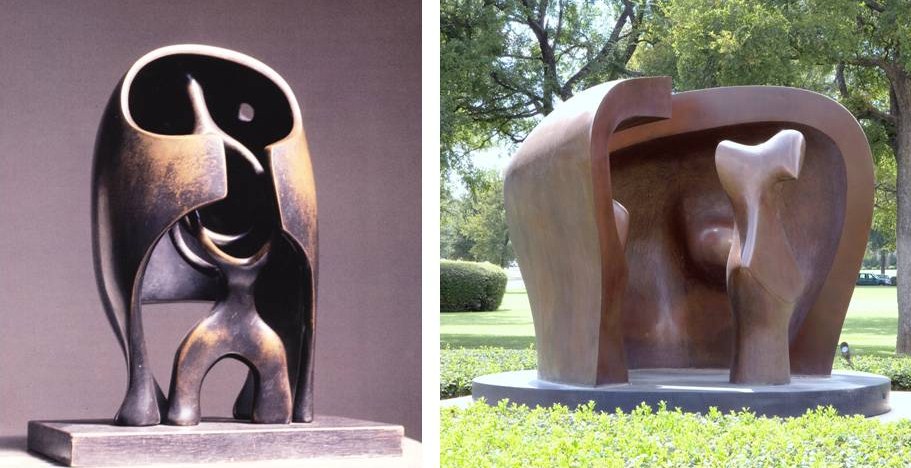
In 1939 Moore began the first of his Helmet works (The Helmet, 1939-40, above left) in which an outer figure contained an inner one. One development of this theme would be Figure in a Shelter (1983, at the Kimbell Art Museum, Fort Worth, above right) and Large Figure in a Shelter of 1986, according to the Henry Moore Foundation:
… the last monumental work to be produced during his lifetime, scaled up to this immense size from the smaller version of 1983. Due to Moore's increasing illness, Bernard Meadows, who had become his first assistant in 1936 and later Professor of Sculpture at the Royal College of Art, was instrumental in seeing through the completion of the work - carried out by Moore's assistants. The initial cast was sited in woodland at Perry Green, and in 1990, negotiations with the Basque and Spanish governments by Sir Alan Bowness led to the second bronze being installed in what is now the Parque de los pueblos de Europa at Guernica. This was a fitting tribute by both artists to the memory of those who perished for the Republican cause, which they had strongly supported during the Spanish Civil War.The Foundation’s description of the Perry Green cast adds:
Moore's continuing interest in the idea of an inner form protected by, but also contained within, an outer form is explored here with two monumental bronze forms that enclose the solitary figure of a third. Large Figure in a Shelter weighs over 21,000kg and was cast at the Morris Singer Foundry in Basingstoke. A second cast of this work stands in the Peace Park at Guernica in northern Spain.
This restoration was carried out in 2011 and was documented by Film Infinity:In accordance with his wishes, The Foundation ceased all casting when Moore died in 1986. Large Figure in a Shelter, however, was at the foundry at the time of his death. Under these unique circumstances, a clear protective lacquer was applied to the sculpture. With time and weather, the lacquer has degraded, leaving the base metal vulnerable to environmental damage. An ambitious project to restore the sculpture has now been completed. The restoration was led by James Copper who trained with Moore's own assistants for more than 12 years. In the course of the restoration, a rich gold-brown patina, in keeping with the majority of Moore's monumental bronzes, has been applied to the sculpture and polished with beeswax in order to allow the patina to develop naturally over time, in accordance with Moore's own approach.
The Henry Moore Foundation. Restoration of Large Figure in a Shelter
from Film Infinity Video Production on Vimeo.
However degraded the Perry Green version was prior to restoration, it is unlikely to have been in anything like such a poor state as the cast at Gernika is at present. As the photographs below (taken in August 2016) show, this is not only adorned with surface graffiti but has been subjected to deeper and more damaging vandalisation.
Many visitors to the Parque will conclude that it is beyond the capability of the local authorities in the town of Gernika-Lumo and the Biskaia province to look after this major work properly in its present location. April 2017 will be the 80th anniversary of the destruction of Guernica. It may also be an appropriate time to consider whether Moore’s work would be more appropriately sited and conserved elsewhere. An obvious location would be at the Guggenheim Museum in Bilbao, less than 40km away, an institution which did not exist at the time of Moore’s death.
Reference:
Henry Moore Writings and Conversations, ed Alan Wilkinson, University of California Press, 2002, page 166.
Previous posts here about Henry Moore:
Moore Rodin at Compton Verney
Bacon and Moore at the Ashmolean
The Arts Council’s Henry Moores in Bath
Henry Moore’s ‘Memorial Figure’ at Dartington Hall
2 November 2015
British Sculpture 1950-2015 at Chatsworth
Since 2006, Sotheby’s have staged annual selling exhibitions of sculpture, Beyond Limits, in the grounds of Chatsworth House, the ancestral seat of the Duke and Duchess of Devonshire and a masterpiece of English baroque architecture. This year’s tenth anniversary exhibition was Beyond Limits: The Landscape of British Sculpture 1950-2015 which ran from 14 September to 25 October. Tim Marlow, Artistic Director at the Royal Academy was the guest curator and also author of an essay for the exhibition catalogue, A Topography of British Sculpture. The sculptures were not arranged at Chatworth in a chronological sequence but the approach in Marlow’s essay was primarily historical and is echoed here.
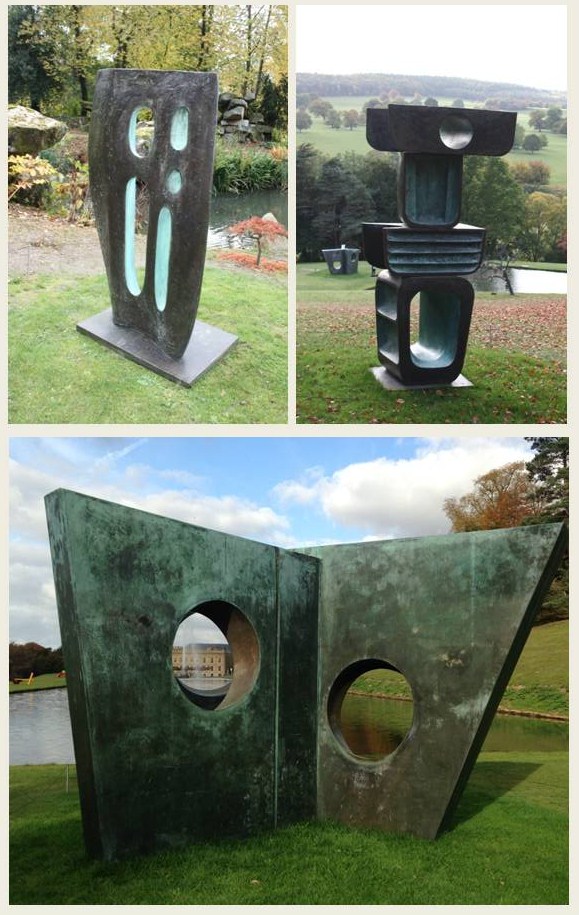
Marlow starts his survey by identifying Henry Moore and Barbara Hepworth as the ‘presiding spirits’ who led post-war British sculpture into the Modernist and post-Modernist mainstream of Western art. One of the inevitable shortcomings of the recent Tate Britain Hepworth show was its inability to place Hepworth’s larger works outdoors, something which Beyond Limits was well-placed to rectify with three pieces: Sea Form Atlantic (1964, below top left), Three Obliques (Walk In) (1969, below lower) and The Family of Man: Figure 1, Ancestor 1 (1972, below top right with Three Obliques (Walk In) in the distance).
After appearing in the British Pavilion at the 1952 Venice Biennale, a group of some younger sculptors became associated with the ‘Geometry of Fear’; for example, Reg Butler (Manipulator,1954, below left) and Lynn Chadwick (Pair of Walking Figures – Jubilee, 1977, below right):
It was in the 1960s that it became apparent that a serious, internationally respected but fundamentally British tradition” of sculpture had emerged, something which in Marlow’s view “became one of the great, yet understated, success stories of post-war British culture". Talents which emerged at this time included Kenneth Armitage (Monitor, 1961, below top) and William Tucker, whose Genghis Kahn (1963, below lower) seems ahead of its time:
Anthony Caro (Sunshine, 1964, below left) had a major exhibition at Chatsworth in 2012 while a post here recently covered the current Arnolfini Richard Long show (Cornwall Slate Line, 1990, below right):
The 1980s, the period of the 'New British Sculpture', saw the emergence of major figures such as Anish Kapoor and Antony Gormley. Gormley’ s Big Gauge II (2014, below top left), Tony Cragg’s Manipulation (2008, below top right) and Stephen Cox’s Kiefer-like Dreadnought: The Problems of History - The Search for the Hidden Stone (1990 to 2015, below lower) are later works.
The prominence of the YBAs since the nineties was reflected in Beyond Limits, though I don’t altogether share Marlow’s enthusiasm for Hurst. Sarah Lucas’s Florian and Kevin (2013, below upper and lower respectively) were produced at Pangolin.
Gavin Turk’s Habitat (Burgundy) (2004, below left) and American Bag (2015, below right), contrary to appearance, are painted bronzes, not as impressive as his Nomad, seen at Crucible2 last year.
Marlow’s survey finishes with two complex works, both with archaic resonance, Thomas Houseago’s Hermaphrodite (2011, below left) and Bill Woodrow’s Regardless of History (1998, below right):
Two pieces which were not specifically mentioned by Marlow were Bernard Meadows’ Large Standing Armed Figure (1962, below left) and the recent Conrad Shawcross, The Dappled Light of the Sun, I-III (2015, part below right):
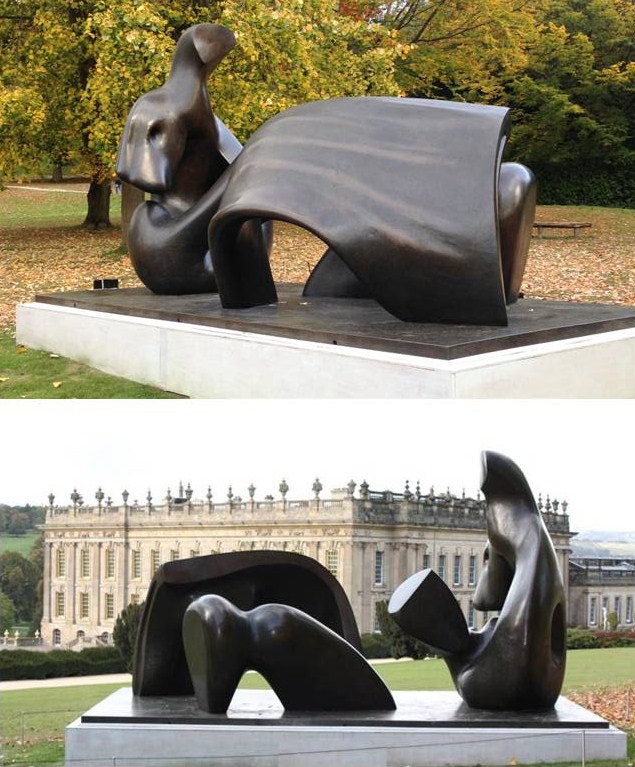
To end where the survey began, two views of a fine Henry Moore, Three Piece Reclining Figure: Draped (1975):
Marlow starts his survey by identifying Henry Moore and Barbara Hepworth as the ‘presiding spirits’ who led post-war British sculpture into the Modernist and post-Modernist mainstream of Western art. One of the inevitable shortcomings of the recent Tate Britain Hepworth show was its inability to place Hepworth’s larger works outdoors, something which Beyond Limits was well-placed to rectify with three pieces: Sea Form Atlantic (1964, below top left), Three Obliques (Walk In) (1969, below lower) and The Family of Man: Figure 1, Ancestor 1 (1972, below top right with Three Obliques (Walk In) in the distance).
After appearing in the British Pavilion at the 1952 Venice Biennale, a group of some younger sculptors became associated with the ‘Geometry of Fear’; for example, Reg Butler (Manipulator,1954, below left) and Lynn Chadwick (Pair of Walking Figures – Jubilee, 1977, below right):
It was in the 1960s that it became apparent that a serious, internationally respected but fundamentally British tradition” of sculpture had emerged, something which in Marlow’s view “became one of the great, yet understated, success stories of post-war British culture". Talents which emerged at this time included Kenneth Armitage (Monitor, 1961, below top) and William Tucker, whose Genghis Kahn (1963, below lower) seems ahead of its time:
Anthony Caro (Sunshine, 1964, below left) had a major exhibition at Chatsworth in 2012 while a post here recently covered the current Arnolfini Richard Long show (Cornwall Slate Line, 1990, below right):
The 1980s, the period of the 'New British Sculpture', saw the emergence of major figures such as Anish Kapoor and Antony Gormley. Gormley’ s Big Gauge II (2014, below top left), Tony Cragg’s Manipulation (2008, below top right) and Stephen Cox’s Kiefer-like Dreadnought: The Problems of History - The Search for the Hidden Stone (1990 to 2015, below lower) are later works.
The prominence of the YBAs since the nineties was reflected in Beyond Limits, though I don’t altogether share Marlow’s enthusiasm for Hurst. Sarah Lucas’s Florian and Kevin (2013, below upper and lower respectively) were produced at Pangolin.
Gavin Turk’s Habitat (Burgundy) (2004, below left) and American Bag (2015, below right), contrary to appearance, are painted bronzes, not as impressive as his Nomad, seen at Crucible2 last year.
Marlow’s survey finishes with two complex works, both with archaic resonance, Thomas Houseago’s Hermaphrodite (2011, below left) and Bill Woodrow’s Regardless of History (1998, below right):
Two pieces which were not specifically mentioned by Marlow were Bernard Meadows’ Large Standing Armed Figure (1962, below left) and the recent Conrad Shawcross, The Dappled Light of the Sun, I-III (2015, part below right):
To end where the survey began, two views of a fine Henry Moore, Three Piece Reclining Figure: Draped (1975):
26 August 2015
Barbara Hepworth at Tate Britain
The British sculptor Barbara Hepworth was born in 1903 in Wakefield, West Yorkshire, where the museum named after her was opened in 2011. But from 1939 until her death in 1975, she lived and worked in South West England at St Ives in Cornwall - I posted here in 2011 about a visit to the Barbara Hepworth Museum and Sculpture Garden, part of Tate St Ives. Elsewhere in the region there are other pieces by her, for example Figure for Landscape (1960 below top) at the University of Exeter and Theme and Variations (1969–72, below lower) at what were the offices of the Cheltenham and Gloucester Building Society in Cheltenham. Barbara Hepworth: Sculpture for a Modern World at Tate Britain seems a welcome opportunity to take a retrospective view of her work – as such it could be regarded as complementary to that provided in 2010 for her contemporary, Henry Moore.
Although chronological, Barbara Hepworth: Sculpture for a Modern World is presented in an ostensibly thematic form starting with carving and moving on through studio to international modernism, equilibrium and eventually pavilion. Ann Compton, in an essay in the exhibition catalogue, Crafting Modernism Hepworth’s Practice in the 1920s, identified an important issue which the curator of a Hepworth retrospective has to face:
with several other works by Skeaping present, fails to inform the visitor (or this one, anyway) that he and Hepworth were married from 1926 until their marriage broke up in the early 1930s.
The next section, studio, has little alternative but to be realistic about Nicholson as a presence in Hepworth’s life. Anyone who left Art and Life at the Dulwich Picture Gallery in 2014 wondering what Ben did next will find an answer here – there are about 17 of his works alongside 24 of Hepworth’s. The couple spent most of the 1930s living and working together and studio aims, among other things, to reveal their dialogue about abstraction. There are some interesting pieces here in this regard, for example Hepworth’s Two Heads (1932, below left) and Nicholson’s painting of the couple, 1933 (St RĂ©my, Provence) (below right):
Perhaps not all visitors will be aware that Hepworth gave birth to their triplets in October 1934, married Nicholson in 1938 and that they would divorce in 1951.
The international modernism section is more interesting than might be expected. Not only does it show how during the 1930s her work became increasingly abstract as in Helicoids in Sphere (1938, poster above) and Three Forms (1935, below):
but also reveals her and Nicholson’s involvement with magazines (books of articles), well displayed, like Circle and Axis with contributors across Europe, some of whom would arrive in London as the political situation deteriorated. A particularly important figure was the constructivist, Naum Gabo, who after 1935 lived in Hampstead near the British modernist community and would move to Cornwall with the Nicholsons after the outbreak of war. No works by him, in particular any from 1937 onwards showing the use of strings in sculpture, are on display, although some were at Tate St Ives in 2011. Hepworth introduced strings into her work after 1938 but the earliest stringed works in this exhibition are from 1943, Sculpture and Colour (Oval Form) Pale Blue and Red (below):
although there are some drawings from 1941 in the next section, equilibrium. As far as I could tell, the exhibition does not address not only the derivation of the use of strings in Hepworth’s sculpture but also her pioneering use of holes in sculpture (Pierced Form, 1931 in pink alabaster was destroyed in the war; the exhibition catalogue (Fig 18 page 39) dates it as 1932 but Tate’s records for a later piece with the same title say 1931).
equilibrium could just as well have been called contrast – between the increasingly large abstract pieces like that above and the series of Hospital drawings she made in 1948. A donation of tropical hardwood, guarea, gives its name to the next section of four large pieces, eg Corinthos (1954-5, below):
The last section of exhibits, pavilion, consists of seven bronzes which all appeared at a retrospective at the Kroller-Muller museum in Holland in 1965, the decade in which Hepworth produced a large number of works and became firmly established as an international figure. Squares with Two Circles (1963, below) is one of the best-known.
Between equilibrium and guarea the visitor passes through the staging sculpture section, its principal feature being Dudley Shaw Ashton’s documentary made in 1952 and released in 1953, Figures in a Landscape, about Hepworth at work in St Ives (available on the BFI website). In an essay in the catalogue, Media and Movement Barbara Hepworth beyond the Lens, Inga Fraser points out that Hepworth was not happy with the film. She suggests:
The exhibition makes no mention of Hepworth’s assistants in St Ives who included Terry Frost and Terence Coventry. The catalogue is very informative, although constrained by the format and underlying philosophy of the exhibition – a timeline would have been helpful. An essay, ‘An Act of Praise’ Religion and the Work of Barbara Hepworth, by Lucy Kent reveals how taken Hepworth was with the ideas of Christian Science, a philosophy she shared with Ben Nicholson. He had been introduced to it by his first wife, Winifred.
Barbara Hepworth: Sculpture for a Modern World ends on 25 October 2015.
Although chronological, Barbara Hepworth: Sculpture for a Modern World is presented in an ostensibly thematic form starting with carving and moving on through studio to international modernism, equilibrium and eventually pavilion. Ann Compton, in an essay in the exhibition catalogue, Crafting Modernism Hepworth’s Practice in the 1920s, identified an important issue which the curator of a Hepworth retrospective has to face:
Accounts of Barbara Hepworth's career frequently divide her practice into stages defined not only by time and place but also by relationships with other key modernists, notably Henry Moore, John Skeaping and Ben Nicholson. Whilst these individuals were unquestionably important, such emphasis on personal connections is symptomatic of the containment of Hepworth's sculpture within a narrow and ultimately reflexive frame of reference. (page 13)However, it is a matter of fact that Moore and Hepworth were at the Leeds School of Art and the Royal College of Art together in the 1920s and neighbours in the Hampstead avant garde of the 1930s. At the time of her death Moore, five years her senior, commented “we were always like a younger sister and an older brother”. Furthermore Hepworth was married to John Skeaping and later to Ben Nicholson, having children with both. Nonetheless carving, while aiming to put Hepworth’s 1920s work in the context of other sculptors around that time practicing direct carving in wood or stone, so allowing comparison of, for example, Skeaping’s Pigeon (c1928, below top left), and her Toad (1928, below top right) and her Musician (1929-30, below lower left) and Moore’s Seated Girl (1931, below lower right):
with several other works by Skeaping present, fails to inform the visitor (or this one, anyway) that he and Hepworth were married from 1926 until their marriage broke up in the early 1930s.
The next section, studio, has little alternative but to be realistic about Nicholson as a presence in Hepworth’s life. Anyone who left Art and Life at the Dulwich Picture Gallery in 2014 wondering what Ben did next will find an answer here – there are about 17 of his works alongside 24 of Hepworth’s. The couple spent most of the 1930s living and working together and studio aims, among other things, to reveal their dialogue about abstraction. There are some interesting pieces here in this regard, for example Hepworth’s Two Heads (1932, below left) and Nicholson’s painting of the couple, 1933 (St RĂ©my, Provence) (below right):
Perhaps not all visitors will be aware that Hepworth gave birth to their triplets in October 1934, married Nicholson in 1938 and that they would divorce in 1951.
The international modernism section is more interesting than might be expected. Not only does it show how during the 1930s her work became increasingly abstract as in Helicoids in Sphere (1938, poster above) and Three Forms (1935, below):
but also reveals her and Nicholson’s involvement with magazines (books of articles), well displayed, like Circle and Axis with contributors across Europe, some of whom would arrive in London as the political situation deteriorated. A particularly important figure was the constructivist, Naum Gabo, who after 1935 lived in Hampstead near the British modernist community and would move to Cornwall with the Nicholsons after the outbreak of war. No works by him, in particular any from 1937 onwards showing the use of strings in sculpture, are on display, although some were at Tate St Ives in 2011. Hepworth introduced strings into her work after 1938 but the earliest stringed works in this exhibition are from 1943, Sculpture and Colour (Oval Form) Pale Blue and Red (below):
although there are some drawings from 1941 in the next section, equilibrium. As far as I could tell, the exhibition does not address not only the derivation of the use of strings in Hepworth’s sculpture but also her pioneering use of holes in sculpture (Pierced Form, 1931 in pink alabaster was destroyed in the war; the exhibition catalogue (Fig 18 page 39) dates it as 1932 but Tate’s records for a later piece with the same title say 1931).
equilibrium could just as well have been called contrast – between the increasingly large abstract pieces like that above and the series of Hospital drawings she made in 1948. A donation of tropical hardwood, guarea, gives its name to the next section of four large pieces, eg Corinthos (1954-5, below):
The last section of exhibits, pavilion, consists of seven bronzes which all appeared at a retrospective at the Kroller-Muller museum in Holland in 1965, the decade in which Hepworth produced a large number of works and became firmly established as an international figure. Squares with Two Circles (1963, below) is one of the best-known.
Between equilibrium and guarea the visitor passes through the staging sculpture section, its principal feature being Dudley Shaw Ashton’s documentary made in 1952 and released in 1953, Figures in a Landscape, about Hepworth at work in St Ives (available on the BFI website). In an essay in the catalogue, Media and Movement Barbara Hepworth beyond the Lens, Inga Fraser points out that Hepworth was not happy with the film. She suggests:
The portrayal of her sculpture was mediated via combination of Shaw Ashton's visual focus on the uncanny, Rainier's esoteric score, Hawkes's poetic narrative and Day-Lewis's theatrical delivery. ln light of her close involvement with the presentation of her work in other formats - exhibition, photography and in publication - it is conceivable that with these additional artistic contributions Hepworth felt her own narrative and conception of sculpture too much compromised. (page 78/79)In 1953 her son with Skeaping was killed in an air accident.
The exhibition makes no mention of Hepworth’s assistants in St Ives who included Terry Frost and Terence Coventry. The catalogue is very informative, although constrained by the format and underlying philosophy of the exhibition – a timeline would have been helpful. An essay, ‘An Act of Praise’ Religion and the Work of Barbara Hepworth, by Lucy Kent reveals how taken Hepworth was with the ideas of Christian Science, a philosophy she shared with Ben Nicholson. He had been introduced to it by his first wife, Winifred.
Barbara Hepworth: Sculpture for a Modern World ends on 25 October 2015.
5 January 2015
William Morris at the NPG
Six years before he died, William Morris (1834-96) published his novel News from Nowhere (above right), set in an idealistic vision of 1952. Nearly 120 years after his death the UK may be far from being the particular Utopia he imagined but Morris’s legacy is hardly inaccessible. His homes at the Red House (South East London), Kelmscott Manor (Oxfordshire) and Kelmscott House (West London) can be visited, as can the William Morris Gallery (East London). Morris & Co lives on to produce “authentic versions of his original designs”, and has a handsome website which would surely have met with his approval. Moreover Morris is currently the subject of an exhibition at Modern Art Oxford (post to follow) and the National Portrait Gallery in London is showing Anarchy & Beauty: William Morris and His Legacy, 1860 – 1960 (above left).
As its title suggests this is an ambitious exhibition in terms of its scope but, perhaps inevitably, is constrained by its NPG location: not all that much space and its strengths being portrait painting and photography, for example GF Watts’ William Morris (1870, above left) and Frederick Hollyer’s William Morris (1884, above right and in the poster). Nonetheless anyone who has an interest in Morris will be pleased to see items which, although in public collections, are not always on show or accessible. For example, the Prioress's Tale wardrobe, painted by Edward Burne-Jones on the exterior, (1859, below left) and Morris’s own La Belle Iseult (1858, below left) for which his wife, Jane, was the model.
Perhaps wisely, given that Tate Britain’s Pre-Raphaelite blockbuster was only two years ago, the NPG show plays down Morris’s relationship with the Brotherhood (he was not one of the PRB seven) and instead gives visitors a chance to appreciate his other interests, like the Arts and Crafts movement, socialism in the years before the Labour party was founded in 1900 and the Suffragettes. Eric Gill (1882-1940) was one of many influenced by Arts and Crafts –Adam and Eve garden roller (1910-20, below upper) while a painting by Roger Fry of one of the Labour’s founders, Edward Carpenter (1894 below lower) provides a link to the Bloomsbury Group.
Various aspects of Morris’s legacy up to 1960 are examined in a fairly rapid succession: Cotswold Arts and Crafts, the Garden City Movement, particularly at Letchworth, and then, following the Second World War, the Festival of Britain and the flowering of one of its assistant designers, Terence Conran. In 2012 the V&A exhibition, British Design 1948–2012, had had the space to cover the latter period more thoroughly but some of its exhibits reappear here, for example Lucienne Day’s Calyx fabric (below left) produced for the Festival in 1951. The interesting portrait of Herbert Read by Patrick Heron (1950, below right) was given to the NPG in 1968 by Barbara Hepworth and Henry Moore.
Anarchy & Beauty: William Morris and His Legacy, 1860 – 1960 ends on 11 January.
12 August 2014
Moore Rodin at Compton Verney
Henry Moore has been mentioned in 13 previous posts here so I am obviously an admirer of his work. Last October I posted about Francis Bacon Henry Moore: Flesh and Bone at the Ashmolean Museum in Oxford and have now seen Moore Rodin at Compton Verney, another show contrasting the work of two great artists*. The Henry Moore Foundation at Perry Green is one of the two co-sponsors and, after being shown there in 2013, Moore Rodin is currently at Compton Verney House whose Trust is the other co-sponsor and celebrating its 10th anniversary. Not surprisingly, the Musée Rodin in Paris also played a major role in making it all happen.
Compton Verney is quite rightly proud of its ‘Capability’ Brown landscape which makes a fine setting for eleven large pieces of sculpture. Moore’s work particularly benefits from being seen in the open (examples previously referred to here were at Kew Gardens, Dartington Hall, and Perry Green and this is no exception; Moore’s The Arch (1969, Fibreglass, below):
There is also the contrast of the 19th and 20th century sculptures with the House’s 18th century facades ; Rodin’s Walking Man on a Column (1900, left) and Moore’s Three Piece Sculpture: Vertebrae (1968, right):
and between sculptures positioned at a distance; Moore’s Seated Woman (1958-59, left) and Rodin’s Jean d’Aire , Monumental Nude (1887, right):
There is also the chance to see details such as Moore’s characteristic scratch marks on The Arch (below left) and to appreciate the viewer’s perspective which Rodin intended for Monument to the Burghers of Calais (1889, below right) but which will no longer be available after its return to Victoria Tower Gardens (Westminster, London, only a few metres from Moore’s Knife Edge Two Piece (1962–65) at Monument Green):
Inside Compton Verney House around 160 smaller items, many of them works on paper, are on display in the galleries and encourage the visitor to make comparisons and seek contrasts between the artists’ subjects, materials and methods of working. Various themes are explored including interlocking forms, mother-and-child embraces, Moore’s shelter drawings from London during World War 2 and Rodin’s ‘black drawings’ made in the aftermath of the Franco-Prussian war. Moore’s daughter, Mary, has curated a fascinating selection of objects from both artist’s personal collections, Rodin’s being primarily classical and Egyptian while Moore’s was more eclectic including ethnographic and found objects - bones and stones.
It is for this part of the exhibition that the guide by its curator, Anita Feldman, is particularly helpful. It includes a transcript of a conversation about Rodin between Moore and Alan Bowness in 1966. Moore admits to not having been much interested in Rodin in the 1920s but that his admiration grew subsequently. Part of their dialogue:
Moore Rodin ends at Compton Verney on 31 August.
* Auguste Rodin (1840-1917), Henry Moore (1898-1986); they never met.
Compton Verney is quite rightly proud of its ‘Capability’ Brown landscape which makes a fine setting for eleven large pieces of sculpture. Moore’s work particularly benefits from being seen in the open (examples previously referred to here were at Kew Gardens, Dartington Hall, and Perry Green and this is no exception; Moore’s The Arch (1969, Fibreglass, below):
There is also the contrast of the 19th and 20th century sculptures with the House’s 18th century facades ; Rodin’s Walking Man on a Column (1900, left) and Moore’s Three Piece Sculpture: Vertebrae (1968, right):
and between sculptures positioned at a distance; Moore’s Seated Woman (1958-59, left) and Rodin’s Jean d’Aire , Monumental Nude (1887, right):
There is also the chance to see details such as Moore’s characteristic scratch marks on The Arch (below left) and to appreciate the viewer’s perspective which Rodin intended for Monument to the Burghers of Calais (1889, below right) but which will no longer be available after its return to Victoria Tower Gardens (Westminster, London, only a few metres from Moore’s Knife Edge Two Piece (1962–65) at Monument Green):
Inside Compton Verney House around 160 smaller items, many of them works on paper, are on display in the galleries and encourage the visitor to make comparisons and seek contrasts between the artists’ subjects, materials and methods of working. Various themes are explored including interlocking forms, mother-and-child embraces, Moore’s shelter drawings from London during World War 2 and Rodin’s ‘black drawings’ made in the aftermath of the Franco-Prussian war. Moore’s daughter, Mary, has curated a fascinating selection of objects from both artist’s personal collections, Rodin’s being primarily classical and Egyptian while Moore’s was more eclectic including ethnographic and found objects - bones and stones.
It is for this part of the exhibition that the guide by its curator, Anita Feldman, is particularly helpful. It includes a transcript of a conversation about Rodin between Moore and Alan Bowness in 1966. Moore admits to not having been much interested in Rodin in the 1920s but that his admiration grew subsequently. Part of their dialogue:
AB: Like many of the drawings, the Dancers and the Walking Man are all very much concerned with the idea of movement. This is clearly of the greatest importance to Rodin, and it links him with the impressionist painters, just as other aspects of hi work link him with the symbolists who were also his contemporaries. But how far do you think that the representation of movement is a proper concern of sculpture?
HM: This is one of the ways in which my generation does stand for a reaction against Rodin. One of my points is that sculpture should not represent actual physical movement. This is something I have never wanted. I believe that sculpture is made out of static, immovable material.
AB: What about the Balzac [right] then? Do you think as many do that it's the culmination of Rodin's work, or do you find it less interesting, because it's clothed for one thing?
HM: No - because underneath one can see that there is the nude figure, and that it's been clothed. It’s the same with the Burghers. What makes Rodin the great sculptor that he is, is his complete understanding of the body s internal structure, his ability to feel inside into the sculpture. This is so intense - even the late work has got behind it all that other observation and knowledge of the human figure. He couldn't have simplified the Balzac - he couldn't have started with the idea of a draped figure. Think of all the studies that he had to make first. (pages 129-130)Earlier on the theme of Finished/Unfinished, Feldman observes:
… with Rodin's bronzes, the physicality of the body is heightened by the impression of his own hands having modelled it initially in clay. Witnessing Rodin at work, Paul Gsell wrote: 'The clay figure was taking shape. Rodin's hands came and went, adding bits of clay, gathering it in his large palms, with swift, accurate movements; then the thumb and the fingers took part, turning a leg with a single pressure, rounding a hip, sloping a shoulder, turning the head, and all with incredible swiftness, almost as if he were performing a conjuring trick.'' Moore on the other hand was more of a carver than a modeller, preferring to pare down the surface of a material rather than build it up. Thus tool marks are often evident in his bronzes, cast from plaster originals where the surfaces have been vigorously hewn with chisels, files and cheese graters.
Finally, both Moore and Rodin took the concept of finished/unfinished a stage further by introducing evidence from industrial fabrication; for example, by allowing the runners, weld marks, pointing marks or joins from the casting process to remain visible rather than 'finishing' the bronzes by filing these down. Rodin relished the accidents which resulted from the piece mould casting process - seams, air bubbles and dollops of liquid plaster, supporting mounds, and finger and cloth imprints. (page 93)Moore's Draped Torso (1953, left)
Moore Rodin ends at Compton Verney on 31 August.
* Auguste Rodin (1840-1917), Henry Moore (1898-1986); they never met.
12 June 2014
Lord Clark at Tate Britain
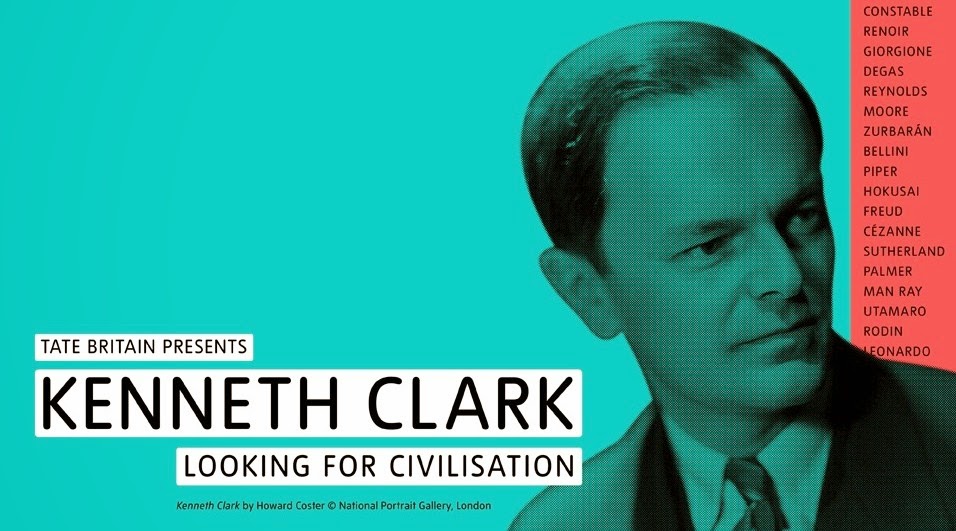
Kenneth Clark (1903-1983) was not only born in the same year as Evelyn Waugh, (mentioned in recent posts here), but also became well-known at a young age in the 1930s. Clark, unlike Waugh, was born into considerable wealth and, after studying the history of art at Oxford and coming under the influence of Roger Fry, was able to spend time in Italy with the American art historian Bernard Berenson, specialising in the Renaissance. On return to England he became Curator of the Ashmolean Museum in Oxford and then Director of the National Gallery from 1930 to 1946. His public service also included being Surveyor of the King’s Pictures, and chairmanships of the War Artists' Advisory Committee, the Arts Council of Great Britain and the Independent Television Authority. In 1969 Clark wrote and presented a celebrated TV series on the history of Western civilisation for BBC television, later shown in the US. When he subsequently received a life peerage, Private Eye dubbed him Lord Clark of Civilisation. The Tate Britain exhibition, Kenneth Clark - Looking for Civilisation, is a survey of his life’s work and brings together art that he had dealt with professionally, had benefitted from his patronage or that he had collected personally.
Not surprisingly, there is much to look at in this show. The 270 objects on display include some which are unfamiliar and may not be seen in public again for a while (one can hazard a guess as to which ‘Private Collection’ they come from). The first room is the most personal with Graham Sutherland’s portrait, Kenneth Clark (1963-64, left), and focusses on his early years. This is followed by works he collected for himself (Seurat’s The Forest at Pontaubert, (1881 below left) or, as Director of the National Gallery, for the nation, for example Constable’s Sketch for Hadleigh Castle (1828-9, below right), later transferred to the Tate. Some of the attributions he made when purchasing for the National Gallery do not seem to have stood the test of time particularly well. However, it was under his Directorship that the Gallery’s Scientific Department was formed, and the techniques which are now available to support judgements on authenticity began to be developed. In the 1930s Clark purchased for himself late works by CĂ©zanne, as would Henry Pearlman a decade later and probably at a much higher price. A CĂ©zanne pencil drawing, Still life, Pain sans mie, 1887-90, is particularly interesting in that its inclusion of commercial typography (“bread without crumbs”!) anticipates Picasso and Braque (but see the 1 July update below).
Clark not only collected but was an active patron looking favourably on Henry Moore (Recumbent Figure, 1938, right), Graham Sutherland, Paul Nash, and John Piper. He did not care much for abstraction (the Ben Nicholson on show seems to have been an exception), Francis Bacon or Lucien Freud’s later work. The fifth and largest space in the show is given over to the War Artists, most of whom worked in the Romantic style Clark liked, and is one of the most interesting. Although familiar in reproduction, the opportunity, during the Imperial War Museum’s closure, to see Paul Nash’s Battle of Britain (1942, below) and one of Moore’s shelter drawings (Tube 1941, below, lower) is welcome.
Among many impressive wartime pictures, ones which caught my eye were John Piper’s Somerset Place, Bath (1942, below,) and Albert Richards’ The Landing: H Hour minus 6. In the Distance Glow of the Lancasters Bombing Battery to be Attacked (1944, below, lower).
The final room concentrates on Clark’s activities after the war, particularly his involvement with television. The BBC are reportedly considering a new Civilisation series:
… "re-imagined … for the digital age". Unlike the original, it is likely to have a number of different presenters.If so, I hope one of them will be Lisa Jardine, the daughter of Jacob Bronowski. His 1973 television series, The Ascent of Man, was complementary to Clark’s and looked at the rise of science as opposed to art, architecture and philosophy.
Just before leaving the exhibition, visitors can see two of the finest works acquired by Clark: a Francisco de Zurbarán still life, A Cup of Water and a Rose (c1630, below left), and CĂ©zanne’s Le Château Noir (c 1904, below, right).
Kenneth Clark - Looking for Civilisation ends on 10 August and anyone with an interest in British art should try to get to Tate Britain before then. The most thought-provoking review I have come across is Kenneth Clark: arrogant snob or saviour of art? by James Hall in the Guardian.
A MINOR QUERY FOR THE CURATORS
In the first room there is a showcase (vitrine?) of Clark family photographs. One of these is of a villa owned by Clark’s father and (when I saw it) was labelled as being Clark’s childhood home in South West France at Cap Ferrat. I thought this unlikely. Although before the First World War Arcachon, on the Gironde department’s Atlantic Coast, was a fashionable resort, the village of Cap Ferret, nearby by sea but remote by land, was little more than a few oyster fishing huts (rather different now). However, Cap Ferrat (Saint-Jean-Cap-Ferrat) on the Mediterranean in the Alpes-Maritime department in South East France had become a magnet for the ultra-wealthy around 1900 and remained so. The Clark villa seems to be in the “Renaissance” style consistent with that location and, of course, Clark’s father was supposedly “the man who broke the bank at Monte Carlo”, not Biarritz. It might be worth checking.
UPDATE 1 JULY
A footnote to CĂ©zanne’s use of commercial typography: I have recently come across this image of The Artist's Father, Reading "L'ÉvĂ©nement", 1866, now in the National Gallery of Art, Washington DC. Apparently it wasn’t Louis-Auguste’s favourite paper but CĂ©zanne’s old friend Emile Zola was L'ÉvĂ©nement’s art critic.
21 October 2013
Mark Tobey at Thomas Williams
Leaving the George Grosz exhibition at Richard Nagy, I went into the Thomas Williams gallery in the same building to look at an exhibition of works by Mark Tobey (1890-1976). New York Abstract Expressionism, which dominated US painting from the mid-1940s through the 1960s, is not something which I’ve posted about (except, in passing, on Lichtenstein), or have much appreciation of. But the gallery’s catalogue, written by Thomas Williams and Hannah Tuck, proved to be extremely informative, pointing out that a poll of leading art critics in 1966:
The exhibition includes an example of ‘white writing’, Untitled 1954 (above), and the pieces on show all seem to be from that period or later, but it was the account of his time in England in the 1930s which interested me, particularly given the nominal pre-occupation of this blog. During this period Tobey was based at Dartington Hall (Devon, SW England) having been invited by the Elmhirsts to join their arts centre:
*Roger Berthoud’s The Life of Henry Moore makes no reference to Tobey. Its only reference to Dartington is in the context of Memorial Figure, the subject of a post here earlier this year.
UPDATE 27 FEBRUARY 2014
To my surprise, this post is still being read, so I thought it might be helpful to update it regarding Tobey’s time at Dartington, drawing on Michael Young’s The Elmhirsts of Dartington, published in 1996 by the Dartington Hall Trust. The most relevant passages are on pages 221 to 223. Young, who had been a pupil at the school, explains how Tobey was invited to Dartington in 1931 by Dorothy Elmhirst:
… put Tobey as one of the six most important living artists, with Picasso, Miro, Ernst, Chagall and Bacon.They describe Tobey’s contribution to Abstract Expressionism:
There is no doubt that when he returned to the U.S. at the end of the 1930s, Tobey was far ahead of his contemporaries. The ‘white writing’ that he had developed in England in 1935 was the first realisation of 'all-over' painting, which later became a central tenet of Abstract Expressionism, and whose most famous exemplar was Jackson Pollock.
… lt was Tobey who provided for Pollock the final piece of artistic information that enabled him to complete his own journey towards ‘all-over’ Free Form or Abstract Expressionism. His paintings had none of Tobey's careful and quiet descent from calligraphy, and their execution was violent and brash by comparison. Pollock made the significant choice greatly to increase the scale of Tobey's images, so that they were no longer easel paintings - an entry requirement for avant-garde art in New York in the late 1940s. Nevertheless, the revolutionary core of Tobey's work, the dramatic break from artistic norms of figuration, perspective, space, form or even the composition of abstract shapes, and their replacement with paintings that had neither focal point nor boundary - that dazzling step into a territory that even Picasso and Matisse had not dared to enter - was Tobey's achievement and Tobey's gift to Pollock, de Kooning and others who followed in New York and elsewhere.
The exhibition includes an example of ‘white writing’, Untitled 1954 (above), and the pieces on show all seem to be from that period or later, but it was the account of his time in England in the 1930s which interested me, particularly given the nominal pre-occupation of this blog. During this period Tobey was based at Dartington Hall (Devon, SW England) having been invited by the Elmhirsts to join their arts centre:
Once at Dartington, he was given a splendid teaching studio in the gatehouse of the Hall and became acquainted with the other residents. These included Henry Moore, Cecil Collins, Bernard Leach, a pioneering ceramicist …
… Tobey also made forays to London, a journey of considerable inconvenience, where he was introduced to two of the most advanced and considerable English artists at that time, Ben Nicholson and his lover, Barbara Hepworth.
… ln 1934 three new and extraordinary pupils arrived at Dartington, Lucian, Clement and Stephan Freud, the grandsons of Sigmund Freud. For the next four years Tobey was thus able to engage with the early artistic development of Lucian.
… As the decade came to a close at Dartington, Ben Nicholson introduced him to another expatriate refugee, Piet Mondrian. Mondrian had fled the turmoil in continental Europe in 1938 and moved into the house next door to his friend Nicholson in Hampstead, north London where they formed an extraordinary working relationship. But the friendship was hardly begun when, in the summer of 1938, Tobey made a trip to New York, and being unable to return to England as he had planned, was obliged to stay there. …Mondrian left for the US in 1940. I posted here about the exhibition at the Courtauld last year on Nicholson and Mondrian in London, and exhibitions of Henry Moore and Barbara Hepworth have been the subjects of several other posts. In none of these contexts has Tobey’s name come up, as far as I am aware*, so the Thomas Williams show, which continues until 2 November, will hopefully be a first step in raising awareness of Tobey’s significance in British art between the wars.
*Roger Berthoud’s The Life of Henry Moore makes no reference to Tobey. Its only reference to Dartington is in the context of Memorial Figure, the subject of a post here earlier this year.
UPDATE 27 FEBRUARY 2014
To my surprise, this post is still being read, so I thought it might be helpful to update it regarding Tobey’s time at Dartington, drawing on Michael Young’s The Elmhirsts of Dartington, published in 1996 by the Dartington Hall Trust. The most relevant passages are on pages 221 to 223. Young, who had been a pupil at the school, explains how Tobey was invited to Dartington in 1931 by Dorothy Elmhirst:
… Dorothy sent Mark an invitation without any specificity about what he was expected to do, and perhaps because it was so vague Mark accepted. He taught amateurs of all ages on the estate, including me. I remember sitting in his studio with other children from the school and adults from many different departments of the estate, looking very awkward, as though they had never held a brush in their hands before, but all intent on their drawing. Mark moved around continuously, making jokes and encouraging more by words than by demonstration. Everyone an artist - he at any rate believed it.
Young quotes a speech given by Tobey to a class in autumn 1931 and a description by the potter, Bernard Leach, of Tobey’s manner of teaching. Young also explains how:
Tobey discovered at Dartington the mode of painting - the 'white writing' - for which he later became world famous. It came upon him in the middle of one night in his studio above the entrance to the courtyard, with its skylight which opened on to the stars like an immensely wide-lens telescope. He was so excited he sent for his friends to come over, even at that hour. He began a long series of paintings made up of lines whitish in tone made up of brush strokes against a dark background. Leach arrived in Dartington from St Ives in Cornwall in 1932.
Young explains:
In the summer of 1932 [Leach] and Tobey left together, at the Elmhirsts’ expense, to spend a year in Japan with Japanese craftsmen. Tobey went to China as well. … The experience of Japan influenced both Leach and Tobey as artists and created a bond between them that lasted.According to Young, the three Freud boys arrived at Dartington in 1933, Clement staying until 1936 (page 174). Young makes no mention of Henry Moore.
8 October 2013
Bacon and Moore at the Ashmolean
Francis Bacon Henry Moore: Flesh and Bone currently at the Ashmolean Museum in Oxford is probably the most ambitious show there since the completion in 2009 of major redevelopment. It is also the first major exhibition bringing together works by Moore (1898-1986) and Bacon (1909-1992) since the artists’ deaths. In retrospect it is becoming more apparent that the art of both men in part embodies their responses to the horrors of the first half of the last century, - two World Wars, the Spanish civil war, the Holocaust, the atomic bombings of Japan, the start of the Cold War and the prospect of nuclear annihilation.
The exhibition offers a sequence of skilful juxtapositions (eg below) which bring out the sculptural quality of Bacon’s figures. The catalogue quotes Myfanwy Piper’s reaction to a Moore/Bacon exhibition in 1963:
What opinions the two men had of each other’s work is not something the exhibition sets out to address, but Richard Calvocoressi (Director of The Henry Moore Foundation) in his catalogue essay relates the following intriguing incident:
The exhibition offers a sequence of skilful juxtapositions (eg below) which bring out the sculptural quality of Bacon’s figures. The catalogue quotes Myfanwy Piper’s reaction to a Moore/Bacon exhibition in 1963:
… Moore ‘never forgets the solidity of flesh upon the bone, the strength of the bone beneath the flesh’ while Bacon ‘never forgets that flesh is meat’. (page 18)
What opinions the two men had of each other’s work is not something the exhibition sets out to address, but Richard Calvocoressi (Director of The Henry Moore Foundation) in his catalogue essay relates the following intriguing incident:
The two artists were not close, had little in common in their personal lives, and took a very different view of honours, awards and official appointments. Moore, the articulate and persuasive spokesman for sculpture as a public art, believed the artist had a responsibility to society; Bacon did not. Bacon was never very complimentary about Moore's work, dismissing his shelter drawings and making other pointed remarks in private. In spite of this gulf between them, Maurice Ash, a friend of Moore's, recounted to the artist's biographer an incident in the 1950s when dinner at the Moores in Hertfordshire was delayed by over an hour while Moore spoke in private to 'a very agitated Bacon' who had turned up unexpectedly.' Francis Warner, who knew both artists, recalls Bacon asking him in the early 1970s if he could take sculpture lessons from Moore. Assuming it was serious - and this was certainly a time when Bacon was thinking deeply about making sculpture - nothing came of the proposal. (page 16)There are 20 paintings by Bacon (some from rarely seen private collections) alongside 20 sculptures and 20 drawings by Moore. My preference is to see Moore’s larger works out-of-doors, (eg at Dartington), but it is not unusual to encounter them in galleries, for example at Tate Britain in 2010 and at the Gagosian Gallery in 2012. Three Upright Motives in close proximity rather than in the open (No2, left at Kew in 2009) may seem slightly intimidating to some visitors. However, in a few months, and not far away, Moore Rodin will be opening at Compton Verney partly in the grounds. In the meantime, anyone with an interest in either artist should visit the Ashmolean before 19 January 2014. The exhibition will appear in modified form at the Art Gallery of Ontario, an institution to which Moore made a sizable donation of his work.
Subscribe to:
Posts (Atom)