Showing posts with label Cornwall. Show all posts

26 August 2015

Barbara Hepworth at Tate Britain

The British sculptor Barbara Hepworth was born in 1903 in Wakefield, West Yorkshire, where the museum named after her was opened in 2011. But from 1939 until her death in 1975, she lived and worked in South West England at St Ives in Cornwall - I posted here in 2011 about a visit to the Barbara Hepworth Museum and Sculpture Garden, part of Tate St Ives. Elsewhere in the region there are other pieces by her, for example Figure for Landscape (1960 below top) at the University of Exeter and Theme and Variations (1969–72, below lower) at what were the offices of the Cheltenham and Gloucester Building Society in Cheltenham. Barbara Hepworth: Sculpture for a Modern World at Tate Britain seems a welcome opportunity to take a retrospective view of her work – as such it could be regarded as complementary to that provided in 2010 for her contemporary, Henry Moore.


Although chronological, Barbara Hepworth: Sculpture for a Modern World is presented in an ostensibly thematic form starting with carving and moving on through studio to international modernism, equilibrium and eventually pavilion. Ann Compton, in an essay in the exhibition catalogue, Crafting Modernism Hepworth’s Practice in the 1920s, identified an important issue which the curator of a Hepworth retrospective has to face:
Accounts of Barbara Hepworth's career frequently divide her practice into stages defined not only by time and place but also by relationships with other key modernists, notably Henry Moore, John Skeaping and Ben Nicholson. Whilst these individuals were unquestionably important, such emphasis on personal connections is symptomatic of the containment of Hepworth's sculpture within a narrow and ultimately reflexive frame of reference. (page 13)
However, it is a matter of fact that Moore and Hepworth were at the Leeds School of Art and the Royal College of Art together in the 1920s and neighbours in the Hampstead avant garde of the 1930s. At the time of her death Moore, five years her senior, commented “we were always like a younger sister and an older brother”. Furthermore Hepworth was married to John Skeaping and later to Ben Nicholson, having children with both. Nonetheless carving, while aiming to put Hepworth’s 1920s work in the context of other sculptors around that time practicing direct carving in wood or stone, so allowing comparison of, for example, Skeaping’s Pigeon (c1928, below top left), and her Toad (1928, below top right) and her Musician (1929-30, below lower left) and Moore’s Seated Girl (1931, below lower right):


with several other works by Skeaping present, fails to inform the visitor (or this one, anyway) that he and Hepworth were married from 1926 until their marriage broke up in the early 1930s.

The next section, studio, has little alternative but to be realistic about Nicholson as a presence in Hepworth’s life. Anyone who left Art and Life at the Dulwich Picture Gallery in 2014 wondering what Ben did next will find an answer here – there are about 17 of his works alongside 24 of Hepworth’s. The couple spent most of the 1930s living and working together and studio aims, among other things, to reveal their dialogue about abstraction. There are some interesting pieces here in this regard, for example Hepworth’s Two Heads (1932, below left) and Nicholson’s painting of the couple, 1933 (St Rémy, Provence) (below right):


Perhaps not all visitors will be aware that Hepworth gave birth to their triplets in October 1934, married Nicholson in 1938 and that they would divorce in 1951.

The international modernism section is more interesting than might be expected. Not only does it show how during the 1930s her work became increasingly abstract as in Helicoids in Sphere (1938, poster above) and Three Forms (1935, below):
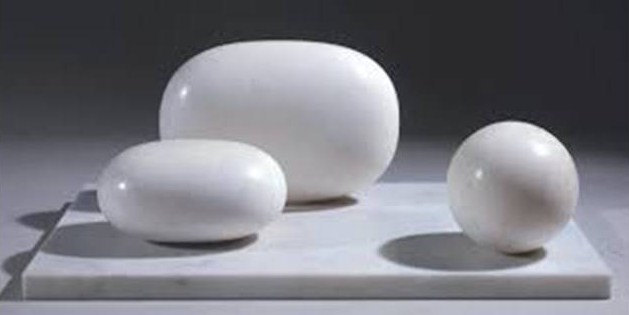

but also reveals her and Nicholson’s involvement with magazines (books of articles), well displayed, like Circle and Axis with contributors across Europe, some of whom would arrive in London as the political situation deteriorated. A particularly important figure was the constructivist, Naum Gabo, who after 1935 lived in Hampstead near the British modernist community and would move to Cornwall with the Nicholsons after the outbreak of war. No works by him, in particular any from 1937 onwards showing the use of strings in sculpture, are on display, although some were at Tate St Ives in 2011. Hepworth introduced strings into her work after 1938 but the earliest stringed works in this exhibition are from 1943, Sculpture and Colour (Oval Form) Pale Blue and Red (below):


although there are some drawings from 1941 in the next section, equilibrium. As far as I could tell, the exhibition does not address not only the derivation of the use of strings in Hepworth’s sculpture but also her pioneering use of holes in sculpture (Pierced Form, 1931 in pink alabaster was destroyed in the war; the exhibition catalogue (Fig 18 page 39) dates it as 1932 but Tate’s records for a later piece with the same title say 1931).

equilibrium could just as well have been called contrast – between the increasingly large abstract pieces like that above and the series of Hospital drawings she made in 1948. A donation of tropical hardwood, guarea, gives its name to the next section of four large pieces, eg Corinthos (1954-5, below):


The last section of exhibits, pavilion, consists of seven bronzes which all appeared at a retrospective at the Kroller-Muller museum in Holland in 1965, the decade in which Hepworth produced a large number of works and became firmly established as an international figure. Squares with Two Circles (1963, below) is one of the best-known.


Between equilibrium and guarea the visitor passes through the staging sculpture section, its principal feature being Dudley Shaw Ashton’s documentary made in 1952 and released in 1953, Figures in a Landscape, about Hepworth at work in St Ives (available on the BFI website). In an essay in the catalogue, Media and Movement Barbara Hepworth beyond the Lens, Inga Fraser points out that Hepworth was not happy with the film. She suggests:
The portrayal of her sculpture was mediated via combination of Shaw Ashton's visual focus on the uncanny, Rainier's esoteric score, Hawkes's poetic narrative and Day-Lewis's theatrical delivery. ln light of her close involvement with the presentation of her work in other formats - exhibition, photography and in publication - it is conceivable that with these additional artistic contributions Hepworth felt her own narrative and conception of sculpture too much compromised. (page 78/79)
In 1953 her son with Skeaping was killed in an air accident.

The exhibition makes no mention of Hepworth’s assistants in St Ives who included Terry Frost and Terence Coventry. The catalogue is very informative, although constrained by the format and underlying philosophy of the exhibition – a timeline would have been helpful. An essay, ‘An Act of Praise’ Religion and the Work of Barbara Hepworth, by Lucy Kent reveals how taken Hepworth was with the ideas of Christian Science, a philosophy she shared with Ben Nicholson. He had been introduced to it by his first wife, Winifred.

Barbara Hepworth: Sculpture for a Modern World ends on 25 October 2015.


13 July 2015

Sculpture in Gloucestershire

This was also the title of a post here four years ago which covered an exhibition at Gallery Pangolin in Chalford and that year’s Fresh Air outdoor sculpture exhibition not far away in Quenington. History repeats itself, sometimes agreeably, because Pangolin are putting on their fourth one-man show of works by Terence Coventry, Sculpture and Works on paper, while Fresh Air 2015 has just finished.

Coventry was born in Birmingham in 1938 but has spent much of his life in Cornwall including a period working for Barbara Hepworth in St Ives. Some of his spare and dramatic pieces are made in Corten steel (COR-TEN) which weathers to a stable oxide surface, for example Corten Owl I (below left) and Corten Torso (below right):


Bronzes of various sizes at Pangolin include Man Releasing Bird II and Woman Releasing Bird (below, left and right): 


Another bronze, Boar II (below top) and the powder-coated steel, Monumental Steel Bull (below lower):


were at Gloucester Cathedral during Crucible2 last year, as were bronzes by Coventry, Monumental Gannet Head, and by Jon Buck, Midnite Movie Heads, both to be seen at Fresh Air 2015:


There were over 170 items at Quenington, so what follows is just a few of those which I liked, starting with a bronze by Carol Peace, Red Ribbon (below left), quite different from Edwina Bridgeman’s Cos After All (below right), constructed from recycled plastic crates:


I’m not sure garden sculpture is at its best when it attempts to compete for space in the border as a quasi-vegetable (top), but Dorcas Casey’s Mule Head (lower) was clearly there on its own terms:


as were Tom Hackett’s Shaggy Dog Stories (below left), funded by Arts Council England, and Paul Cox’s Rabbits (£3000 and £1390 each respectively): 


What would I like to have taken home to my own garden? Probably Wendy Lawrence’s ceramic Disc Form (below):


Terence Coventry, Sculpture and Works continues until 24 July. Fresh Air 2015 ended on 5 July but will be back in 2017, all being well.

I posted here about Fresh Air 2013.


13 December 2014

Mike Leigh’s ‘Mr Turner’

This post is a bit late in the day for the UK where Mr Turner went on general release on 31 October. However, I believe the limited US release (outside film festivals) will start on 19 December, so some readers there may find it of interest. 

Mr Turner is a biopic of the English painter JMW Turner (1775-1851), famous for his land and seascapes. I’m no expert on Leigh’s work, but I think that his only other film which is historical, and also biographical, was Topsy-Turvy about Gilbert and Sullivan. This film, set earlier in Victoria’s reign, follows the life of Turner (Timothy Spall, erstwhile Mikado) over the period from not long before his father’s death in 1829 to his own death. Much of the cinematography is sympathetic to Turner’s style and subject matter and the film is as good to look at and as well-acted, as the critics say. Many of the cast are long-term associates of Leigh. How well-founded Spall’s grunting interpretation of Turner may be, as opposed to just idiosyncratic, I can’t say, but it worked convincingly in his relationship with Marion Bailey’s Mrs Booth, Turner’s Margate landlady and companion in his later years.

Leigh’s film is essentially a sequence of vignettes, undated and unlocated, which also offer few clues about some of the characters. Not everyone may know that Turner’s first mistress and the mother of his two unacknowledged daughters was Sarah Danby, a woman 15 years older than himself. Or that his housekeeper was her niece, Hannah Danby, a psoriasis sufferer. Or that his great patron was Lord Egremont of Petworth House in Sussex where Turner, when not abroad, spent most of the 1830s. And there may be other things, for example about John Ruskin, or John Constable and the other eminent painters of Turner’s day or the Pre-Raphaelites who came after them, which it might be helpful to know about before seeing the film, rather than discover them afterwards from Wikipedia or from some of the knowledgeable commentary, not all of it uncritical, which the film has generated. Otherwise the 150 minutes (surely one death bed scene too many) might drag a little. Some background pieces which I liked:

A brush with Mr Turner, in the Guardian by Andrew Wilton, chairman of the Turner Society.

John Ruskin: Mike Leigh and Emma Thompson have got him all wrong, also in the Guardian, by cultural historian and defender of Ruskin, Philip Hoare.

Mr Turner: Recreating the Royal Academy Show of 1832, Amy Raphael’s interview For Christieswith the film’s production designer Suzie Davies. (below)


Impressions of Mr Turner, again in the Guardian, by the film’s researcher, Jacqueline Riding.

I found the portrayal of Turner’s father by Paul Jesson unconvincing, his being only 10 years older than Spall, who looks all of his 57 years, probably didn’t help, and Jesson's Mummersetshire accent might have been more appropriate for Constable’s East Anglian father than Turner’s Devonian one. On a West Country note, anyone searching for the location of Mrs Booth’s house in Ramsgate should instead try the most south easterly part of Cornwall with its views east across Plymouth Sound, not the Channel!

More filmic licence applies in the scene when a clunking link is made between two of Turner’s most famous paintings: The Fighting Temeraire tugged to her last berth to be broken up, (1838 below top) and Rain, Steam and Speed – The Great Western Railway (1844 or earlier, below lower).


But then Turner never witnessed Temeraire under tow to the breaker’s yard. Pre-release, there was a lot of publicity about the effort Spall made in learning to paint, eg How I became Mr Turner (BBC) and Timothy Spall spent two YEARS learning to paint like Turner in order to play him, (Daily Mail). I don’t recall seeing that much paint being applied, nor am I any judge of the effect all this effort achieved, but Grayson Perry (@Alan_Measles on Twitter on 8 November) certainly is:
Just seen Mr Turner. Very good, but he holds his brush like a shovel and his pencil like a spoon, which disturbed me.

Spall won Best Actor award at the 2014 Cannes Film Festival. In France Turner is an exception in being a British painter who is fairly well-known - how much the debt which Monet and the other Impressionists owe to Turner, Constable and Whistler is appreciated is another matter. It will be interesting to see how Mr Turner gets on in the 2015 Oscars.


UPDATE 18 JANUARY 2015

Mr Turner received four Oscar nominations:

Cinematography - Dick Pope
Production Design - Suzie Davies & Charlotte Watts
Costume Design - Jacqueline Durran
Original Score - Gary Yershon


13 October 2014

No gain for the needy South West

A post earlier this month about the Scottish independence referendum said that the possible relocation of the Royal Navy’s nuclear submarines to SW England would be revisited. 

Back in 2012 a post appeared here called Would Scotland’s loss be the South West’s gain? At the time there was a prospect of an independent Scotland no longer providing a base for the UK’s nuclear submarines and the Trident nuclear deterrent. The post explored the possibility of relocation of the deterrent and thousands of associated jobs to SW England and concluded:
Recent polling suggests that a majority of voters in Scotland do not want independence and if this continues until the referendum, the possibility of any gain does not arise. Otherwise, if the UK sans Scotland is to continue to be a nuclear weapon state, there doesn’t seem to be an alternative to Trident operating from HMNB* Devonport. A suitable armaments depot would have to be constructed there, or possibly in Cornwall, say by 2025. If this turns out to be not so much ‘implausible’ as impossible, something more radical might adopted, but probably would not be revealed until after the 2015 election. Otherwise Trident’s removal from the Clyde ought to be of considerable long-term net benefit to the economy of SW England in the form of jobs, and expenditure by households and on base support.
A key source for this post was Malcolm Chalmers’ and William Walker’s 2001 book, Uncharted Waters - The UK, Nuclear Weapons and The Scottish Question, although they had come to the conclusion that relocation to Devonport was implausible (page 120). A month later a follow-up post, What would be the cost of the South West’s gain?, appeared here. A cost figure which seemed to have some authority had appeared in The Times:
The cost of moving Britain’s four nuclear submarines from the Faslane base on the Clyde, along with stockpiles of warheads and missiles, could be £2.5 billion, according to former senior military commanders.
This figure’s possible provenance was explored and it was compared with the outturn of a couple of recent major projects audited by the NAO, the post's conclusion being:
Neither of these examples would suggest that £2.5 billion is a wild over- or underestimate.
In August 2014, a month before the referendum, Chalmers, who is now Research Director and Director, UK Defence Policy Studies at the Royal United Services Institute for Defence and Security Studies (RUSI), published (with Hugh Chalmers) a detailed analysis, Relocation, Relocation, Relocation Could the UK’s Nuclear Force be Moved after Scottish Independence? To which their answer was Yes - to Devonport and Falmouth:

with the conclusion:
A potential alternative to HMNB Clyde would involve relocating the submarine support functions of Faslane to HMNB Devonport and replicating the munitions-support functions of Coulport from scratch on a greenfield site north of Falmouth. Previous work undertaken at HMNB Clyde in preparation for the current Vanguard-class submarine suggests that this relocation plan could cost between £3 billion and £4 billion (gross, at 2012/13 prices), not including any costs associated with land purchase and clearance of existing buildings at the new munitions-support facility. 
Some of these relocation costs could be funded by the cancellation of planned upgrades to HMNB Clyde to prepare it for a successor to Vanguard. The UK currently anticipates investing £2.3–3.4 billion (at 2012/13 prices) in new infrastructure for a successor submarine. Even if only £500 million of this were dedicated to HMNB Clyde, the net costs of relocating HMNB Clyde may therefore amount to between £2.5 billion and £3.5 billion (at 2012/13 prices), together with any costs associated with land purchase and clearance.
Following the referendum result, the problems that might have arisen after independence, of which Trident’s future was just one, have moved off the political agenda. Although the possibility of Scottish independence cannot be ruled out for all time, it seems most unlikely that resourcing submarine relocation would be recommended in the UK’s Strategic Defence and Security Review (SDSR) due in 2015. That this potential gain is now not forthcoming is regrettable, if only because Devon and Cornwall are in a poor way, as the Western Morning News recently demonstrated drawing on the ManpowerGroup Pay League. Apparently in terms of averages, workers in the Home Counties and London earn up to £17,000 more than in the South West where, at £24,400, annual pay is almost £3,000 lower than in the the UK as a whole at £27,200. A table gave details at local authority level within the SW Region:


The relocation of work from HMNB Clyde would have had greatest impact towards the end of the list (22, 25, 26, 30, 32 and 35).


27 September 2013

A VCtender farewell


The latest Ian Fleming pastiche, Solo by William Boyd, was published on 26 September. It’s 1969 and James Bond, just after his 45th birthday, sets off to adventures in Africa in a BOAC VC10. (BOAC, the British Overseas Airways Corporation, would become part of British Airways in 1974). Just under a week earlier, on 20 September, the RAF had conducted its final operations with VC10 tankers (above), almost 50 years after the aircraft entered commercial service with BOAC in 1964 and 51 years after the first flight in 1962. The last VC10 landing was on 25 September, the day on which copies of Solo were despatched around the world via British Airways.
 

Only 54 VC10 airframes were built, but the history of the type is complicated with at least 11 variants. The aircraft was originally the Vickers VC10, being manufactured by that company at Brooklands, Surrey and is also referred to as the British Aircraft Corporation VC10, Vickers having been merged into BAC. The VC10 was the fastest subsonic commercial airliner, probably had one of the noisiest footprints, and its four rear-mounted Rolls Royce Conway engines were not particularly fuel-efficient, even for its time. It had been designed to operate in and out of small, “hot and high” airfields of the sort Bond was setting off for, and which featured in the flight plans of BOAC’s predecessor, Imperial Airways. However, the VC10 was popular with passengers, offering legroom in standard class superior to current business class and the cabin (above left) was fairly quiet (the noise being left behind), qualities which BOAC made use of in the marketing slogan VCtenderness. I flew long-haul in BOAC VC10s (below) on four occasions in the 1960s and they were the best commercial flights I’ve experienced.
 

Static civilian VC10s can be seen in the UK in Surrey at Brooklands and in Cambridgeshire at Duxford, and military tankers will be on display in Surrey at Dunsfold and in Cornwall (SW England) at Newquay.


8 September 2013

Cornwell’s Cornish Cover Crumbles

Whether J K Rowling or John le Carré is the better-known English writer, I wouldn’t like to say. But certainly le Carré is famous enough for many people to know that his real name is David Cornwell. This is often mentioned in profile pieces and the article about le Carré by Phillipe Sands in the FT Weekend Magazine*, 7/8 September issue, is no exception, touching on it in the first sentence. Sands is a prominent British lawyer and legal academic, specialising in international law. He explains:
I am sitting in a sunny and perfectly ordered garden in north London, engaged in tea and conversation with my neighbour, David Cornwell, the writer John le Carré. We cover our usual topics (Hampstead …
a location which recurs:
I got to know John le Carré by accident, 10 years ago in my local pub, The Wells, after we were introduced by a mutual friend. Before that he’d been a recognisable regular (white hair, warm eyes, brown suede shoes, safe and establishment look) but I had no idea who he was. 
… We’ve not looked back, lunching at The Wells every few months, topping the hours with a rhubarb crumble and a fight over the single scoop of vanilla ice-cream that we allow ourselves, fearful of our respective wives. 
… He and Jane [Mrs Cornwell] are often together in the pub, having lunch, animated, sans crumble [**]. 
… “Come over and meet Murat,” le Carré said one day. So I went to his house … a few days later le Carré and I accompanied Murat to my son’s school … 
There are plenty of reasons to enjoy the company of my neighbour …
I didn’t think that Sands’ article added very much to the previous profiles that I’d read, although his was more up-to-date, with mentions of Edward Snowden and Syria. Sands obviously admires and likes le Carré and it all seems very civilised and agreeable up there in Hampstead. It was this matter of locale which struck me as odd because I’d somehow gained the impression that le Carré lived in Cornwall. Googling ‘le+carre+cornwall’, I could see why:
Wikipedia: “Le Carré has resided in St Buryan, Cornwall, UK, for more than forty years where he owns a mile of cliff close to Land's End.” (referenced to a Guardian article in 1999) 
The author’s official website: “I live on a Cornish cliff and hate cities. Three days and nights in a city are about my maximum. I don’t see many people.” 
This is Cornwall in 2010: “But when you eventually find it, overlooking miles of sparkling deep blue sea, it is easy to see why the three old derelict stone cottages and barn that he and his wife Jane have painstakingly turned into one beautiful structure have become the refuge of one of our country's most famous spy novelists. "I love it here, particularly out of season," he says, as he gazes out across the bay. 
… At 78, he could easily retire to an exotic island … But David John Moore Cornwell, the man behind the le Carré nom de plume, prefers the peace and solitude, the low-key friendships and community, that he has found on a cliff top near Penzance. "The Cornish leave people alone, which is wonderful," he explains. "Here, I don't see many people. I write and walk and swim and drink. Jane and I have put our hearts and souls into this place. We love it here." 
The New York Times Magazine in April 2013: On a recent Saturday morning in February, two dozen or so scent hounds streamed through the streets of St. Buryan, a small village in Cornwall, England. … [Fox-hunting is] an ancient part of the rural culture, [Le Carré] said. It’s egalitarian in this area (some 300 miles west-southwest of London), not an upper-class diversion. 
… Le Carré’s house, where he has lived for more than 40 years with his second wife, Jane, sits atop a cliff near Penzance that offers wraparound views of the English Channel. There is wind-raked solitude here, which he prizes. 
… Soon after his divorce, he married Valerie Jane Eustace … Before long they were spending much of their time in Cornwall. His house and its outbuildings are stately but unpretentious, with a brewing sense of natural drama. …, le Carré has written that an early draft of “Tinker Tailor Soldier Spy” began with this mental image: “a solitary and embittered man living alone on a Cornish cliff, staring up at a single black car as it wove down the hillside towards him.” 
… Le Carré remains obsessed with this terrain. He’s more agile than men 20 years his junior mostly because, when his mornings spent writing fiction are complete, he sets out on arduous hikes. His wife only recently made him curtail these adventures. “I now walk the interior, instead of scampering along the cliffs, because she worries about me taking a fall,” he said … 
When I arrived at the le Carré compound, after a winding 10-mile drive from Penzance along narrow roads lined by hedgerows, he first took me on a brisk tour of the grounds. ...
And so on. As a check, I googled ‘le+carre+hampstead’. First hit was a 1993 article by Zoë Heller on the Independent website:
Once, many years ago, while I was having lunch with my father in a Hampstead restaurant, he furtively pointed out a white-haired man sitting at a nearby table. 'That's John le Carré,' he told me. 'Don't gawp. He doesn't want to be noticed.' 
… on arriving at Le Carré 's home in Hampstead, you find the front door not only sans reinforcements but swinging wide open. In the hallway, you meet him, emerging from the study, all fruity-voiced, eye-contact-y welcome. Tall and handsome - rather more handsome now, at 62, than in his younger, gingery-complexioned days - he has great, fluffy eyebrows that sit on his forehead like apostrophes and he is wearing a baggy, cotton work jacket. He looks the embodiment of arty, Hampstead living. 
… In the drawing-room, full of books and Liberty prints and comfortable antiques, you are urged to choose a seat, have a cigarette, drink some of his champagne. Le Carre's second wife, Jane - also tall and handsome in a flat- heeled, unprinked, Hampstead way - is called in to meet the guest. 
… Mostly he lives in Cornwall, away from London's tawdry social whirl - 'You don't write books,' he says, 'by being relaxed and beautiful' - and when he is not working, he walks the Cornish bluffs or travels …
Scraping the Google barrel, we get: John Connolly interviewing him in 2000 “In a very lovely, very private house in the north London district of Hampstead, …” , the Rotary Club of Hampstead who include le Carré under “Famous past inhabitants” and after that, The Knowhere Guide’s Cringing Cult of Celebrity in Hampstead, which is based on contributions like “John Le Carré the author, aka Hugh [sic] Cornwell, lives off Well Walk.”   And, Google being Google, already there is the Sands article, and references to it.

My guess, for what it’s worth, is that le Carré divides most of his time between London and Cornwall in proportions unknown, and that he reckons that the impression of mostly being inaccessible at Land’s End will discourage unwanted encounters with fans. So, I'm not sure that Cornwall and the South West of England should be too ready to claim him as one of their own. Perhaps I ought to say that I’m not a fan. I liked le Carré’s early novels, particularly A Small Town in Germany, but over 30 years ago, after reading a deprecating depiction of “boring techies” (my words not his) in (probably) The Honourable Schoolboy, I lost interest. I doubt if recent events in the now highly technological world of intelligence collection will have done anything to mellow his views.

* There isn't much point in giving links to the Financial Times because its paywall is one of the most forbidding, which hasn't stopped the paper's falling in circulation by 16% in the last year.

** Or, as the French might say, sans crumble, the French for crumble being crumble. It’s one of the relatively few British dishes which is admired in France (see the comments here), though they seem to prefer less crumble, more fruit, especially apples, and are not too struck on rhubarb.


16 August 2013

Laura Knight at the NPG


This is Laura Knight’s third appearance in a post here within a year. A touring exhibition of her landscapes, in the open air, was followed by Summer in February, a film set in Cornwall (SW England) before the First World War among the Newlyn group of artists which included Laura and her husband. Now the National Portrait Gallery in London has put on a small show of her portraits.

Almost the first painting in the exhibition is from her Cornish period, Rose and Gold (1914, above). Unexpectedly it had links to the last exhibition posted about here, A Crisis of Brilliance at Dulwich. Firstly, the painting probably shows the extent of the influence on Knight’s style of the Roger Fry Post-Impressionist exhibitions whose impact is so evident in A Crisis of Brilliance. Secondly, the sitter for Rose and Gold was the artist’s model, Dolly Henry, who was shot dead shortly after the picture was finished by her lover, John Currie. He then committed suicide. A Slade student, one of his paintings, Some Later Primitives and Madame Tiscaron (1912), is in the Dulwich show. Fans of Summer in February will probably like Lamorna Birch and His Daughters (1916, finished in 1933, below).
 

After Cornwall, the exhibition is grouped into areas which reflect Knight’s inter-war interests: theatre and ballet, (the concert pianist, Ethel Bartlett (1926) in the poster above) and gypsies and circuses. Another pre-war section, Baltimore, consists of paintings and drawings of black Americans made in 1927, when she and her husband worked in the USA. Between 1942 and 1945 she worked on commissions for the War Artists Advisory Committee (see A Balloon Site, Coventry (1943) in the earlier post on the landscape exhibition). I was pleased to see RUSI’s Corporal Elspeth Henderson and Sergeant Helen Turner (1941, left) again. The Imperial War Museum’s The Nuremburg Trial (1946) is doubling as a portrait after its outing as a landscape (again, earlier post).

The exhibition ends with a selection of Knight’s portraits, often commissioned, which demonstrate her skill as a figurative painter (perhaps not at its best in the case of George Bernard Shaw (1933)). That facility was matched by her lack of interest in modernism and possibly helps explain the lack of interest in her work after her death in 1970. It is surprising, given her fight for recognition as a woman artist – the first modern woman RA – and her enthusiasm for portraying high-achieving women, that she never seems to have been regarded as an icon by feminists. Brian Sewell, who disliked this exhibition, calls her a “Very much the “anything you can do I can do better” sort of woman”, and describes at some length how little her work was fetching shortly after her death. Although he has little time for most of the works in the show, he ends:
That I quite liked Laura Knight seriously affects my view of this exhibition. I could have put together a show of paintings — her best in all her genres — that would not have disgraced her; it would not have been truthful, for it would have eliminated all the dross, but it would have been far more entertaining for the visitor to whom she is a stranger, and it would have honoured her. This shoddy little show is a disgrace.
He also comments:
Restricted to her portraits, this [exhibition] unwittingly demonstrates the damage that can be done to a forgotten painter’s reputation when only a single branch of a lifetime’s work is plucked from obscurity like this, and I am inclined to argue that the NPG has done Laura Knight a mortal damage, that no one to whom her name and work are new will ever want to see more of it.
Perhaps because of having seen the landscapes last year as well as these portraits, I am looking forward unreservedly to the Knight retrospective that Dulwich Picture Gallery are planning for 2015. Who knows, the curator may now be seeking Mr Sewell’s advice.

Laura Knight Portraits continues at the NPG until 13 October and will subsequently tour to the Laing Art Gallery, Newcastle (2 November 2013 – 16 February 2014) and Plymouth City Museum and Art Gallery (1 March – 10 May 2014) (SW England).

UPDATE 11 SEPTEMBER

Andrew Lambirth in the Spectator on 7 September took a much more sympathetic view of this exhibition than Sewell.


15 June 2013

Christopher Menaul’s ‘Summer in February’

Christopher Menaul has been directing drama series and films for TV for over 40 years but Summer in February seems to be his first film for commercial release. I mentioned it last November in a post about the Laura Knight exhibition in Worcester. The film, “based on a true story”, is set in Cornwall (SW England) in 1913 and was scripted by Jonathan Smith from his novel of the same title about a love triangle among the bohemian community of artists working at that time in Lamorna. In the film Laura (Hattie Morahan) and her husband Harold (Shaun Dingwall) are onlookers as the young emerging artistic talent of the day, AJ Munnings (Dominic Cooper), and the much more conventional local land agent and army officer, Gilbert Evans (Dan Stevens), vie for the affections of Florence Carter-Wood (Emily Browning).

Summer in February is handsomely filmed against some of the finest coastal scenery in Europe and the period settings are as picturesque as some of the works in the Artists in Cornwall show earlier this year, or those to be found at the Penlee House Gallery in Penzance. However, I wasn’t totally persuaded by its characters’ behaviour, although well-acted. Would Laura and Harold have skinny-dipped in quite so unembarrassed a fashion in front of Gilbert and Florence? [See comments below] Would AJ have used f-words in front of women in 1913, Menaul and Cooper seemingly having decided to portray him as a YBA du temps? Did Munnings, notorious for his speech against modernism in 1949, have such a down on Picasso as early as 1913 – the latter’s style in AJ’s parody seems to belong to a later period? A useful, if not impartial, source of information about Munnings is provided by the Castle House Trust’s website. Although there is no mention of his first wife, their biography does point out that “he spent the first three years of the 1914-18 war mainly in Lamorna” and that “It was from Lamorna that he made his excursions to Hampshire where he had discovered, in the gypsy hop pickers, a wealth of painting material.”

Dr James Fox, in his recently repeated BBC4 series, British Masters, put Munnings into context and drew attention to his considerable skill as an artist. Actors aren’t expected to possess such skills of course, but have to look convincing when they take the part of artists (or, worse, musicians), as does the art they are working on (The Morning Ride, sold at Christie’s in 2000, right). The Spectator sent their art critic, Andrew Lambirth, to review Summer in February and he thought the problem had been handled well.

By an odd coincidence, there have been two period films released in the last two weeks, one set in SW France and the other in SW England, both dealing with the consequences for women of choosing the wrong husband!

22 May 2013

Bojoburg

Two members of the commentariat fixated on the same idea last week. The London Evening Standard on 14 May ran a piece by Simon Jenkins, London should quit the EU and ditch the UK too, and, the next day in The Times (£), David Aaronovitch explained why it was necessary to Unshackle London from the backward shires.

According to Jenkins:
There is an easy solution to Britain in Europe. Let the rest of Britain stay but let London leave.  
… Its future is global. Its two great industries, finance and leisure, are peculiar to itself. They depend on self-government, on regulatory discipline and on the value of the pound. Financial services are worldwide in application. They are clearly threatened by what Lord Lawson called “jealous European banking officials”, by regulations designed to underpin German bankers and clip London’s wings.  
The new city state would have a physical boundary, roughly that of the M25. Digital mapping would police the circumference, though open borders are no great problem. They exist like those between Gulf states, between Ireland and Ulster, Monaco and France. London already has its own government under its elected “monarch”, Boris Johnson.  
The rest of Britain may have reasons for wanting to “stay in Europe”. It is time for London to “get out”, of both the EU and the UK.
Goodness knows what Jenkins thinks digital mapping is. Aaronovitch saw the problem as being one of culture, typified in PMQs the day before:
… of the six Conservative MPs who stood to ask questions, no less than five were talking about when to have a referendum on Europe. They might as well have been in Caracas.  
… Where they sit for in Essex, Lincolnshire, Northamptonshire or Wiltshire, the EU may indeed be more important than it is to me in London. On questions such as immigration, perhaps my metropolitan attitude seems as peculiar to them as their parochialism does to me.  
… Londoners differ from some of their compatriots in attitudes towards the outside world. The pollsters Ipsos/Mori sent me figures for the regional variations on immigration and the EU. Aggregated for January-December 2012, polling showed an average of 21 per cent of Britons naming race relations/ immigration/immigrants as “one of the most important issues facing the country”. The highest figures were the South East with 28 per cent, then the East Midlands, East of England and Yorkshire/Humberside all on 25 per cent. In London it was 13 per cent. This was less dramatically true for Europe/EU. In the South East 10 per cent had it as a vital issue, compared with 5 per cent in London and 6 per cent nationally.  
It is clear that London and the South East are in some ways two different countries and that is why Boris has to be Janus-faced. To become Tory leader he must somehow finesse the fact that he knows a lot of rural/ suburban Tory-Ukippery just doesn’t make sense in the big, competitive, changing world. Like Boris, I do not want to inhabit this parish of 1950s retro enthusiasts.  
… So we may need to secede from the hinterland. And the same is true of our other great cities and university towns which, together, could make an outward-looking, open-minded polity.
So not so much an island state as an archipelago one. Well pundits have to write about something – in 2011 Aaronovitch thought the UK should become part of the USA. And it might have been inhibiting if the position Mrs Thatcher found herself in in 1982 had been remembered:
On the morning of Wednesday 22 September I and my party took off from Tokyo, where I had been visiting, for Peking. Fifteen years remained of the lease to Britain of the New Territories which constitute over 90 per cent of the land of the Colony of Hong Kong. The island of Hong Kong itself is British sovereign territory, but, like the rest of the Colony, dependent on the mainland for water and other supplies. The People's Republic of China refused to recognize the Treaty of Nanking, signed in 1842, by which the island of Hong Kong had been acquired by Britain. Consequently, although my negotiating stance was founded on Britain's sovereign claim to at least part of the territory of Hong Kong, I knew that I could not ultimately rely on this as a means of ensuring the future prosperity and security of the Colony. (The Downing Street Years, page 259)

London, with its “boundary, roughly that of the M25” (see above and the surrounding regions), would be far worse-placed than British Hong Kong. Being on the coast (see below, right), the former colony could trade with the rest of the world without having to enter PRC airspace or territorial waters and at least produced its own electricity and gas.
 

Somehow I don’t see “monarch Boris” converting Tate Modern back into a power station. A secessionist London would have to import electricity and gas from the English grids, would be dependent for its water on the English Thames into which it would also have to discharge its sewage. No doubt the supply of all these things, and a few others (like the westward extension of Heathrow or its replacement) could be arranged amicably – at a price and in return for financial services from London. Until BNP Paribas arrives in Bristol and Crédit Agricole in Birmingham. Of course, London has virtually no armed forces apart from the ceremonial, so all defence capabilities including the nuclear deterrent would be in the hands of the Welsh-English-Scottish rump, as would GCHQ. London would be run out of the Mayor’s office because Jenkins thinks that:
The bulk of British government would have to relocate out of the present capital. Because no one would agree on where, departments would be fragmented around the provinces, to the benefit of all. Parliament could relocate, perhaps to Salford or to an Orwellian “Elizabethville” in south Yorkshire. Essex and Sussex would concentrate development around Stansted and Gatwick, relieving pressure on Heathrow.
All quite barking because London, unlike Singapore (above, left), is land-locked and geography dictates that it cannot become an island city-state. But perhaps there is an even deeper flaw in Jenkins’ concept that London’s
… two great industries, finance and leisure, are peculiar to itself. … Financial services are worldwide in application.
He should have read an article in the Financial Times (£) on 7 May, Cornwall beach buoys London’s financial status. It explained that a beach near Bude in north Cornwall in SW England:
… is one of the main landing points for thousands of miles of submarine cables that carry trading data from New York. Britain’s westerly location means data can reach traders in London several milliseconds quicker than competitors in Frankfurt and Paris – a key advantage in the era of high-frequency trading.  
… “The UK is an underwater cable hub for all the financial institutions in Europe,” says Jack Steven, asset manager at the Crown Estate. “The alternative is to go through somewhere like Portugal, which is closer to the US but which historically hasn’t developed capacity in the same way.”  
According to the Crown Estate, about 95 per cent of the UK’s communication, such as email, internet and telephone calls, is transmitted through submarine cables. They are cheaper and more reliable than satellites, which are expensive to get into orbit and vulnerable to collisions with space debris. The shorter the cables, the quicker data can be transferred. It takes about 65 milliseconds to trade between London and New York. From east London it takes a further five milliseconds to Frankfurt.

Anyone interested can learn more about the global undersea cable network (above) on the Guardian Data Blog.

Boris Johnson, to be fair, has not expressed any opinions, as far as I know, in favour of London’s independence, even though Aaronovitch seems to think he is a closet isolationist. A shame when London could so easily be renamed Bojoburg in his honour as its first head of state. I don’t think either Aaronovitch or Jenkins think for one minute that their proposals will ever happen but, as part of London’s media elite, they are expressing their exasperation with the rest of us.  But most people don't live on six-figure salaries, probably getting away with a day’s work a week writing a thousand words or so about whatever they chose, and having expenses-paid lunches in top restaurants with interesting people talking off the record.

14 May 2013

Welcome Back, Cmdr Hadfield

Chris Hadfield of the RCAF and, until a few days ago, commander of the International Space Station has been safely returned to the planet via Soyuz. As well as a skit on David Bowie’s Space Oddity, instantly famous on YouTube, he has been encouraging school science – see this video for a fascinating demonstration of the significance of surface tension in the absence of gravity. But best of all, he has been sending back amazing images of earth via Twitter (@Cmdr_Hadfield) so, bearing in mind the geographical interests of this blog, here are two of SW England showing the distinct Cornwall and Devon end of the peninsula and the city of Plymouth and its Sound in more detail. The Dartmoor uplands are top right.


And another of the area around Bordeaux in SW France clearly showing the new Jacques-Chaban-Delmas bridge (built in three years and opened on 18 March 2013):


Cmdr Hadfield, a francophone, commented “Bordeaux, France, si célèbre pour ses grands vins”, so here is part of a relevant map (for more details, see here):


UPDATE 23 MAY 2013

Cmdr Hadfield is continuing to tweet, although he seems to be busy with post-flight medical check-ups etc. He recently sent another image from his collection showing the coast of SW England (Dorset to the east of the region):


and he commented “The Isle of Portland looks like an interesting place - the type I'd like to visit now that I'm back on Earth”, which it is (and Chesil Beach to the west), and I hope he gets there sometime.

9 March 2013

Artists in Cornwall at Two Temple Place London


Previous posts here have touched on the artists working in and around Newlyn, Cornwall (SW England) at the end of the 19th century and on Stanhope Forbes’ en plein air realist masterpiece, Fish Sale on a Cornish Beach 1885 (detail in the poster above) which was lent last year to Compton Verney. This work and many others by artists based in West Cornwall from the 1880s to the 1920s feature in Two Temple Place’s exhibition Amongst Heroes: the Artist in Working Cornwall.

The Bulldog Trust’s intention is to bring publicly-owned art from around the UK to Two Temple Place, the opulent late-Victorian mansion built by William Waldorf Astor on London’s Embankment. This show draws on key works from the Royal Cornwall Museum and Penlee House Gallery and Museum and other public and private collections in Conrwall and elsewhere.


The successive galleries present a fine selection of paintings, many of them unfamiliar, and some other items dealing with various aspects of the work of the ordinary Cornish people of the period: fishing (Charles Napier Henry  Pilchards 1897, above)  crafts, agriculture and mining (Harold Harvey A China Clay Pit, Lewidden c1922, below), as well as individual portraits (Henry Scott Tuke Portrait of Jack Rowling 1888, right).


The exhibition is a delight if you are at all interested in art of this kind. Furthermore, admission is free and the catalogue a very reasonable price (though the quality of its reproductions is a little disappointing). ‘Anticipointment’ rating: a rare 1 out of 5, the lower being the better.

Amongst Heroes: the Artist in Working Cornwall continues until 14 April.


Quite different, but only a short walk away, is the Courtauld Gallery's Becoming Picasso: Paris 1901.

27 November 2012

Laura Knight at Worcester

Laura Knight (1877-1970) was born near Nottingham, often painted in Cornwall (SW England) and spent time in her later years at Malvern in Worcestershire. So it seems highly appropriate that this exhibition, Laura Knight in the Open Air, was staged first at Penlee House Gallery & Museum in Penzance, then at Nottingham’s Djanogly Gallery and ends at Worcester City Art Gallery.

Knight (née Johnson), although born into a family whose middle class status was slipping, had sufficient artistic talent to secure a scholarship and attend Nottingham Art School. It is difficult now to appreciate how great an achievement that in itself must have been. An indication of contemporary attitudes is the rule of the time that women art students were not allowed to work from nude models, male or female, a restriction to which her famous Self Portrait (left) of 1913 may, in part, be a reference. At the School she met her husband Harold Knight (1874-1961) and together they pursued successful careers as professional artists. In 1929 Laura became the first artist Dame Commander of the British Empire and in 1936 the first woman to be elected as a Royal Academician (RA), Harold being elected an RA the following year.

The Knights started painting in Cornwall in 1907 and returned there until the 1930s. This exhibition, on the theme of her en plein air work, includes many of Laura’s coastal views, often around Lamorna and featuring female figures (The Cornish Coast right). In retrospect it is not difficult to understand why her sunny impressionistic style was so popular in the decades after the First World War and before the Second. Her gypsy studies, mostly of colourful women, were out-of-doors rather than landscapes, and have more in common with her circus work than the theme of this show. However, the Knights began to spend time around the Malvern Hills from the early 1930s and Laura’s landscapes from the area are well-represented.

Laura Knight’s wartime commissions from 1942 to 1945 often showed women at war work in the Air Force or in factories as subjects, but her A Balloon Site, Coventry of 1943 (left) also offers a very skilful depiction of sunlight on the balloon’s surface. Her The Dock Nuremburg 1946 (below), although essentially indoors, leads the eye as though it were a landscape towards a background of ruins. (Particular defendants can be identified from the Imperial War Museum photograph. Goering is at the far end of the middle row – a far different situation from the one he was in in 1940: see a post here earlier this year which generated an unexpected number of hits from Germany).


Reading Elizabeth Knowles’ exhibition catalogue, I was left with the impression that there was more to learn about Laura Knight and her relationships with Harold and others. A forthcoming film, Summer in February, which dramatizes the Lamorna Group of artists including the Knights, may shed some light or at least generate some discussion. Also, there are plans for a Laura Knight retrospective at the Dulwich Gallery in 2015. In the meantime, I would recommend anyone interested in her work, and who has not seen this show in Penzance or Nottingham, to visit Worcester before 10 February 2013.

7 March 2012

Cornish Independence and the Conservatives

Barring flood and shipwreck, Devon and Cornwall don’t get much attention in the national media in the winter months. So it was a surprise on 5 March, even though it was St Piran’s Day (patron saint of Cornwall), when those parts turned up twice and in a political context too.

First, in the ‘dead tree’ version of The Times, the cover story of Times 2 (the drop out part attuned to those readers who might easily defect to the Daily Mail) was Could Cornwall go the same way as Scotland? with an article by Simon de Bruxelles, All quiet on the southwestern front, taking up a couple of pages inside. (It appears on the website (£) under Life and authored by ‘Simon De Bruxelles and Simon de Bruxelles’ which might be just a bit too much of a good thing.)

After a facetious start:
There are rumblings in the pasty mines, a deep seam of resentment welling to the surface as Scotland prepares to vote on independence.
and some mystical references to:
Cornish character … forged by the geography of the long, narrow windswept peninsula
as well as the Romans and the days before roads and railways, the article concludes with:
[Mebyon Kernow, the Cornish nationalist party] wants Cornwall to be responsible for health, education, economic development, transport, energy, law, forestry and fishing, sports and the arts, the environment and agriculture, though it stops short of calling for full independence.
The same day a Tweet from Andrew Neil (@afneil) observed:
“Murdoch never much liked UK but post -hacking he hates it. His revenge is to campaign for its break up. Scot Sun will back independence.”
which might, at least at first sight, explain why The Times was giving space to Mebyon Kernow. But then the second national-level interest in the South West emerged. On the influential Conservative Home blog Tim Montgomerie reported The Tory masterplan to win 36 seats from Labour and 14 from the Liberal Democrats:
Nearly all of the winnable seats are in England - mainly the South West, North West and Midlands.
As there are only two Labour seats west of Bristol, any such gains in the South West will have to come mostly from the LibDems. This makes one aspect of the Times 2 article more interesting:
In recent years, Cornish separatists have been emboldened by the coalition Government. Cornwall used to be the heartland of Britain’s Liberal Democrats. Nothing, apart perhaps from a tax on pasties, could have done more to boost Mebyon Kernow, the Cornish nationalist party, than the Lib Dems’ alliance with the hated Tories. The party recently won a fifth seat on Cornwall Council. It has four more than Labour and they hope soon to claim a sixth.
which sounds better than the reality that, of the other 118 councillors on Cornwall Council ( a unitary body since 2009), 47 are Conservative, 40 LibDem, 29 Independent, 1 Labour and 1 ‘Standalone’. The article’s reference to support for a referendum on self-government in the form of a petition attracting 50,000 signatures “more than 10% of the population” (actually the electorate), omits the fact that this was in 2000 before the unitary council.


Some heroic number-crunching by the Guardian Datastore has attempted to analyse the impact of the proposed constituency boundary changes (above), with the caveat that their work is “Based on a crude analysis of the composition of the new constituencies, using the 2010 election results in old ones. Assumes uniform vote across old constituencies”. Under new or old boundaries, in a future general election, if disillusioned former LibDem supporters in Cornish constituencies start voting MK, the beneficiaries are likely to be the Conservatives.