Showing posts with label Sarah Lucas. Show all posts

2 November 2015

British Sculpture 1950-2015 at Chatsworth

Since 2006, Sotheby’s have staged annual selling exhibitions of sculpture, Beyond Limits, in the grounds of Chatsworth House, the ancestral seat of the Duke and Duchess of Devonshire and a masterpiece of English baroque architecture. This year’s tenth anniversary exhibition was Beyond Limits: The Landscape of British Sculpture 1950-2015 which ran from 14 September to 25 October. Tim Marlow, Artistic Director at the Royal Academy was the guest curator and also author of an essay for the exhibition catalogue, A Topography of British Sculpture. The sculptures were not arranged at Chatworth in a chronological sequence but the approach in Marlow’s essay was primarily historical and is echoed here.

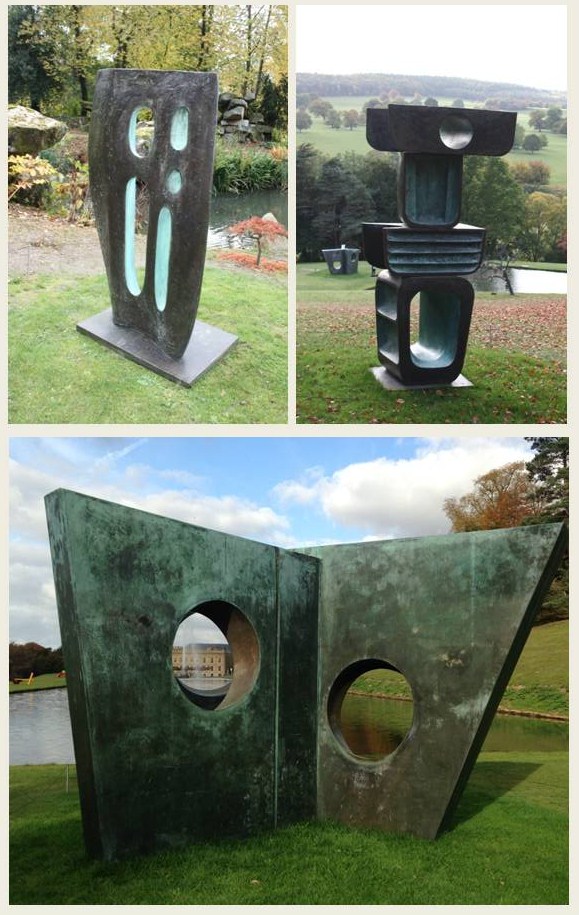
Marlow starts his survey by identifying Henry Moore and Barbara Hepworth as the ‘presiding spirits’ who led post-war British sculpture into the Modernist and post-Modernist mainstream of Western art. One of the inevitable shortcomings of the recent Tate Britain Hepworth show was its inability to place Hepworth’s larger works outdoors, something which Beyond Limits was well-placed to rectify with three pieces: Sea Form Atlantic (1964, below top left), Three Obliques (Walk In) (1969, below lower) and The Family of Man: Figure 1, Ancestor 1 (1972, below top right with Three Obliques (Walk In) in the distance).

After appearing in the British Pavilion at the 1952 Venice Biennale, a group of some younger sculptors became associated with the ‘Geometry of Fear’; for example, Reg Butler (Manipulator,1954, below left) and Lynn Chadwick (Pair of Walking Figures – Jubilee, 1977, below right):


It was in the 1960s that it became apparent that a serious, internationally respected but fundamentally British tradition” of sculpture had emerged, something which in Marlow’s view “became one of the great, yet understated, success stories of post-war British culture". Talents which emerged at this time included Kenneth Armitage (Monitor, 1961, below top) and William Tucker, whose Genghis Kahn (1963, below lower) seems ahead of its time:


Anthony Caro (Sunshine, 1964, below left) had a major exhibition at Chatsworth in 2012 while a post here recently covered the current Arnolfini Richard Long show (Cornwall Slate Line, 1990, below right):


The 1980s, the period of the 'New British Sculpture', saw the emergence of major figures such as Anish Kapoor and Antony Gormley. Gormley’ s Big Gauge II (2014, below top left), Tony Cragg’s Manipulation (2008, below top right) and Stephen Cox’s Kiefer-like Dreadnought: The Problems of History - The Search for the Hidden Stone (1990 to 2015, below lower) are later works.


The prominence of the YBAs since the nineties was reflected in Beyond Limits, though I don’t altogether share Marlow’s enthusiasm for Hurst. Sarah Lucas’s Florian and Kevin (2013, below upper and lower respectively) were produced at Pangolin.


Gavin Turk’s Habitat (Burgundy) (2004, below left) and American Bag (2015, below right), contrary to appearance, are painted bronzes, not as impressive as his Nomad, seen at Crucible2 last year.


Marlow’s survey finishes with two complex works, both with archaic resonance, Thomas Houseago’s Hermaphrodite (2011, below left) and Bill Woodrow’s Regardless of History (1998, below right):


Two pieces which were not specifically mentioned by Marlow were Bernard Meadows’ Large Standing Armed Figure (1962, below left) and the recent Conrad Shawcross, The Dappled Light of the Sun, I-III (2015, part below right):


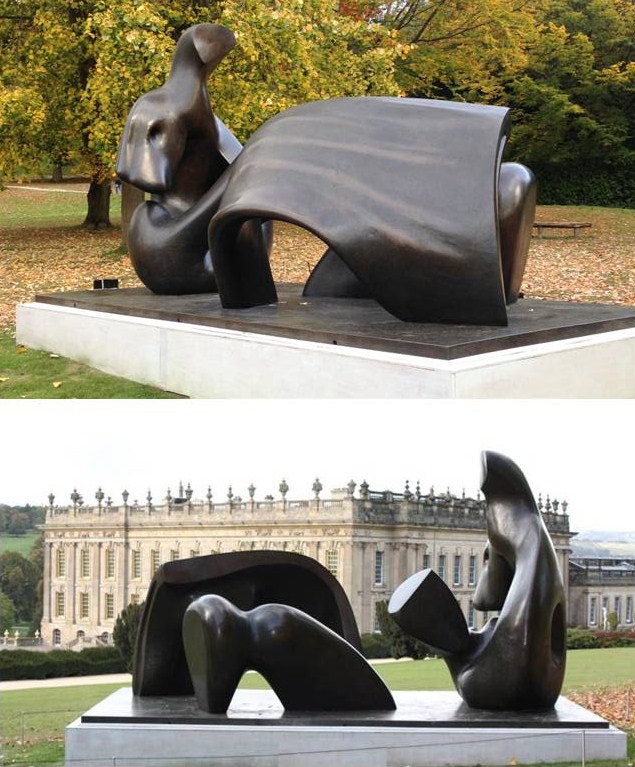
To end where the survey began, two views of a fine Henry Moore, Three Piece Reclining Figure: Draped (1975):



20 October 2014

Crucible2 at Gloucester Cathedral

Crucible2 is the second sculpture exhibition at Gloucester Cathedral curated by Gallery Pangolin of Chalford, Gloucestershire. The first was in 2010 with 76 contemporary sculptures; this time 100 exhibits by 61 sculptors are set in and around the cathedral. Key pieces, in the view of the curators, include works by Kenneth Armitage, David Backhouse, Ralph Brown, Lynn Chadwick (Jubilee IV in the poster,left), Ann Christopher, Antony Gormley and William Tucker. The 20th and 21st century works are often positioned in startling and stimulating contrast to their mostly English Gothic surroundings. For example, Breon O’Casey’s Large Cockerel (circa 2000, below) in the Cloisters with the earliest fan-vaulting in England circa 1350:


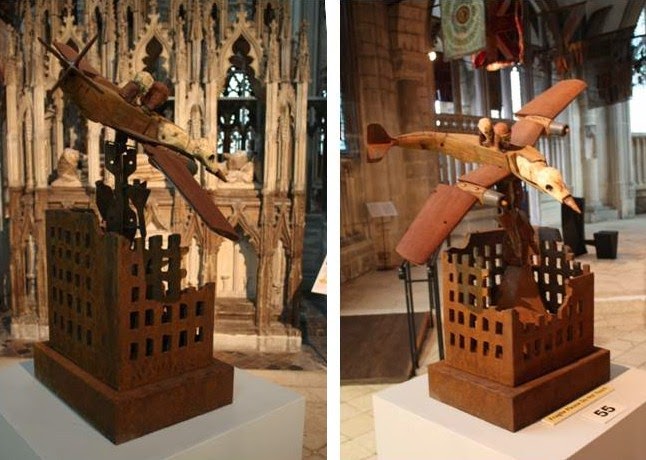
The most celebrated monument at Gloucester is the tomb of Edward II circa 1350, seen below left in the background to Steve Hurst’s Gloucester in Berlin. Hurst, born in 1932 and a witness to bombing in World War 2, sees it as concerning “… the bombing of civilians no matter what their country or who launches the bombing aircraft. It is a personal attempt to regain the viewpoint of a child”.


In the background (right) are the laid up colours of the Gloucestershire Regiment. They appear again (below right) behind Paul Wager’s Omnibus which marks the centenary of the Great War 1914-1918. Similar sentiments inform Deborah van der Beek’s Collateral (below right) – eight million horses died in that war - but it was cast around spent munitions from the conflicts in Iraq and Afghanistan which brought the expression “collateral damage” into common use.


The monument near Damien Hirst’s Anatomy of an Angel (Black) (2008, below) is to Sarah Morley, 29, a mother of four who died a few days after “having sustained the pains of Childbirth at Sea” while returning from Bombay in 1784.


Among the pieces I liked were Antony Gormley’s Pose (2012, below) with In Man’s Nature by Jon Buck behind).


Bryony Marshall’s DNA – Helix of Life (below, left) marks the 60th anniversary of the discovery of DNA. Subsequently mitochondrial DNA was identified as having been passed down to us all from a woman in East Africa about 150,000 years ago, known as Mitochondrial Eve, the inspiration for a sculpture of the same name by Sue Freeborough (below right):


The photograph below left of Geoffrey Clarke’s Taunton Deane Crematorium: Test Panel does not do justice to the colours of the glass. To the right is Sarah Lucas’s Realidad (2013), one of her NUDs series shown as bronzes at the Venice Bienniale in 2013.


John Humphreys’ Ipsius Imago a Latere Extensa probably succeeded as the artist wished in puzzling and confusing the viewer:


but perhaps was not as happily placed as the Eduardo Paolozzi plaster Vulcan near a strange moustachioed carving, perhaps a millennium older:


Among the sculptures in the open were Bruce Beasley’s Breakout II (below, left)in the Cloisters and outside Kenneth Armitage’s final work, Reach for the Stars (below, right).


Crucible2 ends on 31 October. There is no admission charge but a helpful map costs £2 and there is a £3 charge for photography. The catalogue at £16 is both good value and helps support the Cathedral.


UPDATE 2 NOVEMBER 2015

After posting about Beyond Limits: The Landscape of British Sculpture 1950-2015 held at Chatsworth House from 14 September to 25 October 2015, I thought it would be useful to add an image of Gavin Turk's bronze, Nomad (2002, below - and in other colours):


Another version of Chadwick's Jubilee can be seen there, as well.