Showing posts with label National Gallery. Show all posts

7 April 2015

Durand-Ruel at the National Gallery


Anyone who picks over the art section of an Oxfam bookshop is quickly reminded of the popularity of the Impressionists. A comprehensive survey of Impressionism would be a massive undertaking, probably beyond the scope of even the Met in New York (their Centenary exhibition in 1975 had only 42 works) or the Musée d’Orsay in Paris. So the curator of a show with the word Impressionism in its title needs a focus to constrain the scope of their offering and in this case, the Impressionists whose works have been selected are those who were taken up by the Parisian art dealer Paul Durand-Ruel (1831-1922; below top right, Renoir’s portrait of 1910) in the 1870s and after, including Monet, Degas, Manet, Renoir, Pissarro and Sisley*. The National Gallery (London) exhibition, Inventing Impressionism: The Man Who Sold a Thousand Monets, is certain to be very popular and I can't imagine many visitors will leave disappointed. There are 85 major works on display, all of the highest quality and a pleasure to see.


The show starts with some of the pictures from Durand-Ruel’s Paris apartment (above lower) like Renoir’s Dance in the City (1883, above top left). One of the doors from the grand salon is on display with six panels painted in 1883 by Monet: Japanese Lilies, Chrysanthemums, Pot of White Azaleas, Gladioli, Branches of White and Pink Azaleas and Basket of Apples (for an image, see here).  Renoir was a friend of Durand-Ruel’s for nearly 50 years and The Dancer (1874, below, left) and The Cup of Chocolate (c1877/78, below right) are among the others shown here. (Renoir’s Girl with a Cat (1880), one of Durand-Ruel’s favourites apparently, was at the Royal Academy’s From Paris:A Taste for Impressionism Paintings from the Clark in 2012 under the title, Sleeping Girl).


From then on the show follows the path of Durand-Ruel’s career and the next section introduces the painters whose art, not much favoured by the official Salon, was being sold by the family business at the time that Paul took over from his father: Corot, Courbet – Still Life with Apples (1872, below top), the Barbizon school – Millet’s The Sheepfold, Moonlight (1856-8, below lower):


Paul’s sponsorship of the Impressionists was a consequence of the Franco-Prussian war of 1870-71. He moved his stock to London and opened a gallery in New Bond Street. Among the artists in exile were Monet – The Thames below Westminster (c1871, below top) and Pissarro – The Avenue, Sydenham (1871, below lower)  producing the sort of avant garde works which appealed to his taste.


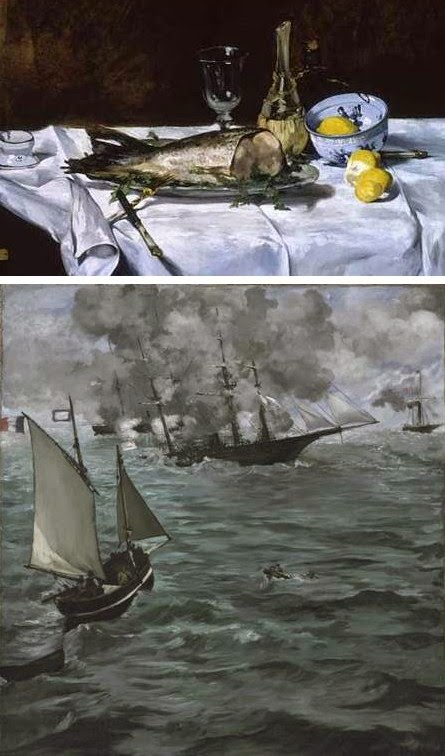
But it was on his return to Paris in 1872 that Durand-Ruel acquired at considerable cost a large number of works by Manet, for example, The Salmon (1869,  below top) and The Battle of the USS Kearsarge and the CSS Alabama (1864, below lower). The latter is an imaginative reconstruction by Manet who painted the Kearsarge at Boulogne after the incident.

Acquisitions of works by Sisley – The Ferry of the Ile de la Loge: Flood (1872, below top left) and Degas – Horses before the Stands (c1866-8, below top right) and Monet - Railroad Bridge, Argenteuil (1873, below lower) were made in the same year, Durand-Ruel not only buying in quantity from his favoured artists but also paying for their work in advance.


At the time of the 1874 First Impressionist Exhibition, Durand-Ruel was in temporary financial difficulty but was able to lend it some of his pictures. By 1876 he was able to take an active part in the Second Impressionist Exhibition and the National Gallery has brought together eight of the 250 works shown then, including Monet’s Springtime (c187, below top) and Degas’ Peasant Girls bathing in the Sea at Dusk (c 1869-75, below lower), both causing controversy at the time.


By the 1880s Durand-Ruel was in a position to put on solo exhibitions for his artists, the case study for this show being Monet with six canvases from 1883, including The Train in the Snow (1875, below top) and The Galettes (1882, below lower).


In 1892 Durand-Ruel displayed in his gallery Monet’s Poplars series, five of the original 15 being brought together again at the National Gallery. By then he had established himself in the New York with the 1886 (Works in Oil and Pastel by the) Impressionists of Paris exhibition and was selling to wealthy American collectors works like Monet’s Autumn Effect at Argenteuil (1873, below top) and Degas’ The Ballet Class (c1880, below lower).


The exhibition ends with a selection of the works Durand-Ruel showed at the Grafton Galleries in London in 1905 – apparently the largest Impressionist exhibition ever held. These include one of the National’s own Degas, Miss La La at the Cirque Fernando (1879, below left), Monet’s The Coal Carriers (c1875, below right top) and Morisot’s dazzling Woman at her Toilette (c1875-80, below right lower).


Wonderful though this show is, I do have a minor reservation about its title: “Inventing Impressionism” – if anyone invented Impressionism surely it was Monet in 1872 with Impression, soleil levant later shown at the 1874 exhibition? Although I can understand why “Marketing Impressionism” or, worse still, “Branding Impressionism” wouldn’t do. However, when it was at the Musée du Luxembourg earlier the show was called Paul Durand-Ruel Le pari de l’impressionnisme (poster below left**), literally ‘the bet on impressionism’ and, if that was acceptable in Paris, I can’t help wondering whether “PD-R the man who gambled on Impressionism” or even “Gambling on Impressionism” might have been both acceptable and more accurate here.


After David Hockney attended the Monet retrospective in Chicago in 1996 he commented:
A great artist, a very great artist. Very finely painted, superb condition now. What? A hundred years old? He knew exactly which paint to use and his work remains in marvellous condition. (Hockney on Art, page 204)
In contrast with the state of some of van Gogh’s works, as touched on in a recent post here. Van Gogh, of course, did not have the benefit of financial support from a Durand-Ruel to assist in the purchase of quality materials. Something which the exhibition hardly touches on is that Durand-Ruel was not exclusively focussed on the Impressionists. Although the term Post-Impressionism would not be invented until 1910, Cézanne featured in the Grafton Galleries exhibition and Seurat’s Bathers at Asnières, to be seen upstairs in the National Gallery, had appeared in the 1886 New York exhibition.

The last time I saw so many Impressionist works in one place was in London in 1973. Unbelievable as it may seem now, the UK was celebrating its entry to the European Economic Community (as the EU was called at the time). The Arts Council’s contribution to this jamboree (Fanfare for Europe) was The Impressionists in London at the Hayward Gallery, with 58 works (though including six by Derain). Looking at the catalogue I noticed the detailed Chronology by Anthea Callen and reproduce it below as it seems so helpful, particularly in the UK.

Inventing Impressionism: The Man Who Sold a Thousand Monets continues until 31 May.

*(Not so) Young French Artists
Monet 1840-1926, so 36 in 1876, the year of the Second Impressionist Exhibition
Degas1834-1917, 42
Manet 1832-1883, 44
Renoir 1841-1919, 35
Pissarro 1830-1903, 46
Sisley 1839-1899, 37

** with Renoir’s Dance at Bougival (centre) and Dance in the Country (right), both 1883. The latter also hang in Durand-Ruel’s grand salon.




2 March 2015

Late Rembrandt at the Rijksmuseum

I missed this winter’s Rembrandt: The Late Works at the National Gallery in London, but what better excuse could there be for a trip to Amsterdam where the same exhibition is continuing at the Rijksmuseum as Late Rembrandt. This is almost certainly the most significant exhibition I will ever post about on this blog, and, as such, readers would probably benefit far more from articles about the NG show by Simon Schama (“jaw-dropping”) or Martin Gayford (“the supreme painter of the inner life”). However, even the best critics seem to have been overwhelmed by The Late Works, so here’s my tuppenceworth.


Titus at his Desk, 1655 (left) Titus in Monk’s Habit, 1660 (right)
This is, it seems, the first exhibition ever to address “late” Rembrandt. The painter’s dates are 1606-1669, the earliest exhibit is dated “about 1648–55” but there are few before 1652, so most are from the painter’s mid-40s until his death at 63. Life had gone well for Rembrandt until early middle age. For a time he had been one of the most successful painters in Holland in the period known as its Golden Age. He had bought a splendid family house in Amsterdam (see below) with borrowed money when he was 33, but three years later his wife, Saskia, died. During perennial financial difficulties he would eventually lose the house. Three of Saskia’s four children would die, only his son, Titus (above), reaching adulthood; Hendrickje Stoffels (probably below), his housekeeper who became his mistress and mother of his daughter, would die in 1663; Titus died the year before his father.

A Woman bathing in a Stream, 1654 
This painting was in the unfashionable less finely finished style which Rembrandt had adopted after 1650. His The Conspiracy of the Batavians under Claudius Civilis (c1661–62, below top) was possibly rejected on these grounds after having been commissioned for the Amsterdam town hall, although at the same time he continued to produce more conventional works like The Sampling Officials of the Amsterdam Drapers’ Guild (1662, known as The Syndics, below lower).


There are far too many magnificent pictures in Late Rembrandt for them all to be reported here. Just a few that I was struck by include the Portrait of Jan Six (c1654, below left) and the Portrait of an Elderly Man (1667, below right) – old chaps are easy for me to identify with of course:


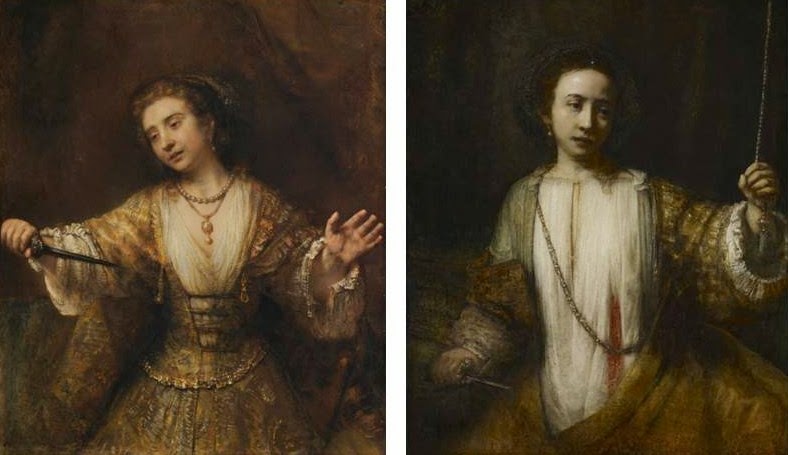
And who could not be moved by poor Lucretia (1664, below left and 1666, below right):


Similarly, The Apostle Batholomew (1657, below left and 1661, below right):


Among the portraits, Portrait of a Lady with an Ostrich-Feather Fan (c1656–58, below), was, like The Syndics, more conventional but no less impressive:


As with the Rubens show currently at the Royal Academy in London, the Late Rembrandt curators have avoided chronology and organised around abstract nouns, eg Intimacy, Contemplation, Emulation and so on. This means that the six significant Rembrandt Self Portraits here are separated after an introductory trio; they are: SP 1659, SP as the Apostle Paul 1661, SP as Zeuxis 1662, SP with Two Circles 1665-9 (also in the poster above), SP at the Age of 63 1669, SP 1669 (clockwise from top left):


One of the last images of Rembrandt is the print of Self Portrait, drawing on an Etching Plate (1658, below left) one of many etchings and drawings featured in Late Rembrandt, too many to describe here. Another is The Conspiracy of the Batavians under Claudius Civilis (c1661, below right) which reveals the full extent of the painting of the same name above before it was cut down in size after rejection.


Anyone seeing the Amsterdam version of Late Rembrandt/Rembrandt: The Late Works, an exhibition which is truly deserving of the term "unmissable", will have the opportunity to view some of his other major works elsewhere in the Rijksmuseum and to visit his house and financial millstone, now a museum, Het Rembrandthuis.

Late Rembrandt continues until 17 May.

Subsequent posts are about the Rembrandt House Museum and some other things seen in the Rijksmuseum and elsewhere in Amsterdam. There is also a post about the Van Gogh Museum.


15 June 2014

Two London Exhibitions - Better late than never

This post is mostly for the record, both these shows having closed on 15 June, but I was glad to have been able to finally get to see them just a few days earlier.

Veronese 


At the National Gallery, Veronese Magnificence in Renaissance Venice fully lived up to its title. Paolo Bazaro (also Caliari), who came from Verona and so was known as Veronese, lived from 1528 to 1588. The time line on the way into the exhibition helpfully explained that these years spanned the establishment of the Church of England, the birth of Shakespeare and the Spanish Armada. Then a chronological sequence of fifty works followed his artistic progress from his home town to Vicenza, Mantua and, from1555, Venice. Some of these were being reunited at the National Gallery, which has ten Veroneses of its own, for the first time in many years.

Many of the pictures were of religious scenes and intended to decorate churches (12 altarpieces), some were based on classical mythology and a few were portraits. In these, Veronese carefully documented the opulent costumes of his wealthy aristocratic subjects, but still managed to convey something of the sitter's personality, as for example in Portrait of a Lady, known as the 'Bellamy Nani' (about 1560-5, below).


I suppose that fewer of us than would have been the case in the past have the biblical awareness to appreciate immediately the content of, say, Christ and the Centurion (about 1750, below)


or to know that a jar is associated with Mary Magdalene. Fortunately, the curators compensated for this in their guide. Some of the exhibits were larger than any I had seen before in a temporary exhibition. For example, The Martyrdom of Saint George (about 1565, below), removed from the church of San Giorgio in Braida, Verona for only the second time in its existence, is approximately 4m by 3m.


The curators and lenders must have faced considerable problems in ensuring its secure and safe transit. Knowing all too little classical mythology, I was also grateful for being provided with brief accounts of works like Perseus and Andromeda (1575-80, below).


However ill-equipped some of us might be to appreciate the biblical and classical references, the details in the paintings revealed an unfamiliar and fascinating 16th century world full of consiglieri, servants, horses, dogs and monkeys. Sea-borne trade was the economic basis of Venice’s wealth and I liked the two Allegories of Navigation, about 1555-60, one with a Cross-Staff (left) and the other with an Astrolabe (right).


No doubt like many others, I left the exhibition thinking it was time to visit Northern Italy, particularly Venice, again. A complementary exhibition, Paolo Veronese L'illusione della realtà, will be at the Museo di Castelvecchio, Verona, from 5 July – 5 October 2014).


Great War Portraits

The Great War in Portraits at the National Portrait Gallery was a small and rather crowded show scheduled to end before the centenary of the start of World War 1 had been reached, or even that of the assassination of Archduke Franz Ferdinand. Perhaps the current Director of the NPG wanted to do something on the subject before he leaves, or it was a Whitehall priority. I can't believe it will be the Gallery's last word on the War before 2018.  Nonetheless, this exhibition quite rightly induced sombre reflection. What a contrast there was between Orpen's slick portraits of the top brass, no doubt unfailingly pleasing to their subjects (particularly himself), and the wall of photographs showing the haunted faces of the ‘Poor Bloody Infantry’. Field Marshal Sir Douglas Haig (1861–1928), KT, GCB, GCVO, KCIE, Commander-in-Chief, France, from 15 December 1915 (1917, below left) and Self-portrait (1917, below, right).


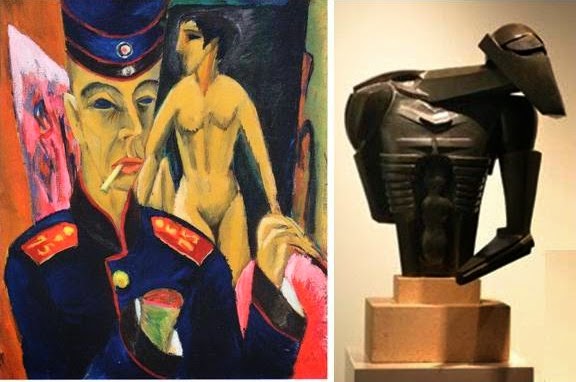
I saw for the first time some of Henry Tonks' famous pastel drawings of injured faces (they feature in Pat Barker’s Toby’s Room). The text didn’t point out that Tonks was originally trained as a surgeon. There was also an opportunity to see a work by the Die Brücke expressionist Ernst Ludwig Kirchner: Selbstbildnis als Soldat (Self-Portrait as a Soldier, 1915, below left) and Jacob Epstein’s Torso in Metal from The Rock Drill 1913 – 14 (below, right).


 A bigger show with more German art would almost certainly have been of more value. Also, while screening German as well as British contemporary newsreel footage was highly desirable, it made the exhibition seem even more crowded. It might have been better left to the BBC, who will probably show most of what is worth seeing in the next four years.


12 June 2014

Lord Clark at Tate Britain


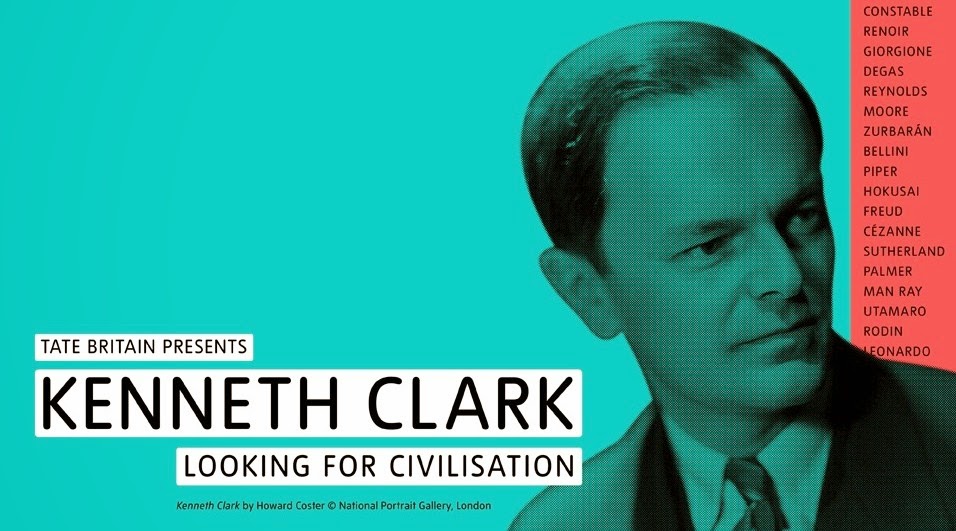
Kenneth Clark (1903-1983) was not only born in the same year as Evelyn Waugh, (mentioned in recent posts here), but also became well-known at a young age in the 1930s. Clark, unlike Waugh, was born into considerable wealth and, after studying the history of art at Oxford and coming under the influence of Roger Fry, was able to spend time in Italy with the American art historian Bernard Berenson, specialising in the Renaissance. On return to England he became Curator of the Ashmolean Museum in Oxford and then Director of the National Gallery from 1930 to 1946. His public service also included being Surveyor of the King’s Pictures, and chairmanships of the War Artists' Advisory Committee, the Arts Council of Great Britain and the Independent Television Authority. In 1969 Clark wrote and presented a celebrated TV series on the history of Western civilisation for BBC television, later shown in the US. When he subsequently received a life peerage, Private Eye dubbed him Lord Clark of Civilisation. The Tate Britain exhibition, Kenneth Clark - Looking for Civilisation, is a survey of his life’s work and brings together art that he had dealt with professionally, had benefitted from his patronage or that he had collected personally.

Not surprisingly, there is much to look at in this show. The 270 objects on display include some which are unfamiliar and may not be seen in public again for a while (one can hazard a guess as to which ‘Private Collection’ they come from). The first room is the most personal with Graham Sutherland’s portrait, Kenneth Clark (1963-64, left), and focusses on his early years. This is followed by works he collected for himself (Seurat’s The Forest at Pontaubert, (1881 below left) or, as Director of the National Gallery, for the nation, for example Constable’s Sketch for Hadleigh Castle (1828-9, below right), later transferred to the Tate. Some of the attributions he made when purchasing for the National Gallery do not seem to have stood the test of time particularly well. However, it was under his Directorship that the Gallery’s Scientific Department was formed, and the techniques which are now available to support judgements on authenticity began to be developed. In the 1930s Clark purchased for himself late works by Cézanne, as would Henry Pearlman a decade later and probably at a much higher price. A Cézanne pencil drawing, Still life, Pain sans mie, 1887-90, is particularly interesting in that its inclusion of commercial typography (“bread without crumbs”!) anticipates Picasso and Braque (but see the 1 July update below).


Clark not only collected but was an active patron looking favourably on Henry Moore (Recumbent Figure, 1938, right), Graham Sutherland, Paul Nash, and John Piper. He did not care much for abstraction (the Ben Nicholson on show seems to have been an exception), Francis Bacon or Lucien Freud’s later work. The fifth and largest space in the show is given over to the War Artists, most of whom worked in the Romantic style Clark liked, and is one of the most interesting. Although familiar in reproduction, the opportunity, during the Imperial War Museum’s closure, to see Paul Nash’s Battle of Britain (1942, below) and one of Moore’s shelter drawings (Tube 1941, below, lower) is welcome.


Among many impressive wartime pictures, ones which caught my eye were John Piper’s Somerset Place, Bath (1942, below,) and Albert Richards’ The Landing: H Hour minus 6. In the Distance Glow of the Lancasters Bombing Battery to be Attacked (1944, below, lower).


The final room concentrates on Clark’s activities after the war, particularly his involvement with television. The BBC are reportedly considering a new Civilisation series:
… "re-imagined … for the digital age". Unlike the original, it is likely to have a number of different presenters.
If so, I hope one of them will be Lisa Jardine, the daughter of Jacob Bronowski. His 1973 television series, The Ascent of Man, was complementary to Clark’s and looked at the rise of science as opposed to art, architecture and philosophy.

Just before leaving the exhibition, visitors can see two of the finest works acquired by Clark: a Francisco de Zurbarán still life, A Cup of Water and a Rose (c1630, below left), and Cézanne’s Le Château Noir (c 1904, below, right).


Kenneth Clark - Looking for Civilisation ends on 10 August and anyone with an interest in British art should try to get to Tate Britain before then. The most thought-provoking review I have come across is Kenneth Clark: arrogant snob or saviour of art? by James Hall in the Guardian.


A MINOR QUERY FOR THE CURATORS

In the first room there is a showcase (vitrine?) of Clark family photographs. One of these is of a villa owned by Clark’s father and (when I saw it) was labelled as being Clark’s childhood home in South West France at Cap Ferrat. I thought this unlikely. Although before the First World War Arcachon, on the Gironde department’s Atlantic Coast, was a fashionable resort, the village of Cap Ferret, nearby by sea but remote by land, was little more than a few oyster fishing huts (rather different now). However, Cap Ferrat (Saint-Jean-Cap-Ferrat) on the Mediterranean in the Alpes-Maritime department in South East France had become a magnet for the ultra-wealthy around 1900 and remained so. The Clark villa seems to be in the “Renaissance” style consistent with that location and, of course, Clark’s father was supposedly “the man who broke the bank at Monte Carlo”, not Biarritz. It might be worth checking.


UPDATE 1 JULY

A footnote to Cézanne’s use of commercial typography: I have recently come across this image of The Artist's Father, Reading "L'Événement", 1866, now in the National Gallery of Art, Washington DC. Apparently it wasn’t Louis-Auguste’s favourite paper but Cézanne’s old friend Emile Zola was L'Événement’s art critic.


11 November 2013

Viennese Portraits at the National Gallery


When the title of an exhibition includes a date, as does Facing the Modern: The Portrait in Vienna 1900, currently at The National Gallery in London, it shouldn’t always be taken at face value. Certainly, earlier this year, the Courtauld’s Becoming Picasso: Paris 1901 was exact as to artist, place and time, whereas in 2000 the Royal Academy’s 1900: Art at the Crossroads covered the decade up to 1900. In 2002 the RA’s Paris: Capital of the Arts 1900-1968 was specific, and, if that example had been followed, the title of the NG show would probably be something like Portraiture in the Austro-Hungarian Empire 1867-1918. How much less immediately appealing this would have been to those whose primary interests are Klimt and Schiele is hard to say.


As it is, if the well-known Viennese modernists are what you are seeking out, you may feel that you have had to make your way past a lot of their rather less interesting Austro-Hungarian predecessors. But it’s worth it. After all there is only one painting by Gustav Klimt (1862 - 1918) in a public gallery in the UK, the NG’s own Portrait of Hermine Gallia 1904 (above right), currently in this exhibition as might be expected. There is now the chance to see, among others, his Lady in Black, c.1894 (above left), Portrait of Amalie Zuckerkandl 1917-18 (poster above), and Posthumous Portrait of Ria Monk III 1917-18 (above centre).


There are no works by Egon Schiele (1890-1918) in UK public collections, so we should take the opportunity to view The Family (Self-Portrait) 1918 and Erich Lederer 1912 while we can (above left and right). Portraits by Oscar Kokoschka (Count Verona 1910) and Richard Gerstl’s Nude Self-Portrait with Palette 1908 (just before his suicide) are also worth seeing.

Facing the Modern: The Portrait in Vienna 1900 continues until 12 January 2014.


29 April 2012

Turner and Claude at the National Gallery, London

In a post last year I commented, after a visit to Claude Lorrain: The Enchanted Landscape at the Ashmolean in Oxford, that there were relatively few paintings being shown by comparison with the numerous drawings and etchings (13 vs 125). The National Gallery’s current spring exhibition, Turner Inspired: In the Light of Claude, provides an opportunity to see about 10 oils by Claude and 20 by Turner, and the ratio of paintings to other works is better balanced. The theme of the National Gallery (NG) show is Claude’s influence on Turner so the latter’s paintings being in the majority is as to be expected. Also Turner’s paintings are readily available in London, so many having been held by the NG and Tate Britain since his 1856 Bequest.

Joseph Mallord William  Turner (1775-1851) painted 200 years after Claude (1604-1682). But Claude became a major influence after Turner’s first encounter in 1799 with works in the possession of the dealer Angerstein (a collection which later became the kernel of the NG). Turner was impressed by and sought to emulate Claude’s ability to invest an ethereal quality to the light at the beginning and end of the day. An impressive example of this is A View of the Roman Campagna from Tivoli, Evening (below) on loan from the Royal Collection.


Turner left the NG his paintings Dido building Carthage and Sun rising through Vapour: Fishermen cleaning and selling Fish on the condition that they would be hung between two paintings by Claude: Seaport with the Embarkation of the Queen of Sheba and Landscape with the Marriage of Isaac and Rebecca and the exhibition hangs all these pictures in close proximity. Later works by Turner reveal his move away from Claude’s style (though commonalities remained – neither painter cared much for figures in their landscapes, preferring trees and water as subjects) to his later, more romantic and free-flowing style, much admired by the French impressionists, particularly Monet.

Turner Inspired: In the Light of Claude ends on 5 June and should not be missed by anyone interested in either of these painters or in the evolution of landscape painting.

27 February 2011

Bridget Riley in London

Just off Trafalgar Square are two opportunities to see works from early and late in the career of Bridget Riley. She became well-known in the 1960s for her distinctive black and white (and later multicoloured) abstracts with marked optical effects – Op Art. Riley will be 80 in April and is still an active artist, as is Susan Hiller -a mere 70 - currently at Tate Britain. Bridget Riley: Paintings and Related Work at the National Gallery focuses on recent paintings, including two made directly on to the walls of the exhibition space. At the artist’s request, a selection of paintings from the Gallery’s collection are displayed which explain the relationship between her pictures and historical figurative work.

The small but free exhibition has been sponsored by Bloomberg, and quite possibly their support extended to the Catalogue. This is excellent value at £9.99 and expands considerably on the theme of the exhibition. The images of Riley’s Set Fair and Matisse’s Dance II (pages 37 and 38) seem particularly to make the point. The exhibition runs to 22 May.

Older Woman Looking Down
Bridget Riley, c.1950
Around the corner at the National Portrait Gallery (NPG), until 20 March and also free, is a display of early life drawings, Bridget Riley: From Life. This was the area of her  training at Goldsmiths’ College. Perhaps fancifully, to me these seem to reveal an exploration of linearity even in addressing representation of the human face.

Nearby is a display, Camden Town and Beyond, of key portraits by leading members of the Camden Town Group, (Gore, Sickert) . It also explores the subsequent development of British post-impressionism in portraits by Augustus John and Mark Gertler. The display continues to 31 August.