Showing posts with label 'Private Eye' magazine. Show all posts

31 December 2015

Andrew Marr’s ‘Head of State’

A disappointing first novel from a political insider, neither thriller nor satire 

At last I have got round to reading the paperback edition of Andrew Marr’s first novel, originally published in September 2014. At the time Head of State came out, I was intrigued by a piece in Private Eye (No 1376, 3 October, page 29 – familiarity with this magazine can only be helpful to readers of Marr’s book) which reported the launch in 10 Downing Street:


Head of State received faint praise from the critics then, and, when I looked recently on Amazon, it had acquired an oddly balanced set of Customer Review scores:


However, Marr, as well as having written other books about history, politics, poetry and the Queen, has been editor of a national newspaper (the Independent) and the BBC’s political editor and also, as the host of BBC1’s The Andrew Marr Show, has regularly interviewed top politicians for over 10 years. And his Author’s Note (dated April 2014), prefacing Head of State (which is subtitled A Political Entertainment - echoes of Graham Greene), seemed encouraging:
… I had long wanted to write a political satire that would help lift the lid on how aspects of government and the media really worked in a way that’s not possible in conventional journalism. 
… Some of the characters and stories in the novel are derived directly from my thirty years as a political reporter, though of course almost everything here is fictional.
I would guess that the bulk of the writing was done in 2013 when Marr was recovering from a stroke. At that time, well before the 2015 general election, a referendum on the UK’s leaving the EU (Brexit) set in September 2017, the motor of Head of State, must have seemed only a possibility and safely distant at that. By comparison, Michel Houellebecq, who must have been writing Submission at about the same time, was setting his novel in 2022. Now, Marr’s readers, less than 18 months after publication, are having to put to one side the facts that there will be an EU referendum this year or next and that David Cameron is still Prime Minister leading a Conservative government since May 2015. Fortunately in Marr’s 2017 the Tories are obviously in power, the Chancellor of the Exchequer being one Jo Johnson (Boris’s brother, currently Minister for Universities and Science (page 339).

Is Marr’s novel a roman à clef? Houellebecq mentions quite a few contemporary personalities in his future France but keeps them in the background, his main characters being plausible, but imaginary. Head of State mentions no end of real people, including, Marr himself (page 96), and Ian Hislop, the editor of Private Eye, (eating a cake on page 247). Moreover, while most of the foreground characters are fictional, readers of Private Eye’s Street of Shame column could make a guess at the inspirations, and there are several, for Ken Cooper, editor of the fictitious National Chronicle. However, one of the few admirable characters in the book, the modern historian, Lord Briskett, is surely without parallel in the real world:
Dressed in his trademark coarse green tweeds, with his halo of frizzy white hair and heavy horn-rimmed spectacles, part A.J.P. Taylor part Bamber Gascoigne, Trevor Briskett was famous enough from his TV performances to attract second glances from his fellow commuters. On the streets of Oxford that crowded, clucking duckpond of vanity and ruffled feathers - he was stopped-in-the-street famous. 
And rightly so. For Briskett was the finest political historian of the late twentieth and early twenty-first centuries. His early biographies - Blair, Thatcher, Johnson - were still in print, while the memoirs of scores of almost-forgotten politicians had long since vanished to charity shops and recycling dumps after selling only a few score copies. Briskett's account of the modern constitution had been compared to the works of that Victorian master-journalist Walter Bagehot. His history of British intelligence during the Cold War had been praised by all the right people. Emeritus professor at Wadham, winner of numerous literary prizes, elevated five years ago to the Lords as a crossbencher after chairing a royal commission on security lapses at the Ministry of Defence, Briskett was regularly tipped to be the next member of the Order of Merit. 
Yet somehow these decorative embellishments, which might have weighed him down and made him soft, slow and comfortable, had had little apparent effect on Trevor Briskett. At seventy he was as sharp, as boyishly enthusiastic, as wicked a gossip with as rasping a laugh, as he had been at thirty. The exact nature of the pornography discovered on the minister's lost laptop. The attempt to blackmail a senior minister over his wife's cocaine habit. Just who Olivia Kite was taking to her bed these days … If you really wanted to know you went to Briskett, and he would tap his nose, lean towards you, give a wolfish smile and a 'dear boy', and spill all the beans. (page 15/16)
Funnily enough, it was pointed out on the History Today website recently, when marking the 50th anniversary of the Journal of Contemporary History, that modern historians are dismissed as not dealing in real history, just gossip.

But without any attempt at disguise, a key role in Head of State is taken by Rory Bremner, a real British actor (and a Scot like Marr) who has made a career from comic impersonation of public figures. And what to make of a Scotsman called Nelson Fraser - did Martin Andrews have anyone particular in mind? Not to mention a female character described as whetstone-hard (page 285). Almost totally unambiguous is the King, for in Head of State the Queen has become “late” – presumably a few years after the publication of Marr’s The Diamond Queen: Elizabeth II and Her People in 2011. The characterisation of “Kingy”, as the staff of Marr’s Number 10 call him, owes rather too much to Silvie Krin’s Heir of Sorrows, as occasionally appearing in, yet again, Private Eye. By the way, in the United Kingdom the King or Queen is the Head of State, the Prime Minister is the Head of the Government. Marr is, of course, aware of this distinction and the title of the book is a pun on a particularly gruesome aspect of his tale.

Something similar happens with the locations: Gordon’s wine bar is real enough but Marr chose to put the “Universities and Constitutional Club” in the place of the Athenaeum – perhaps he’s a member.

If Head of State is too uneasily placed between imaginary and real worlds to be a satisfactory roman à clef, is it a thriller or a satire? In so far as the events being described are packed into eight days from 15 to 22 September 2017, the Brexit Referendum Day, surely the former. But Head of State is no Six Days of the Condor. There are 14 chapters, each titled with a date, and to explain the sequencing Marr chose rather than a normal narrative flow, a picture is worth thousand words:


The events in the eight days are too numerous, involve too many characters and mostly too far-fetched to yield a convincing thriller, and the leaping about in time reduces what suspense is mustered. On the other hand, there are too many attempts at wit which fall flat:
… ‘Fuzzy Blue oatcake’, the most influential right-wing blogger … (page342) 
… Christ Almighty, a recent Hollywood adaptation of Evelyn Waugh’s biography of Ronald Knox (page 20)
to provide the entertainment of one of Waugh’s comic novels, and too much grotesque unreality (for example, the said head) to make for a thought-provoking satire. There is also some poor, or just careless, writing which the editors (described by Marr in his Note as “legend[s] in the trade”) should have picked up. Just a few examples:
… hair for whose colour there was no adequate description - corngold and copper, silver birch with licks of flame. (page 24 – is this a Clairol ad?) 
… a wooden cabinet whose numbered chambers were perfectly sized to hold Blackberries and iPhones (page 82 – “with numbered chambers for Blackberries and iPhones” - they can’t be perfect for both) 
… [he] felt himself a man brimming with talents in a world that no longer needed them; an itchy-palmed electrician, as it were, during the New Stone Age (page 247 – the New Stone Age ended almost 4000 years before the practical application of electricity!).
Marr’s dislike of bloggers (discussed here in 2010) comes up repeatedly and, no doubt for related reasons, in Head of State he makes frequent and disparaging references to “Witter”, right up to page 342. So why on page 358 does he relent and use “tweeting”?

Does Marr “help lift the lid on how aspects of government and the media really work[ed]”? Well, there are a few lines about Brexit, which might provide the flavour of arguments which will appear as the real Referendum Day draws near:
… A Europe that fragmented now would soon become a mere vacuum, a playground for American technology, Chinese money and Russian political ambition. And Britain? Britain would again find itself desperately trying to negotiate the balance of power between Berlin and Paris, from a position of no significance. It would be impossible. (page 104) 
… Increasingly excited, he and Charmian began to talk numbers. 'lf the UK does leave the EU - well, the dollar is 1.55 to the pound now. Sterling will no longer be a reserve currency, so it will fall to, say, 1.35. Probably lower than that. (page 204, Sterling is 4% of all currency reserves at present – so would this happen? I’ve no idea, like many other readers, I suspect)
And towards the end of the novel there is this intriguing passage:
The whole thing is simply incredible. Oh no, it couldn't happen here. It's as bonkers as - what? - two brothers fighting each other for the leadership of the Labour Party, or a husband and wife jailing each other. over a pretty minor traffic offence, or two eminent members of the Conservative Party being in a gay relationship even as they proclaim family values, or a prime minister having an. affair with one of his own ministers. Loopy. Loony. It's as bonkers as manufacturing the case for an entire war and thinking no one would notice. Mad as cheese. No, no, none of that could ever happen here. The great British public simply wouldn't let them get away with it. (page 327/8)
I would expect that some of these ‘incredible’ happenings are recognisable to most of the book’s likely readership, but are the others figments of Marr’s imagination or things he knows about and we don’t?

In a while I will post about Marr’s second attempt at a political novel, Children of the Master, published in September 2015 and again not enthusiastically reviewed. Both books will probably become available in an Oxfam near you before long.


27 June 2014

But a whimper

Not many people appear twice in the same issue of Private Eye but Dominic Cummings, a former special adviser (spad) for Michael Gove has managed it this week (No 1369 27 June – 10 July), under The New Coalition Academy (page 23) and Me and My Spoon (page 26):


This feat stems from an interview he gave Alice Thomson and Rachel Sylvester which made the front page of The Times on 16 June. He is quoted as saying:
As Bismarck said about Napoleon III, Cameron is a sphinx without a riddle – he bumbles from one shambles to another without the slightest sense of purpose. … Everyone is trying to find the secret of David Cameron, but he is what he appears to be. He had a picture of Macmillan on his wall – that’s all you need to know.
Subsequently he posted on his Wordpress blog A few responses to comments, misconceptions etc about my Times interview, referring in passing to an earlier post The Hollow Men (Part 1). This starts with a selection from TS Eliot’s poem:

Close up:

On Wordpress blogs the readers’ comments are called “thoughts”, and I offered one, a very short one: “Eliot”. This wasn’t allowed through. On this blog, when I’m offered an acceptable correction I not only let it stand but respond with “Thanks, corrected” or some such. Cummings’ blog is a much grander affair than mine, and he might well have regarded Western Independent’s input as a trivial attempt at attention-seeking off his back. So, if he’d not published but had corrected his misspelling of Eliot’s name, I really wouldn’t have minded.

But at the time of this post, it’s still “Elliot”. Readers can draw their own conclusions, particularly when he and Mr G have such a reputation as advocates for academic rigour.


12 June 2014

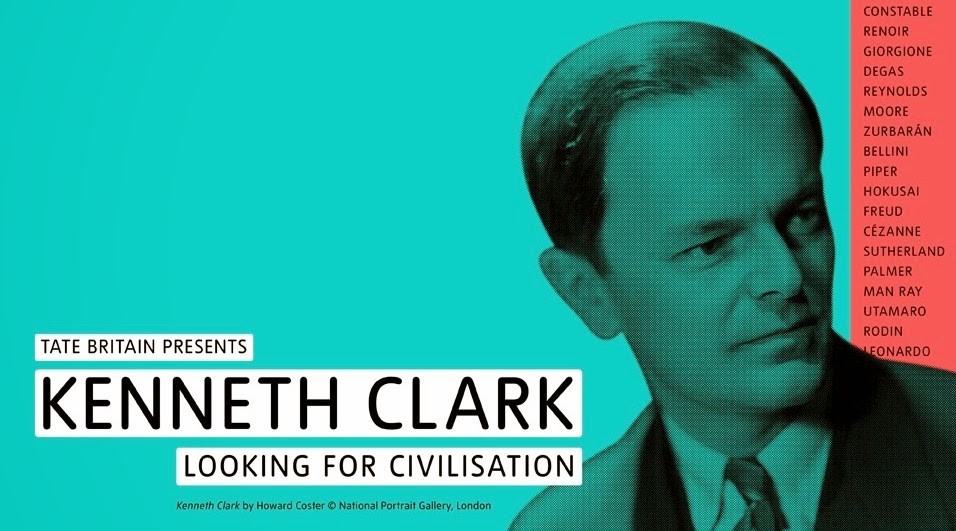
Lord Clark at Tate Britain


Kenneth Clark (1903-1983) was not only born in the same year as Evelyn Waugh, (mentioned in recent posts here), but also became well-known at a young age in the 1930s. Clark, unlike Waugh, was born into considerable wealth and, after studying the history of art at Oxford and coming under the influence of Roger Fry, was able to spend time in Italy with the American art historian Bernard Berenson, specialising in the Renaissance. On return to England he became Curator of the Ashmolean Museum in Oxford and then Director of the National Gallery from 1930 to 1946. His public service also included being Surveyor of the King’s Pictures, and chairmanships of the War Artists' Advisory Committee, the Arts Council of Great Britain and the Independent Television Authority. In 1969 Clark wrote and presented a celebrated TV series on the history of Western civilisation for BBC television, later shown in the US. When he subsequently received a life peerage, Private Eye dubbed him Lord Clark of Civilisation. The Tate Britain exhibition, Kenneth Clark - Looking for Civilisation, is a survey of his life’s work and brings together art that he had dealt with professionally, had benefitted from his patronage or that he had collected personally.

Not surprisingly, there is much to look at in this show. The 270 objects on display include some which are unfamiliar and may not be seen in public again for a while (one can hazard a guess as to which ‘Private Collection’ they come from). The first room is the most personal with Graham Sutherland’s portrait, Kenneth Clark (1963-64, left), and focusses on his early years. This is followed by works he collected for himself (Seurat’s The Forest at Pontaubert, (1881 below left) or, as Director of the National Gallery, for the nation, for example Constable’s Sketch for Hadleigh Castle (1828-9, below right), later transferred to the Tate. Some of the attributions he made when purchasing for the National Gallery do not seem to have stood the test of time particularly well. However, it was under his Directorship that the Gallery’s Scientific Department was formed, and the techniques which are now available to support judgements on authenticity began to be developed. In the 1930s Clark purchased for himself late works by Cézanne, as would Henry Pearlman a decade later and probably at a much higher price. A Cézanne pencil drawing, Still life, Pain sans mie, 1887-90, is particularly interesting in that its inclusion of commercial typography (“bread without crumbs”!) anticipates Picasso and Braque (but see the 1 July update below).


Clark not only collected but was an active patron looking favourably on Henry Moore (Recumbent Figure, 1938, right), Graham Sutherland, Paul Nash, and John Piper. He did not care much for abstraction (the Ben Nicholson on show seems to have been an exception), Francis Bacon or Lucien Freud’s later work. The fifth and largest space in the show is given over to the War Artists, most of whom worked in the Romantic style Clark liked, and is one of the most interesting. Although familiar in reproduction, the opportunity, during the Imperial War Museum’s closure, to see Paul Nash’s Battle of Britain (1942, below) and one of Moore’s shelter drawings (Tube 1941, below, lower) is welcome.


Among many impressive wartime pictures, ones which caught my eye were John Piper’s Somerset Place, Bath (1942, below,) and Albert Richards’ The Landing: H Hour minus 6. In the Distance Glow of the Lancasters Bombing Battery to be Attacked (1944, below, lower).


The final room concentrates on Clark’s activities after the war, particularly his involvement with television. The BBC are reportedly considering a new Civilisation series:
… "re-imagined … for the digital age". Unlike the original, it is likely to have a number of different presenters.
If so, I hope one of them will be Lisa Jardine, the daughter of Jacob Bronowski. His 1973 television series, The Ascent of Man, was complementary to Clark’s and looked at the rise of science as opposed to art, architecture and philosophy.

Just before leaving the exhibition, visitors can see two of the finest works acquired by Clark: a Francisco de Zurbarán still life, A Cup of Water and a Rose (c1630, below left), and Cézanne’s Le Château Noir (c 1904, below, right).


Kenneth Clark - Looking for Civilisation ends on 10 August and anyone with an interest in British art should try to get to Tate Britain before then. The most thought-provoking review I have come across is Kenneth Clark: arrogant snob or saviour of art? by James Hall in the Guardian.


A MINOR QUERY FOR THE CURATORS

In the first room there is a showcase (vitrine?) of Clark family photographs. One of these is of a villa owned by Clark’s father and (when I saw it) was labelled as being Clark’s childhood home in South West France at Cap Ferrat. I thought this unlikely. Although before the First World War Arcachon, on the Gironde department’s Atlantic Coast, was a fashionable resort, the village of Cap Ferret, nearby by sea but remote by land, was little more than a few oyster fishing huts (rather different now). However, Cap Ferrat (Saint-Jean-Cap-Ferrat) on the Mediterranean in the Alpes-Maritime department in South East France had become a magnet for the ultra-wealthy around 1900 and remained so. The Clark villa seems to be in the “Renaissance” style consistent with that location and, of course, Clark’s father was supposedly “the man who broke the bank at Monte Carlo”, not Biarritz. It might be worth checking.


UPDATE 1 JULY

A footnote to Cézanne’s use of commercial typography: I have recently come across this image of The Artist's Father, Reading "L'Événement", 1866, now in the National Gallery of Art, Washington DC. Apparently it wasn’t Louis-Auguste’s favourite paper but Cézanne’s old friend Emile Zola was L'Événement’s art critic.


29 January 2014

In no small measure

It seems odd when something reminds you that 20 years ago John Major was Prime Minister. In fact he was the last Conservative leader to win an election, in 1992, and was in office from November 1990 to May 1997, not as long as Thatcher or Blair but well above the duration of most 20th century prime ministerships.

By coincidence, two references to Major’s John Major The Autobiography, published in 1999, came up recently. Christain Wolmar, authority on railways and potential candidate as Mayor of London, contributed a “counter-factual” column for last December’s Prospect Magazine (£), What if…British Rail had never been privatised? It can be read in full on his website. He explains:
The grey prime minister somehow allowed rail privatisation into the manifesto for the 1992 election but it did not matter since they were going to lose anyway. When the Tories surprisingly won the election with an overall majority of 21 seats, enough to see through a five year Parliament, panic set in over the commitment to sell off the railways as no one had thought through how it could be done.
and concludes:
If there is one telling aspect of the whole process, it is that John Major does not mention rail privatisation in his 816 page autobiography, even though it was a key area of controversy throughout the 1992 – 7 administration. I recently bumped into him and asked about this omission. He answered that he had wanted to include it ‘but we ran out of time’. Shame the same did not go for his rail privatisation plans.
And then in January after the revelations about Francois Hollande’s private life, BBC Radio 4’s Woman’s Hour invited former MP Edwina Currie, who had had an affair with Major in the 1980s, and French journalist Anne Elizabeth Moutet to discuss “the aphrodisiac of power”. Currie explained, possibly not for the first time, that in 2002 she had spilled the beans about their relationship because she had been omitted from Major’s autobiography.

It occurred to me that in its 816 pages there might be something which could have informed two posts here last year: one about Prime Ministers’ audiences with the sovereign, the other, Deciders meet deliverers, about their visiting the submarines which provide Britain’s nuclear deterrent. In fact, as far as I could tell, there was nothing relevant to either topic. However, I did come across this on page 144:
Over Christmas at Finings I closeted myself away from the festivities with papers prepared for the pre-budget discussions at Chevening. When I was reading them on Boxing Day Elizabeth, whose eighteenth birthday we had celebrated the previous month, asked me what I was doing. I explained to her that the Chevening weekend had become something of an institution. 'So has Christmas,' she said. 'Put the papers away.'
which goes to show how nature imitated art in the form of Private Eye’s 1990s parody, John Major: The Secret Diary of John Major (aged 47¾). This gets revived from time to time, most recently following Currie’s appearance on Woman’s Hour:


But if you want to read it in full, buy the current Private Eye (No 1358)!


21 March 2013

Private Eye, Guido Fawkes and blogging

I have read Private Eye off and on for most of its existence. So perhaps it’s not surprising that criticism of the Eye from Guido Fawkes’ “blog of plots, rumours and conspiracies”, Order-Order, has seemed to me a bit like the sort of obstreperousness to be expected from a new-kid-on-the-block. In particular, Guido has repeatedly chided the Eye for being behind with the news, playing to the advantage that his website-based product has over a fortnightly magazine. Furthermore, the Eye seems to see the internet primarily as a means of selling merchandise and subscriptions.


But the juxtaposition of two stories (above) on page 5 of the new Private Eye (Issue No. 1336, 22 March 2013) suggests that it needs to try a bit harder sometimes. I can understand why Ian Hislop, Private Eye’s editor, is exercised about the post-Leveson arrangements for press regulation. But Grant’s tweet was about a rumour that he had heard. Is the Eye’s point that because rumours can’t be fact-checked, none should never be reported? If so, it seems like an oblique way of criticising a blog of rumours. The Eye argument went uneasily with the other story just 8cm away on the same page. On the other hand, the Eye’s Huhn-Pryce coverage on pages 5 and 7 of the same issue are worth the £1.50 alone and far better than a lot of the stuff on Order-Order.

By the way, as far as press regulation is concerned, the current New Statesman editorial contains this warning:
The definition of “publisher” covered by the new regulator was set out as not just either a newspaper or a political and cultural magazine, such as the New Statesman, but also “a website containing news-related material”. This threatened to drag in personal blogs and social media accounts; in effect, it would try to “regulate the internet”, a completely impossible task, and one not covered by Lord Justice Leveson’s inquiry or recommendations. Downing Street once again tried to brief that this was not the case but failed to explain exactly what was meant by “news-related material”. The danger is that bloggers will now find themselves subject to “exemplary damages”, imposed by a regulator that they were never originally supposed to join.
Not surprisingly, Guido Fawkes, despite Order-Order apparently being Ireland-based and with its servers in California, is watching this development closely and supports the Blog-off campaign. Whether I will be able to risk continuing with this little blog, given that its interest in current UK politics is by definition news-related, remains to be seen. Come to that, are my jejune, but possibly irritating to some, comments on current art exhibitions news-related?


30 November 2011

Setting Hampstead Ablaze

Checking a link for a recent post about the Iraq Inquiry, I read again the story in the Observer on 16 October which had predicted the Inquiry’s report being postponed to summer 2012. It also said:
Intriguingly, Chilcot is known over the summer to have attended a performance of Loyalty, a play about the build-up to the Iraq war that was performed at the Hampstead Theatre. Written by journalist and author Sarah Helm, the wife of Tony Blair's chief of staff, Jonathan Powell, the play provided a rare insight into the psychology of those involved.
Some scenes, including a phone call from Rupert Murdoch to Blair on the eve of the war and another suggesting British officials harboured doubts about the sources behind claims that Saddam Hussein possessed WMD, are close to the truth, say Whitehall insiders.
Private Eye magazine reported that Chilcot had demanded to review some of the evidence presented to his inquiry after attending the play.
Loyalty ran from 14 July to 13 August, so some time had elapsed before Private Eye ran its story (see below) in the 14 October issue. The Hampstead Theatre seats about 325 and there were, it seems, 30 performances including matinees, so only about 9750 people at most saw the play. By comparison in September BBC2’s Page Eight (MI5 as envisaged by David Hare) was watched by nearly four million (high for that channel, but ITV’s hit Downton Abbey series was getting about 11 million). I wasn’t one of the 9750, so I decided to buy a copy of the text, published by Oberon Books, and read it.

It doesn’t take long for the main challenge presented by Helm’s play to emerge: not so much one of loyalty as of veracity. On the cover Loyalty is described as “A fictionalised memoir”, and, on page 7, a Note states: “This play is a work of fiction”. The Foreword, written by Sir Sherard Cowper-Coles (who has appeared in this blog before), sets out to clarify this:
Sarah Helm's remarkable play …
… documents real events of great historical importance. Of course, it is a play, it is fiction. Yet it is also a roman à clef in which we all know that Laura is really Sarah Helm, Nick is her partner Jonathan Powell (Tony Blair's Chief of Staff), Tony is Tony, Alastair is Alastair (Campbell), and Jack is Jack (Straw), and so on.
So in one, and perhaps the most important sense, it is an upclose, insider's, account of what it felt like to be living with the daily agonies of deciding to invade Iraq, and then finding out that the original justification for the war - that Saddam Hussein had Weapons of Mass Destruction - did not exist, and had been based on false intelligence.
… Even if the plot is not literally true, the characterisation is authentic - alarmingly so.
and closes with:
The first and last question most people will ask about Loyalty will be 'Is it true?' Only Sarah Helm herself can answer this. But my guess is that Loyalty must be at once true, and not true, and somewhere in-between. Not everything in it can be literally true - it is not a documentary - though many or most of the details are remarkably accurate. Paradoxically, however, it uses fiction to get at some much deeper truths, about the reality of the Iraq war, and about how human beings relate to each other.
One could well imagine some of the assessments of Saddam’s WMD capabilities as having been equally categorical.

As for the play itself, the reviews seem a bit lukewarm on the whole (aggregated at the Omnivore, and ongo.com ). In any case, reading the text is a poor basis for judging how it might have seemed on the stage. The first Act is set in LAURA and NICK’s home (like the text, I will put Characters names in capitals) in early 2003, and reminded me of the domestic scenes in BBC R4’s Clare in the Community, as if scripted by Hare. Most of the second Act is set in 10 Downing Street in September 2004. Although no-one should expect cinematic realism on a stage, after a while that feeling of observing a parallel universe set in, often induced by Hare or Stephen Poliakoff dramas. The anomalies eventually undermine the required suspension of incredulity. For example, the RAF has no decoration called a “DFO” (page 80). The PM’s Outer Office has “a vast TV screen showing Sky News” (page 79) whereas Jonathan Powell, no less, describes it as having several (The New Machiavelli, page 48). In the civil service the job title “Clerk” doesn’t always involve clerical duties (or Secretary, secretarial ones, come to that).

But rather more disconcerting is when, in Act 1 Scene 3, LAURA tells us:
At one point a BBC reporter, called Andrew Gilligan, thought he’d got a scoop on the intelligence but instead he botched it up; and there were tragic consequences (page 46)
PETE, “an unidentified government figure”, announces on page 47/48 that “Andrew Gilligan”’s source, “Kelly”, was “A junior official” and “Too junior to have known anything”. Why this “Andrew Gilligan” and “Kelly” are brought in at all in March 2003 is unclear. Curiously for a roman à clef, there are no clues as to the identity of PETE, but he can’t be ALASTAIR, the Press Secretary.

Later, in Act 2 Scene 8, DAVID (C), the "Head of the Secret Intelligence Service (MI6)", says “Look I told the inquiry all this” (page 99), perhaps referring to Lord Hutton’s [Report of the] Inquiry into the Circumstances Surrounding the Death of Dr David Kelly C.M.G. Dr Kelly died in late July 2003. Or was he referring to Lord Butler’s 2004 Review of Intelligence on Weapons of Mass Destruction? In the real world the Chief of SIS gave evidence to both. Then on page 100, C says “It wasn’t me who wrote that dossier”, which the reader has to conclude must be the September Dossier of 2002, never mentioned by the omniscient LAURA (in whose world there seems to be no Joint Intelligence Committee).

Also in Act 1 there was no end of business with “the Brent”, NICK’s special secure phone (“very antiquated in appearance”), forever being unpacked and put away. In fact, it’s Laura’s listening-in on the phone’s second earpiece which makes her so well-informed about affairs of state. But something odd happens in Scene 4 when Nick and Laura listen in to a conversation between PM TONY and RUPERT, “a newspaper proprietor”. On page 50, at the beginning LAURA “sits up next to [NICK] and hears on the ordinary landline. We hear the conversation with TONY is already underway”. At the end, NICK “Puts the phone down. NICK starts putting it back in its box.” So was RUPERT on “the Brent” or not? And if so, where was he, having been “speaking today to Rumsfeld”?

In the end, the MacGuffin is not “the Brent” but an intelligence source with the codename Daisy. Sarah Helm is the author of A Life in Secrets: Vera Atkins and the Lost Agents of SOE, published in 2005 (and LAURA, of course, had been working on something similar, page 36). One can’t help thinking that Daisy sounds more like one of SOE's codenames than, say, Curveball.

But is there any point in spending time on these or other minor, or not so minor, details and discrepancies? Well, many of the Hampstead theatre-goers, and most of us who will ever read the play, inevitably find themselves lost in a no man’s land between Cowper-Coles’ “not literally true” and his “many or most of the details [which] are remarkably accurate”. We are hardly helped by him also telling us:
Naturally the details of the play's plot are fiction, and have to be, not least for legal reasons.
so we are left to our own devices in trying to make any sense of it all.

There is an unprecedented amount of official and other documentation in the public domain about the Blair government and Iraq to pore over, even before Sir John Chilcot’s report next year. Not only is Powell’s own book available (and several of LAURA’s narrations align with incidents he describes less dramatically), but Lord Hutton’s Report can easily be downloaded, and similarly Lord Butler’s Review (and, of course, evidence to the Iraq Inquiry). Lastly, Gordon Corera’s well-regarded, The Art of Betrayal: Life and Death in the British Secret Service, might provide rather more insight into what went on than Loyalty, which, come to think of it, is the opposite of Betrayal – shame Pinter got there first.

Alongside this welter of information, Loyalty may be doomed to fail as a roman à clef because it tries hard to get close, but inevitably ends up being tangential. In the end it’s neither documentary nor metaphor. Adam Lang, the subject of Robert Harris’s The Ghost, is Blair-like, but in neither his book nor Polanski’s film are we left in any doubt that we are engaging with a fictional thriller, from which we can draw wider moral lessons about the nature of modern politics if inclined to do so.

If forced to draw conclusions, I would be reluctant to accept that Jonathan Powell habitually breached the rules for custodianship of official secrets like Nick Beeching did. I’m also uncertain as to how much credence to give the Observer and Private Eye stories about the effect on the progress of Chilcot’s inquiry of a play which clearly declares itself to be a work of fiction. On the other hand, Powell in The New Machiavelli mentions “my future brother-in-law, the journalist Toby Helm” (page 68) who may be the same Toby Helm as the Political Editor of the Observer – if so, things become even less clear. To be honest, like I suspect nearly everyone else, I’m in the same position as Alexander Armstrong’s Geordie window cleaner, the one who always concludes his monologues with "but what do I know?":


PRIVATE EYE 14 October 2011 (Issue 1299, page 5)
When Sarah Helm’s play Loyalty opened at the Hampstead Theatre this summer much was made of the fact that she is married to Tony Blair's former chief of staff Jonathan Powell. Since the drama featured Downing Street discussions before the invasion of Iraq, as the Observer noted*, “the question that will be asked in Whitehall is to what extent the play is art mirroring life”.
Sir John Chilcot seems to have asked himself the same question when he saw the play in August. Certain scenes - such as a conversation between Tony Blair and MI6 chief Sir Richard Dearlove - included details that hadn't been mentioned by Dearlove himself when he gave his testimony (in private) to Chilcot's Iraq War inquiry. After his night at the theatre Sir John asked Whitehall to supply him with more secret files, even though Dearlove and co had supposedly already handed everything over in a spirit of full cooperation.
Chilcot has now obtained the new files - and they confirm what Helm revealed in Loyalty. Although the play was billed as fiction for legal reasons, it appears to have been rather: more informative than some of the evidence from the spooks!
*“as the Observer noted” is a reference to an article on 15 May written in advance of the staging of Loyalty.

29 August 2011

Eric Schmidt's MacTaggart lecture

On 26 August, Eric Schmidt, executive chairman of Google (and unknowingly host of this blog of course), gave the keynote MacTaggart Lecture at the Edinburgh International Television Festival. The full text is available at the Guardian website, but I found that the section headed ‘The golden age is coming’ resonated with some previous posts. Having suggested that the UK (in the form of Sky, ITV and the BBC) had great strengths in producing content, and in supplying it on demand through, for example, the iPlayer, Schmidt then went on:
So what could go wrong? Well, everything. If I may be so impolite … your track record isn't great! The UK is the home of so many media-related inventions. You invented photography. You invented TV. You invented computers in both concept and practice. … Yet today, none of the world's leading exponents in these fields are from the UK.
So how can you avoid the same fate for your TV innovations? Of course there is no simple fix, but I have a few suggestions. First: you need to bring art and science back together. Think back to the glory days of the Victorian era. It was a time when the same people wrote poetry and built bridges. Lewis Carroll didn't just write one of the classic fairy tales of all time, he was also a mathematics tutor at Oxford. James Clerk Maxwell was described by Einstein as among the best physicists since Newton - but was also a published poet.
Over the past century the UK has stopped nurturing its polymaths. There's been a drift to the humanities - engineering and science aren't championed. Even worse, both sides seem to denigrate the other - to use what l'm told is the local vernacular, you're either a 'luvvy' or a 'boffin'.
I suspect he was a little misinformed: I thought ‘luvvies’, was a term used unsympathetically by the British satirical magazine Private Eye for members of the acting profession and its hangers-on (example from the issue of 5 August). More importantly, there is a well-established argument that it was much more than a century ago that the UK first lost interest in technology. Martin Wiener’s English Culture and the Decline of the Industrial Spirit: 1850-1980 was first published in 1981. His thesis was that the children of the early Victorian industrial entrepreneurs were sent to public schools (ie expensive private boarding schools) which favoured training in the classics over science.

Schmidt continued that we needed to start with education, not only in schools but:
At college-level too, the UK needs to provide more encouragement and opportunity for people to study science and engineering. In June, President Obama announced a programme to train 10,000 more engineers a year. I hope others will follow suit - the world needs more engineers. I saw the other day that on The Apprentice Alan Sugar said engineers are no good at business. Really? I don't think we've done too badly!
If the UK's creative businesses want to thrive in the digital future, you need people who understand all facets of it integrated from the very beginning. Take a lead from the Victorians and ignore Lord Sugar: bring engineers into your company at all levels, including the top.
A post here in June was in reaction to Sugar’s comments, where Schmidt has surely got it right. What seems to have eluded him though (or he was too tactful to mention) is that British television is dominated by arts and humanities graduates rather than ‘luvvies’. These people come from a narrow section of society, almost entirely London-based, famously Guardian-reading and certainly having little interest in science and technology, although enthusiastic users of iPads and the like. They are a key part of what the Independent’s John Rentoul refers to as the LBLM&C (London-based liberal media and culturati) – himself included.

An interesting question is how did the BBC get itself to be in the favourable position that it is with digital broadcasting, the iPlayer and so on? The answer is probably down to one controversial figure, John Birt (now Lord Birt), who was BBC Director General from 1992 to 2000. He introduced numerous reforms to the way the BBC was run and introduced much of its new technology, but exhibited a fondness for management speak which many of the LBLM&C in the BBC found hard to take. Private Eye still runs the occasional column of examples which, if nothing else, show that the cultural changes and tensions Birt introduced to the BBC continue to the present (example from the issue of 20 June). Birt had worked in television since leaving Oxford, but, unlike most of his contemporaries at the top of the media, he was an engineering graduate.

Birt gave the MacTaggart Lecture in 2005, when he predicted:
A single, wireless system in the home - one box at its hub - may manage your media, your communication, your computing, and your household security and utilities. The battle in the home will see the telcos and cable operators in the red corner trying to build a box to connect your TV and the rest of your home to broadband - a passport to an on-demand world. And in the blue corner - surprise, surprise - Sky, creating an enormous memory in your Sky Plus box, in which you - or they! - can store thousands of hours of treasures, a box Sky can build to be your home hub supplying all the functionality I outlined earlier.
So watch out over the next decade for a new battle of the boxes, with BT and Sky likely to be the two Goliaths fighting it out to the death. The next generation of technology will pose substantial issues for policy makers and public service broadcasters alike.
I’m not sure that six years later it’s actually working out like this. The originators identified by Schmidt (and Google’s YouTube) are holding the repositories of content which are accessible through the internet to the latest TVs or Blu-ray players. These seem to be subsuming the role of Birt’s ‘box’. The telcos seem to be stuck with providing internet connectivity to the wifi modems servicing TVs, and the household galaxy of iPads, BlackBerries, Kindles etc.

ADDENDUM 30 AUGUST

The Financial Times this morning picks up another thread in Schmidt’s lecture:
The UK does a great job at backing small firms and cottage industries. But there’s little point getting a thousand seeds to sprout if they’re then left to wither or get transplanted overseas.
and goes on to point out:
The agreed takeover of Autonomy, Britain’s biggest software champion, by Hewlett-Packard of the US is a blow to the UK’s hopes of building a “global gorilla” in the sector, even if its operations remain in Britain. But more worrying, as Strathclyde University’s Prof Colin Mason pointed out in a letter to the FT on 23 August, are the smaller technology companies acquired by large foreign ones.
As Mason had explained:
Elizabeth Garnsey and Vivian Mohr of Cambridge’s Institute for Manufacturing found that 42 per cent of high-growth companies in the Cambridge cluster were acquired between 1998 and 2008 – double the 1980s’ rate. Almost half the acquirers were foreign. … emerging companies are likely to be much more vulnerable to being uprooted, especially if it is their intellectual property that makes them an attractive acquisition target. I recently heard of one Scottish life sciences company that had attracted six potential buyers, four of which would have closed it down if they had acquired it, because of the competitive threat that it represented.
The FT echoes his conclusions:
In many ways the UK has advanced as a technology centre over the past decade. Some companies grow to a decent size and there are more repeat entrepreneurs who reinvest their expertise into new ventures. But many sell too soon. Is this because entrepreneurs lack staying power, or because the funding system is flawed, with business angels or venture capitalists seeking too quick a return? Vince Cable, business secretary, is fond of reviews. This is surely worthy of investigation.
Perhaps any investigator could take the time to look out a copy of Martin Wiener's book (not available on Kindle!).

26 December 2010

Baldwin and the Harlot’s Prerogative

Parallels have been drawn between David Cameron and one of his Conservative predecessors, Stanley Baldwin. For example, in a guest post in July 2010, Laurence Taylor warned fellow Young Fabians:
As historical actors, Baldwin and Cameron strike a similar pose. Both modernisers, both easy media performers, both leaders of anti-Labour coalitions. It seems from his speeches that Cameron is taking Baldwin’s style of leadership seriously, and so should we.
However irritating the coalition’s problems this month with the Daily Telegraph must be, Cameron’s difficulties are nothing like those faced by Baldwin 80 years ago. In 1929 Baldwin had campaigned unsuccessfully for re-election under slogans of “Safety First” and “Trust Baldwin”. Out of 616 seats, Labour under Ramsay MacDonald won 287 seats, Baldwin’s Conservatives 260 and the Liberals, led by David Lloyd George, 59. Unlike 2010 (Con 306, Lab 258, LibDem 57), the majority party did not seek to form a coalition with the Liberals, but by relying on their erratic support Macdonald was able to form a Labour government which would continue until 1931. Baldwin soon came under attack from the two rival right-wing press barons of the day, Lords Rothermere (Daily Mail) and Beaverbrook (Daily and Sunday Express, Evening Standard (London)). The two rivals made a common cause over free trade in the British empire, running their own candidates against the Conservatives in a couple of by-elections, but with mixed success. Baldwin, seeing the press barons’ campaign was faltering and antagonising the Tory party’s rank-and-file, counter-attacked on 17 March 1931 in a famous speech incorporating words from his cousin, Rudyard Kipling:
The papers conducted by Lord Rothermere and Lord Beaverbrook are not newspapers in the ordinary acceptance of the term. They are engines of propaganda for the constantly changing policies, desires, personal wishes, personal likes and dislikes of two men. What are their methods? Their methods are direct falsehood, misrepresentation, half-truths, the alteration of the speaker's meaning by putting sentences apart from the context, suppression and editorial criticism of speeches which are not reported in the paper. What the proprietorship of these papers is aiming at is power, but power without responsibility - the prerogative of the harlot through the ages.
Immediately Baldwin was able to consolidate his leadership of the Conservatives for most of the 1930s, becoming PM in 1935. A remnant of Beaverbrook’s Empire Crusade lives on in Express newspapers' logo, parodied since the 1960s by Private Eye magazine.


Malcolm Muggeridge in his The Thirties noted that:
There are, indeed, few more tantalising situations in life than a Press Lord's. He has money, he has his circle of paid flatterers; he can have as much publicity as he likes since the headlines are his own to get into, and can make others famous or infamous as he pleases. Yet whenever he attempts to exercise his potential authority, he finds himself frustrated.
Rothermere and Beaverbrook had over six million readers to influence at a time when the total population was under 38 million, radio was still in its infancy and television unknown. Just under 14 million votes were cast in the 1931 general election.  Currently newspaper sales are much lower and declining (see chart below), although the population is over 61 million, and over 27 million voted in the 2010 election. Are the current owners of newspapers directing their editors to pursue political goals, or are they more interested in adopting whatever journalistic ruses might slow the decline in circulations? The Empire of interest to a Press Baron today is more likely to be his own multinational.

The loss of sales over the last decade must, in part, be due to the availability of news and comment for free over the web and is not unique to the UK. It is interesting to note that in the last year The Daily Telegraph, without a pay wall on its website so far, has lost over 12% of sales and The Times, with, has lost over 17%. The value of advertising on a website, be it free or pay, by comparison with print must be difficult to ascertain. But what is the future of print? Presumably some of the former hard copy readers of The Times are now downloading onto an iPad, but do they take in the ads in the same way?  Against this background it seems unlikely that all the current titles will be printing in five years time, let alone ten.

No doubt if, as has been rumoured, The Times and The Sunday Times are put up for sale, there will be eager buyers because of the prestige and access that still come with ownership. But the situation in the early 1990s - before Blair became Prime Minister, he and Alastair Campbell seem to have been in a perpetual state of high anxiety over the attitude of the press – is unlikely to recur. If an iPad-type device were made available at low cost, but locked mobile phone-style to a particular newspaper group, things might be different. As it is, control seems to be passing to the individual iPad user, who, even if he or she subscribes, is likely to want to download other news and views, readily available on the web. Newspapers, long accustomed to sharing the media space with television, are now being squeezed even further in terms of ability to influence individual voters. With such an uncertain future, could newspapers and their owners ever again going to be a serious threat to party leaders, as the “harlots” did to Baldwin, or have they been reduced to being at worst irritating bit-players in the saga of the 24-hour news cycle?