Showing posts with label William Morris. Show all posts

8 September 2015

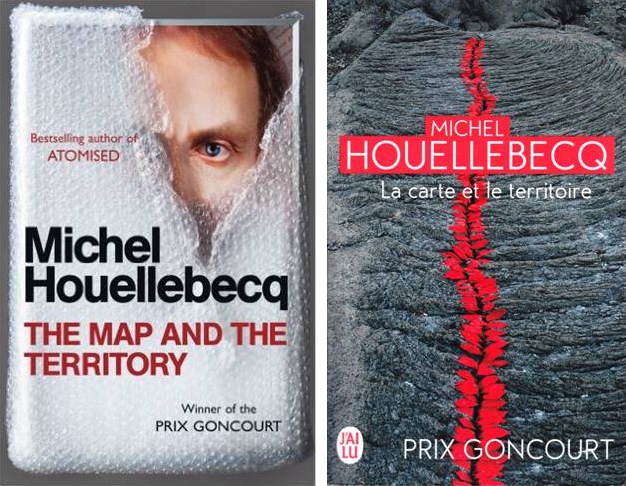
Michel Houellebecq’s ‘The Map and the Territory’

This week sees the publication in English of Michel Houellebecq’s novel, Submission (Soumission). I thought it would be interesting to re-read The Map and the Territory (La carte et le territoire) published in France in 2010 and in English* translation in 2011. The novel gained Houellebecq the Prix Goncourt (for "the best and most imaginative prose work of the year") in 2010.

The Map and the Territory follows the life of a successful French contemporary artist, Jed Martin. After developing one genre based on photographs of Michelin maps, he switches to another, more conventional one of portraits of people at work. Works like Bill Gates and Steve Jobs Discussing the Future of Information Technology, subtitled The Conversation at Palo Alto become internationally successful, although Jed has a problem with Damien Hirst and Jeff Koons Dividing Up the Art Market which is where the book starts:
Koons's forehead was slightly shiny. Jed shaded it off with his brush and stepped back three paces. There was certainly a problem with Koons. Hirst was basically easy to capture: you could make him brutal, cynical in an 'I shit on you from the top of my pile of dosh' kind of way; you could also make him a rebel artist, (but rich all the same) pursuing an anguished work on death; finally, there was in his face something ruddy and heavy, typically English, which made him look like a rank-and-file Arsenal supporter. In short, there were various aspects, but all of them could be combined in the coherent, representable portrait of a British artist typical of his generation. Koons, on the other hand, seemed to carry in him something dual, like an insurmountable contradiction between the basic cunning of the technical sales rep and the exaltation of the ascetic. (page 1)
He also paints portraits of his father, The Architect Jean-Pierre Martin Leaving the Management of his Business, and of Michel Houellebecq, Writer. Jed’s conversations with his father and the alter-Houellebecq are surprising to an English reader because of the interest both characters share in William Morris. Jean-Pierre as a young man had admired Morris as a designer as much as he disliked Mies van der Rohe and
... above all Le Corbusier, who tirelessly built concentration-camp-like spaces, divided into identical cells that were suited ... only for model prisons. (page 145)
but alter-Houellebecq, although admiring Morris as a social reformer, comes to the conclusion that:
What can undoubtedly be said is that the model of society proposed by William Morris certainly would not be utopian in a world where all men were like William Morris. (page 175)
What French readers make of it, one has to wonder, William Morris not being particularly familiar to many of them. Come to that, most English readers will be at a loss with the description of the FR1 (France 1 television) New Year’s Eve party and the personalities there like Jean-Pierre Pernaut.

Houellebecq is never afraid to give offence with his opinions. Jed meets and observes a senior manager at Michelin:
… again he searched for the right words, which is a disadvantage with former pupils of the Polytechnique; they’re a bit cheaper to hire than those of the École Nationale d’Administration but they take more time finding their words; … (page 55)
Jed eventually decides to move into his grandparents’ house in the Creuse. Houellebecq likes the French countryside (see, for example his letters to Bernard-Henri Lévy) but, if his view is the same as Jed’s, not its residents:
Jed had no illusions about the welcome he would get from the inhabitants of his grandparents' village. He had noticed that while he was travelling through La France profonde with Olga, many years before: outside certain very touristy zones like the Provençal hinterland or the Dordogne, the inhabitants of rural zones are generally inhospitable, aggressive and stupid. If you wanted to avoid gratuitous assaults and trouble more generally in the course of your journey, it was preferable, from all points of view, not to leave the beaten paths. And this hostility which was simply latent towards passing visitors, transformed into hate pure and simple when the latter acquired a residence. (page 278)
Nor is Jed keen on Mercedes:
Although he knew nothing about his life, Jed was hardly surprised to see Jasselin arrive at the wheel of a Mercedes Class A. The Mercedes Class A is the ideal car for an old couple without children, who live in an urban or periurban area, yet do not hesitate to treat themselves from time to time to an escapade in a hôtel de charme; but it can also suit a young couple of conservative temperament - it will, then, often be their first Mercedes. An entry into the range offered by the firm with the Silver Star, it is a discreetly different car; the Mercedes four-door saloon Class C and the Mercedes four door Class E are more paradigmatic. The Mercedes in general is the car preferred by those who aren't really interested in cars, who place security and comfort over driving sensations - also for those, of course, who have sufficient means. For more than fifty years - despite the impressive commercial strike force of Toyota, despite the pugnacity of Audi the global bourgeoisie had, on the whole, remained loyal to Mercedes. (page 240).
Jed likes Audis which
… characterise themselves by a particularly high level of finishing which can only be rivalled, according to Auto-Journal, by certain Lexus models. This car was the first one he'd bought since reaching a new wealthy status; from his first visit to the dealer, he'd been seduced by the rigour and precision of the metal assemblages, the gentle click of the doors when he closed them, all that was machine-tooled like a safe. Turning the speed-regulator control, he opted for a cruising speed of 105 km per hour. Some small notches, marking every 5 kph, made driving all the smoother; this car was indeed perfect. (page 165)
Houellebecq places some interesting characters in Jed’s life, for example, the art world PR, Marylin, and Inspecteur Jasselin, the Maigret-like detective who investigates alter-Houellebecq’s murder, and his un-Mme Maigret-like wife. However Olga, for a while Jed’s glamorous Russian girlfriend, is too much of a male fantasy.

Something about Houellebecq which I find intriguing is that he must be one of the very few novelists with an international reputation who had a scientific education, in his case as an agronomist. His mother had trained as an anaesthetist. Although from his student days he was inclined towards literature, Houellebecq later earned a living in information technology (until he could get out) and, according to an interview in Le Figaro magazine this summer, he has had a long-term interest in photography. Certainly if, as he recently told the Guardian, “…the job of a novelist is foremost to hold a mirror up to contemporary society”, he is not reluctant to introduce its technical details, for example here the life-cycle of the housefly. But Houellebecq’s readers can never be sure where the boundary of his satire lies. Does Jed’s dislike of Mercedes and encomium for Audi, both expressed in marketing speak, reflect the author’s world view or, rather more likely, is he tilting at the commercial shallowness of contemporary art and some of its practitioners?

A couple of oddities in the translation. On page 165 Jed is driving an “Audi Sport Wagon” which on page 177 has turned into an Audi Allroad A6. As far as I can tell, “Sport Wagon” is a type of BMW SUV sold in North America. The French original refers to “son break de chasse Audi” – “his Audi shooting brake” or nowadays “his Audi estate”, which could indeed be an Allroad A6.

On page 287 there is a reference in a description of Jed’s camera equipment to “a hard disk of two teraoctets” which non-French readers might not recognise as two Terabytes. The French (with the Romanians and Quebecois) use octet instead of byte for eight bits .

*By “English readers” I mean those in that language, not, of course, just those resident in England.  Page numbers are as in the 2011 UK hardback, (cover above).


11 February 2015

Morris and Warhol at Modern Art Oxford

I had thought of calling this post, Jeremy Deller’s Morris and Warhol at Modern Art Oxford, to recognise its auteur. In fact, the show’s full title does the job: Love is Enough: William Morris & Andy Warhol curated by Jeremy Deller. Deller is a conceptual, video and installation artist who won the Turner Prize in 2004 for a film and who regards Morris and Warhol as his greatest artistic influences. He sees similarities between the two as he explained at length to Stuart Jeffries in the Guardian:
Both established printmaking businesses, both envisaged art not as something done in lonely garrets but through collaboration. One critiqued the industrial culture of the 19th century; the other parodied the industrial culture of the 20th. Both wanted art to be for the people. Both – and this is where Deller is at his most challenging – were political artists. Come on, Warhol political? “The electric chair? The pictures of race riots? There’s more to him than his trademark blankness.” 
Deller takes these politicised Warholian images as parallel to Morris’s political writings almost a century earlier. “Morris wrote furiously about how the crafts skills in India and Malaya were ruined because the British empire wanted cheap mass-produced products. He totally understood the processes and how that affected art making. William Morris was the precursor of modernism.” Really? “He stood for things being beautiful and practical and well made. Bauhaus was a reaction against cheaply made goods. Morris got there long before them.” 
He shows me a political pamphlet Morris wrote called A Factory as It Might Be. “Everyone thinks he’s a luddite. He wanted people to have gardens and grow their own vegetables. But Morris didn’t oppose machines: he thought they were good if they took away demeaning labour.” The factory that the English communist dreamed of was not, Deller argues, so very far away from the Factory that Andy Warhol ran in midtown Manhattan. 
“Both were very much hoping that work might be idyllic,” says Deller. Did Warhol really care about that? “The working environment he created at the Factory is a norm now for creative people. There’s a flow of people from whom you get ideas that feed into the art. I think that William Morris would be very happy that, in 2014, we live in Warhol’s world, that we don’t work in the kind of factories he hated.” He describes Morris as the Warhol of his day, trying to revolutionise the alienating world of industrial work by the means of, incredibly, soft furnishings and floral wallpaper.
And so on. Visitors may or may not be convinced by this line of argument - Richard Derwent in the Daily Telegraph certainly wasn’t:
Nothing I’ve seen in any medium begins to touch the depths of the exhibition Jeremy Deller has put together about what he conceives to be the many points of similarity between two great artists, William Morris and Andy Warhol. But these exist only in his own mind. Virtually every comparison he draws between the two either in the catalogue or in interviews is at best a half-truth, which he then justifies by blatant sophistry.
and later called it one of the worst exhibitions of 2014. Perhaps he made the mistake of seeing this show and the Ashmolean’s William Blake on the same day out. But let’s look on the bright side: the exhibition is free and so is the MAO Exhibition Guide with background essays, eg The Relationship Between the Neural Plumbing and the Agape by Dr Anders Sandberg of the Future of Humity Institute – well we are in Oxford. And those of us who are ill-equipped for that level of appreciation and also aren’t desperate to synthesise the two men’s work, can enjoy the show, with its hundred plus items including books and photographs. MAO has a bigger area available than was the case at the recent National Portrait Gallery William Morris exhibition and makes use of it to show the technique of block-printing wallpaper and one of the large Quest for the Holy Grail Tapestries designed by Burne-Jones, Dearle and Morris, The Attainment; The Vision of the Holy Grail to Sir Galahad, Sir Boris and Sir Percival (1895-96, 6th panel below):


Among the Warhols (which include the inevitable images of Jackie, Marilyn et al), I was intrigued by Map of the Eastern U.S.S.R. Missile Bases (below 1985-86):


However, as I pointed out in the post here about the NPG show, Morris’s life and work is permanently on display in various locations in the UK, while Warhol turns up all the time. As for the links between them, the beholder can make their own mind up, there being numerous opportunities for comparison, for example a Morris wallpaper (below left) and Warhol’s Head with Flowers (1958, below right):


But one fairly obvious question is never answered in Deller's show – what, if anything, did Warhol think of his predecessor, Morris?

Love is Enough continues at MAO until 8 March and will be at Birmingham Museum and Art Gallery from 25 April to 6 September 2015.


UPDATE 16 FEBRUARY

From Google statistics I know that not everyone who reads this blog has English as their first language. So an explanation may be helpful – there is no such word as “humity”, even though it does appear on page 7 of the MAO’s Exhibition Guide:


A Google search reveals that “humity” is often as a misprint of “humidity” (commonly, it would seem, in queries from cannabis growers and in hotel visitors' reports). We can safely rule out “homity”, an English pie made from potato, onion and leek (enough said):


And being Oxford, you can rule out “humility” and start looking for something much grander – ah, yes “humanity”. The University of Oxford Future of Humanity Institute in the Oxford Martin School, what else?


5 January 2015

William Morris at the NPG


Six years before he died, William Morris (1834-96) published his novel News from Nowhere (above right), set in an idealistic vision of 1952. Nearly 120 years after his death the UK may be far from being the particular Utopia he imagined but Morris’s legacy is hardly inaccessible. His homes at the Red House (South East London), Kelmscott Manor (Oxfordshire) and Kelmscott House (West London) can be visited, as can the William Morris Gallery (East London). Morris & Co lives on to produce “authentic versions of his original designs”, and has a handsome website which would surely have met with his approval. Moreover Morris is currently the subject of an exhibition at Modern Art Oxford (post to follow) and the National Portrait Gallery in London is showing Anarchy & Beauty: William Morris and His Legacy, 1860 – 1960 (above left).


As its title suggests this is an ambitious exhibition in terms of its scope but, perhaps inevitably, is constrained by its NPG location: not all that much space and its strengths being portrait painting and photography, for example GF Watts’ William Morris (1870, above left) and Frederick Hollyer’s William Morris (1884, above right and in the poster). Nonetheless anyone who has an interest in Morris will be pleased to see items which, although in public collections, are not always on show or accessible. For example, the Prioress's Tale wardrobe, painted by Edward Burne-Jones on the exterior, (1859, below left) and Morris’s own La Belle Iseult (1858, below left) for which his wife, Jane, was the model.


Perhaps wisely, given that Tate Britain’s Pre-Raphaelite blockbuster was only two years ago, the NPG show plays down Morris’s relationship with the Brotherhood (he was not one of the PRB seven) and instead gives visitors a chance to appreciate his other interests, like the Arts and Crafts movement, socialism in the years before the Labour party was founded in 1900 and the Suffragettes. Eric Gill (1882-1940) was one of many influenced by Arts and Crafts –Adam and Eve garden roller (1910-20, below upper) while a painting by Roger Fry of one of the Labour’s founders, Edward Carpenter (1894 below lower) provides a link to the Bloomsbury Group.


Various aspects of Morris’s legacy up to 1960 are examined in a fairly rapid succession: Cotswold Arts and Crafts, the Garden City Movement, particularly at Letchworth, and then, following the Second World War, the Festival of Britain and the flowering of one of its assistant designers, Terence Conran. In 2012 the V&A exhibition, British Design 1948–2012, had had the space to cover the latter period more thoroughly but some of its exhibits reappear here, for example Lucienne Day’s Calyx fabric (below left) produced for the Festival in 1951. The interesting portrait of Herbert Read by Patrick Heron (1950, below right) was given to the NPG in 1968 by Barbara Hepworth and Henry Moore.


Anarchy & Beauty: William Morris and His Legacy, 1860 – 1960 ends on 11 January.


28 September 2012

The Pre-Raphaelites at Tate Britain


BBC2 has now finished screening an adaptation, by no less than Tom Stoppard, of Ford Madox Ford’s novel quartet Parade’s End, lavishly filmed at numerous locations no doubt made affordable by HBO backing. Despite the strength of its themes of war, love and social standing and much excellent acting, Parade’s End fails to be as engaging as it should be. Something similar applies to Tate Britain’s Pre-Raphaelites: Victorian Avant-Garde, which, as it happens, features numerous works by Ford’s grandfather, Ford Madox Brown (The Last of England 1860, left).

Perhaps the exhibition, like Parade’s End, suffers from putting forward too many characters and events while not always explaining their relationships and development. At this point I must own up to having been to The Pre-Raphaelites at the Tate Gallery (as it then was) in 1984, and that, if the PRB only appear en masse in London at 28 year intervals like a mutant species of cicada, I’m not expecting to see them again. In 1984 an educational approach was still considered appropriate, so, as well as the main catalogue, informative guides were available (right). This is the text of the first section, “The Group”:
The Pre-Raphaelite Brotherhood was a secret society of seven artists, or aspirant artists, founded in London in September 1848. Its members were, in alphabetical order, James Collinson (1825- 1881), William Holman Hunt (1827-1910), John Everett Millais (1829- 1896), Dante Gabriel Rossetti (1828- 1882), William Michael Rossetti ( 1829-1919), Frederic George Stephens (1828-1907) and Thomas Woolner (1825- 1892). Of these, the original creators of the group and by a long way its dominating personalities, were Hunt, Millais and D.G. Rossetti. All three were brilliantly gifted and very young - twenty-one, nineteen and twenty respectively at the time of the Brotherhood's foundation. Five of the seven were painters, Thomas Woolner was a sculptor, and William Michael Rossetti (Dante Gabriel's brother) quickly dropped the practice of art to become a writer and critic who acted as the group secretary and for a time (1849-1853) kept a journal of its activities. He was also the editor of the group's short lived magazine The Germ, of which four issues appeared between January and March 1850. The Germ was sub-titled Thoughts towards Nature in Poetry, Literature and Art and reminds us that in general the Pre-Raphaelite Brotherhood had a strong literary flavour right from the beginning. Dante Gabriel Rossetti in particular was as distinguished a poet as painter.  
William Holman Hunt was the son of a London warehouse manager who enjoyed art but had a low opinion of it as a means of earning a living. Hunt records that his father treated with 'measured toleration my passion for art', a passion developed after a visit to an artist with his father at the age of five. At twelve Hunt became a clerk to an estate agent but continued to practise drawing and eventually entered the Royal Academy Schools in 1844 where he supported himself by making portraits and copies.  
In 1844 John Everett Millais had already been four years at the R.A. Schools. At entry in 1840 he was its youngest ever pupil and became a star, winning a silver medal for drawing in 1843 and a gold for painting in 1847. Millais was born in Southampton, his mother's native town. His father came from an old Jersey family and was well off. Millais was brought up in Jersey, and Dinan in Brittany, but when by the age of eight his exceptional gifts as an artist had become clearly evident his parents moved to London in order to further his career. In London he continued to enjoy full parental backing. He and Hunt met at the Royal Academy Schools, becoming close friends sometime about the Spring of 1846.   
Dante Gabriel Rossetti was born in London into an academic and intensely artistic family. His father was an Italian political refugee, a poet and Dante scholar who from 1831 taught Italian at King's College, London. His mother was a teacher. One of his two sisters, Christina, became a well known poet. Rossetti entered the Royal Academy Schools in 1844, at the same time as Hunt, but the two only met and became friends in the early Summer of 1848 after Rossetti had admired Hunt's painting of a subject from Keats (No.9) in the Royal Academy Exhibition of that year. Hunt then introduced Rossetti to Millais. The three began to meet regularly at Millais's house where they carried on intensive discussions about art. It was out of these discussions that was born the idea of a revolutionary group of artists: '...our talk is deepest treason against our betters' said Hunt one day.
which was followed by another eight equally didactic sections and some “Further Reading”, all with 30 illustrations in black-and-white. Quite a contrast with the first sections of the smaller but colourful leaflet visitors are given currently:
This exhibition presents the Pre-Raphaelites as an avant-garde movement, a group with a self-conscious, radical project of overturning artistic orthodoxies. Boldly original in style and conception, the Pre-Raphaelites made a profound contribution to the history of modern art.  
The movement coincided almost exactly with the long reign of Queen Victoria (ruled 1837-1901). The Pre-Raphaelite Brotherhood (PRB) was founded in 1848, a year of revolution across Europe, in a recognisably modern world. Steamships plied the globe. Railway networks linked expanding cities. Science challenged traditional beliefs. Photography offered new ways of seeing. Pre-Raphaelite art distilled the energy of the world's first industrial society into striking new forms.  
The leading members of the PRB were the young painters John Everett Millais, Dante Gabriel Rossetti and William Holman Hunt. Their older friend and mentor Ford Madox Brown never formally joined the group. They believed that art had become decadent, and rejected their teachers' belief that the Italian artist Raphael (1483-1520) represented the pinnacle of aesthetic achievement. They looked to earlier art whose bright colours, flat surfaces and truth to nature they admired.  
But rather than imitate the early masters, they espoused a rule-breaking originality. Whether painting subjects from Shakespeare, the Bible, landscapes of the Alps or the view from a window, the Pre-Raphaelites brought a new beauty and intensity of vision to British art.  
The Pre-Raphaelite Brotherhood was founded in September 1848 at a turbulent time when ruptures in the new industrial society became visible. Hunt and Millais witnessed a Chartist demonstration in that year.  
Many Victorians felt that in the machine age, beauty and spirituality had been lost. Gothic Revival architects like Augustus Pugin turned back to medieval styles. The German Nazarene painters rejected modernity and adopted historical styles of painting and of dress. John Ruskin described in The Stones of Venice the 'freedom' of medieval times in contrast to the 'slavery' of the modern factory. The invention of photography in 1839 profoundly changed the way people perceived the world. All these influenced the young Pre-Raphaelites.  
At first, they formed a tight-knit, conspiratorial group, refusing to explain the initials PRB on their canvases. Their early works caused critical protest. The sharp outlines and bright colours derived from the early ltalian paintings at the National Gallery. The PRB published a journal, The Germ, which acted as a manifesto, planting the seeds of artistic revolution.  
The Pre-Raphaelites managed to be both historical and contemporary in their approach. They adopted the freshness of early-Renaissance art, but their work is essentially modern.
- more accessible, but less assured in its handling of facts – we get Raphael’s dates but not those of the Brotherhood. The Guardian’s Fiona MacCarthy in her article, Why the pre-Raphaelites were the YBAs of their day, clearly prefers the new way:
The Tate's last exhibition of pre-Raphaelite art, held in a now distant 1984, was a rather dully chronological affair. According to one critic, the treatment "seemed to symbolise a newly conservative reading of the pre-Raphaelites". Greenery-yallery to Laura Ashley. A press photograph shows Margaret Thatcher at the opening alongside Arthur Hughes's April Love. With 250 exhibits this was a catch-all survey. I remember emerging from it reeling with exhaustion. It succeeded in what one might have thought would be impossible. It managed to make the pre-Raphaelites bland.  
The current exhibition will be altogether different: leaner, more thematic, more politically charged. Women will be better represented. (Not difficult, considering that only two paintings by one woman, Elizabeth Siddal, were included in 1984.) Alongside pre-Raphaelite paintings and drawings will be sculpture, photography and prize examples of pre-Raphaelite furniture and textiles, emphasising the wide reach of a movement that was fiercely revolutionary in its aims.
The organisation of the two exhibitions provides a similar contrast. In 1984 the sections were resolutely chronological, eg: Early Work, 1845-48, The Critics Attack, 1850; Success and Dissolution, 1852-1854; After 1860, Rossetti and Burne-Jones. But the 1984 exhibition was intended to be a milestone in the revival of interest in the Pre-Raphaelite movement at a time when, unlikely as it may seem now, there was far less public awareness of the painters or the sequence of their works. One could argue that in 2012 the Tate has correctly assumed a level of familiarity sufficient to allow the works to be distributed into themes according to their subject, eg: Nature, Salvation, Beauty. But after these chronology becomes implicit with Paradise given over to William Morris and Arts and Crafts and Mythologies to works by Burne-Jones and late Rossetti (Astarte Syriaca 1877, banner above).

What the visitor does get is a chance to see somewhere in the exhibition most of the significant works we think of as Pre-Raphaelite without having to go to Manchester (Ford Madox Brown, Work, below).


Or Birmingham, or Tyneside or even Delaware (Rossetti Lady Lilith, below).


In practice the allocation of works to Nature as opposed to Paradise can seem arbitrary when they have such a high metaphorical content and are full of details of imaginary historical settings, many out of doors. Perhaps this makes remembering exactly what you have seen more difficult than usual. My favourite art critic, Jackie Wullschlager, remarked in her FT (£) review:
Rossetti, infatuated with William Morris’s wife Jane, attempted suicide, then developed a proto-symbolist oeuvre whose high point is a depiction of Jane as “Proserpine” (1874), goddess of the underworld. The 1984 catalogue acknowledged this as Rossetti’s outstanding work; disgracefully, although it belongs to Tate, and is Rossetti’s most beloved painting, this show omits it. Is it too personal, distinctive, exceptional? Its absence will not only disappoint – it also renders less meaningful the show’s trophy loan, Hunt’s dense final painting “The Lady of Shalott” (1888-1905), borrowed from the Wadsworth Atheneum in Connecticut.
A fair point, but if you look up Proserpine on the Tate website, you are advised “On display at Tate Britain Exhibition: Pre-Raphaelites”. I’m not sure I can now definitely remember its being there, but one imagines that the Tate knows the whereabouts of their pictures.

Rossetti's Prosperine and Hunt's Lady of Shallott
The exhibition’s thesis that the PRB was an avant garde movement which made a profound contribution to the history of modern art seems unarguable. MacCarthy’s equivalencing of the PRB with the YBA (Young British Artists) is more doubtful. In fact all her article offers in support of its headline is:
If we can compare 1850s PRBs and 1990s YBAs (and in terms of shock value we definitely can) then [Hunt’s] The Scapegoat finds its obvious parallel in Damien Hirst's shark.
To those of us who are just looking, as John Updike put it, the big difference between the YBA and PRB might be that those boys could ‘paint’, in the traditional sense, exceptionally well. Whether the girls could is something that the visitors in 2012/13 can decide for themselves.

Anyone who wants to see the finest Pre-Raphaelites in British collections during the next 12 months on home territory will need to get to Tate Britain by 13 January. Without any of the various concessions it will cost £14. After that Pre-Raphaelites: Victorian Avant-Garde will be at the National Gallery, Washington, from February to May and the Pushkin, Moscow from June to September.