Showing posts with label Antony Gormley. Show all posts

12 November 2015

Periodic Tales at Compton Verney

If anyone thought that CP Snow’s “Two Cultures” debate was no longer relevant, they would have to think again after reading an article in the Daily Telegraph on 7 November, 'My daughter shouldn't have to study science', says Cristina Odone. Apparently young Izzy
… demanded to know why she should waste her time studying three sciences to GCSE given that she did not wish to pursue a career in maths or science …
a view her mother supported. It could be that, as a former editor of the Catholic Herald, Cristina Odone’s disengagement with science has deep roots. However, last time I looked on the Telegraph website there were over 500 comments on the article and those I sampled were not particularly sympathetic to her point of view, mostly making the obvious counter-arguments. I suggest mother and daughter have a day out at Compton Verney to see and reflect on, Periodic Tales: The Art of the Elements - perhaps Izzy will have second thoughts. At least, she might take a look at Compton Verney’s video on YouTube:


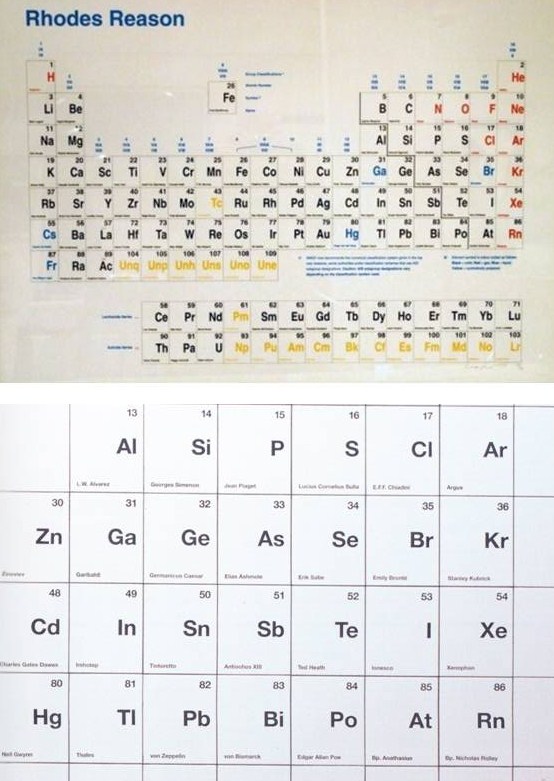
To be honest, this exhibition is rather more about British contemporary art than about science*. It draws on Hugh Aldersey-Williams's book, Periodic Tales, – he co-curated at Compton Verney – and aims in his words to provide a “cultural history of the elements”. The starting point, after a brief dabble with alchemy, is the periodic table of the 118 elements (at present, 24 of them man-made). After that, about 30 works are arranged around a succession of 15 of the elements, mostly metallic. The periodic table is, as they say, iconic and its appearance can be adapted for all sorts of purposes, as in the exhibition poster above. Simon Patterson is probably best-known for his lithographic take on the London Underground Tube map, The Great Bear. Another of his lithographs, Rhodes Reason (1995, below top), and his much larger assembly of ceramic tiles Quattro Formaggi II (1992, below lower), play with the appearance of the periodic table and its namings (for example, Br becomes Bertolt Brecht; Sn, Tintoretto) are among the first things a visitor encounters.

The next section is given over to Primo Levi’s short story collection, The Periodic Table, with accompanying linocuts from 1994 and of the same title by Bill Woodrow. The first element is Silver as in the crushed and suspended Thirty Pieces of Silver (Exhaled), Sugar Bowl** (2003, below), one of eight pieces in the show by Cornelia Parker.


Gold can, as it were compensating for its price, be hammered very thin as in John Newling’s Value; Coin, Note and Ellipse (2011, below), made with pressed and gilded Jersey kale.


Mercury is present in spirit rather than its tricky reality in Marc Quinn’s Etymology of Morphology (1996, below) made of silvered glass.


Antony Gormley’s Fuse (2011, below top) is made from cast Iron (well-rusted, so we are looking at ferric oxide) and Eduardo Paolozzi’s Tin Head –Mr Cruickshank (1950, below lower) explains itself:


Roger Hiorns’ Nunhead (2004, below top), with engines covered in Copper sulphate crystals, is dramatic but hardly elemental.  Nor is Danny Lane’s Blue Moon (2015, below lower) made of glass with a Cobalt compound, also blue:


Heatherwick Studio’s Aluminium Billet 1: Extrusion 9, (2009, below top) comes with a video showing its fabrication in China, the country on whose nuclear power industry the UK will be increasingly reliant. Once we had our own, as Kate Williams’ and Keith Lloyd’s striking Uranium glass (well, uranium oxide probably) Nuclear Power Stations remind us; Springfield Nuclear Power Station (both 2006, left, below lower) and Dounreay Nuclear Power Station (right, below lower):


Whether David Nash was thinking about Carbon when he produced his charcoal Nature to Nature 4: pyramid, sphere, cube (1990/94, below top), we don’t know, but Tim Etchells was certainly thinking about Neon when he made something common in the universe but rare on earth (2015, below lower) for the show:


On the way in and out, you can hardly miss David Nash’s Big Black (2008-15, below) in carbonised California redwood:


There were some missed opportunities. I can understand that Damien Hirst’s For the Love of God (2007, left) in diamond and platinum might have been difficult to secure for this show, but something to underline diamond as another form of carbon, and introducing allotropy, seems appropriate. More feasible might have been one of Julian Opie’s computer animations like Marina in purple shawl (2010), visible in a post here last year, its LED screen being dependent on compounds of gallium, indium and other elements. I have jibbed a little at elements appearing in this show in the form of compounds, but the latter are the basis of most colour and pigmentation, and were much developed by 19th-century industrial chemists. As Pierre-Auguste Renoir said, “Without colours in tubes, there would be no Cézanne, no Monet, no Pissarro, and no Impressionism.”

Periodic Tales: The Art of the Elements ends on 13 December

* The exhibition catalogue in its Endnotes and elsewhere states that “The chemical elements are the fundamental building blocks of all matter”. “Up to a point, Lord Copper”, depending on what is meant by “fundamental” and “matter”. The chart below comes from Wikipedia:


The periodic table arranges the elements by their atomic number which is the number of protons in the nucleus. Protons and neutrons are the Nuclei in this chart above. An element has an equal number of protons and electrons. Protons are positively charged, electrons negatively. Electrons are a type of Lepton, see the chart. The periodic table groups the elements to reflect their electron configurations, when these are similar, the elements have similar properties, eg the noble gases, like neon. The same element can have different numbers of neutrons – isotopes of the same element. For example, most hydrogen on earth has just one proton and one electron, but it can have one neutron, when it is called deuterium, or two, tritium. Tritium, unlike deuterium, is unstable and decays to produce an isotope of helium – radioactivity.

** Or possibly Thirty Pieces of Silver (Exhaled) cake stand (2003).


2 November 2015

British Sculpture 1950-2015 at Chatsworth

Since 2006, Sotheby’s have staged annual selling exhibitions of sculpture, Beyond Limits, in the grounds of Chatsworth House, the ancestral seat of the Duke and Duchess of Devonshire and a masterpiece of English baroque architecture. This year’s tenth anniversary exhibition was Beyond Limits: The Landscape of British Sculpture 1950-2015 which ran from 14 September to 25 October. Tim Marlow, Artistic Director at the Royal Academy was the guest curator and also author of an essay for the exhibition catalogue, A Topography of British Sculpture. The sculptures were not arranged at Chatworth in a chronological sequence but the approach in Marlow’s essay was primarily historical and is echoed here.

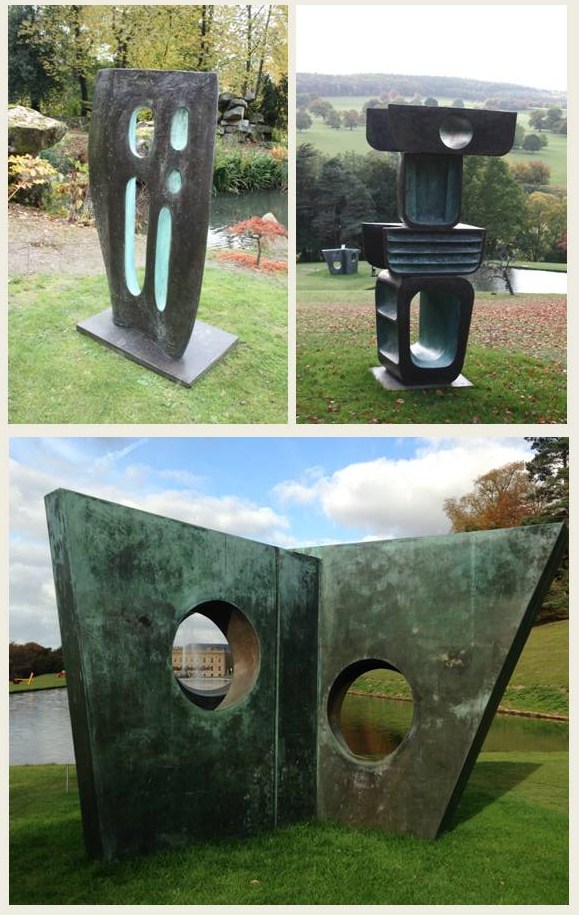
Marlow starts his survey by identifying Henry Moore and Barbara Hepworth as the ‘presiding spirits’ who led post-war British sculpture into the Modernist and post-Modernist mainstream of Western art. One of the inevitable shortcomings of the recent Tate Britain Hepworth show was its inability to place Hepworth’s larger works outdoors, something which Beyond Limits was well-placed to rectify with three pieces: Sea Form Atlantic (1964, below top left), Three Obliques (Walk In) (1969, below lower) and The Family of Man: Figure 1, Ancestor 1 (1972, below top right with Three Obliques (Walk In) in the distance).


After appearing in the British Pavilion at the 1952 Venice Biennale, a group of some younger sculptors became associated with the ‘Geometry of Fear’; for example, Reg Butler (Manipulator,1954, below left) and Lynn Chadwick (Pair of Walking Figures – Jubilee, 1977, below right):


It was in the 1960s that it became apparent that a serious, internationally respected but fundamentally British tradition” of sculpture had emerged, something which in Marlow’s view “became one of the great, yet understated, success stories of post-war British culture". Talents which emerged at this time included Kenneth Armitage (Monitor, 1961, below top) and William Tucker, whose Genghis Kahn (1963, below lower) seems ahead of its time:


Anthony Caro (Sunshine, 1964, below left) had a major exhibition at Chatsworth in 2012 while a post here recently covered the current Arnolfini Richard Long show (Cornwall Slate Line, 1990, below right):


The 1980s, the period of the 'New British Sculpture', saw the emergence of major figures such as Anish Kapoor and Antony Gormley. Gormley’ s Big Gauge II (2014, below top left), Tony Cragg’s Manipulation (2008, below top right) and Stephen Cox’s Kiefer-like Dreadnought: The Problems of History - The Search for the Hidden Stone (1990 to 2015, below lower) are later works.


The prominence of the YBAs since the nineties was reflected in Beyond Limits, though I don’t altogether share Marlow’s enthusiasm for Hurst. Sarah Lucas’s Florian and Kevin (2013, below upper and lower respectively) were produced at Pangolin.


Gavin Turk’s Habitat (Burgundy) (2004, below left) and American Bag (2015, below right), contrary to appearance, are painted bronzes, not as impressive as his Nomad, seen at Crucible2 last year.


Marlow’s survey finishes with two complex works, both with archaic resonance, Thomas Houseago’s Hermaphrodite (2011, below left) and Bill Woodrow’s Regardless of History (1998, below right):


Two pieces which were not specifically mentioned by Marlow were Bernard Meadows’ Large Standing Armed Figure (1962, below left) and the recent Conrad Shawcross, The Dappled Light of the Sun, I-III (2015, part below right):


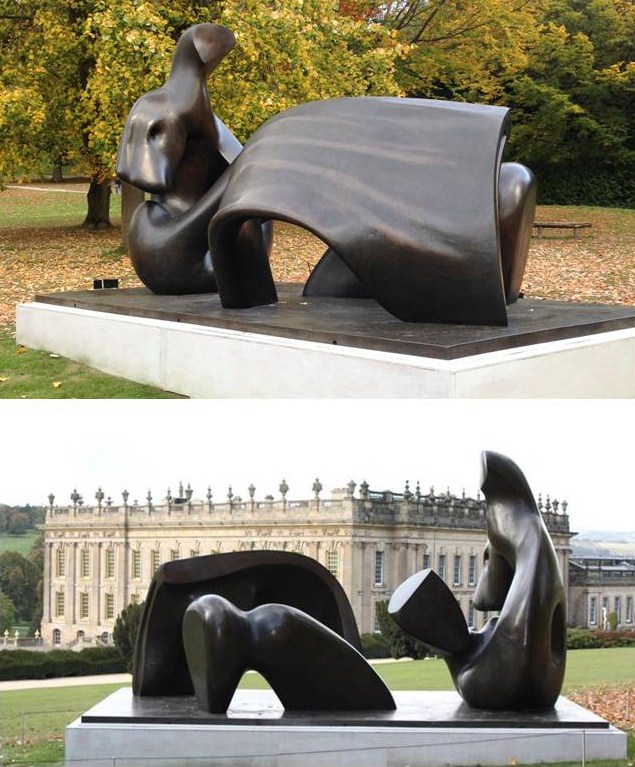
To end where the survey began, two views of a fine Henry Moore, Three Piece Reclining Figure: Draped (1975):


3 July 2015

The RA Summer Exhibition 2015


The current Royal Academy Summer Exhibition in London is the best I can remember in over 20 years, most of it good, very little bad or ugly, and the most enjoyable one too, with virtually no photography restrictions and images of all the works available on line. The co-ordinator, Michael Craig-Martin RA, has made the gallery spaces more colourful and reallocated the architecture and other themes within the Academy galleries. At which point I suggest that anyone who reads this post as far as this would, instead of continuing here, probably gain more from exploring the RA Exhibition website pages which include a short introduction by Craig-Martin, behind-the-scenes videos and personal selections by Sebastian Faulks, Grayson Perry, Cath Kidston and others.


But for the record, here are a few items which registered with me out of more than 1100 on show in this slyly cerebral Summer Exhibition. Even before going in, I liked Jim Lambie’s treatment of the main staircase with ZOBOP (above). Craig-Martin chose magenta for Gallery III, enhancing all the work there, including his own Untitled (Watch) (below centre).


In that gallery I was also struck by Gillian Ayres' Tremenheere (below top left), Chantal Joffe’s Megan in Spotted Silk Blouse (below top right) and Mick Moon’s Noon Fishing and Dawn Fishing (below lower left and right respectively).


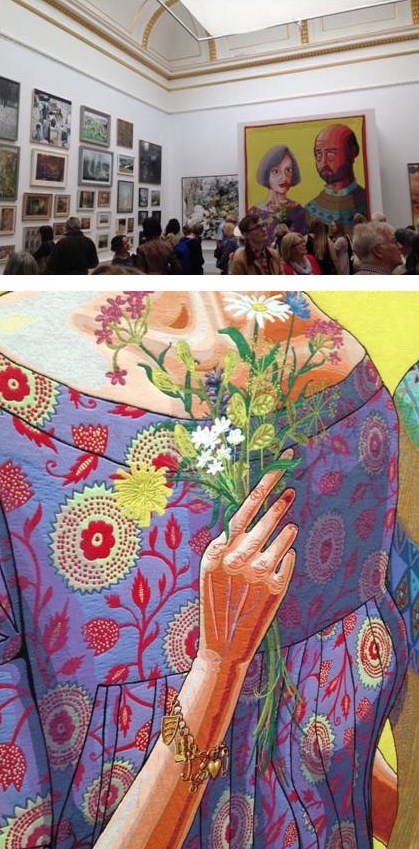
Gallery I this year is given over to small works with the exception of Grayson Perry’s tapestry, Julie and Rob, (below). As explained here in a post in May about A House for Essex, Julie Cope is a fictional “secular Essex everywoman”. Her charm bracelet includes that county’s shield, a cassette tape (a generational thing) and the cause of her untimely decease – was there a particular choice of wild flowers for the bouquet?


The Large Weston Room (below) now has the architectural models and drawings – I sometimes wonder whether the notions on show will ever be constructed but inspiration has to start somewhere, as with Gehry’s Fondation Louis Vuitton.


The Small Weston Room, no longer crammed with small works, is given over to some impressive drawings in ink on torn pages by William Kerridge, installed there by the artist, for example Untitled (The Periphery) (below):


There were two abstract pieces appealed to me in Gallery IV: Christine Stark’s When D'You Last Think You Saw It? (below upper) and Marion Jones’ Bars and Triangles (below lower):


Galleries V and VII are given over to prints, scores of them. So here are just a few; John Duffin’s etching Thames Bridges East (top left below) and Julian Opie’s Tourist with Beard (top right below); and two with South West scenes, Catherine Greenwood’s Silbury Treasure and Iona Howard’s Goonhilly Downs (below lower left and right respectively):


Between V and VII, Gallery VI is arranged by Craig-Martin with several interesting pieces including Lisa Milroy’s Black Dress (below left) and Gary Hume’s The Blue Ground (below right):


which is in the background to this photograph of Anish Kapoor’s study of refraction, Untitled (below):


Gallery VIII provided many fine things, including another South West scene, Cyril Croucher’s PZ101 at Mousehole (below left, PZ indicates a fishing boat registered at Penzance, Cornwall) and two contrasting bronzes by James Butler, Soldier and In the Sun (below right, upper and lower respectively):


Gallery IX, arranged by Alison Wilding and Bill Woodrow around Michael Sandle’s monumental bronze, As Ye Sow So Shall Ye Reap: An Allegory (Acknowledgements to Holman Hunt) (below left), included some interesting political pieces like Bob and Roberta Smith’s Sir Peter Bazalgette's P45, positioned just below Allen Jones’ Salome, (below right):


and Emily Allchurch’s Babel London (After Bruegel) (below) with its warning signs:


The Lecture Room is given over to things sculptural, for example Antony Gormley’s series of six “Small” below:


Nicola Hicks’ Relic (below top) and Dido Crosby's  5 Sheep and a Goat (below lower) seem particularly flattered by the sky blue walls:


More challenging are Eva Rothschild’s What the Eye Wants (below top) and Phillip King’s The Unpainted Gum Tree (below lower):


Geoffrey Clarke’s Taunton Deane Crematorium Test Panel was at Crucible2 in November.

Finally, Gallery X is exclusive to Tom Philips’ A Humement (1966-2015), a page-by-page artistic reworking of an old book (below):


The RA Summer Exhibition 2015 ends on 16 August.


20 October 2014

Crucible2 at Gloucester Cathedral

Crucible2 is the second sculpture exhibition at Gloucester Cathedral curated by Gallery Pangolin of Chalford, Gloucestershire. The first was in 2010 with 76 contemporary sculptures; this time 100 exhibits by 61 sculptors are set in and around the cathedral. Key pieces, in the view of the curators, include works by Kenneth Armitage, David Backhouse, Ralph Brown, Lynn Chadwick (Jubilee IV in the poster,left), Ann Christopher, Antony Gormley and William Tucker. The 20th and 21st century works are often positioned in startling and stimulating contrast to their mostly English Gothic surroundings. For example, Breon O’Casey’s Large Cockerel (circa 2000, below) in the Cloisters with the earliest fan-vaulting in England circa 1350:


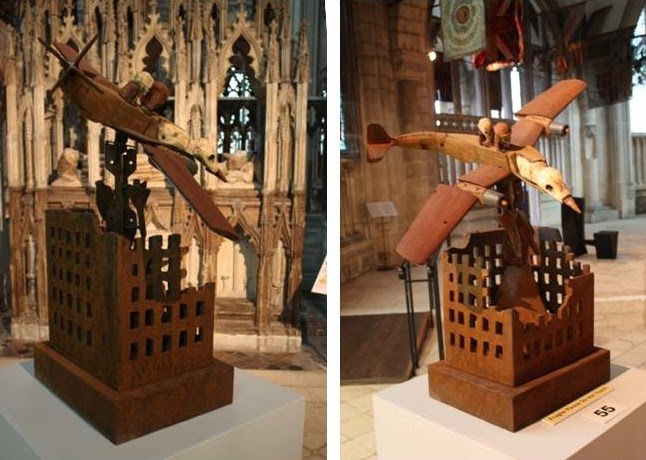
The most celebrated monument at Gloucester is the tomb of Edward II circa 1350, seen below left in the background to Steve Hurst’s Gloucester in Berlin. Hurst, born in 1932 and a witness to bombing in World War 2, sees it as concerning “… the bombing of civilians no matter what their country or who launches the bombing aircraft. It is a personal attempt to regain the viewpoint of a child”.


In the background (right) are the laid up colours of the Gloucestershire Regiment. They appear again (below right) behind Paul Wager’s Omnibus which marks the centenary of the Great War 1914-1918. Similar sentiments inform Deborah van der Beek’s Collateral (below right) – eight million horses died in that war - but it was cast around spent munitions from the conflicts in Iraq and Afghanistan which brought the expression “collateral damage” into common use.


The monument near Damien Hirst’s Anatomy of an Angel (Black) (2008, below) is to Sarah Morley, 29, a mother of four who died a few days after “having sustained the pains of Childbirth at Sea” while returning from Bombay in 1784.


Among the pieces I liked were Antony Gormley’s Pose (2012, below) with In Man’s Nature by Jon Buck behind).


Bryony Marshall’s DNA – Helix of Life (below, left) marks the 60th anniversary of the discovery of DNA. Subsequently mitochondrial DNA was identified as having been passed down to us all from a woman in East Africa about 150,000 years ago, known as Mitochondrial Eve, the inspiration for a sculpture of the same name by Sue Freeborough (below right):


The photograph below left of Geoffrey Clarke’s Taunton Deane Crematorium: Test Panel does not do justice to the colours of the glass. To the right is Sarah Lucas’s Realidad (2013), one of her NUDs series shown as bronzes at the Venice Bienniale in 2013.


John Humphreys’ Ipsius Imago a Latere Extensa probably succeeded as the artist wished in puzzling and confusing the viewer:


but perhaps was not as happily placed as the Eduardo Paolozzi plaster Vulcan near a strange moustachioed carving, perhaps a millennium older:


Among the sculptures in the open were Bruce Beasley’s Breakout II (below, left)in the Cloisters and outside Kenneth Armitage’s final work, Reach for the Stars (below, right).


Crucible2 ends on 31 October. There is no admission charge but a helpful map costs £2 and there is a £3 charge for photography. The catalogue at £16 is both good value and helps support the Cathedral.


UPDATE 2 NOVEMBER 2015

After posting about Beyond Limits: The Landscape of British Sculpture 1950-2015 held at Chatsworth House from 14 September to 25 October 2015, I thought it would be useful to add an image of Gavin Turk's bronze, Nomad (2002, below - and in other colours):


Another version of Chadwick's Jubilee can be seen there, as well.