Showing posts with label Roger Fry. Show all posts

5 January 2015

William Morris at the NPG


Six years before he died, William Morris (1834-96) published his novel News from Nowhere (above right), set in an idealistic vision of 1952. Nearly 120 years after his death the UK may be far from being the particular Utopia he imagined but Morris’s legacy is hardly inaccessible. His homes at the Red House (South East London), Kelmscott Manor (Oxfordshire) and Kelmscott House (West London) can be visited, as can the William Morris Gallery (East London). Morris & Co lives on to produce “authentic versions of his original designs”, and has a handsome website which would surely have met with his approval. Moreover Morris is currently the subject of an exhibition at Modern Art Oxford (post to follow) and the National Portrait Gallery in London is showing Anarchy & Beauty: William Morris and His Legacy, 1860 – 1960 (above left).


As its title suggests this is an ambitious exhibition in terms of its scope but, perhaps inevitably, is constrained by its NPG location: not all that much space and its strengths being portrait painting and photography, for example GF Watts’ William Morris (1870, above left) and Frederick Hollyer’s William Morris (1884, above right and in the poster). Nonetheless anyone who has an interest in Morris will be pleased to see items which, although in public collections, are not always on show or accessible. For example, the Prioress's Tale wardrobe, painted by Edward Burne-Jones on the exterior, (1859, below left) and Morris’s own La Belle Iseult (1858, below left) for which his wife, Jane, was the model.


Perhaps wisely, given that Tate Britain’s Pre-Raphaelite blockbuster was only two years ago, the NPG show plays down Morris’s relationship with the Brotherhood (he was not one of the PRB seven) and instead gives visitors a chance to appreciate his other interests, like the Arts and Crafts movement, socialism in the years before the Labour party was founded in 1900 and the Suffragettes. Eric Gill (1882-1940) was one of many influenced by Arts and Crafts –Adam and Eve garden roller (1910-20, below upper) while a painting by Roger Fry of one of the Labour’s founders, Edward Carpenter (1894 below lower) provides a link to the Bloomsbury Group.


Various aspects of Morris’s legacy up to 1960 are examined in a fairly rapid succession: Cotswold Arts and Crafts, the Garden City Movement, particularly at Letchworth, and then, following the Second World War, the Festival of Britain and the flowering of one of its assistant designers, Terence Conran. In 2012 the V&A exhibition, British Design 1948–2012, had had the space to cover the latter period more thoroughly but some of its exhibits reappear here, for example Lucienne Day’s Calyx fabric (below left) produced for the Festival in 1951. The interesting portrait of Herbert Read by Patrick Heron (1950, below right) was given to the NPG in 1968 by Barbara Hepworth and Henry Moore.


Anarchy & Beauty: William Morris and His Legacy, 1860 – 1960 ends on 11 January.


12 June 2014

Lord Clark at Tate Britain


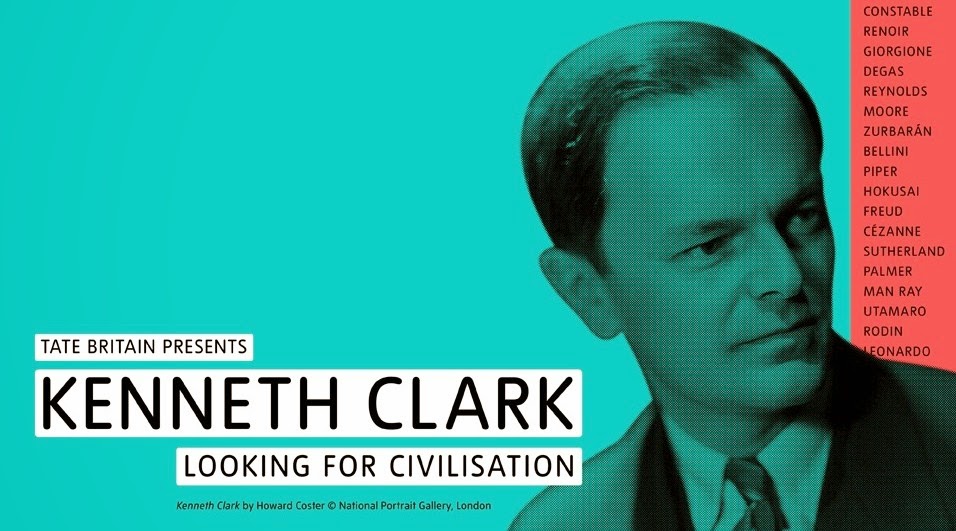
Kenneth Clark (1903-1983) was not only born in the same year as Evelyn Waugh, (mentioned in recent posts here), but also became well-known at a young age in the 1930s. Clark, unlike Waugh, was born into considerable wealth and, after studying the history of art at Oxford and coming under the influence of Roger Fry, was able to spend time in Italy with the American art historian Bernard Berenson, specialising in the Renaissance. On return to England he became Curator of the Ashmolean Museum in Oxford and then Director of the National Gallery from 1930 to 1946. His public service also included being Surveyor of the King’s Pictures, and chairmanships of the War Artists' Advisory Committee, the Arts Council of Great Britain and the Independent Television Authority. In 1969 Clark wrote and presented a celebrated TV series on the history of Western civilisation for BBC television, later shown in the US. When he subsequently received a life peerage, Private Eye dubbed him Lord Clark of Civilisation. The Tate Britain exhibition, Kenneth Clark - Looking for Civilisation, is a survey of his life’s work and brings together art that he had dealt with professionally, had benefitted from his patronage or that he had collected personally.

Not surprisingly, there is much to look at in this show. The 270 objects on display include some which are unfamiliar and may not be seen in public again for a while (one can hazard a guess as to which ‘Private Collection’ they come from). The first room is the most personal with Graham Sutherland’s portrait, Kenneth Clark (1963-64, left), and focusses on his early years. This is followed by works he collected for himself (Seurat’s The Forest at Pontaubert, (1881 below left) or, as Director of the National Gallery, for the nation, for example Constable’s Sketch for Hadleigh Castle (1828-9, below right), later transferred to the Tate. Some of the attributions he made when purchasing for the National Gallery do not seem to have stood the test of time particularly well. However, it was under his Directorship that the Gallery’s Scientific Department was formed, and the techniques which are now available to support judgements on authenticity began to be developed. In the 1930s Clark purchased for himself late works by Cézanne, as would Henry Pearlman a decade later and probably at a much higher price. A Cézanne pencil drawing, Still life, Pain sans mie, 1887-90, is particularly interesting in that its inclusion of commercial typography (“bread without crumbs”!) anticipates Picasso and Braque (but see the 1 July update below).


Clark not only collected but was an active patron looking favourably on Henry Moore (Recumbent Figure, 1938, right), Graham Sutherland, Paul Nash, and John Piper. He did not care much for abstraction (the Ben Nicholson on show seems to have been an exception), Francis Bacon or Lucien Freud’s later work. The fifth and largest space in the show is given over to the War Artists, most of whom worked in the Romantic style Clark liked, and is one of the most interesting. Although familiar in reproduction, the opportunity, during the Imperial War Museum’s closure, to see Paul Nash’s Battle of Britain (1942, below) and one of Moore’s shelter drawings (Tube 1941, below, lower) is welcome.


Among many impressive wartime pictures, ones which caught my eye were John Piper’s Somerset Place, Bath (1942, below,) and Albert Richards’ The Landing: H Hour minus 6. In the Distance Glow of the Lancasters Bombing Battery to be Attacked (1944, below, lower).


The final room concentrates on Clark’s activities after the war, particularly his involvement with television. The BBC are reportedly considering a new Civilisation series:
… "re-imagined … for the digital age". Unlike the original, it is likely to have a number of different presenters.
If so, I hope one of them will be Lisa Jardine, the daughter of Jacob Bronowski. His 1973 television series, The Ascent of Man, was complementary to Clark’s and looked at the rise of science as opposed to art, architecture and philosophy.

Just before leaving the exhibition, visitors can see two of the finest works acquired by Clark: a Francisco de Zurbarán still life, A Cup of Water and a Rose (c1630, below left), and Cézanne’s Le Château Noir (c 1904, below, right).


Kenneth Clark - Looking for Civilisation ends on 10 August and anyone with an interest in British art should try to get to Tate Britain before then. The most thought-provoking review I have come across is Kenneth Clark: arrogant snob or saviour of art? by James Hall in the Guardian.


A MINOR QUERY FOR THE CURATORS

In the first room there is a showcase (vitrine?) of Clark family photographs. One of these is of a villa owned by Clark’s father and (when I saw it) was labelled as being Clark’s childhood home in South West France at Cap Ferrat. I thought this unlikely. Although before the First World War Arcachon, on the Gironde department’s Atlantic Coast, was a fashionable resort, the village of Cap Ferret, nearby by sea but remote by land, was little more than a few oyster fishing huts (rather different now). However, Cap Ferrat (Saint-Jean-Cap-Ferrat) on the Mediterranean in the Alpes-Maritime department in South East France had become a magnet for the ultra-wealthy around 1900 and remained so. The Clark villa seems to be in the “Renaissance” style consistent with that location and, of course, Clark’s father was supposedly “the man who broke the bank at Monte Carlo”, not Biarritz. It might be worth checking.


UPDATE 1 JULY

A footnote to Cézanne’s use of commercial typography: I have recently come across this image of The Artist's Father, Reading "L'Événement", 1866, now in the National Gallery of Art, Washington DC. Apparently it wasn’t Louis-Auguste’s favourite paper but Cézanne’s old friend Emile Zola was L'Événement’s art critic.


5 March 2012

Picasso at Tate Britain


Anyone with an interest in 20th Century British art will want to see Picasso & Modern British Art at Tate Britain. In November 1910, Roger Fry in his exhibition Manet and the Post-Impressionists introduced Picasso’s work to Britain having encountered it through Leo and Gertrude Stein in Paris. The Tate show traces Picasso’s subsequent influence in two ways. Firstly, his personal presence in the form of visits to Britain in 1919 and 1950 and also the showings here of his major works, particularly Guernica in late 1938/early 1939. Secondly, by revealing the responses of seven British artists whose work, if only at some stage, was affected by Picasso: Duncan Grant, Wyndham Lewis, Ben Nicholson, Henry Moore, Francis Bacon, Graham Sutherland and David Hockney. About 90 works by these artists appear alongside more than 60 of Picasso’s, including some of his major works.

My post about the Lucien Freud exhibition at the NPG remarked that “So much is available about Freud and his work that it needs little description here” and that applies again. However, it is worth pointing out that Graham Sutherland’s landscapes can be further explored currently at Modern Art Oxford. Also, nearby in London there is an opportunity at the Courtauld Gallery to explore the influence on Ben Nicholson of Piet Mondrian. Nicholson was a sophisticated and cosmopolitan painter, eclectic in his sources which extended to the Cornish naïve painter Alfred Wallis.

The Tate show concludes with The Three Dancers (1925), purchased by the Tate in 1964 for £80,000 (about £M1.4 now). Elizabeth Cowling’s Visiting Picasso describes the diplomacy required of Roland Penrose to persuade Picasso to sell the work to the Tate direct from his studio. British admirers of Picasso should be eternally grateful to Penrose for securing for the nation a painting whose auction price now one can only guess at, but could well be in the $M150 - £M100 region. Penrose recounts the conversation he had in 1965 about the picture:
I said,'One can see the beginnings of "Guernica" in "3 Dancers".’
P[icasso].'Peut-être mais des deux tableaux je préfère de beaucoup les "3 D". C'est peint comme un tableau sans arrière-pensée.’*
Penrose had first met Picasso in 1936 and later had a key role in arranging Guernica’s UK tour. He resumed contact after the war, wrote a biography of Picasso in 1958, Picasso, His Life and Work and organised the Picasso retrospective at the Tate in London two years later. He introduced Picasso to a wider audience in 1960 than ever before with the following:
It is largely due to Pablo Picasso that the conception of art as a powerful emotional medium, rather than a search for the perfection of ideal forms of beauty, has become accepted among the artists of the twentieth century.
The turning-point in Picasso’s early career came when he was 25. The struggle in which the young artist found himself involved is forcibly illustrated in the great picture, Les Demoiselles d’Avignon, painted in Paris in the spring of 1907. It came as a shock to his friends that he should abandon a style that they had grown to love and produce instead a form of art that they could no longer understand. No one, not even Matisse, Braque and Derain, nor his devoted patrons, nor even his close friend and admirer Guillaume Apollinaire could stomach this work, which at first sight seemed to them outrageous. It took many months to digest this insult to their sensibility, but gradually they came not only to accept it but to find that it was exerting a profound influence on them.
Although since that time the work of Picasso has not always been cubist in style, the discoveries made between 1909 and the outbreak of the 1914 war (which ended his close association with Braque), have led to innumerable developments in his work and have spread their influence more widely than any other single movement in the arts.
The enveloping tenderness of maternity, the wonder of the human head, the dilemma of the artist in relation to his model, the sacrificial drama of the bullfight, the heroism of classical myths, the metamorphosis of living beings and inanimate objects, the mystery of landscape or the familiar domesticity of a still life: these themes have always absorbed him.
Although painting is his major art, the universality of his genius extends to sculpture, drawing, etching and ceramics, murals and designs for the theatre, poetry, the writing of plays and the cinema.
Picasso looks at the world with new vision, and by his art he enables us to do likewise.
In the summer of 1960 nearly half a million people queued at the Tate Gallery on London’s Millbank for the Picasso exhibition – I was one of them and a teenager (only just). In fact, it was the first major show that I had been to. I can clearly remember how crowded it was and I have wondered subsequently how much of it must have passed over me. However, the unexpected feeling of déjà vu visiting Tate Britain over 50 years later for Picasso & Modern British Art goes to show that not much in life gets totally forgotten.

Picasso & Modern British Art continues at Tate Britain until 15 July 2012 and then will be at the Scottish Gallery of Modern Art in Edinburgh from 4 August to 4 November. As well as providing a record of the exhibition, the Tate’s catalogue includes some informative essays and a fascinating interview with John Richardson, another biographer of Picasso, about the malevolent ‘capers’ of the Anglophobic collector Douglas Cooper.

*literally: 'Perhaps, but of the two pictures I much prefer the "3 D". It is painted without a second thought’; but the catalogue offers: ‘a painting in itself without outside consideration’ (page 212).

23 December 2011

Two Paris Exhibitions

Paul Cézanne was born in Aix-en-Provence in 1839, and it was in Provence that many of his most celebrated works were produced. However, encouraged by his school friend, Émile Zola, he first travelled to Paris in 1861 and would return there many times to paint in the city or in the surrounding countryside (Pontoise, below). About 80 works from in or around the capital provide the theme for Cézanne et Paris, currently at the Musée du Luxembourg.

Cézanne now seems to be classed as a Post-Impressionist rather than as an Impressionist (“un peintre déjà sorti de l’impressionisme”, said Renoir), and many of the works in the exhibition (portrait of Mme Cézanne, left) hint at later developments by other artists, particularly Cubism . He is often called the father of modern art ("notre père à tous" said Picasso or Matisse, or both of them). Nonetheless, Cézanne had exhibited at the 1863 Salon des Refusés and at the first Impressionist exhibition in 1874 when his works were among the most disliked.

The son of a banker, Cézanne had no financial need to sell his work and it was only after the solo exhibition put on by the dealer Ambroise Vollard (right) in November 1895 that his reputation became established. Cézanne died in Aix-en-Provence in 1906. By this time some wealthy young Americans had come to live in Paris, and their art collection is the subject of the second exhibition, Matisse, Cézanne, Picasso… L’aventure des Stein, in the Petit Palais, across the Seine from the Musée du Luxembourg.

The Stein family were of German-Jewish origins and had become wealthy through the San Francisco tramway business co-owned by Daniel Stein. Daniel died in 1891 at the age of 59, three years after his wife who had died at 46. This left their four children, aged between 17 and 26, to pursue lives that, but for their intellectual inclinations, might have been labelled trustafarian in Britain a century later. Leo Stein (1872-1947) was the first to develop a serious interest in art. In 1900 he was studying 15th century Italian art in Florence under the influence of Bernard Berenson. However, while there he met Roger Fry (who was to introduce Post-Impressionism to Britain in 1910) and saw a Cézanne for the first time. At the end of 1902 he moved to Paris. In 1903 he purchased a Cézanne and was joined by his younger sister Gertrude Stein (1874-1946). By 1904 Leo and Gertrude had bought more works by Cézanne, as well as by Gauguin and Renoir. That year they were joined by the oldest Stein brother and would-be paterfamilias, Michael (1865-1938), and his wife Sarah (1870-1953). In the years that followed all four Steins were to make substantial purchases of works by these and other artists.  Hung in their two Paris apartments (Michael and Sarah's, left; Gertrude and Leo's, right) the paintings were to be admired during Saturday soirées held for Paris’s artistic avante garde.

Picasso became a close friend of Gertrude and painted her famous portrait  in 1905-6 (below), (photographed together by Man Ray in 1922). Gertrude had by then started her literary career and became a supporter of Picasso during his development of Cubism. She famously remarked of Picasso:
He alone among painters did not set himself the problem of expressing truths which all the world can see, but the truth which only he can see.

The exhibition brings together some of the exceptional works which passed through the Steins’ hands, and are now dispersed in museums and private collections around the world. Michael and Sarah collected many works by Matisse only to lose some of the best during the First World War while on loan to a gallery in Berlin. In the late 1920s Le Corbusier designed them a Modernist villa near Paris but they were to leave after a few years when the rise of fascism prompted their return to the US. By 1914 Leo had taken himself and his preferred pictures, mostly Renoirs, to Italy. This left his sister and her companion, Alice B Toklas, to be the core of the American literary and artistic community in Paris in the 1920s and 30s, (recently portrayed in Woody Allen’s comedy, Midnight in Paris). 

After the First World War, Gertrude could no longer afford to buy Picasso’s work and, although she continued to act as patron to emerging artistic talent, her later acquisitions turned out to be much less significant. The expensive exhibition catalogue (63 euros for the English edition) makes little mention of her experiences in France during the Occupation of the Second World War (she and Alice had been highly regarded for their American Red Cross work during the First). However, as Barbara Will has shown in Unlikely Collaboration: Gertrude Stein, Bernard Fay, and the Vichy Dilemma, Gertrude's judgement in becoming an apologist for Pétain’s Vichy France, particularly by translating his speeches for US consumption, was questionable, even if it ensured the preservation of her art collection. 

Both exhibitions contain works of the highest quality and are rewarding to visit. Cézanne et Paris is the more straightforward as a retrospective on one artist, whereas L’aventure des Stein has to weave together the works of four major artists (63 Matisses, 43 Picassos etc) and many others and the histories of their collectors, a complex task skilfully done.  Cézanne et Paris continues to 26 February 2012. Matisse, Cézanne, Picasso… L’aventure des Stein has been extended to 22 January (check!) and then travels to the Metropolitan Museum of Art, New York (1 February to 3 June 2012). It started at the San Francisco Museum of Modern Art (May to September 2011).


4 December 2010

Post: as in Post-Impressionism

In his the friday column in yesterday’s Times 2 (3 December 2010) Richard Morrison set about debunking Virginia Woolf’s idea that December 1910 marked a significant moment in the history of human nature. There is no point in giving a link to an article behind The (London) Times’ paywall, but this extract gives the gist of Morrison’s opening argument:

“On or about December 1910,” Woolf wrote, “human character changed.” Relations shifted, she went on, between “masters and servants, husbands and wives, parents and children. And when human relations change there is at the same time a change in religion, conduct politics and literature.”
It says something about Woolf’s intellectual confidence – or perhaps her ignorance of what had been going on in Europe for the previous 30 years – that she was blithely able to identify a single month as the moment when civilisation went crazy. As we now know the Impressionists – who so dazzled Woolf and her Bloomsbury circle when Roger Fry organised his London show of their work in 1910 – had been around since the 1880s in Paris.
It says something about Morrison’s blithe self-confidence, and The Times’ standard of fact-checking, that he can get this wrong. It is certainly true that French Impressionism was not much liked by the Edwardians. In 1905 the first major show in England of French Impressionist paintings (300 works by Degas, Monet, Manet, Renoir etc) had been organised by the dealer Durand-Ruel. It had a poor press and few pictures were sold. Roger Fry (b1866), a leading British art critic, was known at the time for having little taste for Impressionism and to favour a return to the traditional techniques and structural design of the Renaissance. However, the show Fry organised in 1910, which was of course Manet and the Post-Impressionists, introduced London to Cezanne, van Gogh and Gauguin. Fry saw in their work a return to constructive design, but others were deeply shocked and even thought the show would destroy the fabric of European painting. The exhibition coincided with a Welsh miner’s strike, growing Suffragette violence and an accelerating naval arms race with Germany, all resonating with the public unease which it provoked.

Morrison goes on to suggest that Woolf's pinpointing one month is risible, but acknowledges that a lot changed between 1890 and 1920 (!).  He then asks whether digital technology and the internet are effecting a change in human affairs now “comparable to that seismic shift a century ago” – the one that he has just cast doubt on presumably. He doesn’t know at present, but we might do in 2024 – Woolf wrote her essay in 1924, you see.