I missed the Sargent exhibition at the Tate in 1998 (in Washington and Boston the following year), which I regretted, having been impressed in 1979 by the London National Portrait Gallery’s John Singer Sargent and the Edwardian Age (which went on to Detroit). So I was looking forward to Sargent: Portraits of Artists and Friends, again at the National Portrait Gallery, and I was not disappointed.
Sargent (1856-1925) certainly was the leading portrait painter of the Edwardian age (circa 1900-1910), much sought after to produce impressive portraits of the top “1%” at a time when the disparity between the wealthiest and the poorest was as great as it is today. But Sargent also painted portraits of his friends, often men and women who were of distinction in the artistic world and who he could portray in a less mannered style of his own choosing. Ideally I would post all the pictures in this exhibition, the ones which follow are those I found particularly striking.
The NPG show is chronological, starting with the artist’s early years spent in Paris (1874-85), initially as a pupil of Carolus-Duran (1879, below left). Sargent’s first exhibit at the Royal Academy was Dr Pozzi at Home (1881, below right), the founder of modern French gynaecology, looking just as Central Casting would have offered for the part.
Sargent, although never married, obviously enjoyed female company and revealing depth of character in the women who sat for him. As soon as you see them, you want to know more about them, for example the Italian Renaissance intellectual, Vernon Lee (1881, below left) and the habituée of Parisian artistic and political circles, Madame Allouard-Jouan (c1882, below right):
Particularly impressive is the double portrait of the children of one of Sargent’s earliest patrons, Edouard Pailleron, Portraits de M.E.P. … et de Mlle E.P. (1881, below); the brushwork of the detail in Marie-Louise’s costume is fascinating.
The next section of the exhibition, Broadway (Worcestershire, England not New York), covers the years 1885-89 and various paintings Sargent made in southern England. There was a community of artists and writers at Broadway where one Tate Britain’s most popular works, Carnation, Lily, Lily, Rose (below) was painted in 1885-86, the subjects being the daughters of Sargent’s artist friend, Frederick Barnard.
The following section is the largest and covers the years Sargent was dividing his time between Boston and New York (1888-1912) and London (1889-1913). There are only five pictures to cover the former, one of interest being Edwin Booth (1890, below left) - he was an actor, like his brother John Wilkes Booth, Lincoln’s assassin, and distantly related to Cherie Booth, wife of former Prime Minister, Tony Blair. In the London selection, W. Graham Robertson (1894, below right) has elements of the society “swagger” portraits for which Sargent was celebrated.
Again, some strong female portraiture: Ellen Terry as Lady Macbeth (1889, below left) and Mrs George Batten Singing (1897, below right):
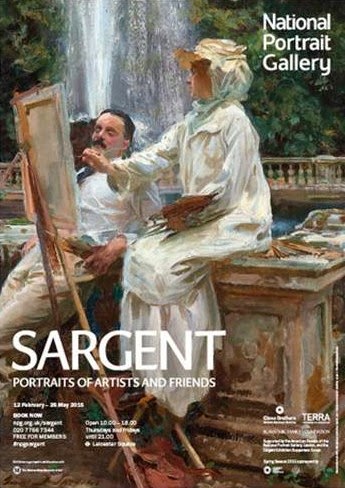
The exhibition ends with Europe (1899-1914) with paintings Sargent made on painting holidays with friends, many in Italy. The poster above is of The Fountain, Villa Torlonia, Frascati, Italy (1907) with Wilfrid and Jane de Glehn. The same couple are in the watercolour, Sketching on the Giudecca, Venice (c1904, below top) while other friends are captured on holiday in the Alps in Group with Parasols (c 1904/5, below lower):
Within a few years the cataclysm of World War 1 would engulf Europe. Nothing could be further from the paintings at the end of this exhibition than the massive work recently on show at the Imperial War Museum which Sargent would undertake in 1918, Gassed. Within a few years of his death Sargent’s reputation was in decline, undermined by Roger Fry on the grounds of its having been overtaken by modernism in much the same way as his successor as the UK’s leading society portrait painter, William Orpen, was done for by John Rothenstein. Sargent and Orpen had much in common artistically, in particular a facility to produce portraiture that was pleasing to its subject while being more revealing of character than the sitter would realise. An ability that must have been very irksome to fellow artists who lacked it.
Sargent: Portraits of Artists and Friends ends on 25 May.
UPDATE 23 MARCH
Christopher Snowdon (@cjsnowdon) tweeted this last week. The opening lines of AJP Taylor's English History (1914-1945) seem to sum up the world that people in the privileged position of Sargent and his friends lost at the outbreak of WW1:
Showing posts with label National Portrait Gallery. Show all posts
16 March 2015
29 January 2015
Grayson Perry, Establishment Man
This post began as Grayson Perry at the NPG but providing the necessary context turned it into a wider review.
In 2013 Perry was the BBC’s Reith Lecturer and in a series titled Playing to the Gallery he discussed “what makes him an artist and the limits of contemporary art”. The BBC website has downloadable pdf transcripts of his four lectures and also shows some drawings he made for them. In 2014 he authored a book, Playing to the Gallery: Helping contemporary art in its struggle to be understood (PttG) with additional material and images. It’s worth reading, not just to have Perry’s astute observations in a more accessible form, but also for some of the extra illustrations which are very amusing (eg page 69, ‘inspiration for the staff bedrooms’; page 90/91, a London art map; page 113, curation) but I thought one conveys Perry’s sardonic views particularly well:
On inspection, Map of Museum based on Interior of Curator’s Head might have been more appropriately titled Map of Art Gallery based on Interior of Director’s Head. But Perry, who regards himself as “a fully paid-up member of the Establishment” (PttG page 82), presumably knows not to bite other dogs .
About a month after PttG was published, Perry was Guest Editor for the 10 October New Statesman magazine – “A special issue on the Great White Male - That’s the straight, white, middle-class men who dominate our culture (and our politics)”. In the issue’s The NS Essay, They walk among us, Perry bemoaned the fact that:
There isn’t space here to describe all of the items, let alone reference the 140 or so minutes of video essential to their explanation – see next year’s book by Perry perhaps. But a few are worth mentioning, not least because Default Man turns up in the form of the Huhne Vase (below top). Why Huhne allowed Perry so close when he was in such dire circumstances (before imprisonment and subsequently on release) is a mystery. Later at the NPG, Huhne’s meeting with potter and vase, (which, according to the Guardian:
Another item which attracted attention when the show opened was The Ashford Hijab (above lower), a portrait of young Muslim convert, Kayleigh Khosravi, from Ashford in Kent. Perry commented:
Probably the most memorable item was the Jesus Army Money Box (above lower), a ceramic in the form of a medieval chasse, a small enamelled chest containing a holy relic. This was inspired by the time Perry spent with a Christian group which helps the homeless.
In the few years since he was first mentioned here, Perry seems to have grown even more popular – no crime that. At the end of 2104 he used his Twitter account (@alan_measles) to keep followers informed, and patiently answering queries, about the construction and decoration of a large (one meter tall) vase:
Large, but not exactly breaking new ground. In the year that Perry became a RA, Brian Sewell wrote rather caustically about Perry:
Is he “a fully paid-up member of the Establishment”? Peter Hennessy offered some relevant comment in a recent extended essay called Establishment and Meritocracy:
Who are you? continues at the NPG until 15 March
* Respectively, Royal Academician and Commander of the Most Excellent Order of the British Empire.
** In January 2015 Perry was included as one of the 24 most influential people in Art (alongside Tracey Emin, Damien Hirst, David Hockney, Banksy and Iwan Wirth and Manuela Hauser, et al) in Debrett’s Britain’s 500 most influential people in 2015.
UPDATE 31 JANUARY
The London Evening Standard on 30 January carried an article by its owner, Evgeny Lebedev, describing how, as part of his paper’s ongoing campaign, he and Grayson Perry had met homeless veterans at a hostel in East London earlier in the month. According to the article, Perry has offered:
UPDATE 12 APRIL – ESTABLISHMENT MEN AT WORK
On 11 April Grayson Perry wrote a piece in the Guardian, My hero: Neil MacGregor The retiring director of the British Museum transformed a stately institution into a cultural powerhouse.
In 2013 Perry was the BBC’s Reith Lecturer and in a series titled Playing to the Gallery he discussed “what makes him an artist and the limits of contemporary art”. The BBC website has downloadable pdf transcripts of his four lectures and also shows some drawings he made for them. In 2014 he authored a book, Playing to the Gallery: Helping contemporary art in its struggle to be understood (PttG) with additional material and images. It’s worth reading, not just to have Perry’s astute observations in a more accessible form, but also for some of the extra illustrations which are very amusing (eg page 69, ‘inspiration for the staff bedrooms’; page 90/91, a London art map; page 113, curation) but I thought one conveys Perry’s sardonic views particularly well:
On inspection, Map of Museum based on Interior of Curator’s Head might have been more appropriately titled Map of Art Gallery based on Interior of Director’s Head. But Perry, who regards himself as “a fully paid-up member of the Establishment” (PttG page 82), presumably knows not to bite other dogs .
About a month after PttG was published, Perry was Guest Editor for the 10 October New Statesman magazine – “A special issue on the Great White Male - That’s the straight, white, middle-class men who dominate our culture (and our politics)”. In the issue’s The NS Essay, They walk among us, Perry bemoaned the fact that:
… white, middle-class, heterosexual men, usually middle-aged … [are] a group that punches far, far above its weight.
They dominate the upper echelons of our society, imposing, unconsciously or otherwise, their values and preferences on the rest of the population.and christened them Default Man. Though he had to admit:
I must confess that I qualify in many ways to be a Default Man myself but I feel that by coming from a working-class background and being an artist and a transvestite, I have enough cultural distance from the towers of power. I have space to turn round and get a fairly good look at the edifice. and then spent much of the rest of the essay in the fortunate position of having his cake and being able to eat it: When I am out and about in an eye-catching frock, men often remark to me, “Oh, I wish I could dress like you and did not have to wear a boring suit.” Have to!
… Personally, working in the arts, I do not often encounter Default Man en masse, but when I do it is a shock. I occasionally get invited to formal dinners in the City of London and on arrival, I am met, in my lurid cocktail dress, with a sea of dinner jackets; perhaps harshly, my expectations of a satisfying conversation drop. I feel rude mentioning the black-clad elephant in the room. I sense that I am the anthropologist allowed in to the tribal ritual.Just why post-industrial societies in general, not just the UK, are still dominated at their upper levels by men is not something Perry gives much consideration to. At one point he quotes Sherrie Bourg Carter:
Women in today’s workforce ... are experiencing a much more camouflaged foe – second-generation gender biases ... “work cultures and practices that appear neutral and natural on their face”, yet they reflect masculine values and life situations of men.but he seems more interested in the wearing of suits than the raising of children. Only in The NS Interview, when Perry invites Martin Amis to his studio for a dialogue, does that aspect of reality begin to intrude:
MA You have to whisper it now that there are differences between men and women. There are, though. Women have children, you know.
GP Yeah, but there’s also a much more encultured version of what it is to be a man and a woman. I sometimes characterise it as: males are defined by what they do and women are often defined by what they are. …
GP I think that the male role is more heavily policed, in terms of constricting behaviours that are available to it. The male aesthetic is often about camouflage – because he then retains his ability to observe from a supposedly neutral standpoint. Women are one of the groups to be looked at. Everything is defined from that male gaze. Is it possible to unpick the white, male, middle-class, middle-aged, heterosexual effect on culture and take it out? Because they’ve become inextricably woven into what we call culture and “right thinking”.
MA Males?
GP Yes. How do you think men have branded the nature of intellectualism and seriousness?
MA It would take for ever to untangle that, wouldn’t it? …Early on in The NS Essay, Perry reveals that:
In the course of making my documentary series about identity, Who Are You?, for Channel 4, the identity I found hardest to talk about, the most elusive, was Default Man’s. Somehow, his world-view, his take on society, now so overlaps with the dominant narrative that it is like a Death Star hiding behind the moon. We cannot unpick his thoughts and feelings from the “proper, right-thinking” attitudes of our society. It is like in the past, when people who spoke in cut-glass, RP, BBC tones would insist they did not have an accent, only northerners and poor people had one of those. We live and breathe in a Default Male world: no wonder he succeeds, for much of our society operates on his terms.
Chris Huhne (60, Westminster, PPE Magdalen, self-destructively heterosexual), the Default Man we chose to interview for our series, pooh-poohed any suggestion when asked if he benefited from membership or if he represented this group.Who Are You?, in which Perry “turns his attention to identity as he creates portraits - from tapestries to sculptures and pots - of diverse individuals who are all trying to define who they are”, was broadcast in three parts starting on 29 October. It was a successor to his 2012 Channel 4 series, In the Best Possible Taste, with its six large accompanying tapestries, The Vanity of Small Differences, which eventually went on a UK tour. This time the Who Are You? pieces are displayed among the National Portrait Gallery’s collection in London (below):
![]() |
| ‘Vibrant’ art that working-class people might like – surely not |
… was purposefully smashed by Perry and then repaired using an ancient Chinese technique which involves lacquer resin dusted or mixed with gold. The Huhne vase has been decorated with the motifs of Huhne’s face, his H11HNE number plate and a penis. Perry said: “This is a riposte to the common Default Man’s defence that he is an ‘individual’ and his achievements and behaviour have nothing to do with group identity. I have smashed the pot and had it repaired with gold to symbolise that vulnerability might be an asset in relationships to such a person.”)was filmed for the first part of the series, an encounter which resembled that of water and a duck’s back, Huhne not being in the least fazed by Perry, who, he pointed out, was a RA and CBE*. I didn’t think Perry closed on Huhne, who, although he didn’t say so directly, seemed to regard Perry as just another player in the influence game** albeit one with an outrĂ© image.
Another item which attracted attention when the show opened was The Ashford Hijab (above lower), a portrait of young Muslim convert, Kayleigh Khosravi, from Ashford in Kent. Perry commented:
What does Islam offer to a young white woman in her twenties? The answer, I found, appears to be a refuge from the nagging consumer pressures and constant, often sexual, scrutiny of women all pervasive in western society. Conversion also offers a strong and supportive sisterhood within the congregation of the mosque.Nearby in Room 31 is Wallis, Duchess of Windsor (1939) by Gerald Leslie Brockhurst, a portrait of a woman who had been on an even more remarkable journey. Whether this was an intentional juxtaposition, the visitor doesn’t know. But it was doubtless deliberate that The Line of Departure (below top), a tapestry in the style of an Afghan rug showing three wounded war veterans, is in Room 23, Expansion and Empire, near Florence Nightingale receiving the Wounded at Scutari by Barrett. I don’t believe the vets featured in the Channel 4 series, an omission which wouldn’t have surprised Kipling. [But see UPDATE 31 JANUARY below]
Probably the most memorable item was the Jesus Army Money Box (above lower), a ceramic in the form of a medieval chasse, a small enamelled chest containing a holy relic. This was inspired by the time Perry spent with a Christian group which helps the homeless.
In the few years since he was first mentioned here, Perry seems to have grown even more popular – no crime that. At the end of 2104 he used his Twitter account (@alan_measles) to keep followers informed, and patiently answering queries, about the construction and decoration of a large (one meter tall) vase:
Large, but not exactly breaking new ground. In the year that Perry became a RA, Brian Sewell wrote rather caustically about Perry:
In the quarter of a century that he has been making them [pots] they have remained essentially the same - perhaps bigger and more provocative in imagery and narrative, but they are so undeveloped that they demonstrate stultifying intellectual and aesthetic limitations. Meanwhile, Claire [*] has gone from strength to strength and it is for her tasteless and preposterous dresses, worn on every possible public occasion, that Perry is now notorious.
[* earlier] … a female alter ego, Claire, who is now, in adult life, his public persona and has become not only much the subject of his work but the work itself, with the sedulous promotion of being Claire a constantly performed performance that more or less obliterates his unmemorable pottery.But since then Perry has become a CBE and Reith Lecturer, and Claire engages with duchesses.
![]() |
| Perry with the Duchess of Cambridge |
I reckon there is a permanent element at the core of the British Establishment - a kind of gyroscope - which embraces the grand old professions like the Law and the Civil Service (though the latter is a tad tattered at the moment), the House of Lords (especially sections of the crossbenches where sit the former Cabinet Secretaries, Law Lords, Chiefs of the Defence Staff and Queen's Private Secretaries), the Royal Society, the British Academy, the learned societies generally, the scientific and engineering institutes and the great medical colleges. The reach and clout of these institutions and tribes may fluctuate but they never truly fade, let alone disappear. While around this rooted, inner core there swirl the transient elements in the media, the financial world and the celebritocracy in constellations that vary from generation to generation who can have a powerful, if often passing influence on the mood music of political and economic discussion, and in the case of celebritocracy, the norms of our wider society. (pages 14-15)So I think it's almost certain that Perry, if not "fully paid-up" and only transiently, is one of the celibritocrats within the British Establishment - will his knighthood arrive before or after Tracey Emin becomes a Dame?
Who are you? continues at the NPG until 15 March
* Respectively, Royal Academician and Commander of the Most Excellent Order of the British Empire.
** In January 2015 Perry was included as one of the 24 most influential people in Art (alongside Tracey Emin, Damien Hirst, David Hockney, Banksy and Iwan Wirth and Manuela Hauser, et al) in Debrett’s Britain’s 500 most influential people in 2015.
UPDATE 31 JANUARY
The London Evening Standard on 30 January carried an article by its owner, Evgeny Lebedev, describing how, as part of his paper’s ongoing campaign, he and Grayson Perry had met homeless veterans at a hostel in East London earlier in the month. According to the article, Perry has offered:
… to create a unique piece of art that would not only reflect the stories of those this campaign is helping but which we could also then exclusively auction to raise more funds for those who need it.Also:
The CEO of Veterans Aid, Dr Hugh Milroy, was delighted by the visit. “Welcoming Grayson to New Belvedere House was a real pleasure,” he said. “The staff and residents warmed to him immediately.
“Grayson’s empathy, humanity, humility and genuine interest shone through. We were stunned to learn that he was prepared to create an artwork for us and immensely grateful. Many of the veterans we help have an interest in painting, ceramics, photography or some kind of creative activity so there was great curiosity and enthusiasm when his visit was announced.”
UPDATE 12 APRIL – ESTABLISHMENT MEN AT WORK
On 11 April Grayson Perry wrote a piece in the Guardian, My hero: Neil MacGregor The retiring director of the British Museum transformed a stately institution into a cultural powerhouse.
… Neil was the major museum director’s major museum director. He is effortlessly learned, an astute diplomat and above all a lovely, lovely man.
I sort of engineered our first meeting [in 2008] after I heard him talk to a small group where he gently berated the clergy of St Paul’s for charging entry fees. Afterwards we all went for supper at Pizza Express and I spotted an opportunity and sat down next to him. As casually as I could, I dropped in that I had an idea for an exhibition. Neil said: “Send me a letter,” and three years later my show, The Tomb of the Unknown Craftsman, opened. It is still my proudest achievement and its passage through the souk of fiefdoms that is the BM I’m sure was much eased by Neil’s initial enthusiasm.
… I have just been appointed a trustee of the BM; …
5 January 2015
William Morris at the NPG
Six years before he died, William Morris (1834-96) published his novel News from Nowhere (above right), set in an idealistic vision of 1952. Nearly 120 years after his death the UK may be far from being the particular Utopia he imagined but Morris’s legacy is hardly inaccessible. His homes at the Red House (South East London), Kelmscott Manor (Oxfordshire) and Kelmscott House (West London) can be visited, as can the William Morris Gallery (East London). Morris & Co lives on to produce “authentic versions of his original designs”, and has a handsome website which would surely have met with his approval. Moreover Morris is currently the subject of an exhibition at Modern Art Oxford (post to follow) and the National Portrait Gallery in London is showing Anarchy & Beauty: William Morris and His Legacy, 1860 – 1960 (above left).
As its title suggests this is an ambitious exhibition in terms of its scope but, perhaps inevitably, is constrained by its NPG location: not all that much space and its strengths being portrait painting and photography, for example GF Watts’ William Morris (1870, above left) and Frederick Hollyer’s William Morris (1884, above right and in the poster). Nonetheless anyone who has an interest in Morris will be pleased to see items which, although in public collections, are not always on show or accessible. For example, the Prioress's Tale wardrobe, painted by Edward Burne-Jones on the exterior, (1859, below left) and Morris’s own La Belle Iseult (1858, below left) for which his wife, Jane, was the model.
Perhaps wisely, given that Tate Britain’s Pre-Raphaelite blockbuster was only two years ago, the NPG show plays down Morris’s relationship with the Brotherhood (he was not one of the PRB seven) and instead gives visitors a chance to appreciate his other interests, like the Arts and Crafts movement, socialism in the years before the Labour party was founded in 1900 and the Suffragettes. Eric Gill (1882-1940) was one of many influenced by Arts and Crafts –Adam and Eve garden roller (1910-20, below upper) while a painting by Roger Fry of one of the Labour’s founders, Edward Carpenter (1894 below lower) provides a link to the Bloomsbury Group.
Various aspects of Morris’s legacy up to 1960 are examined in a fairly rapid succession: Cotswold Arts and Crafts, the Garden City Movement, particularly at Letchworth, and then, following the Second World War, the Festival of Britain and the flowering of one of its assistant designers, Terence Conran. In 2012 the V&A exhibition, British Design 1948–2012, had had the space to cover the latter period more thoroughly but some of its exhibits reappear here, for example Lucienne Day’s Calyx fabric (below left) produced for the Festival in 1951. The interesting portrait of Herbert Read by Patrick Heron (1950, below right) was given to the NPG in 1968 by Barbara Hepworth and Henry Moore.
Anarchy & Beauty: William Morris and His Legacy, 1860 – 1960 ends on 11 January.
18 August 2014
Rex Whistler and Laura Knight at Haddon Hall
Haddon Hall, near Bakewell in Derbyshire, is described in Pevsner’s Buildings of England for the county as:
The 70th anniversary last month of Rex Whistler’s death in combat during the Normandy campaign seemed to have passed without note. He was 39 and had had early success. Henry Tonks, his Professor at the Slade, remarked that he had only ever known three or four people with a natural gift for drawing, and Rex Whistler was one of them. Thanks to Tonks’ sponsorship, Whistler was able to produce one of his best known works, the mural The Expedition in Pursuit of Rare Meats, for the restaurant at Tate Britain when he was only 23. Various commissions followed from the wealthy and fashionable, so when in 1933 the 9th Duke of Rutland wanted to celebrate the end of his restoration work at Haddon he secured Whistler’s services to paint a landscape featuring the Hall to go over the fireplace in the Long Gallery. It shows the Duke and his son looking over their Arcadia:
Whistler completed his longest mural in 1937 for the Dining Room at Plas Newydd, A Capriccio (short title), commissioned by Charles, 6th Marquess of Anglesey. The Marquess’s wife was one of the daughters of Henry Manners, 8th Duke of Rutland. In 2013 a biography, In Search of Rex Whistler: His life and work by Hugh and Mirabel Cecil was reviewed admiringly and at length for The Times Literary Supplement by Matthew Sturgis. He points out:
It was drawn in 1934 in preparation for an oil painting of Kathleen Manners, the 9th Duchess of Rutland. The painting is at Belvoir Castle, presumably on view to visitors. Although the NPG show made do with the sketch, perhaps the painting will be made available to the Dulwich Picture Gallery for the Laura Knight exhibition planned for the winter of 2015-16 and marking the 50th anniversary of her Royal Academy retrospective.
Footnote
This Penguin Guide to Derbyshire and the Peak District, “Revised and Reprinted, 1949”, says about Haddon Hall that it “is considered by some to be the most lovely medieval house in England. The house is now open to the public daily 11 a.m. to 6 p.m, admission 2s”. For current opening times please consult the Haddon Hall website and also note that the basic admission price is now £10 (“2s” or Two Shillings is the pre-decimalisation equivalent of £0.10, so a 100-fold increase in 65 years ). Actually, £10 is good value, given the quality of the house and its contents and the gardens. On the other hand, the equivalent of £10 for a paperback of 169 pages, with maps but no illustrations, certainly was not!
… the English castle par excellence, not the forbidding fortress on an unassailable crag, but the large, rambling, safe, grey, lovable house of knights and their ladies, the unreasonable dream-castle of those who think of the Middle Ages as a time of chivalry and valour and noble feelings. None other in England is so complete and convincing.Simon Jenkins, in his England's Thousand Best Houses, puts it in the top 20 with 5* (out of 5):
Haddon is the most perfect English house to survive from the Middle Ages. …. It has not changed because it never needed to change. … Those aristocratic curses of extravagance and infertility have not visted Haddon. The place is still owned by the Manners family, the Dukes of Rutland. To wander up the slope to the worn gatehouse steps and enter the ancient courtyard is as agreeable an experience as England can offer.And he explains:
Through the 18th and 19th centuries, the Rutlands neglected Haddon in favour of the seat of Belvoir (Leics). This saved it from the drastic alterations that occurred to most houses over that period. Haddon’s restoration by the 9th Duke after 1912 and recently by his grandson have been deferential.So it was a surprise during a recent visit to Haddon Hall to encounter work by two twentieth-century British artists, Rex Whistler and Laura Knight, and a reminder of the extent of aristocratic patronage, even in the 1930s.
The 70th anniversary last month of Rex Whistler’s death in combat during the Normandy campaign seemed to have passed without note. He was 39 and had had early success. Henry Tonks, his Professor at the Slade, remarked that he had only ever known three or four people with a natural gift for drawing, and Rex Whistler was one of them. Thanks to Tonks’ sponsorship, Whistler was able to produce one of his best known works, the mural The Expedition in Pursuit of Rare Meats, for the restaurant at Tate Britain when he was only 23. Various commissions followed from the wealthy and fashionable, so when in 1933 the 9th Duke of Rutland wanted to celebrate the end of his restoration work at Haddon he secured Whistler’s services to paint a landscape featuring the Hall to go over the fireplace in the Long Gallery. It shows the Duke and his son looking over their Arcadia:
Whistler completed his longest mural in 1937 for the Dining Room at Plas Newydd, A Capriccio (short title), commissioned by Charles, 6th Marquess of Anglesey. The Marquess’s wife was one of the daughters of Henry Manners, 8th Duke of Rutland. In 2013 a biography, In Search of Rex Whistler: His life and work by Hugh and Mirabel Cecil was reviewed admiringly and at length for The Times Literary Supplement by Matthew Sturgis. He points out:
The suggestion that Rex Whistler was the model for Charles Ryder in Evelyn Waugh’s Brideshead Revisited is properly dismissed here by the Guinnesses. Nevertheless, that sense – so well delineated in the novel – of a modest, conventional middle-class young man of talent and charm being drawn into an enchanted and perhaps emotionally dangerous aristocratic world does have strong echoes in the story of Whistler’s life.Just after the Long Gallery, in the Great Chamber, is this ‘sketch’ by Laura Knight, seen a year ago at the National Portrait Gallery:
It was drawn in 1934 in preparation for an oil painting of Kathleen Manners, the 9th Duchess of Rutland. The painting is at Belvoir Castle, presumably on view to visitors. Although the NPG show made do with the sketch, perhaps the painting will be made available to the Dulwich Picture Gallery for the Laura Knight exhibition planned for the winter of 2015-16 and marking the 50th anniversary of her Royal Academy retrospective.
Footnote
This Penguin Guide to Derbyshire and the Peak District, “Revised and Reprinted, 1949”, says about Haddon Hall that it “is considered by some to be the most lovely medieval house in England. The house is now open to the public daily 11 a.m. to 6 p.m, admission 2s”. For current opening times please consult the Haddon Hall website and also note that the basic admission price is now £10 (“2s” or Two Shillings is the pre-decimalisation equivalent of £0.10, so a 100-fold increase in 65 years ). Actually, £10 is good value, given the quality of the house and its contents and the gardens. On the other hand, the equivalent of £10 for a paperback of 169 pages, with maps but no illustrations, certainly was not!
16 July 2014
Julian Opie at the Holburne, Bath
One of the surprises provided by Julian Opie: Collected Works at the Holburne Museum in Bath is that it is his first one-person exhibition in a UK museum for over ten years, a period in which his work has been highly visible, for example on the covers of Blur: The Best Of and the National Portrait Gallery’s Visitor Guide (Alex, Bassist. Darren, Singer. Dave, Drummer. Graham, Guitarist, 2000 and still from animation, Julian with t-shirt, 2005, below):
Another surprise in the show is Opie’s personal collection of art which includes sculpture from ancient Egypt and Rome, 17th and 18th century paintings and sculpture (works by Lely, Reynolds and Romney) and Japanese prints. Items from his collection occupy half of the display in the Holburne, juxtaposed with the other half which consists of works by the artist since about 1995 (Lely’s Portrait of an unknown woman, Opie’s At home with Maria 2, 2011, below left and right):
Opie makes use of new technology such as 3D printing, vector drawing and computer-animated LED and LCD screens, eg Marina in purple shawl, 2010:
Opie’s technology-based work is often associated with that of Michael Craig-Martin, his teacher at Goldsmiths, though I was reminded of Patrick Caulfield’s use of flat areas of simple colour bounded by black outlines. Animation allows more than one of a sitter’s facial expressions to be revealed in succession (eg Imogen, 2013), thought-provoking in terms portraiture’s ability to convey personality, given the Opie style’s lack of detail.
3D scanning and printing was used to produce the sculpture Reed 1 2012 (below left) which then had to be hand-painted, one of the sources for this being an Egyptian mask, 664-332 BC, (below right):
Other small-scale works fall between sculpture and painting, for example two of a series in collaboration with Royal Ballet dancers and staff: Caterina dancing, 2010, 10 Blue and 09 Red, both silkscreen on painted wood, below left and right:
Three sculptures (Aniela at the spring, 2011; 3 men walking, 2008; Peeing boy, 2012, right) are available for all to see in the garden of the Holburne Museum where Julian Opie: Collected Works continues until 14 September. The show will move to the Bowes Museum from 25 October to 22 February 2015. The exhibition catalogue includes interesting essays by Sandy Nairne, the Director of the NPG, and Julian Opie, and commentaries by the artist on the works on display.
Another surprise in the show is Opie’s personal collection of art which includes sculpture from ancient Egypt and Rome, 17th and 18th century paintings and sculpture (works by Lely, Reynolds and Romney) and Japanese prints. Items from his collection occupy half of the display in the Holburne, juxtaposed with the other half which consists of works by the artist since about 1995 (Lely’s Portrait of an unknown woman, Opie’s At home with Maria 2, 2011, below left and right):
Opie makes use of new technology such as 3D printing, vector drawing and computer-animated LED and LCD screens, eg Marina in purple shawl, 2010:
Opie’s technology-based work is often associated with that of Michael Craig-Martin, his teacher at Goldsmiths, though I was reminded of Patrick Caulfield’s use of flat areas of simple colour bounded by black outlines. Animation allows more than one of a sitter’s facial expressions to be revealed in succession (eg Imogen, 2013), thought-provoking in terms portraiture’s ability to convey personality, given the Opie style’s lack of detail.
3D scanning and printing was used to produce the sculpture Reed 1 2012 (below left) which then had to be hand-painted, one of the sources for this being an Egyptian mask, 664-332 BC, (below right):
Other small-scale works fall between sculpture and painting, for example two of a series in collaboration with Royal Ballet dancers and staff: Caterina dancing, 2010, 10 Blue and 09 Red, both silkscreen on painted wood, below left and right:
Three sculptures (Aniela at the spring, 2011; 3 men walking, 2008; Peeing boy, 2012, right) are available for all to see in the garden of the Holburne Museum where Julian Opie: Collected Works continues until 14 September. The show will move to the Bowes Museum from 25 October to 22 February 2015. The exhibition catalogue includes interesting essays by Sandy Nairne, the Director of the NPG, and Julian Opie, and commentaries by the artist on the works on display.
15 June 2014
Two London Exhibitions - Better late than never
This post is mostly for the record, both these shows having closed on 15 June, but I was glad to have been able to finally get to see them just a few days earlier.
Veronese
At the National Gallery, Veronese Magnificence in Renaissance Venice fully lived up to its title. Paolo Bazaro (also Caliari), who came from Verona and so was known as Veronese, lived from 1528 to 1588. The time line on the way into the exhibition helpfully explained that these years spanned the establishment of the Church of England, the birth of Shakespeare and the Spanish Armada. Then a chronological sequence of fifty works followed his artistic progress from his home town to Vicenza, Mantua and, from1555, Venice. Some of these were being reunited at the National Gallery, which has ten Veroneses of its own, for the first time in many years.
Many of the pictures were of religious scenes and intended to decorate churches (12 altarpieces), some were based on classical mythology and a few were portraits. In these, Veronese carefully documented the opulent costumes of his wealthy aristocratic subjects, but still managed to convey something of the sitter's personality, as for example in Portrait of a Lady, known as the 'Bellamy Nani' (about 1560-5, below).
I suppose that fewer of us than would have been the case in the past have the biblical awareness to appreciate immediately the content of, say, Christ and the Centurion (about 1750, below)
or to know that a jar is associated with Mary Magdalene. Fortunately, the curators compensated for this in their guide. Some of the exhibits were larger than any I had seen before in a temporary exhibition. For example, The Martyrdom of Saint George (about 1565, below), removed from the church of San Giorgio in Braida, Verona for only the second time in its existence, is approximately 4m by 3m.
The curators and lenders must have faced considerable problems in ensuring its secure and safe transit. Knowing all too little classical mythology, I was also grateful for being provided with brief accounts of works like Perseus and Andromeda (1575-80, below).
However ill-equipped some of us might be to appreciate the biblical and classical references, the details in the paintings revealed an unfamiliar and fascinating 16th century world full of consiglieri, servants, horses, dogs and monkeys. Sea-borne trade was the economic basis of Venice’s wealth and I liked the two Allegories of Navigation, about 1555-60, one with a Cross-Staff (left) and the other with an Astrolabe (right).
No doubt like many others, I left the exhibition thinking it was time to visit Northern Italy, particularly Venice, again. A complementary exhibition, Paolo Veronese L'illusione della realtĂ , will be at the Museo di Castelvecchio, Verona, from 5 July – 5 October 2014).
Great War Portraits
The Great War in Portraits at the National Portrait Gallery was a small and rather crowded show scheduled to end before the centenary of the start of World War 1 had been reached, or even that of the assassination of Archduke Franz Ferdinand. Perhaps the current Director of the NPG wanted to do something on the subject before he leaves, or it was a Whitehall priority. I can't believe it will be the Gallery's last word on the War before 2018. Nonetheless, this exhibition quite rightly induced sombre reflection. What a contrast there was between Orpen's slick portraits of the top brass, no doubt unfailingly pleasing to their subjects (particularly himself), and the wall of photographs showing the haunted faces of the ‘Poor Bloody Infantry’. Field Marshal Sir Douglas Haig (1861–1928), KT, GCB, GCVO, KCIE, Commander-in-Chief, France, from 15 December 1915 (1917, below left) and Self-portrait (1917, below, right).
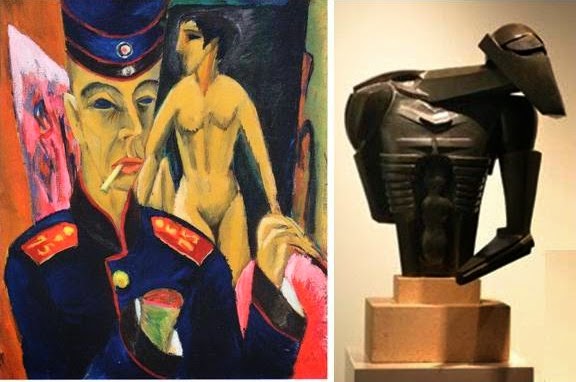
I saw for the first time some of Henry Tonks' famous pastel drawings of injured faces (they feature in Pat Barker’s Toby’s Room). The text didn’t point out that Tonks was originally trained as a surgeon. There was also an opportunity to see a work by the Die BrĂĽcke expressionist Ernst Ludwig Kirchner: Selbstbildnis als Soldat (Self-Portrait as a Soldier, 1915, below left) and Jacob Epstein’s Torso in Metal from The Rock Drill 1913 – 14 (below, right).
A bigger show with more German art would almost certainly have been of more value. Also, while screening German as well as British contemporary newsreel footage was highly desirable, it made the exhibition seem even more crowded. It might have been better left to the BBC, who will probably show most of what is worth seeing in the next four years.
Veronese
At the National Gallery, Veronese Magnificence in Renaissance Venice fully lived up to its title. Paolo Bazaro (also Caliari), who came from Verona and so was known as Veronese, lived from 1528 to 1588. The time line on the way into the exhibition helpfully explained that these years spanned the establishment of the Church of England, the birth of Shakespeare and the Spanish Armada. Then a chronological sequence of fifty works followed his artistic progress from his home town to Vicenza, Mantua and, from1555, Venice. Some of these were being reunited at the National Gallery, which has ten Veroneses of its own, for the first time in many years.
Many of the pictures were of religious scenes and intended to decorate churches (12 altarpieces), some were based on classical mythology and a few were portraits. In these, Veronese carefully documented the opulent costumes of his wealthy aristocratic subjects, but still managed to convey something of the sitter's personality, as for example in Portrait of a Lady, known as the 'Bellamy Nani' (about 1560-5, below).
I suppose that fewer of us than would have been the case in the past have the biblical awareness to appreciate immediately the content of, say, Christ and the Centurion (about 1750, below)
or to know that a jar is associated with Mary Magdalene. Fortunately, the curators compensated for this in their guide. Some of the exhibits were larger than any I had seen before in a temporary exhibition. For example, The Martyrdom of Saint George (about 1565, below), removed from the church of San Giorgio in Braida, Verona for only the second time in its existence, is approximately 4m by 3m.
The curators and lenders must have faced considerable problems in ensuring its secure and safe transit. Knowing all too little classical mythology, I was also grateful for being provided with brief accounts of works like Perseus and Andromeda (1575-80, below).
However ill-equipped some of us might be to appreciate the biblical and classical references, the details in the paintings revealed an unfamiliar and fascinating 16th century world full of consiglieri, servants, horses, dogs and monkeys. Sea-borne trade was the economic basis of Venice’s wealth and I liked the two Allegories of Navigation, about 1555-60, one with a Cross-Staff (left) and the other with an Astrolabe (right).
No doubt like many others, I left the exhibition thinking it was time to visit Northern Italy, particularly Venice, again. A complementary exhibition, Paolo Veronese L'illusione della realtĂ , will be at the Museo di Castelvecchio, Verona, from 5 July – 5 October 2014).
Great War Portraits
The Great War in Portraits at the National Portrait Gallery was a small and rather crowded show scheduled to end before the centenary of the start of World War 1 had been reached, or even that of the assassination of Archduke Franz Ferdinand. Perhaps the current Director of the NPG wanted to do something on the subject before he leaves, or it was a Whitehall priority. I can't believe it will be the Gallery's last word on the War before 2018. Nonetheless, this exhibition quite rightly induced sombre reflection. What a contrast there was between Orpen's slick portraits of the top brass, no doubt unfailingly pleasing to their subjects (particularly himself), and the wall of photographs showing the haunted faces of the ‘Poor Bloody Infantry’. Field Marshal Sir Douglas Haig (1861–1928), KT, GCB, GCVO, KCIE, Commander-in-Chief, France, from 15 December 1915 (1917, below left) and Self-portrait (1917, below, right).
I saw for the first time some of Henry Tonks' famous pastel drawings of injured faces (they feature in Pat Barker’s Toby’s Room). The text didn’t point out that Tonks was originally trained as a surgeon. There was also an opportunity to see a work by the Die BrĂĽcke expressionist Ernst Ludwig Kirchner: Selbstbildnis als Soldat (Self-Portrait as a Soldier, 1915, below left) and Jacob Epstein’s Torso in Metal from The Rock Drill 1913 – 14 (below, right).
A bigger show with more German art would almost certainly have been of more value. Also, while screening German as well as British contemporary newsreel footage was highly desirable, it made the exhibition seem even more crowded. It might have been better left to the BBC, who will probably show most of what is worth seeing in the next four years.
20 February 2012
Lucien Freud Portraits at the NPG
The National Portrait Gallery (NPG) in London is currently showing Lucien Freud Portraits, the first major retrospective of Lucien Freud (1922-2011) since Tate Britain’s in 2002. So much is available about Freud and his work that it needs little description here. Martin Gayford’s description of his experiences sitting for Freud, Man with a Blue Scarf: On Sitting for a Portrait by Lucian Freud, is fascinating and informative, and the resulting work, Man in a Blue Scarf (2004) is in the NPG exhibition. David Dawson worked for over 20 years as Lucian Freud's assistant, occasionally his model, and was able to take many revealing photographs of the artist at work. He discusses these at The Economist and also his own work at the BBC.
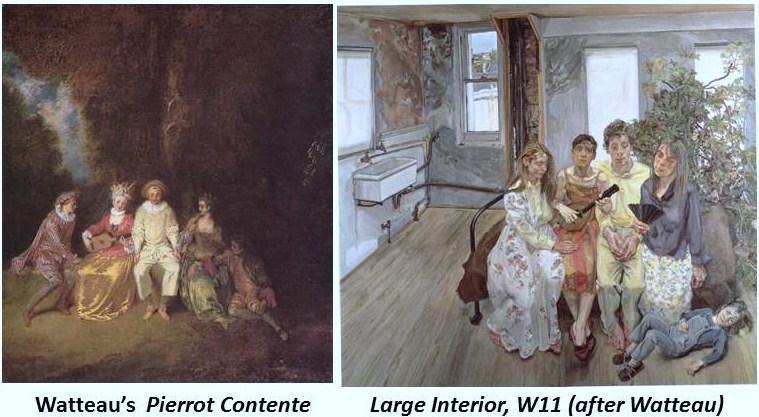
As with the Tate retrospective (with which there is an inevitable overlap), the works on display at the NPG clearly show the change in technique from fine sable brushwork to the heavy application using hog bristle which Freud settled on the late 1950s. Two of the Freud paintings on show were made with explicit reference to other artists (see below).
One of the NPG’s publications to go with their show is Painting People. This might have been more accurate description than Portraits, given that some of the subjects are as much concerned with the human form as portraiture. But there are many conventional portraits whch clearly demonstrate Freud’s ability to capture his sitter’s personality.
Lucien Freud Portraits continues at the NPG until 28 May. Without hesitation, my ‘Anticipointment Index’ rating (out of 5, the lower the better) is 1.
As with the Tate retrospective (with which there is an inevitable overlap), the works on display at the NPG clearly show the change in technique from fine sable brushwork to the heavy application using hog bristle which Freud settled on the late 1950s. Two of the Freud paintings on show were made with explicit reference to other artists (see below).
One of the NPG’s publications to go with their show is Painting People. This might have been more accurate description than Portraits, given that some of the subjects are as much concerned with the human form as portraiture. But there are many conventional portraits whch clearly demonstrate Freud’s ability to capture his sitter’s personality.
Lucien Freud Portraits continues at the NPG until 28 May. Without hesitation, my ‘Anticipointment Index’ rating (out of 5, the lower the better) is 1.
27 February 2011
Bridget Riley in London
Just off Trafalgar Square are two opportunities to see works from early and late in the career of Bridget Riley. She became well-known in the 1960s for her distinctive black and white (and later multicoloured) abstracts with marked optical effects – Op Art. Riley will be 80 in April and is still an active artist, as is Susan Hiller -a mere 70 - currently at Tate Britain. Bridget Riley: Paintings and Related Work at the National Gallery focuses on recent paintings, including two made directly on to the walls of the exhibition space. At the artist’s request, a selection of paintings from the Gallery’s collection are displayed which explain the relationship between her pictures and historical figurative work.
The small but free exhibition has been sponsored by Bloomberg, and quite possibly their support extended to the Catalogue. This is excellent value at £9.99 and expands considerably on the theme of the exhibition. The images of Riley’s Set Fair and Matisse’s Dance II (pages 37 and 38) seem particularly to make the point. The exhibition runs to 22 May.
![]() |
| Older Woman Looking Down Bridget Riley, c.1950 |
Nearby is a display, Camden Town and Beyond, of key portraits by leading members of the Camden Town Group, (Gore, Sickert) . It also explores the subsequent development of British post-impressionism in portraits by Augustus John and Mark Gertler. The display continues to 31 August.
Subscribe to:
Posts (Atom)