Showing posts with label Paul Nash. Show all posts

16 February 2015

WW1 British Art at the IWM

2014’s being the centennial of the outbreak of the First World War (WW1), was an opportunity with obvious appeal for the Political-Media Complex. The BBC even appointed a “centenary controller” in 2013 to oversee the "biggest and most ambitious pan-BBC project ever commissioned". As might be expected, the warning on an archived BBC History webpage, no doubt relegated early on in this grand projet, that “The war that 'would be over by Christmas' dragged on for four long years of bloody stalemate” went unnoticed. But the BBC’s coverage of WW1, once the “1914 Christmas Truce” was over, has turned out to be minimal, although we are promised a return to the Somme and Jutland in 2016. It is, of course, unfair to single out the BBC because most of the media seem to have lost interest in the centennial, although The Times is continuing to draw a 100 year-old item from its archive every day. The politicians are, of course, focussed on the 2015 election and the media has moved on to the 70th anniversary of the ending of WW2.


Most of the big art-related WW1 guns were fired off early too. The popular installation by Paul Cummins and Tom Piper, Blood Swept Lands and Seas of Red, in the Tower of London moat (above) ended in November 2014, although some of its 888,246 ceramic poppies will go on a UK tour. 888,246 is officially the number of British military fatalities in the war, a number which, by definition, couldn’t have been arrived at before November 1918, so the installation might have been more appropriate for the centennial of the Armistice in 2018. The Great War in Portraits at the National Portrait Gallery ran from 27 February to 15 June, ending well before the centenary of the assassination of Archduke Franz Ferdinand, let alone hostilities. But one exhibition, and probably the most significant art offering of the WW1 centennial, did manage to see out the first winter of the hostilities (a harsh one as shown in Eric Kennington’s oil on glass, The Kensingtons at Laventie, (1915 below), the London Imperial War Museum’s Truth and Memory: British Art of the First World War.


The exhibition was part of the reopening of the IWM last year after refurbishment and is the largest show of British First World War art for almost 100 years. Most of the 120 works come from the museum’s own holdings or Tate Britain’s. The division into Truth and Memory - two slippery entities in any context, let alone war art - was certainly expedient given that the two exhibition areas on the third floor of IWM are separated by the landing. On top of this distinction there is another theme: that the initial artistic response to the war may have been expressed in classical and heroic terms but that modernism turned out to be the more appropriate style for the emerging horrors of trench and aerial warfare. An added complexity in curation was the convoluted nature of the government’s sponsorship of war artists. As recorders their images didn’t always suit the government’s wish to maintain wartime morale, and as memorialists their works turned out to be too large for the accommodation post-War governments were prepared to finance. To quote Waldemar Januszczak (his review of Truth and Memory is the best I’ve seen):
No one was sure where to place it [the IWM], or what to do with the art that might go in it. The original idea was to build a new museum commemorating the war in Whitehall, but that proved too expensive. The art was initially put on show in the Crystal Palace, in Sydenham, where the glass walls proved thunderously inappropriate for the showing of pictures. Next, they took it to South Kensington, to galleries adjoining the Imperial Institute, which stood where Imperial College stands now. Finally, after a further decade of muddling, the Imperial War Museum and its great collection of First World War art was installed in its present home, in the building that used to house the most notorious madhouse in the world, Bethlem Royal Hospital — “Bedlam”.
Some of the war artists’ works were passed on to the Tate Gallery, for example CRW Nevinson’s La Mitrailleuse (1915 below left) and Bursting Shell (1915 below right):


Works by Nevinson and Orpen, for example his Dead Germans in A Trench (1918 below left) and The Mad Woman of Douai (1918 below right) dominate the Truth side of the exhibition. Most of Orpen’s work here is in marked contrast with his portraits at the NPG. He gifted his WW1 works to the nation (in 2005 the IWM’s William Orpen Politics Sex and Death provided an opportunity to see these works in the context of his whole career).


The Memory section of the IWM show seemed to attract fewer visitors when I was there, oddly given that there are major works on show, exciting to see as large originals. Both Nash brothers are well-represented: John Nash’s Oppy Wood, 1917: Evening (1918) and 'Over The Top'. 1st Artists' Rifles at Marcoing, 30th December 1917 (1918, below):


and Paul Nash’s We Are Making a New World (1918 below top) and The Menin Road (1919 below lower): 


There are also a major works by the Vorticist, Percy Wyndham Lewis, A Battery Shelled (1919, below top) and by Stanley Spencer, Travoys Arriving with Wounded at a Dressing Station at Smol, Macedonia, September 1916 (1919, below lower):


And there are some interesting pictures of life on the home front in hospitals and munitions production. Anna Airey’s Shop for Machining 15-inch Shells: Singer Manufacturing Company, Clydebank, Glasgow, (1918 below) is a remarkable picture of arduous work by women:


Memory concludes with some very large pieces including Charles Sergeant Jagger’s plaster relief of The Battle of Ypres: The Worcesters at Gheluvelt (1919, below top), Orpen’s controversial To the Unknown British Soldier in France (1921) and, of course, John Singer Sargent’s 2.3 metre-wide Gassed (1919 below lower):


Truth and Memory ends on 8 March, so the opportunity to see some of the finest British 20th century art will be over by Easter, you might say.


7 September 2014

John and Paul Nash at RWA Bristol

Perhaps because Britain has a hereditary monarchy, we seem to look kindly on dynastic successions (acceptable even to the political left – the ‘Red Princes and Princesses’) but are reluctant to consider brothers as equals. One Johnson or Dimbleby is regarded as numero uno – fairly or possibly unfairly, for example in the case of the Attenborough brothers. One wonders if some people will ever forgive Ed Miliband for overturning what was perceived as the correct order of things. When it comes to the painters John Nash (1893-1977) and Paul Nash (1889- 1946), it’s Paul who is the more highly regarded, so part of the interest of Brothers in Art: John and Paul Nash at the Royal West of England Academy (RWA) Bristol is to see whether in this case the consensus view is the correct one.

This show is part of a wider RWA activity:
Back from the Front - Art, Memory and the Aftermath of War is a programme of exhibitions and events at the RWA commemorating the start of The Great War, and 75th anniversary of the start of the Second World War. It explores the theme of conflict and memory across a series of interrelated exhibitions …
So it is disconcerting that although both brothers were official war artists in both World Wars when they produced major paintings, there are only peacetime works, landscapes mostly, in Brothers in Art, some from just before the First World War, the majority from the interwar years. Accepting this constraint, among the 40-odd items on display, there are some interesting pieces to see, particularly works by John which are less familiar than those of his brother, for example, A Gloucestershire Landscape (1914, below top) and The Cornfield, (1918, below lower):


Although there are similarities in the brothers’ approach to landscape in the years after the First World War – John’s The Edge of the Plain (1926, below top) and Paul’s Dymchurch (c1921-4 below lower):


Paul’s interest in modernism would lead to Landscape of the Megaliths (1934, below top) and to the surrealistic Equivalents of the Megaliths (1935, below lower):


The absence of any wartime works means that the visitor cannot progress to the next stage of Paul’s work such as his celebrated Battle of Britain, 1941 (see a post here earlier this year) and Totes Meer (Dead Sea) 1940-1. Similarly, there is no opportunity to examine the relationship of John’s The Farm Pond (1940, below top) to his Oppy Wood, 1917: Evening (1918, below lower):


However, there are some interesting examples of John’s skill as an engraver and illustrator, something which is explored further in Paul Gough’s catalogue Brothers in Art: John and Paul Nash and the Aftermath of the Great War.  For a much more informed opinion than this one, see Andrew Lambirth’s review in the Spectator.

Brothers in Art: John and Paul Nash ends on 14 September.


12 June 2014

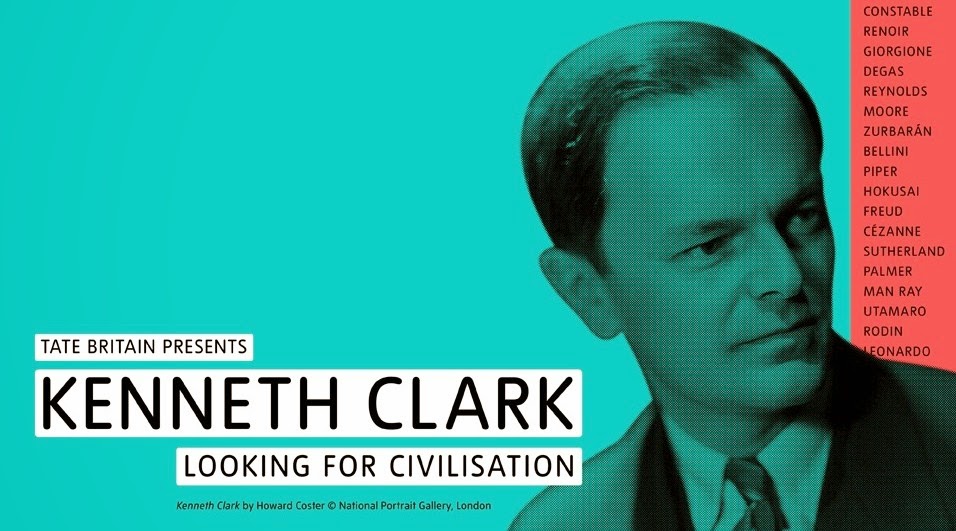
Lord Clark at Tate Britain


Kenneth Clark (1903-1983) was not only born in the same year as Evelyn Waugh, (mentioned in recent posts here), but also became well-known at a young age in the 1930s. Clark, unlike Waugh, was born into considerable wealth and, after studying the history of art at Oxford and coming under the influence of Roger Fry, was able to spend time in Italy with the American art historian Bernard Berenson, specialising in the Renaissance. On return to England he became Curator of the Ashmolean Museum in Oxford and then Director of the National Gallery from 1930 to 1946. His public service also included being Surveyor of the King’s Pictures, and chairmanships of the War Artists' Advisory Committee, the Arts Council of Great Britain and the Independent Television Authority. In 1969 Clark wrote and presented a celebrated TV series on the history of Western civilisation for BBC television, later shown in the US. When he subsequently received a life peerage, Private Eye dubbed him Lord Clark of Civilisation. The Tate Britain exhibition, Kenneth Clark - Looking for Civilisation, is a survey of his life’s work and brings together art that he had dealt with professionally, had benefitted from his patronage or that he had collected personally.

Not surprisingly, there is much to look at in this show. The 270 objects on display include some which are unfamiliar and may not be seen in public again for a while (one can hazard a guess as to which ‘Private Collection’ they come from). The first room is the most personal with Graham Sutherland’s portrait, Kenneth Clark (1963-64, left), and focusses on his early years. This is followed by works he collected for himself (Seurat’s The Forest at Pontaubert, (1881 below left) or, as Director of the National Gallery, for the nation, for example Constable’s Sketch for Hadleigh Castle (1828-9, below right), later transferred to the Tate. Some of the attributions he made when purchasing for the National Gallery do not seem to have stood the test of time particularly well. However, it was under his Directorship that the Gallery’s Scientific Department was formed, and the techniques which are now available to support judgements on authenticity began to be developed. In the 1930s Clark purchased for himself late works by Cézanne, as would Henry Pearlman a decade later and probably at a much higher price. A Cézanne pencil drawing, Still life, Pain sans mie, 1887-90, is particularly interesting in that its inclusion of commercial typography (“bread without crumbs”!) anticipates Picasso and Braque (but see the 1 July update below).


Clark not only collected but was an active patron looking favourably on Henry Moore (Recumbent Figure, 1938, right), Graham Sutherland, Paul Nash, and John Piper. He did not care much for abstraction (the Ben Nicholson on show seems to have been an exception), Francis Bacon or Lucien Freud’s later work. The fifth and largest space in the show is given over to the War Artists, most of whom worked in the Romantic style Clark liked, and is one of the most interesting. Although familiar in reproduction, the opportunity, during the Imperial War Museum’s closure, to see Paul Nash’s Battle of Britain (1942, below) and one of Moore’s shelter drawings (Tube 1941, below, lower) is welcome.


Among many impressive wartime pictures, ones which caught my eye were John Piper’s Somerset Place, Bath (1942, below,) and Albert Richards’ The Landing: H Hour minus 6. In the Distance Glow of the Lancasters Bombing Battery to be Attacked (1944, below, lower).


The final room concentrates on Clark’s activities after the war, particularly his involvement with television. The BBC are reportedly considering a new Civilisation series:
… "re-imagined … for the digital age". Unlike the original, it is likely to have a number of different presenters.
If so, I hope one of them will be Lisa Jardine, the daughter of Jacob Bronowski. His 1973 television series, The Ascent of Man, was complementary to Clark’s and looked at the rise of science as opposed to art, architecture and philosophy.

Just before leaving the exhibition, visitors can see two of the finest works acquired by Clark: a Francisco de Zurbarán still life, A Cup of Water and a Rose (c1630, below left), and Cézanne’s Le Château Noir (c 1904, below, right).


Kenneth Clark - Looking for Civilisation ends on 10 August and anyone with an interest in British art should try to get to Tate Britain before then. The most thought-provoking review I have come across is Kenneth Clark: arrogant snob or saviour of art? by James Hall in the Guardian.


A MINOR QUERY FOR THE CURATORS

In the first room there is a showcase (vitrine?) of Clark family photographs. One of these is of a villa owned by Clark’s father and (when I saw it) was labelled as being Clark’s childhood home in South West France at Cap Ferrat. I thought this unlikely. Although before the First World War Arcachon, on the Gironde department’s Atlantic Coast, was a fashionable resort, the village of Cap Ferret, nearby by sea but remote by land, was little more than a few oyster fishing huts (rather different now). However, Cap Ferrat (Saint-Jean-Cap-Ferrat) on the Mediterranean in the Alpes-Maritime department in South East France had become a magnet for the ultra-wealthy around 1900 and remained so. The Clark villa seems to be in the “Renaissance” style consistent with that location and, of course, Clark’s father was supposedly “the man who broke the bank at Monte Carlo”, not Biarritz. It might be worth checking.


UPDATE 1 JULY

A footnote to Cézanne’s use of commercial typography: I have recently come across this image of The Artist's Father, Reading "L'Événement", 1866, now in the National Gallery of Art, Washington DC. Apparently it wasn’t Louis-Auguste’s favourite paper but Cézanne’s old friend Emile Zola was L'Événement’s art critic.


5 August 2013

'A Crisis of Brilliance' at the Dulwich Picture Gallery

When an exhibition gets good reviews from professional art critics, even I start to wonder why I bother with my tuppenceworth. So if you want to stop reading here about Nash, Nevinson, Spencer, Gertler, Carrington, Bomberg: A Crisis of Brilliance, 1908-1922 (its very full title) and instead find out what Brian Sewell or Andrew Lambirth had to say about it, I really won’t mind.


So what can I add? Having read the book and seen the exhibition, I can opine that if one was of interest, the other will be too. The book, David Haycock’s A Crisis of Brilliance Five Young British Artists and the Great War, came out in 2010. His five were Stanley Spencer, Paul Nash, Mark
Gertler, Richard Nevinson and Dora Carrington; the exhibition which Haycock has now curated includes David Bomberg as well. The notion of this group engendering a “crisis of brilliance” came from Henry Tonks, teacher and professor at the Slade from 1892 to 1930 (apart from war service), who had first applied it to a previous generation of his students there in the 1890s which had included Augustus and Gwen John and Percy Wyndham Lewis. Both his crises were the existence of a superfluity of talent in particular cohorts of students whereas Haycock’s crisis reveals itself as the one inflicted by the First World War on the six contemporaries in the Dulwich exhibition.

In the catalogue Haycock provides a very helpful description of the sequence of art exhibitions and of the groups of artists which were being formed in the years just before the War. The most important of the former were the 1910 Manet and the Post-Impressionists exhibition and the 1912 Second Post-Impressionist Exhibition, both organised by Roger Fry. It was the latter show which Tonks advised his students, all about 20 at the time, to avoid – what could have been more guaranteed to ensure their attendance? In1912 London was also introduced to Italian Futurism which would lead to the appearance of Wyndham Lewis’s Vorticism movement just a few months before the War began.
 

Although visitors encounter Bomberg’s In the Hold (1913-14) (above) juxtaposed with Dulwich’s old masters before entering, the exhibition adopts a chronological approach and starts with works showing the initial impact of exposure to modernism and futurism on a group of students originally preoccupied with early Renaissance Italian art (John Currie’s Some Later Primitives and Madame Tiscaron (1912) below).
 

Examples are Stanley Spencer’s Apple Gatherers 1912-13 and Paul Nash’s Apple Pickers (1914), both regarded as being influenced by Gauguin (below left and right) and Gertler’s The Fruit Sorters in the exhibition poster.
 

Subsequently the show makes clear how this exposure to modernism conditioned the group’s artistic response to the dislocations and innovations (eg Nevinson’s Futurist Spiral Descent 1916 left) of the First World War and the consequences for their work in the years after 1918. Two major works which were not made available to the exhibition were Gertler’s masterpiece, Merry-Go-Round (1916), which is a highlight of Tate Britain’s recent rehang, and Nash’s The Menin Road (1919) which is owned by the currently closed Imperial War Museum (below left and right). Hopefully the First World War centenary programme the UK government is running from 2014 to 2018 will include a major exhibition of art from the period to put the work of the Dulwich six in a wider context.


Does the Dulwich show work? On the whole exhibitions concentrate on one artist in retrospect or bring together artists who, if only for a period, embraced a similar artistic philosophy, be it Pre-Raphaelite or Bauhaus. Haycock’s book impressed by skilful intertwining of the biographies of his five subjects, but inevitably it is a different proposition for an exhibition to provide six retrospectives in parallel. The individuals concerned had the War in common, but had different experiences with varying effects on their art. Their lives would come to disparate ends, some distinguished, some tragic. Anyone interested in 20th century English art will find the Dulwich exhibition rewarding, but Haycock’s book or the exhibition catalogue are likely to prove very helpful in providing wider context to the works on display. Nash, Nevinson, Spencer, Gertler, Carrington, Bomberg: A Crisis of Brilliance, 1908-1922 closes on 22 September.


FOOTNOTE

Bomberg taught in one of London South Bank University ‘s predecessor organisations and its Borough Road Gallery is now providing opportunities to see his work.


16 October 2012

Non-appearances can be deceptive, too!

The Royal British Legion is the UK’s leading charity in support of serving and former members of the armed forces and their families. It was founded in 1921 when Earl Haig became its first president. His direction of British forces in France from 1915 to 1918 continues to be a subject of controversy among historians. However, the Legion is famous now for its major fund-raising activity, the Poppy Appeal. British politicians rarely appear in public from late October to 11 November not wearing a poppy. So it was surprising when Paul Staines and Harry Cole reported in their Guido Fawkes column in 14 October’s Daily Star on Sunday that:
DURING his leader’s speech at the Tory Conference last week, David Cameron emotively led the hall in a standing ovation for our troops to “show how profoundly grateful we are for everything they do”. Yet this year was the first time ever that a Tory party leader has failed to put in an appearance at the Royal British Legion’s reception at the Conservative Party Conference. Downing Street tells Guido that while “the Prime Minister is very supportive of the Royal British Legion and the excellent work they do…unfortunately he is unable to attend more than a tiny number” of receptions at conference. An event for property developers Canary Wharf Group was one of the tiny number he did manage to attend. It was held at the same time as the Legion’s reception, in the room next door. Seems our wartime leader misplaced his gratitude.
However, immediately after his party’s Conference on 11 October the PM had announced in a speech at the Imperial War Museum (IWM) the government’s plans to mark the centenary of the start of the First World War in 2014, mentioning the Legion twice. A possible explanation for Cameron’s non-appearance at the Legion event in Birmingham may be a story in the Sunday Times (£) also on 14 October. This was an exposé of former senior military officers who were claiming to be able to lobby Whitehall on behalf of defence firms. It stated that:
The Royal British Legion began an investigation after Lieutenant-General Sir John Kiszely, its president, was named as one of six former commanders recorded by undercover reporters, who claimed they represented a South Korean arms firm looking for business. Sir John was quoted by The Sunday Times as saying that he could use his role at the charity to promote the company’s agenda with the Prime Minister and other figures at Remembrance Day events.  
… Sir John described how his role at the Legion exposed him to various senior figures. “It sounds totally grand: you’re standing there waiting for the Queen with nothing else to talk about to Philip Hammond than whatever,” he said. The Falklands veteran also claimed that the Festival of Remembrance for Britain’s war dead was a “tremendous networking opportunity”. Contacted by The Sunday Times after the sting, the Sir John said that he had always kept his commercial interests “entirely separate” from his role with the Legion and had never used access gained through it to discuss any business interests.
On 15 October, Kiszely resigned as Legion president. And possibly the Number 10 press team in the days before the story broke had been living up to their reputation for competence.

In his speech Cameron made the point that:
However frustrating and however difficult the debates in Europe, 100 years on we sort out our differences through dialogue and meetings around conference tables, not through the battles on the fields of Flanders or the frozen lakes of western Russia.
The Menin Road by Paul Nash
(next to the PM at the IWM on 11 October)
Libby Purves in The Times on 15 October, writing in support of the recent award of the Nobel Peace Prize to the EU, put it more pointedly:
Maybe our present justifiable disgruntlement with the EU (I see even Michael Gove is joining in) will actually be tempered a little by the coming year of remembrance of the 1914-1918 war. We will be made to see the horror of that period more clearly than we ever do through the fuzzy sentimentality of Downton or the poppy-wreath dignity of the Cenotaph.  
… The EU is, very often, a pain in the neck. But it is part of an attempt never to do it again: to create what Churchill called a “richer, freer, more contented European commonality”. OK, Churchill didn’t think Britain should be actually inside it (“We are linked but not compromised, interested and associated but not absorbed”) but he spoke for his own proud, bruised times. Whether or not Britain should stay within its sticky and often mismanaged embrace, I do not know. But looking across the Channel, and remembering worse times, it would be wrong to begrudge the EU its prize.
A post here earlier this year contained a quote from Cameron:
If your vision of Britain was that we should just withdraw [from the EU] and become a sort of greater Switzerland, I think that would be a complete denial of our national interests.
It will be interesting to see what line (if any) the WW1 centenary activities will take about the UK’s relationship with a historically belligerent Europe. I would be surprised if it were one to help UKIP.