Showing posts with label Richard Long. Show all posts

2 November 2015

British Sculpture 1950-2015 at Chatsworth

Since 2006, Sotheby’s have staged annual selling exhibitions of sculpture, Beyond Limits, in the grounds of Chatsworth House, the ancestral seat of the Duke and Duchess of Devonshire and a masterpiece of English baroque architecture. This year’s tenth anniversary exhibition was Beyond Limits: The Landscape of British Sculpture 1950-2015 which ran from 14 September to 25 October. Tim Marlow, Artistic Director at the Royal Academy was the guest curator and also author of an essay for the exhibition catalogue, A Topography of British Sculpture. The sculptures were not arranged at Chatworth in a chronological sequence but the approach in Marlow’s essay was primarily historical and is echoed here.

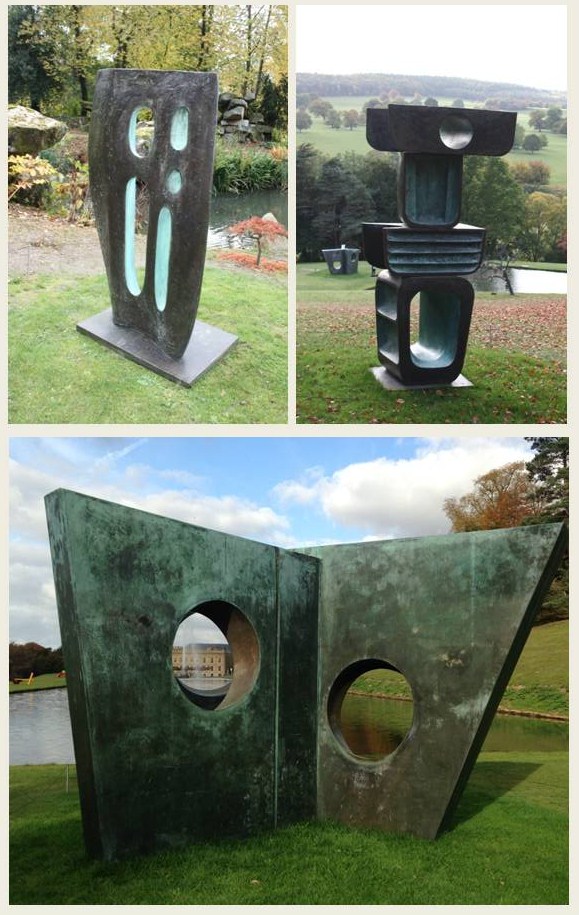
Marlow starts his survey by identifying Henry Moore and Barbara Hepworth as the ‘presiding spirits’ who led post-war British sculpture into the Modernist and post-Modernist mainstream of Western art. One of the inevitable shortcomings of the recent Tate Britain Hepworth show was its inability to place Hepworth’s larger works outdoors, something which Beyond Limits was well-placed to rectify with three pieces: Sea Form Atlantic (1964, below top left), Three Obliques (Walk In) (1969, below lower) and The Family of Man: Figure 1, Ancestor 1 (1972, below top right with Three Obliques (Walk In) in the distance).

After appearing in the British Pavilion at the 1952 Venice Biennale, a group of some younger sculptors became associated with the ‘Geometry of Fear’; for example, Reg Butler (Manipulator,1954, below left) and Lynn Chadwick (Pair of Walking Figures – Jubilee, 1977, below right):


It was in the 1960s that it became apparent that a serious, internationally respected but fundamentally British tradition” of sculpture had emerged, something which in Marlow’s view “became one of the great, yet understated, success stories of post-war British culture". Talents which emerged at this time included Kenneth Armitage (Monitor, 1961, below top) and William Tucker, whose Genghis Kahn (1963, below lower) seems ahead of its time:


Anthony Caro (Sunshine, 1964, below left) had a major exhibition at Chatsworth in 2012 while a post here recently covered the current Arnolfini Richard Long show (Cornwall Slate Line, 1990, below right):


The 1980s, the period of the 'New British Sculpture', saw the emergence of major figures such as Anish Kapoor and Antony Gormley. Gormley’ s Big Gauge II (2014, below top left), Tony Cragg’s Manipulation (2008, below top right) and Stephen Cox’s Kiefer-like Dreadnought: The Problems of History - The Search for the Hidden Stone (1990 to 2015, below lower) are later works.


The prominence of the YBAs since the nineties was reflected in Beyond Limits, though I don’t altogether share Marlow’s enthusiasm for Hurst. Sarah Lucas’s Florian and Kevin (2013, below upper and lower respectively) were produced at Pangolin.


Gavin Turk’s Habitat (Burgundy) (2004, below left) and American Bag (2015, below right), contrary to appearance, are painted bronzes, not as impressive as his Nomad, seen at Crucible2 last year.


Marlow’s survey finishes with two complex works, both with archaic resonance, Thomas Houseago’s Hermaphrodite (2011, below left) and Bill Woodrow’s Regardless of History (1998, below right):


Two pieces which were not specifically mentioned by Marlow were Bernard Meadows’ Large Standing Armed Figure (1962, below left) and the recent Conrad Shawcross, The Dappled Light of the Sun, I-III (2015, part below right):


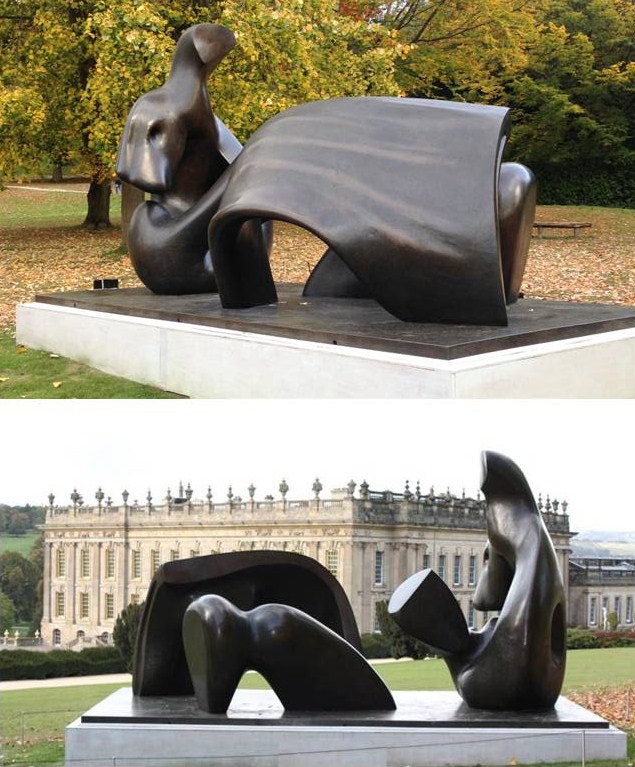
To end where the survey began, two views of a fine Henry Moore, Three Piece Reclining Figure: Draped (1975):


29 August 2015

An Arty Day in Bristol

Bristol is the largest conurbation in South West England. The extent of its built-up area is not well-defined but its population is of the order of 500,000 - about 10% of the region’s. Bristol is not a city I enjoy going to but it is well-known for its art scene – Banksy is a Bristolian – and some current shows seemed worth a visit.

The Arnolfini arts centre moved to the run-down docks area of central Bristol 40 years ago and regards itself as having set a precedent for Tate Liverpool, the BALTIC and even the Guggenheim Bilbao as a force for regeneration. Looking at this building, just round the corner from the Arnolfini, it’s clear that there is still more to be done.

The current exhibition at the Arnolfini is Richard Long TIME AND SPACE. Long ,like Banksy, is a Bristol artist with a global reputation – for example, CAPC in Bordeaux owns nine of his works including two stone lines (Slate Line Cornwall 1981 left) – but has had shows at the Arnolfini since 1972. Long’s work can be described as conceptualist and minimalist but it also conveys the artist’s personal response to his environment. There seem to be three main areas of activity. He is probably best-known for his sculptures – assemblies of stones in the landscape or indoors, like Time and Space  (2015, below) created for this exhibition:


and sculptural images like Bristol 1967/2015, recreated for it:


There are also some of his textworks:


and drawings using mud – on driftwood:


and on a larger scale directly onto the gallery walls in the form of Muddy Water Falls, 2015 made with mud from the banks of the Avon:


Long has also created Boyhood Line, 170 metres of white limestone on The Downs at Clifton in Bristol as part of the Arnolfini show.

Boyhood Line and Richard Long TIME AND SPACE continue until mid-November.

At the RWA (Royal West of England Academy) in Clifton are two exhibitions which will soon be ending. The first is Peter Randall-Page and Kate MccGwire. At first sight, one of Randall-Page’s sculptures, Wing (2009 below), has something in common with Long’s arrangements of stones, but the terra cotta tile arrangement was inspired by a microscopic study of a grasshopper wing:


The bronzes in the foreground, Inside Out (2014, above), like much of his work, are inspired by biological shapes and forms. Kate MccGwire draws from nature even more directly making complex abstract geometries with feather surfaces. Skirmish (2015, below) is made with pheasant feathers and shown in an antique dome: 


while Gyre (2012, below) was made over four years with crow feathers:


Peter Randall-Page and Kate MccGwire ends on 10 September.

The other RWA show is Into the Fields: The Newlyn School and Other Artists which was at Penlee House Penzance earlier as Sons and Daughters of the Soil. I’ve posted about art in Cornwall several times and the Newlyn artists as recently as 2013. On this occasion the net has been spread wider than Penlee’s excellent collection to fetch in other painters en plein air under the influence of the Barbizon School with works like George Clausen’s In the Orchard (1871, below left) and Henry La Thangue’s Landscape Study (c1889, below right), neither set in Cornwall:


There are, as to be expected, quite a few works by Harold Harvey, for example, Blackberrying (1917, below left) and The Clay Pit (1923, below right):


And, of course, Samuel John ‘Lamorna’ Birch, for example his Morning Fills the Bowl (1926, below top) and Laura Knight’s impressive if busy Spring (1916-20, below lower):


The model in this picture is Ella Naper, better-known in the same artist’s famous Artist and Model.

Into the Fields: The Newlyn School and Other Artists ends on 6 September.


ADDENDUM 11 September 

If my reservations about Bristol seem unwarranted to those who like the city, they should read Bristol, the European capital of green nannying and bureaucracy, in the Spectator on 5 September by a Bristolian, Anthony Whitehead – and the comments.