Showing posts with label Francis Bacon. Show all posts

29 May 2015

A Visit to the Fondation Louis Vuitton


Note: this post is based on a visit to the Fondation in early May 2105 

The Fondation Louis Vuitton in Paris was opened in October 2014 by Francois Hollande, President of France, and Bernard Arnault, President of LVMH - Moët Hennessy Louis Vuitton - and one of the wealthiest people in France. In 2001 he visited the Guggenheim Museum in Bilbao and met its architect, Frank Gehry. Five years later the Fondation was established as a private cultural initiative by LVMH to support contemporary artistic creation. Under a 55 year lease from the City of Paris, the Fondation’s building, designed by Gehry, is set in one hectare of land in the Bois de Boulogne next to the Jardin d’Acclimatation.

Like Gaul, a visit to the Fondation can be divided into three parts: the current exhibition, the display from the permanent collection and the building itself.

Keys to a Passion

In May 2015 the current exhibition is Les Clefs d’une passion (Keys to a Passion), “a selection of major works from the first half of the 20th century that established the foundations of modernity”. It is organised into four sequences: Subjective Expressionism, Contemplative, Popist (popiste) and Music which are in accord with the themes which structure the Fondation’s own collection (… en resonance avec les quatre axes structurant, de façon plastique et mouvante, la collection …).

Subjective Expressionism “evokes the questions each of us have about life, death, anguish, solitude and the desparate rage to live, despite oneself, despite others …”. It also provides a chance to see Munch’s The Scream (1893? 1910?, below left), a work normally confined to the Munch Museum in Oslo and not made available for the 2012 Pompidou Centre/Tate Modern Munch exhibition. That show was, of course, intended to have a post-1900 emphasis but so has Keys to a Passion!


A series of self-portraits (1934, above right) by Helene Schjerfbeck (1862-1946), a painter known best in her native Sweden, stand up to their proximity to The Scream. As well as a sculpture and two oils by Giacometti, this section includes two major 1949 works by Francis Bacon, Study from the Human Body (below left) and Study for Portrait (below right):


a Malevich not at Tate Modern in 2014, Complex Presentiment or Bust with a Yellow Shirt (c 1932, below left), and Otto Dix’s Portrait of the Dancer Anita Berber (1925, below right):


Contemplative occupies three rooms, the first dominated by two of Monet’s Water Lilies of 1916-19 borrowed from Paris museums. On one side of the room are four lake and mountain landscapes by the Swiss painter Ferdinand Hodler, on the other there are four studies of Lake Keitele from 1904-05 by the Finnish painter Aksell Gallen-Kalleila, one from the National Gallery in London. Complementing these are five seascapes, two by Emil Nolde and three from 1909 by Mondrian, the style of these being in marked contrast to some of his later works in the next room, for example Composition in line, second state (1916-17, below left) and Lozenge Composition with Yellow Lines (1933, below right):


However, this room is dominated by three of Malevich’s most significant works (again not at Tate Modern) lent from St Petersburg: Black Square, Black Cross and Black Circle, all c1923 and pointless to reproduce individually. They can be seen in the photograph (below top) with two of the Mondrians (including the one above left) and Brancusi’s Endless Column Version 1 from 1918. Opposite the Malevich’s, and to me as inducing of contemplation as the Monets, is a Rothko, No 46 (Black, Ochre, Red over Red) (1957, below lower):


In the next room an interesting Bonnard (Summer, 1917) is, to put it kindly, at a disadvantage near to a Picasso plaster sculpture (Head of a Woman with Large Eyes, 1931) and three of his Marie-Thérèse Walter paintings. One of these (Nude Woman in a Red Armchair, 1932) is familiar in London from Tate Modern, as Woman with Yellow Hair (1931, below left) and Reading (1932, below right), no doubt are in New York (Guggenheim) and Paris (Musée Picasso) respectively:


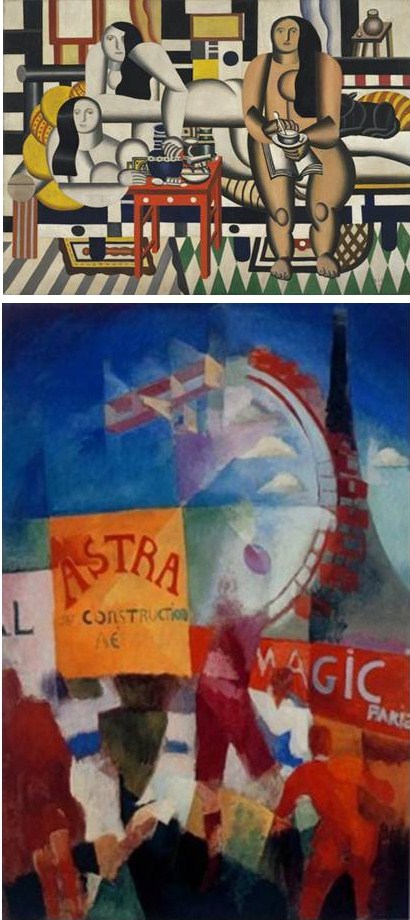
I found Popist the least successful of the four sequences. Picabia arguably anticipated Pop art and deserves a place in a section “resolutely engaged with the vitality, momentum and progress of modern life” but five large pictures, three of them nudes “veer[ing] between a joyous exaltation in nudity and a vaguely salacious eroticism”? Again three Legers, Three Women, (1921-22, below top), but the one other painting in the sequence, Robert Delaunay’s The Cardiff Team (1912-13, below lower) was new to me:

Music provides a triumphant conclusion to the exhibition, the four Kandinsky panels and works by Kupka and Severini being swept aside by two Matisse masterworks, The Dance (1909-10, below top) from St Petersburg and The Sorrow of the Kings (1952, below lower) from the Pompidou Centre in Paris (not lent to the Tate Modern/MoMA show last year):


Keys to a Passion certainly achieves its goal in bringing together some of the major art works of the 20th century. These include items which rarely travel, and for that as well as other reasons is worth making an effort to see before it ends on 6 July.


Items from the Permanent Collection 

Walking through these I was struck by Rachel Harrison’s Zombie Rothko (2011, below left) and Maurizio Cattalan’s Charlie don’t surf (1977 below right – the attendant and photographers are not part of the work). Harrison was awarded the Calder Prize in 2011 for exemplary work in the spirit of Alexander Calder.


It was pleasing to see works by UK artists including Ed Atkins’ video installations Us Dead Talk Love (2012) and Even Pricks (2013) and Tacita Dean, including her Lightning Series (2007) and Hünengrab (2008, below top). According to the caption it is one of a series depicting megalithic prehistoric stone formations in Cornwall (SW England). The series was inspired by Caspar David Friedrich’s Walk at Dusk (c1830-35, below lower), hence the title (Giant’s Tomb).


A large space is given to Sigmar Polke Cloud Paintings (1992-2009, below) – four paintings and a 4-billion-year-old meteorite, the third biggest discovered after a Siberian meteor shower in February 1947:


A small gallery is showing several works by Ellsworth Kelly, who was commissioned to provide works for the Auditorium (see below). These include Green Relief (2009, below left), Blue Diagonal (2008, below centre) and Purple Curve in Relief (2009, below right, lent by the artist):


There are also some fine Giacometti sculptures including Buste d’Homme assis (Lotar III), (1965, below left) and Grande femme II (1959-60, below right):


 THE GEHRY BUILDING 
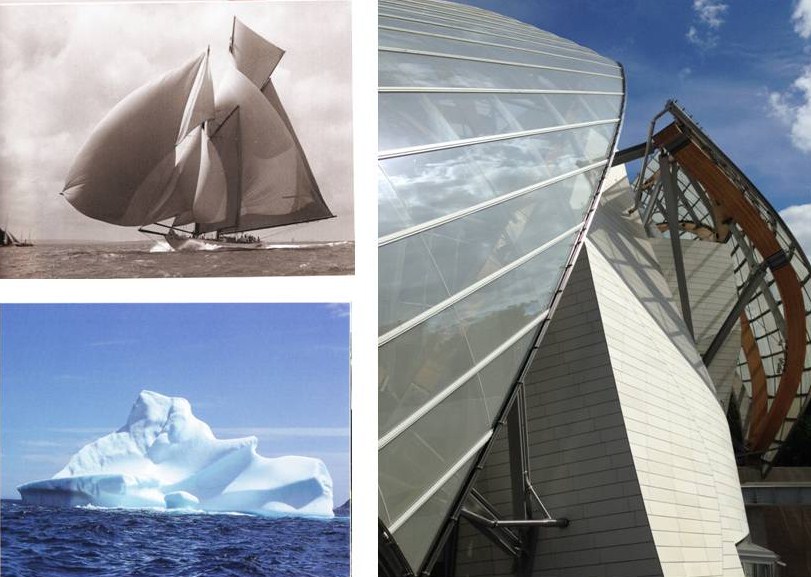

The interior of the Fondation building, containing the 11 gallery spaces (the underground ones vastly better than their equivalents at the National Gallery Sainsbury Wing in London), the Auditorium, shop and so on, is restrained and functional in contrast to the exterior. Some of the inspiration for Gehry’s design seems to have come from a yacht, the Susanne, built in 1911 and an iceberg (above), as well as from some of Paris’s famous metal and glass structures like the Grand Palais. The building is covered with over 19000 panels of white Ductal ® high performance cement (beton) and moving around the building and on the terraces provides a series of contrasts between the “iceberg” and the glass and steel “sails”. Its advanced design, fabrication and construction are a credit to French engineering.


There are some remarkable views over Paris and the Jardin, for example towards La Defense (below top). One of the terraces is displaying a living sculpture made of found objects by Adrian Villar Rojas, Where the Slaves Live (2014, below lower):


Inside are the Ellsworth Kelly works commissioned in 2014 for the Auditorium including Spectrum VIII (below right) and Color Panels Yellow and Red (below left).


Is the Fondation Louis Vuitton worth a visit? Definitely, but it may be a while before there is another show quite like Keys to a Passion.


UPDATE 3 JULY

Hopefully anyone in the UK interested in Frank Gehry will have been able to see Alan Yentob’s documentary, Frank Gehry: The Architect Says "Why Can't I?", in the BBC1 imagine strand before it disappears into iPlayer limbo.

Among the many points of interest are firstly that Gehry, when designing the Guggenheim Museum Bilbao in the mid-1990s, made use of what was at the time advanced software from France’s Dassault Group, aerospace being one of its main activities. Secondly he lived in Paris with his young family and the Jardin d’Acclimatation has very personal memories for him.


10 March 2015

The Van Gogh Museum, Amsterdam


I remember years ago reading a holiday brochure which was urging travellers to visit Arles in southern France, one of its attractions being a Van Gogh museum. Well certainly Arles was the setting for some of Vincent van Gogh’s most famous paintings, eg The Yellow House (1888 above), but there’s no Van Gogh museum there, nor is there ever likely to be, unless Amsterdam’s Museumplein, along with the rest of northern Europe, is threatened by an ice sheet. In the meantime, thanks to van Gogh’s descendants, the world’s largest collection of his works remains in the country of the painter’s birth at the Van Gogh Museum in Amsterdam, very near the Reijksmuseum. Anyone visiting the city should take the opportunity, if they can, to see the originals of some of the most famous images in art, like The Bedroom/Bedroom in Arles (1888, below – there are other versions in Paris and Chicago).


On the Museum’s ground floor there is an introduction to van Gogh (1853-90), mainly in the form of a series of self-portraits, concentrating on the ten years up to his death, the dominant period of his artistic life. (Below right: Self Portrait with Grey Felt Hat, 1887; below left: a portrait by his Australian friend, John Peter Russell, Vincent van Gogh, 1886) A display case shows a palette that van Gogh used and some of his tubes of paint. These had come into use in the 1840s, and were being filled with the new pigments developed by chemists in the 19th century (but see below). Renoir said that “Without tubes of paint, there would be no Cézanne, no Monet, no Pissarro, and no Impressionism” and, one can assume, no van Gogh.


On the first floor the visitor’s initial encounter is with work from van Gogh’s early years as an artist in Brussels and Holland, sombre landscapes and studies of peasant life. Probably the best-known is The Potato Eaters (1885 below):


But in March 1886 Vincent moved to live with his brother Theo in Paris. Tuition and encountering Impressionism had a transformative effect on his art. Among the artists he met was Henri de Toulouse-Lautrec, whose Young woman at a table (Poudre de riz, 1887, below left) was owned by Theo and eventually passed to the Museum. Vincent painted his lover, a café owner, in a similar style – In the café Agostina Sagatori in Le Tambourin (1887, below right):


Van Gogh put on an exhibition of his Japanese woodcuts in Le Tambourin. These had become available in the 1870s and were admired by contemporary artists. Not only were some of his works - Bridge in the rain (1887, below left) directly after Hiroshige, but others like Fishing Boats on the Beach at Saintes-Maries (1888, below right) reveal the indirect influence of Japanese art.


In the spring of 1888, and sponsored by Theo, van Gogh left Paris for Arles where he would work frenetically, attempt to set up an artists’ colony in the Yellow House, and be joined later in the year by Gaugin. Works from this time are on the Museum’s second floor, for example, The Harvest (1888, below left) and Gaugin’s Chair (1888, below right):


And one version of probably his most famous work, Sunflowers:


There are two series of van Gogh Sunflowers. The first is of four pictures all made in Paris, the second is of four painted in Arles in 1888 with three more “Repetitions” made in 1889. Last year the Van Gogh Museum’s Repetition was exhibited in London alongside the National Gallery’s 1888 version (below left). The NG’s Vincent’s Chair (1888, below right) is shown for comparison with Gaugin’s Chair and The Bedroom, both above.

Both in the National Gallery, London
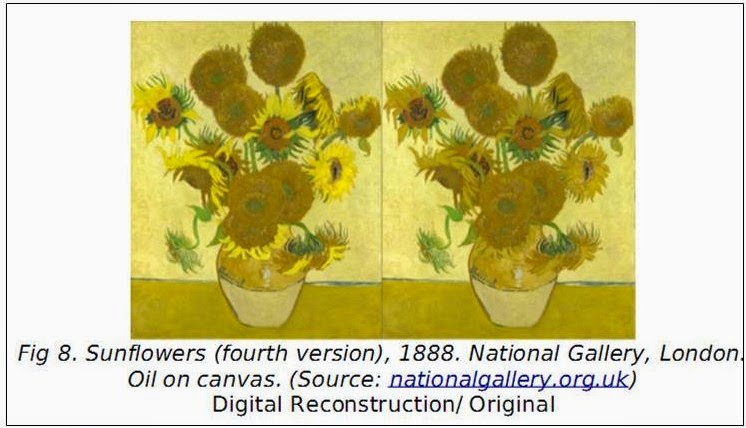
There are good grounds for thinking that the colours we see in these paintings are not the ones van Gogh was intending. For various reasons, the pigments have changed their appearance. Below is one suggestion as to how the appearance of the National Gallery Sunflowers may have changed. This is obviously a subject for experts and probably a contentious one, but Alex Daish’s paper, from which the figure below is taken, is an informative initial introduction and contains other examples. Not surprisingly, the Museum is undertaking research ion the subject (REVIGO - REassessing VIncent van Gogh).


The recently redeveloped third floor of the Museum covers the period 1889-90. By the end of 1888, Van Gogh’s health had deteriorated and he would spend much of 1889 in the asylum at Saint-Remy. In 1890 he left the south and took up residence in the village of Auvers-sur-Oise where he would produce two of his most famous paintings, both in the Musée d’Orsay in Paris: The Church at Auvers (1890) and a portrait of the local doctor who was supervising him, Portrait of Dr Gachet (1890, 2nd version):

Both in the Musée d'Orsay, Paris
Vincent van Gogh died in July 1890 after shooting himself in the chest. Theo died in 1881 and is buried at Auvers next to Vincent. The third floor of the Museum also has a selection of his considerable correspondence, much of it with Theo, and conducted in French. Vincent had revealed a preference for French language and culture in Still Life with Bible 1886 (below left) with its copy of Zola’s La Joie de Vivre. In one letter, he told his sister Willemina not to study in Holland. The Van Gogh Museum collection includes works by many other artists and on the third floor they are used, not as before to explain influences on van Gogh, but instead as examples of his posthumous influence on later artists, for example Vlaminck’s The Seine at Nanterre (1907, below right) which the Museum purchased in 2008.


At the end was a temporary loan from the UK Arts Council of a picture I’d last seen in 2013, Francis Bacon’s Study for Portrait of Van Gogh VI (1957, below right), alongside a reproduction of the van Gogh self-depiction, The Painter on the Road to Tarascon (1888, below left), destroyed, like one of the four 1888 Arlesian Sunflowers, by fire in WW2.


In September 2015 a new entrance to the Van Gogh Museum from the Museumplein, designed by Kisho Kurokawa & Associates, will open. The exhibition Munch:Van Gogh, exploring parallels between the two artists, will transfer from the Munch Museum in Oslo later that month.


UPDATE 14 MARCH

Since my post the March issue of Apollo, an international art magazine published in the UK, has appeared with the Van Gogh Museum as its cover story. The editorial by Thomas Marks is on the theme of the single-artist museum (he likes Leighton House) and he says that after visiting the Van Gogh Museum recently he “left with the glow of a pilgrim”. His accompanying article, Versions of Vincent, describes the Museum with a much more informed eye than mine and reports his interview with the Museum’s director, Axel Rüger.

In the last few days there has also been coverage in the mainstream media of the problem of deterioration of some of the pigments use by van Gogh (see above). The Mail Online Science and Tech provided more details than most and gave links to the recent Belgian chemical research.


8 October 2013

Bacon and Moore at the Ashmolean

Francis Bacon Henry Moore: Flesh and Bone currently at the Ashmolean Museum in Oxford is probably the most ambitious show there since the completion in 2009 of major redevelopment. It is also the first major exhibition bringing together works by Moore (1898-1986) and Bacon (1909-1992) since the artists’ deaths. In retrospect it is becoming more apparent that the art of both men in part embodies their responses to the horrors of the first half of the last century, - two World Wars, the Spanish civil war, the Holocaust, the atomic bombings of Japan, the start of the Cold War and the prospect of nuclear annihilation.

The exhibition offers a sequence of skilful juxtapositions (eg below) which bring out the sculptural quality of Bacon’s figures. The catalogue quotes Myfanwy Piper’s reaction to a Moore/Bacon exhibition in 1963:
… Moore ‘never forgets the solidity of flesh upon the bone, the strength of the bone beneath the flesh’ while Bacon ‘never forgets that flesh is meat’. (page 18)
 

What opinions the two men had of each other’s work is not something the exhibition sets out to address, but Richard Calvocoressi (Director of The Henry Moore Foundation) in his catalogue essay relates the following intriguing incident:
The two artists were not close, had little in common in their personal lives, and took a very different view of honours, awards and official appointments. Moore, the articulate and persuasive spokesman for sculpture as a public art, believed the artist had a responsibility to society; Bacon did not. Bacon was never very complimentary about Moore's work, dismissing his shelter drawings and making other pointed remarks in private. In spite of this gulf between them, Maurice Ash, a friend of Moore's, recounted to the artist's biographer an incident in the 1950s when dinner at the Moores in Hertfordshire was delayed by over an hour while Moore spoke in private to 'a very agitated Bacon' who had turned up unexpectedly.' Francis Warner, who knew both artists, recalls Bacon asking him in the early 1970s if he could take sculpture lessons from Moore. Assuming it was serious - and this was certainly a time when Bacon was thinking deeply about making sculpture - nothing came of the proposal. (page 16)
There are 20 paintings by Bacon (some from rarely seen private collections) alongside 20 sculptures and 20 drawings by Moore. My preference is to see Moore’s larger works out-of-doors, (eg at Dartington), but it is not unusual to encounter them in galleries, for example at Tate Britain in 2010 and at the Gagosian Gallery in 2012. Three Upright Motives in close proximity rather than in the open (No2, left at Kew in 2009) may seem slightly intimidating to some visitors. However, in a few months, and not far away, Moore Rodin will be opening at Compton Verney partly in the grounds. In the meantime, anyone with an interest in either artist should visit the Ashmolean before 19 January 2014. The exhibition will appear in modified form at the Art Gallery of Ontario, an institution to which Moore made a sizable donation of his work.