Showing posts with label Piet Mondrian. Show all posts

29 May 2015

A Visit to the Fondation Louis Vuitton


Note: this post is based on a visit to the Fondation in early May 2105 

The Fondation Louis Vuitton in Paris was opened in October 2014 by Francois Hollande, President of France, and Bernard Arnault, President of LVMH - Moët Hennessy Louis Vuitton - and one of the wealthiest people in France. In 2001 he visited the Guggenheim Museum in Bilbao and met its architect, Frank Gehry. Five years later the Fondation was established as a private cultural initiative by LVMH to support contemporary artistic creation. Under a 55 year lease from the City of Paris, the Fondation’s building, designed by Gehry, is set in one hectare of land in the Bois de Boulogne next to the Jardin d’Acclimatation.

Like Gaul, a visit to the Fondation can be divided into three parts: the current exhibition, the display from the permanent collection and the building itself.

Keys to a Passion

In May 2015 the current exhibition is Les Clefs d’une passion (Keys to a Passion), “a selection of major works from the first half of the 20th century that established the foundations of modernity”. It is organised into four sequences: Subjective Expressionism, Contemplative, Popist (popiste) and Music which are in accord with the themes which structure the Fondation’s own collection (… en resonance avec les quatre axes structurant, de façon plastique et mouvante, la collection …).

Subjective Expressionism “evokes the questions each of us have about life, death, anguish, solitude and the desparate rage to live, despite oneself, despite others …”. It also provides a chance to see Munch’s The Scream (1893? 1910?, below left), a work normally confined to the Munch Museum in Oslo and not made available for the 2012 Pompidou Centre/Tate Modern Munch exhibition. That show was, of course, intended to have a post-1900 emphasis but so has Keys to a Passion!


A series of self-portraits (1934, above right) by Helene Schjerfbeck (1862-1946), a painter known best in her native Sweden, stand up to their proximity to The Scream. As well as a sculpture and two oils by Giacometti, this section includes two major 1949 works by Francis Bacon, Study from the Human Body (below left) and Study for Portrait (below right):


a Malevich not at Tate Modern in 2014, Complex Presentiment or Bust with a Yellow Shirt (c 1932, below left), and Otto Dix’s Portrait of the Dancer Anita Berber (1925, below right):


Contemplative occupies three rooms, the first dominated by two of Monet’s Water Lilies of 1916-19 borrowed from Paris museums. On one side of the room are four lake and mountain landscapes by the Swiss painter Ferdinand Hodler, on the other there are four studies of Lake Keitele from 1904-05 by the Finnish painter Aksell Gallen-Kalleila, one from the National Gallery in London. Complementing these are five seascapes, two by Emil Nolde and three from 1909 by Mondrian, the style of these being in marked contrast to some of his later works in the next room, for example Composition in line, second state (1916-17, below left) and Lozenge Composition with Yellow Lines (1933, below right):


However, this room is dominated by three of Malevich’s most significant works (again not at Tate Modern) lent from St Petersburg: Black Square, Black Cross and Black Circle, all c1923 and pointless to reproduce individually. They can be seen in the photograph (below top) with two of the Mondrians (including the one above left) and Brancusi’s Endless Column Version 1 from 1918. Opposite the Malevich’s, and to me as inducing of contemplation as the Monets, is a Rothko, No 46 (Black, Ochre, Red over Red) (1957, below lower):


In the next room an interesting Bonnard (Summer, 1917) is, to put it kindly, at a disadvantage near to a Picasso plaster sculpture (Head of a Woman with Large Eyes, 1931) and three of his Marie-Thérèse Walter paintings. One of these (Nude Woman in a Red Armchair, 1932) is familiar in London from Tate Modern, as Woman with Yellow Hair (1931, below left) and Reading (1932, below right), no doubt are in New York (Guggenheim) and Paris (Musée Picasso) respectively:


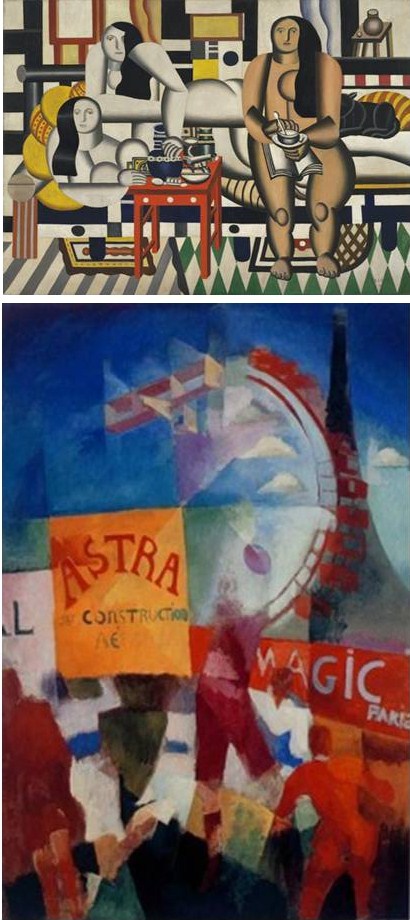
I found Popist the least successful of the four sequences. Picabia arguably anticipated Pop art and deserves a place in a section “resolutely engaged with the vitality, momentum and progress of modern life” but five large pictures, three of them nudes “veer[ing] between a joyous exaltation in nudity and a vaguely salacious eroticism”? Again three Legers, Three Women, (1921-22, below top), but the one other painting in the sequence, Robert Delaunay’s The Cardiff Team (1912-13, below lower) was new to me:

Music provides a triumphant conclusion to the exhibition, the four Kandinsky panels and works by Kupka and Severini being swept aside by two Matisse masterworks, The Dance (1909-10, below top) from St Petersburg and The Sorrow of the Kings (1952, below lower) from the Pompidou Centre in Paris (not lent to the Tate Modern/MoMA show last year):


Keys to a Passion certainly achieves its goal in bringing together some of the major art works of the 20th century. These include items which rarely travel, and for that as well as other reasons is worth making an effort to see before it ends on 6 July.


Items from the Permanent Collection 

Walking through these I was struck by Rachel Harrison’s Zombie Rothko (2011, below left) and Maurizio Cattalan’s Charlie don’t surf (1977 below right – the attendant and photographers are not part of the work). Harrison was awarded the Calder Prize in 2011 for exemplary work in the spirit of Alexander Calder.


It was pleasing to see works by UK artists including Ed Atkins’ video installations Us Dead Talk Love (2012) and Even Pricks (2013) and Tacita Dean, including her Lightning Series (2007) and Hünengrab (2008, below top). According to the caption it is one of a series depicting megalithic prehistoric stone formations in Cornwall (SW England). The series was inspired by Caspar David Friedrich’s Walk at Dusk (c1830-35, below lower), hence the title (Giant’s Tomb).


A large space is given to Sigmar Polke Cloud Paintings (1992-2009, below) – four paintings and a 4-billion-year-old meteorite, the third biggest discovered after a Siberian meteor shower in February 1947:


A small gallery is showing several works by Ellsworth Kelly, who was commissioned to provide works for the Auditorium (see below). These include Green Relief (2009, below left), Blue Diagonal (2008, below centre) and Purple Curve in Relief (2009, below right, lent by the artist):


There are also some fine Giacometti sculptures including Buste d’Homme assis (Lotar III), (1965, below left) and Grande femme II (1959-60, below right):


 THE GEHRY BUILDING 
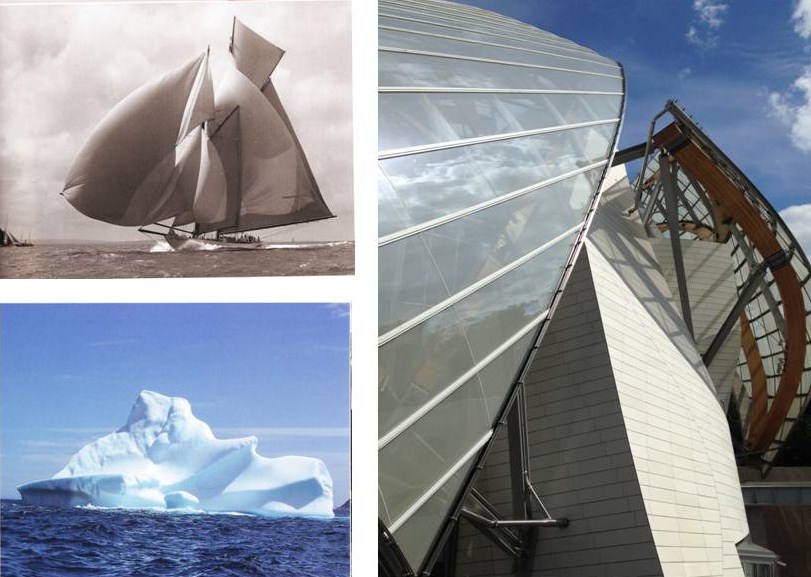

The interior of the Fondation building, containing the 11 gallery spaces (the underground ones vastly better than their equivalents at the National Gallery Sainsbury Wing in London), the Auditorium, shop and so on, is restrained and functional in contrast to the exterior. Some of the inspiration for Gehry’s design seems to have come from a yacht, the Susanne, built in 1911 and an iceberg (above), as well as from some of Paris’s famous metal and glass structures like the Grand Palais. The building is covered with over 19000 panels of white Ductal ® high performance cement (beton) and moving around the building and on the terraces provides a series of contrasts between the “iceberg” and the glass and steel “sails”. Its advanced design, fabrication and construction are a credit to French engineering.


There are some remarkable views over Paris and the Jardin, for example towards La Defense (below top). One of the terraces is displaying a living sculpture made of found objects by Adrian Villar Rojas, Where the Slaves Live (2014, below lower):


Inside are the Ellsworth Kelly works commissioned in 2014 for the Auditorium including Spectrum VIII (below right) and Color Panels Yellow and Red (below left).


Is the Fondation Louis Vuitton worth a visit? Definitely, but it may be a while before there is another show quite like Keys to a Passion.


UPDATE 3 JULY

Hopefully anyone in the UK interested in Frank Gehry will have been able to see Alan Yentob’s documentary, Frank Gehry: The Architect Says "Why Can't I?", in the BBC1 imagine strand before it disappears into iPlayer limbo.

Among the many points of interest are firstly that Gehry, when designing the Guggenheim Museum Bilbao in the mid-1990s, made use of what was at the time advanced software from France’s Dassault Group, aerospace being one of its main activities. Secondly he lived in Paris with his young family and the Jardin d’Acclimatation has very personal memories for him.


21 October 2013

Mark Tobey at Thomas Williams

Leaving the George Grosz exhibition at Richard Nagy, I went into the Thomas Williams gallery in the same building to look at an exhibition of works by Mark Tobey (1890-1976). New York Abstract Expressionism, which dominated US painting from the mid-1940s through the 1960s, is not something which I’ve posted about (except, in passing, on Lichtenstein), or have much appreciation of. But the gallery’s catalogue, written by Thomas Williams and Hannah Tuck, proved to be extremely informative, pointing out that a poll of leading art critics in 1966:
… put Tobey as one of the six most important living artists, with Picasso, Miro, Ernst, Chagall and Bacon.
They describe Tobey’s contribution to Abstract Expressionism:
There is no doubt that when he returned to the U.S. at the end of the 1930s, Tobey was far ahead of his contemporaries. The ‘white writing’ that he had developed in England in 1935 was the first realisation of 'all-over' painting, which later became a central tenet of Abstract Expressionism, and whose most famous exemplar was Jackson Pollock. 
… lt was Tobey who provided for Pollock the final piece of artistic information that enabled him to complete his own journey towards ‘all-over’ Free Form or Abstract Expressionism. His paintings had none of Tobey's careful and quiet descent from calligraphy, and their execution was violent and brash by comparison. Pollock made the significant choice greatly to increase the scale of Tobey's images, so that they were no longer easel paintings - an entry requirement for avant-garde art in New York in the late 1940s. Nevertheless, the revolutionary core of Tobey's work, the dramatic break from artistic norms of figuration, perspective, space, form or even the composition of abstract shapes, and their replacement with paintings that had neither focal point nor boundary - that dazzling step into a territory that even Picasso and Matisse had not dared to enter - was Tobey's achievement and Tobey's gift to Pollock, de Kooning and others who followed in New York and elsewhere.

The exhibition includes an example of ‘white writing’, Untitled 1954 (above), and the pieces on show all seem to be from that period or later, but it was the account of his time in England in the 1930s which interested me, particularly given the nominal pre-occupation of this blog. During this period Tobey was based at Dartington Hall (Devon, SW England) having been invited by the Elmhirsts to join their arts centre:
Once at Dartington, he was given a splendid teaching studio in the gatehouse of the Hall and became acquainted with the other residents. These included Henry Moore, Cecil Collins, Bernard Leach, a pioneering ceramicist … 
… Tobey also made forays to London, a journey of considerable inconvenience, where he was introduced to two of the most advanced and considerable English artists at that time, Ben Nicholson and his lover, Barbara Hepworth. 
… ln 1934 three new and extraordinary pupils arrived at Dartington, Lucian, Clement and Stephan Freud, the grandsons of Sigmund Freud. For the next four years Tobey was thus able to engage with the early artistic development of Lucian. 
… As the decade came to a close at Dartington, Ben Nicholson introduced him to another expatriate refugee, Piet Mondrian. Mondrian had fled the turmoil in continental Europe in 1938 and moved into the house next door to his friend Nicholson in Hampstead, north London where they formed an extraordinary working relationship. But the friendship was hardly begun when, in the summer of 1938, Tobey made a trip to New York, and being unable to return to England as he had planned, was obliged to stay there. …
Mondrian left for the US in 1940. I posted here about the exhibition at the Courtauld last year on Nicholson and Mondrian in London, and exhibitions of Henry Moore and Barbara Hepworth have been the subjects of several other posts. In none of these contexts has Tobey’s name come up, as far as I am aware*, so the Thomas Williams show, which continues until 2 November, will hopefully be a first step in raising awareness of Tobey’s significance in British art between the wars.

*Roger Berthoud’s The Life of Henry Moore makes no reference to Tobey. Its only reference to Dartington is in the context of Memorial Figure, the subject of a post here earlier this year.


UPDATE 27 FEBRUARY 2014

To my surprise, this post is still being read, so I thought it might be helpful to update it regarding Tobey’s time at Dartington, drawing on Michael Young’s The Elmhirsts of Dartington, published in 1996 by the Dartington Hall Trust. The most relevant passages are on pages 221 to 223. Young, who had been a pupil at the school, explains how Tobey was invited to Dartington in 1931 by Dorothy Elmhirst:
… Dorothy sent Mark an invitation without any specificity about what he was expected to do, and perhaps because it was so vague Mark accepted. He taught amateurs of all ages on the estate, including me. I remember sitting in his studio with other children from the school and adults from many different departments of the estate, looking very awkward, as though they had never held a brush in their hands before, but all intent on their drawing. Mark moved around continuously, making jokes and encouraging more by words than by demonstration. Everyone an artist - he at any rate believed it.
Young quotes a speech given by Tobey to a class in autumn 1931 and a description by the potter, Bernard Leach, of Tobey’s manner of teaching. Young also explains how:
Tobey discovered at Dartington the mode of painting - the 'white writing' - for which he later became world famous. It came upon him in the middle of one night in his studio above the entrance to the courtyard, with its skylight which opened on to the stars like an immensely wide-lens telescope. He was so excited he sent for his friends to come over, even at that hour. He began a long series of paintings made up of lines whitish in tone made up of brush strokes against a dark background. Leach arrived in Dartington from St Ives in Cornwall in 1932.
Young explains:
In the summer of 1932 [Leach] and Tobey left together, at the Elmhirsts’ expense, to spend a year in Japan with Japanese craftsmen. Tobey went to China as well. … The experience of Japan influenced both Leach and Tobey as artists and created a bond between them that lasted.
According to Young, the three Freud boys arrived at Dartington in 1933, Clement staying until 1936 (page 174). Young makes no mention of Henry Moore.


23 April 2012

Mondrian and Nicholson at the Courtauld

A post last year touched on the influence that the Cornish naïve painter Alfred Wallis had in the late 1920s and early 1930s on the artistic development of Ben Nicholson (1894-1982). Nicholson was a cosmopolitan individual who had already absorbed modernist ideas from Picasso in Paris, as the current Tate Britain exhibition, Picasso & Modern British Art, makes clear. In 1934, again in Paris, Nicholson, who had been exploring abstract composition, encountered Piet Mondrian (1872–1944). By this time Mondrian had arrived at his characteristic style of geometrical abstraction: horizontal and vertical lines placed on a white background with some of the resulting interstices filled in with primary colours.

The Courtauld Gallery exhibition, Mondrian || Nicholson: In Parallel, explores the relationship between the two artists from their first meeting until Mondrian’s departure to the USA in 1940. Works by both men during this period are on display including Nicholson’s pure white reliefs. These were built up or relieved laminas of different geometry, rectangular and circular, creating complex shadows. The reliefs merit careful examination to appreciate their construction, their apparent simplicity being deceptive. Mondrian’s pictures seem be presenting a curatorial challenge in long-term preservation akin to that of modernist architecture. This exhibition is particularly valuable as there are few public opportunities in England to see Mondrian’s works. The Tate has six in its collection, Composition C (no.III), with Red, Yellow and Blue, 1935 (above and currently at the Courtauld), being a long-term loan. The BBC Your Paintings website shows only that one.

Mondrian left Paris as war seemed imminent in 1938 to come to London at Nicholson’s invitation. After travelling to London in the company of the estranged Winifred Nicholson he settled into the artistic colony of Hampstead, living at Parkhill Road with Nicholson and Barbara Hepworth and their triplets around the corner in the Mall Studios. At the outbreak of war Nicholson and Hepworth left for Cornwall to be joined by Naum Gabo and his wife. Mondrian left London for New York after the fall of France in 1940.

The archival material on display includes Winifred Nicholson’s tiny diary (“Gabo telephone 10:30” “Ski lesson 3-4”) and correspondence between the two artists (“Dear Nicholson and Barbara”). It’s easy to get the feeling that for Nicholson parallels existed not only with Mondrian but in his relationships with Barbara and Winifred. An aide-mémoire of his first two marriages might be useful:
  • 1920-1938 Winifred Roberts (two sons and a daughter born 1927-31)
  • 1938-1951 Barbara Hepworth (triplets: a son and two daughters born 1934)
Admission (until 20 May) at £6 (full price) is reasonably priced and includes access to the Courtauld Gallery’s permanent collection. The exhibition catalogue is £30 and may be of considerable scholarly merit, although some visitors might consider it slim and short of colour illustration even at the current Amazon price of £19-50.