Showing posts with label Naum Gabo. Show all posts

26 August 2015

Barbara Hepworth at Tate Britain

The British sculptor Barbara Hepworth was born in 1903 in Wakefield, West Yorkshire, where the museum named after her was opened in 2011. But from 1939 until her death in 1975, she lived and worked in South West England at St Ives in Cornwall - I posted here in 2011 about a visit to the Barbara Hepworth Museum and Sculpture Garden, part of Tate St Ives. Elsewhere in the region there are other pieces by her, for example Figure for Landscape (1960 below top) at the University of Exeter and Theme and Variations (1969–72, below lower) at what were the offices of the Cheltenham and Gloucester Building Society in Cheltenham. Barbara Hepworth: Sculpture for a Modern World at Tate Britain seems a welcome opportunity to take a retrospective view of her work – as such it could be regarded as complementary to that provided in 2010 for her contemporary, Henry Moore.


Although chronological, Barbara Hepworth: Sculpture for a Modern World is presented in an ostensibly thematic form starting with carving and moving on through studio to international modernism, equilibrium and eventually pavilion. Ann Compton, in an essay in the exhibition catalogue, Crafting Modernism Hepworth’s Practice in the 1920s, identified an important issue which the curator of a Hepworth retrospective has to face:
Accounts of Barbara Hepworth's career frequently divide her practice into stages defined not only by time and place but also by relationships with other key modernists, notably Henry Moore, John Skeaping and Ben Nicholson. Whilst these individuals were unquestionably important, such emphasis on personal connections is symptomatic of the containment of Hepworth's sculpture within a narrow and ultimately reflexive frame of reference. (page 13)
However, it is a matter of fact that Moore and Hepworth were at the Leeds School of Art and the Royal College of Art together in the 1920s and neighbours in the Hampstead avant garde of the 1930s. At the time of her death Moore, five years her senior, commented “we were always like a younger sister and an older brother”. Furthermore Hepworth was married to John Skeaping and later to Ben Nicholson, having children with both. Nonetheless carving, while aiming to put Hepworth’s 1920s work in the context of other sculptors around that time practicing direct carving in wood or stone, so allowing comparison of, for example, Skeaping’s Pigeon (c1928, below top left), and her Toad (1928, below top right) and her Musician (1929-30, below lower left) and Moore’s Seated Girl (1931, below lower right):


with several other works by Skeaping present, fails to inform the visitor (or this one, anyway) that he and Hepworth were married from 1926 until their marriage broke up in the early 1930s.

The next section, studio, has little alternative but to be realistic about Nicholson as a presence in Hepworth’s life. Anyone who left Art and Life at the Dulwich Picture Gallery in 2014 wondering what Ben did next will find an answer here – there are about 17 of his works alongside 24 of Hepworth’s. The couple spent most of the 1930s living and working together and studio aims, among other things, to reveal their dialogue about abstraction. There are some interesting pieces here in this regard, for example Hepworth’s Two Heads (1932, below left) and Nicholson’s painting of the couple, 1933 (St Rémy, Provence) (below right):


Perhaps not all visitors will be aware that Hepworth gave birth to their triplets in October 1934, married Nicholson in 1938 and that they would divorce in 1951.

The international modernism section is more interesting than might be expected. Not only does it show how during the 1930s her work became increasingly abstract as in Helicoids in Sphere (1938, poster above) and Three Forms (1935, below):
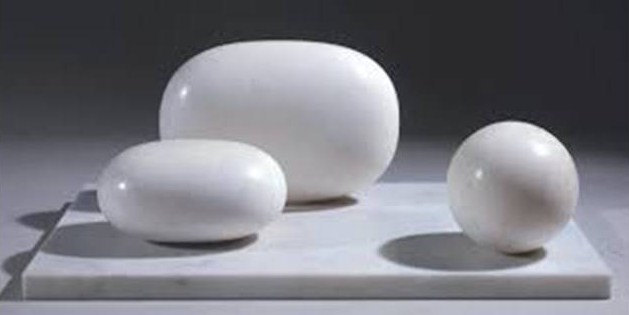

but also reveals her and Nicholson’s involvement with magazines (books of articles), well displayed, like Circle and Axis with contributors across Europe, some of whom would arrive in London as the political situation deteriorated. A particularly important figure was the constructivist, Naum Gabo, who after 1935 lived in Hampstead near the British modernist community and would move to Cornwall with the Nicholsons after the outbreak of war. No works by him, in particular any from 1937 onwards showing the use of strings in sculpture, are on display, although some were at Tate St Ives in 2011. Hepworth introduced strings into her work after 1938 but the earliest stringed works in this exhibition are from 1943, Sculpture and Colour (Oval Form) Pale Blue and Red (below):


although there are some drawings from 1941 in the next section, equilibrium. As far as I could tell, the exhibition does not address not only the derivation of the use of strings in Hepworth’s sculpture but also her pioneering use of holes in sculpture (Pierced Form, 1931 in pink alabaster was destroyed in the war; the exhibition catalogue (Fig 18 page 39) dates it as 1932 but Tate’s records for a later piece with the same title say 1931).

equilibrium could just as well have been called contrast – between the increasingly large abstract pieces like that above and the series of Hospital drawings she made in 1948. A donation of tropical hardwood, guarea, gives its name to the next section of four large pieces, eg Corinthos (1954-5, below):


The last section of exhibits, pavilion, consists of seven bronzes which all appeared at a retrospective at the Kroller-Muller museum in Holland in 1965, the decade in which Hepworth produced a large number of works and became firmly established as an international figure. Squares with Two Circles (1963, below) is one of the best-known.


Between equilibrium and guarea the visitor passes through the staging sculpture section, its principal feature being Dudley Shaw Ashton’s documentary made in 1952 and released in 1953, Figures in a Landscape, about Hepworth at work in St Ives (available on the BFI website). In an essay in the catalogue, Media and Movement Barbara Hepworth beyond the Lens, Inga Fraser points out that Hepworth was not happy with the film. She suggests:
The portrayal of her sculpture was mediated via combination of Shaw Ashton's visual focus on the uncanny, Rainier's esoteric score, Hawkes's poetic narrative and Day-Lewis's theatrical delivery. ln light of her close involvement with the presentation of her work in other formats - exhibition, photography and in publication - it is conceivable that with these additional artistic contributions Hepworth felt her own narrative and conception of sculpture too much compromised. (page 78/79)
In 1953 her son with Skeaping was killed in an air accident.

The exhibition makes no mention of Hepworth’s assistants in St Ives who included Terry Frost and Terence Coventry. The catalogue is very informative, although constrained by the format and underlying philosophy of the exhibition – a timeline would have been helpful. An essay, ‘An Act of Praise’ Religion and the Work of Barbara Hepworth, by Lucy Kent reveals how taken Hepworth was with the ideas of Christian Science, a philosophy she shared with Ben Nicholson. He had been introduced to it by his first wife, Winifred.

Barbara Hepworth: Sculpture for a Modern World ends on 25 October 2015.


17 April 2013

The Arts Council’s Henry Moores in Bath

The Arts Council Collection of works by British sculptors includes 11 sculptures and 15 works on paper by Henry Moore purchased between 1948 and 1963. Not for the first time these are on a UK tour which on this occasion has reached SW England at the Victoria Art Gallery in Bath. In the Bath show the Arts Council’s collection is supplemented with a loan of etchings by Moore from a local gallery.

One of the earliest works on paper on display is Standing Nude 1929 and the newest Women Winding Wool 1948 (below left and right). Regrettably the Arts Council collection does not include any of Moore’s World War 2 shelter drawings.
 

The sculptural works offer an opportunity to see one of Moore’s pre-War bronzes with strings, Stringed Figure 1938 (left).  Moore had met the emigré constructivist Naum Gabo by then but such works were as much surreal as abstract.  There are also some working models, the latest being Working Model for Knife Edge Two Piece 1962 (below left). The models are interesting but lack the monumental quality of the full size works in the open, for example the similar Knife Edge Two Piece (below right at Kew in 2008) which is familiar from another cast near Parliament in London, often a background to television interviews and currently under restoration.


In a departure from previous practice the Victoria Art Gallery has started to charge for admission to special exhibitions, in this case £3.50. The Bath and North East Somerset local authority which owns the gallery no doubt had their financial reasons for making this change. But perhaps this wasn’t the best exhibition to start with. Firstly, the taxpayers of Bath and beyond in the past supported the Arts Council in the original purchase of some of these works and subsequently in their conservation and in providing insurance through the Government Indemnity Scheme. Secondly, there was no charge to see this exhibition in its previous tour stop in Canterbury, nor will there be at its next in Limerick. More generally, Bath is a leading UK destination for cultural tourism with millions of visitors a year who bring obvious economic benefits to local businesses and employment. Is it appropriate for a city with UNESCO World Heritage site status to be charging £3.50 to see only 26 works, even if they do provide a useful survey in miniature of a major British artist?

Henry Moore In the Arts Council Collection continues in Bath until 23 June.


UPDATE 24 MAY 2013

On 17 May the Victoria Art Gallery retweeted:


Here are the forthcoming temporary exhibitions:


UPDATE 17 AUGUST

National Art Pass holders are now receiving a 50% discount on Victoria Art Gallery admissions.
Next summer's exhibition schedule has been revised.

24 March 2013

Schwitters at Tate Britain


Schwitters in Britain at Tate Britain is comprehensive, chronological and, even better, turns out to be modestly titled. It is in fact a near-retrospective of Kurt Schwitters (1887-1948), an artist who is not so popular as to guarantee that the show is unpleasantly crowded.


Although close to Dada and other avant-garde art movements in Europe after World War I, Schwitters, perhaps because of his relative isolation in Hanover, developed a movement of his own, MERZ. He alighted on these letters as a residue when cutting up a newspaper printed with the word COMMERZBANK and took them to mean art, sculptures or even buildings, Merzbauten, which could be assembled from anything. Perhaps not surprisingly many of the exhibits surviving from the years before he came to Britain are collages, often incorporating three-dimensional found objects. Inevitably, these do not reproduce well on the printed page (or LED screen) and have to be seen to fully appreciate the subtlety of their composition and colour - Merzbild 1a (The Psychiatrist) 1919, above.

Schwitters had decided to leave Germany for Norway in January 1937 before the exhibition in July that year of what Goebbels and others labelled degenerate art. He probably never wished to come to Britain but three years after arriving in Norway, the Nazi invasion meant that he, his son and daughter-in-law had to leave. The British authorities eventually interned Schwitters on the Isle of Man with many other mittel-European intellectual refugees until he was released in November 1941. After a brief sojourn in Paddington where he met his companion, Edith ‘Wantee’ Thomas, he spent the rest of the war in Barnes, SW London, at 39 Westmoreland Road, whose owners probably now have a good case for a Blue Plaque should they want one  (Relief in relief 1942-5 right).  During this period he made contact with old friends who were also refugees like Naum Gabo and encountered British artists like Ben Nicolson.

After the end of the war Schwitters moved to Ambleside in the Lake District where he started to construct the Merzbarn, the interior wall of which is now preserved in the Hatton Gallery, Newcastle. Its exterior was reproduced in the courtyard of the Royal Academy in 2011 as part of the exhibition Modern British Sculpture.

While happier making Merz collages and reliefs, Schwitters would turn his conventional artistic talent to more readily sold landscapes and portraits. Examples of the latter are Untitled (Portrait of Klaus Hinrichsen) 1941 (left), from his time on the Isle of Man, and Untitled (Portrait of Henry Pierce), painted in Ambleside in 1947, the same year as he made En Morn, detail in the Tate’s banner above.

Brian Sewell’s review of the exhibition is well worth reading and, among other things, draws attention to Schwitters as a link between Dadaism and the emergence of British Pop Art in the years after his death. Sewell suggests that the word MERZ to Schwitters was “irresistibly akin to the French merde, slang that he translated as rubbish or garbage, but that is better known as shit.” Certainly Schwitters served in the German infantry in the First World War and may well have picked up some French obscenities.

Schwitters in Britain continues until 12 May and will be at the Sprengel Museum Hannover from 2 June to 25 August.

3 November 2011

Constructivists at the RA

Back in June I posted about the 2011 Tate St Ives Summer Exhibition which had included works by Naum Gabo. Gabo and his wife moved to Cornwall from Hampstead at the outbreak of war in 1939, but Gabo had been born a Russian in 1890. He studied in Germany, returning home after the Revolution in 1917. Avant-garde art, in particular the Suprematist movement led by Malevich, had already appeared in Russia. After the Revolution the associated Constructivist movement in art and architecture, which Gabo joined, embraced the Communist cause. It did so by drawing on the non-bourgeois abstract language of Suprematism and by adopting new materials and three-dimensionality.

The Royal Academy exhibition, Building the Revolution: Soviet Art and Architecture 1915-1935, examines the Russian avant-garde architecture which its designers intended to reflect the energy and optimism of the new Soviet Socialist state. As well as some Suprematist pictures, the exhibition shows black and white photographs and drawings of the buildings when newly-constructed alongside excellent large-scale colour photographs taken by Richard Pare, mostly in the 1990s. I thought the Melnikov House and the Gosplan Garage to be particularly striking. The difficulties of long-term maintenance of these and later Modernist buildings, given the nature of their steel and concrete construction and the large flat rendered surfaces, were apparent in many of Pare’s photographs (see an English Heritage Conservation Bulletin article about the restoration of the De La Warr Pavilion at Bexhill). The Chekist Housing (left), perhaps not surprisingly, seemed to be one of the few exceptions in terms of its condition.

Of all the many striking images available, the one chosen by the RA for publicity is a vertical view through a piece of engineering as much as architecture, Vladimir Shukhov’s Shabolovka Radio Tower, innovatively formed by steel-lattice hyperboloids (left). This was planned to be taller than the Eiffel Tower but was never fully implemented due to steel shortages. Never realised at all was Vladimir Tatlin’s Monument to the Third International, (known as ‘Tatlin’s Tower’). It was intended to be constructed as the headquarters of the Comintern in St Petersburg (Petrograd, then Leningrad, at the time) with a height of 400 metres. The courtyard of the RA is currently exhibiting a 1:40 scale model built by Dixon Jones Architects, probably the first to be seen in London for decades. In 1971, a similar model appeared on the balcony outside the Hayward Gallery during the British Council’s tribulated exhibition, Art in Revolution: Soviet art and design since 1917. The Soviet Ministry of Culture, a major source of the exhibits, demanded and achieved the removal of all works by Malevich, and insisted that a reconstruction of El Lissitzky’s Proun Room be blocked off.

Tatlin's Tower; USSR 1920, London 1971 and 2011

In 1934 the Lawn Road Flats (known as the Isokon Building) opened in Hampstead, London. Now a Grade 1 listed building, this is a clear descendant of the Moscow communal housing constructed in the previous decade. The restaurant and bar, the Isobar, soon became a meeting place for Hampstead’s artistic community including Ben Nicholson and Barbara Hepworth, and Naum Gabo after his arrival in 1936.

The Ove Arup and Norman Foster Foundations, and Richard and Ruth Rogers have supported the exhibition. Lords Foster of Thames Bank and Rogers of Riverside are the UK’s most prominent architects, with international practices, and Ove Arup is one of the world’s leading consultancies providing related services. Building the Revolution runs to 22 January 2012.

12 June 2011

Tate and Hepworth at St Ives

A post last month described the recent exhibition at Compton Verney of works by Alfred Wallis and Ben Nicholson, two artists associated with St Ives (Cornwall, SW England). Virginia Button’s St Ives Artists: A Companion, published by the Tate, provides a helpful introduction to 18 of the best-known members of the colony of artists working there in a significant way from the 1930s to the 1960s (and also to the potter Bernard Leach.

The mission of the Tate’s outpost at St Ives is to present 20th-century art in the context of Cornwall. The displays change regularly, allowing a different selection from the Tate's extensive collection of St Ives art to be shown each year. Visitors need to be aware that there is no permanent display of St Ives artists’ work in the Gallery. However, this year the Tate St Ives Summer Exhibition includes works by two artists with local links: Naum Gabo and Margaret Mellis, both active there during the Second World War.

The St Ives artist whose works are permanently held locally is Barbara Hepworth. Her former studio, now Museum and Sculpture Garden, is near, and part of, Tate St Ives. Gabo and his wife, and Hepworth and her husband, Ben Nicholson (and their triplets), moved to Cornwall in 1939, having been part of the Hampstead community of artists and sculptors from earlier in the 1930s. Common influences such as the use of strings in sculpture can be seen in the Gabo and Hepworth pieces currently at St Ives. Mellis and her first husband also moved to St Ives in 1939 (the Nicholsons lived with them for a while). The work of Nicholson and Gabo led Mellis to experiment with collages, some of which are exhibited. Most of her work on display is from the 1970s: attractive constructions made from driftwood found on the beach at Southwold (Suffolk), where she lived until her death in 2009 at the age of 95.

The St Ives colony was the second such in west Cornwall. There had been rail links to Penzance from 1859 and through services on the Great Western Railway reached St Ives in 1877. The area soon attracted artistic attention: the scenery, the fisherfolk and their boats, together with the exceptional quality of the light and the vogue for painting en plein air, influenced by the naturalism of French painters of the time, led to a settlement of artists at Newlyn. Part of the attraction of Newlyn was its similarity to Brittany. Penlee House Museum and Gallery in Penzance is the only Cornish public gallery specialising in the Newlyn School artists including Stanhope and Elizabeth Forbes, Walter Langley, Harold Harvey and Laura Knight.

As well as a selection from its permanent collection, Penlee House is running an exhibition this summer, Walter Langley and the Birmingham Boys, featuring some of the artists who came from the Midlands to work in Newlyn from the 1880s onwards.

There are tickets available for combined entry to Tate St Ives, including the Barbara Hepworth Museum and Sculpture Garden, and Penlee House, which offer a useful saving – these do not seem to be publicised on either organisations’ websites, but are featured at the Tate St Ives ticket desk.

Among the London galleries, Messum’s has a continuing interest in West Country paintings from the 1880s onwards. Locally, the Market House Gallery in Marazion holds a good stock of prints by Terry Frost and others, any of which might suit the whitewashed walls of what was once a fisherman’s cottage.

However, any visitor with a taste for late St Ives abstractionism, should not ignore the vagaries of the Cornish weather, well-appreciated by the realists of the Newlyn School:

The Rain it Raineth Every Day by Norman Garstin