Since 2006, Sotheby’s have staged annual selling exhibitions of sculpture, Beyond Limits, in the grounds of Chatsworth House, the ancestral seat of the Duke and Duchess of Devonshire and a masterpiece of English baroque architecture. This year’s tenth anniversary exhibition was Beyond Limits: The Landscape of British Sculpture 1950-2015 which ran from 14 September to 25 October. Tim Marlow, Artistic Director at the Royal Academy was the guest curator and also author of an essay for the exhibition catalogue, A Topography of British Sculpture. The sculptures were not arranged at Chatworth in a chronological sequence but the approach in Marlow’s essay was primarily historical and is echoed here.
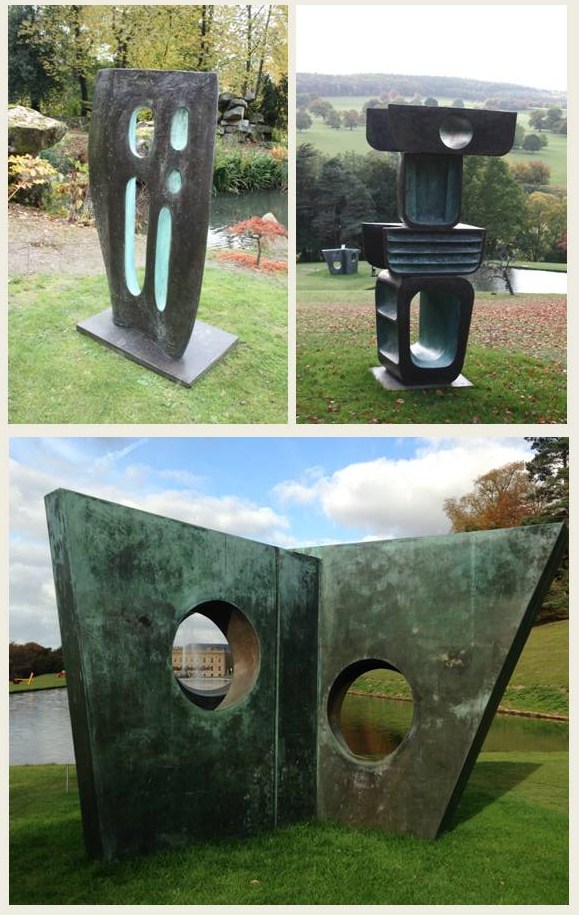
Marlow starts his survey by identifying Henry Moore and Barbara Hepworth as the ‘presiding spirits’ who led post-war British sculpture into the Modernist and post-Modernist mainstream of Western art. One of the inevitable shortcomings of the recent Tate Britain Hepworth show was its inability to place Hepworth’s larger works outdoors, something which Beyond Limits was well-placed to rectify with three pieces: Sea Form Atlantic (1964, below top left), Three Obliques (Walk In) (1969, below lower) and The Family of Man: Figure 1, Ancestor 1 (1972, below top right with Three Obliques (Walk In) in the distance).
After appearing in the British Pavilion at the 1952 Venice Biennale, a group of some younger sculptors became associated with the ‘Geometry of Fear’; for example, Reg Butler (Manipulator,1954, below left) and Lynn Chadwick (Pair of Walking Figures – Jubilee, 1977, below right):
It was in the 1960s that it became apparent that a serious, internationally respected but fundamentally British tradition” of sculpture had emerged, something which in Marlow’s view “became one of the great, yet understated, success stories of post-war British culture". Talents which emerged at this time included Kenneth Armitage (Monitor, 1961, below top) and William Tucker, whose Genghis Kahn (1963, below lower) seems ahead of its time:
Anthony Caro (Sunshine, 1964, below left) had a major exhibition at Chatsworth in 2012 while a post here recently covered the current Arnolfini Richard Long show (Cornwall Slate Line, 1990, below right):
The 1980s, the period of the 'New British Sculpture', saw the emergence of major figures such as Anish Kapoor and Antony Gormley. Gormley’ s Big Gauge II (2014, below top left), Tony Cragg’s Manipulation (2008, below top right) and Stephen Cox’s Kiefer-like Dreadnought: The Problems of History - The Search for the Hidden Stone (1990 to 2015, below lower) are later works.
The prominence of the YBAs since the nineties was reflected in Beyond Limits, though I don’t altogether share Marlow’s enthusiasm for Hurst. Sarah Lucas’s Florian and Kevin (2013, below upper and lower respectively) were produced at Pangolin.
Gavin Turk’s Habitat (Burgundy) (2004, below left) and American Bag (2015, below right), contrary to appearance, are painted bronzes, not as impressive as his Nomad, seen at Crucible2 last year.
Marlow’s survey finishes with two complex works, both with archaic resonance, Thomas Houseago’s Hermaphrodite (2011, below left) and Bill Woodrow’s Regardless of History (1998, below right):
Two pieces which were not specifically mentioned by Marlow were Bernard Meadows’ Large Standing Armed Figure (1962, below left) and the recent Conrad Shawcross, The Dappled Light of the Sun, I-III (2015, part below right):
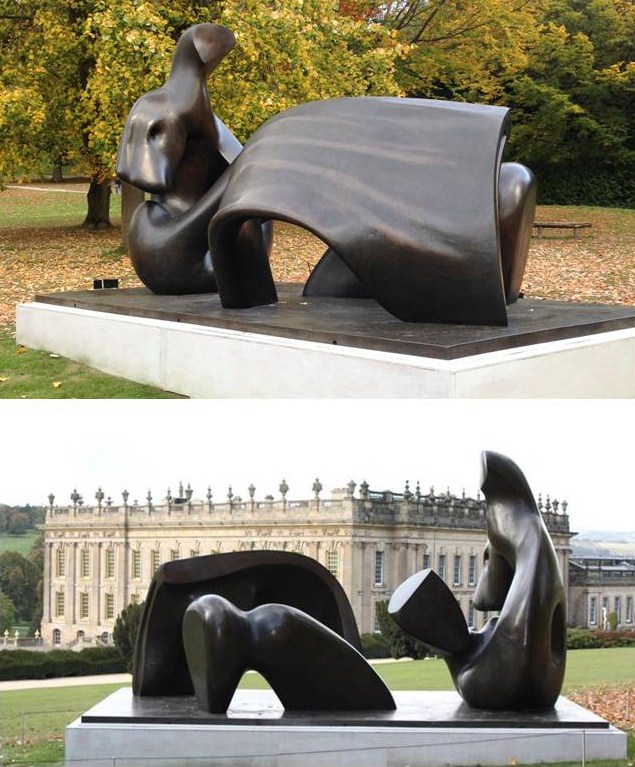
To end where the survey began, two views of a fine Henry Moore, Three Piece Reclining Figure: Draped (1975):
Showing posts with label Anthony Caro. Show all posts
2 November 2015
3 June 2012
Chatsworth: Caro and the Cohen Collection
Caro at Chatsworth
Chatsworth House in Derbyshire, the home of the Duke of Devonshire, is one of Britain’s most magnificent country houses, architecturally and in its setting. The Duke has a keen interest in modern art and works from his collection are on loan at present to the Lucien Freud exhibition at the NPG. Currently 15 sculptures by Sir Anthony Caro are on display at Chatsworth, sited around the Canal Pond and its famous Emperor Fountain, in front of the south façade. The works which date from 1960 to the mid-1990s are on loan from the sculptor.
Caro started studying sculpture in London in 1947 and until 1953 worked as a part-time assistant to Henry Moore in Hertfordshire. His early work was figurative, bodies modelled in plaster and cast in bronze. In the US he encountered the abstract expressionist work of David Smith (CubiXVIII (1958), left) and turned to constructing sculpture from industrial metals, primarily steel and aluminium. His work, which began to receive attention in the 1960s, contrasted with Smith’s in being closer to the ground and without plinths, and planar and horizontal. It also took a ‘New Generation’ of British sculpture in a direction away from the concerns of Moore and Barbara Hepworth.
In the catalogue (good value at £10) Martina Roth from the Yale Center for British Art explores the relationship of Caro’s work with that of Smith and Moore. She also considers his somewhat ambiguous preferences for his work to be “unpublic” and to be seen “indoors” - which would be more like his Early One Morning (1962) when shown at the RA last year:
than Sculpture Seven (1961) at Chatsworth:
and clearly was never his intention for Goodwood Steps. Other works are representative of his ‘flat’ style of the 1970s and his later more solid pieces (Cliff Song (1976) and Forum (1992-4) below, left and right).
Caro at Chatsworth continues to 1 July.
Frank and Cherryl Cohen at Chatsworth
Inside Chatsworth House, in the New Gallery, but unfortunately only until 10 June, is the first public display of Frank and Cherryl Cohen’s collection of modern British art built up during their 40 year marriage.
In a post here last March, Social Mobility and the Conscience of the Rich, I commented on some work done by the Resolution Foundation, and concluded:
The catalogue is excellent value at £9.95 and includes an Introduction by Howard Jacobson (excerpted in the Daily Telegraph) and an account of a conversation between the curator of the show, Robert Upstone, and the Cohens (left). No doubt they will be pleased to see their collection back in Wilmslow in their Mies van der Rohe style house (interview with Jackie Wullslager in the Financial Times (£)). But hopefully some or all of it will be lent again in the coming years. An ideal gallery would be Bath’s extended Holburne Museum, which would allow more space for the larger works to be appreciated than the New Gallery at Chatsworth could provide.
Chatsworth House in Derbyshire, the home of the Duke of Devonshire, is one of Britain’s most magnificent country houses, architecturally and in its setting. The Duke has a keen interest in modern art and works from his collection are on loan at present to the Lucien Freud exhibition at the NPG. Currently 15 sculptures by Sir Anthony Caro are on display at Chatsworth, sited around the Canal Pond and its famous Emperor Fountain, in front of the south façade. The works which date from 1960 to the mid-1990s are on loan from the sculptor.
| Goodwood Steps (1994-6) |
In the catalogue (good value at £10) Martina Roth from the Yale Center for British Art explores the relationship of Caro’s work with that of Smith and Moore. She also considers his somewhat ambiguous preferences for his work to be “unpublic” and to be seen “indoors” - which would be more like his Early One Morning (1962) when shown at the RA last year:
than Sculpture Seven (1961) at Chatsworth:
and clearly was never his intention for Goodwood Steps. Other works are representative of his ‘flat’ style of the 1970s and his later more solid pieces (Cliff Song (1976) and Forum (1992-4) below, left and right).
Caro at Chatsworth continues to 1 July.
Frank and Cherryl Cohen at Chatsworth
Inside Chatsworth House, in the New Gallery, but unfortunately only until 10 June, is the first public display of Frank and Cherryl Cohen’s collection of modern British art built up during their 40 year marriage.
In a post here last March, Social Mobility and the Conscience of the Rich, I commented on some work done by the Resolution Foundation, and concluded:
What should rich men with a conscience and a broader interest in society than making money out of it do with their money? Of course it’s up to them if they want to set up think tanks to investigate hobby-horse issues. (Personally I would want to emulate Bryan Ferry and collect modern British art!)It’s difficult to imagine someone being more upwardly mobile than Frank Cohen who started on a market stall and now mixes with leading artists and the Duke of Devonshire. He and his wife have lent 40 paintings and sculptures from their collection for the exhibition at Chatsworth. Among the items on display which I admired are Stanley Spencer’s Christ Preaching at Cookham Regatta: Conversation between Punts (1956), Sickert’s The New Bedford (1915), and Auerbach’s Head of William Feaver (2010). John Minton’s Cornish Coast (1945) (left) has an obvious SW England connection.
The catalogue is excellent value at £9.95 and includes an Introduction by Howard Jacobson (excerpted in the Daily Telegraph) and an account of a conversation between the curator of the show, Robert Upstone, and the Cohens (left). No doubt they will be pleased to see their collection back in Wilmslow in their Mies van der Rohe style house (interview with Jackie Wullslager in the Financial Times (£)). But hopefully some or all of it will be lent again in the coming years. An ideal gallery would be Bath’s extended Holburne Museum, which would allow more space for the larger works to be appreciated than the New Gallery at Chatsworth could provide.
Subscribe to:
Posts (Atom)


