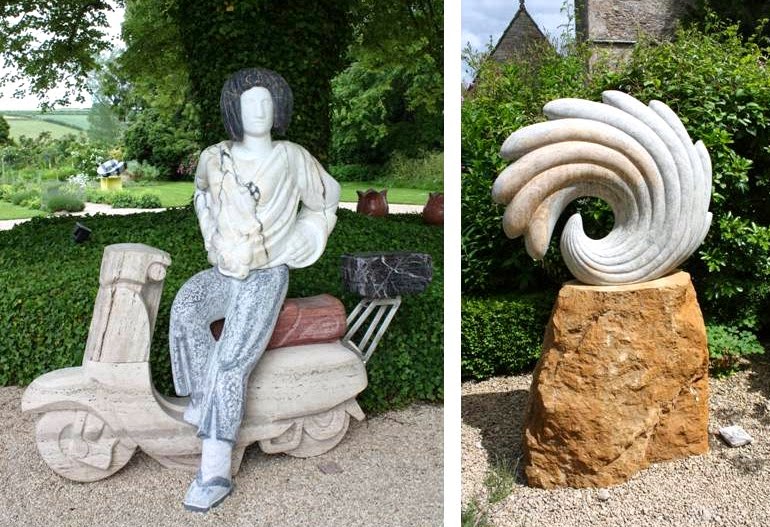
This was also the title of a post here four years ago which covered an exhibition at Gallery Pangolin in Chalford and that year’s Fresh Air outdoor sculpture exhibition not far away in Quenington. History repeats itself, sometimes agreeably, because Pangolin are putting on their fourth one-man show of works by Terence Coventry, Sculpture and Works on paper, while Fresh Air 2015 has just finished.
Coventry was born in Birmingham in 1938 but has spent much of his life in Cornwall including a period working for Barbara Hepworth in St Ives. Some of his spare and dramatic pieces are made in Corten steel (COR-TEN) which weathers to a stable oxide surface, for example Corten Owl I (below left) and Corten Torso (below right):
Bronzes of various sizes at Pangolin include Man Releasing Bird II and Woman Releasing Bird (below, left and right):
Another bronze, Boar II (below top) and the powder-coated steel, Monumental Steel Bull (below lower):
were at Gloucester Cathedral during Crucible2 last year, as were bronzes by Coventry, Monumental Gannet Head, and by Jon Buck, Midnite Movie Heads, both to be seen at Fresh Air 2015:
There were over 170 items at Quenington, so what follows is just a few of those which I liked, starting with a bronze by Carol Peace, Red Ribbon (below left), quite different from Edwina Bridgeman’s Cos After All (below right), constructed from recycled plastic crates:
I’m not sure garden sculpture is at its best when it attempts to compete for space in the border as a quasi-vegetable (top), but Dorcas Casey’s Mule Head (lower) was clearly there on its own terms:
as were Tom Hackett’s Shaggy Dog Stories (below left), funded by Arts Council England, and Paul Cox’s Rabbits (£3000 and £1390 each respectively):
What would I like to have taken home to my own garden? Probably Wendy Lawrence’s ceramic Disc Form (below):
Terence Coventry, Sculpture and Works continues until 24 July. Fresh Air 2015 ended on 5 July but will be back in 2017, all being well.
I posted here about Fresh Air 2013.
Showing posts with label sculpture. Show all posts
13 July 2015
20 October 2014
Crucible2 at Gloucester Cathedral
Crucible2 is the second sculpture exhibition at Gloucester Cathedral curated by Gallery Pangolin of Chalford, Gloucestershire. The first was in 2010 with 76 contemporary sculptures; this time 100 exhibits by 61 sculptors are set in and around the cathedral. Key pieces, in the view of the curators, include works by Kenneth Armitage, David Backhouse, Ralph Brown, Lynn Chadwick (Jubilee IV in the poster,left), Ann Christopher, Antony Gormley and William Tucker. The 20th and 21st century works are often positioned in startling and stimulating contrast to their mostly English Gothic surroundings. For example, Breon O’Casey’s Large Cockerel (circa 2000, below) in the Cloisters with the earliest fan-vaulting in England circa 1350:
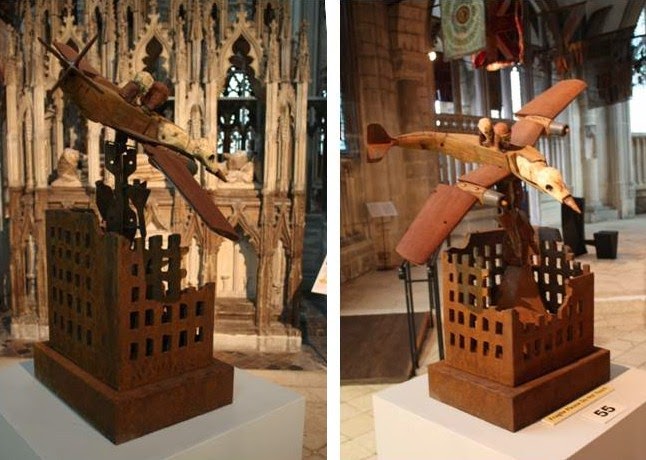
The most celebrated monument at Gloucester is the tomb of Edward II circa 1350, seen below left in the background to Steve Hurst’s Gloucester in Berlin. Hurst, born in 1932 and a witness to bombing in World War 2, sees it as concerning “… the bombing of civilians no matter what their country or who launches the bombing aircraft. It is a personal attempt to regain the viewpoint of a child”.
In the background (right) are the laid up colours of the Gloucestershire Regiment. They appear again (below right) behind Paul Wager’s Omnibus which marks the centenary of the Great War 1914-1918. Similar sentiments inform Deborah van der Beek’s Collateral (below right) – eight million horses died in that war - but it was cast around spent munitions from the conflicts in Iraq and Afghanistan which brought the expression “collateral damage” into common use.
The monument near Damien Hirst’s Anatomy of an Angel (Black) (2008, below) is to Sarah Morley, 29, a mother of four who died a few days after “having sustained the pains of Childbirth at Sea” while returning from Bombay in 1784.
Among the pieces I liked were Antony Gormley’s Pose (2012, below) with In Man’s Nature by Jon Buck behind).
Bryony Marshall’s DNA – Helix of Life (below, left) marks the 60th anniversary of the discovery of DNA. Subsequently mitochondrial DNA was identified as having been passed down to us all from a woman in East Africa about 150,000 years ago, known as Mitochondrial Eve, the inspiration for a sculpture of the same name by Sue Freeborough (below right):
The photograph below left of Geoffrey Clarke’s Taunton Deane Crematorium: Test Panel does not do justice to the colours of the glass. To the right is Sarah Lucas’s Realidad (2013), one of her NUDs series shown as bronzes at the Venice Bienniale in 2013.
John Humphreys’ Ipsius Imago a Latere Extensa probably succeeded as the artist wished in puzzling and confusing the viewer:
but perhaps was not as happily placed as the Eduardo Paolozzi plaster Vulcan near a strange moustachioed carving, perhaps a millennium older:
Among the sculptures in the open were Bruce Beasley’s Breakout II (below, left)in the Cloisters and outside Kenneth Armitage’s final work, Reach for the Stars (below, right).
Crucible2 ends on 31 October. There is no admission charge but a helpful map costs £2 and there is a £3 charge for photography. The catalogue at £16 is both good value and helps support the Cathedral.
UPDATE 2 NOVEMBER 2015
After posting about Beyond Limits: The Landscape of British Sculpture 1950-2015 held at Chatsworth House from 14 September to 25 October 2015, I thought it would be useful to add an image of Gavin Turk's bronze, Nomad (2002, below - and in other colours):
Another version of Chadwick's Jubilee can be seen there, as well.
The most celebrated monument at Gloucester is the tomb of Edward II circa 1350, seen below left in the background to Steve Hurst’s Gloucester in Berlin. Hurst, born in 1932 and a witness to bombing in World War 2, sees it as concerning “… the bombing of civilians no matter what their country or who launches the bombing aircraft. It is a personal attempt to regain the viewpoint of a child”.
In the background (right) are the laid up colours of the Gloucestershire Regiment. They appear again (below right) behind Paul Wager’s Omnibus which marks the centenary of the Great War 1914-1918. Similar sentiments inform Deborah van der Beek’s Collateral (below right) – eight million horses died in that war - but it was cast around spent munitions from the conflicts in Iraq and Afghanistan which brought the expression “collateral damage” into common use.
The monument near Damien Hirst’s Anatomy of an Angel (Black) (2008, below) is to Sarah Morley, 29, a mother of four who died a few days after “having sustained the pains of Childbirth at Sea” while returning from Bombay in 1784.
Among the pieces I liked were Antony Gormley’s Pose (2012, below) with In Man’s Nature by Jon Buck behind).
Bryony Marshall’s DNA – Helix of Life (below, left) marks the 60th anniversary of the discovery of DNA. Subsequently mitochondrial DNA was identified as having been passed down to us all from a woman in East Africa about 150,000 years ago, known as Mitochondrial Eve, the inspiration for a sculpture of the same name by Sue Freeborough (below right):
The photograph below left of Geoffrey Clarke’s Taunton Deane Crematorium: Test Panel does not do justice to the colours of the glass. To the right is Sarah Lucas’s Realidad (2013), one of her NUDs series shown as bronzes at the Venice Bienniale in 2013.
John Humphreys’ Ipsius Imago a Latere Extensa probably succeeded as the artist wished in puzzling and confusing the viewer:
but perhaps was not as happily placed as the Eduardo Paolozzi plaster Vulcan near a strange moustachioed carving, perhaps a millennium older:
Among the sculptures in the open were Bruce Beasley’s Breakout II (below, left)in the Cloisters and outside Kenneth Armitage’s final work, Reach for the Stars (below, right).
Crucible2 ends on 31 October. There is no admission charge but a helpful map costs £2 and there is a £3 charge for photography. The catalogue at £16 is both good value and helps support the Cathedral.
UPDATE 2 NOVEMBER 2015
After posting about Beyond Limits: The Landscape of British Sculpture 1950-2015 held at Chatsworth House from 14 September to 25 October 2015, I thought it would be useful to add an image of Gavin Turk's bronze, Nomad (2002, below - and in other colours):
Another version of Chadwick's Jubilee can be seen there, as well.
Labels:
Antony Gormley,
contemporary art,
Damien Hirst,
Deborah van der Beek,
DNA,
Gallery Pangolin,
Gloucestershire,
Lynn Chadwick,
Sarah Lucas,
sculpture,
World War 1,
World War 2,
YBA
21 September 2014
Hauser & Wirth Somerset
Hauser & Wirth Somerset recently opened at Durslade Farm on the edge of the small town of Bruton. Part of a major international art dealership, it seems a long way from their other establishments in Zurich, London, New York and Los Angeles - which is not to say that South West England should be anything but grateful for the arrival of a world-class gallery and arts centre. The investment in renovating buildings and two new-build galleries designed by the Parisian architects, Laplace, must have been considerable. Hauser & Wirth’s aim for the gallery is to:
The inaugural art exhibition is GIG by Phyllida Barlow. Barlow was commissioned by Tate Britain in 2014 to produce a large sculptural installation for the Duveen Galleries, known as dock. At Bruton she has produced a series of installations responding to the gallery’s spaces and rural surroundings, made with common materials similar to those in dock: cement, cardboard, expanded polystyrene, plywood, timber and so on. Photography is not permitted indoors but images are available for untitled (suspended fabric pompoms, below left) and grinder, (below right.
After seeing postscorral inside and stackedchairs (below) outside in the Piggery, I began to wonder whether Barlow had been to the Somerset coast, the latter work called to mind deckchairs at Clevedon or Weston-super-Mare. But part of the fascination of Barlow’s work is that every visitor will be reminded of something different as they walk round, through or under her constructions. Moreover on close examination the viewer begins to appreciate how complex these constructions are in the ways they have been assembled from numerous components and also the subtlety of their colouring.
Photography is unlimited outside and works which I liked included Louise Bourgeois’ Spider 1994 (below, top) and Josephson’s Untitled 1970/73 (below, lower).
It was a delight to visit Hauser & Wirth Somerset on one of the last days of this summer. However, I couldn’t help wondering whether work by Pipilotti Rist will be as appealing to visitors from far and near on a wet Wednesday afternoon in February when the garden will have little to offer but muddy shoes. Across the front of Durslade Farm is a neon by Martin Creed, EVERYTHING IS GOING TO BE ALRIGHT (2011, Work 1086, below top with Subodh Gupta’s Untitled, 2008 in the foreground). Well, I do hope so and that it won’t be necessary to seek comfort from the stylish French neon described in a post here earlier this year: Jamais renoncer. And, of course, it’s far better for the South West that Iwan and Manuela Wirth chose to make Bruton their home and a location for a new gallery rather than, say, Beijing.
… share contemporary art with new audiences and … to engage the public with art, the countryside and the local community. The centre will also provide resources including an archive, reading room, landscaped garden designed by Piet Oudolf and a restaurant for locally-sourced food …Admission is free and there are two opening shows underway. Open Field consists of Oudolf’s designs for this and other projects including The High Line in New York and the Serpentine Gallery in London. Anyone interested in garden design and planting will no doubt enjoy learning more about Oudolf’s approach and his choices for the Hauser & Wirth Somerset garden which contains over 26,000 herbaceous perennials, (below, with Anri Sala’s perspective-defying Clocked Perspective 2012).
The inaugural art exhibition is GIG by Phyllida Barlow. Barlow was commissioned by Tate Britain in 2014 to produce a large sculptural installation for the Duveen Galleries, known as dock. At Bruton she has produced a series of installations responding to the gallery’s spaces and rural surroundings, made with common materials similar to those in dock: cement, cardboard, expanded polystyrene, plywood, timber and so on. Photography is not permitted indoors but images are available for untitled (suspended fabric pompoms, below left) and grinder, (below right.
After seeing postscorral inside and stackedchairs (below) outside in the Piggery, I began to wonder whether Barlow had been to the Somerset coast, the latter work called to mind deckchairs at Clevedon or Weston-super-Mare. But part of the fascination of Barlow’s work is that every visitor will be reminded of something different as they walk round, through or under her constructions. Moreover on close examination the viewer begins to appreciate how complex these constructions are in the ways they have been assembled from numerous components and also the subtlety of their colouring.
Photography is unlimited outside and works which I liked included Louise Bourgeois’ Spider 1994 (below, top) and Josephson’s Untitled 1970/73 (below, lower).
It was a delight to visit Hauser & Wirth Somerset on one of the last days of this summer. However, I couldn’t help wondering whether work by Pipilotti Rist will be as appealing to visitors from far and near on a wet Wednesday afternoon in February when the garden will have little to offer but muddy shoes. Across the front of Durslade Farm is a neon by Martin Creed, EVERYTHING IS GOING TO BE ALRIGHT (2011, Work 1086, below top with Subodh Gupta’s Untitled, 2008 in the foreground). Well, I do hope so and that it won’t be necessary to seek comfort from the stylish French neon described in a post here earlier this year: Jamais renoncer. And, of course, it’s far better for the South West that Iwan and Manuela Wirth chose to make Bruton their home and a location for a new gallery rather than, say, Beijing.
12 August 2014
Moore Rodin at Compton Verney
Henry Moore has been mentioned in 13 previous posts here so I am obviously an admirer of his work. Last October I posted about Francis Bacon Henry Moore: Flesh and Bone at the Ashmolean Museum in Oxford and have now seen Moore Rodin at Compton Verney, another show contrasting the work of two great artists*. The Henry Moore Foundation at Perry Green is one of the two co-sponsors and, after being shown there in 2013, Moore Rodin is currently at Compton Verney House whose Trust is the other co-sponsor and celebrating its 10th anniversary. Not surprisingly, the Musée Rodin in Paris also played a major role in making it all happen.
Compton Verney is quite rightly proud of its ‘Capability’ Brown landscape which makes a fine setting for eleven large pieces of sculpture. Moore’s work particularly benefits from being seen in the open (examples previously referred to here were at Kew Gardens, Dartington Hall, and Perry Green and this is no exception; Moore’s The Arch (1969, Fibreglass, below):
There is also the contrast of the 19th and 20th century sculptures with the House’s 18th century facades ; Rodin’s Walking Man on a Column (1900, left) and Moore’s Three Piece Sculpture: Vertebrae (1968, right):
and between sculptures positioned at a distance; Moore’s Seated Woman (1958-59, left) and Rodin’s Jean d’Aire , Monumental Nude (1887, right):
There is also the chance to see details such as Moore’s characteristic scratch marks on The Arch (below left) and to appreciate the viewer’s perspective which Rodin intended for Monument to the Burghers of Calais (1889, below right) but which will no longer be available after its return to Victoria Tower Gardens (Westminster, London, only a few metres from Moore’s Knife Edge Two Piece (1962–65) at Monument Green):
Inside Compton Verney House around 160 smaller items, many of them works on paper, are on display in the galleries and encourage the visitor to make comparisons and seek contrasts between the artists’ subjects, materials and methods of working. Various themes are explored including interlocking forms, mother-and-child embraces, Moore’s shelter drawings from London during World War 2 and Rodin’s ‘black drawings’ made in the aftermath of the Franco-Prussian war. Moore’s daughter, Mary, has curated a fascinating selection of objects from both artist’s personal collections, Rodin’s being primarily classical and Egyptian while Moore’s was more eclectic including ethnographic and found objects - bones and stones.
It is for this part of the exhibition that the guide by its curator, Anita Feldman, is particularly helpful. It includes a transcript of a conversation about Rodin between Moore and Alan Bowness in 1966. Moore admits to not having been much interested in Rodin in the 1920s but that his admiration grew subsequently. Part of their dialogue:
Moore Rodin ends at Compton Verney on 31 August.
* Auguste Rodin (1840-1917), Henry Moore (1898-1986); they never met.
Compton Verney is quite rightly proud of its ‘Capability’ Brown landscape which makes a fine setting for eleven large pieces of sculpture. Moore’s work particularly benefits from being seen in the open (examples previously referred to here were at Kew Gardens, Dartington Hall, and Perry Green and this is no exception; Moore’s The Arch (1969, Fibreglass, below):
There is also the contrast of the 19th and 20th century sculptures with the House’s 18th century facades ; Rodin’s Walking Man on a Column (1900, left) and Moore’s Three Piece Sculpture: Vertebrae (1968, right):
and between sculptures positioned at a distance; Moore’s Seated Woman (1958-59, left) and Rodin’s Jean d’Aire , Monumental Nude (1887, right):
There is also the chance to see details such as Moore’s characteristic scratch marks on The Arch (below left) and to appreciate the viewer’s perspective which Rodin intended for Monument to the Burghers of Calais (1889, below right) but which will no longer be available after its return to Victoria Tower Gardens (Westminster, London, only a few metres from Moore’s Knife Edge Two Piece (1962–65) at Monument Green):
Inside Compton Verney House around 160 smaller items, many of them works on paper, are on display in the galleries and encourage the visitor to make comparisons and seek contrasts between the artists’ subjects, materials and methods of working. Various themes are explored including interlocking forms, mother-and-child embraces, Moore’s shelter drawings from London during World War 2 and Rodin’s ‘black drawings’ made in the aftermath of the Franco-Prussian war. Moore’s daughter, Mary, has curated a fascinating selection of objects from both artist’s personal collections, Rodin’s being primarily classical and Egyptian while Moore’s was more eclectic including ethnographic and found objects - bones and stones.
It is for this part of the exhibition that the guide by its curator, Anita Feldman, is particularly helpful. It includes a transcript of a conversation about Rodin between Moore and Alan Bowness in 1966. Moore admits to not having been much interested in Rodin in the 1920s but that his admiration grew subsequently. Part of their dialogue:
AB: Like many of the drawings, the Dancers and the Walking Man are all very much concerned with the idea of movement. This is clearly of the greatest importance to Rodin, and it links him with the impressionist painters, just as other aspects of hi work link him with the symbolists who were also his contemporaries. But how far do you think that the representation of movement is a proper concern of sculpture?
HM: This is one of the ways in which my generation does stand for a reaction against Rodin. One of my points is that sculpture should not represent actual physical movement. This is something I have never wanted. I believe that sculpture is made out of static, immovable material.
AB: What about the Balzac [right] then? Do you think as many do that it's the culmination of Rodin's work, or do you find it less interesting, because it's clothed for one thing?
HM: No - because underneath one can see that there is the nude figure, and that it's been clothed. It’s the same with the Burghers. What makes Rodin the great sculptor that he is, is his complete understanding of the body s internal structure, his ability to feel inside into the sculpture. This is so intense - even the late work has got behind it all that other observation and knowledge of the human figure. He couldn't have simplified the Balzac - he couldn't have started with the idea of a draped figure. Think of all the studies that he had to make first. (pages 129-130)Earlier on the theme of Finished/Unfinished, Feldman observes:
… with Rodin's bronzes, the physicality of the body is heightened by the impression of his own hands having modelled it initially in clay. Witnessing Rodin at work, Paul Gsell wrote: 'The clay figure was taking shape. Rodin's hands came and went, adding bits of clay, gathering it in his large palms, with swift, accurate movements; then the thumb and the fingers took part, turning a leg with a single pressure, rounding a hip, sloping a shoulder, turning the head, and all with incredible swiftness, almost as if he were performing a conjuring trick.'' Moore on the other hand was more of a carver than a modeller, preferring to pare down the surface of a material rather than build it up. Thus tool marks are often evident in his bronzes, cast from plaster originals where the surfaces have been vigorously hewn with chisels, files and cheese graters.
Finally, both Moore and Rodin took the concept of finished/unfinished a stage further by introducing evidence from industrial fabrication; for example, by allowing the runners, weld marks, pointing marks or joins from the casting process to remain visible rather than 'finishing' the bronzes by filing these down. Rodin relished the accidents which resulted from the piece mould casting process - seams, air bubbles and dollops of liquid plaster, supporting mounds, and finger and cloth imprints. (page 93)Moore's Draped Torso (1953, left)
Moore Rodin ends at Compton Verney on 31 August.
* Auguste Rodin (1840-1917), Henry Moore (1898-1986); they never met.
16 June 2014
on form 14 at Asthall Manor
The seventh biennial on form outdoor sculpture exhibition is being held at Asthall Manor in Oxfordshire (I posted here about their 2012 show). Like its predecessors it is a display of sculpture in stone. 204 works of high quality from 30 sculptors are on show, mostly in the grounds but some in the ballroom and others in St Nicholas church near the house.
The on form 14 website is so comprehensive that there is little need for much description here, but the following (in no particular order) interested me. Matthew Spener’s Campionessa (various marble pieces, left) and Jude Tucker’s Blue Helicore (Ancaster weatherbed, right):
John Joekes’ Stela (Slate, gold leaf and paint) (caesura, pause, Latin):
William Peers’ Darzle was in Horton stone (much used by Henry Moore) but looked like metal:
Matthew Simmonds’ troglodytic Rotunda II (Travatine, left) was an unusual idea, as was Alasdair Thomson’s Naomi (Carrara marble, one of four like pieces, right) – (though I worry about the loading on that coathook):
I would like to have taken home David Klein’s War Horse II (Bath stone, left) and Paul Vanstone’s Rainforest Giants (Indian rainforest marble, right):
The ‘male gaze’ was well catered for, mostly by the female hand (this is a selling exhibition), left to right, Aly Brown’s Hathor (Vietnam marble), David Klein’s Line II (Bath stone), Aly Brown’s Parvati (Portland stone), and Selene (Purbeck marble):
while Mel Fraser took a more robust view of the female form in Destiny (Persian travertine, right) and Venus (Zimbabwean springstone, left):
on form 14 continues to 6 July and isnwell worth visiting - the garden is looking particularly fine this year. Asthall Manor may offer additional interest for some in having been the home of the Mitford sisters from 1919-26. Katherine Frelon (Shop.Cook.Eat) is in charge of the pop-up café, The Potting Shed – highly recommended.
And in the skies over Oxfordshire:
The on form 14 website is so comprehensive that there is little need for much description here, but the following (in no particular order) interested me. Matthew Spener’s Campionessa (various marble pieces, left) and Jude Tucker’s Blue Helicore (Ancaster weatherbed, right):
John Joekes’ Stela (Slate, gold leaf and paint) (caesura, pause, Latin):
William Peers’ Darzle was in Horton stone (much used by Henry Moore) but looked like metal:
Matthew Simmonds’ troglodytic Rotunda II (Travatine, left) was an unusual idea, as was Alasdair Thomson’s Naomi (Carrara marble, one of four like pieces, right) – (though I worry about the loading on that coathook):
I would like to have taken home David Klein’s War Horse II (Bath stone, left) and Paul Vanstone’s Rainforest Giants (Indian rainforest marble, right):
The ‘male gaze’ was well catered for, mostly by the female hand (this is a selling exhibition), left to right, Aly Brown’s Hathor (Vietnam marble), David Klein’s Line II (Bath stone), Aly Brown’s Parvati (Portland stone), and Selene (Purbeck marble):
while Mel Fraser took a more robust view of the female form in Destiny (Persian travertine, right) and Venus (Zimbabwean springstone, left):
on form 14 continues to 6 July and isnwell worth visiting - the garden is looking particularly fine this year. Asthall Manor may offer additional interest for some in having been the home of the Mitford sisters from 1919-26. Katherine Frelon (Shop.Cook.Eat) is in charge of the pop-up café, The Potting Shed – highly recommended.
And in the skies over Oxfordshire:
Ceci n'est pas une sculpture
(A USAF B2 deployed to RAF Fairford)
|
28 May 2014
Bordeaux’s Institut Culturel Bernard Magrez
Visitors to Bordeaux with an interest in contemporary art should try to find time to visit the Institut Culturel Bernard Magrez. The Institut opened in 2011 in the Château Labottière, not far from the city centre. Until 20 July it is offering a show between shows, Entre deux expositions, exhibiting some of the Institut’s recent acquisitions for its collection.
Before entry the visitor encounters an arresting neon on the Pavilion, Bernard Magrez’s own ‘Autograph’:
A successful entrepreneur, who now owns four major wine-producing chateaux, Magrez is stating the Institut’s mission based on his own four cardinal virtues:
Vivre debout The strength of Living Upright
Respecter l’autre The justice of Respecting the other
Jamais renoncer The courage to Never give up
Gagner en tempérance The wisdom to Gain temperance
These provide a counterpoint to the other neon attached to the building, Le réveil de la jeunesse empoisonnée (The awakening of poisoned youth, 2011?) by Claude Lévêque:
Inside the Pavilion, three videos are being screened, one of them, by Benoit Maire and commissioned by Magrez in 2010, is on the theme of Jamais renoncer. Another, Tracking Happiness (2010), by Mircea Cantor is a hypnotic film of women sweeping sand (left). British visitors may be reminded of Carroll’s “seven maids with seven mops” but can be reassured that its duration at 11 minutes is less than “half a year”, (if slightly in breach of Red Alan’s rule 5).
There are also three large and detailed paintings on paper by a Franco-Serbian artist, Nebojsa Bezanic, exploring the history of three of Magret’s Grand Cru Classé Chateaux (La Tour Carnet 2010, below left) and, as you leave the Pavilion, another neon by Claude Lévêque, advises Riez! (2012, Laugh!, or perhaps more appropriately, Have Fun!):
After the Pavilion the visitor moves on to the main exhibition in a new space adjacent to the Chateau. I won’t attempt to report on all the recent additions to the Collection, but I was struck by the Belgian Wim Delvoye’s Untitled (Car Tyre) 2007 (a hand-carved car tyre, below left) and Serge Poliakoff’s Composition en cinq couleurs (Composition in five colours, 1956-57, below right), one of the earliest-dated works in the collection.
Photographing the exhibits was difficult because of reflections, but prints by Andy Warhol (Depardieu, 1986) and Peter Doig (Canoe Island, 2000) are recognisable, below left and right:
More of the collection is to be found in the main building of Château Labottière which provides a handsome background for sculpture like Jean-Michel Othonier’s Le nœud de Babel, (Node of Babel, 2013):
and for photography - Jean-Marie Périer’s 1966 portrait of Françoise Hardy in a Paco Rabane dress couldn’t be further from Steve McCurry’s Afghan Girl of 1985:
Just as much of a contrast are Damien Hirst’s Painted Skulls 2 (eyes open) (2013, below left) and Pierre et Gilles’ Le Désesperé (The desperate one, 2013, below right), more sedate than Vive La France, their previous appearance on this blog. Another YBA photograph recently acquired for the collection is Sam Taylor-Wood’s large Self Portrait suspended 1 on display near the ticket office.
Finally, although the collection seems to be mainly focussed on two-dimensional representation, as already mentioned it does include sculptures including this piece in the Chateau garden. By Shen Yuan, Crâne de la Terre (Skull of the Earth, 2011) was made in stone and cement and its contrast of skyscrapers and rough stone can be seen as her comment on contemporary China.
Vistors to the Institut’s collection will find that it is well-documented in French and English. It is open Thursday to Sunday, 14:00 to 19:00 but, as always, it is advisable to confirm this on the website. British visitors might like to think which of their countries’ artists they would to see added to the collection – my suggestions (for what they are worth) are Peter Howson and Julian Opie.
Entre deux expositions ends on 20 July.
Before entry the visitor encounters an arresting neon on the Pavilion, Bernard Magrez’s own ‘Autograph’:
A successful entrepreneur, who now owns four major wine-producing chateaux, Magrez is stating the Institut’s mission based on his own four cardinal virtues:
Vivre debout The strength of Living Upright
Respecter l’autre The justice of Respecting the other
Jamais renoncer The courage to Never give up
Gagner en tempérance The wisdom to Gain temperance
These provide a counterpoint to the other neon attached to the building, Le réveil de la jeunesse empoisonnée (The awakening of poisoned youth, 2011?) by Claude Lévêque:
Inside the Pavilion, three videos are being screened, one of them, by Benoit Maire and commissioned by Magrez in 2010, is on the theme of Jamais renoncer. Another, Tracking Happiness (2010), by Mircea Cantor is a hypnotic film of women sweeping sand (left). British visitors may be reminded of Carroll’s “seven maids with seven mops” but can be reassured that its duration at 11 minutes is less than “half a year”, (if slightly in breach of Red Alan’s rule 5).
There are also three large and detailed paintings on paper by a Franco-Serbian artist, Nebojsa Bezanic, exploring the history of three of Magret’s Grand Cru Classé Chateaux (La Tour Carnet 2010, below left) and, as you leave the Pavilion, another neon by Claude Lévêque, advises Riez! (2012, Laugh!, or perhaps more appropriately, Have Fun!):
After the Pavilion the visitor moves on to the main exhibition in a new space adjacent to the Chateau. I won’t attempt to report on all the recent additions to the Collection, but I was struck by the Belgian Wim Delvoye’s Untitled (Car Tyre) 2007 (a hand-carved car tyre, below left) and Serge Poliakoff’s Composition en cinq couleurs (Composition in five colours, 1956-57, below right), one of the earliest-dated works in the collection.
Photographing the exhibits was difficult because of reflections, but prints by Andy Warhol (Depardieu, 1986) and Peter Doig (Canoe Island, 2000) are recognisable, below left and right:
More of the collection is to be found in the main building of Château Labottière which provides a handsome background for sculpture like Jean-Michel Othonier’s Le nœud de Babel, (Node of Babel, 2013):
and for photography - Jean-Marie Périer’s 1966 portrait of Françoise Hardy in a Paco Rabane dress couldn’t be further from Steve McCurry’s Afghan Girl of 1985:
Just as much of a contrast are Damien Hirst’s Painted Skulls 2 (eyes open) (2013, below left) and Pierre et Gilles’ Le Désesperé (The desperate one, 2013, below right), more sedate than Vive La France, their previous appearance on this blog. Another YBA photograph recently acquired for the collection is Sam Taylor-Wood’s large Self Portrait suspended 1 on display near the ticket office.
Vistors to the Institut’s collection will find that it is well-documented in French and English. It is open Thursday to Sunday, 14:00 to 19:00 but, as always, it is advisable to confirm this on the website. British visitors might like to think which of their countries’ artists they would to see added to the collection – my suggestions (for what they are worth) are Peter Howson and Julian Opie.
Entre deux expositions ends on 20 July.
Subscribe to:
Posts (Atom)