Showing posts with label Ben Nicholson. Show all posts

26 August 2015

Barbara Hepworth at Tate Britain

The British sculptor Barbara Hepworth was born in 1903 in Wakefield, West Yorkshire, where the museum named after her was opened in 2011. But from 1939 until her death in 1975, she lived and worked in South West England at St Ives in Cornwall - I posted here in 2011 about a visit to the Barbara Hepworth Museum and Sculpture Garden, part of Tate St Ives. Elsewhere in the region there are other pieces by her, for example Figure for Landscape (1960 below top) at the University of Exeter and Theme and Variations (1969–72, below lower) at what were the offices of the Cheltenham and Gloucester Building Society in Cheltenham. Barbara Hepworth: Sculpture for a Modern World at Tate Britain seems a welcome opportunity to take a retrospective view of her work – as such it could be regarded as complementary to that provided in 2010 for her contemporary, Henry Moore.


Although chronological, Barbara Hepworth: Sculpture for a Modern World is presented in an ostensibly thematic form starting with carving and moving on through studio to international modernism, equilibrium and eventually pavilion. Ann Compton, in an essay in the exhibition catalogue, Crafting Modernism Hepworth’s Practice in the 1920s, identified an important issue which the curator of a Hepworth retrospective has to face:
Accounts of Barbara Hepworth's career frequently divide her practice into stages defined not only by time and place but also by relationships with other key modernists, notably Henry Moore, John Skeaping and Ben Nicholson. Whilst these individuals were unquestionably important, such emphasis on personal connections is symptomatic of the containment of Hepworth's sculpture within a narrow and ultimately reflexive frame of reference. (page 13)
However, it is a matter of fact that Moore and Hepworth were at the Leeds School of Art and the Royal College of Art together in the 1920s and neighbours in the Hampstead avant garde of the 1930s. At the time of her death Moore, five years her senior, commented “we were always like a younger sister and an older brother”. Furthermore Hepworth was married to John Skeaping and later to Ben Nicholson, having children with both. Nonetheless carving, while aiming to put Hepworth’s 1920s work in the context of other sculptors around that time practicing direct carving in wood or stone, so allowing comparison of, for example, Skeaping’s Pigeon (c1928, below top left), and her Toad (1928, below top right) and her Musician (1929-30, below lower left) and Moore’s Seated Girl (1931, below lower right):


with several other works by Skeaping present, fails to inform the visitor (or this one, anyway) that he and Hepworth were married from 1926 until their marriage broke up in the early 1930s.

The next section, studio, has little alternative but to be realistic about Nicholson as a presence in Hepworth’s life. Anyone who left Art and Life at the Dulwich Picture Gallery in 2014 wondering what Ben did next will find an answer here – there are about 17 of his works alongside 24 of Hepworth’s. The couple spent most of the 1930s living and working together and studio aims, among other things, to reveal their dialogue about abstraction. There are some interesting pieces here in this regard, for example Hepworth’s Two Heads (1932, below left) and Nicholson’s painting of the couple, 1933 (St Rémy, Provence) (below right):


Perhaps not all visitors will be aware that Hepworth gave birth to their triplets in October 1934, married Nicholson in 1938 and that they would divorce in 1951.

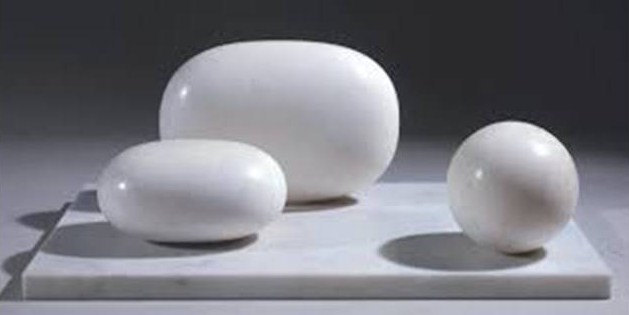
The international modernism section is more interesting than might be expected. Not only does it show how during the 1930s her work became increasingly abstract as in Helicoids in Sphere (1938, poster above) and Three Forms (1935, below):

but also reveals her and Nicholson’s involvement with magazines (books of articles), well displayed, like Circle and Axis with contributors across Europe, some of whom would arrive in London as the political situation deteriorated. A particularly important figure was the constructivist, Naum Gabo, who after 1935 lived in Hampstead near the British modernist community and would move to Cornwall with the Nicholsons after the outbreak of war. No works by him, in particular any from 1937 onwards showing the use of strings in sculpture, are on display, although some were at Tate St Ives in 2011. Hepworth introduced strings into her work after 1938 but the earliest stringed works in this exhibition are from 1943, Sculpture and Colour (Oval Form) Pale Blue and Red (below):


although there are some drawings from 1941 in the next section, equilibrium. As far as I could tell, the exhibition does not address not only the derivation of the use of strings in Hepworth’s sculpture but also her pioneering use of holes in sculpture (Pierced Form, 1931 in pink alabaster was destroyed in the war; the exhibition catalogue (Fig 18 page 39) dates it as 1932 but Tate’s records for a later piece with the same title say 1931).

equilibrium could just as well have been called contrast – between the increasingly large abstract pieces like that above and the series of Hospital drawings she made in 1948. A donation of tropical hardwood, guarea, gives its name to the next section of four large pieces, eg Corinthos (1954-5, below):


The last section of exhibits, pavilion, consists of seven bronzes which all appeared at a retrospective at the Kroller-Muller museum in Holland in 1965, the decade in which Hepworth produced a large number of works and became firmly established as an international figure. Squares with Two Circles (1963, below) is one of the best-known.


Between equilibrium and guarea the visitor passes through the staging sculpture section, its principal feature being Dudley Shaw Ashton’s documentary made in 1952 and released in 1953, Figures in a Landscape, about Hepworth at work in St Ives (available on the BFI website). In an essay in the catalogue, Media and Movement Barbara Hepworth beyond the Lens, Inga Fraser points out that Hepworth was not happy with the film. She suggests:
The portrayal of her sculpture was mediated via combination of Shaw Ashton's visual focus on the uncanny, Rainier's esoteric score, Hawkes's poetic narrative and Day-Lewis's theatrical delivery. ln light of her close involvement with the presentation of her work in other formats - exhibition, photography and in publication - it is conceivable that with these additional artistic contributions Hepworth felt her own narrative and conception of sculpture too much compromised. (page 78/79)
In 1953 her son with Skeaping was killed in an air accident.

The exhibition makes no mention of Hepworth’s assistants in St Ives who included Terry Frost and Terence Coventry. The catalogue is very informative, although constrained by the format and underlying philosophy of the exhibition – a timeline would have been helpful. An essay, ‘An Act of Praise’ Religion and the Work of Barbara Hepworth, by Lucy Kent reveals how taken Hepworth was with the ideas of Christian Science, a philosophy she shared with Ben Nicholson. He had been introduced to it by his first wife, Winifred.

Barbara Hepworth: Sculpture for a Modern World ends on 25 October 2015.


4 August 2014

Radev Revisited


Two years ago a post appeared here about The Radev Collection: from Pissarro to Picasso at the Victoria Art Gallery in Bath, an exhibition during the Collection’s 2011-13 UK tour. Now on at the same location is The Radev Show 2, and again visitors can be sure to find something they will like. There was some background to the Collection’s formation in the previous post, so I won’t repeat it here.

Some of the works on show last time have come back to Bath, like Modigliani’s Portrait of Soutine and Jawlensky’s Blaue Strasse c1916 (below, left and right):


Others are having a first showing: Vanessa Bell, Vase, Hat and Flowers, 1910 and a couple of Duncan Grant ceramic table-tops c 1950 (below, top and lower):


One of the originators of the Collection was Eardley Knollys, co-partner in the Storan Gallery in the inter-war period. Two pictures now in the Tate Gallery which were purchased from the Storan originally have been leant for this show, Maurice Utrillo’s Eglise de St Hilaire (Church at St Hilaire, c 1911, below left) and Chaïm Soutine’s La Route de la colline (Vence) (The Road up the Hill, c1924, below right):


However, as in 2012, most of the works in the exhibition are by British artists (more Ben Nicholson and Alfred Wallis!) and, as I said then, “Anyone interested in British 20th century art should try to see it” – again, possibly. The Radev Show 2 ends on 31 August. There might be a clue as to why the Radev Collection has returned to Bath towards the end of this post.


28 July 2014

'Art and Life' at Dulwich

Art and Life: Ben Nicholson, Winifred Nicholson, Christopher Wood, Alfred Wallis, William Staite Murray, 1920 – 1931 is now at Dulwich Picture Gallery after spells at Leeds Museums and Galleries and Kettle’s Yard in Cambridge. Earlier posts here have covered shows at Compton Verney in 2011 which examined the impact on Ben Nicholson of encountering Alfred Wallis in 1928, and at the Courtauld in 2012 which examined Nicholson’s work in the 1930s after his encounter with Mondrian. The Dulwich show (Art and Life from now on) looks at an earlier period starting with Ben Nicholson’s marriage to Winifred in 1920, then the couple’s meeting Kit Wood in 1926, the three artists’ responses to Alfred Wallis in 1928 and ends with the Nicholson’s separation, de facto after 1931. Art and Life features more than 80 works, some 15 of which have been exhibited publicly for the first time and many are on loan from “Private Collection”. It includes items by the potter William Staite Murray who often exhibited with the Nicholsons. The show has been curated by the art historian Jovan Nicholson, Ben and Winifred’s grandson, who gave a very informative lecture, Art and Life: Ben and Winifred Nicholson, at this year’s Oxford Literary Festival.

Art and Life can be regarded primarily as a portrait of an artists’ marriage – for the years it lasted. Ben and Winifred both came from upper class backgrounds, his father being the painter Sir William Nicholson and her family being north of England aristocrats with unusually artistic inclinations. The exhibition starts early in their married life when they were painting together at Lugano, producing work like his Cortivallo Lugano 1921 (below, top) and her Window Sill Lugano (below, lower) and Cyclamen and Primula (poster above), both 1923, the year of their first joint exhibition:


They would often produce works on the same theme, thoughtfully juxtaposed like many of the exhibits, for example the moorland scenery in 1920 at Tippacott (Devon, SW England), her Watercolour below top, his Pencil Drawing below, lower:


The consensus seems to be that at this stage of their artistic lives, his work is more concerned with form, hers with colour. This is, of course, with the benefit of retrospect from the 1930s when he is clearly far more interested in form than colour. In 1923 the Nicholsons began to spend time at Bankshead in Cumbria near Hadrian’s Wall and the exhibition includes further examples of the same landscape being pictured by both. What is apparent is how anodyne their work seems in comparison with that of avant garde artists like Malevich a decade earlier. Soon three works by Ben Nicholson indicate an interest in something more unconventional: 1924 (First Abstract Painting, Chelsea) (below, top left), Jamaique, circa 1925 (below, top right) and Still Life with Jug Mugs Cup and Goblet, 1925 (below, lower):


In 1926 Ben met Christopher Wood who later took a painter’s holiday with the Nicholsons in Cornwall (SW England), before the area’s revival of interest to artists. Wood’s Pill Creek Eock Cornwall, 1928 (below top) and Winifred Nicholson’s Summer, 1928 (below, lower) are among the three’s responses:


Soon they met Alfred Wallis in St Ives. Wallis was a retired mariner and prolific painter of self-taught sea studies like The Schooner the Beata, Penzance, Mount’s Bay, and Newlyn Harbour, undated (below, left) and St Ives Harbour, circa 1932-34 (below, right):


which made a lasting impression on all three artists, particularly Ben, Cornish Port, circa 1930, (below, top) and Wood, Le Phare, 1929 (below middle), perhaps less so Winifred, Seascape with Two Boats, circa 1932 (below, lowest):


although her Autumn Flowers on a Mantelpiece shows a small Wallis. Then came the climactic events of 1930: Ben Nicholson’s meeting Barbara Hepworth and Christopher Wood’s suicide at Salisbury station. Wood’s influence on Ben is apparent later that year in 1930 (Christmas night):


By the end of 1931, the year Winifred gave birth to their third child, Andrew, the Nicholson’s relationship had sundered. The saddest pictures in the exhibition are Wood’s The Fisherman’s Farewell, 1928 (below, top) and her Jake and Kate on the Isle of Wight, 1931 (below, lower):


Art and Life provides a welcome opportunity to see several works by Wood, for example Blue Necklace, 1928 (his mistress, Frosca Munswer) and Zebra and Parachute, 1930. The final exhibits in the show go beyond its nominal dates, but are of considerable interest including Ben’s 1935 (White Relief) and an abstract by Winifred, White and Black Ellipse, Outwards, 1936. The Nicholsons did not divorce until 1938 when Ben married Barbara. The famous Hepworth triplets had been born in 1934.

Art and Life: Ben Nicholson, Winifred Nicholson, Christopher Wood, Alfred Wallis, William Staite Murray*, 1920 – 1931 ends at Dulwich on 21 September 2014, nearly a year after it began at Leeds.

*Ben Nicholson 1894 - 1982
Winifred Nicholson 1893 - 1981
Christopher Wood 1901 - 1930
Alfred Wallis 1855 - 1942
William Staite Murray 1881 - 1962


21 October 2013

Mark Tobey at Thomas Williams

Leaving the George Grosz exhibition at Richard Nagy, I went into the Thomas Williams gallery in the same building to look at an exhibition of works by Mark Tobey (1890-1976). New York Abstract Expressionism, which dominated US painting from the mid-1940s through the 1960s, is not something which I’ve posted about (except, in passing, on Lichtenstein), or have much appreciation of. But the gallery’s catalogue, written by Thomas Williams and Hannah Tuck, proved to be extremely informative, pointing out that a poll of leading art critics in 1966:
… put Tobey as one of the six most important living artists, with Picasso, Miro, Ernst, Chagall and Bacon.
They describe Tobey’s contribution to Abstract Expressionism:
There is no doubt that when he returned to the U.S. at the end of the 1930s, Tobey was far ahead of his contemporaries. The ‘white writing’ that he had developed in England in 1935 was the first realisation of 'all-over' painting, which later became a central tenet of Abstract Expressionism, and whose most famous exemplar was Jackson Pollock. 
… lt was Tobey who provided for Pollock the final piece of artistic information that enabled him to complete his own journey towards ‘all-over’ Free Form or Abstract Expressionism. His paintings had none of Tobey's careful and quiet descent from calligraphy, and their execution was violent and brash by comparison. Pollock made the significant choice greatly to increase the scale of Tobey's images, so that they were no longer easel paintings - an entry requirement for avant-garde art in New York in the late 1940s. Nevertheless, the revolutionary core of Tobey's work, the dramatic break from artistic norms of figuration, perspective, space, form or even the composition of abstract shapes, and their replacement with paintings that had neither focal point nor boundary - that dazzling step into a territory that even Picasso and Matisse had not dared to enter - was Tobey's achievement and Tobey's gift to Pollock, de Kooning and others who followed in New York and elsewhere.

The exhibition includes an example of ‘white writing’, Untitled 1954 (above), and the pieces on show all seem to be from that period or later, but it was the account of his time in England in the 1930s which interested me, particularly given the nominal pre-occupation of this blog. During this period Tobey was based at Dartington Hall (Devon, SW England) having been invited by the Elmhirsts to join their arts centre:
Once at Dartington, he was given a splendid teaching studio in the gatehouse of the Hall and became acquainted with the other residents. These included Henry Moore, Cecil Collins, Bernard Leach, a pioneering ceramicist … 
… Tobey also made forays to London, a journey of considerable inconvenience, where he was introduced to two of the most advanced and considerable English artists at that time, Ben Nicholson and his lover, Barbara Hepworth. 
… ln 1934 three new and extraordinary pupils arrived at Dartington, Lucian, Clement and Stephan Freud, the grandsons of Sigmund Freud. For the next four years Tobey was thus able to engage with the early artistic development of Lucian. 
… As the decade came to a close at Dartington, Ben Nicholson introduced him to another expatriate refugee, Piet Mondrian. Mondrian had fled the turmoil in continental Europe in 1938 and moved into the house next door to his friend Nicholson in Hampstead, north London where they formed an extraordinary working relationship. But the friendship was hardly begun when, in the summer of 1938, Tobey made a trip to New York, and being unable to return to England as he had planned, was obliged to stay there. …
Mondrian left for the US in 1940. I posted here about the exhibition at the Courtauld last year on Nicholson and Mondrian in London, and exhibitions of Henry Moore and Barbara Hepworth have been the subjects of several other posts. In none of these contexts has Tobey’s name come up, as far as I am aware*, so the Thomas Williams show, which continues until 2 November, will hopefully be a first step in raising awareness of Tobey’s significance in British art between the wars.

*Roger Berthoud’s The Life of Henry Moore makes no reference to Tobey. Its only reference to Dartington is in the context of Memorial Figure, the subject of a post here earlier this year.


UPDATE 27 FEBRUARY 2014

To my surprise, this post is still being read, so I thought it might be helpful to update it regarding Tobey’s time at Dartington, drawing on Michael Young’s The Elmhirsts of Dartington, published in 1996 by the Dartington Hall Trust. The most relevant passages are on pages 221 to 223. Young, who had been a pupil at the school, explains how Tobey was invited to Dartington in 1931 by Dorothy Elmhirst:
… Dorothy sent Mark an invitation without any specificity about what he was expected to do, and perhaps because it was so vague Mark accepted. He taught amateurs of all ages on the estate, including me. I remember sitting in his studio with other children from the school and adults from many different departments of the estate, looking very awkward, as though they had never held a brush in their hands before, but all intent on their drawing. Mark moved around continuously, making jokes and encouraging more by words than by demonstration. Everyone an artist - he at any rate believed it.
Young quotes a speech given by Tobey to a class in autumn 1931 and a description by the potter, Bernard Leach, of Tobey’s manner of teaching. Young also explains how:
Tobey discovered at Dartington the mode of painting - the 'white writing' - for which he later became world famous. It came upon him in the middle of one night in his studio above the entrance to the courtyard, with its skylight which opened on to the stars like an immensely wide-lens telescope. He was so excited he sent for his friends to come over, even at that hour. He began a long series of paintings made up of lines whitish in tone made up of brush strokes against a dark background. Leach arrived in Dartington from St Ives in Cornwall in 1932.
Young explains:
In the summer of 1932 [Leach] and Tobey left together, at the Elmhirsts’ expense, to spend a year in Japan with Japanese craftsmen. Tobey went to China as well. … The experience of Japan influenced both Leach and Tobey as artists and created a bond between them that lasted.
According to Young, the three Freud boys arrived at Dartington in 1933, Clement staying until 1936 (page 174). Young makes no mention of Henry Moore.


24 March 2013

Schwitters at Tate Britain


Schwitters in Britain at Tate Britain is comprehensive, chronological and, even better, turns out to be modestly titled. It is in fact a near-retrospective of Kurt Schwitters (1887-1948), an artist who is not so popular as to guarantee that the show is unpleasantly crowded.


Although close to Dada and other avant-garde art movements in Europe after World War I, Schwitters, perhaps because of his relative isolation in Hanover, developed a movement of his own, MERZ. He alighted on these letters as a residue when cutting up a newspaper printed with the word COMMERZBANK and took them to mean art, sculptures or even buildings, Merzbauten, which could be assembled from anything. Perhaps not surprisingly many of the exhibits surviving from the years before he came to Britain are collages, often incorporating three-dimensional found objects. Inevitably, these do not reproduce well on the printed page (or LED screen) and have to be seen to fully appreciate the subtlety of their composition and colour - Merzbild 1a (The Psychiatrist) 1919, above.

Schwitters had decided to leave Germany for Norway in January 1937 before the exhibition in July that year of what Goebbels and others labelled degenerate art. He probably never wished to come to Britain but three years after arriving in Norway, the Nazi invasion meant that he, his son and daughter-in-law had to leave. The British authorities eventually interned Schwitters on the Isle of Man with many other mittel-European intellectual refugees until he was released in November 1941. After a brief sojourn in Paddington where he met his companion, Edith ‘Wantee’ Thomas, he spent the rest of the war in Barnes, SW London, at 39 Westmoreland Road, whose owners probably now have a good case for a Blue Plaque should they want one  (Relief in relief 1942-5 right).  During this period he made contact with old friends who were also refugees like Naum Gabo and encountered British artists like Ben Nicolson.

After the end of the war Schwitters moved to Ambleside in the Lake District where he started to construct the Merzbarn, the interior wall of which is now preserved in the Hatton Gallery, Newcastle. Its exterior was reproduced in the courtyard of the Royal Academy in 2011 as part of the exhibition Modern British Sculpture.

While happier making Merz collages and reliefs, Schwitters would turn his conventional artistic talent to more readily sold landscapes and portraits. Examples of the latter are Untitled (Portrait of Klaus Hinrichsen) 1941 (left), from his time on the Isle of Man, and Untitled (Portrait of Henry Pierce), painted in Ambleside in 1947, the same year as he made En Morn, detail in the Tate’s banner above.

Brian Sewell’s review of the exhibition is well worth reading and, among other things, draws attention to Schwitters as a link between Dadaism and the emergence of British Pop Art in the years after his death. Sewell suggests that the word MERZ to Schwitters was “irresistibly akin to the French merde, slang that he translated as rubbish or garbage, but that is better known as shit.” Certainly Schwitters served in the German infantry in the First World War and may well have picked up some French obscenities.

Schwitters in Britain continues until 12 May and will be at the Sprengel Museum Hannover from 2 June to 25 August.

24 September 2012

The Radev Collection reaches Bath

The Radev Collection is described as being “The private picture collections of: Eardley Knollys (1902 - 1991), Eddy Sackville-West (1901 – 1965) and Mattei Radev (1927 - 2009). Bequeathed in friendship, begun in 1938, and preserved in the 21st Century.” Some of the history of the Collection, and of the “male salon” which formed it, can be found on its website. Each of the three men added to the Collection of 800 works which mirror their differing interests: Knollys in French artists acquired through his gallery which in turn Sackville-West patronised for Modernist pieces. Knollys inherited from Sackville-West in 1965 and later left their combined collections to Radev.

A selection of works from the Radev Collection is currently on a UK tour which began in 2011 and will end in 2013. Curiously, on the first two stops, in Chichester and Lincoln, its title was The Radev Collection – Bloomsbury and Beyond, but at Bath’s Victoria Art Gallery it has become The Radev Collection: from Pissarro to Picasso (at the time of writing, on their website as “Pisarro – Piccasso”). The current title has the virtue of accuracy, Radev’s connection with the Bloomsbury Group being a little tenuous despite the Pallant House Gallery’s description of him as “a feature of artistic and literary Bloomsbury society”. For example, one of the leading Bloomsberries, Vanessa Bell, three of whose works are in the Collection, was born in 1879 and was in her seventies when Radev arrived in the UK from Bulgaria. Eddy, on the other hand, was Vita Sackville-West’s nephew and in the 1920s mixed with the Bloomsbury set at Charleston and elsewhere, though perhaps not on such intimate terms as his aunt.

Visitors to the exhibition will see unfamiliar works of an agreeably domestic scale by British and international artists including Keith Vaughan, Duncan Grant, Ivon Hitchens, Maurice Denis, Jean Metzinger, Jean Millet, Amedeo Modigliani (on the website, “Modigliano”). and Lucien Pissarro. Artists shown who have featured in previous posts here include Graham Sutherland, John Piper, Ben Nicholson (Carbis Bay 1942, left), Alfred Wallis and Christopher Wood.


There is also an opportunity to see works by Winifred Nicholson, Henry Lamb and Matthew Smith (Cornish flowers c1920, right), British artists who are perhaps less well-known than they were. As well as the Vanessa Bell, Bloomsbury fans can enjoy several works by Duncan Grant (Brighton pier and boats 1938, below)


Two notable pieces are the bronze by Henri Gaudier-Brzeska, Bronze Dancer 1913 (left) and Blaue strasse c 1916, (below) by Alexei Jawlensky, the Russian Expressionist who painted in Germany with Der Blau Reiter.

The Radev Collection: from Pissarro to Picasso continues in Bath until 18 November. It re-appears in Falmouth Art Gallery, Cornwall in February 2013 retitled again, this time as A Framer's Collection. Radev’s abilities in this regard are clear from the exhibits like the Smith above. Next summer the tour will return to London at the Redfern Gallery and end the year at the Abbott Hall Art Gallery in Kendal. Anyone interested in British 20th century art should try to see it. The exhibition catalogue provides more details of the Collection's founders and history as well as  responses from the curators of its tour, but is a little expensive at £5-70. However admission in Bath is free.


30 May 2012

The far side of Grayson Perry RA

RA is the Royal Academy of Arts Magazine and the Summer 2012 issue has just arrived:


I like Grayson Perry (as I explained in a post about his British Museum exhibition) and I thought his cover for RA was quite amusing. It was described inside:
Turner Prize-winning artist Grayson Perry RA is famous for his wonderful pots which combine dazzling visual exuberance and dramatic physical presence with imagery that reveals a sharp social observation. For our summer cover he has drawn a special Summer Exhibition pot, bulging inside with the show's goodies, while offering on the outside a gently teasing vision of its supposedly Waitrose-shopping, Radio 4-listening, National Trust-supporting audience.
Although I’m not a great fan of the RA Summer Exhibition or BBC1’s Antiques Roadshow, I’m afraid that my household has to put ticks of varying thicknesses, rather than crosses, in all the other ‘boxes’ (including the NT) except for The Proms. This issue of RA is launching a new opinion column with a contribution from Perry, No accounting for taste, on the class basis of aesthetics. As he points out:
In Britain, the most pervasive influence on the things we buy and do is social class.
He goes on to observe that the bedrock notion of middle-class taste is restraint and that:
I think this buttoned-up refinement can be seen in some of my favourite paintings. Someone once described modern British art as 'tightrope walking six inches off the ground'. I interpret this as an observation that British artists such as Paul Nash, Eric Ravilious, Ben Nicholson, even Francis Bacon with his glazed gold frames, did a polite, drawing-room-friendly version of Modernism, unlike those garish shouty foreigners with their café philosophy and angry politics. The shrine to this tasteful notion of bohemia must surely be Charleston in Sussex, the exquisitely faded farmhouse plavground of the Bloomsbury group …
Oh dear, more ticks: Ravilious and Nicholson have appeared in posts here, as would have Nash and Bacon if the opportunity had arisen – and I have been a supporter of the Charleston Trust for over 20 years …

So, just as people used to speculate about the once unseen far side of the moon, what would there have been on the far side of Perry’s RA pot, if it had been made, not just drawn? Well here are some suggestions for additional middle-class, Summer Exhibition-goers preferences in 2012:

The Dordogne
Volvo for sure at one time, but perhaps BMW or Audi now
The Killing or, better, Forbrydelsen
The Duchess of Cambridge
Ikea (mentioned in the article but not on the pot)
A trio of ’national treasures’: Alan Bennett, David Attenborough and Tony Benn
Most but probably not all of GAMA - Google, Amazon, Microsoft, Apple
Emma Bridgewater
Paul Smith (added 1 June)

I will add more if I can think of them, but coontributions are, as always, welcome.

On 5 June Perry is starting a three-part Channel 4 series, In the Best Possible Taste, based on talking to people from some of the tribes that make up modern British society that he came across in Sunderland, Tunbridge Wells, and the Cotswolds. The last of these is mostly located in South West England, of course. If it seems appropriate I will comment here on the series and also on his related exhibition, The Vanity of Small Differences, at the Victoria Miro Gallery, if I get to it.

Addendum 8 June

I should have known better than to try to be clever where Perry is concerned.  His Victoria Miro show includes the original, RA Pot, for the RA cover, and also a companion piece, Tate Pot, (left) for the Tate incorporating another 14 favoured brands. Assuming that there isn’t much to differentiate the taste of Summer Exhibition goers and Tate supporters, it’s a fair conclusion that the Tate pot is in effect the far side of the RA one. Well, I got three right: Apple, Amazon and Ikea. And what is a MINI if not a BMW? But I’m kicking myself about Pret A Manger.

I will post soon about The Vanity of Small Differences and the TV series, but in the meantime I recommend anyone interested in Perry’s work to make the trip to Victoria Miro 14 in Wharf Road, N1 to see Perry's six large tapestries and some new pots.

If, like me, you don’t aspire to the use of taxis, a 43 bus works fine: get out at Windsor Terrace, aim for the back of McDonald’s (not to be found on either pot ...) and look out for the Victoria Miro banner.


7 May 2012

John Piper and the Church in Dorchester Abbey

The English artist John Piper (1903-1992) was very much a contemporary of Graham Sutherland (1903-1980), who has been the subject of previous posts here. During the 2nd World War both men became war artists.  In the early 1960s designs by both men were juxtaposed in the new Coventry Cathedral, in the form of Piper’s (and Patrick Reyntiens’) stained-glass Baptistery Window and Sutherland’s tapestry. Piper had been interested in churches from his schooldays, but in his thirties, and under the influence of Ben Nicholson, he had become a promoter and producer of abstract art.

However, in the late 1930s he became friendly with John Betjeman who revived his interest in architecture, particularly that of religious buildings. An exhibition, John Piper and the Church, drawing on his work from that period onwards has been mounted in Dorchester Abbey (below), Dorchester-on-Thames, Oxfordshire by the Friends of Dorchester Abbey. Ostensibly the exhibition is to celebrate the Queen’s Diamond Jubilee but it also marks the 20th anniversary of Piper’s death. More than 70 works are on display, on paper and canvas, and in the form of church vestments and stained glass, all providing an excellent opportunity to admire Piper’s draughtsmanship and his imaginative use of colour.

The Friends’ ambitious undertaking is an undoubted success and worth travelling to Dorchester to see. John Piper and the Church continues until 10 June.

23 April 2012

Mondrian and Nicholson at the Courtauld

A post last year touched on the influence that the Cornish naïve painter Alfred Wallis had in the late 1920s and early 1930s on the artistic development of Ben Nicholson (1894-1982). Nicholson was a cosmopolitan individual who had already absorbed modernist ideas from Picasso in Paris, as the current Tate Britain exhibition, Picasso & Modern British Art, makes clear. In 1934, again in Paris, Nicholson, who had been exploring abstract composition, encountered Piet Mondrian (1872–1944). By this time Mondrian had arrived at his characteristic style of geometrical abstraction: horizontal and vertical lines placed on a white background with some of the resulting interstices filled in with primary colours.

The Courtauld Gallery exhibition, Mondrian || Nicholson: In Parallel, explores the relationship between the two artists from their first meeting until Mondrian’s departure to the USA in 1940. Works by both men during this period are on display including Nicholson’s pure white reliefs. These were built up or relieved laminas of different geometry, rectangular and circular, creating complex shadows. The reliefs merit careful examination to appreciate their construction, their apparent simplicity being deceptive. Mondrian’s pictures seem be presenting a curatorial challenge in long-term preservation akin to that of modernist architecture. This exhibition is particularly valuable as there are few public opportunities in England to see Mondrian’s works. The Tate has six in its collection, Composition C (no.III), with Red, Yellow and Blue, 1935 (above and currently at the Courtauld), being a long-term loan. The BBC Your Paintings website shows only that one.

Mondrian left Paris as war seemed imminent in 1938 to come to London at Nicholson’s invitation. After travelling to London in the company of the estranged Winifred Nicholson he settled into the artistic colony of Hampstead, living at Parkhill Road with Nicholson and Barbara Hepworth and their triplets around the corner in the Mall Studios. At the outbreak of war Nicholson and Hepworth left for Cornwall to be joined by Naum Gabo and his wife. Mondrian left London for New York after the fall of France in 1940.

The archival material on display includes Winifred Nicholson’s tiny diary (“Gabo telephone 10:30” “Ski lesson 3-4”) and correspondence between the two artists (“Dear Nicholson and Barbara”). It’s easy to get the feeling that for Nicholson parallels existed not only with Mondrian but in his relationships with Barbara and Winifred. An aide-mémoire of his first two marriages might be useful:
  • 1920-1938 Winifred Roberts (two sons and a daughter born 1927-31)
  • 1938-1951 Barbara Hepworth (triplets: a son and two daughters born 1934)
Admission (until 20 May) at £6 (full price) is reasonably priced and includes access to the Courtauld Gallery’s permanent collection. The exhibition catalogue is £30 and may be of considerable scholarly merit, although some visitors might consider it slim and short of colour illustration even at the current Amazon price of £19-50.

5 March 2012

Picasso at Tate Britain


Anyone with an interest in 20th Century British art will want to see Picasso & Modern British Art at Tate Britain. In November 1910, Roger Fry in his exhibition Manet and the Post-Impressionists introduced Picasso’s work to Britain having encountered it through Leo and Gertrude Stein in Paris. The Tate show traces Picasso’s subsequent influence in two ways. Firstly, his personal presence in the form of visits to Britain in 1919 and 1950 and also the showings here of his major works, particularly Guernica in late 1938/early 1939. Secondly, by revealing the responses of seven British artists whose work, if only at some stage, was affected by Picasso: Duncan Grant, Wyndham Lewis, Ben Nicholson, Henry Moore, Francis Bacon, Graham Sutherland and David Hockney. About 90 works by these artists appear alongside more than 60 of Picasso’s, including some of his major works.

My post about the Lucien Freud exhibition at the NPG remarked that “So much is available about Freud and his work that it needs little description here” and that applies again. However, it is worth pointing out that Graham Sutherland’s landscapes can be further explored currently at Modern Art Oxford. Also, nearby in London there is an opportunity at the Courtauld Gallery to explore the influence on Ben Nicholson of Piet Mondrian. Nicholson was a sophisticated and cosmopolitan painter, eclectic in his sources which extended to the Cornish naïve painter Alfred Wallis.

The Tate show concludes with The Three Dancers (1925), purchased by the Tate in 1964 for £80,000 (about £M1.4 now). Elizabeth Cowling’s Visiting Picasso describes the diplomacy required of Roland Penrose to persuade Picasso to sell the work to the Tate direct from his studio. British admirers of Picasso should be eternally grateful to Penrose for securing for the nation a painting whose auction price now one can only guess at, but could well be in the $M150 - £M100 region. Penrose recounts the conversation he had in 1965 about the picture:
I said,'One can see the beginnings of "Guernica" in "3 Dancers".’
P[icasso].'Peut-être mais des deux tableaux je préfère de beaucoup les "3 D". C'est peint comme un tableau sans arrière-pensée.’*
Penrose had first met Picasso in 1936 and later had a key role in arranging Guernica’s UK tour. He resumed contact after the war, wrote a biography of Picasso in 1958, Picasso, His Life and Work and organised the Picasso retrospective at the Tate in London two years later. He introduced Picasso to a wider audience in 1960 than ever before with the following:
It is largely due to Pablo Picasso that the conception of art as a powerful emotional medium, rather than a search for the perfection of ideal forms of beauty, has become accepted among the artists of the twentieth century.
The turning-point in Picasso’s early career came when he was 25. The struggle in which the young artist found himself involved is forcibly illustrated in the great picture, Les Demoiselles d’Avignon, painted in Paris in the spring of 1907. It came as a shock to his friends that he should abandon a style that they had grown to love and produce instead a form of art that they could no longer understand. No one, not even Matisse, Braque and Derain, nor his devoted patrons, nor even his close friend and admirer Guillaume Apollinaire could stomach this work, which at first sight seemed to them outrageous. It took many months to digest this insult to their sensibility, but gradually they came not only to accept it but to find that it was exerting a profound influence on them.
Although since that time the work of Picasso has not always been cubist in style, the discoveries made between 1909 and the outbreak of the 1914 war (which ended his close association with Braque), have led to innumerable developments in his work and have spread their influence more widely than any other single movement in the arts.
The enveloping tenderness of maternity, the wonder of the human head, the dilemma of the artist in relation to his model, the sacrificial drama of the bullfight, the heroism of classical myths, the metamorphosis of living beings and inanimate objects, the mystery of landscape or the familiar domesticity of a still life: these themes have always absorbed him.
Although painting is his major art, the universality of his genius extends to sculpture, drawing, etching and ceramics, murals and designs for the theatre, poetry, the writing of plays and the cinema.
Picasso looks at the world with new vision, and by his art he enables us to do likewise.
In the summer of 1960 nearly half a million people queued at the Tate Gallery on London’s Millbank for the Picasso exhibition – I was one of them and a teenager (only just). In fact, it was the first major show that I had been to. I can clearly remember how crowded it was and I have wondered subsequently how much of it must have passed over me. However, the unexpected feeling of déjà vu visiting Tate Britain over 50 years later for Picasso & Modern British Art goes to show that not much in life gets totally forgotten.

Picasso & Modern British Art continues at Tate Britain until 15 July 2012 and then will be at the Scottish Gallery of Modern Art in Edinburgh from 4 August to 4 November. As well as providing a record of the exhibition, the Tate’s catalogue includes some informative essays and a fascinating interview with John Richardson, another biographer of Picasso, about the malevolent ‘capers’ of the Anglophobic collector Douglas Cooper.

*literally: 'Perhaps, but of the two pictures I much prefer the "3 D". It is painted without a second thought’; but the catalogue offers: ‘a painting in itself without outside consideration’ (page 212).

19 January 2012

Graham Sutherland at Modern Art Oxford

It wouldn’t be controversial to say that the standing of Graham Sutherland (1903-80) was at a peak 50 to 60 years ago (for example at the 1952 Venice Biennale). Or that he is currently out of fashion and now remembered for his portraiture on display at Tate Britain (left) and in the National Portrait Gallery. Ironically his most famous portrait, that of Winston Churchill, was destroyed early in its existence. The catalogue for the show, Graham Sutherland An Unfinished World, at Modern Art Oxford (MAO) goes as far as suggesting that Sutherland might be regarded as “underrated, forgotten or having fallen out of favour”. Perhaps this exhibition of his landscapes and works as a war artist, curated by George Shaw, will be part of an overdue upgrading of his reputation, happily coinciding with a revival of attention being paid to landscapes.

Sutherland first visited Pembrokeshire (now Dyfed) in 1934 and for the rest of the decade produced a succession of landscapes there, concentrating, like David Hockney recently in East Yorkshire, on particular favourite locations. Sutherland is not an artist who can easily be labelled and, although he is sometimes regarded as a neo-Romantic, there are marked differences between his work and, say, Paul Nash’s. One influence on Sutherland was Picasso, who he eventually met in 1947, but he was also a contributor to the International Surrealism Exhibition in London in 1936. The style of these contorted landscapes with their searingly bright colours and deep shadows lent itself to Sutherland’s later depictions of the violent and unpredictable re-arrangements of blitzed buildings. Others of his works seem to anticipate Francis Bacon.


Sutherland’s reputation should also benefit from being one of the seven painters (the others are Duncan Grant, Wyndham Lewis, Ben Nicholson, Henry Moore, Francis Bacon, and David Hockney) whose works will be examined in Tate Britain’s forthcoming Picasso & Modern British Art. In old age Sutherland began to feel that he should repay the debt which he owed to Pembrokeshire, so he presented to the region a collection of 15 oil paintings and over 100 watercolours, gouaches, drawings and lithographs relating to the area. These were housed in a gallery at Picton Castle, which I can remember visiting in the early 1990s, but are now in the custody of National Museum Wales. Hopefully they will become accessible again, in part if not as a whole, at Oriel y Parc in Pembrokeshire. It is perhaps unfortunate that Sutherland did not take care of his posthumous reputation more in the manner of, say, Henry Moore.

Unusually, entrance is free to An Unfinished World although a donation to MAO is suggested. Alternatively, for some visitors that might make affordable the purchase of the excellent catalogue which includes essays by Shaw and Alexandra Harris, author of Romantic Moderns. It seems carping in these circumstances to suggest that the rooms in MAO (their sequence being slightly bewildering to a newcomer) should each have their own poster explaining the particular theme of that part of the show, but it surely would cost very little and be appropriate when over 80 works on paper are on display.

Graham Sutherland An Unfinished World continues at MAO until 18 March.

My ‘Anticipointment Index’ rating is 1 (ie the best out of 5). Although the show has been mentioned favourably in the national press, it would be unfair to describe it in any way as having been hyped, and no one ought to go away feeling that their time has been wasted getting to know Sutherland’s work better.

12 June 2011

Tate and Hepworth at St Ives

A post last month described the recent exhibition at Compton Verney of works by Alfred Wallis and Ben Nicholson, two artists associated with St Ives (Cornwall, SW England). Virginia Button’s St Ives Artists: A Companion, published by the Tate, provides a helpful introduction to 18 of the best-known members of the colony of artists working there in a significant way from the 1930s to the 1960s (and also to the potter Bernard Leach.

The mission of the Tate’s outpost at St Ives is to present 20th-century art in the context of Cornwall. The displays change regularly, allowing a different selection from the Tate's extensive collection of St Ives art to be shown each year. Visitors need to be aware that there is no permanent display of St Ives artists’ work in the Gallery. However, this year the Tate St Ives Summer Exhibition includes works by two artists with local links: Naum Gabo and Margaret Mellis, both active there during the Second World War.

The St Ives artist whose works are permanently held locally is Barbara Hepworth. Her former studio, now Museum and Sculpture Garden, is near, and part of, Tate St Ives. Gabo and his wife, and Hepworth and her husband, Ben Nicholson (and their triplets), moved to Cornwall in 1939, having been part of the Hampstead community of artists and sculptors from earlier in the 1930s. Common influences such as the use of strings in sculpture can be seen in the Gabo and Hepworth pieces currently at St Ives. Mellis and her first husband also moved to St Ives in 1939 (the Nicholsons lived with them for a while). The work of Nicholson and Gabo led Mellis to experiment with collages, some of which are exhibited. Most of her work on display is from the 1970s: attractive constructions made from driftwood found on the beach at Southwold (Suffolk), where she lived until her death in 2009 at the age of 95.

The St Ives colony was the second such in west Cornwall. There had been rail links to Penzance from 1859 and through services on the Great Western Railway reached St Ives in 1877. The area soon attracted artistic attention: the scenery, the fisherfolk and their boats, together with the exceptional quality of the light and the vogue for painting en plein air, influenced by the naturalism of French painters of the time, led to a settlement of artists at Newlyn. Part of the attraction of Newlyn was its similarity to Brittany. Penlee House Museum and Gallery in Penzance is the only Cornish public gallery specialising in the Newlyn School artists including Stanhope and Elizabeth Forbes, Walter Langley, Harold Harvey and Laura Knight.

As well as a selection from its permanent collection, Penlee House is running an exhibition this summer, Walter Langley and the Birmingham Boys, featuring some of the artists who came from the Midlands to work in Newlyn from the 1880s onwards.

There are tickets available for combined entry to Tate St Ives, including the Barbara Hepworth Museum and Sculpture Garden, and Penlee House, which offer a useful saving – these do not seem to be publicised on either organisations’ websites, but are featured at the Tate St Ives ticket desk.

Among the London galleries, Messum’s has a continuing interest in West Country paintings from the 1880s onwards. Locally, the Market House Gallery in Marazion holds a good stock of prints by Terry Frost and others, any of which might suit the whitewashed walls of what was once a fisherman’s cottage.

However, any visitor with a taste for late St Ives abstractionism, should not ignore the vagaries of the Cornish weather, well-appreciated by the realists of the Newlyn School:

The Rain it Raineth Every Day by Norman Garstin

25 May 2011

Alfred Wallis at Compton Verney

Compton Verney in Warwickshire is a handsomely set Georgian mansion which has been transformed into an art gallery with the support of the Peter Moores Foundation. As well as its permanent collections, it hosts temporary exhibitions. Currently, but only to 6 June, works by Alfred Wallis and Ben Nicholson are on display, exploring “Wallis’ unique vision and his influence on Nicholson’s work, focusing on paintings and drawings by the two artists dating from the late 1920s to the 1940s.”
It is 90 years since Wallis was first exhibited in London, following his discovery as a primitive painter in St Ives (Cornwall, in SW England) by established artists in the late 1920s. Most of the exhibits at Compton Verney are of Wallis’ work, many from the extensive collection at Kettle’s Yard, Cambridge.  The three-room exhibition makes a fair case for Wallis’ influence on Nicholson, although there were clearly many others, including major artists such as Mondrian and Picasso and movements such as cubism.

With the recent opening of The Hepworth Wakefield, Barbara Hepworth’s life and work is receiving more attention than in previous years. It is helpful by way of background to some of the Compton Verney exhibits to know that Nicholson (1894-1982) married and divorced three times:
1920-1938 Winifred Roberts (three children)
1938-1951 Barbara Hepworth (triplets)
1957-1977 Felicitas Vogler

Compton Verney has in the past put on some first class exhibitions, for example Van Gogh and Britain: Pioneer Collectors in 2006 and The Naked Portrait in 2007. However, some potential visitors to their next major exhibition, Stanley Spencer and the English Garden, may well be deterred by the pricing. Because this show will coincide with the “peak rate” period, and because exhibition admission is only available bundled with admission to the grounds and permanent collections, the Adult ticket will cost £13.20 (there are concessions). This seems steep for its likely scale, particularly for anyone contemplating a second visit to Compton Verney within a few months, and who has already had an opportunity to admire the restored ice house.
Restored ice house at Compton Verney, Warwickshire