Showing posts with label Graham Sutherland. Show all posts

12 June 2014

Lord Clark at Tate Britain


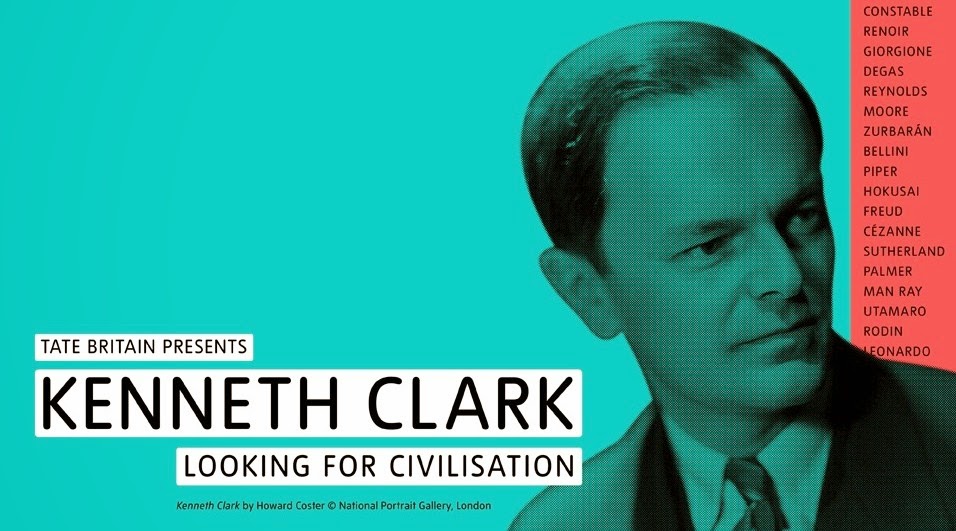
Kenneth Clark (1903-1983) was not only born in the same year as Evelyn Waugh, (mentioned in recent posts here), but also became well-known at a young age in the 1930s. Clark, unlike Waugh, was born into considerable wealth and, after studying the history of art at Oxford and coming under the influence of Roger Fry, was able to spend time in Italy with the American art historian Bernard Berenson, specialising in the Renaissance. On return to England he became Curator of the Ashmolean Museum in Oxford and then Director of the National Gallery from 1930 to 1946. His public service also included being Surveyor of the King’s Pictures, and chairmanships of the War Artists' Advisory Committee, the Arts Council of Great Britain and the Independent Television Authority. In 1969 Clark wrote and presented a celebrated TV series on the history of Western civilisation for BBC television, later shown in the US. When he subsequently received a life peerage, Private Eye dubbed him Lord Clark of Civilisation. The Tate Britain exhibition, Kenneth Clark - Looking for Civilisation, is a survey of his life’s work and brings together art that he had dealt with professionally, had benefitted from his patronage or that he had collected personally.

Not surprisingly, there is much to look at in this show. The 270 objects on display include some which are unfamiliar and may not be seen in public again for a while (one can hazard a guess as to which ‘Private Collection’ they come from). The first room is the most personal with Graham Sutherland’s portrait, Kenneth Clark (1963-64, left), and focusses on his early years. This is followed by works he collected for himself (Seurat’s The Forest at Pontaubert, (1881 below left) or, as Director of the National Gallery, for the nation, for example Constable’s Sketch for Hadleigh Castle (1828-9, below right), later transferred to the Tate. Some of the attributions he made when purchasing for the National Gallery do not seem to have stood the test of time particularly well. However, it was under his Directorship that the Gallery’s Scientific Department was formed, and the techniques which are now available to support judgements on authenticity began to be developed. In the 1930s Clark purchased for himself late works by Cézanne, as would Henry Pearlman a decade later and probably at a much higher price. A Cézanne pencil drawing, Still life, Pain sans mie, 1887-90, is particularly interesting in that its inclusion of commercial typography (“bread without crumbs”!) anticipates Picasso and Braque (but see the 1 July update below).


Clark not only collected but was an active patron looking favourably on Henry Moore (Recumbent Figure, 1938, right), Graham Sutherland, Paul Nash, and John Piper. He did not care much for abstraction (the Ben Nicholson on show seems to have been an exception), Francis Bacon or Lucien Freud’s later work. The fifth and largest space in the show is given over to the War Artists, most of whom worked in the Romantic style Clark liked, and is one of the most interesting. Although familiar in reproduction, the opportunity, during the Imperial War Museum’s closure, to see Paul Nash’s Battle of Britain (1942, below) and one of Moore’s shelter drawings (Tube 1941, below, lower) is welcome.


Among many impressive wartime pictures, ones which caught my eye were John Piper’s Somerset Place, Bath (1942, below,) and Albert Richards’ The Landing: H Hour minus 6. In the Distance Glow of the Lancasters Bombing Battery to be Attacked (1944, below, lower).


The final room concentrates on Clark’s activities after the war, particularly his involvement with television. The BBC are reportedly considering a new Civilisation series:
… "re-imagined … for the digital age". Unlike the original, it is likely to have a number of different presenters.
If so, I hope one of them will be Lisa Jardine, the daughter of Jacob Bronowski. His 1973 television series, The Ascent of Man, was complementary to Clark’s and looked at the rise of science as opposed to art, architecture and philosophy.

Just before leaving the exhibition, visitors can see two of the finest works acquired by Clark: a Francisco de Zurbarán still life, A Cup of Water and a Rose (c1630, below left), and Cézanne’s Le Château Noir (c 1904, below, right).


Kenneth Clark - Looking for Civilisation ends on 10 August and anyone with an interest in British art should try to get to Tate Britain before then. The most thought-provoking review I have come across is Kenneth Clark: arrogant snob or saviour of art? by James Hall in the Guardian.


A MINOR QUERY FOR THE CURATORS

In the first room there is a showcase (vitrine?) of Clark family photographs. One of these is of a villa owned by Clark’s father and (when I saw it) was labelled as being Clark’s childhood home in South West France at Cap Ferrat. I thought this unlikely. Although before the First World War Arcachon, on the Gironde department’s Atlantic Coast, was a fashionable resort, the village of Cap Ferret, nearby by sea but remote by land, was little more than a few oyster fishing huts (rather different now). However, Cap Ferrat (Saint-Jean-Cap-Ferrat) on the Mediterranean in the Alpes-Maritime department in South East France had become a magnet for the ultra-wealthy around 1900 and remained so. The Clark villa seems to be in the “Renaissance” style consistent with that location and, of course, Clark’s father was supposedly “the man who broke the bank at Monte Carlo”, not Biarritz. It might be worth checking.


UPDATE 1 JULY

A footnote to Cézanne’s use of commercial typography: I have recently come across this image of The Artist's Father, Reading "L'Événement", 1866, now in the National Gallery of Art, Washington DC. Apparently it wasn’t Louis-Auguste’s favourite paper but Cézanne’s old friend Emile Zola was L'Événement’s art critic.


7 May 2012

John Piper and the Church in Dorchester Abbey

The English artist John Piper (1903-1992) was very much a contemporary of Graham Sutherland (1903-1980), who has been the subject of previous posts here. During the 2nd World War both men became war artists.  In the early 1960s designs by both men were juxtaposed in the new Coventry Cathedral, in the form of Piper’s (and Patrick Reyntiens’) stained-glass Baptistery Window and Sutherland’s tapestry. Piper had been interested in churches from his schooldays, but in his thirties, and under the influence of Ben Nicholson, he had become a promoter and producer of abstract art.

However, in the late 1930s he became friendly with John Betjeman who revived his interest in architecture, particularly that of religious buildings. An exhibition, John Piper and the Church, drawing on his work from that period onwards has been mounted in Dorchester Abbey (below), Dorchester-on-Thames, Oxfordshire by the Friends of Dorchester Abbey. Ostensibly the exhibition is to celebrate the Queen’s Diamond Jubilee but it also marks the 20th anniversary of Piper’s death. More than 70 works are on display, on paper and canvas, and in the form of church vestments and stained glass, all providing an excellent opportunity to admire Piper’s draughtsmanship and his imaginative use of colour.

The Friends’ ambitious undertaking is an undoubted success and worth travelling to Dorchester to see. John Piper and the Church continues until 10 June.

5 March 2012

Picasso at Tate Britain


Anyone with an interest in 20th Century British art will want to see Picasso & Modern British Art at Tate Britain. In November 1910, Roger Fry in his exhibition Manet and the Post-Impressionists introduced Picasso’s work to Britain having encountered it through Leo and Gertrude Stein in Paris. The Tate show traces Picasso’s subsequent influence in two ways. Firstly, his personal presence in the form of visits to Britain in 1919 and 1950 and also the showings here of his major works, particularly Guernica in late 1938/early 1939. Secondly, by revealing the responses of seven British artists whose work, if only at some stage, was affected by Picasso: Duncan Grant, Wyndham Lewis, Ben Nicholson, Henry Moore, Francis Bacon, Graham Sutherland and David Hockney. About 90 works by these artists appear alongside more than 60 of Picasso’s, including some of his major works.

My post about the Lucien Freud exhibition at the NPG remarked that “So much is available about Freud and his work that it needs little description here” and that applies again. However, it is worth pointing out that Graham Sutherland’s landscapes can be further explored currently at Modern Art Oxford. Also, nearby in London there is an opportunity at the Courtauld Gallery to explore the influence on Ben Nicholson of Piet Mondrian. Nicholson was a sophisticated and cosmopolitan painter, eclectic in his sources which extended to the Cornish naïve painter Alfred Wallis.

The Tate show concludes with The Three Dancers (1925), purchased by the Tate in 1964 for £80,000 (about £M1.4 now). Elizabeth Cowling’s Visiting Picasso describes the diplomacy required of Roland Penrose to persuade Picasso to sell the work to the Tate direct from his studio. British admirers of Picasso should be eternally grateful to Penrose for securing for the nation a painting whose auction price now one can only guess at, but could well be in the $M150 - £M100 region. Penrose recounts the conversation he had in 1965 about the picture:
I said,'One can see the beginnings of "Guernica" in "3 Dancers".’
P[icasso].'Peut-être mais des deux tableaux je préfère de beaucoup les "3 D". C'est peint comme un tableau sans arrière-pensée.’*
Penrose had first met Picasso in 1936 and later had a key role in arranging Guernica’s UK tour. He resumed contact after the war, wrote a biography of Picasso in 1958, Picasso, His Life and Work and organised the Picasso retrospective at the Tate in London two years later. He introduced Picasso to a wider audience in 1960 than ever before with the following:
It is largely due to Pablo Picasso that the conception of art as a powerful emotional medium, rather than a search for the perfection of ideal forms of beauty, has become accepted among the artists of the twentieth century.
The turning-point in Picasso’s early career came when he was 25. The struggle in which the young artist found himself involved is forcibly illustrated in the great picture, Les Demoiselles d’Avignon, painted in Paris in the spring of 1907. It came as a shock to his friends that he should abandon a style that they had grown to love and produce instead a form of art that they could no longer understand. No one, not even Matisse, Braque and Derain, nor his devoted patrons, nor even his close friend and admirer Guillaume Apollinaire could stomach this work, which at first sight seemed to them outrageous. It took many months to digest this insult to their sensibility, but gradually they came not only to accept it but to find that it was exerting a profound influence on them.
Although since that time the work of Picasso has not always been cubist in style, the discoveries made between 1909 and the outbreak of the 1914 war (which ended his close association with Braque), have led to innumerable developments in his work and have spread their influence more widely than any other single movement in the arts.
The enveloping tenderness of maternity, the wonder of the human head, the dilemma of the artist in relation to his model, the sacrificial drama of the bullfight, the heroism of classical myths, the metamorphosis of living beings and inanimate objects, the mystery of landscape or the familiar domesticity of a still life: these themes have always absorbed him.
Although painting is his major art, the universality of his genius extends to sculpture, drawing, etching and ceramics, murals and designs for the theatre, poetry, the writing of plays and the cinema.
Picasso looks at the world with new vision, and by his art he enables us to do likewise.
In the summer of 1960 nearly half a million people queued at the Tate Gallery on London’s Millbank for the Picasso exhibition – I was one of them and a teenager (only just). In fact, it was the first major show that I had been to. I can clearly remember how crowded it was and I have wondered subsequently how much of it must have passed over me. However, the unexpected feeling of déjà vu visiting Tate Britain over 50 years later for Picasso & Modern British Art goes to show that not much in life gets totally forgotten.

Picasso & Modern British Art continues at Tate Britain until 15 July 2012 and then will be at the Scottish Gallery of Modern Art in Edinburgh from 4 August to 4 November. As well as providing a record of the exhibition, the Tate’s catalogue includes some informative essays and a fascinating interview with John Richardson, another biographer of Picasso, about the malevolent ‘capers’ of the Anglophobic collector Douglas Cooper.

*literally: 'Perhaps, but of the two pictures I much prefer the "3 D". It is painted without a second thought’; but the catalogue offers: ‘a painting in itself without outside consideration’ (page 212).

19 January 2012

Graham Sutherland at Modern Art Oxford

It wouldn’t be controversial to say that the standing of Graham Sutherland (1903-80) was at a peak 50 to 60 years ago (for example at the 1952 Venice Biennale). Or that he is currently out of fashion and now remembered for his portraiture on display at Tate Britain (left) and in the National Portrait Gallery. Ironically his most famous portrait, that of Winston Churchill, was destroyed early in its existence. The catalogue for the show, Graham Sutherland An Unfinished World, at Modern Art Oxford (MAO) goes as far as suggesting that Sutherland might be regarded as “underrated, forgotten or having fallen out of favour”. Perhaps this exhibition of his landscapes and works as a war artist, curated by George Shaw, will be part of an overdue upgrading of his reputation, happily coinciding with a revival of attention being paid to landscapes.

Sutherland first visited Pembrokeshire (now Dyfed) in 1934 and for the rest of the decade produced a succession of landscapes there, concentrating, like David Hockney recently in East Yorkshire, on particular favourite locations. Sutherland is not an artist who can easily be labelled and, although he is sometimes regarded as a neo-Romantic, there are marked differences between his work and, say, Paul Nash’s. One influence on Sutherland was Picasso, who he eventually met in 1947, but he was also a contributor to the International Surrealism Exhibition in London in 1936. The style of these contorted landscapes with their searingly bright colours and deep shadows lent itself to Sutherland’s later depictions of the violent and unpredictable re-arrangements of blitzed buildings. Others of his works seem to anticipate Francis Bacon.


Sutherland’s reputation should also benefit from being one of the seven painters (the others are Duncan Grant, Wyndham Lewis, Ben Nicholson, Henry Moore, Francis Bacon, and David Hockney) whose works will be examined in Tate Britain’s forthcoming Picasso & Modern British Art. In old age Sutherland began to feel that he should repay the debt which he owed to Pembrokeshire, so he presented to the region a collection of 15 oil paintings and over 100 watercolours, gouaches, drawings and lithographs relating to the area. These were housed in a gallery at Picton Castle, which I can remember visiting in the early 1990s, but are now in the custody of National Museum Wales. Hopefully they will become accessible again, in part if not as a whole, at Oriel y Parc in Pembrokeshire. It is perhaps unfortunate that Sutherland did not take care of his posthumous reputation more in the manner of, say, Henry Moore.

Unusually, entrance is free to An Unfinished World although a donation to MAO is suggested. Alternatively, for some visitors that might make affordable the purchase of the excellent catalogue which includes essays by Shaw and Alexandra Harris, author of Romantic Moderns. It seems carping in these circumstances to suggest that the rooms in MAO (their sequence being slightly bewildering to a newcomer) should each have their own poster explaining the particular theme of that part of the show, but it surely would cost very little and be appropriate when over 80 works on paper are on display.

Graham Sutherland An Unfinished World continues at MAO until 18 March.

My ‘Anticipointment Index’ rating is 1 (ie the best out of 5). Although the show has been mentioned favourably in the national press, it would be unfair to describe it in any way as having been hyped, and no one ought to go away feeling that their time has been wasted getting to know Sutherland’s work better.