Showing posts with label Picasso. Show all posts

19 September 2016

The Henry Moore at Gernika

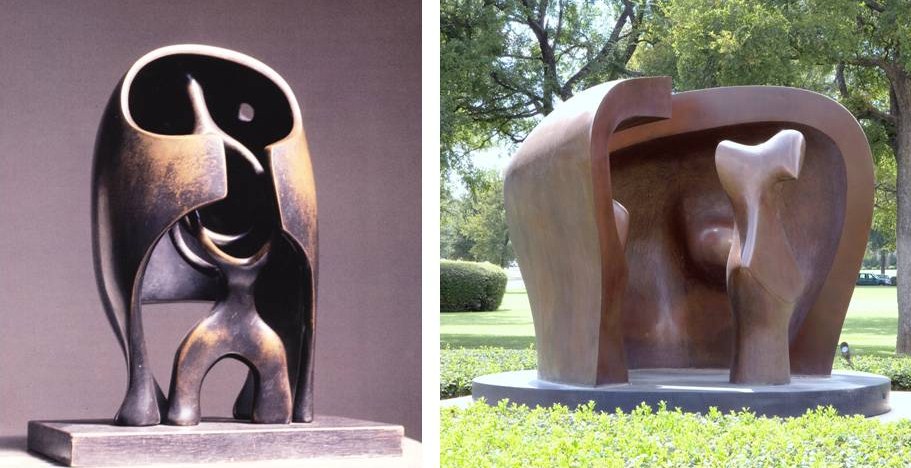
Large Figure in a Shelter, 1986, Gernika, Spain
On 26 April 1937 the town of Guernica in the Basque country of Spain (Gernika in Basque) was subjected to aerial bombing by the German Luftwaffe with Italian air force support. Hitler and Mussolini’s forces undertook the operation on behalf of the nationalists under General Franco in the Spanish civil war (1936-39). Guernica was being used by Franco’s republican opponents as a communications centre near the front line. The destruction of the town with much loss of life was immortalised in one of the twentieth century’s most famous paintings, Picasso’s Guernica, now in the Reina Sofia Museum in Madrid. Henry Moore, like most of the British intelligentsia, was anti-fascist and a supporter of the republican cause:
Most artists were of the same mind about Spain – I remember that when Irina and I were in Paris in the summer of 1937 Picasso invited a whole lot of us to go along to his studio and see how ‘Guernica’ was getting on. (Reference below)

In 1939 Moore began the first of his Helmet works (The Helmet, 1939-40, above left) in which an outer figure contained an inner one. One development of this theme would be Figure in a Shelter (1983, at the Kimbell Art Museum, Fort Worth, above right) and Large Figure in a Shelter of 1986, according to the Henry Moore Foundation:
… the last monumental work to be produced during his lifetime, scaled up to this immense size from the smaller version of 1983. Due to Moore's increasing illness, Bernard Meadows, who had become his first assistant in 1936 and later Professor of Sculpture at the Royal College of Art, was instrumental in seeing through the completion of the work - carried out by Moore's assistants. The initial cast was sited in woodland at Perry Green, and in 1990, negotiations with the Basque and Spanish governments by Sir Alan Bowness led to the second bronze being installed in what is now the Parque de los pueblos de Europa at Guernica. This was a fitting tribute by both artists to the memory of those who perished for the Republican cause, which they had strongly supported during the Spanish Civil War.
The Foundation’s description of the Perry Green cast adds:
Moore's continuing interest in the idea of an inner form protected by, but also contained within, an outer form is explored here with two monumental bronze forms that enclose the solitary figure of a third. Large Figure in a Shelter weighs over 21,000kg and was cast at the Morris Singer Foundry in Basingstoke. A second cast of this work stands in the Peace Park at Guernica in northern Spain. 
In accordance with his wishes, The Foundation ceased all casting when Moore died in 1986. Large Figure in a Shelter, however, was at the foundry at the time of his death. Under these unique circumstances, a clear protective lacquer was applied to the sculpture. With time and weather, the lacquer has degraded, leaving the base metal vulnerable to environmental damage. An ambitious project to restore the sculpture has now been completed. The restoration was led by James Copper who trained with Moore's own assistants for more than 12 years. In the course of the restoration, a rich gold-brown patina, in keeping with the majority of Moore's monumental bronzes, has been applied to the sculpture and polished with beeswax in order to allow the patina to develop naturally over time, in accordance with Moore's own approach.
This restoration was carried out in 2011 and was documented by Film Infinity:


However degraded the Perry Green version was prior to restoration, it is unlikely to have been in anything like such a poor state as the cast at Gernika is at present. As the photographs below (taken in August 2016) show, this is not only adorned with surface graffiti but has been subjected to deeper and more damaging vandalisation.


Many visitors to the Parque will conclude that it is beyond the capability of the local authorities in the town of Gernika-Lumo and the Biskaia province to look after this major work properly in its present location. April 2017 will be the 80th anniversary of the destruction of Guernica. It may also be an appropriate time to consider whether Moore’s work would be more appropriately sited and conserved elsewhere. An obvious location would be at the Guggenheim Museum in Bilbao, less than 40km away, an institution which did not exist at the time of Moore’s death.

Reference:

Henry Moore Writings and Conversations, ed Alan Wilkinson, University of California Press, 2002, page 166.

Previous posts here about Henry Moore:

Moore Rodin at Compton Verney
Bacon and Moore at the Ashmolean
The Arts Council’s Henry Moores in Bath
Henry Moore’s ‘Memorial Figure’ at Dartington Hall

15 January 2016

Three Paris Exhibitions: (2) Splendeurs et misères

Shows seen last month in a city subdued and uncrowded after les évènements of 13 December 


Of the three exhibitions I saw in Paris in December 2015, I have already posted about Picasso.Mania
at the Grand Palais, and the next will be on Villa Flora at the Musée Marmottan Monet. This post is about Splendeurs et misères, images de la prostitution en France (1850-1910) at the Musée d’Orsay, an exhibition which will reappear later in 2016 at Amsterdam’s Van Gogh Museum, to be called Lichte zeden (Easy Virtue). The Paris title presumably refers to a part of Honoré de Balzac's La Comédie humaine: Splendeurs et misères des courtisanes, (The Splendours and Miseries of Courtesans or A Harlot High and Low) published in four parts from 1838-1847. The Musée d’Orsay is not reluctant to take on difficult subjects, their male nude show in 2013 being an example. Splendeurs et misères, examining prostitution, not just in art but as an aspect of the social history of France, is certainly another, a revelation of misery for the many and splendour for a few.

The d’Orsay version addressed five themes and was spread over 15 rooms with numerous pictures and photographs. The first theme, Ambiguity, looked at the position of women, respectable or otherwise, in public places during the daytime and at night in cafés, cabarets and at the opera. Procurement and soliciting were often near the surface at any time of the day, for example in Giovanni Boldini’s En traversant la rue (1873/75, below left) and James Tissot’s La Demoiselle du magasin (1883/85, below right):


Women drinking alone in cafés is a recurrent theme in the art of the time, as in Degas’ L’Absinthe (1875/76, below left) and Manet’s La Prune (1878, below right). Agostina Sagatori au Tambourin (1887, seen earlier in 2015) was on loan from the Van Gogh Museum which also holds Toulouse-Lautrec’s Poudre de riz, (1887).


The cabaret pictures included Lautrec’s Moulin de la Galette (1889, below upper), on loan from the Art Institute of Chicago, and, from the Ny-Carlsberg-Glyptothek Copenhagen, the less well-known M Delaporte au Jardin de Paris (c1893, below lower):


At the opera, Eugène Giraud’s Le Bal de l'Opéra (1866, below top) and Edouard Degas’ Masked Ball at the Opera (1873, below lower) convey the same scene, the latter being far more compelling in its composition: 


After Ambiguity, Brothels - more Lautrecs, of course and photography (there are two sections of contemporary photography). Again from Chicago, Courbet’s Mère Grégoire (1855, 57/59, below left) refers to a character from a popular song, the proprietress of a Parisian brothel. An unfamiliar Lautrec from Budapest was Les Dames au réfectoire (1893/5, below right) conveying the unhappy position of the women employed as prostitutes who had to undergo frequent medical checks – a study for Rue des Moulins, (1894), was in this show, but not the final work, now in Washington.


Prostitution operated at all levels of society including the highest (for which abolition would only finally come in 1946). The section, Les Grandes Horizontales, included, as well as a Fauteuil d’Amour (below top), reputedly used by the Prince of Wales in the 1890s in pursuit of entente cordiale, Rolla (1878, below lower) by Henri Gervex:


followed by Manet’s Olympia (1863, below), bought by the French government in 1890, and introducing the final, rather diffuse, sections of the show:


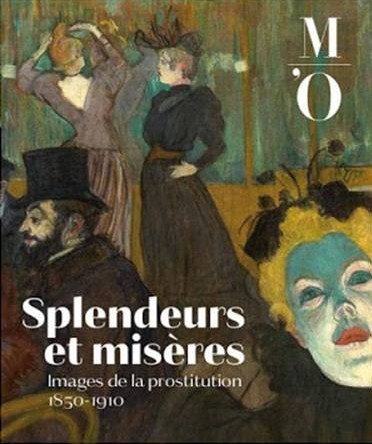
... Prostitution and the imagination and Prostitution and modernity. Lautrec reappeared with the famous Au Moulin Rouge (1892/95, detail in the poster above), again from Chicago, and the Courtauld’s Private Room in the "Le rat mort" (1899, below left) leading on to, among much else, some Picassos from 1901 including Nu aux bas rouges (below right):


Two final images from a show which is informative if not uplifting: Picasso’s La Buveuse d’absinthe (1901, below left) and Kees van Dongen’s Liverpool Lighthouse (1897, below right):


Splendeurs et misères, images de la prostitution en France (1850-1910) ends on 17 January but will be at the Van Gogh Museum from 19 February to 19 June. Unfortunately, although Professor Richard Thomson from Edinburgh University was one of the curators of the exhibition, it will not be coming to the UK.


POST-EXHIBITION NOTE

If one measure of an exhibition is whether it alters one’s ways of seeing, Splendeurs et misères was a success – as recently Manet’s A Bar at the Folies-Bergère (1882, below) in the Courtauld Gallery, London.


And in case anyone should choose to believe that Paris and London were quite different in their mores, The Awakening Conscience (1853, below) by William Holman Hunt clearly shows a man and his mistress, though sanctimoniously overlaid with religious salvation, in keeping with the susceptibilities of Victorian England.


8 January 2016

Three Paris Exhibitions: (1) Picasso

Shows seen last month in a city subdued and uncrowded after les évènements of 13 December


While in Paris, I came across an article by Robin Pogrebin in the International New York Times about developments at the Museum of Modern Art (MoMA) in New York. Back in 2010, a NYT art critic had described MoMA’s conventional wisdom as “a reluctance to question the linear unspooling of art history according to designated styles that remains the Modern’s core value and its Achilles’ heel”. Now, MoMA’s chief curator of painting and sculpture was being quoted as saying that the museum was “reflecting a more widespread shift from thinking in categories – or thinking in so-called canonical narratives – to thinking about multiple histories. Having a sense of curiosity, rather than a desire for pronouncement.” Of the three exhibitions in Paris, the first two, Picasso.Mania at the Grand Palais (described below) and Splendeurs et Misères, can probably be regarded as concerned with multiple histories, the third, Villa Flora (to follow), probably not.

Shows at the Grand Palais aren’t what they used to be. By comparison with their major retrospectives, Georges Braque in 2013 and Edward Hopper in 2012, Picasso.Mania seemed thin stuff. Its thesis was apparently that
After World War II, Picasso became renowned as a modern artistic genius. This public recognition came at a time when contemporary art was once again moving towards “avant-gardism”. This movement’s values, as incarnated by Marcel Duchamp, were in contradiction with Pablo Picasso’s flamboyant subjectivity, media presence and commercial success. As a result, it was only in 1971 that a collective tribute by living artists from different disciplines was organised for the artist’s 90th birthday. In the 1980s, exhibitions showed a new generation of artists how Picasso’s later works were years ahead of his time.
A proposition which was not exactly supported by telling visitors that in the 1960s Roy Lichtenstein was inspired by Picasso and that David Hockney was a repeat visitor to the Picasso exhibition at the Tate in 1960. The show made a good initial impression with Sort of Fabulous (2015), a video installation of 18 artists talking about the impact of Picasso on their work, including Jeff Koons, Frank Gehry, Thomas Houseago and Cecily Brown. An unspooling of art history then followed, starting with All hail the artist!, the Self-Portrait of 1901 (below left), borrowed from the Picasso Museum, and some recent images of the artist including Van Pei Ming’s Portrait of Picasso (2009, below centre) and Rudolf Stingel’s Untitled (2012, below right):


and some of the 90th birthday lithographs from 1971:


The most successful of the exhibition themes which followed was probably that given over to cubism – a wall of Picassos:


and then a homage in the form of various works, many by David Hockney, beginning with his Artist and Model (1973/4, below left) and Harlequin (1975, below right):


From the 1980s onwards Hockney explored multiple viewpoints evoking cubism (“a kind of mechanical cubism”) in, for example, Paint Trolley, LA (1985, below top) and Place Ferstenberg, Paris, August 7, 8, 9 (1985, below lower):


More recent Hockney works were The Jugglers, June 24th 2012 (2012, below), 18 films on 18 screens shown over 22 minutes:


and A Bigger Card Players (2015), as at Annely Juda Fine Art, London last summer. After that, the show began to meander. Picasso on screen projected on three walls clips from a wide variety of films (below) in which either the painter or his works or both appear, ranging from Truffaut’s Jules et Jim to Jean-Luc Godard’s King Lear to Woody Allen’s Midnight in Paris.


Demoiselles from elsewhere and Guernica, a political icon were both Hamlet without the prince, the originals not being available. Various works inspired by Les Demoiselles d’Avignon (1907), included Untitled by Sigmar Polke (2006, below top) and Jeff Koons’ Antiquity (2011, below lower):


Of the works pertinent to Guernica, one of the most interesting to British eyes was Goshka Macuga’s construction, The Nature of the Beast (2009), commissioned by the Whitechapel Gallery in memory of their having exhibited Guernica in 1939 and now owned by the Castello di Rivoli (below left). Part of the work is a glazed circular table which exhibits documents relating to the Spanish civil war and more recent conflicts. I thought the photographs from the Whitechapel’s archive of Clement Attlee in 1939 were thought-provoking (below right) – there is a mention of the Major Attlee Company (sic) in his Wikipedia entry.


After this, a section, It’s a Picasso!, grouped his paintings and prints from the late 1930s and later:


and then some pieces relevant to Picasso and Pop art’s reaction to abstract expressionism including Andy Warhol’s Head (after Picasso) No III (1966, below right top) and Roy Lichtenstein’s Still Life after Picasso (1964, below right lower):


Out of what followed, the impact of Picasso on Jasper Johns’ The Seasons (1985 – 87, Summer below left) with, nearby, Picasso’s Minotaure à la carriole (1936, below right) was notable:


A section covering the media attention Picasso received in his later years was followed by a large display of his late works, some reminiscent of Japanese shunga, seen at Avignon in 1970 and 1973. The final theme was the impact on artists in New York of the Guggenheim’s 1984 Picasso show, for example Jean-Michel Basquiat’s Untitled (Pablo Picasso) (1984, below):


Picasso.Mania ends on 29 February 2016.


29 May 2015

A Visit to the Fondation Louis Vuitton


Note: this post is based on a visit to the Fondation in early May 2105 

The Fondation Louis Vuitton in Paris was opened in October 2014 by Francois Hollande, President of France, and Bernard Arnault, President of LVMH - Moët Hennessy Louis Vuitton - and one of the wealthiest people in France. In 2001 he visited the Guggenheim Museum in Bilbao and met its architect, Frank Gehry. Five years later the Fondation was established as a private cultural initiative by LVMH to support contemporary artistic creation. Under a 55 year lease from the City of Paris, the Fondation’s building, designed by Gehry, is set in one hectare of land in the Bois de Boulogne next to the Jardin d’Acclimatation.

Like Gaul, a visit to the Fondation can be divided into three parts: the current exhibition, the display from the permanent collection and the building itself.

Keys to a Passion

In May 2015 the current exhibition is Les Clefs d’une passion (Keys to a Passion), “a selection of major works from the first half of the 20th century that established the foundations of modernity”. It is organised into four sequences: Subjective Expressionism, Contemplative, Popist (popiste) and Music which are in accord with the themes which structure the Fondation’s own collection (… en resonance avec les quatre axes structurant, de façon plastique et mouvante, la collection …).

Subjective Expressionism “evokes the questions each of us have about life, death, anguish, solitude and the desparate rage to live, despite oneself, despite others …”. It also provides a chance to see Munch’s The Scream (1893? 1910?, below left), a work normally confined to the Munch Museum in Oslo and not made available for the 2012 Pompidou Centre/Tate Modern Munch exhibition. That show was, of course, intended to have a post-1900 emphasis but so has Keys to a Passion!


A series of self-portraits (1934, above right) by Helene Schjerfbeck (1862-1946), a painter known best in her native Sweden, stand up to their proximity to The Scream. As well as a sculpture and two oils by Giacometti, this section includes two major 1949 works by Francis Bacon, Study from the Human Body (below left) and Study for Portrait (below right):


a Malevich not at Tate Modern in 2014, Complex Presentiment or Bust with a Yellow Shirt (c 1932, below left), and Otto Dix’s Portrait of the Dancer Anita Berber (1925, below right):


Contemplative occupies three rooms, the first dominated by two of Monet’s Water Lilies of 1916-19 borrowed from Paris museums. On one side of the room are four lake and mountain landscapes by the Swiss painter Ferdinand Hodler, on the other there are four studies of Lake Keitele from 1904-05 by the Finnish painter Aksell Gallen-Kalleila, one from the National Gallery in London. Complementing these are five seascapes, two by Emil Nolde and three from 1909 by Mondrian, the style of these being in marked contrast to some of his later works in the next room, for example Composition in line, second state (1916-17, below left) and Lozenge Composition with Yellow Lines (1933, below right):


However, this room is dominated by three of Malevich’s most significant works (again not at Tate Modern) lent from St Petersburg: Black Square, Black Cross and Black Circle, all c1923 and pointless to reproduce individually. They can be seen in the photograph (below top) with two of the Mondrians (including the one above left) and Brancusi’s Endless Column Version 1 from 1918. Opposite the Malevich’s, and to me as inducing of contemplation as the Monets, is a Rothko, No 46 (Black, Ochre, Red over Red) (1957, below lower):


In the next room an interesting Bonnard (Summer, 1917) is, to put it kindly, at a disadvantage near to a Picasso plaster sculpture (Head of a Woman with Large Eyes, 1931) and three of his Marie-Thérèse Walter paintings. One of these (Nude Woman in a Red Armchair, 1932) is familiar in London from Tate Modern, as Woman with Yellow Hair (1931, below left) and Reading (1932, below right), no doubt are in New York (Guggenheim) and Paris (Musée Picasso) respectively:


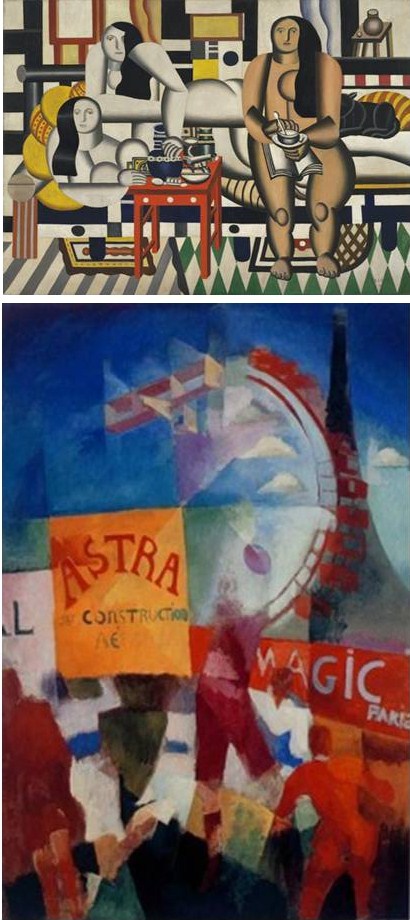
I found Popist the least successful of the four sequences. Picabia arguably anticipated Pop art and deserves a place in a section “resolutely engaged with the vitality, momentum and progress of modern life” but five large pictures, three of them nudes “veer[ing] between a joyous exaltation in nudity and a vaguely salacious eroticism”? Again three Legers, Three Women, (1921-22, below top), but the one other painting in the sequence, Robert Delaunay’s The Cardiff Team (1912-13, below lower) was new to me:


Music provides a triumphant conclusion to the exhibition, the four Kandinsky panels and works by Kupka and Severini being swept aside by two Matisse masterworks, The Dance (1909-10, below top) from St Petersburg and The Sorrow of the Kings (1952, below lower) from the Pompidou Centre in Paris (not lent to the Tate Modern/MoMA show last year):


Keys to a Passion certainly achieves its goal in bringing together some of the major art works of the 20th century. These include items which rarely travel, and for that as well as other reasons is worth making an effort to see before it ends on 6 July.


Items from the Permanent Collection 

Walking through these I was struck by Rachel Harrison’s Zombie Rothko (2011, below left) and Maurizio Cattalan’s Charlie don’t surf (1977 below right – the attendant and photographers are not part of the work). Harrison was awarded the Calder Prize in 2011 for exemplary work in the spirit of Alexander Calder.


It was pleasing to see works by UK artists including Ed Atkins’ video installations Us Dead Talk Love (2012) and Even Pricks (2013) and Tacita Dean, including her Lightning Series (2007) and Hünengrab (2008, below top). According to the caption it is one of a series depicting megalithic prehistoric stone formations in Cornwall (SW England). The series was inspired by Caspar David Friedrich’s Walk at Dusk (c1830-35, below lower), hence the title (Giant’s Tomb).


A large space is given to Sigmar Polke Cloud Paintings (1992-2009, below) – four paintings and a 4-billion-year-old meteorite, the third biggest discovered after a Siberian meteor shower in February 1947:


A small gallery is showing several works by Ellsworth Kelly, who was commissioned to provide works for the Auditorium (see below). These include Green Relief (2009, below left), Blue Diagonal (2008, below centre) and Purple Curve in Relief (2009, below right, lent by the artist):


There are also some fine Giacometti sculptures including Buste d’Homme assis (Lotar III), (1965, below left) and Grande femme II (1959-60, below right):


 THE GEHRY BUILDING 


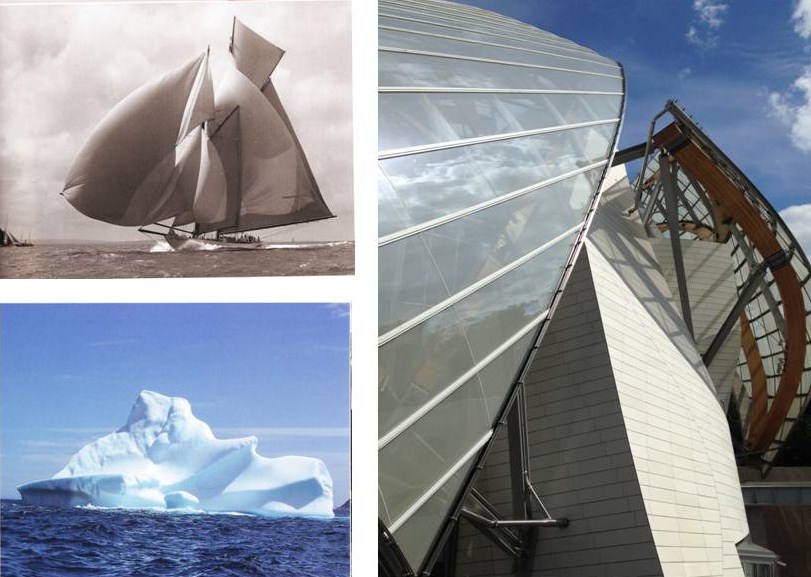
The interior of the Fondation building, containing the 11 gallery spaces (the underground ones vastly better than their equivalents at the National Gallery Sainsbury Wing in London), the Auditorium, shop and so on, is restrained and functional in contrast to the exterior. Some of the inspiration for Gehry’s design seems to have come from a yacht, the Susanne, built in 1911 and an iceberg (above), as well as from some of Paris’s famous metal and glass structures like the Grand Palais. The building is covered with over 19000 panels of white Ductal ® high performance cement (beton) and moving around the building and on the terraces provides a series of contrasts between the “iceberg” and the glass and steel “sails”. Its advanced design, fabrication and construction are a credit to French engineering.


There are some remarkable views over Paris and the Jardin, for example towards La Defense (below top). One of the terraces is displaying a living sculpture made of found objects by Adrian Villar Rojas, Where the Slaves Live (2014, below lower):


Inside are the Ellsworth Kelly works commissioned in 2014 for the Auditorium including Spectrum VIII (below right) and Color Panels Yellow and Red (below left).


Is the Fondation Louis Vuitton worth a visit? Definitely, but it may be a while before there is another show quite like Keys to a Passion.


UPDATE 3 JULY

Hopefully anyone in the UK interested in Frank Gehry will have been able to see Alan Yentob’s documentary, Frank Gehry: The Architect Says "Why Can't I?", in the BBC1 imagine strand before it disappears into iPlayer limbo.

Among the many points of interest are firstly that Gehry, when designing the Guggenheim Museum Bilbao in the mid-1990s, made use of what was at the time advanced software from France’s Dassault Group, aerospace being one of its main activities. Secondly he lived in Paris with his young family and the Jardin d’Acclimatation has very personal memories for him.


29 October 2014

V&A Prints on tour

The V&A has an extensive collection of fine art prints and related material. The range of the modern holdings is clear from their 2001 publication, Impressions of the 20th Century, and these have been drawn on to send Modern Masters: Matisse, Picasso, Dali and Warhol on tour this year to Lincoln, Plymouth, currently Bath’s Victoria Art Gallery and soon Inverness. Visitors to the show should be able to find something of interest from all four artists in the form of prints, books and other items.

The works by Picasso spanned most of his career from 1904 to 1957. I liked the portrait of the dealer Ambroise Vollard (1937, below left) and The Sleeping Woman (1947, below right):


There were also four of the sugar-lift aquatint and drypoint etchings from the portfolio of Buffon’s L’Histoire Naturelle, including The Lizard (1942, below left), which were printed during the Occupation, and Skull of a Goat on a Table (1952, below right):


The Matisse exhibits included both the print (image unavailable) and the wood block (1905, below right) for Nude in Profile on a Chaise Longue. The lithograph Interior, Reading (1925, below right) is of a subject he painted on various occasions:


Visitors to the recent Matisse exhibition at Tate Modern may have come away with the impression that his later work consisted only of cut-outs. Not so, as demonstrated colourfully by Marie-Jose in a Yellow Dress (1950, below):


Curiously, Salavador Dali was omitted from Impressions of the 20th Century. I hadn’t seen before any of the six posters which Salvador Dali designed for the French railways (SNCF) in 1969, two of the four on display here:


Andy Warhol’s work like Marilyn (exhibition poster above, three of the ten colour ways of this print are on show) is, as they say, iconic and also ubiquitous to the point of over-exposure (in a week I came across him in shows in Bath and Blenheim and at the NPG) but this colour offset litho poster from 1978, based on two of his Self Portraits from 1966, was striking:


This Louisiana is the Museum of Modern Art in Humlebaek, Denmark which, from its website, seems well worth visiting, although like many British people I’m deterred by the prospect of Danish prices. However, as the website states “DINNER BUFFET IN LOUISIANA CAFÉ EAT AS MUCH AS YOU WANT FOR DKK 149”, which would be just under £16 (US$26), perhaps I ought to think again.

Modern Masters in Print Matisse, Picasso, Dali and Warhol ends in Bath on 23 November 2014.