Showing posts with label John Piper. Show all posts

12 June 2014

Lord Clark at Tate Britain


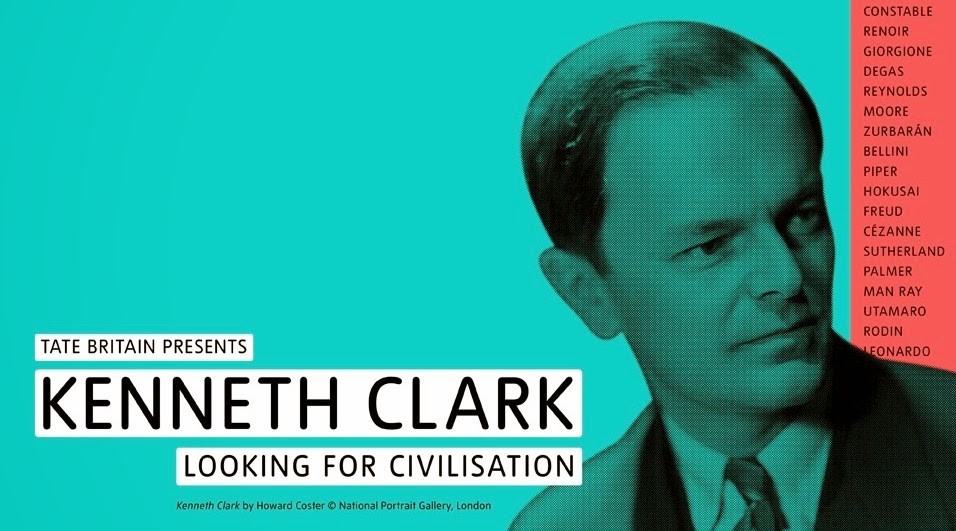
Kenneth Clark (1903-1983) was not only born in the same year as Evelyn Waugh, (mentioned in recent posts here), but also became well-known at a young age in the 1930s. Clark, unlike Waugh, was born into considerable wealth and, after studying the history of art at Oxford and coming under the influence of Roger Fry, was able to spend time in Italy with the American art historian Bernard Berenson, specialising in the Renaissance. On return to England he became Curator of the Ashmolean Museum in Oxford and then Director of the National Gallery from 1930 to 1946. His public service also included being Surveyor of the King’s Pictures, and chairmanships of the War Artists' Advisory Committee, the Arts Council of Great Britain and the Independent Television Authority. In 1969 Clark wrote and presented a celebrated TV series on the history of Western civilisation for BBC television, later shown in the US. When he subsequently received a life peerage, Private Eye dubbed him Lord Clark of Civilisation. The Tate Britain exhibition, Kenneth Clark - Looking for Civilisation, is a survey of his life’s work and brings together art that he had dealt with professionally, had benefitted from his patronage or that he had collected personally.

Not surprisingly, there is much to look at in this show. The 270 objects on display include some which are unfamiliar and may not be seen in public again for a while (one can hazard a guess as to which ‘Private Collection’ they come from). The first room is the most personal with Graham Sutherland’s portrait, Kenneth Clark (1963-64, left), and focusses on his early years. This is followed by works he collected for himself (Seurat’s The Forest at Pontaubert, (1881 below left) or, as Director of the National Gallery, for the nation, for example Constable’s Sketch for Hadleigh Castle (1828-9, below right), later transferred to the Tate. Some of the attributions he made when purchasing for the National Gallery do not seem to have stood the test of time particularly well. However, it was under his Directorship that the Gallery’s Scientific Department was formed, and the techniques which are now available to support judgements on authenticity began to be developed. In the 1930s Clark purchased for himself late works by Cézanne, as would Henry Pearlman a decade later and probably at a much higher price. A Cézanne pencil drawing, Still life, Pain sans mie, 1887-90, is particularly interesting in that its inclusion of commercial typography (“bread without crumbs”!) anticipates Picasso and Braque (but see the 1 July update below).


Clark not only collected but was an active patron looking favourably on Henry Moore (Recumbent Figure, 1938, right), Graham Sutherland, Paul Nash, and John Piper. He did not care much for abstraction (the Ben Nicholson on show seems to have been an exception), Francis Bacon or Lucien Freud’s later work. The fifth and largest space in the show is given over to the War Artists, most of whom worked in the Romantic style Clark liked, and is one of the most interesting. Although familiar in reproduction, the opportunity, during the Imperial War Museum’s closure, to see Paul Nash’s Battle of Britain (1942, below) and one of Moore’s shelter drawings (Tube 1941, below, lower) is welcome.


Among many impressive wartime pictures, ones which caught my eye were John Piper’s Somerset Place, Bath (1942, below,) and Albert Richards’ The Landing: H Hour minus 6. In the Distance Glow of the Lancasters Bombing Battery to be Attacked (1944, below, lower).


The final room concentrates on Clark’s activities after the war, particularly his involvement with television. The BBC are reportedly considering a new Civilisation series:
… "re-imagined … for the digital age". Unlike the original, it is likely to have a number of different presenters.
If so, I hope one of them will be Lisa Jardine, the daughter of Jacob Bronowski. His 1973 television series, The Ascent of Man, was complementary to Clark’s and looked at the rise of science as opposed to art, architecture and philosophy.

Just before leaving the exhibition, visitors can see two of the finest works acquired by Clark: a Francisco de Zurbarán still life, A Cup of Water and a Rose (c1630, below left), and Cézanne’s Le Château Noir (c 1904, below, right).


Kenneth Clark - Looking for Civilisation ends on 10 August and anyone with an interest in British art should try to get to Tate Britain before then. The most thought-provoking review I have come across is Kenneth Clark: arrogant snob or saviour of art? by James Hall in the Guardian.


A MINOR QUERY FOR THE CURATORS

In the first room there is a showcase (vitrine?) of Clark family photographs. One of these is of a villa owned by Clark’s father and (when I saw it) was labelled as being Clark’s childhood home in South West France at Cap Ferrat. I thought this unlikely. Although before the First World War Arcachon, on the Gironde department’s Atlantic Coast, was a fashionable resort, the village of Cap Ferret, nearby by sea but remote by land, was little more than a few oyster fishing huts (rather different now). However, Cap Ferrat (Saint-Jean-Cap-Ferrat) on the Mediterranean in the Alpes-Maritime department in South East France had become a magnet for the ultra-wealthy around 1900 and remained so. The Clark villa seems to be in the “Renaissance” style consistent with that location and, of course, Clark’s father was supposedly “the man who broke the bank at Monte Carlo”, not Biarritz. It might be worth checking.


UPDATE 1 JULY

A footnote to Cézanne’s use of commercial typography: I have recently come across this image of The Artist's Father, Reading "L'Événement", 1866, now in the National Gallery of Art, Washington DC. Apparently it wasn’t Louis-Auguste’s favourite paper but Cézanne’s old friend Emile Zola was L'Événement’s art critic.


21 June 2012

Post-War British Design at the V&A

I suppose it must have seemed a good idea at the time – a survey of British design in the years since the last time the Olympic Games were in London, 1948. And so came about BRITISH DESIGN 1948–2012: Innovation in the Modern Age, now on at the V&A. It’s in the same space used for Postmodernism: Style and Subversion 1970–1990 last year, which perhaps explains any feeling of ‘déjà vu all over again’.

The new show is in three overlapping sections. The first, Tradition and Modernity, covers the period from the end of WW2 to the mid-1960s, more or less. The second, Subversion, runs from the 1960s onwards but doesn’t show much after 2003. The last, Innovation and Creativity, is spread over the “last half century” or so. And at this point I ought to admit to being someone who grew up in the first period and saw the rest of it through adult eyes at the time. Perhaps that was why for me the first section (view below) worked best:


To the left of Henry Moore’s Harlow Family Group (1954-55) is part of Reg Butler’s Woman Resting (1951). The painting above is William Gear’s Autumn Landscape of the same year. Further to the left and not visible is a fine Lynn Chadwick maquette of 1951 for Stabile Cypress. At the entrance is part of The Englishman’s Home mural (left) by John Piper made for the Festival of Britain in 1951 and his 1962 work (with Patrick Reyntiens) for Coventry Cathedral’s baptistry window appears nearby. After an austere post-War start we move on to a more consumerist society in the form of Terence Conran’s Habitat and the Country House-style of Laura Ashley. Although the exhibition ties these influences to the 1960s, neither seems to have disappeared since. This section ends with a Mini (sadly with a slight dent over the nearside rear wheel arch, but otherwise immaculate). 

Then comes Subversion. The art here includes one of David Hockney’s Walt Whitman-inspired works, We Two Boys Together Clinging (1961, right), and others by Richard Hamilton and Eduardo Paolozzi. The over-whelming impression however is of fashion and pop with costumes for David Bowie and others and contributions from Mary Quant and Alexander McQueen. The YBAs are represented by a section of Damien Hirst’s restaurant/art installation Pharmacy. Only once did an exhibit label make a reference to ‘postmodernism’. 

On to Innovation and Creativity, though the first and most striking objects (see below):


are an E-type Jaguar and Concorde, both more the product of function than of form. It would have been of value to see some of the china, glass and cutlery designed for BA's Concordes.  The aircraft was, of course, an Anglo-French project and at this point the reality of globalisation becomes apparent.  Jonathan Ive rightly appears for his role in designing Apple products, but not Martin Smith for his Audi Quattro. The statement on one of the panel texts:
Innovation has characterised British design from the introduction of spinning machines in the 1780s and the engineering of ships and bridges in the 1840s to the development of computer codes after the Second World War and the invention of the worldwide web in the 1980s.
seems facile, given that Tim Berners-Lee was working at CERN when he proposed the web and brought together hypertext and the internet, both originating in the US. This is not to belittle his achievements, but can they reasonably be labelled “British”?

The exhibition finishes with some complimentary remarks about British architecture and a model of 30 St Mary Axe (the Gherkin to most of us), but the most dominant new building in London is Shard London Bridge designed by an Italian, Renzo Piano. Its observation platform will open to the public next month. In 2012 it seems strange that there is no mention of Anish Kapoor and Cecil Balmond's ArcelorMittal Orbit sculpture at the Olympic Park, surely creative and innovative, albeit controversial.

Innovation in the Modern Age continues until August 31.

7 May 2012

John Piper and the Church in Dorchester Abbey

The English artist John Piper (1903-1992) was very much a contemporary of Graham Sutherland (1903-1980), who has been the subject of previous posts here. During the 2nd World War both men became war artists.  In the early 1960s designs by both men were juxtaposed in the new Coventry Cathedral, in the form of Piper’s (and Patrick Reyntiens’) stained-glass Baptistery Window and Sutherland’s tapestry. Piper had been interested in churches from his schooldays, but in his thirties, and under the influence of Ben Nicholson, he had become a promoter and producer of abstract art.

However, in the late 1930s he became friendly with John Betjeman who revived his interest in architecture, particularly that of religious buildings. An exhibition, John Piper and the Church, drawing on his work from that period onwards has been mounted in Dorchester Abbey (below), Dorchester-on-Thames, Oxfordshire by the Friends of Dorchester Abbey. Ostensibly the exhibition is to celebrate the Queen’s Diamond Jubilee but it also marks the 20th anniversary of Piper’s death. More than 70 works are on display, on paper and canvas, and in the form of church vestments and stained glass, all providing an excellent opportunity to admire Piper’s draughtsmanship and his imaginative use of colour.

The Friends’ ambitious undertaking is an undoubted success and worth travelling to Dorchester to see. John Piper and the Church continues until 10 June.