Since 2006, Sotheby’s have staged annual selling exhibitions of sculpture, Beyond Limits, in the grounds of Chatsworth House, the ancestral seat of the Duke and Duchess of Devonshire and a masterpiece of English baroque architecture. This year’s tenth anniversary exhibition was Beyond Limits: The Landscape of British Sculpture 1950-2015 which ran from 14 September to 25 October. Tim Marlow, Artistic Director at the Royal Academy was the guest curator and also author of an essay for the exhibition catalogue, A Topography of British Sculpture. The sculptures were not arranged at Chatworth in a chronological sequence but the approach in Marlow’s essay was primarily historical and is echoed here.
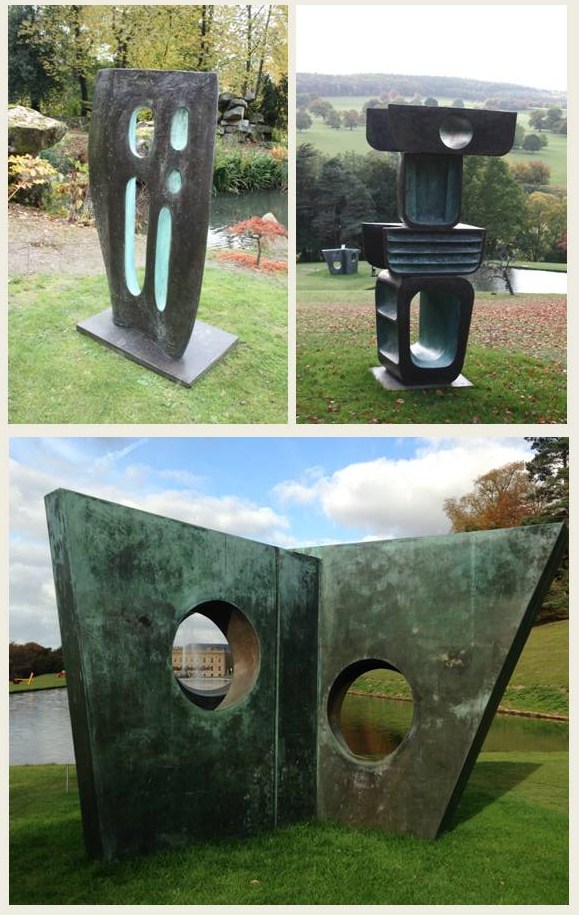
Marlow starts his survey by identifying Henry Moore and Barbara Hepworth as the ‘presiding spirits’ who led post-war British sculpture into the Modernist and post-Modernist mainstream of Western art. One of the inevitable shortcomings of the recent Tate Britain Hepworth show was its inability to place Hepworth’s larger works outdoors, something which Beyond Limits was well-placed to rectify with three pieces: Sea Form Atlantic (1964, below top left), Three Obliques (Walk In) (1969, below lower) and The Family of Man: Figure 1, Ancestor 1 (1972, below top right with Three Obliques (Walk In) in the distance).
After appearing in the British Pavilion at the 1952 Venice Biennale, a group of some younger sculptors became associated with the ‘Geometry of Fear’; for example, Reg Butler (Manipulator,1954, below left) and Lynn Chadwick (Pair of Walking Figures – Jubilee, 1977, below right):
It was in the 1960s that it became apparent that a serious, internationally respected but fundamentally British tradition” of sculpture had emerged, something which in Marlow’s view “became one of the great, yet understated, success stories of post-war British culture". Talents which emerged at this time included Kenneth Armitage (Monitor, 1961, below top) and William Tucker, whose Genghis Kahn (1963, below lower) seems ahead of its time:
Anthony Caro (Sunshine, 1964, below left) had a major exhibition at Chatsworth in 2012 while a post here recently covered the current Arnolfini Richard Long show (Cornwall Slate Line, 1990, below right):
The 1980s, the period of the 'New British Sculpture', saw the emergence of major figures such as Anish Kapoor and Antony Gormley. Gormley’ s Big Gauge II (2014, below top left), Tony Cragg’s Manipulation (2008, below top right) and Stephen Cox’s Kiefer-like Dreadnought: The Problems of History - The Search for the Hidden Stone (1990 to 2015, below lower) are later works.
The prominence of the YBAs since the nineties was reflected in Beyond Limits, though I don’t altogether share Marlow’s enthusiasm for Hurst. Sarah Lucas’s Florian and Kevin (2013, below upper and lower respectively) were produced at Pangolin.
Gavin Turk’s Habitat (Burgundy) (2004, below left) and American Bag (2015, below right), contrary to appearance, are painted bronzes, not as impressive as his Nomad, seen at Crucible2 last year.
Marlow’s survey finishes with two complex works, both with archaic resonance, Thomas Houseago’s Hermaphrodite (2011, below left) and Bill Woodrow’s Regardless of History (1998, below right):
Two pieces which were not specifically mentioned by Marlow were Bernard Meadows’ Large Standing Armed Figure (1962, below left) and the recent Conrad Shawcross, The Dappled Light of the Sun, I-III (2015, part below right):
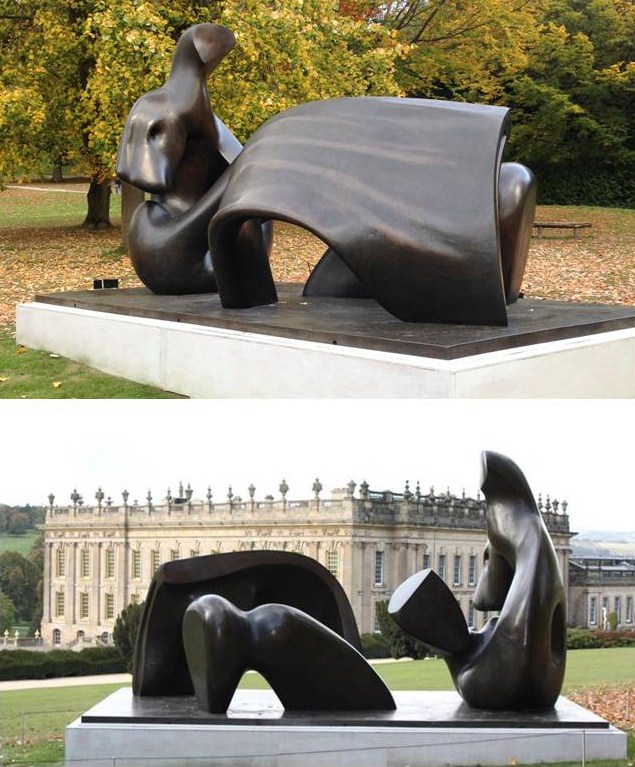
To end where the survey began, two views of a fine Henry Moore, Three Piece Reclining Figure: Draped (1975):
Showing posts with label Lynn Chadwick. Show all posts
2 November 2015
20 October 2014
Crucible2 at Gloucester Cathedral
Crucible2 is the second sculpture exhibition at Gloucester Cathedral curated by Gallery Pangolin of Chalford, Gloucestershire. The first was in 2010 with 76 contemporary sculptures; this time 100 exhibits by 61 sculptors are set in and around the cathedral. Key pieces, in the view of the curators, include works by Kenneth Armitage, David Backhouse, Ralph Brown, Lynn Chadwick (Jubilee IV in the poster,left), Ann Christopher, Antony Gormley and William Tucker. The 20th and 21st century works are often positioned in startling and stimulating contrast to their mostly English Gothic surroundings. For example, Breon O’Casey’s Large Cockerel (circa 2000, below) in the Cloisters with the earliest fan-vaulting in England circa 1350:
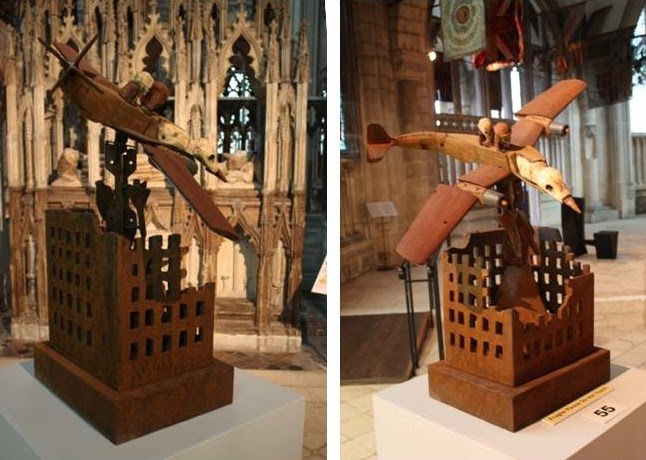
The most celebrated monument at Gloucester is the tomb of Edward II circa 1350, seen below left in the background to Steve Hurst’s Gloucester in Berlin. Hurst, born in 1932 and a witness to bombing in World War 2, sees it as concerning “… the bombing of civilians no matter what their country or who launches the bombing aircraft. It is a personal attempt to regain the viewpoint of a child”.
In the background (right) are the laid up colours of the Gloucestershire Regiment. They appear again (below right) behind Paul Wager’s Omnibus which marks the centenary of the Great War 1914-1918. Similar sentiments inform Deborah van der Beek’s Collateral (below right) – eight million horses died in that war - but it was cast around spent munitions from the conflicts in Iraq and Afghanistan which brought the expression “collateral damage” into common use.
The monument near Damien Hirst’s Anatomy of an Angel (Black) (2008, below) is to Sarah Morley, 29, a mother of four who died a few days after “having sustained the pains of Childbirth at Sea” while returning from Bombay in 1784.
Among the pieces I liked were Antony Gormley’s Pose (2012, below) with In Man’s Nature by Jon Buck behind).
Bryony Marshall’s DNA – Helix of Life (below, left) marks the 60th anniversary of the discovery of DNA. Subsequently mitochondrial DNA was identified as having been passed down to us all from a woman in East Africa about 150,000 years ago, known as Mitochondrial Eve, the inspiration for a sculpture of the same name by Sue Freeborough (below right):
The photograph below left of Geoffrey Clarke’s Taunton Deane Crematorium: Test Panel does not do justice to the colours of the glass. To the right is Sarah Lucas’s Realidad (2013), one of her NUDs series shown as bronzes at the Venice Bienniale in 2013.
John Humphreys’ Ipsius Imago a Latere Extensa probably succeeded as the artist wished in puzzling and confusing the viewer:
but perhaps was not as happily placed as the Eduardo Paolozzi plaster Vulcan near a strange moustachioed carving, perhaps a millennium older:
Among the sculptures in the open were Bruce Beasley’s Breakout II (below, left)in the Cloisters and outside Kenneth Armitage’s final work, Reach for the Stars (below, right).
Crucible2 ends on 31 October. There is no admission charge but a helpful map costs £2 and there is a £3 charge for photography. The catalogue at £16 is both good value and helps support the Cathedral.
UPDATE 2 NOVEMBER 2015
After posting about Beyond Limits: The Landscape of British Sculpture 1950-2015 held at Chatsworth House from 14 September to 25 October 2015, I thought it would be useful to add an image of Gavin Turk's bronze, Nomad (2002, below - and in other colours):
Another version of Chadwick's Jubilee can be seen there, as well.
Labels:
Antony Gormley,
contemporary art,
Damien Hirst,
Deborah van der Beek,
DNA,
Gallery Pangolin,
Gloucestershire,
Lynn Chadwick,
Sarah Lucas,
sculpture,
World War 1,
World War 2,
YBA
21 June 2012
Post-War British Design at the V&A
I suppose it must have seemed a good idea at the time – a survey of British design in the years since the last time the Olympic Games were in London, 1948. And so came about BRITISH DESIGN 1948–2012: Innovation in the Modern Age, now on at the V&A. It’s in the same space used for Postmodernism: Style and Subversion 1970–1990 last year, which perhaps explains any feeling of ‘déjà vu all over again’.
The new show is in three overlapping sections. The first, Tradition and Modernity, covers the period from the end of WW2 to the mid-1960s, more or less. The second, Subversion, runs from the 1960s onwards but doesn’t show much after 2003. The last, Innovation and Creativity, is spread over the “last half century” or so. And at this point I ought to admit to being someone who grew up in the first period and saw the rest of it through adult eyes at the time. Perhaps that was why for me the first section (view below) worked best:
To the left of Henry Moore’s Harlow Family Group (1954-55) is part of Reg Butler’s Woman Resting (1951). The painting above is William Gear’s Autumn Landscape of the same year. Further to the left and not visible is a fine Lynn Chadwick maquette of 1951 for Stabile Cypress. At the entrance is part of The Englishman’s Home mural (left) by John Piper made for the Festival of Britain in 1951 and his 1962 work (with Patrick Reyntiens) for Coventry Cathedral’s baptistry window appears nearby. After an austere post-War start we move on to a more consumerist society in the form of Terence Conran’s Habitat and the Country House-style of Laura Ashley. Although the exhibition ties these influences to the 1960s, neither seems to have disappeared since.
This section ends with a Mini (sadly with a slight dent over the nearside rear wheel arch, but otherwise immaculate). 
Then comes Subversion. The art here includes one of David Hockney’s Walt Whitman-inspired works, We Two Boys Together Clinging (1961, right), and others by Richard Hamilton and Eduardo Paolozzi. The over-whelming impression however is of fashion and pop with costumes for David Bowie and others and contributions from Mary Quant and Alexander McQueen. The YBAs are represented by a section of Damien Hirst’s restaurant/art installation Pharmacy. Only once did an exhibit label make a reference to ‘postmodernism’.
On to Innovation and Creativity, though the first and most striking objects (see below):
are an E-type Jaguar and Concorde, both more the product of function than of form. It would have been of value to see some of the china, glass and cutlery designed for BA's Concordes. The aircraft was, of course, an Anglo-French project and at this point the reality of globalisation becomes apparent. Jonathan Ive rightly appears for his role in designing Apple products, but not Martin Smith for his Audi Quattro. The statement on one of the panel texts:
The exhibition finishes with some complimentary remarks about British architecture and a model of 30 St Mary Axe (the Gherkin to most of us), but the most dominant new building in London is Shard London Bridge designed by an Italian, Renzo Piano. Its observation platform will open to the public next month. In 2012 it seems strange that there is no mention of Anish Kapoor and Cecil Balmond's ArcelorMittal Orbit sculpture at the Olympic Park, surely creative and innovative, albeit controversial.
Innovation in the Modern Age continues until August 31.
The new show is in three overlapping sections. The first, Tradition and Modernity, covers the period from the end of WW2 to the mid-1960s, more or less. The second, Subversion, runs from the 1960s onwards but doesn’t show much after 2003. The last, Innovation and Creativity, is spread over the “last half century” or so. And at this point I ought to admit to being someone who grew up in the first period and saw the rest of it through adult eyes at the time. Perhaps that was why for me the first section (view below) worked best:
To the left of Henry Moore’s Harlow Family Group (1954-55) is part of Reg Butler’s Woman Resting (1951). The painting above is William Gear’s Autumn Landscape of the same year. Further to the left and not visible is a fine Lynn Chadwick maquette of 1951 for Stabile Cypress. At the entrance is part of The Englishman’s Home mural (left) by John Piper made for the Festival of Britain in 1951 and his 1962 work (with Patrick Reyntiens) for Coventry Cathedral’s baptistry window appears nearby. After an austere post-War start we move on to a more consumerist society in the form of Terence Conran’s Habitat and the Country House-style of Laura Ashley. Although the exhibition ties these influences to the 1960s, neither seems to have disappeared since.
This section ends with a Mini (sadly with a slight dent over the nearside rear wheel arch, but otherwise immaculate). 
Then comes Subversion. The art here includes one of David Hockney’s Walt Whitman-inspired works, We Two Boys Together Clinging (1961, right), and others by Richard Hamilton and Eduardo Paolozzi. The over-whelming impression however is of fashion and pop with costumes for David Bowie and others and contributions from Mary Quant and Alexander McQueen. The YBAs are represented by a section of Damien Hirst’s restaurant/art installation Pharmacy. Only once did an exhibit label make a reference to ‘postmodernism’.
On to Innovation and Creativity, though the first and most striking objects (see below):
are an E-type Jaguar and Concorde, both more the product of function than of form. It would have been of value to see some of the china, glass and cutlery designed for BA's Concordes. The aircraft was, of course, an Anglo-French project and at this point the reality of globalisation becomes apparent. Jonathan Ive rightly appears for his role in designing Apple products, but not Martin Smith for his Audi Quattro. The statement on one of the panel texts:
Innovation has characterised British design from the introduction of spinning machines in the 1780s and the engineering of ships and bridges in the 1840s to the development of computer codes after the Second World War and the invention of the worldwide web in the 1980s.seems facile, given that Tim Berners-Lee was working at CERN when he proposed the web and brought together hypertext and the internet, both originating in the US. This is not to belittle his achievements, but can they reasonably be labelled “British”?
The exhibition finishes with some complimentary remarks about British architecture and a model of 30 St Mary Axe (the Gherkin to most of us), but the most dominant new building in London is Shard London Bridge designed by an Italian, Renzo Piano. Its observation platform will open to the public next month. In 2012 it seems strange that there is no mention of Anish Kapoor and Cecil Balmond's ArcelorMittal Orbit sculpture at the Olympic Park, surely creative and innovative, albeit controversial.
Innovation in the Modern Age continues until August 31.
23 June 2011
Sculpture in Gloucestershire
There are currently two opportunities to see some modern British sculpture in Gloucestershire (SW England) – at Quenington and at Chalford, 18 miles (30km) to the west.
The Quenington Sculpture Trust has been running shows of contemporary sculpture in the riverside gardens of Quenington Old Rectory since 1992. The 10th show, Fresh Air 2011, which started on 19 June, features about 170 items from over 100 contributors, all in the delightful setting of Mr and Mrs Abel-Smith’s garden. Thanks to their support, what started as a local event has now become a significant biennale of sculpture with coverage in the national media.
Lorraine Robbins, the curator, asked five young artists to produce responses to Chadwick’s work and these are displayed alongside the relevant piece. Robbins gamely made her own contribution intended as a reaction to Chadwick’s Beast VII, commenting:
We are left to draw our own conclusions as to the significance of Robbins' head being concealed by an empty box of dog biscuits, in contrast to the ravaging mandibles of Chadwick’s creation. Beast 43 was still on sale when I visited – I hope it finds a buyer at £2000 before the show ends on 15 July.
Fresh Air 2011 closes on 10 July.
The Quenington Sculpture Trust has been running shows of contemporary sculpture in the riverside gardens of Quenington Old Rectory since 1992. The 10th show, Fresh Air 2011, which started on 19 June, features about 170 items from over 100 contributors, all in the delightful setting of Mr and Mrs Abel-Smith’s garden. Thanks to their support, what started as a local event has now become a significant biennale of sculpture with coverage in the national media.
Soaring Figure by Rick Kirby
![]() |
|
Fragment by Jilly Sutton
|
Gallery Pangolin at Chalford is the showcase for the sculpture foundry, Pangolin Editions. The foundry had a long relationship with the sculptor Lynn Chadwick (1914-2003) and to mark the 60th anniversary of the Festival of Britain, when Chadwick’s talent was first recognised, the Gallery is showing Strange Beasts Lynn Chadwick and the New Generation.
![]() |
| Beast VII by Lynn Chadwick |
Lorraine Robbins, the curator, asked five young artists to produce responses to Chadwick’s work and these are displayed alongside the relevant piece. Robbins gamely made her own contribution intended as a reaction to Chadwick’s Beast VII, commenting:
What strikes me about Chadwick's work and this piece in particular, is a real maleness in its welded angular construction, emphasising hard geometric shapes. In her book, The Nude in Art, Lynda Nead suggests that ‘if the male signifies culture, order, geometry ... then the female stands for nature and physicality.' She also posits that within the ideal, muscular, male body there lies a fear that it may revert to ‘its own female formlessness' or 'the beast within'. Beast 43 started as a desire to physically become Chadwick's beast. I wanted to perch heavily and precariously on a plinth, an unsavoury intruder in the gallery. In making the cast I chose to wear a bra and G-string, (a garment described by Roland Barthes in his essay 'Striptease' as the ‘ultimate triangle'), the flimsy, ornate triangles of underwear forming a distorted echo to the simple, masculine forms of Chadwick's Beast VII.
![]() |
| Beast 43 by Lorraine Robbins |
Fresh Air 2011 closes on 10 July.
Subscribe to:
Posts (Atom)


VA-Images-7.jpg)