Showing posts with label SW England. Show all posts

9 November 2015

John Harris on Bristol and Plymouth

The Guardian last week ran a series of articles by John Harris on the future of cities – urban despatches from within the UK. As well as Bradford and Manchester, his articles covered the two cities of the South West region, Bristol and Plymouth. Knowing both fairly well, I thought his accounts of the situations they face were excellent and should be read by anyone with the least interest in either place or in the south west.

He didn’t say so specifically, but Plymouth in the past lacked a significant middle class, as is revealed by this description of its housing stock:
Part of Plymouth’s problem is that until recently, we only had 56 houses in Band H council tax – 90% of Plymothians live in either C, B or A. So our council tax base is low.
So it possibly has more in common with Liverpool than Bristol. Harris starts his Bristol piece:
“Bristol is perhaps the one southern city which really feels independent of London,” writes Owen Hatherley in his brilliant architectural travelogue A New Kind Of Bleak.
An endorsement which I’m not sure I support. To me Bristol seems to have an inferiority complex with regard to London which leads it to overcompensate. This may worsen when rail electrification reduces the travel time by 20 minutes - as a Mexican president said, “so far from God and so close to the United States”*. It could also be an alternative explanation to Harris’s when he observes:
Bristol was the only English city to vote for an elected mayor in the referendums that took place in 2012, something put down to the apparent chaos of its politics (between 2001 and 2011, the old city council was led by seven different people) and the city’s ancient fondness for doing its own thing.
At which point a key difference between Plymouth and Bristol should be made clear. The latter actually is a meaningful conurbation surrounded by rural Devon, whereas the city of Bristol is merely the core of a built-up area which extends seamlessly into South Gloucestershire and North East Somerset. It’s not just because of the topography that Bristol’s public transport is incoherent and inadequate for its size. North East Somerset includes Bath which, although much smaller than Bristol, doesn’t do anything to mitigate the latter’s inferiority complex. From 1974 to 1996, these areas were part of the county of Avon, abolished by John Major’s Conservative government and, if meaningful devolution is to take place in future, probably needs to be re-established.

An article earlier this year, Bristol, the European capital of green nannying and bureaucracy, by Anthony Whitehead, gives a resident’s view of current life in the city. I posted here last year about the Royal William Yard redevelopment in Plymouth to which Harris refers.


*If Bristol is too close to London, Plymouth is probably too far from the capital for its own good. The M5 stops at Exeter, Plymouth airport is mothballed – Newquay or Exeter are the nearest at present - and GWR electrification gets no closer than Bristol, although other more marginal improvements to the rail service are programmed. [Added 10 November].


26 August 2015

Barbara Hepworth at Tate Britain

The British sculptor Barbara Hepworth was born in 1903 in Wakefield, West Yorkshire, where the museum named after her was opened in 2011. But from 1939 until her death in 1975, she lived and worked in South West England at St Ives in Cornwall - I posted here in 2011 about a visit to the Barbara Hepworth Museum and Sculpture Garden, part of Tate St Ives. Elsewhere in the region there are other pieces by her, for example Figure for Landscape (1960 below top) at the University of Exeter and Theme and Variations (1969–72, below lower) at what were the offices of the Cheltenham and Gloucester Building Society in Cheltenham. Barbara Hepworth: Sculpture for a Modern World at Tate Britain seems a welcome opportunity to take a retrospective view of her work – as such it could be regarded as complementary to that provided in 2010 for her contemporary, Henry Moore.


Although chronological, Barbara Hepworth: Sculpture for a Modern World is presented in an ostensibly thematic form starting with carving and moving on through studio to international modernism, equilibrium and eventually pavilion. Ann Compton, in an essay in the exhibition catalogue, Crafting Modernism Hepworth’s Practice in the 1920s, identified an important issue which the curator of a Hepworth retrospective has to face:
Accounts of Barbara Hepworth's career frequently divide her practice into stages defined not only by time and place but also by relationships with other key modernists, notably Henry Moore, John Skeaping and Ben Nicholson. Whilst these individuals were unquestionably important, such emphasis on personal connections is symptomatic of the containment of Hepworth's sculpture within a narrow and ultimately reflexive frame of reference. (page 13)
However, it is a matter of fact that Moore and Hepworth were at the Leeds School of Art and the Royal College of Art together in the 1920s and neighbours in the Hampstead avant garde of the 1930s. At the time of her death Moore, five years her senior, commented “we were always like a younger sister and an older brother”. Furthermore Hepworth was married to John Skeaping and later to Ben Nicholson, having children with both. Nonetheless carving, while aiming to put Hepworth’s 1920s work in the context of other sculptors around that time practicing direct carving in wood or stone, so allowing comparison of, for example, Skeaping’s Pigeon (c1928, below top left), and her Toad (1928, below top right) and her Musician (1929-30, below lower left) and Moore’s Seated Girl (1931, below lower right):


with several other works by Skeaping present, fails to inform the visitor (or this one, anyway) that he and Hepworth were married from 1926 until their marriage broke up in the early 1930s.

The next section, studio, has little alternative but to be realistic about Nicholson as a presence in Hepworth’s life. Anyone who left Art and Life at the Dulwich Picture Gallery in 2014 wondering what Ben did next will find an answer here – there are about 17 of his works alongside 24 of Hepworth’s. The couple spent most of the 1930s living and working together and studio aims, among other things, to reveal their dialogue about abstraction. There are some interesting pieces here in this regard, for example Hepworth’s Two Heads (1932, below left) and Nicholson’s painting of the couple, 1933 (St Rémy, Provence) (below right):


Perhaps not all visitors will be aware that Hepworth gave birth to their triplets in October 1934, married Nicholson in 1938 and that they would divorce in 1951.

The international modernism section is more interesting than might be expected. Not only does it show how during the 1930s her work became increasingly abstract as in Helicoids in Sphere (1938, poster above) and Three Forms (1935, below):


but also reveals her and Nicholson’s involvement with magazines (books of articles), well displayed, like Circle and Axis with contributors across Europe, some of whom would arrive in London as the political situation deteriorated. A particularly important figure was the constructivist, Naum Gabo, who after 1935 lived in Hampstead near the British modernist community and would move to Cornwall with the Nicholsons after the outbreak of war. No works by him, in particular any from 1937 onwards showing the use of strings in sculpture, are on display, although some were at Tate St Ives in 2011. Hepworth introduced strings into her work after 1938 but the earliest stringed works in this exhibition are from 1943, Sculpture and Colour (Oval Form) Pale Blue and Red (below):


although there are some drawings from 1941 in the next section, equilibrium. As far as I could tell, the exhibition does not address not only the derivation of the use of strings in Hepworth’s sculpture but also her pioneering use of holes in sculpture (Pierced Form, 1931 in pink alabaster was destroyed in the war; the exhibition catalogue (Fig 18 page 39) dates it as 1932 but Tate’s records for a later piece with the same title say 1931).

equilibrium could just as well have been called contrast – between the increasingly large abstract pieces like that above and the series of Hospital drawings she made in 1948. A donation of tropical hardwood, guarea, gives its name to the next section of four large pieces, eg Corinthos (1954-5, below):


The last section of exhibits, pavilion, consists of seven bronzes which all appeared at a retrospective at the Kroller-Muller museum in Holland in 1965, the decade in which Hepworth produced a large number of works and became firmly established as an international figure. Squares with Two Circles (1963, below) is one of the best-known.


Between equilibrium and guarea the visitor passes through the staging sculpture section, its principal feature being Dudley Shaw Ashton’s documentary made in 1952 and released in 1953, Figures in a Landscape, about Hepworth at work in St Ives (available on the BFI website). In an essay in the catalogue, Media and Movement Barbara Hepworth beyond the Lens, Inga Fraser points out that Hepworth was not happy with the film. She suggests:
The portrayal of her sculpture was mediated via combination of Shaw Ashton's visual focus on the uncanny, Rainier's esoteric score, Hawkes's poetic narrative and Day-Lewis's theatrical delivery. ln light of her close involvement with the presentation of her work in other formats - exhibition, photography and in publication - it is conceivable that with these additional artistic contributions Hepworth felt her own narrative and conception of sculpture too much compromised. (page 78/79)
In 1953 her son with Skeaping was killed in an air accident.

The exhibition makes no mention of Hepworth’s assistants in St Ives who included Terry Frost and Terence Coventry. The catalogue is very informative, although constrained by the format and underlying philosophy of the exhibition – a timeline would have been helpful. An essay, ‘An Act of Praise’ Religion and the Work of Barbara Hepworth, by Lucy Kent reveals how taken Hepworth was with the ideas of Christian Science, a philosophy she shared with Ben Nicholson. He had been introduced to it by his first wife, Winifred.

Barbara Hepworth: Sculpture for a Modern World ends on 25 October 2015.


13 July 2015

Sculpture in Gloucestershire

This was also the title of a post here four years ago which covered an exhibition at Gallery Pangolin in Chalford and that year’s Fresh Air outdoor sculpture exhibition not far away in Quenington. History repeats itself, sometimes agreeably, because Pangolin are putting on their fourth one-man show of works by Terence Coventry, Sculpture and Works on paper, while Fresh Air 2015 has just finished.

Coventry was born in Birmingham in 1938 but has spent much of his life in Cornwall including a period working for Barbara Hepworth in St Ives. Some of his spare and dramatic pieces are made in Corten steel (COR-TEN) which weathers to a stable oxide surface, for example Corten Owl I (below left) and Corten Torso (below right):


Bronzes of various sizes at Pangolin include Man Releasing Bird II and Woman Releasing Bird (below, left and right): 


Another bronze, Boar II (below top) and the powder-coated steel, Monumental Steel Bull (below lower):


were at Gloucester Cathedral during Crucible2 last year, as were bronzes by Coventry, Monumental Gannet Head, and by Jon Buck, Midnite Movie Heads, both to be seen at Fresh Air 2015:


There were over 170 items at Quenington, so what follows is just a few of those which I liked, starting with a bronze by Carol Peace, Red Ribbon (below left), quite different from Edwina Bridgeman’s Cos After All (below right), constructed from recycled plastic crates:


I’m not sure garden sculpture is at its best when it attempts to compete for space in the border as a quasi-vegetable (top), but Dorcas Casey’s Mule Head (lower) was clearly there on its own terms:


as were Tom Hackett’s Shaggy Dog Stories (below left), funded by Arts Council England, and Paul Cox’s Rabbits (£3000 and £1390 each respectively): 


What would I like to have taken home to my own garden? Probably Wendy Lawrence’s ceramic Disc Form (below):


Terence Coventry, Sculpture and Works continues until 24 July. Fresh Air 2015 ended on 5 July but will be back in 2017, all being well.

I posted here about Fresh Air 2013.


14 May 2015

RN Trident after the UK General Election

During the election campaign Labour made it clear that they would continue with a UK nuclear deterrent and that it would by implication be in the form of SSBNs with Trident SLBMs:
Labour remains committed to a minimum, credible, independent nuclear capability, delivered through a Continuous At-Sea Deterrent. We will actively work to increase momentum on global multilateral disarmament efforts and negotiations, and look at further reductions in global stockpiles and the numbers of weapons. (page 78 and 79, Britain can be better, The Labour Party Manifesto 2015)
Elsewhere there were four mentions of NATO, none in the context of nuclear deterrence.

Almost as near to the end of their manifesto, the Conservatives were more specific about the number of submarines and the Trident system:
We will retain the Trident continuous at sea nuclear deterrent to provide the ultimate guarantee of our safety and build the new fleet of four Successor Ballistic Missile Submarines – securing thousands of highly-skilled engineering jobs in the UK. We will work closely with our allies to continue to strengthen NATO – supporting its new multi-national rapid response force. We will maintain our global presence, strengthening our defence partnerships in the Gulf and Asia. Later this year, we will hold a National Security Strategy and Strategic Defence and Security Review to plan for the future. (page 77, The Conservative Party Manifesto 2015)
There were six other mentions of NATO, again none were in the context of nuclear deterrence.

By comparison, the SNP seemed mildly obsessed with Trident and nuclear weapons, a subject which appeared six times in their manifesto spread from pages 3 to 38 (see Annex below). However, there was no mention of NATO at all, even though the “High North and Arctic are a key priority for Scotland”. Of course, this avoided any need to address the problem of pursuing unilateral disarmament and in so doing destabilising a nuclear alliance, as had been apparent in the 2013 white paper, Scotland’s Future Your Guide to an Independent Scotland (discussed here last year).

SNP leader Nicola Sturgeon at a CND rally in April 2015
But the election of a Conservative government seems to have given a green light (if not a blue one) to four new SSBNs with Trident missiles. The bloc of 56 SNP MPs at Westminster could not win a vote against it, even with the support of left-wing Labour and Liberal (Democrat) members. But this ignores the new reality of Scottish politics with the SNP seeking to make any suitable issue – the repeal of the Human Rights Act, for example – into one of Westminster dominating Scotland and so bolstering the case for another independence referendum.

In terms of defence planning, with its timescales of years or even decades at the level of the “National Security Strategy and Strategic Defence and Security Review”, endorsement of the future of the deterrent can hardly avoid addressing the contingency of another independence referendum in which the No/Yes vote of 45/55% in 2014 might be reversed. So adamant are the views of the SNP on the subject in their manifesto that it seems unlikely that any compromise would be forthcoming in any independence negotiations. The relocation of the deterrent from Scotland to SW England has been the subject of more than one post on this blog. Most recently, last October, I concluded:
Following the referendum result, the problems that might have arisen after independence, of which Trident’s future was just one, have moved off the political agenda. Although the possibility of Scottish independence cannot be ruled out for all time, it seems most unlikely that resourcing submarine relocation would be recommended in the UK’s Strategic Defence and Security Review (SDSR) due in 2015.
Now I’m not so sure – and having taken so many Lib Dem seats in SW England, the Conservatives will doubtless want to hold on to them. An article in the Financial Times on 14 May, Conservative vote rose in seats receiving extra government money, drawing on Social Market Foundation research, makes the point nicely.


Annex Stronger for Scotland 

And we want the precious resources of our country to be invested in building a better future for our children, not on a new generation of nuclear weapons. (page 3, Stronger for Scotland, SNP Manifesto 2015)

• For no new nuclear weapons – we continue to oppose nuclear weapons and will seek to block a new generation of nuclear weapons, saving as much as £4 billion a year in the mid-2020s. (page 5)

We will invest in our economy to create more and better paid jobs. And we will oppose a new generation of nuclear weapons. (page 7)

We will oppose plans for a new generation of Trident nuclear weapons and seek to build an alliance in the House of Commons against Trident renewal. We will vote for the £100 billion that the Westminster parties plan to spend on Trident renewal to be invested instead in better childcare, education and the NHS. (page 8)

We also propose different spending and taxation priorities. At a time when thousands of our citizens are forced to use food banks, there can be no doubt that spending billions on a new generation of nuclear weapons is unjustifiable. A vote for the SNP is a vote to halt progress on Trident renewal, delivering a saving of £100 billion over the next 35 years. (page 14)

And in a lengthy section on Defence that works for the people of Scotland:

As a northern European nation, our near neighbourhood including the High North and Arctic are a key priority for Scotland. The forthcoming UK Strategic Defence and Security Review (SDSR) must take full account of the particular challenges and opportunities of the northern regional dimension, and of the need to be more effective at combatting cyber-terrorism where the SDSR must lay out a clear strategy, including continued engagement with the Scottish Government.

The SDSR must review the current Ministry of Defence record, which includes falsely inflating spending commitments, mismanaging Army personnel reforms and creating dangerous capability gaps.

In particular, we believe there should be ocean going conventional patrol vessels based permanently in Scotland and will seek the early procurement of multirole Maritime Patrol Aircraft purchased ‘off the shelf’ by the end of this parliament and operating from Scotland. The SDSR must also fully consider the advantages of a defence policy without weapons of mass destruction and wasting £100bn renewing Trident. We will continue in our principled opposition to nuclear weapons and believe that the UK should abandon plans to renew the Trident nuclear missile system. In addition, the MoD should also publish in full current and projected annual costs of the Trident system and its proposed successor programme, including nuclear weapons through-life costs. (pages 19 and 20)

The SNP goes into this election with a clear message - none of us can afford more austerity. Our NHS, our economy and our children can't afford the billions of pounds of additional cuts that the Tories, Labour and Liberals have signed up to. And none of us can afford the £100 billion they plan to spend on new nuclear weapons. (page 38)


10 November 2014

An informal Labour / Lib Dem pact?

The by-election for the post of Police and Crime Commissioner (PCC) in South Yorkshire took place on 30 October and the results received little attention in the media which have been more interested in UKIP’s progress in the two parliamentary by-elections in Clacton and Rochester & Strood. A typical report noted that Labour had won with a small majority on a low turnout. However, it’s worth looking at the results in a little more detail and comparing what happened this year with the results of the first PCC election in South Yorkshire in 2012:


Several things stand out:

  • The turnout was actually higher in 2014 than in 2012 by 2,800* votes. 
  • The Labour vote was only 500* votes down on 2012. 
  • There was no Liberal Democrat candidate in 2014 but in 2012 there had been 10,000* Lib Dem votes. By that time the 2010 general election Lib Dem surge (“Cleggmania”) was in the distant past so these were probably long-term Lib Dem supporters. 
  • The English Democrats, a right-wing party of no national significance but big in South Yorkshire, lost 14,500* votes, the Conservatives lost 2,500* votes from 2012 levels. 
  • UKIP increased its votes by about 30,000*. 

But it’s not obvious what was happening underneath. Probably some erstwhile English Democrats and Conservatives moved to UKIP and the slight increase in the turnout was mostly to their benefit as well - about 20,000* votes in all. Where did the other 10,000* come from? At a guess, many came from Labour but their departure was compensated for on this occasion by the arrival of former Lib Dems.

Which raises an interesting question – what would have happened if there had been a Lib Dem PCC candidate? As a guess, something like this, which assumes (middle column) that 5,000 votes go back to the Lib Dems from Labour and 2,500 from both the Conservatives and UKIP. The numbers don’t matter too much because the key point is that almost certainly Labour would not have had more than 50% of the vote in the first round:


In these circumstances the second vote system used for PCC elections would have come into effect. Where the first preference vote had been for Conservative, Lib Dem or English Democrat and the second preference was for Labour or UKIP (with the two largest vote shares), the votes would be transferred. 

There would then have been a second count of the Labour and UKIP votes. A similar argument to that above can be used to estimate what might have happened, assuming that all the voters had expressed second preferences, which they almost certainly didn’t**. It is worth considering what might have been the best case for UKIP. They might have picked up all the Conservative and all the English Democrat votes as second preferences. If they had also acquired all the Lib Dem second votes they would have won, but more probably, as above, at least 50% of the Lib Dems would probably have gone to Labour and 2,500* might have been ‘wasted’ on the Conservatives or not expressed any second preference at all. Even if 2,500* Lib Dems had voted UKIP as second choice, the second round would have given Labour its majority. It’s therefore not surprising that in the real ballot UKIP, even when the Labour first round margin over 50% was wafer-thin, didn’t ask for a recount.

But the margin of 29 wouldn’t have existed if there had been a Lib Dem candidate in the first round. I have no idea why this was the case, but, if nothing else, this PCC by-election offers an insight into how useful an informal Labour Lib Dem pact could be in normal parliamentary elections, even though these are “first-past-the–post”. If the Lib Dems were to soft-pedal their campaigning in Northern constituencies and concentrate their resources on holding onto their existing seats, particularly in SW England where, if Labour were to do the same in return, there would almost certainly be benefits to both. It would reduce UKIP’s impact on Labour in the North and the Conservative threat to the Lib Dems in the South West.

* Rounded figures.

** For example, in the 2012 Avon & Somerset PCC election second round, only 56% of the votes cast for the eliminated candidates indicated a second preference for one or other of the two candidates remaining.


13 October 2014

No gain for the needy South West

A post earlier this month about the Scottish independence referendum said that the possible relocation of the Royal Navy’s nuclear submarines to SW England would be revisited. 

Back in 2012 a post appeared here called Would Scotland’s loss be the South West’s gain? At the time there was a prospect of an independent Scotland no longer providing a base for the UK’s nuclear submarines and the Trident nuclear deterrent. The post explored the possibility of relocation of the deterrent and thousands of associated jobs to SW England and concluded:
Recent polling suggests that a majority of voters in Scotland do not want independence and if this continues until the referendum, the possibility of any gain does not arise. Otherwise, if the UK sans Scotland is to continue to be a nuclear weapon state, there doesn’t seem to be an alternative to Trident operating from HMNB* Devonport. A suitable armaments depot would have to be constructed there, or possibly in Cornwall, say by 2025. If this turns out to be not so much ‘implausible’ as impossible, something more radical might adopted, but probably would not be revealed until after the 2015 election. Otherwise Trident’s removal from the Clyde ought to be of considerable long-term net benefit to the economy of SW England in the form of jobs, and expenditure by households and on base support.
A key source for this post was Malcolm Chalmers’ and William Walker’s 2001 book, Uncharted Waters - The UK, Nuclear Weapons and The Scottish Question, although they had come to the conclusion that relocation to Devonport was implausible (page 120). A month later a follow-up post, What would be the cost of the South West’s gain?, appeared here. A cost figure which seemed to have some authority had appeared in The Times:
The cost of moving Britain’s four nuclear submarines from the Faslane base on the Clyde, along with stockpiles of warheads and missiles, could be £2.5 billion, according to former senior military commanders.
This figure’s possible provenance was explored and it was compared with the outturn of a couple of recent major projects audited by the NAO, the post's conclusion being:
Neither of these examples would suggest that £2.5 billion is a wild over- or underestimate.
In August 2014, a month before the referendum, Chalmers, who is now Research Director and Director, UK Defence Policy Studies at the Royal United Services Institute for Defence and Security Studies (RUSI), published (with Hugh Chalmers) a detailed analysis, Relocation, Relocation, Relocation Could the UK’s Nuclear Force be Moved after Scottish Independence? To which their answer was Yes - to Devonport and Falmouth:

with the conclusion:
A potential alternative to HMNB Clyde would involve relocating the submarine support functions of Faslane to HMNB Devonport and replicating the munitions-support functions of Coulport from scratch on a greenfield site north of Falmouth. Previous work undertaken at HMNB Clyde in preparation for the current Vanguard-class submarine suggests that this relocation plan could cost between £3 billion and £4 billion (gross, at 2012/13 prices), not including any costs associated with land purchase and clearance of existing buildings at the new munitions-support facility. 
Some of these relocation costs could be funded by the cancellation of planned upgrades to HMNB Clyde to prepare it for a successor to Vanguard. The UK currently anticipates investing £2.3–3.4 billion (at 2012/13 prices) in new infrastructure for a successor submarine. Even if only £500 million of this were dedicated to HMNB Clyde, the net costs of relocating HMNB Clyde may therefore amount to between £2.5 billion and £3.5 billion (at 2012/13 prices), together with any costs associated with land purchase and clearance.
Following the referendum result, the problems that might have arisen after independence, of which Trident’s future was just one, have moved off the political agenda. Although the possibility of Scottish independence cannot be ruled out for all time, it seems most unlikely that resourcing submarine relocation would be recommended in the UK’s Strategic Defence and Security Review (SDSR) due in 2015. That this potential gain is now not forthcoming is regrettable, if only because Devon and Cornwall are in a poor way, as the Western Morning News recently demonstrated drawing on the ManpowerGroup Pay League. Apparently in terms of averages, workers in the Home Counties and London earn up to £17,000 more than in the South West where, at £24,400, annual pay is almost £3,000 lower than in the the UK as a whole at £27,200. A table gave details at local authority level within the SW Region:


The relocation of work from HMNB Clyde would have had greatest impact towards the end of the list (22, 25, 26, 30, 32 and 35).


21 September 2014

Hauser & Wirth Somerset

Hauser & Wirth Somerset recently opened at Durslade Farm on the edge of the small town of Bruton. Part of a major international art dealership, it seems a long way from their other establishments in Zurich, London, New York and Los Angeles - which is not to say that South West England should be anything but grateful for the arrival of a world-class gallery and arts centre. The investment in renovating buildings and two new-build galleries designed by the Parisian architects, Laplace, must have been considerable. Hauser & Wirth’s aim for the gallery is to:
… share contemporary art with new audiences and … to engage the public with art, the countryside and the local community. The centre will also provide resources including an archive, reading room, landscaped garden designed by Piet Oudolf and a restaurant for locally-sourced food
Admission is free and there are two opening shows underway. Open Field consists of Oudolf’s designs for this and other projects including The High Line in New York and the Serpentine Gallery in London. Anyone interested in garden design and planting will no doubt enjoy learning more about Oudolf’s approach and his choices for the Hauser & Wirth Somerset garden which contains over 26,000 herbaceous perennials, (below, with Anri Sala’s perspective-defying Clocked Perspective 2012).


The inaugural art exhibition is GIG by Phyllida Barlow. Barlow was commissioned by Tate Britain in 2014 to produce a large sculptural installation for the Duveen Galleries, known as dock. At Bruton she has produced a series of installations responding to the gallery’s spaces and rural surroundings, made with common materials similar to those in dock: cement, cardboard, expanded polystyrene, plywood, timber and so on. Photography is not permitted indoors but images are available for untitled (suspended fabric pompoms, below left) and grinder, (below right.


After seeing postscorral inside and stackedchairs (below) outside in the Piggery, I began to wonder whether Barlow had been to the Somerset coast, the latter work called to mind deckchairs at Clevedon or Weston-super-Mare. But part of the fascination of Barlow’s work is that every visitor will be reminded of something different as they walk round, through or under her constructions. Moreover on close examination the viewer begins to appreciate how complex these constructions are in the ways they have been assembled from numerous components and also the subtlety of their colouring.


Photography is unlimited outside and works which I liked included Louise Bourgeois’ Spider 1994 (below, top) and Josephson’s Untitled 1970/73 (below, lower).


It was a delight to visit Hauser & Wirth Somerset on one of the last days of this summer. However, I couldn’t help wondering whether work by Pipilotti Rist will be as appealing to visitors from far and near on a wet Wednesday afternoon in February when the garden will have little to offer but muddy shoes. Across the front of Durslade Farm is a neon by Martin Creed, EVERYTHING IS GOING TO BE ALRIGHT (2011, Work 1086, below top with Subodh Gupta’s Untitled, 2008 in the foreground). Well, I do hope so and that it won’t be necessary to seek comfort from the stylish French neon described in a post here earlier this year: Jamais renoncer. And, of course, it’s far better for the South West that Iwan and Manuela Wirth chose to make Bruton their home and a location for a new gallery rather than, say, Beijing.


9 June 2014

Here is not there

A post about Madresfield Court and how it was depicted in Evelyn Waugh’s Brideshead Revisited appeared here on 3 June. The day before, The Times had published a photograph (below) of the return to Castle Howard of a vintage Rolls Royce used in the filming there of the Brideshead Revisited TV series. (A more detailed story appeared in the Yorkshire Post.)


The day after (4 June), a letter from Professor Emeritus (of architecture) A Peter Fawcett was published in The Times (£):
Sir, Although Hawksmoor’s baroque Castle Howard (picture story, June 2) will be forever associated with Evelyn Waugh’s Brideshead Revisited, his real inspiration came from a building of a very different architectural persuasion: Madresfield Court in Worcestershire. The English Arts and Crafts designer CR Ashbee designed the library in 1902, and the chapel (which features prominently in the novel) is a fine assembly of artefacts from Birmingham’s Arts and Crafts workshops — a far cry from English baroque. Waugh visited Madresfield frequently, and members of its Lygon family owners also appear as prominent players in the narrative.
On 6 June, there were three more letters. Neville Peel thought that:
… Waugh, like other writers, had a variety of sources of inspiration. His description of Brideshead’s central rotunda reminds one of Ickworth and is very far from the Arts and Crafts of Madresfield.
David Bertram pointed out that:
Professor Fawcett deplores the use of the baroque Castle Howard as a visual shorthand for Brideshead, but there was good reason for its use in the TV film. In the novel Charles Ryder says staying at Brideshead signalled the end of his love for the medieval and his “conversion to the baroque”.
Nigel Thomas felt that:
A more obvious candidate is Wardour Castle in Wiltshire, which Waugh would have known through his friendship with Cecil Beaton and the Herberts. Waugh placed Brideshead in a Wiltshire park with a castle that gave its name to a Georgian successor. … Old Wardour Castle overlooks a lake that points to the new mansion on a nearby hill. The largest Georgian house in Wiltshire, Wardour Castle, has splendid interiors and a spectacular chapel. It too was the home to a Catholic dynasty, the Arundells.
which is a little ingenuous given that Sebastian Flyte tells Charles:
“… We had a castle a mile away, down by the village. Then we took a fancy to the valley and pulled the castle down, carted the stones up here, and built a new house.” (Book 1 Chapter 4)
and that New Wardour Castle is in the Palladian style (as is Ickworth), not baroque. On the other hand, a little later Charles remembers:
It was an aesthetic education to live within those walls, to wander from room to room, from the Soanesque library to the Chinese drawing room … from the Pompeian parlour to the great tapestry-hung hall, which stood unchanged as it had been designed two hundred and fifty years before; …
that would be circa 1675, which, while about a century before John Soane started work as an architect and James Paine’s designing New Wardour Castle, was only a few decades before Vanbrugh’s Castle Howard being built in a thoroughly baroque style.

At this point there is a danger of becoming one of those Sherlockians who argue about the exact location on Dartmoor of Baskerville Hall. Obviously it would be pleasing to think that Brideshead was in Wiltshire, South West England, but I suspect the region will just have to be satisfied with Waugh’s having spent much of his adult life there. Not only friendly with the Herberts, in 1937 he had married one, Laura, whose grandmother bought the couple Piers Court in Gloucestershire. In 1956 the family moved further west to Combe Florey in Somerset where Waugh died in 1966. He wrote Brideshead Revisited in Devon in 1944 while on unpaid leave from the Army.

Perhaps Waugh’s notion of baroque in the novel is more a metaphor for Catholicism than a Pevsner-like description of a particular building’s architectural style. His author’s note, "I am not I: thou art not he or she: they are not they” might be extended: “here is not there”.


1 March 2014

RUSI and CASD

(ie the Royal United Services Institute for Defence & Security Studies and Continuous At-Sea Deterrence) 

There have been about 15 posts here relating in some way to the UK’s Trident nuclear deterrent. This is not least because the submarines might, conceivably, have to be rebased in SW England if Scotland were to become independent, the subject of the last Trident post in December 2013. Since then there didn’t seem to be much of interest on Trident until a letter from two Conservative MPs appeared in the Daily Telegraph on 10 February:
SIR - We do not believe that the Royal United Services Institute (Rusi) has, as an organisation, endorsed the idea that continuous at-sea deterrence can safely be abandoned by our Trident nuclear force (report, January 31). The views expressed in the Rusi analyst Hugh Chalmers's convoluted paper are clearly labelled as “entirely the author's own" and should not be ascribed to the institute as a whole. 
His conclusion that “even an inactive fleet of submarines can help to deter actors from seriously threatening the UK” is based on a fallacy. Though admitting that such a fleet “would be vulnerable to a no notice [enemy] strike", Mr Chalmers asserts that “such an attack seems highly unlikely without prior indication or provocation”. 
If we were known to have a part-time deterrent posture, any rational enemy would have maximum incentive to strike without warning, precisely to prevent the reconstitution of our power to retaliate. History abounds with cases of aggression which took the victim wholly by surprise. It also teaches us that some aggressors may take enormous risks if, but only if, they think they may avoid the consequences. 
It is the certainty of retaliation, as much as the magnitude of retaliation, which lies at the heart of deterrence. An uncertain deterrent may ward off some attackers, but it would be an open invitation to others that the risks are now worth taking. 
Julian Lewis MP (Con) 
Bernard Jenkin MP (Con) 
London SW1
Chalmers’ paper can be downloaded from RUSI. The point the MPs were making about responsibility for its contents is perhaps slightly more involved than they suggest. On page ii of the paper it is explained that:
This Occasional Paper is part of a series commissioned by the Nuclear Security Project (NSP) of the Nuclear Threat Initiative (NTI), which examines key factors that will shape the UK’s nuclear forces over the course of the next decade.
and
The views expressed in this report are entirely the authors’ [sic] own and not those of the NSP or NTI. For more information, see www.nuclearsecurity.org
whereas on page iv:
The views expressed in this paper are the author’s own, and do not necessarily reflect those of RUSI or any other institutions with which the author is associated.
which leaves out the “entirely” and introduces a “not necessarily”. As for NSP and NTI, the www.nuclearsecurity.org link didn’t work for me, but NTI does have a website:
The Nuclear Threat Initiative works to strengthen global security by reducing global threats from nuclear, biological and chemical weapons
as does the NSP:
… an effort to galvanize global action to reduce urgent nuclear dangers and build support for reducing reliance on nuclear weapons, ultimately ending them as a threat to the world.
None of which would anyone want to argue against, although, noting the eminence of its four founders, NTI might seem a bit like a CND (“campaigns to scrap nuclear weapons and create genuine security for future generations”) for the Bilderberg/Davos set.

But what of the merits of Chalmers’ paper as disputed in the MPs’ letter? Its main title, A Disturbance in the Force, (as many readers probably know, but I had to turn to Google), is a quotation from the screenplay of Star Wars IV:
Obi-Wan Kenobi: I felt a great disturbance in the Force, as if millions of voices suddenly cried out in terror and were suddenly silenced.
which doesn’t seem particularly apt, given the paper’s subtitle, Debating Continuous At-Sea Deterrence.

The opening sentence is:
The traditional theory of deterrence suggests that the most effective way of dissuading an enemy from hostile action is with the certainty that such action would be promptly followed by devastating retribution.
Surely the word “nuclear” is required before “deterrence” if the appropriate retribution is “devastating”? Then follows:
For the past forty-five years, the UK has provided this certainty by maintaining a nuclear-armed submarine on patrol at all times, ready to fire if required. However, it is also accepted that in practice such certainty is not always achievable.
What is the meaning of “such certainty is not always achievable” in this sentence, given the “has provided this certainty” in the previous one?  Does it mean “has not always been achieved”, or “is not always being achieved”, or “need not be achieved in future”. The sentence is endnoted to page 24 of Michael Quinlan’s Thinking About Nuclear Weapons: Principles, Problems, Prospects, published in 2009. (Quinlan was the top civil servant in the UK Ministry of Defence and is the dedicatee of the second edition of Peter Hennessy’s The Secret State.) This seems to be the passage on page 24/25 which is relevant:
In ideal circumstances deterrence is most securely provided by certainty both that grave misbehaviour will be promptly detected and that condign retribution or rectification will follow. Amid the world's complexities, however, that partnership of assurances is not always achievable. Where that is so there is no option - for all parties - but to deal in probabilities and possibilities. That need not destroy deterrence. During the East/West confrontation leading figures as diverse as President Charles de Gaulle and Dr. Henry Kissinger at one time or another, in their own styles, reminded their hearers that it was at best unprovable that the United States would risk embarking, for European causes, on sequences of action that might imperil its own cities ('sacrificing Chicago for Hamburg'). But the contrary was also unprovable for Soviet leaders. Even a modest chance of a huge penalty can have great deterrent force. In different jargon, the 'expected value, of a disbenefit - the magnitude of the penalty factored with the perceived probability of its being levied - can outweigh even a high valuation of hoped-for benefit.
One is left feeling that Quinlan was dealing with certainty in terms of whether there would be the political will to make use of nuclear weapons, but was not addressing uncertainty in their availability. Nor was he addressing the impact on political will of there being any uncertainty relating to availability. The paper continues:
The fleet of Vanguard-class submarines that currently operates this tag-team patrol, known as continuous at-sea deterrence (CASD), will eventually retire to be replaced by a successor. While current UK policy states that a replacement fleet will take up this baton and maintain CASD for the foreseeable future, this will not be without cost. The UK government has stated that maintaining CASD will require a fleet of at least four submarines, one of which will patrol while the remaining three undertake training, undergo maintenance, or sit in reserve (see Figure 1)
At this point there is a danger of being too picky, for example about the expression “tag-team patrol”.  But if a paper has endnotes at all, wouldn’t it be appropriate to support categorical assertions such as “UK policy states …” and “The UK government has stated …”? The interested reader may wish to know the sources. And Figure 1 has to be remarked on:


Periods are illustrative only; a period may be longer or shorter than others” - Well, yes. A recent patrol by HMS Vigilant lasted three months, according to the Royal Navy’s website. This was after a five year (60 month) programme of overhaul. Figure 1 is hardly “indicative” or “illustrative” of timescales but could be misleading.

The paper then takes up the 2013 Trident Alternatives Review (TAR) and the subsequent Liberal Democrat policy proposal (covered in a post here, CASD, or not CASD, last October) and explores the relationship between non-continuous patrolling postures and having fewer than four submarines. Some interesting facts are offered. For example on page 4:
The next generation of nuclear submarine will be armed with up to forty warheads on eight missiles. [Endnote 13] On average, therefore, less than half of the missile’s capacity will be used, which increases the range of the missiles up to approximately 11,000 km. This makes far-flung deployments unnecessary by giving the UK’s missiles – in effect – a global range. [Endnote 14]
Endnote 13, (Initial Gate Parliamentary Report, page 4) certainly supports the first sentence. But an 11,000 km range for a partially-loaded Trident D5 missile is not exactly the implication of Endnote 14, the TAR, which, when examining generic delivery vehicles, said:
2.17 Ballistic Missiles (BM): Ballistic missiles perform a guided rocket boost into space before releasing their payload onto a ballistic trajectory early on in flight (i.e. letting the payload “fall‟ through space). This “throwing‟ of the payload onto a high arc gives ballistic missiles long range (circa 10000km). The re-entry vehicles (the payload) then fall through the atmosphere at high speed, requiring advanced defences to neutralise them. Given current UK-US arrangements for the Trident D5 ballistic missile and our knowledge of and experience with this system, it was decided only to model the D5 in this review.
Again, in a paragraph on page 7 of the paper:
Every generation of submarine so far has required a long period of overhaul to conduct repairs and to refuel the nuclear reactors that power them (known as Long Overhaul Period (Refuel), or LOP(R)). During these periods, major refurbishment work is conducted on the propulsion reactors, drive systems, weapons systems and other elements of submarine infrastructure. While the current Vanguard-class submarines require a three-year LOP(R), [Endnote 26] successor submarines will be equipped with a new reactor (the PWR-3) that will fuel each submarine for the entirety of its lifetime, removing the most significant element of current LOP(R) procedures. [Endnote 27]
Endnote 26 is a Babcock International Group PLC media release concerning the current refit of HMS Vengeance in Devonport Royal Dockyard (Plymouth, SW England) which is expected to take three-and-a-half years. Endnote 27 is “Ibid”, but, perhaps not surprisingly, Babcock made no mention of PWR3. However, the Endnote 13 reference (Initial Gate Parliamentary Report) does state on page 5:
PWR3 provides superior performance over PWR2. In availability terms the simplicity of PWR3 and the application of modern design practices and newly matured technology will significantly reduce periods in upkeep and maintenance.
but nothing about “entirety of its lifetime”. On page 13, the reader is told that:
… submarines can be held at varying levels of readiness. As a crisis loomed, submarine reactors could be activated within a day or two, crews could be mustered, and provisions loaded without actually launching the submarine. For instance, even if submarines were not deployed, a ‘sustained’ posture would maintain one submarine ‘on deterrent duty’ and ready to deploy swiftly, perhaps by keeping its reactor online or by a host of other measures.
The practicability of submarine reactors being “activated within a day or two” or kept “online” seems to be key to the feasibility of non-CASD postures. Chalmers, according to his LinkedIn profile, has a degree in astrophysics, so presumably his opinion is informed, but again an endnote source supporting it would be useful. In such non-CASD circumstances (page 14):
Rather than being faced with a single ‘terrible choice’, as a crisis emerged or receded the government would be faced with an array of choices with inactivity at one extreme and the rushed deployment of armed submarines at the other. Choosing which (if any) steps to take may not be easy; calibrating the readiness of nuclear forces in such a way would be entirely unfamiliar to those accustomed to the simplicity of CASD. [Endnote 45] 
(Endnote 45: In contrast, the UK often has to consider the international implications of overt changes in readiness of its conventional forces. “accustomed to simplicity”)
which seems to echo a comment on the first page:
… the civil servants and armed forces that develop and implement the UK’s nuclear-weapons policy have spent their entire careers working within the constructs of CASD. For them, a step away from CASD would be a step (both bureaucratically and philosophically) into the unknown.
Perhaps an explanation for this conservatism can be found later on page 14 when the possibility of A Bolt from the Blue is discussed:
By monitoring the submarines and training activities at the UK’s naval base in Faslane, one can imagine an unknown adversary covertly developing an impression of how quickly the UK could deploy its submarines in the event of an imminent attack. Such an adversary might feel tempted to exploit this window of vulnerability by striking the UK’s forces out of the blue. 
If the UK were unaware of this threat, it would have little chance to prepare a response. Deploying an inactive submarine would not be instantaneous … Without any prior preparation aside from training, current deployment procedures would require a submarine to be activated, loaded with supplies, checked over, carefully armed with up to forty warheads, and then piloted to a safe patrolling zone. In all, these activities take up to two weeks to complete. [Endnote 47]
Endnote 47, unfortunately, is not a source reference for this process but a comment from the author: “To keep health and safety risks as low as reasonably practicable (the ALARP principle) warheads are currently transported and fitted to missiles one at a time.” Even in such extreme circumstances?  But later on page 15 we are told:
… a pre-emptive strike against inactive nuclear forces (through conventional or nuclear means) would be an extremely drastic move. A serious threat to the UK would not come out of the blue in this way.
and
In the unlikely event that this threat emerged without any warning, an aggressor would have to be extremely bold to ignore the probability that such pre-emptive aggression would be met with stern punishment from sources other than the UK, which is likely to remain a member of NATO.
But doesn’t the UK provide part of NATO’s nuclear deterrent, and wasn’t Polaris (and subsequently Trident) made available to the UK under the Nassau agreement of December 1962 on the basis of its being committed to NATO but with independence of operation if supreme national interests were at stake? I suspect that by this time many readers of this post will have lost interest or alternatively will have decided to read Chalmers’ paper for themselves. But in short, the paper goes on to examine the implications of a non-CASD deterrent and how it might be perceived by an adversary. However, on page 18 there is an interesting concession, extracted here but worth reading in full:
… the immutability of CASD disengages nuclear forces from the day-to-day management of international relations. While crises may erupt and recede, the UK’s nuclear forces continue their patrols unchanged and would only play a part in crisis management in the most extreme circumstances. … Adopting a flexible approach to non-continuous postures, in which the UK would calibrate its forces from high to low readiness, would require the UK to consider the status of its nuclear forces on a more frequent basis. In the face of an evolving crisis, the UK would need to take a number of decisions over whether and how to initiate, sustain and ultimately terminate extended periods of patrolling – decisions that are currently unfamiliar. 
… a non-continuous nuclear force would not ‘de-couple nuclear weapons from the day-to-day calculus of national security’; instead, it would pollute areas of decision-making where it was previously of little relevance. 
In this case, a key challenge to abandoning continuous at-sea deterrence may not be the preservation of credible nuclear threats, but the development and implementation of organisational structures that would allow decision-makers the time, freedom and confidence to calibrate nuclear forces in response to emerging threats. At the political level, overt changes to nuclear readiness may have to be explained not just to the public, but also to the UK’s adversaries and allies. …
And on page 19:
A former submarine officer has voiced concerns that if the UK’s nuclear forces are rarely, if ever, called upon to deploy (such as in a ‘preserved’ posture), then a similar rot [to that affecting silo-based USAF ICBM crews] might eventually set in. In this case, rather than reinvigorating morale by moving back to continuous at-sea deterrence, the wholesale abandonment of the UK’s nuclear forces would be a more suitable alternative.
Regrettably there is no endnote as to where these concerns were voiced. Finally, one of the concluding remarks has certainly got it right:
… the desirability of abandoning continuous at-sea deterrence rests upon a rigorous analysis of how non-continuous postures would actually work in practice, with explicit consideration of when the UK might have to call upon its nuclear forces and how exactly it might calibrate them in response to an emerging threat.
Possibly such an analysis wasn’t provided by this paper, but as its author pointed out on page 2, “As always, the devil is in the detail.” My guess is that at some point in the future a Conservative or Labour National Security Council, or some ministerial subset of it, will meet to decide whether to order the third and fourth Successor submarines. They will know things that we don’t, like the outcome of the Scottish independence referendum and the extent of the recovery of the UK economy, and many things we probably never will, like the maintenance requirements of PWR3. One can imagine that if extensive analysis by the RN and the Ministry of Defence shows that CASD can be maintained for a very high proportion of the Trident Successor in-service life (ie to the fifth or sixth decade of this century) with three submarines, there might be reluctance to order a fourth. However, if the fourth Successor makes the difference between sustainable CASD and any of the alternative postures identified so far, it would have to be a group of politicians with a high degree of confidence in their ability to manage a crisis who would decide to spend the money on something else.


24 February 2014

The Royal William Yard, Plymouth

Plymouth, in Devon SW England, is an historic coastal city which was badly damaged by bombing in the Second World War. Many of its significant buildings were originally constructed  for the Royal Navy. Plymouth would now like to be seen as an “Ocean City” rather than naval town. 

Last September I posted about the Old Royal Naval College at Greenwich in London. Originally the Royal Hospital for Seamen, the magnificent buildings by Wren and Hawksmoor next to the Thames date back to 1700. The interior of the baroque Painted Hall by Thornhill portrays the supremacy of British seapower, something which would endure for two centuries. King William IV, who reigned from 1830 to 1937, had joined the Royal Navy in 1778 at the age of 13 and was known as the “Sailor King”, so it was fitting that when a new victualling yard was built in Stonehouse (map left) next to Devonport dockyard between 1825 and 1833, it would be named after him.

The Royal William Yard was designed by Sir John Rennie, engineer to the Admiralty, who is probably best known for his version of London Bridge, now in Arizona. Bridget Cherry and Nikolaus Pevsner’s Buildings of England Devon (2nd edition) describe the Yard as “by far the most impressive single architectural group in Plymouth” and “the most grandiloquent of the monumental compositions created by the Victualling Board of the Navy after the Napoleonic wars [and] among the most remarkable examples of an early C19 planned layout of industrial buildings anywhere in England”.

The Yard closed in 1992 and after restoration, conservation and modernisation was converted by Urban Splash to provide a basin for visiting boats and restaurants, cafés, and shops as well as flats. Visitors enter through an impressive gateway with King William’s statue.


The Gateway and the substantial buildings inside the Yard: Bakery, Slaughterhouse, Cooperage, Brewery etc, are made of local stone in an imposing late Georgian classical style.


All the buildings are Grade 1 listed and, being next to the harbour and Tamar river, provide photogenic subjects.


These plaques reminding visitors of the contributions made to the restoration by the EC and the now defunct local RDA could do with some restoration themselves:


18 February 2014

The view from the unter-middle*

On 15 February the Financial Times lead was one of those designed to sell copies of Saturday’s paper: Über-middle' pulls ahead' on pay:
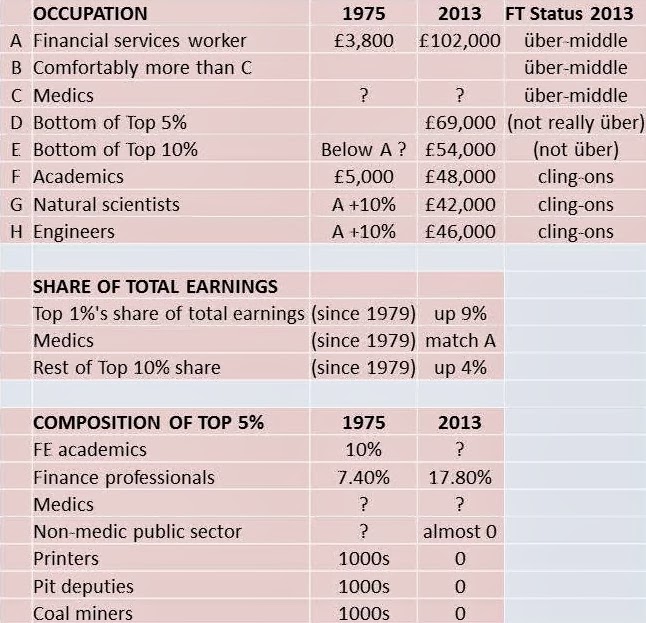
In this tale of two middle classes, doctors, barristers and London's financial services workers emerge as the big winners. But this "über-middle" is dwarfed by a much larger group of "cling-ons" who have seen their relative position dramatically worsen even during the years of economic boom. The data, prepared for the FT by two of the nation's foremost labour market economists, Professors Brian Bell and Stephen Machin, shines a light on the shifting fortunes of the professional middle class.
Actually, there wasn’t that much data. From page 1 and supplementary material on page 2 under the heading The fractured middle, the reader can pull together the following:


There was also a graphic, Winners and losers: how professional salaries have changed over the decades, adding data for 1994 and for more occupations but using the somewhat opaque statistic of ‘Ratio of mean earnings for each profession compared with the top 10% of earners’:


The only two occupations which have pulled ahead are London finance and Medical practitioners. I was not surprised to read that:
Underpinning this shake-up in the top tier of society is a severing of the bond that for decades tied the top 1 per cent of earners to the 1 per cent below them. Since 1979, the very highest earners have increased their share of total earnings by almost nine percentage points while the rest of the top 10 per cent have captured only an extra four percentage points.
- hardly a revelation. In 2011 Will Hutton’s final report of the Review of Fair Pay in the public sector was published and it showed that the top 1% had been moving ahead since 1980:


in the UK and US that is. And from everybody else in the UK:


But I was surprised to read in the FT:
Doctors, Prof Bell pointed out, were the only group of public sector workers to have done well" "Public sector workers have almost disappeared from the top of the income distribution,"…
because Hutton’s Review had stated that
… public sector employees represent around seven per cent of the highest one per cent of earners [although] those seven per cent only receive one per cent of top earnings. Approximately one in 85 workers in the private sector earn over £150,000 a year, compared to just one in 280 public sector workers. (pages 17/18, 2009 figures)
Top civil servants had certainly done less well than local authority chief executives who, in turn, had failed to keep up with private sector chief executives:


 Hutton thought that when comparing budgets in the public sector and turnover in the private, together with “analyses of job size and complexity [it was still consistently found] that public sector roles pay considerably less than equivalent roles in the private sector” and produced a chart to back that up:


Hutton admitted that:
Simple comparisons of organisation size of course mask very real differences in the size of the role of the leader in what are very different types of organisation; and it may be objected that any private sector CEO can only be paid if his or her organisation is profitable - a crucial test that does not apply to the public sector.
Not the only objection I would have thought. Take the position of university vice-chancellors as reported in the Times Higher Education Supplement last year:
The vice-chancellor with the highest salary in 2011-12 was the University of Birmingham’s David Eastwood, who took home £372,000 in basic pay; he also collected £34,000 in pension contributions. (However, the highest remuneration package overall went to the University of Oxford’s Andrew Hamilton – [£371,000 salary, unknown expenses, £53,000 pension]. That is dwarfed by the remuneration awarded to Mark Allan, chief executive of student housing company Unite Group. According to Unite’s accounts, he received not only £393,000 in basic pay but also a £428,370 performance- related bonus and £78,600 in pension contributions for the year ended February 2012 - a total package of almost £900,000, not including long-term share options. The FTSE 250 company’s annual income of £219.5 million is less than half of Birmingham’s £472 million income in 2011-12 and only about a fifth of the University of Oxford’s £1 billion income over the same period. Oxford’s Hamilton received £371,000 in basic pay and £53,000 in pension contributions in 2011-12, less than half Allan’s income. 
But is the comparison with the private sector reasonable? While vice-chancellors might increasingly need to act like CEOs, captains of industry would surely claim that their business models - and levels of risk - are nothing like the work of politically protected institutions largely reliant on public funds (regardless of whether that money flows through research and teaching grants or state-subsidised student loans).
To appreciate what might be meant by "levels of risk", consider the Bath/Bristol area of SW England where there are four universities within a 12km radius:


and whose vice-chancellors were rewarded as in the table below in 2011-2012:


In similar geographical circumstances in the private sector, one can’t help thinking that the vice-chancellor equivalents would be under pressure from institutional shareholders and, more scarily, private equity to rationalise to reduce overheads in what are very similar areas of business and increase profitability. This table certainly brings out the FT’s point that the average academic is now what they charmingly describe as a cling-on. Professors are hardly in the über-middle. The FT also pointed out the concentration of the best paid jobs of all kinds in London and the southeast. The further the cling-ons are from that region, the better off they probably feel. However, housing costs across a large part of southern England are driven by a London effect extending into the South West , as shown by this map produced by Neil Hudson of Savills Research last year:


*Why the FT chose “cling-on”, as opposed to “unter-middle” (or unter-Mitte even), wasn’t explained – perhaps too close to Untermenschen. Anyway that’s where I put myself, for sure!


UPDATE 18 APRIL

Some data from Bell and Machin here.