Showing posts with label Compton Verney. Show all posts

12 November 2015

Periodic Tales at Compton Verney

If anyone thought that CP Snow’s “Two Cultures” debate was no longer relevant, they would have to think again after reading an article in the Daily Telegraph on 7 November, 'My daughter shouldn't have to study science', says Cristina Odone. Apparently young Izzy
… demanded to know why she should waste her time studying three sciences to GCSE given that she did not wish to pursue a career in maths or science …
a view her mother supported. It could be that, as a former editor of the Catholic Herald, Cristina Odone’s disengagement with science has deep roots. However, last time I looked on the Telegraph website there were over 500 comments on the article and those I sampled were not particularly sympathetic to her point of view, mostly making the obvious counter-arguments. I suggest mother and daughter have a day out at Compton Verney to see and reflect on, Periodic Tales: The Art of the Elements - perhaps Izzy will have second thoughts. At least, she might take a look at Compton Verney’s video on YouTube:


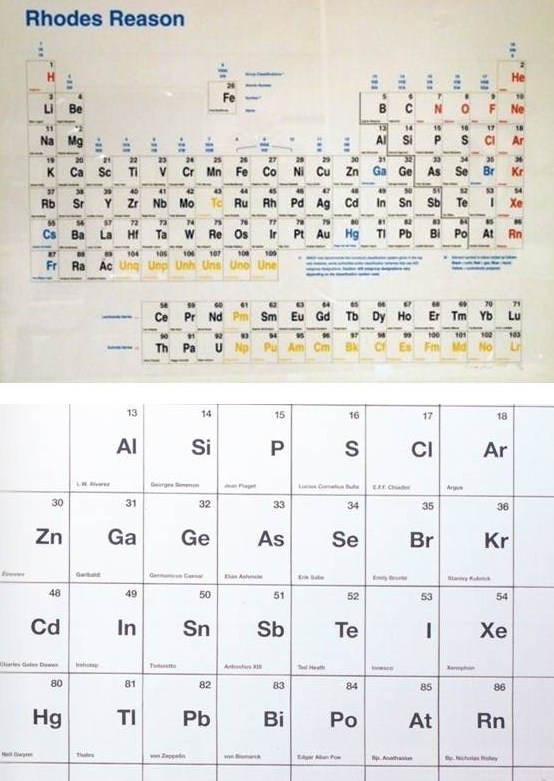
To be honest, this exhibition is rather more about British contemporary art than about science*. It draws on Hugh Aldersey-Williams's book, Periodic Tales, – he co-curated at Compton Verney – and aims in his words to provide a “cultural history of the elements”. The starting point, after a brief dabble with alchemy, is the periodic table of the 118 elements (at present, 24 of them man-made). After that, about 30 works are arranged around a succession of 15 of the elements, mostly metallic. The periodic table is, as they say, iconic and its appearance can be adapted for all sorts of purposes, as in the exhibition poster above. Simon Patterson is probably best-known for his lithographic take on the London Underground Tube map, The Great Bear. Another of his lithographs, Rhodes Reason (1995, below top), and his much larger assembly of ceramic tiles Quattro Formaggi II (1992, below lower), play with the appearance of the periodic table and its namings (for example, Br becomes Bertolt Brecht; Sn, Tintoretto) are among the first things a visitor encounters.

The next section is given over to Primo Levi’s short story collection, The Periodic Table, with accompanying linocuts from 1994 and of the same title by Bill Woodrow. The first element is Silver as in the crushed and suspended Thirty Pieces of Silver (Exhaled), Sugar Bowl** (2003, below), one of eight pieces in the show by Cornelia Parker.


Gold can, as it were compensating for its price, be hammered very thin as in John Newling’s Value; Coin, Note and Ellipse (2011, below), made with pressed and gilded Jersey kale.


Mercury is present in spirit rather than its tricky reality in Marc Quinn’s Etymology of Morphology (1996, below) made of silvered glass.


Antony Gormley’s Fuse (2011, below top) is made from cast Iron (well-rusted, so we are looking at ferric oxide) and Eduardo Paolozzi’s Tin Head –Mr Cruickshank (1950, below lower) explains itself:


Roger Hiorns’ Nunhead (2004, below top), with engines covered in Copper sulphate crystals, is dramatic but hardly elemental.  Nor is Danny Lane’s Blue Moon (2015, below lower) made of glass with a Cobalt compound, also blue:


Heatherwick Studio’s Aluminium Billet 1: Extrusion 9, (2009, below top) comes with a video showing its fabrication in China, the country on whose nuclear power industry the UK will be increasingly reliant. Once we had our own, as Kate Williams’ and Keith Lloyd’s striking Uranium glass (well, uranium oxide probably) Nuclear Power Stations remind us; Springfield Nuclear Power Station (both 2006, left, below lower) and Dounreay Nuclear Power Station (right, below lower):


Whether David Nash was thinking about Carbon when he produced his charcoal Nature to Nature 4: pyramid, sphere, cube (1990/94, below top), we don’t know, but Tim Etchells was certainly thinking about Neon when he made something common in the universe but rare on earth (2015, below lower) for the show:


On the way in and out, you can hardly miss David Nash’s Big Black (2008-15, below) in carbonised California redwood:


There were some missed opportunities. I can understand that Damien Hirst’s For the Love of God (2007, left) in diamond and platinum might have been difficult to secure for this show, but something to underline diamond as another form of carbon, and introducing allotropy, seems appropriate. More feasible might have been one of Julian Opie’s computer animations like Marina in purple shawl (2010), visible in a post here last year, its LED screen being dependent on compounds of gallium, indium and other elements. I have jibbed a little at elements appearing in this show in the form of compounds, but the latter are the basis of most colour and pigmentation, and were much developed by 19th-century industrial chemists. As Pierre-Auguste Renoir said, “Without colours in tubes, there would be no Cézanne, no Monet, no Pissarro, and no Impressionism.”

Periodic Tales: The Art of the Elements ends on 13 December

* The exhibition catalogue in its Endnotes and elsewhere states that “The chemical elements are the fundamental building blocks of all matter”. “Up to a point, Lord Copper”, depending on what is meant by “fundamental” and “matter”. The chart below comes from Wikipedia:


The periodic table arranges the elements by their atomic number which is the number of protons in the nucleus. Protons and neutrons are the Nuclei in this chart above. An element has an equal number of protons and electrons. Protons are positively charged, electrons negatively. Electrons are a type of Lepton, see the chart. The periodic table groups the elements to reflect their electron configurations, when these are similar, the elements have similar properties, eg the noble gases, like neon. The same element can have different numbers of neutrons – isotopes of the same element. For example, most hydrogen on earth has just one proton and one electron, but it can have one neutron, when it is called deuterium, or two, tritium. Tritium, unlike deuterium, is unstable and decays to produce an isotope of helium – radioactivity.

** Or possibly Thirty Pieces of Silver (Exhaled) cake stand (2003).


21 September 2015

Canaletto at the Holburne, Bath

It is difficult to imagine anyone taking a strong dislike to the art of Canaletto (Giovanni Antonio Canal, 1697-1768). Representational certainly, camera obscura produced even, nonetheless it provides an invaluable, almost photographic, record of the Europe of nearly 300 years ago. From 1746, when he was invited by the Duke of Northumberland to record the construction of the new Westminster Bridge, to 1755, Canaletto painted English scenes, mostly in London. Canaletto Celebrating Britain, now at the Holburne Museum, Bath after a first showing at Compton Verney, brings together major works from his time here.


The son of the painter Bernardo Canal, and hence known as Canaletto, was born into a townscape shaped by architects like Andrea Palladio (1508-80). So starting the show with a reminder of Canaletto's Venice and two fine canvases from Manchester of about 1740, Church of the Redentore (below) and Church of San Giorgio Maggiore, seems wholly appropriate.


Canaletto's Britain then follows, starting with two of Compton Verney's own scenes of the London pleasure gardens of the day, The Interior of the Rotunda, Ranelagh, London (1754) and The Grand Walk, Vauxhall Gardens, London (c1751, below):


followed by Dulwich Picture Gallery's View of Walton Bridge (c1754, poster above) and the Royal Collection's two Views from the Terrace of Somerset House (1750-51) of the City and of Westminster (below):


The Old Horse Guards from St James' Park (c1749, below) is complemented by the rarely shown c1752 view of the New Horse Guards.


Canaletto's paintings are large so there is an inevitable loss of detail in small scale reproductions. A close look at the originals reveals some pleasing features, for example the coach and horses going over Walton Bridge and the carpet beaters at work near Horse Guards:


And they invariably flatter the English climate by making it resemble the Italian spring of an aristocrat's Grand Tour.

Finally, Canaletto's legacy is demonstrated in works by Samuel Scott - An Arch of Westminster Bridge (c1751, below):


 and William Marlow's dramatic and imaginary fusion of London and Venice, Capriccio: St Paul's Cathedral and a Venetian Canal (c1795, below):


Although the construction of Georgian Bath in the Palladian style had begun in the early 1700s and the Circus was under construction at the time he left England, sadly for us Canaletto does not seem to have had the opportunity to paint in the fashionable spa.

Canaletto Celebrating Britain ends in Bath on 4 October and will be at Abbot Hall, Kendal from 22 October to 13 February 2016.


12 August 2014

Moore Rodin at Compton Verney

Henry Moore has been mentioned in 13 previous posts here so I am obviously an admirer of his work. Last October I posted about Francis Bacon Henry Moore: Flesh and Bone at the Ashmolean Museum in Oxford and have now seen Moore Rodin at Compton Verney, another show contrasting the work of two great artists*. The Henry Moore Foundation at Perry Green is one of the two co-sponsors and, after being shown there in 2013, Moore Rodin is currently at Compton Verney House whose Trust is the other co-sponsor and celebrating its 10th anniversary. Not surprisingly, the Musée Rodin in Paris also played a major role in making it all happen.

Compton Verney is quite rightly proud of its ‘Capability’ Brown landscape which makes a fine setting for eleven large pieces of sculpture. Moore’s work particularly benefits from being seen in the open (examples previously referred to here were at Kew Gardens, Dartington Hall, and Perry Green and this is no exception; Moore’s The Arch (1969, Fibreglass, below):


There is also the contrast of the 19th and 20th century sculptures with the House’s 18th century facades ; Rodin’s Walking Man on a Column (1900, left) and Moore’s Three Piece Sculpture: Vertebrae (1968, right):


and between sculptures positioned at a distance; Moore’s Seated Woman (1958-59, left) and Rodin’s Jean d’Aire , Monumental Nude (1887, right):


There is also the chance to see details such as Moore’s characteristic scratch marks on The Arch (below left) and to appreciate the viewer’s perspective which Rodin intended for Monument to the Burghers of Calais (1889, below right) but which will no longer be available after its return to Victoria Tower Gardens (Westminster, London, only a few metres from Moore’s Knife Edge Two Piece (1962–65) at Monument Green):


Inside Compton Verney House around 160 smaller items, many of them works on paper, are on display in the galleries and encourage the visitor to make comparisons and seek contrasts between the artists’ subjects, materials and methods of working. Various themes are explored including interlocking forms, mother-and-child embraces, Moore’s shelter drawings from London during World War 2 and Rodin’s ‘black drawings’ made in the aftermath of the Franco-Prussian war. Moore’s daughter, Mary, has curated a fascinating selection of objects from both artist’s personal collections, Rodin’s being primarily classical and Egyptian while Moore’s was more eclectic including ethnographic and found objects - bones and stones.

It is for this part of the exhibition that the guide by its curator, Anita Feldman, is particularly helpful. It includes a transcript of a conversation about Rodin between Moore and Alan Bowness in 1966. Moore admits to not having been much interested in Rodin in the 1920s but that his admiration grew subsequently. Part of their dialogue:
AB: Like many of the drawings, the Dancers and the Walking Man are all very much concerned with the idea of movement. This is clearly of the greatest importance to Rodin, and it links him with the impressionist painters, just as other aspects of hi work link him with the symbolists who were also his contemporaries. But how far do you think that the representation of movement is a proper concern of sculpture? 
HM: This is one of the ways in which my generation does stand for a reaction against Rodin. One of my points is that sculpture should not represent actual physical movement. This is something I have never wanted. I believe that sculpture is made out of static, immovable material. 
AB: What about the Balzac [right] then? Do you think as many do that it's the culmination of Rodin's work, or do you find it less interesting, because it's clothed for one thing? 
HM: No - because underneath one can see that there is the nude figure, and that it's been clothed. It’s the same with the Burghers. What makes Rodin the great sculptor that he is, is his complete understanding of the body s internal structure, his ability to feel inside into the sculpture. This is so intense - even the late work has got behind it all that other observation and knowledge of the human figure. He couldn't have simplified the Balzac - he couldn't have started with the idea of a draped figure. Think of all the studies that he had to make first. (pages 129-130)
Earlier on the theme of Finished/Unfinished, Feldman observes:
… with Rodin's bronzes, the physicality of the body is heightened by the impression of his own hands having modelled it initially in clay. Witnessing Rodin at work, Paul Gsell wrote: 'The clay figure was taking shape. Rodin's hands came and went, adding bits of clay, gathering it in his large palms, with swift, accurate movements; then the thumb and the fingers took part, turning a leg with a single pressure, rounding a hip, sloping a shoulder, turning the head, and all with incredible swiftness, almost as if he were performing a conjuring trick.'' Moore on the other hand was more of a carver than a modeller, preferring to pare down the surface of a material rather than build it up. Thus tool marks are often evident in his bronzes, cast from plaster originals where the surfaces have been vigorously hewn with chisels, files and cheese graters. 
Finally, both Moore and Rodin took the concept of finished/unfinished a stage further by introducing evidence from industrial fabrication; for example, by allowing the runners, weld marks, pointing marks or joins from the casting process to remain visible rather than 'finishing' the bronzes by filing these down. Rodin relished the accidents which resulted from the piece mould casting process - seams, air bubbles and dollops of liquid plaster, supporting mounds, and finger and cloth imprints. (page 93)
Moore's Draped Torso (1953, left)

Moore Rodin ends at Compton Verney on 31 August.


* Auguste Rodin (1840-1917), Henry Moore (1898-1986); they never met.


30 April 2012

'Into the Light' at Compton Verney

The long-list of 10 gallery and museum projects for the Art Fund’s 2012 Prize features three from South West England: M Shed in Bristol, the Holburne Museum in Bath and Exeter’s Royal Albert Memorial Museum & Art Gallery (RAMM). RAMM reopened in December 2011, marking the occasion with a major exhibition, Into the Light: French and British painting from Impressionism to the early 1920s, which has now transferred to Compton Verney.

53 works are on show by artists including Vanessa Bell, Eugene Boudin, Paul Cezanne, Claude Monet, Camille Pissarro, Pierre Auguste Renoir, Walter Sickert, Alfred Sisley, Alexander Stanhope Forbes and Philip Wilson Steer. Into the light describes the cross-Channel travels, connections and influences on their work of British and French Impressionists and Post-impressionists. This exhibition is a delight for anyone with an interest in British art and RAMM deserve praise for their efforts in bringing it about. Professor Sam Smiles of the University of Plymouth and Penelope Sexton (formerly of RAMM and now at Compton Verney) seem to be particularly deserving of appreciation.

Not to neglect two of the themes of this blog (SW England and SW France), there is an opportunity for those unlikely to travel as far west as Plymouth to admire Stanhope Forbes’ dramatic en plein air 'A Fish Sale on a Cornish Beach':


and to compare two Scottish Colourist views of Royan at the mouth of the Gironde estuary:


Into the Light continues until 10 June. The exhibition catalogue by Sam Smiles is excellent value at £14.95, particularly by comparison with the current equivalent on offer at the Courtauld. Better still for Exonians, RAMM have it on sale at £12.50!

Compton Verney is also hosting Gainsborough’s Landscapes: Themes and Variations, which was the subject of a post here when first shown at the Holburne.

4 September 2011

Stanley Spencer at Compton Verney

In May I posted about Compton Verney and their Alfred Wallis and Ben Nicholson exhibition. Compton Verney’s current shows include Stanley Spencer and the English garden which runs until 2 October, and is well worth seeing.

'Wisteria, Cookham'
Spencer (1891-1959) is well-known for his First World War murals for the Memorial Chapel at Sandham (near Burghclere, Hampshire), which belongs to the National Trust, and for his monumental series of Second World War paintings, Shipbuilding on the Clyde. These are owned by the Imperial War Museum and, although recently restored, have no permanent exhibition space. A selection can be seen until 15 January 2012 at the Stanley Spencer Gallery in Cookham, Berkshire, Spencer’s birthplace.

Spencer was always deeply rooted in Cookham, and even when a student at the Slade before the First World War preferred to commute to London daily. He chose Cookham and its inhabitants as the subjects for his biblical scenes, probably the most famous being The Resurrection, now in the Tate Britain collection. Because of their settings, the religious paintings often include domestic gardens, but, as this exhibition shows, Spencer’s execution of detail comes to the fore in his paintings of flowers, or more prosaically a bunch of onions. Even in the apparently secular scenes, the white picket fences seem to be echoing the crosses at Sandham.

25 May 2011

Alfred Wallis at Compton Verney

Compton Verney in Warwickshire is a handsomely set Georgian mansion which has been transformed into an art gallery with the support of the Peter Moores Foundation. As well as its permanent collections, it hosts temporary exhibitions. Currently, but only to 6 June, works by Alfred Wallis and Ben Nicholson are on display, exploring “Wallis’ unique vision and his influence on Nicholson’s work, focusing on paintings and drawings by the two artists dating from the late 1920s to the 1940s.”
It is 90 years since Wallis was first exhibited in London, following his discovery as a primitive painter in St Ives (Cornwall, in SW England) by established artists in the late 1920s. Most of the exhibits at Compton Verney are of Wallis’ work, many from the extensive collection at Kettle’s Yard, Cambridge.  The three-room exhibition makes a fair case for Wallis’ influence on Nicholson, although there were clearly many others, including major artists such as Mondrian and Picasso and movements such as cubism.

With the recent opening of The Hepworth Wakefield, Barbara Hepworth’s life and work is receiving more attention than in previous years. It is helpful by way of background to some of the Compton Verney exhibits to know that Nicholson (1894-1982) married and divorced three times:
1920-1938 Winifred Roberts (three children)
1938-1951 Barbara Hepworth (triplets)
1957-1977 Felicitas Vogler

Compton Verney has in the past put on some first class exhibitions, for example Van Gogh and Britain: Pioneer Collectors in 2006 and The Naked Portrait in 2007. However, some potential visitors to their next major exhibition, Stanley Spencer and the English Garden, may well be deterred by the pricing. Because this show will coincide with the “peak rate” period, and because exhibition admission is only available bundled with admission to the grounds and permanent collections, the Adult ticket will cost £13.20 (there are concessions). This seems steep for its likely scale, particularly for anyone contemplating a second visit to Compton Verney within a few months, and who has already had an opportunity to admire the restored ice house.
Restored ice house at Compton Verney, Warwickshire