Showing posts with label Lisa Jardine. Show all posts

12 June 2014

Lord Clark at Tate Britain


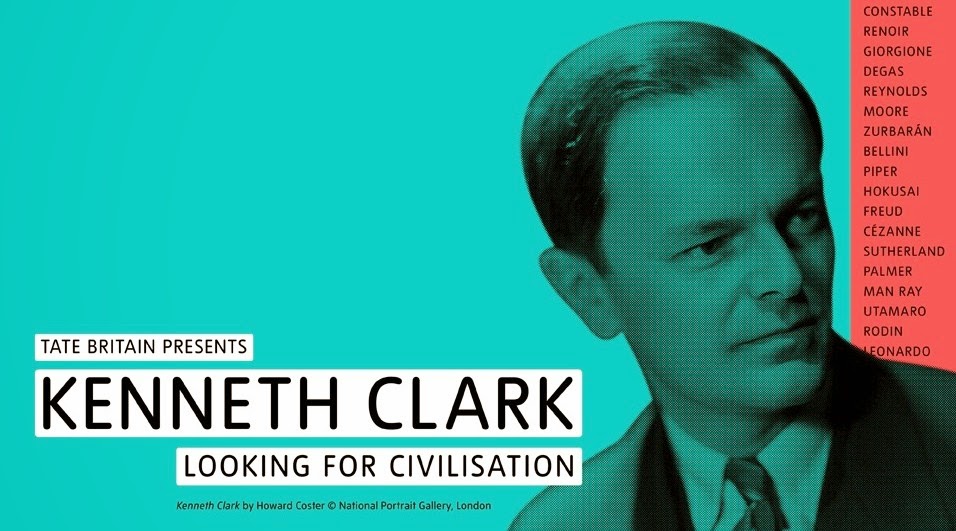
Kenneth Clark (1903-1983) was not only born in the same year as Evelyn Waugh, (mentioned in recent posts here), but also became well-known at a young age in the 1930s. Clark, unlike Waugh, was born into considerable wealth and, after studying the history of art at Oxford and coming under the influence of Roger Fry, was able to spend time in Italy with the American art historian Bernard Berenson, specialising in the Renaissance. On return to England he became Curator of the Ashmolean Museum in Oxford and then Director of the National Gallery from 1930 to 1946. His public service also included being Surveyor of the King’s Pictures, and chairmanships of the War Artists' Advisory Committee, the Arts Council of Great Britain and the Independent Television Authority. In 1969 Clark wrote and presented a celebrated TV series on the history of Western civilisation for BBC television, later shown in the US. When he subsequently received a life peerage, Private Eye dubbed him Lord Clark of Civilisation. The Tate Britain exhibition, Kenneth Clark - Looking for Civilisation, is a survey of his life’s work and brings together art that he had dealt with professionally, had benefitted from his patronage or that he had collected personally.

Not surprisingly, there is much to look at in this show. The 270 objects on display include some which are unfamiliar and may not be seen in public again for a while (one can hazard a guess as to which ‘Private Collection’ they come from). The first room is the most personal with Graham Sutherland’s portrait, Kenneth Clark (1963-64, left), and focusses on his early years. This is followed by works he collected for himself (Seurat’s The Forest at Pontaubert, (1881 below left) or, as Director of the National Gallery, for the nation, for example Constable’s Sketch for Hadleigh Castle (1828-9, below right), later transferred to the Tate. Some of the attributions he made when purchasing for the National Gallery do not seem to have stood the test of time particularly well. However, it was under his Directorship that the Gallery’s Scientific Department was formed, and the techniques which are now available to support judgements on authenticity began to be developed. In the 1930s Clark purchased for himself late works by Cézanne, as would Henry Pearlman a decade later and probably at a much higher price. A Cézanne pencil drawing, Still life, Pain sans mie, 1887-90, is particularly interesting in that its inclusion of commercial typography (“bread without crumbs”!) anticipates Picasso and Braque (but see the 1 July update below).


Clark not only collected but was an active patron looking favourably on Henry Moore (Recumbent Figure, 1938, right), Graham Sutherland, Paul Nash, and John Piper. He did not care much for abstraction (the Ben Nicholson on show seems to have been an exception), Francis Bacon or Lucien Freud’s later work. The fifth and largest space in the show is given over to the War Artists, most of whom worked in the Romantic style Clark liked, and is one of the most interesting. Although familiar in reproduction, the opportunity, during the Imperial War Museum’s closure, to see Paul Nash’s Battle of Britain (1942, below) and one of Moore’s shelter drawings (Tube 1941, below, lower) is welcome.


Among many impressive wartime pictures, ones which caught my eye were John Piper’s Somerset Place, Bath (1942, below,) and Albert Richards’ The Landing: H Hour minus 6. In the Distance Glow of the Lancasters Bombing Battery to be Attacked (1944, below, lower).


The final room concentrates on Clark’s activities after the war, particularly his involvement with television. The BBC are reportedly considering a new Civilisation series:
… "re-imagined … for the digital age". Unlike the original, it is likely to have a number of different presenters.
If so, I hope one of them will be Lisa Jardine, the daughter of Jacob Bronowski. His 1973 television series, The Ascent of Man, was complementary to Clark’s and looked at the rise of science as opposed to art, architecture and philosophy.

Just before leaving the exhibition, visitors can see two of the finest works acquired by Clark: a Francisco de Zurbarán still life, A Cup of Water and a Rose (c1630, below left), and Cézanne’s Le Château Noir (c 1904, below, right).


Kenneth Clark - Looking for Civilisation ends on 10 August and anyone with an interest in British art should try to get to Tate Britain before then. The most thought-provoking review I have come across is Kenneth Clark: arrogant snob or saviour of art? by James Hall in the Guardian.


A MINOR QUERY FOR THE CURATORS

In the first room there is a showcase (vitrine?) of Clark family photographs. One of these is of a villa owned by Clark’s father and (when I saw it) was labelled as being Clark’s childhood home in South West France at Cap Ferrat. I thought this unlikely. Although before the First World War Arcachon, on the Gironde department’s Atlantic Coast, was a fashionable resort, the village of Cap Ferret, nearby by sea but remote by land, was little more than a few oyster fishing huts (rather different now). However, Cap Ferrat (Saint-Jean-Cap-Ferrat) on the Mediterranean in the Alpes-Maritime department in South East France had become a magnet for the ultra-wealthy around 1900 and remained so. The Clark villa seems to be in the “Renaissance” style consistent with that location and, of course, Clark’s father was supposedly “the man who broke the bank at Monte Carlo”, not Biarritz. It might be worth checking.


UPDATE 1 JULY

A footnote to Cézanne’s use of commercial typography: I have recently come across this image of The Artist's Father, Reading "L'Événement", 1866, now in the National Gallery of Art, Washington DC. Apparently it wasn’t Louis-Auguste’s favourite paper but Cézanne’s old friend Emile Zola was L'Événement’s art critic.


18 December 2011

Christopher Hitchens

Christopher Hitchens died on 15 December at the age of 62. So much has been written in the last few days by people who knew him, (for example Ian McEwan, [but not yet it seems] Martin Amis, and Simon Schama and, of course, his brother, Peter,) that there is not much left for the rest of us to say. When I was reading his memoir, Hitch-22, I found, rather to my surprise, that we seemed to have a few things in common. One was obvious, also we were both born in the late 1940s and had 1950s boyhoods, and went to not dissimilar sorts of school. But not much after that, as is to be expected in the land of CP Snow’s 'two cultures'*. And the small point that he was exceptionally talented.

Most of us in now our sixties didn’t go on the ‘political journey’ which David Aaronovitch in the Times (£) describes Hitchens as having made – obviously from the ‘Left’, the word appearing 10 times in the article, but where to? Surely not to the ‘Right’, which isn’t mentioned. It seems more like a journey from Trotskyism to Neo-conservatism, but how many neocons are atheists?

Hitchens was a very elegant writer, but I stumbled on one sentence in Hitch-22 when he was describing an interview not long after Oxford for a traineeship at the BBC:
I wasn’t stupid enough not to realise that he wouldn’t have asked that question if he didn’t already know the answer to it.
which I reckon to be a quadruple negative, and not to be attempted by novices!

Hitchens’ death seems to have induced a ‘Diana moment’ among the literary intelligentsia in London and on the East Coast (judging from here). But probably not a global one like Steve Jobs’ passing at the age of 56 in October. In Paris Le Figaro covered Hitchens’ death briefly, describing him as a “polémiste réputé dans le monde anglo-saxon”. The political intelligentsia in London had had their Diana moment in November when New Labour’s polling expert Philip Gould died at the age of 61.

Our expectations of life expectancy are now such that any death under 70 seems to induce a sense of loss. Not least because of the things that these three men in particular might have done if they had worked for another 10 years or more. Gould could well have influenced the outcome of the next general election in the UK. Both Hitchens and Gould died as a consequence of the relatively rare cancer of the oesophagus, associated with tobacco smoking and heavy alcohol use.

* For a recent view of this, see ‘CP Snow’s Two Cultures Revisited’, the 2009 CP Snow Lecture given by Professor Lisa Jardine (Jacob Bronowski’s daughter) downloadable here.

ADDENDUM 22 DECEMBER

A thoughtful piece about Hitchens by David Goodhart has now appeared on the Prospect Magazine website.
(Personal hobbyhorse: the US, not the UK, had babyboomers.) 

ADDENDUM 24 APRIL 2012

On 20 April 2012 a memorial service for Christopher Hitchens was held in New York. Martin Amis delivered the eulogy which Vanity Fair (to which Hitchens was a contributing editor) has made available.

ADDENDUM 31 AUGUST 2012

Martin Amis in an interview with Joseph Weisburg of Slate on 29 August offered “reflections on the life and passing of his dear friend, Christopher Hitchens.”