Showing posts with label Tate Britain. Show all posts

24 December 2015

Frank Auerbach at Tate Britain

On the edge of abstraction - a retrospective of one of Britain’s finest living painters 

Although I’ve been looking at his work for a long time, visiting the retrospective, Frank Auerbach, at Tate Britain it still came as a shock to realise that the artist will be 85 next year. Born in 1931, he arrived in Britain from Germany in April 1939 and became a British citizen in 1947. His extensive training as an artist included time at St Martins, the Royal College of Art and Borough Polytechnic where he was a pupil of David Bomberg. After some years teaching art, he became a full-time artist in the mid-1960s.


Frank Auerbach is arranged in a succession of decades starting with the 1950s and ending with the 2000s. It ends with a room of works selected by the curator, Catherine Lampert, taken from across Auerbach’s oeuvre. Portraits of the same sitters (including Lampert) and locations near his studio in London are recurrent. Because of their size and the artist’s use of heavy impasto in his earlier years, his paintings do not reproduce particularly well. However I have selected some of the images which are available – many of the exhibits are marked “Private Collection". From the 1950s, Head of EOW (1955, below left) and E.O.W. half-length nude (1958, below right):


From the 1960s, Primrose Hill Spring Sunshine (1961/62 & 64, below top) and Mornington Crescent (1967, below lower):


Primrose Hill is much painted by Auerbach, for example in the 1970s, Winter Evening, Primrose Hill Study, (1974-75, below top) and Primrose Hill (1978, below lower):


In the 1980s as well as landscapes, there is some fine portraiture including Portrait of Catherine Lampert (1981–82, below left) and Head of J.Y.M II (1984-85, below right):


From the 90s onwards, the same themes are being revisited, for example Catherine Lampert Seated (1990, below left), Mornington Crescent Looking South (1997, below right) and Head of William Feaver (2003, exhibition poster above).


Among the final selection made by Lampert was the Tate’s own To the Studios (1979-80, below):


A painter whose works, more than most, need to be seen to be fully appreciated, Frank Auerbach ends on 13 March.


26 August 2015

Barbara Hepworth at Tate Britain

The British sculptor Barbara Hepworth was born in 1903 in Wakefield, West Yorkshire, where the museum named after her was opened in 2011. But from 1939 until her death in 1975, she lived and worked in South West England at St Ives in Cornwall - I posted here in 2011 about a visit to the Barbara Hepworth Museum and Sculpture Garden, part of Tate St Ives. Elsewhere in the region there are other pieces by her, for example Figure for Landscape (1960 below top) at the University of Exeter and Theme and Variations (1969–72, below lower) at what were the offices of the Cheltenham and Gloucester Building Society in Cheltenham. Barbara Hepworth: Sculpture for a Modern World at Tate Britain seems a welcome opportunity to take a retrospective view of her work – as such it could be regarded as complementary to that provided in 2010 for her contemporary, Henry Moore.


Although chronological, Barbara Hepworth: Sculpture for a Modern World is presented in an ostensibly thematic form starting with carving and moving on through studio to international modernism, equilibrium and eventually pavilion. Ann Compton, in an essay in the exhibition catalogue, Crafting Modernism Hepworth’s Practice in the 1920s, identified an important issue which the curator of a Hepworth retrospective has to face:
Accounts of Barbara Hepworth's career frequently divide her practice into stages defined not only by time and place but also by relationships with other key modernists, notably Henry Moore, John Skeaping and Ben Nicholson. Whilst these individuals were unquestionably important, such emphasis on personal connections is symptomatic of the containment of Hepworth's sculpture within a narrow and ultimately reflexive frame of reference. (page 13)
However, it is a matter of fact that Moore and Hepworth were at the Leeds School of Art and the Royal College of Art together in the 1920s and neighbours in the Hampstead avant garde of the 1930s. At the time of her death Moore, five years her senior, commented “we were always like a younger sister and an older brother”. Furthermore Hepworth was married to John Skeaping and later to Ben Nicholson, having children with both. Nonetheless carving, while aiming to put Hepworth’s 1920s work in the context of other sculptors around that time practicing direct carving in wood or stone, so allowing comparison of, for example, Skeaping’s Pigeon (c1928, below top left), and her Toad (1928, below top right) and her Musician (1929-30, below lower left) and Moore’s Seated Girl (1931, below lower right):


with several other works by Skeaping present, fails to inform the visitor (or this one, anyway) that he and Hepworth were married from 1926 until their marriage broke up in the early 1930s.

The next section, studio, has little alternative but to be realistic about Nicholson as a presence in Hepworth’s life. Anyone who left Art and Life at the Dulwich Picture Gallery in 2014 wondering what Ben did next will find an answer here – there are about 17 of his works alongside 24 of Hepworth’s. The couple spent most of the 1930s living and working together and studio aims, among other things, to reveal their dialogue about abstraction. There are some interesting pieces here in this regard, for example Hepworth’s Two Heads (1932, below left) and Nicholson’s painting of the couple, 1933 (St Rémy, Provence) (below right):


Perhaps not all visitors will be aware that Hepworth gave birth to their triplets in October 1934, married Nicholson in 1938 and that they would divorce in 1951.

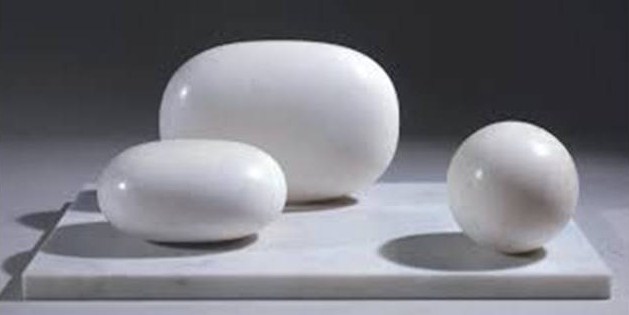
The international modernism section is more interesting than might be expected. Not only does it show how during the 1930s her work became increasingly abstract as in Helicoids in Sphere (1938, poster above) and Three Forms (1935, below):


but also reveals her and Nicholson’s involvement with magazines (books of articles), well displayed, like Circle and Axis with contributors across Europe, some of whom would arrive in London as the political situation deteriorated. A particularly important figure was the constructivist, Naum Gabo, who after 1935 lived in Hampstead near the British modernist community and would move to Cornwall with the Nicholsons after the outbreak of war. No works by him, in particular any from 1937 onwards showing the use of strings in sculpture, are on display, although some were at Tate St Ives in 2011. Hepworth introduced strings into her work after 1938 but the earliest stringed works in this exhibition are from 1943, Sculpture and Colour (Oval Form) Pale Blue and Red (below):


although there are some drawings from 1941 in the next section, equilibrium. As far as I could tell, the exhibition does not address not only the derivation of the use of strings in Hepworth’s sculpture but also her pioneering use of holes in sculpture (Pierced Form, 1931 in pink alabaster was destroyed in the war; the exhibition catalogue (Fig 18 page 39) dates it as 1932 but Tate’s records for a later piece with the same title say 1931).

equilibrium could just as well have been called contrast – between the increasingly large abstract pieces like that above and the series of Hospital drawings she made in 1948. A donation of tropical hardwood, guarea, gives its name to the next section of four large pieces, eg Corinthos (1954-5, below):


The last section of exhibits, pavilion, consists of seven bronzes which all appeared at a retrospective at the Kroller-Muller museum in Holland in 1965, the decade in which Hepworth produced a large number of works and became firmly established as an international figure. Squares with Two Circles (1963, below) is one of the best-known.


Between equilibrium and guarea the visitor passes through the staging sculpture section, its principal feature being Dudley Shaw Ashton’s documentary made in 1952 and released in 1953, Figures in a Landscape, about Hepworth at work in St Ives (available on the BFI website). In an essay in the catalogue, Media and Movement Barbara Hepworth beyond the Lens, Inga Fraser points out that Hepworth was not happy with the film. She suggests:
The portrayal of her sculpture was mediated via combination of Shaw Ashton's visual focus on the uncanny, Rainier's esoteric score, Hawkes's poetic narrative and Day-Lewis's theatrical delivery. ln light of her close involvement with the presentation of her work in other formats - exhibition, photography and in publication - it is conceivable that with these additional artistic contributions Hepworth felt her own narrative and conception of sculpture too much compromised. (page 78/79)
In 1953 her son with Skeaping was killed in an air accident.

The exhibition makes no mention of Hepworth’s assistants in St Ives who included Terry Frost and Terence Coventry. The catalogue is very informative, although constrained by the format and underlying philosophy of the exhibition – a timeline would have been helpful. An essay, ‘An Act of Praise’ Religion and the Work of Barbara Hepworth, by Lucy Kent reveals how taken Hepworth was with the ideas of Christian Science, a philosophy she shared with Ben Nicholson. He had been introduced to it by his first wife, Winifred.

Barbara Hepworth: Sculpture for a Modern World ends on 25 October 2015.


12 January 2015

Late Turner at Tate Britain

Joseph Mallord William Turner (1775-1851) has been the subject of only two posts here. The first was about the National Gallery show in 2012, Turner Inspired, which examined the influence of Claude Lorrain on Turner’s early work, the second, last month, was about Mike Leigh’s Mr Turner which dramatized the last 25 years or so of the painter’s life. Tate Britain’s The EY Exhibition: Late Turner – Painting Set Free complements the film in looking works from 1835 to the late 1840s. Turner’s reworking of The Wreck Buoy (1849 over 1807, below) was described by his admirer Ruskin as "...the last oil he painted before his noble hand forgot its cunning."


At the risk of being simplistic, a visitor may well conclude that once over 60 and so established in his profession as having nothing to lose, Turner painted as he wanted, undertaking a continuous experiment with colour and form. We see these works through eyes conditioned by impressionism, abstraction and much else that came after him, but that should serve to amplify Turner’s achievements not detract from them. (Richard Dorment in the Daily Telegraph pointed out that Turner’s eye may have been conditioned too – by cataracts and other health problems). Of the two famous works mentioned in the Mr Turner post, the National Gallery has lent Rain, Steam and Speed but not Temeraire, but its absence is more than made up for by Peace - Burial at Sea of the Body of Sir David Wilkie (1842, below top), one of nine square paintings disliked by his contemporaries and now brought together at Tate Britain, and Snow Storm - Steam-Boat off a Harbour’s Mouth Making Signals in Shallow Water (1842, below lower):


This exhibition provides a welcome opportunity to see a range of Turner’s watercolours, like Norham Castle, Sunrise (c1845, below top) and Heidelburg: Sunset (c1842, below lower):


the three Mount Rigi watercolours of 1842 brought together for the first time, one from Australia: The Red Rigi (1842, below top)


and one of his Margate pictures Wreck on the Goodwin Sands: Sunset (1845, above lower). The National Gallery and Tate Britain’s holdings of Turner’s work are based on the artist’s bequest to the nation, so this exhibition offers a chance to see loans from abroad like The Burning of the House of Lords and Commons, 16th October 1834 (1835, below), less familiar but of historical interest here and normally in Philadelphia:


Tate Britain has also put on display many of Turner’s note and sketchbooks. The latter emphasise just how intrepid and frequent a traveller he was even in late middle age and at the time before the European railway systems had been established.

Late Turner – Painting Set Free ends on 25 January.


21 September 2014

Hauser & Wirth Somerset

Hauser & Wirth Somerset recently opened at Durslade Farm on the edge of the small town of Bruton. Part of a major international art dealership, it seems a long way from their other establishments in Zurich, London, New York and Los Angeles - which is not to say that South West England should be anything but grateful for the arrival of a world-class gallery and arts centre. The investment in renovating buildings and two new-build galleries designed by the Parisian architects, Laplace, must have been considerable. Hauser & Wirth’s aim for the gallery is to:
… share contemporary art with new audiences and … to engage the public with art, the countryside and the local community. The centre will also provide resources including an archive, reading room, landscaped garden designed by Piet Oudolf and a restaurant for locally-sourced food …
Admission is free and there are two opening shows underway. Open Field consists of Oudolf’s designs for this and other projects including The High Line in New York and the Serpentine Gallery in London. Anyone interested in garden design and planting will no doubt enjoy learning more about Oudolf’s approach and his choices for the Hauser & Wirth Somerset garden which contains over 26,000 herbaceous perennials, (below, with Anri Sala’s perspective-defying Clocked Perspective 2012).


The inaugural art exhibition is GIG by Phyllida Barlow. Barlow was commissioned by Tate Britain in 2014 to produce a large sculptural installation for the Duveen Galleries, known as dock. At Bruton she has produced a series of installations responding to the gallery’s spaces and rural surroundings, made with common materials similar to those in dock: cement, cardboard, expanded polystyrene, plywood, timber and so on. Photography is not permitted indoors but images are available for untitled (suspended fabric pompoms, below left) and grinder, (below right.


After seeing postscorral inside and stackedchairs (below) outside in the Piggery, I began to wonder whether Barlow had been to the Somerset coast, the latter work called to mind deckchairs at Clevedon or Weston-super-Mare. But part of the fascination of Barlow’s work is that every visitor will be reminded of something different as they walk round, through or under her constructions. Moreover on close examination the viewer begins to appreciate how complex these constructions are in the ways they have been assembled from numerous components and also the subtlety of their colouring.


Photography is unlimited outside and works which I liked included Louise Bourgeois’ Spider 1994 (below, top) and Josephson’s Untitled 1970/73 (below, lower).


It was a delight to visit Hauser & Wirth Somerset on one of the last days of this summer. However, I couldn’t help wondering whether work by Pipilotti Rist will be as appealing to visitors from far and near on a wet Wednesday afternoon in February when the garden will have little to offer but muddy shoes. Across the front of Durslade Farm is a neon by Martin Creed, EVERYTHING IS GOING TO BE ALRIGHT (2011, Work 1086, below top with Subodh Gupta’s Untitled, 2008 in the foreground). Well, I do hope so and that it won’t be necessary to seek comfort from the stylish French neon described in a post here earlier this year: Jamais renoncer. And, of course, it’s far better for the South West that Iwan and Manuela Wirth chose to make Bruton their home and a location for a new gallery rather than, say, Beijing.


12 June 2014

Lord Clark at Tate Britain


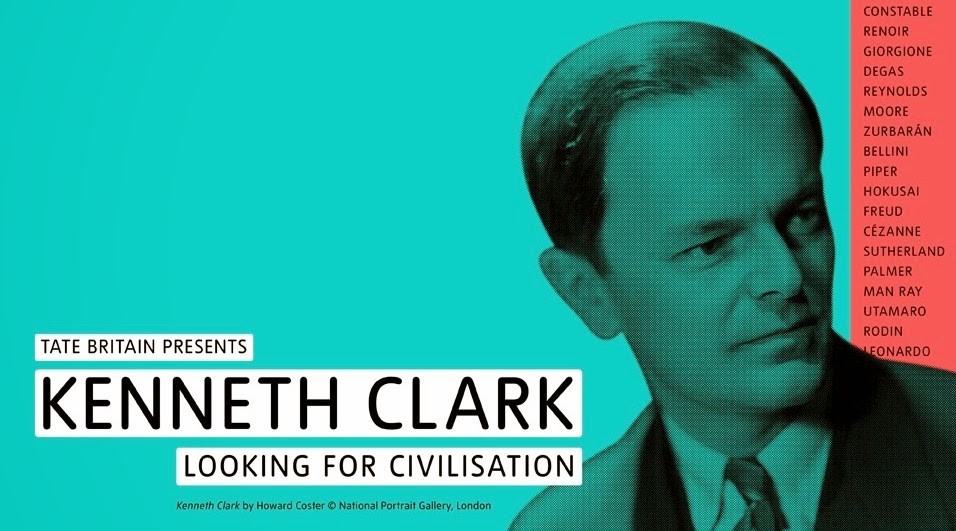
Kenneth Clark (1903-1983) was not only born in the same year as Evelyn Waugh, (mentioned in recent posts here), but also became well-known at a young age in the 1930s. Clark, unlike Waugh, was born into considerable wealth and, after studying the history of art at Oxford and coming under the influence of Roger Fry, was able to spend time in Italy with the American art historian Bernard Berenson, specialising in the Renaissance. On return to England he became Curator of the Ashmolean Museum in Oxford and then Director of the National Gallery from 1930 to 1946. His public service also included being Surveyor of the King’s Pictures, and chairmanships of the War Artists' Advisory Committee, the Arts Council of Great Britain and the Independent Television Authority. In 1969 Clark wrote and presented a celebrated TV series on the history of Western civilisation for BBC television, later shown in the US. When he subsequently received a life peerage, Private Eye dubbed him Lord Clark of Civilisation. The Tate Britain exhibition, Kenneth Clark - Looking for Civilisation, is a survey of his life’s work and brings together art that he had dealt with professionally, had benefitted from his patronage or that he had collected personally.

Not surprisingly, there is much to look at in this show. The 270 objects on display include some which are unfamiliar and may not be seen in public again for a while (one can hazard a guess as to which ‘Private Collection’ they come from). The first room is the most personal with Graham Sutherland’s portrait, Kenneth Clark (1963-64, left), and focusses on his early years. This is followed by works he collected for himself (Seurat’s The Forest at Pontaubert, (1881 below left) or, as Director of the National Gallery, for the nation, for example Constable’s Sketch for Hadleigh Castle (1828-9, below right), later transferred to the Tate. Some of the attributions he made when purchasing for the National Gallery do not seem to have stood the test of time particularly well. However, it was under his Directorship that the Gallery’s Scientific Department was formed, and the techniques which are now available to support judgements on authenticity began to be developed. In the 1930s Clark purchased for himself late works by Cézanne, as would Henry Pearlman a decade later and probably at a much higher price. A Cézanne pencil drawing, Still life, Pain sans mie, 1887-90, is particularly interesting in that its inclusion of commercial typography (“bread without crumbs”!) anticipates Picasso and Braque (but see the 1 July update below).


Clark not only collected but was an active patron looking favourably on Henry Moore (Recumbent Figure, 1938, right), Graham Sutherland, Paul Nash, and John Piper. He did not care much for abstraction (the Ben Nicholson on show seems to have been an exception), Francis Bacon or Lucien Freud’s later work. The fifth and largest space in the show is given over to the War Artists, most of whom worked in the Romantic style Clark liked, and is one of the most interesting. Although familiar in reproduction, the opportunity, during the Imperial War Museum’s closure, to see Paul Nash’s Battle of Britain (1942, below) and one of Moore’s shelter drawings (Tube 1941, below, lower) is welcome.


Among many impressive wartime pictures, ones which caught my eye were John Piper’s Somerset Place, Bath (1942, below,) and Albert Richards’ The Landing: H Hour minus 6. In the Distance Glow of the Lancasters Bombing Battery to be Attacked (1944, below, lower).


The final room concentrates on Clark’s activities after the war, particularly his involvement with television. The BBC are reportedly considering a new Civilisation series:
… "re-imagined … for the digital age". Unlike the original, it is likely to have a number of different presenters.
If so, I hope one of them will be Lisa Jardine, the daughter of Jacob Bronowski. His 1973 television series, The Ascent of Man, was complementary to Clark’s and looked at the rise of science as opposed to art, architecture and philosophy.

Just before leaving the exhibition, visitors can see two of the finest works acquired by Clark: a Francisco de Zurbarán still life, A Cup of Water and a Rose (c1630, below left), and Cézanne’s Le Château Noir (c 1904, below, right).


Kenneth Clark - Looking for Civilisation ends on 10 August and anyone with an interest in British art should try to get to Tate Britain before then. The most thought-provoking review I have come across is Kenneth Clark: arrogant snob or saviour of art? by James Hall in the Guardian.


A MINOR QUERY FOR THE CURATORS

In the first room there is a showcase (vitrine?) of Clark family photographs. One of these is of a villa owned by Clark’s father and (when I saw it) was labelled as being Clark’s childhood home in South West France at Cap Ferrat. I thought this unlikely. Although before the First World War Arcachon, on the Gironde department’s Atlantic Coast, was a fashionable resort, the village of Cap Ferret, nearby by sea but remote by land, was little more than a few oyster fishing huts (rather different now). However, Cap Ferrat (Saint-Jean-Cap-Ferrat) on the Mediterranean in the Alpes-Maritime department in South East France had become a magnet for the ultra-wealthy around 1900 and remained so. The Clark villa seems to be in the “Renaissance” style consistent with that location and, of course, Clark’s father was supposedly “the man who broke the bank at Monte Carlo”, not Biarritz. It might be worth checking.


UPDATE 1 JULY

A footnote to Cézanne’s use of commercial typography: I have recently come across this image of The Artist's Father, Reading "L'Événement", 1866, now in the National Gallery of Art, Washington DC. Apparently it wasn’t Louis-Auguste’s favourite paper but Cézanne’s old friend Emile Zola was L'Événement’s art critic.


13 June 2013

Patrick Caulfield at Tate Britain


Tate Britain in its lower level galleries is showing retrospectives of Patrick Caulfield (1936–2005) and Gary Hume (1962- ) in parallel. Hume, Tate tells us, was one of the YBAs (Young British Artists) featured in the 1988 Freeze exhibition and is now “one of Britain’s most highly respected painters”. There are about 24 of his works on show, mostly gloss paint on aluminium sheet, including Tony Blackburn, first seen in 1993 at the Lucky Kunst show. Hume invented that show’s name according to Gregor Muir in his book - same title - on the rise and fall of YBA. However, it was Caulfield’s work that I wanted to see.


Caulfield was a contemporary of David Hockney and Peter Blake at the Royal College of Art in the early 1960s but despite this association (and being introduced to screenprinting by Richard Hamilton) rejected classification as a pop artist. As Clarrie Wallis (Curator of Modern and Contemporary Art at Tate) explains in her book about Caulfield for the British Artists series, he engaged with modern life but as part of the European artistic tradition, his work being influenced by Matisse, Gris, Dufy, Braque (Tate's own Braque Curtain 2005 above) and others, including Picasso (below). Looking at Caulfield’s interiors, it isn’t surprising to learn that the American artist he admired was Hopper, not Lichtenstein, despite their common use of black delineation of blocks of colour.


The Tate Britain exhibition is complemented by others at Waddington Custot and the Alan Cristea Gallery (both until 13 July). At the latter there is a chance to see Caulfield’s 1999 screenprint, Les Demoiselles d’Avignon vues de Derrière (above), which Wallis refers to but does not reproduce. I wish I had bought her book, which is an impressive explanation of the complexities of Caulfield’s work and his artistic development in terms accessible to the lay reader, before seeing the Tate show - therefore, ideally, another visit before it closes on 1 September.


24 March 2013

Schwitters at Tate Britain


Schwitters in Britain at Tate Britain is comprehensive, chronological and, even better, turns out to be modestly titled. It is in fact a near-retrospective of Kurt Schwitters (1887-1948), an artist who is not so popular as to guarantee that the show is unpleasantly crowded.


Although close to Dada and other avant-garde art movements in Europe after World War I, Schwitters, perhaps because of his relative isolation in Hanover, developed a movement of his own, MERZ. He alighted on these letters as a residue when cutting up a newspaper printed with the word COMMERZBANK and took them to mean art, sculptures or even buildings, Merzbauten, which could be assembled from anything. Perhaps not surprisingly many of the exhibits surviving from the years before he came to Britain are collages, often incorporating three-dimensional found objects. Inevitably, these do not reproduce well on the printed page (or LED screen) and have to be seen to fully appreciate the subtlety of their composition and colour - Merzbild 1a (The Psychiatrist) 1919, above.

Schwitters had decided to leave Germany for Norway in January 1937 before the exhibition in July that year of what Goebbels and others labelled degenerate art. He probably never wished to come to Britain but three years after arriving in Norway, the Nazi invasion meant that he, his son and daughter-in-law had to leave. The British authorities eventually interned Schwitters on the Isle of Man with many other mittel-European intellectual refugees until he was released in November 1941. After a brief sojourn in Paddington where he met his companion, Edith ‘Wantee’ Thomas, he spent the rest of the war in Barnes, SW London, at 39 Westmoreland Road, whose owners probably now have a good case for a Blue Plaque should they want one  (Relief in relief 1942-5 right).  During this period he made contact with old friends who were also refugees like Naum Gabo and encountered British artists like Ben Nicolson.

After the end of the war Schwitters moved to Ambleside in the Lake District where he started to construct the Merzbarn, the interior wall of which is now preserved in the Hatton Gallery, Newcastle. Its exterior was reproduced in the courtyard of the Royal Academy in 2011 as part of the exhibition Modern British Sculpture.

While happier making Merz collages and reliefs, Schwitters would turn his conventional artistic talent to more readily sold landscapes and portraits. Examples of the latter are Untitled (Portrait of Klaus Hinrichsen) 1941 (left), from his time on the Isle of Man, and Untitled (Portrait of Henry Pierce), painted in Ambleside in 1947, the same year as he made En Morn, detail in the Tate’s banner above.

Brian Sewell’s review of the exhibition is well worth reading and, among other things, draws attention to Schwitters as a link between Dadaism and the emergence of British Pop Art in the years after his death. Sewell suggests that the word MERZ to Schwitters was “irresistibly akin to the French merde, slang that he translated as rubbish or garbage, but that is better known as shit.” Certainly Schwitters served in the German infantry in the First World War and may well have picked up some French obscenities.

Schwitters in Britain continues until 12 May and will be at the Sprengel Museum Hannover from 2 June to 25 August.

28 September 2012

The Pre-Raphaelites at Tate Britain


BBC2 has now finished screening an adaptation, by no less than Tom Stoppard, of Ford Madox Ford’s novel quartet Parade’s End, lavishly filmed at numerous locations no doubt made affordable by HBO backing. Despite the strength of its themes of war, love and social standing and much excellent acting, Parade’s End fails to be as engaging as it should be. Something similar applies to Tate Britain’s Pre-Raphaelites: Victorian Avant-Garde, which, as it happens, features numerous works by Ford’s grandfather, Ford Madox Brown (The Last of England 1860, left).

Perhaps the exhibition, like Parade’s End, suffers from putting forward too many characters and events while not always explaining their relationships and development. At this point I must own up to having been to The Pre-Raphaelites at the Tate Gallery (as it then was) in 1984, and that, if the PRB only appear en masse in London at 28 year intervals like a mutant species of cicada, I’m not expecting to see them again. In 1984 an educational approach was still considered appropriate, so, as well as the main catalogue, informative guides were available (right). This is the text of the first section, “The Group”:
The Pre-Raphaelite Brotherhood was a secret society of seven artists, or aspirant artists, founded in London in September 1848. Its members were, in alphabetical order, James Collinson (1825- 1881), William Holman Hunt (1827-1910), John Everett Millais (1829- 1896), Dante Gabriel Rossetti (1828- 1882), William Michael Rossetti ( 1829-1919), Frederic George Stephens (1828-1907) and Thomas Woolner (1825- 1892). Of these, the original creators of the group and by a long way its dominating personalities, were Hunt, Millais and D.G. Rossetti. All three were brilliantly gifted and very young - twenty-one, nineteen and twenty respectively at the time of the Brotherhood's foundation. Five of the seven were painters, Thomas Woolner was a sculptor, and William Michael Rossetti (Dante Gabriel's brother) quickly dropped the practice of art to become a writer and critic who acted as the group secretary and for a time (1849-1853) kept a journal of its activities. He was also the editor of the group's short lived magazine The Germ, of which four issues appeared between January and March 1850. The Germ was sub-titled Thoughts towards Nature in Poetry, Literature and Art and reminds us that in general the Pre-Raphaelite Brotherhood had a strong literary flavour right from the beginning. Dante Gabriel Rossetti in particular was as distinguished a poet as painter.  
William Holman Hunt was the son of a London warehouse manager who enjoyed art but had a low opinion of it as a means of earning a living. Hunt records that his father treated with 'measured toleration my passion for art', a passion developed after a visit to an artist with his father at the age of five. At twelve Hunt became a clerk to an estate agent but continued to practise drawing and eventually entered the Royal Academy Schools in 1844 where he supported himself by making portraits and copies.  
In 1844 John Everett Millais had already been four years at the R.A. Schools. At entry in 1840 he was its youngest ever pupil and became a star, winning a silver medal for drawing in 1843 and a gold for painting in 1847. Millais was born in Southampton, his mother's native town. His father came from an old Jersey family and was well off. Millais was brought up in Jersey, and Dinan in Brittany, but when by the age of eight his exceptional gifts as an artist had become clearly evident his parents moved to London in order to further his career. In London he continued to enjoy full parental backing. He and Hunt met at the Royal Academy Schools, becoming close friends sometime about the Spring of 1846.   
Dante Gabriel Rossetti was born in London into an academic and intensely artistic family. His father was an Italian political refugee, a poet and Dante scholar who from 1831 taught Italian at King's College, London. His mother was a teacher. One of his two sisters, Christina, became a well known poet. Rossetti entered the Royal Academy Schools in 1844, at the same time as Hunt, but the two only met and became friends in the early Summer of 1848 after Rossetti had admired Hunt's painting of a subject from Keats (No.9) in the Royal Academy Exhibition of that year. Hunt then introduced Rossetti to Millais. The three began to meet regularly at Millais's house where they carried on intensive discussions about art. It was out of these discussions that was born the idea of a revolutionary group of artists: '...our talk is deepest treason against our betters' said Hunt one day.
which was followed by another eight equally didactic sections and some “Further Reading”, all with 30 illustrations in black-and-white. Quite a contrast with the first sections of the smaller but colourful leaflet visitors are given currently:
This exhibition presents the Pre-Raphaelites as an avant-garde movement, a group with a self-conscious, radical project of overturning artistic orthodoxies. Boldly original in style and conception, the Pre-Raphaelites made a profound contribution to the history of modern art.  
The movement coincided almost exactly with the long reign of Queen Victoria (ruled 1837-1901). The Pre-Raphaelite Brotherhood (PRB) was founded in 1848, a year of revolution across Europe, in a recognisably modern world. Steamships plied the globe. Railway networks linked expanding cities. Science challenged traditional beliefs. Photography offered new ways of seeing. Pre-Raphaelite art distilled the energy of the world's first industrial society into striking new forms.  
The leading members of the PRB were the young painters John Everett Millais, Dante Gabriel Rossetti and William Holman Hunt. Their older friend and mentor Ford Madox Brown never formally joined the group. They believed that art had become decadent, and rejected their teachers' belief that the Italian artist Raphael (1483-1520) represented the pinnacle of aesthetic achievement. They looked to earlier art whose bright colours, flat surfaces and truth to nature they admired.  
But rather than imitate the early masters, they espoused a rule-breaking originality. Whether painting subjects from Shakespeare, the Bible, landscapes of the Alps or the view from a window, the Pre-Raphaelites brought a new beauty and intensity of vision to British art.  
The Pre-Raphaelite Brotherhood was founded in September 1848 at a turbulent time when ruptures in the new industrial society became visible. Hunt and Millais witnessed a Chartist demonstration in that year.  
Many Victorians felt that in the machine age, beauty and spirituality had been lost. Gothic Revival architects like Augustus Pugin turned back to medieval styles. The German Nazarene painters rejected modernity and adopted historical styles of painting and of dress. John Ruskin described in The Stones of Venice the 'freedom' of medieval times in contrast to the 'slavery' of the modern factory. The invention of photography in 1839 profoundly changed the way people perceived the world. All these influenced the young Pre-Raphaelites.  
At first, they formed a tight-knit, conspiratorial group, refusing to explain the initials PRB on their canvases. Their early works caused critical protest. The sharp outlines and bright colours derived from the early ltalian paintings at the National Gallery. The PRB published a journal, The Germ, which acted as a manifesto, planting the seeds of artistic revolution.  
The Pre-Raphaelites managed to be both historical and contemporary in their approach. They adopted the freshness of early-Renaissance art, but their work is essentially modern.
- more accessible, but less assured in its handling of facts – we get Raphael’s dates but not those of the Brotherhood. The Guardian’s Fiona MacCarthy in her article, Why the pre-Raphaelites were the YBAs of their day, clearly prefers the new way:
The Tate's last exhibition of pre-Raphaelite art, held in a now distant 1984, was a rather dully chronological affair. According to one critic, the treatment "seemed to symbolise a newly conservative reading of the pre-Raphaelites". Greenery-yallery to Laura Ashley. A press photograph shows Margaret Thatcher at the opening alongside Arthur Hughes's April Love. With 250 exhibits this was a catch-all survey. I remember emerging from it reeling with exhaustion. It succeeded in what one might have thought would be impossible. It managed to make the pre-Raphaelites bland.  
The current exhibition will be altogether different: leaner, more thematic, more politically charged. Women will be better represented. (Not difficult, considering that only two paintings by one woman, Elizabeth Siddal, were included in 1984.) Alongside pre-Raphaelite paintings and drawings will be sculpture, photography and prize examples of pre-Raphaelite furniture and textiles, emphasising the wide reach of a movement that was fiercely revolutionary in its aims.
The organisation of the two exhibitions provides a similar contrast. In 1984 the sections were resolutely chronological, eg: Early Work, 1845-48, The Critics Attack, 1850; Success and Dissolution, 1852-1854; After 1860, Rossetti and Burne-Jones. But the 1984 exhibition was intended to be a milestone in the revival of interest in the Pre-Raphaelite movement at a time when, unlikely as it may seem now, there was far less public awareness of the painters or the sequence of their works. One could argue that in 2012 the Tate has correctly assumed a level of familiarity sufficient to allow the works to be distributed into themes according to their subject, eg: Nature, Salvation, Beauty. But after these chronology becomes implicit with Paradise given over to William Morris and Arts and Crafts and Mythologies to works by Burne-Jones and late Rossetti (Astarte Syriaca 1877, banner above).

What the visitor does get is a chance to see somewhere in the exhibition most of the significant works we think of as Pre-Raphaelite without having to go to Manchester (Ford Madox Brown, Work, below).


Or Birmingham, or Tyneside or even Delaware (Rossetti Lady Lilith, below).


In practice the allocation of works to Nature as opposed to Paradise can seem arbitrary when they have such a high metaphorical content and are full of details of imaginary historical settings, many out of doors. Perhaps this makes remembering exactly what you have seen more difficult than usual. My favourite art critic, Jackie Wullschlager, remarked in her FT (£) review:
Rossetti, infatuated with William Morris’s wife Jane, attempted suicide, then developed a proto-symbolist oeuvre whose high point is a depiction of Jane as “Proserpine” (1874), goddess of the underworld. The 1984 catalogue acknowledged this as Rossetti’s outstanding work; disgracefully, although it belongs to Tate, and is Rossetti’s most beloved painting, this show omits it. Is it too personal, distinctive, exceptional? Its absence will not only disappoint – it also renders less meaningful the show’s trophy loan, Hunt’s dense final painting “The Lady of Shalott” (1888-1905), borrowed from the Wadsworth Atheneum in Connecticut.
A fair point, but if you look up Proserpine on the Tate website, you are advised “On display at Tate Britain Exhibition: Pre-Raphaelites”. I’m not sure I can now definitely remember its being there, but one imagines that the Tate knows the whereabouts of their pictures.

Rossetti's Prosperine and Hunt's Lady of Shallott
The exhibition’s thesis that the PRB was an avant garde movement which made a profound contribution to the history of modern art seems unarguable. MacCarthy’s equivalencing of the PRB with the YBA (Young British Artists) is more doubtful. In fact all her article offers in support of its headline is:
If we can compare 1850s PRBs and 1990s YBAs (and in terms of shock value we definitely can) then [Hunt’s] The Scapegoat finds its obvious parallel in Damien Hirst's shark.
To those of us who are just looking, as John Updike put it, the big difference between the YBA and PRB might be that those boys could ‘paint’, in the traditional sense, exceptionally well. Whether the girls could is something that the visitors in 2012/13 can decide for themselves.

Anyone who wants to see the finest Pre-Raphaelites in British collections during the next 12 months on home territory will need to get to Tate Britain by 13 January. Without any of the various concessions it will cost £14. After that Pre-Raphaelites: Victorian Avant-Garde will be at the National Gallery, Washington, from February to May and the Pushkin, Moscow from June to September.


5 March 2012

Picasso at Tate Britain


Anyone with an interest in 20th Century British art will want to see Picasso & Modern British Art at Tate Britain. In November 1910, Roger Fry in his exhibition Manet and the Post-Impressionists introduced Picasso’s work to Britain having encountered it through Leo and Gertrude Stein in Paris. The Tate show traces Picasso’s subsequent influence in two ways. Firstly, his personal presence in the form of visits to Britain in 1919 and 1950 and also the showings here of his major works, particularly Guernica in late 1938/early 1939. Secondly, by revealing the responses of seven British artists whose work, if only at some stage, was affected by Picasso: Duncan Grant, Wyndham Lewis, Ben Nicholson, Henry Moore, Francis Bacon, Graham Sutherland and David Hockney. About 90 works by these artists appear alongside more than 60 of Picasso’s, including some of his major works.

My post about the Lucien Freud exhibition at the NPG remarked that “So much is available about Freud and his work that it needs little description here” and that applies again. However, it is worth pointing out that Graham Sutherland’s landscapes can be further explored currently at Modern Art Oxford. Also, nearby in London there is an opportunity at the Courtauld Gallery to explore the influence on Ben Nicholson of Piet Mondrian. Nicholson was a sophisticated and cosmopolitan painter, eclectic in his sources which extended to the Cornish naïve painter Alfred Wallis.

The Tate show concludes with The Three Dancers (1925), purchased by the Tate in 1964 for £80,000 (about £M1.4 now). Elizabeth Cowling’s Visiting Picasso describes the diplomacy required of Roland Penrose to persuade Picasso to sell the work to the Tate direct from his studio. British admirers of Picasso should be eternally grateful to Penrose for securing for the nation a painting whose auction price now one can only guess at, but could well be in the $M150 - £M100 region. Penrose recounts the conversation he had in 1965 about the picture:
I said,'One can see the beginnings of "Guernica" in "3 Dancers".’
P[icasso].'Peut-être mais des deux tableaux je préfère de beaucoup les "3 D". C'est peint comme un tableau sans arrière-pensée.’*
Penrose had first met Picasso in 1936 and later had a key role in arranging Guernica’s UK tour. He resumed contact after the war, wrote a biography of Picasso in 1958, Picasso, His Life and Work and organised the Picasso retrospective at the Tate in London two years later. He introduced Picasso to a wider audience in 1960 than ever before with the following:
It is largely due to Pablo Picasso that the conception of art as a powerful emotional medium, rather than a search for the perfection of ideal forms of beauty, has become accepted among the artists of the twentieth century.
The turning-point in Picasso’s early career came when he was 25. The struggle in which the young artist found himself involved is forcibly illustrated in the great picture, Les Demoiselles d’Avignon, painted in Paris in the spring of 1907. It came as a shock to his friends that he should abandon a style that they had grown to love and produce instead a form of art that they could no longer understand. No one, not even Matisse, Braque and Derain, nor his devoted patrons, nor even his close friend and admirer Guillaume Apollinaire could stomach this work, which at first sight seemed to them outrageous. It took many months to digest this insult to their sensibility, but gradually they came not only to accept it but to find that it was exerting a profound influence on them.
Although since that time the work of Picasso has not always been cubist in style, the discoveries made between 1909 and the outbreak of the 1914 war (which ended his close association with Braque), have led to innumerable developments in his work and have spread their influence more widely than any other single movement in the arts.
The enveloping tenderness of maternity, the wonder of the human head, the dilemma of the artist in relation to his model, the sacrificial drama of the bullfight, the heroism of classical myths, the metamorphosis of living beings and inanimate objects, the mystery of landscape or the familiar domesticity of a still life: these themes have always absorbed him.
Although painting is his major art, the universality of his genius extends to sculpture, drawing, etching and ceramics, murals and designs for the theatre, poetry, the writing of plays and the cinema.
Picasso looks at the world with new vision, and by his art he enables us to do likewise.
In the summer of 1960 nearly half a million people queued at the Tate Gallery on London’s Millbank for the Picasso exhibition – I was one of them and a teenager (only just). In fact, it was the first major show that I had been to. I can clearly remember how crowded it was and I have wondered subsequently how much of it must have passed over me. However, the unexpected feeling of déjà vu visiting Tate Britain over 50 years later for Picasso & Modern British Art goes to show that not much in life gets totally forgotten.

Picasso & Modern British Art continues at Tate Britain until 15 July 2012 and then will be at the Scottish Gallery of Modern Art in Edinburgh from 4 August to 4 November. As well as providing a record of the exhibition, the Tate’s catalogue includes some informative essays and a fascinating interview with John Richardson, another biographer of Picasso, about the malevolent ‘capers’ of the Anglophobic collector Douglas Cooper.

*literally: 'Perhaps, but of the two pictures I much prefer the "3 D". It is painted without a second thought’; but the catalogue offers: ‘a painting in itself without outside consideration’ (page 212).