Showing posts with label Cézanne. Show all posts

18 January 2016

Three Paris Exhibitions: (3) Villa Flora, the Hahnloser Collection

Shows seen last month in a city subdued and uncrowded after les évènements of 13 December 

Of the three exhibitions which I saw in Paris in December 2015, I have already posted about Picasso.Mania at the Grand Palais, and Splendeurs et misères, images de la prostitution en France (1850-1910) at the Musée d’Orsay. This post is about Villa Flora, Les Temps enchantés at the Musée Marmottan Monet. In 1898, Hedy Buhler married Arthur Hahnloser, and from 1906 to 1936 this wealthy Swiss couple formed an art collection for their home, the Villa Flora at Winterthur, near Zurich. About 75 of the collection’s works, paintings and small sculptures, have been lent to the Marmottan – a first European showing and a pleasure to visit.

Initially the Hahnlosers collected contemporary Swiss art and acquired works by Ferdinand Hodler, like Le massif de la Jungfrau vu de Mürren (1911, below top) and Le Lac Léman avec les Alpes savoyardes (c1905, below lower):


Giovanni Giacometti, Maisons ensolleillées à Stampa (1912, below left) and Self-portrait (1907, below right):
 

and Félix Vallotton (subject of an exhibition in Paris in 2013/14 and one planned for the Royal Academy in London in 2019). The Villa Flora, as well as family portraits by Vallotton, had on show en famille his more challenging Baigneuse de face (1907, below top), and La Blanche et la Noire (1913, below lower):


After 1908, through Vallotton, the Hahnlosers became involved with a wider circle of artists in Paris including Fauves and Nabis and began to acquire works by Pierre Bonnard: Débarcadère (ou l’embarcadère) de Cannes (1928-1934, in the poster above) and La Carafe Provençale (1915, below left):


and Odilon Redon, Le Rêve, (c1908 above right) and Henri Manguin, La Sieste ou Le Rocking-chair, Jeanne (1905, below top) and Albert Marquet, La Fete nationale au Havre (1906 ?-13, below lower):


The Hahnlosers would go on to add depth to the collection by purchasing works by artists they regarded as precursors to the modern works they had already acquired. These include a Cézanne, Portrait de l’artiste (1877-1878, below left) and a Manet, Amazone (1883, below right):


Van Gogh’s Le Semeur (1888, below) would join the collection at a later date having originally been acquired by Arthur’s brother Emil.


Villa Flora, Les Temps enchantés ends on 7 February.


12 June 2014

Lord Clark at Tate Britain


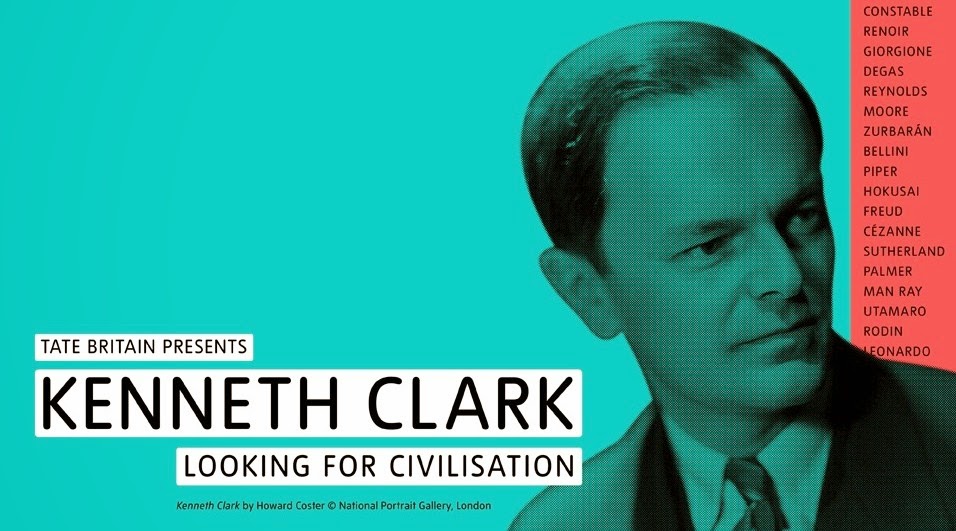
Kenneth Clark (1903-1983) was not only born in the same year as Evelyn Waugh, (mentioned in recent posts here), but also became well-known at a young age in the 1930s. Clark, unlike Waugh, was born into considerable wealth and, after studying the history of art at Oxford and coming under the influence of Roger Fry, was able to spend time in Italy with the American art historian Bernard Berenson, specialising in the Renaissance. On return to England he became Curator of the Ashmolean Museum in Oxford and then Director of the National Gallery from 1930 to 1946. His public service also included being Surveyor of the King’s Pictures, and chairmanships of the War Artists' Advisory Committee, the Arts Council of Great Britain and the Independent Television Authority. In 1969 Clark wrote and presented a celebrated TV series on the history of Western civilisation for BBC television, later shown in the US. When he subsequently received a life peerage, Private Eye dubbed him Lord Clark of Civilisation. The Tate Britain exhibition, Kenneth Clark - Looking for Civilisation, is a survey of his life’s work and brings together art that he had dealt with professionally, had benefitted from his patronage or that he had collected personally.

Not surprisingly, there is much to look at in this show. The 270 objects on display include some which are unfamiliar and may not be seen in public again for a while (one can hazard a guess as to which ‘Private Collection’ they come from). The first room is the most personal with Graham Sutherland’s portrait, Kenneth Clark (1963-64, left), and focusses on his early years. This is followed by works he collected for himself (Seurat’s The Forest at Pontaubert, (1881 below left) or, as Director of the National Gallery, for the nation, for example Constable’s Sketch for Hadleigh Castle (1828-9, below right), later transferred to the Tate. Some of the attributions he made when purchasing for the National Gallery do not seem to have stood the test of time particularly well. However, it was under his Directorship that the Gallery’s Scientific Department was formed, and the techniques which are now available to support judgements on authenticity began to be developed. In the 1930s Clark purchased for himself late works by Cézanne, as would Henry Pearlman a decade later and probably at a much higher price. A Cézanne pencil drawing, Still life, Pain sans mie, 1887-90, is particularly interesting in that its inclusion of commercial typography (“bread without crumbs”!) anticipates Picasso and Braque (but see the 1 July update below).


Clark not only collected but was an active patron looking favourably on Henry Moore (Recumbent Figure, 1938, right), Graham Sutherland, Paul Nash, and John Piper. He did not care much for abstraction (the Ben Nicholson on show seems to have been an exception), Francis Bacon or Lucien Freud’s later work. The fifth and largest space in the show is given over to the War Artists, most of whom worked in the Romantic style Clark liked, and is one of the most interesting. Although familiar in reproduction, the opportunity, during the Imperial War Museum’s closure, to see Paul Nash’s Battle of Britain (1942, below) and one of Moore’s shelter drawings (Tube 1941, below, lower) is welcome.


Among many impressive wartime pictures, ones which caught my eye were John Piper’s Somerset Place, Bath (1942, below,) and Albert Richards’ The Landing: H Hour minus 6. In the Distance Glow of the Lancasters Bombing Battery to be Attacked (1944, below, lower).


The final room concentrates on Clark’s activities after the war, particularly his involvement with television. The BBC are reportedly considering a new Civilisation series:
… "re-imagined … for the digital age". Unlike the original, it is likely to have a number of different presenters.
If so, I hope one of them will be Lisa Jardine, the daughter of Jacob Bronowski. His 1973 television series, The Ascent of Man, was complementary to Clark’s and looked at the rise of science as opposed to art, architecture and philosophy.

Just before leaving the exhibition, visitors can see two of the finest works acquired by Clark: a Francisco de Zurbarán still life, A Cup of Water and a Rose (c1630, below left), and Cézanne’s Le Château Noir (c 1904, below, right).


Kenneth Clark - Looking for Civilisation ends on 10 August and anyone with an interest in British art should try to get to Tate Britain before then. The most thought-provoking review I have come across is Kenneth Clark: arrogant snob or saviour of art? by James Hall in the Guardian.


A MINOR QUERY FOR THE CURATORS

In the first room there is a showcase (vitrine?) of Clark family photographs. One of these is of a villa owned by Clark’s father and (when I saw it) was labelled as being Clark’s childhood home in South West France at Cap Ferrat. I thought this unlikely. Although before the First World War Arcachon, on the Gironde department’s Atlantic Coast, was a fashionable resort, the village of Cap Ferret, nearby by sea but remote by land, was little more than a few oyster fishing huts (rather different now). However, Cap Ferrat (Saint-Jean-Cap-Ferrat) on the Mediterranean in the Alpes-Maritime department in South East France had become a magnet for the ultra-wealthy around 1900 and remained so. The Clark villa seems to be in the “Renaissance” style consistent with that location and, of course, Clark’s father was supposedly “the man who broke the bank at Monte Carlo”, not Biarritz. It might be worth checking.


UPDATE 1 JULY

A footnote to Cézanne’s use of commercial typography: I have recently come across this image of The Artist's Father, Reading "L'Événement", 1866, now in the National Gallery of Art, Washington DC. Apparently it wasn’t Louis-Auguste’s favourite paper but Cézanne’s old friend Emile Zola was L'Événement’s art critic.


20 April 2014

The Pearlman Collection at the Ashmolean

Exhibitions based on collections provide a fascination which can’t be found in shows given over to individual artists or to particular periods in art history. I think it lies in the way the collector (or collectors) exercised their taste given the opportunities and resources which were available. Gertrude Stein and her brothers, for example, were wealthy and were collecting contemporary talent in the right place and time, Paris in the 1920s. Sterling and Francine Clark had been in a similar position a decade earlier. The Radev Collection, on the other hand, reflects its creators’ tastes and long-term opportunities to make acquisitions rather than their funds. So what of Henry and Rose Pearlman’s collection, now on an international tour starting at the Ashmolean Museum, Oxford: Cézanne and the Modern: Masterpieces of Modern Art from the Pearlman Collection?


Henry Pearlman was born in New York in 1895 and set up Eastern Cold Storage in 1919. One can well believe that his company would have done well in the war years and certainly in 1945 he was able to make his first significant purchase of modern art, Chaïm Soutine’s Village Square, Céret (above, top). For nearly 30 years he went on building up his collection, most of which is now at the Ashmolean. The show starts with a large number of late Cézannes, mostly watercolours (not often displayed, no doubt for reasons of conservation), eg Three Pears, (Trois Poires, 1888-90 above lower), from the painter’s later years in Aix en Provence. These lead on to the next room’s Cistern in the Park of Chateau Noir (Citerne au Parc du Château Noir, c 1900, below in Pearlman’s office) and one of the versions of Montagne Sainte-Victoire (c 1902, poster above), much-painted by the artist.


Nearby are Vincent van Gogh’s Tarascon Stage Coach (Tarascon Diligence, 1888, again below in Pearlman’s office) and less satisfactory works by Gauguin, Degas (After the Bath, Woman Drying Herself /Après le bain, femme s'essuyant, 1892, above left) and Toulouse-Lautrec (Messaline, 1901, above right). I found the latter interesting because it was inspired by a visit to the opera in Bordeaux shortly before the painter’s death at Chateau Malromé. Earlier and more pleasing, if undemanding, works are Sisley’s Seine at Verneuil (La Seine à Verneuil, 1889, below, left) and Camille Pissaro’s Still Life: Apples and Pears in a Round Basket (Nature Morte: Pommes et Poires Dans un Panier Rond, 1872, below, right).


Finally, there are more works by Soutine, and two oils and a sculpture by Modigliani. Pearlman discovered after purchase that the small Daumier oil shown nearby, Head of an Old Woman (Tête de Vieille Femme, 1856-60, left), was one of the first purchases made by Leo and Gertrude Stein. It is a pity that Pearlman hadn’t started his collection a decade or two earlier when the opportunities for acquisitions of works by the painters he liked might have been greater (the absence of any cubist work is intriguing when Cézanne is often regarded as their precursor). He displayed what he considered to be his major pieces in his office at Eastern Cold Storage: the van Gogh, its acquisition surely being his apogee as a collector, Modigliani’s Jean Cocteau 1919-17, and Cézanne’s Cistern in the Park of Chateau Noir, (below).


Cézanne and the Modern provides a welcome opportunity in the UK to see works by Soutine and Modigliani as well as some fine Impressionist and Post-Impressionist works. The Pearlman website contains some interesting background information including Henry’s reminiscences, eg:
I found art dealers at first quite difficult to understand with regard to pricing works of art. Being accustomed to a business where selling price is based on cost plus small overhead and ten percent profit, I found that art dealers' prices in most cases bore little relationship to their costs, but were based on what the traffic could bear. I know of a pair of Douanier Rousseau portraits, for example, that were purchased at an auction in the Midi of France for about twenty dollars, repurchased by my French dealer friend for under $600, then sold to one of the New York galleries for $12,000; when I saw them exhibited here and asked the price I was advised that they could be bought for $30,000. Not being interested in owning these Rousseaus, I was amused by the gyrations of the prices. The last price I saw them offered for was $150,000 for the pair.
The show continues at the Ashmolean until 22 June and will be at Le Musée Granet in Aix-en-Provence from 12 July to 5 October. After showings in Atlanta and Vancouver it will return to the Princeton University Art Museum, where the Pearlman collection is on long-term loan, in 2015.


6 April 2013

Man Ray, Gertrude Stein and Picasso

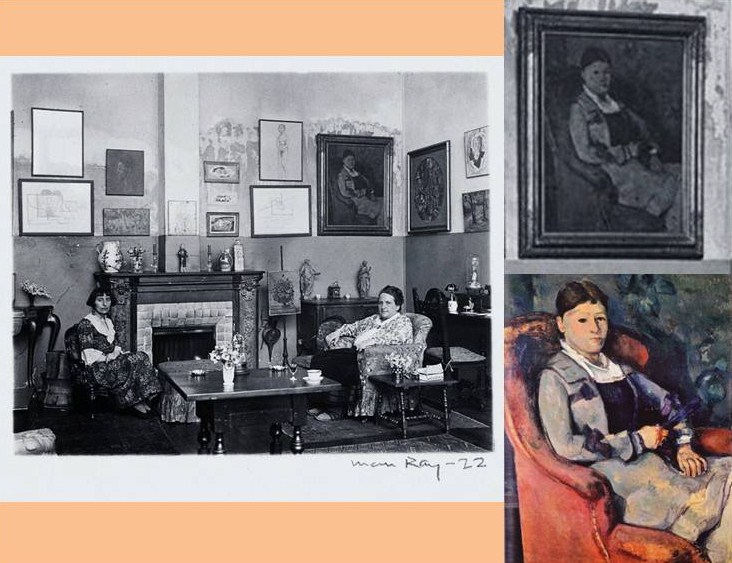
Last month a post here about the Man Ray exhibition currently at the National Portrait Gallery in London bemoaned the cost of its catalogue. But subsequently I had the chance to browse a copy bought by a less parsimonious friend (people from South West England are notoriously tight-fisted). I was surprised to read that the picture in the background to a Man Ray photograph of Gertrude Stein with Alice B Toklas (below left) was, according to the catalogue, Picasso’s portrait of Stein.

Surely the picture in this photograph, taken in 1922, is one of Cezanne’s studies of his wife - Madame Cézanne à l'éventail (The Artist's Wife with a Fan), c 1878/88 (above lower right) - which was at that time owned by Stein and is now at the Foundation E. G. Bührle Collection in Zurich? A post here in December 2011 about the exhibition Matisse, Cézanne, Picasso… L’aventure des Stein, then in Paris, juxtaposed Picasso’s Gertrude Stein 1905-6 (below left) with the Man Ray photograph of Stein taken in1924 which has the Picasso in the background. In 1946 Stein left her portrait to the Metropolitan Museum of Art in New York.

Ah well, I’m sure there are far worse errors in this blog.

23 December 2011

Two Paris Exhibitions

Paul Cézanne was born in Aix-en-Provence in 1839, and it was in Provence that many of his most celebrated works were produced. However, encouraged by his school friend, Émile Zola, he first travelled to Paris in 1861 and would return there many times to paint in the city or in the surrounding countryside (Pontoise, below). About 80 works from in or around the capital provide the theme for Cézanne et Paris, currently at the Musée du Luxembourg.

Cézanne now seems to be classed as a Post-Impressionist rather than as an Impressionist (“un peintre déjà sorti de l’impressionisme”, said Renoir), and many of the works in the exhibition (portrait of Mme Cézanne, left) hint at later developments by other artists, particularly Cubism . He is often called the father of modern art ("notre père à tous" said Picasso or Matisse, or both of them). Nonetheless, Cézanne had exhibited at the 1863 Salon des Refusés and at the first Impressionist exhibition in 1874 when his works were among the most disliked.

The son of a banker, Cézanne had no financial need to sell his work and it was only after the solo exhibition put on by the dealer Ambroise Vollard (right) in November 1895 that his reputation became established. Cézanne died in Aix-en-Provence in 1906. By this time some wealthy young Americans had come to live in Paris, and their art collection is the subject of the second exhibition, Matisse, Cézanne, Picasso… L’aventure des Stein, in the Petit Palais, across the Seine from the Musée du Luxembourg.

The Stein family were of German-Jewish origins and had become wealthy through the San Francisco tramway business co-owned by Daniel Stein. Daniel died in 1891 at the age of 59, three years after his wife who had died at 46. This left their four children, aged between 17 and 26, to pursue lives that, but for their intellectual inclinations, might have been labelled trustafarian in Britain a century later. Leo Stein (1872-1947) was the first to develop a serious interest in art. In 1900 he was studying 15th century Italian art in Florence under the influence of Bernard Berenson. However, while there he met Roger Fry (who was to introduce Post-Impressionism to Britain in 1910) and saw a Cézanne for the first time. At the end of 1902 he moved to Paris. In 1903 he purchased a Cézanne and was joined by his younger sister Gertrude Stein (1874-1946). By 1904 Leo and Gertrude had bought more works by Cézanne, as well as by Gauguin and Renoir. That year they were joined by the oldest Stein brother and would-be paterfamilias, Michael (1865-1938), and his wife Sarah (1870-1953). In the years that followed all four Steins were to make substantial purchases of works by these and other artists.  Hung in their two Paris apartments (Michael and Sarah's, left; Gertrude and Leo's, right) the paintings were to be admired during Saturday soirées held for Paris’s artistic avante garde.

Picasso became a close friend of Gertrude and painted her famous portrait  in 1905-6 (below), (photographed together by Man Ray in 1922). Gertrude had by then started her literary career and became a supporter of Picasso during his development of Cubism. She famously remarked of Picasso:
He alone among painters did not set himself the problem of expressing truths which all the world can see, but the truth which only he can see.

The exhibition brings together some of the exceptional works which passed through the Steins’ hands, and are now dispersed in museums and private collections around the world. Michael and Sarah collected many works by Matisse only to lose some of the best during the First World War while on loan to a gallery in Berlin. In the late 1920s Le Corbusier designed them a Modernist villa near Paris but they were to leave after a few years when the rise of fascism prompted their return to the US. By 1914 Leo had taken himself and his preferred pictures, mostly Renoirs, to Italy. This left his sister and her companion, Alice B Toklas, to be the core of the American literary and artistic community in Paris in the 1920s and 30s, (recently portrayed in Woody Allen’s comedy, Midnight in Paris). 

After the First World War, Gertrude could no longer afford to buy Picasso’s work and, although she continued to act as patron to emerging artistic talent, her later acquisitions turned out to be much less significant. The expensive exhibition catalogue (63 euros for the English edition) makes little mention of her experiences in France during the Occupation of the Second World War (she and Alice had been highly regarded for their American Red Cross work during the First). However, as Barbara Will has shown in Unlikely Collaboration: Gertrude Stein, Bernard Fay, and the Vichy Dilemma, Gertrude's judgement in becoming an apologist for Pétain’s Vichy France, particularly by translating his speeches for US consumption, was questionable, even if it ensured the preservation of her art collection. 

Both exhibitions contain works of the highest quality and are rewarding to visit. Cézanne et Paris is the more straightforward as a retrospective on one artist, whereas L’aventure des Stein has to weave together the works of four major artists (63 Matisses, 43 Picassos etc) and many others and the histories of their collectors, a complex task skilfully done.  Cézanne et Paris continues to 26 February 2012. Matisse, Cézanne, Picasso… L’aventure des Stein has been extended to 22 January (check!) and then travels to the Metropolitan Museum of Art, New York (1 February to 3 June 2012). It started at the San Francisco Museum of Modern Art (May to September 2011).