Showing posts with label Ashmolean. Show all posts

16 February 2016

Warhol at the Ashmolean

A survey of mid to late Warhol which should not be missed

Oxford seems to have a thing about Warhol. As recently as last March Modern Art Oxford was showing Love is Enough: William Morris & Andy Warhol curated by Jeremy Deller. Perhaps it derives from Warhol’s only visit, made in 1980 when he escaped from London to a party in north Oxford. Now, Andy Warhol: Works from the Hall Collection is at the Ashmolean Museum. The Hall and Hall Art Foundation was set up in Vermont in 2007 by Andrew and Christine Hall and holds about 5000 modern and contemporary works by numerous artists. Andrew Hall is an Oxford graduate who manages a hedge fund in the US. The Foundation loans its own works and those in the Halls’ own collection and has a partnership with the Ashmolean to present a series of exhibitions curated by Sir Norman Rosenthal.

This exhibition begins with Warhol in the 1960s, the period when he was establishing “The Factory” and producing silkscreen images - Self-portrait (1967, in the poster above) and copies of iconic objects - Brillo Soap Pads Box (1964, below right):


Part of the fascination of the multiple screen prints is the extent of the variations In the same run, apparent when looking at the eight prints of The American Man (Portrait of Watson Powell), (1964, above left) in the show, out of the 32 produced. There is also an opportunity to see some of the portrait films Warhol was making at this time – the four minute shorts of Marcel Duchamp (curiously, almost as conventionally respectable in appearance as René Magritte) and Bob Dylan being more likely to be watched in full by visitors than the eight hours static view of the Empire State Building.

The 70s Portraits begins with one image of a politician, Willy Brandt (1976, below top) and several prints on various media of the artist Joseph Beuys (1980, below lower):

before, almost inevitably, the Great Helmsman with Mao (1973, left) and Twenty Fuchsia Maos (1979, right):


Most striking in this section was the wall of Celebrity Portraits. Just to pick out two of interest: Pia Miller (c1985, below left) apparently introduced Ai Weiwei’s work to the West as recently as 2008, and Farah Ashraf Pahlavi (Princess of Iran) (1977, below right) established with her cousin (also portrayed by Warhol) the Tehran Museum of Contemporary Art, an exceptional collection little seen since 1979 but, according to the Financial Times last December, about to re-emerge and start lending.


Nearby are some Experiments In Abstraction including the Untitled (Oxidation Painting) (1978, below left), produced, we are told, by urinating onto copper, and some jollier handprints and Hammer and Sickle (1976, below right):


The final section, The Last Year, actually covering 1985 to Warhol’s untimely death in February 1987, was well-stocked but less interesting. He was producing black and white images inverted to provide positive and negative versions, eg Hamburger (positive) (1985‒86, below top) and the Map of the Eastern U.S.S.R. Missile Bases (1985-86, below lower, negative; for the positive see the Modern Art Oxford show post): 


Nearby on the gallery wall was a quotation from the artist:
Black is my favourite colour and white is my favourite colour
No point in laboring what might be wrong with that!

This exhibition provides a welcome opportunity to see a selection of Warhol's later work. Anyone unfamiliar with his career might be frustrated by the lack of context it provided – I didn’t see the usual timeline at the entrance - so some preliminary reading could be helpful, say 15 minutes’ worth?

Andy Warhol: Works from the Hall Collection continues at the Ashmolean until 15 May.


29 June 2015

Turner and perspective

A post here earlier this month covered the exhibition, David Hockney Painting and Photography, which explores his interest in perspective. Not long after, an appeal arrived from the Ashmolean Museum Oxford to secure for a national collection Turner’s painting, The High Street, Oxford (1810, below).


The Guardian website superimposed Turner’s painting and a photograph of the same scene taken recently by David Fisher (above). The webpage provides a dissolve between the two images and allows a comparison of the photographic perspective and the painter’s.

Please support the appeal!


4 February 2015

William Blake at the Ashmolean

William Blake Apprentice and Master at the Ashmolean Museum, Oxford aims to provide a chronological account of the life and work of Blake (1757 – 1827), engraver, painter and poet, though, inevitably as an exhibition, it is most informative about the first two of these roles. At the age of 17 Blake entered a seven-year apprenticeship as an engraver after which he studied at the Royal Academy. Zoffany’s painting of the Academy’s Professor of Anatomy, William Hunter MD (c1772 below) indicates the thoroughness of its schooling at the time.


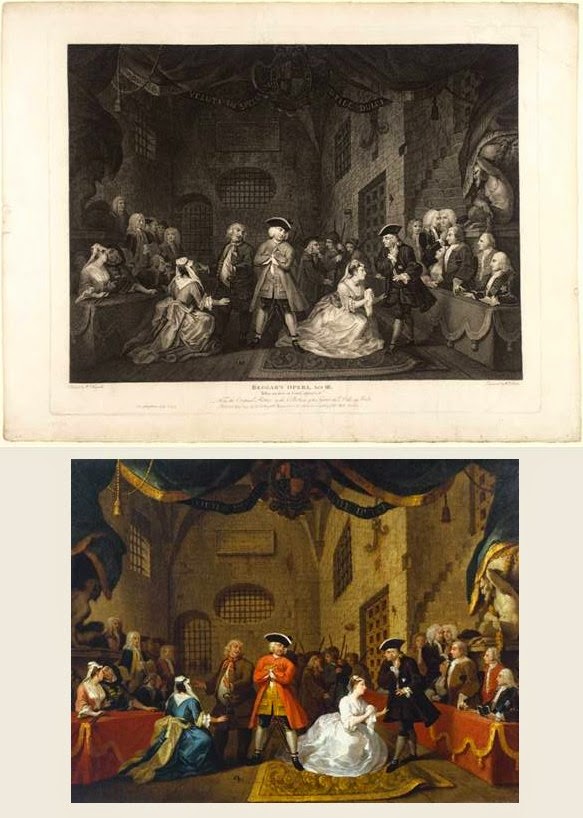
The exhibition is largely chronological and shows how, once developed, Blake’s skill as an engraver brought commercial success, for example his copy, Beggar’s Opera, Act III (1790, below top), of Hogarth’s painting, A Scene from ‘The Beggar’s Opera’ VI (1731, below lower).


The exhibition then moves on to Blake’s innovations in printmaking which allowed the integration of text and illustration, eg Laocoon (1826-7, below):


and in hand-coloured relief etching through which he created such memorable images as Los Howl’d from the First Book of Urizen (1796, poster above), Nebuchadnezzar (c1795–1805, below top) and Newton (1795, below lower):


The interpretation of these and other images and their place in his writings is rather beyond the scope of this blog. Blake’s religiosity, mysticism and political views to be found in his writings are specialist areas in their own right. But I did recall this passage from one of Anthony Powell’s A Dance to the Music of Time novels. Nicholas Jenkins (the novels’ narrator) is attending the Victory service held in St Paul’s Cathedral, London in 1945:
…We rose to sing Jerusalem
'Bring me my Bow of burning gold;
Bring me my Arrows of desire; 
Bring me my spear; O Clouds unfold!
Bring me my chariot of fire!'
Was all that about sex too? If so, why were we singing it at the Victory Service? Blake was as impenetrable as Isaiah; in his way, more so. It was not quite such wonderful stuff as the Prophet rendered into Elizabethan English, yet wonderful enough. At the same time, so I always felt, never quite for me. Blake was a genius, but not one for the classical taste. He was too cranky. No doubt that was being ungrateful for undoubted marvels offered and accepted. One often felt ungrateful in literary matters, as in so many others. (The Military Philosophers, page 229)
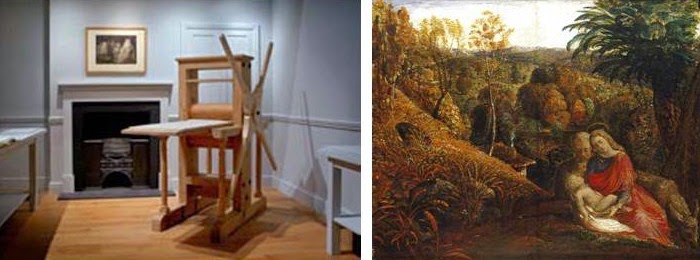
The curator has taken the trouble to recreate the room in Blake’s house in Lambeth (demolished nearly 100 years ago) where he made his prints, complete with a new printing press of the type he used (below left). One imagines that the original would have been well-stained with spilt ink. The show ends with works by some of the younger artists who had become his followers at the end of his life, for example Samuel Palmer’s Landscape with the Repose of the Holy Family (1824–1825, below right).


William Blake Apprentice and Master ends on 1 March 2015.


12 June 2014

Lord Clark at Tate Britain


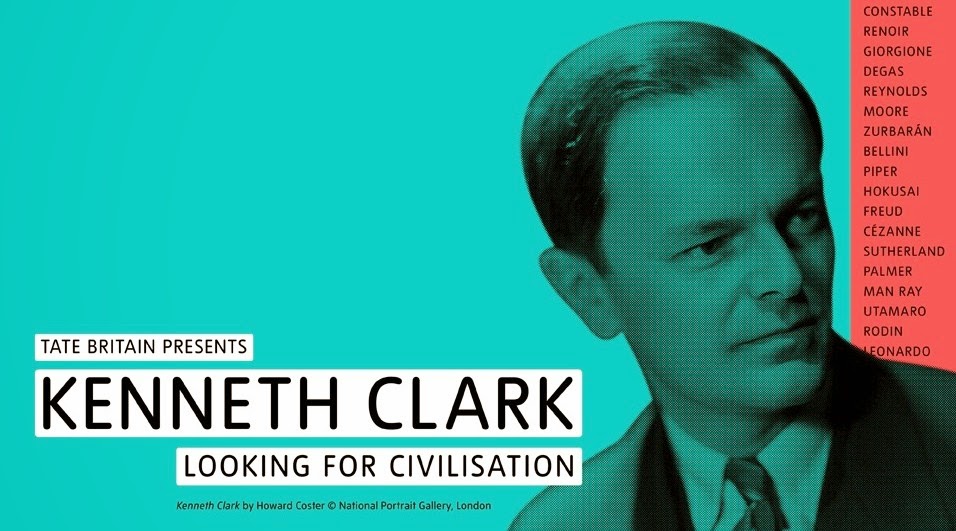
Kenneth Clark (1903-1983) was not only born in the same year as Evelyn Waugh, (mentioned in recent posts here), but also became well-known at a young age in the 1930s. Clark, unlike Waugh, was born into considerable wealth and, after studying the history of art at Oxford and coming under the influence of Roger Fry, was able to spend time in Italy with the American art historian Bernard Berenson, specialising in the Renaissance. On return to England he became Curator of the Ashmolean Museum in Oxford and then Director of the National Gallery from 1930 to 1946. His public service also included being Surveyor of the King’s Pictures, and chairmanships of the War Artists' Advisory Committee, the Arts Council of Great Britain and the Independent Television Authority. In 1969 Clark wrote and presented a celebrated TV series on the history of Western civilisation for BBC television, later shown in the US. When he subsequently received a life peerage, Private Eye dubbed him Lord Clark of Civilisation. The Tate Britain exhibition, Kenneth Clark - Looking for Civilisation, is a survey of his life’s work and brings together art that he had dealt with professionally, had benefitted from his patronage or that he had collected personally.

Not surprisingly, there is much to look at in this show. The 270 objects on display include some which are unfamiliar and may not be seen in public again for a while (one can hazard a guess as to which ‘Private Collection’ they come from). The first room is the most personal with Graham Sutherland’s portrait, Kenneth Clark (1963-64, left), and focusses on his early years. This is followed by works he collected for himself (Seurat’s The Forest at Pontaubert, (1881 below left) or, as Director of the National Gallery, for the nation, for example Constable’s Sketch for Hadleigh Castle (1828-9, below right), later transferred to the Tate. Some of the attributions he made when purchasing for the National Gallery do not seem to have stood the test of time particularly well. However, it was under his Directorship that the Gallery’s Scientific Department was formed, and the techniques which are now available to support judgements on authenticity began to be developed. In the 1930s Clark purchased for himself late works by Cézanne, as would Henry Pearlman a decade later and probably at a much higher price. A Cézanne pencil drawing, Still life, Pain sans mie, 1887-90, is particularly interesting in that its inclusion of commercial typography (“bread without crumbs”!) anticipates Picasso and Braque (but see the 1 July update below).


Clark not only collected but was an active patron looking favourably on Henry Moore (Recumbent Figure, 1938, right), Graham Sutherland, Paul Nash, and John Piper. He did not care much for abstraction (the Ben Nicholson on show seems to have been an exception), Francis Bacon or Lucien Freud’s later work. The fifth and largest space in the show is given over to the War Artists, most of whom worked in the Romantic style Clark liked, and is one of the most interesting. Although familiar in reproduction, the opportunity, during the Imperial War Museum’s closure, to see Paul Nash’s Battle of Britain (1942, below) and one of Moore’s shelter drawings (Tube 1941, below, lower) is welcome.


Among many impressive wartime pictures, ones which caught my eye were John Piper’s Somerset Place, Bath (1942, below,) and Albert Richards’ The Landing: H Hour minus 6. In the Distance Glow of the Lancasters Bombing Battery to be Attacked (1944, below, lower).


The final room concentrates on Clark’s activities after the war, particularly his involvement with television. The BBC are reportedly considering a new Civilisation series:
… "re-imagined … for the digital age". Unlike the original, it is likely to have a number of different presenters.
If so, I hope one of them will be Lisa Jardine, the daughter of Jacob Bronowski. His 1973 television series, The Ascent of Man, was complementary to Clark’s and looked at the rise of science as opposed to art, architecture and philosophy.

Just before leaving the exhibition, visitors can see two of the finest works acquired by Clark: a Francisco de Zurbarán still life, A Cup of Water and a Rose (c1630, below left), and Cézanne’s Le Château Noir (c 1904, below, right).


Kenneth Clark - Looking for Civilisation ends on 10 August and anyone with an interest in British art should try to get to Tate Britain before then. The most thought-provoking review I have come across is Kenneth Clark: arrogant snob or saviour of art? by James Hall in the Guardian.


A MINOR QUERY FOR THE CURATORS

In the first room there is a showcase (vitrine?) of Clark family photographs. One of these is of a villa owned by Clark’s father and (when I saw it) was labelled as being Clark’s childhood home in South West France at Cap Ferrat. I thought this unlikely. Although before the First World War Arcachon, on the Gironde department’s Atlantic Coast, was a fashionable resort, the village of Cap Ferret, nearby by sea but remote by land, was little more than a few oyster fishing huts (rather different now). However, Cap Ferrat (Saint-Jean-Cap-Ferrat) on the Mediterranean in the Alpes-Maritime department in South East France had become a magnet for the ultra-wealthy around 1900 and remained so. The Clark villa seems to be in the “Renaissance” style consistent with that location and, of course, Clark’s father was supposedly “the man who broke the bank at Monte Carlo”, not Biarritz. It might be worth checking.


UPDATE 1 JULY

A footnote to Cézanne’s use of commercial typography: I have recently come across this image of The Artist's Father, Reading "L'Événement", 1866, now in the National Gallery of Art, Washington DC. Apparently it wasn’t Louis-Auguste’s favourite paper but Cézanne’s old friend Emile Zola was L'Événement’s art critic.


20 April 2014

The Pearlman Collection at the Ashmolean

Exhibitions based on collections provide a fascination which can’t be found in shows given over to individual artists or to particular periods in art history. I think it lies in the way the collector (or collectors) exercised their taste given the opportunities and resources which were available. Gertrude Stein and her brothers, for example, were wealthy and were collecting contemporary talent in the right place and time, Paris in the 1920s. Sterling and Francine Clark had been in a similar position a decade earlier. The Radev Collection, on the other hand, reflects its creators’ tastes and long-term opportunities to make acquisitions rather than their funds. So what of Henry and Rose Pearlman’s collection, now on an international tour starting at the Ashmolean Museum, Oxford: Cézanne and the Modern: Masterpieces of Modern Art from the Pearlman Collection?


Henry Pearlman was born in New York in 1895 and set up Eastern Cold Storage in 1919. One can well believe that his company would have done well in the war years and certainly in 1945 he was able to make his first significant purchase of modern art, Chaïm Soutine’s Village Square, Céret (above, top). For nearly 30 years he went on building up his collection, most of which is now at the Ashmolean. The show starts with a large number of late Cézannes, mostly watercolours (not often displayed, no doubt for reasons of conservation), eg Three Pears, (Trois Poires, 1888-90 above lower), from the painter’s later years in Aix en Provence. These lead on to the next room’s Cistern in the Park of Chateau Noir (Citerne au Parc du Château Noir, c 1900, below in Pearlman’s office) and one of the versions of Montagne Sainte-Victoire (c 1902, poster above), much-painted by the artist.


Nearby are Vincent van Gogh’s Tarascon Stage Coach (Tarascon Diligence, 1888, again below in Pearlman’s office) and less satisfactory works by Gauguin, Degas (After the Bath, Woman Drying Herself /Après le bain, femme s'essuyant, 1892, above left) and Toulouse-Lautrec (Messaline, 1901, above right). I found the latter interesting because it was inspired by a visit to the opera in Bordeaux shortly before the painter’s death at Chateau Malromé. Earlier and more pleasing, if undemanding, works are Sisley’s Seine at Verneuil (La Seine à Verneuil, 1889, below, left) and Camille Pissaro’s Still Life: Apples and Pears in a Round Basket (Nature Morte: Pommes et Poires Dans un Panier Rond, 1872, below, right).


Finally, there are more works by Soutine, and two oils and a sculpture by Modigliani. Pearlman discovered after purchase that the small Daumier oil shown nearby, Head of an Old Woman (Tête de Vieille Femme, 1856-60, left), was one of the first purchases made by Leo and Gertrude Stein. It is a pity that Pearlman hadn’t started his collection a decade or two earlier when the opportunities for acquisitions of works by the painters he liked might have been greater (the absence of any cubist work is intriguing when Cézanne is often regarded as their precursor). He displayed what he considered to be his major pieces in his office at Eastern Cold Storage: the van Gogh, its acquisition surely being his apogee as a collector, Modigliani’s Jean Cocteau 1919-17, and Cézanne’s Cistern in the Park of Chateau Noir, (below).


Cézanne and the Modern provides a welcome opportunity in the UK to see works by Soutine and Modigliani as well as some fine Impressionist and Post-Impressionist works. The Pearlman website contains some interesting background information including Henry’s reminiscences, eg:
I found art dealers at first quite difficult to understand with regard to pricing works of art. Being accustomed to a business where selling price is based on cost plus small overhead and ten percent profit, I found that art dealers' prices in most cases bore little relationship to their costs, but were based on what the traffic could bear. I know of a pair of Douanier Rousseau portraits, for example, that were purchased at an auction in the Midi of France for about twenty dollars, repurchased by my French dealer friend for under $600, then sold to one of the New York galleries for $12,000; when I saw them exhibited here and asked the price I was advised that they could be bought for $30,000. Not being interested in owning these Rousseaus, I was amused by the gyrations of the prices. The last price I saw them offered for was $150,000 for the pair.
The show continues at the Ashmolean until 22 June and will be at Le Musée Granet in Aix-en-Provence from 12 July to 5 October. After showings in Atlanta and Vancouver it will return to the Princeton University Art Museum, where the Pearlman collection is on long-term loan, in 2015.


8 October 2013

Bacon and Moore at the Ashmolean

Francis Bacon Henry Moore: Flesh and Bone currently at the Ashmolean Museum in Oxford is probably the most ambitious show there since the completion in 2009 of major redevelopment. It is also the first major exhibition bringing together works by Moore (1898-1986) and Bacon (1909-1992) since the artists’ deaths. In retrospect it is becoming more apparent that the art of both men in part embodies their responses to the horrors of the first half of the last century, - two World Wars, the Spanish civil war, the Holocaust, the atomic bombings of Japan, the start of the Cold War and the prospect of nuclear annihilation.

The exhibition offers a sequence of skilful juxtapositions (eg below) which bring out the sculptural quality of Bacon’s figures. The catalogue quotes Myfanwy Piper’s reaction to a Moore/Bacon exhibition in 1963:
… Moore ‘never forgets the solidity of flesh upon the bone, the strength of the bone beneath the flesh’ while Bacon ‘never forgets that flesh is meat’. (page 18)
 

What opinions the two men had of each other’s work is not something the exhibition sets out to address, but Richard Calvocoressi (Director of The Henry Moore Foundation) in his catalogue essay relates the following intriguing incident:
The two artists were not close, had little in common in their personal lives, and took a very different view of honours, awards and official appointments. Moore, the articulate and persuasive spokesman for sculpture as a public art, believed the artist had a responsibility to society; Bacon did not. Bacon was never very complimentary about Moore's work, dismissing his shelter drawings and making other pointed remarks in private. In spite of this gulf between them, Maurice Ash, a friend of Moore's, recounted to the artist's biographer an incident in the 1950s when dinner at the Moores in Hertfordshire was delayed by over an hour while Moore spoke in private to 'a very agitated Bacon' who had turned up unexpectedly.' Francis Warner, who knew both artists, recalls Bacon asking him in the early 1970s if he could take sculpture lessons from Moore. Assuming it was serious - and this was certainly a time when Bacon was thinking deeply about making sculpture - nothing came of the proposal. (page 16)
There are 20 paintings by Bacon (some from rarely seen private collections) alongside 20 sculptures and 20 drawings by Moore. My preference is to see Moore’s larger works out-of-doors, (eg at Dartington), but it is not unusual to encounter them in galleries, for example at Tate Britain in 2010 and at the Gagosian Gallery in 2012. Three Upright Motives in close proximity rather than in the open (No2, left at Kew in 2009) may seem slightly intimidating to some visitors. However, in a few months, and not far away, Moore Rodin will be opening at Compton Verney partly in the grounds. In the meantime, anyone with an interest in either artist should visit the Ashmolean before 19 January 2014. The exhibition will appear in modified form at the Art Gallery of Ontario, an institution to which Moore made a sizable donation of his work.

2 December 2011

Landscapes in Oxford and Bath

In a post back in August I remarked in passing “should France ever leave the Eurozone, which may seem unlikely”. Now we are being told that the breakup of the euro is the subject of contingency planning in finance ministries, embassies and the headquarters of multinationals across the world. What could be a better way to escape briefly from the encircling economic gloom than two visits to Arcadia?

The Ashmolean in Oxford is showing Claude Lorrain: The Enchanted Landscape, the first major exhibition of his work in over a decade. Claude Gellée (c.1600–1682), spent most of his working life in Rome, but his origins were in the commune of Chamagne in the Duchy of Lorraine, (now in Vosges (88) in France; never Champagne as the Ashmolean press pack states, perhaps wanting to inject some fizz). His biographical details are unclear, he may even have been trained originally as a pastry-cook, but by his thirties he was settled in Rome and had begun to make a name for himself by painting port scenes and landscapes. During his long artistic career he had the patronage of royalty as well as popes and cardinals.

The exhibition is organised in three sections: firstly, sketches and drawings from the Roman countryside; then thirteen paintings mostly with classical (Aeneas and Dido in Carthage, left) or religious themes, all providing the enchantment promised by the show’s name; finally, etchings including the fascinating series of the fireworks in Rome in 1637.

Claude’s work was encountered and collected on the Grand Tour by the English aristocracy who later laid out their parklands in the spirit of his pastoral idyll. One English artist he had some influence over was Thomas Gainsborough (1727-88) whose landscapes are the subject of the Bath Holburne Museum’s second major exhibition since redevelopment, Gainsborough’s Landscapes: Themes and Variations. Although only six paintings are shown, these were well-chosen and helpfully complemented by drawings and prints, all skilfully curated by Susan Sloman. Gainsborough’s fame and livelihood came from his portraiture, particularly during the years 1759-74 when he lived in Bath, but as he said:
I’m sick of portraits and wish very much to take up my viol de gamba and walk off to some sweet village where I can paint landskips and enjoy the fag end of life in quietness and ease.
Perhaps this shows in his portrait of Mr and Mrs Andrews (below) in the National Gallery, London, which, although telling us all we might want to know about them, still manages to be 50% landscape.

Gainsborough painted a romantic view of the countryside around Bath but populated it with more realistic inhabitants, Peasants Returning from Market (left) or looking after pigs, than Claude’s paintings feature. The exhibition reminds us of our encircling economic realities when it explains that Bath’s popularity as an all year spa and resort depended on winter heating provided by the coal mined a few miles to the south of the city.

Economic reality may also be intruding in the way that shows are increasingly augmenting a relatively small number of paintings with drawings, etchings and so on (Table below). In so far as these lesser works add depth and focus and encourage a more scholarly approach in visiting exhibitions, this is probably not entirely a retrograde step. Anyway, given that paintings are inevitably more expensive to transport and insure, we are probably going to have to get used to it.


Claude Lorrain: The Enchanted Landscape continues at the Ashmolean until 8 January and then can be seen at the Städel Museum, Frankfurt from 3 February to 6 May 2012. Gainsborough’s Landscapes: Themes and Variations will be in Bath until 22 January and then the appropriate parkland surroundings of Compton Verney from 11 February to 10 June 2012. Let’s hope the eurozone will survive for both.

17 November 2010

'The Pre-Raphaelites in Italy' at the Ashmolean

Away from the great South West again, just for a day, driving through frost and fog to Oxford, primarily to visit the Ashmolean Museum.

Rick Mather’s skilful redevelopment of the Ashmolean has provided space for temporary exhibitions on the third floor, their first major show being The Pre-Raphaelites and Italy. The Pre-Raphaelite Brotherhood was closely associated with Oxford and many of their works are held in the Ashmolean’s collection or by the colleges. Italy was a central inspiration for the PRB and provides a good subject for this scholarly exhibition, definitely worth seeing before it closes on 5 December. Busy, but not crowded when I went; captioning good by current standards (I recently moaned about this); £6 maximum, guide good value at £4.

Two oddities: John Brett’s Capri in the Evening, lent by a private collection, being last exhibited in 1866; Burne-Jones’ The Tree of Life, lent by the V&A, with an unusual, almost geeky, formatting of some of the details on the frame:

b1833) SIR EDWARD COVEY BURNE-JONES (d1890

The Ashmolean Dining Room was as described by John Lanchester in the Guardian last month - attempting to select sensibly from the menu items which were actually available had a Carrollian twist.