In this blog there have been several encounters with Louise Bourgeois’ ‘spider’ sculptures (at the Royal Academy, at the Guggenheim Bilbao in 2015 and at Hauser & Wirth Somerset in 2014), but with only one exhibition of her work. That was Do Not Abandon Me, a show at the RWA Bristol in 2011 of Louise Bourgeois gouaches which had been adorned by Tracey Emin with small drawings and handwriting. Now two more extensive Bourgeois exhibitions have come along in just a few months.
The first, again at the Guggenheim Bilbao, was Louise Bourgeois Structures of Existence: the Cells, which ran from 18 March to 4 September 2016. In 2015 this exhibition was at the Haus der Kunst in Munich, and then the Garage Museum of Contemporary Art in Moscow before Bilbao. From 13 October 2016 it will be at the Louisiana Museum of Modern Art in Denmark until 26 February 2017. The Haus der Kunst website and the Guggenheim’s continue to host extensive descriptions of the Cells and their place in the artist’s oeuvre. Louise Bourgeois was born in Paris in 1911 and died in her 98th year in Manhattan. She left France in 1938 on marrying an American art historian but continued to use French in titles of her works (eg Passage Dangereux, 1997, above) and when hand-writing on them. Between 1991 and the end of her life Bourgeois created 62 Cells, 25 of them in this show.
The Cells are room-sized spaces, often constructed as cages, which are stocked with objects having personal resonance for Bourgeois, often reaching back into her childhood (Red Room (Parents) 1994, below top). The full significance to the artist of a particular installation is unknowable but the visitor cannot fail to be drawn into her disturbing and claustrophobic world view (Spider 1997, lower left and Cell (Choisy) 1990-93, lower right).
At Hauser & Wirth Somerset, Louise Bourgeois Turning Inwards is an exhibition of sculpture and etchings. After opening with Spider 1996:
again these explore Bourgeois’ memories and feelings (I Go to Pieces: My Inner Life (#6) 2010, below top), but also reveal her keen observation of the natural world and the forms it provides (Swelling 2007, below lower).
There is also an exhibition of photographs of Louise Bourgeois taken in the final years of her life by Alex Van Gelder, Mumbling Beauty, and an opportunity to see the documentary Louise Bourgeois: The Spider, the Mistress and the Tangerine, directed by Marion Cajori and Amei Wallach in 2008.
Louise Bourgeois Turning Inwards ends on 1 January 2017.
An Addendum about Artist Rooms: Louise Bourgeois at Tate Modern hopefully will be added to this post before too long.
Showing posts with label Louise Bourgeois. Show all posts
17 October 2016
3 December 2015
A Visit to the Guggenheim Bilbao
A post here in May described A Visit to the Fondation Louis Vuitton in Paris. This is a companion piece following a visit during the summer of 2015 to the Guggenheim Museum in Bilbao, also designed by Frank Gehry.
After the collapse of its industrial base in the 1980s, Bilbao was in desperate need of transformation. In 1991 the local administration and the Guggenheim Foundation reached an agreement to construct a contemporary art gallery on a derelict site next to the estuary and near the city centre. The Foundation had previously commissioned Frank Lloyd Wright for its museum in New York which had opened in 1959. Construction of Gehry’s design for Bilbao, which has become almost as well-known as Wright’s, began in 1993 and the museum opened in 1997. The structure is of steel, the surface being clad in titanium where not glazed and with limestone exposed on the exterior and the interior. The complex curving shapes were designed using computer applications originally developed for aerospace by Dassault in France in the 1970s. The exterior presents different forms at different viewpoints and references Bilbao’s maritime history of ships and fishing.
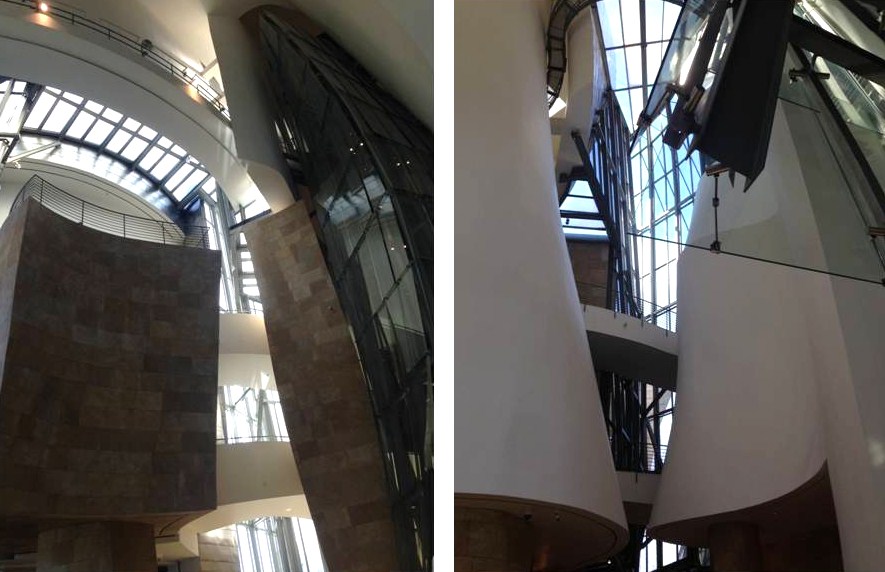
The interior is as just complex, as these views of the atrium reveal:
The Guggenheim Bilbao's permanent collection includes some major site-specific pieces on display externally including Anish Kapoor’s Tall Tree and the Eye (2009, below left) and Louise Bourgeois’ Maman (1999, below right):
and two works by Jeff Koons, Tulips (1995-2004, below top) and Puppy (1992, below lower):
Inside, in the ArcelorMittal gallery, are the seven massive pieces which constitute Richard Serra’s The Matter of Time (2005, below). Made of weathering steel and fabricated locally, they embody Bilbao’s industrial heritage.
At the time of this visit, most of the gallery space was given over to two exhibitions: Jeff Koons: A Retrospective (previously at the Centre Pompidou in Paris and the Whitney Museum of American Art, New York) and Jean-Michel Basquiat: Now’s the Time. People seem either to like Koon’s work or dislike it, not many are indifferent. Michel Houellebecq (quoted in a post here earlier this year) described Koons in unflattering terms as seen through the eyes of another imaginary artist. Julian Barnes at the Edinburgh book festival in August
Having seen this show, it may be a while before I feel the need to seek out any more Koons. I was more taken with Basquiat whose work I was seeing for the first time – if BBC Your Paintings is right, he is not represented in any UK public collection. Jean-Michel Basquiat was born in New York in 1960 and died of a heroin overdose in 1988, a year after Andy Warhol who had been his collaborator in the 1980s. Two works which epitomise Basquiat's style and preoccupations are Irony of a Negro Policeman (1981, below left) and Dark Race Horse—Jesse Owens (1983, below right):
Typical of Basquiat’s work with Warhol are Win $ 1,000,000 (below top) and Ailing Ali in Fight of Life (below lower), both 1984:
Man from Naples (1982, below), from Guggenheim Bilbao’s own collection, is a good example of Basquiat’s street graffiti work:
While the Guggenheim Bilbao is probably an even more impressive building than Gehry’s later Fondation Louis Vuitton, I thought it was less visitor-friendly. The gallery space is less appropriate for exhibitions, particularly retrospectives. The Warhol show was spread over two floors while Basquiat required walking back through galleries 306 and 305 after reaching 307 and then down a corridor to 303 and 302 – not so good, at least on an initial visit. Also, to enter the Museum, visitors descend a flight of steps from street level to the level of the atrium floor level. Leaving is via another flight of steps down to river level. A third set of steps, the length of the other two combined, then has to be climbed to get back to street level. If you want to get back in to the Museum – allowed during the day of visiting – you then redescend the first flight … None of this should deter anyone from visiting in 2016 when Guggenheim Bilbao will be offering shows of works by Warhol and Bourgeois and Windows on the City: The School of Paris, 1900-1945.
After the collapse of its industrial base in the 1980s, Bilbao was in desperate need of transformation. In 1991 the local administration and the Guggenheim Foundation reached an agreement to construct a contemporary art gallery on a derelict site next to the estuary and near the city centre. The Foundation had previously commissioned Frank Lloyd Wright for its museum in New York which had opened in 1959. Construction of Gehry’s design for Bilbao, which has become almost as well-known as Wright’s, began in 1993 and the museum opened in 1997. The structure is of steel, the surface being clad in titanium where not glazed and with limestone exposed on the exterior and the interior. The complex curving shapes were designed using computer applications originally developed for aerospace by Dassault in France in the 1970s. The exterior presents different forms at different viewpoints and references Bilbao’s maritime history of ships and fishing.
The interior is as just complex, as these views of the atrium reveal:
The Guggenheim Bilbao's permanent collection includes some major site-specific pieces on display externally including Anish Kapoor’s Tall Tree and the Eye (2009, below left) and Louise Bourgeois’ Maman (1999, below right):
and two works by Jeff Koons, Tulips (1995-2004, below top) and Puppy (1992, below lower):
Inside, in the ArcelorMittal gallery, are the seven massive pieces which constitute Richard Serra’s The Matter of Time (2005, below). Made of weathering steel and fabricated locally, they embody Bilbao’s industrial heritage.
At the time of this visit, most of the gallery space was given over to two exhibitions: Jeff Koons: A Retrospective (previously at the Centre Pompidou in Paris and the Whitney Museum of American Art, New York) and Jean-Michel Basquiat: Now’s the Time. People seem either to like Koon’s work or dislike it, not many are indifferent. Michel Houellebecq (quoted in a post here earlier this year) described Koons in unflattering terms as seen through the eyes of another imaginary artist. Julian Barnes at the Edinburgh book festival in August
… offered a text written by American artist Jeff Koons to accompany his work Puppy, a vast sculpture formed from flowering plants belonging to the Guggenheim Bilbao in northern Spain. Reading aloud from Koons’ text, he told the Edinburgh audience that Puppy “helps you have a dialogue about the organic and the inorganic. It’s really about the issue of the baroque, where everything is negotiated. The different aspects of the eternal through biology. Whether you want to serve or be served, love or be loved, all these types of polarities come into play because Puppy sets them up.” Barnes added: “To use the technical term of art criticism, it’s bollocks. I know it’s like shooting fish in a barrel but sometimes fish need to be shot.”In October Barnes told a Cheltenham Literature Festival audience (including me) that Koons produced “machine-tooled whimsicality”. Jeff Koons: A Retrospective provided plenty of opportunity to make one’s own mind up and included examples of his work from The New Series in the early 1980s (vacuum cleaners in vitrines) to the recent Antiquity series. I couldn’t help being impressed by the skill of Koons’ technicians in fabricating objects like Lobster (2003, below left), with the appearance of a PVC inflatable but made from “Polychromed aluminum”, and Large Vase of Flowers (1994, below right) made in polychromed wood.
Having seen this show, it may be a while before I feel the need to seek out any more Koons. I was more taken with Basquiat whose work I was seeing for the first time – if BBC Your Paintings is right, he is not represented in any UK public collection. Jean-Michel Basquiat was born in New York in 1960 and died of a heroin overdose in 1988, a year after Andy Warhol who had been his collaborator in the 1980s. Two works which epitomise Basquiat's style and preoccupations are Irony of a Negro Policeman (1981, below left) and Dark Race Horse—Jesse Owens (1983, below right):
Typical of Basquiat’s work with Warhol are Win $ 1,000,000 (below top) and Ailing Ali in Fight of Life (below lower), both 1984:
Man from Naples (1982, below), from Guggenheim Bilbao’s own collection, is a good example of Basquiat’s street graffiti work:
While the Guggenheim Bilbao is probably an even more impressive building than Gehry’s later Fondation Louis Vuitton, I thought it was less visitor-friendly. The gallery space is less appropriate for exhibitions, particularly retrospectives. The Warhol show was spread over two floors while Basquiat required walking back through galleries 306 and 305 after reaching 307 and then down a corridor to 303 and 302 – not so good, at least on an initial visit. Also, to enter the Museum, visitors descend a flight of steps from street level to the level of the atrium floor level. Leaving is via another flight of steps down to river level. A third set of steps, the length of the other two combined, then has to be climbed to get back to street level. If you want to get back in to the Museum – allowed during the day of visiting – you then redescend the first flight … None of this should deter anyone from visiting in 2016 when Guggenheim Bilbao will be offering shows of works by Warhol and Bourgeois and Windows on the City: The School of Paris, 1900-1945.
21 September 2014
Hauser & Wirth Somerset
Hauser & Wirth Somerset recently opened at Durslade Farm on the edge of the small town of Bruton. Part of a major international art dealership, it seems a long way from their other establishments in Zurich, London, New York and Los Angeles - which is not to say that South West England should be anything but grateful for the arrival of a world-class gallery and arts centre. The investment in renovating buildings and two new-build galleries designed by the Parisian architects, Laplace, must have been considerable. Hauser & Wirth’s aim for the gallery is to:
The inaugural art exhibition is GIG by Phyllida Barlow. Barlow was commissioned by Tate Britain in 2014 to produce a large sculptural installation for the Duveen Galleries, known as dock. At Bruton she has produced a series of installations responding to the gallery’s spaces and rural surroundings, made with common materials similar to those in dock: cement, cardboard, expanded polystyrene, plywood, timber and so on. Photography is not permitted indoors but images are available for untitled (suspended fabric pompoms, below left) and grinder, (below right.
After seeing postscorral inside and stackedchairs (below) outside in the Piggery, I began to wonder whether Barlow had been to the Somerset coast, the latter work called to mind deckchairs at Clevedon or Weston-super-Mare. But part of the fascination of Barlow’s work is that every visitor will be reminded of something different as they walk round, through or under her constructions. Moreover on close examination the viewer begins to appreciate how complex these constructions are in the ways they have been assembled from numerous components and also the subtlety of their colouring.
Photography is unlimited outside and works which I liked included Louise Bourgeois’ Spider 1994 (below, top) and Josephson’s Untitled 1970/73 (below, lower).
It was a delight to visit Hauser & Wirth Somerset on one of the last days of this summer. However, I couldn’t help wondering whether work by Pipilotti Rist will be as appealing to visitors from far and near on a wet Wednesday afternoon in February when the garden will have little to offer but muddy shoes. Across the front of Durslade Farm is a neon by Martin Creed, EVERYTHING IS GOING TO BE ALRIGHT (2011, Work 1086, below top with Subodh Gupta’s Untitled, 2008 in the foreground). Well, I do hope so and that it won’t be necessary to seek comfort from the stylish French neon described in a post here earlier this year: Jamais renoncer. And, of course, it’s far better for the South West that Iwan and Manuela Wirth chose to make Bruton their home and a location for a new gallery rather than, say, Beijing.
… share contemporary art with new audiences and … to engage the public with art, the countryside and the local community. The centre will also provide resources including an archive, reading room, landscaped garden designed by Piet Oudolf and a restaurant for locally-sourced food …Admission is free and there are two opening shows underway. Open Field consists of Oudolf’s designs for this and other projects including The High Line in New York and the Serpentine Gallery in London. Anyone interested in garden design and planting will no doubt enjoy learning more about Oudolf’s approach and his choices for the Hauser & Wirth Somerset garden which contains over 26,000 herbaceous perennials, (below, with Anri Sala’s perspective-defying Clocked Perspective 2012).
The inaugural art exhibition is GIG by Phyllida Barlow. Barlow was commissioned by Tate Britain in 2014 to produce a large sculptural installation for the Duveen Galleries, known as dock. At Bruton she has produced a series of installations responding to the gallery’s spaces and rural surroundings, made with common materials similar to those in dock: cement, cardboard, expanded polystyrene, plywood, timber and so on. Photography is not permitted indoors but images are available for untitled (suspended fabric pompoms, below left) and grinder, (below right.
After seeing postscorral inside and stackedchairs (below) outside in the Piggery, I began to wonder whether Barlow had been to the Somerset coast, the latter work called to mind deckchairs at Clevedon or Weston-super-Mare. But part of the fascination of Barlow’s work is that every visitor will be reminded of something different as they walk round, through or under her constructions. Moreover on close examination the viewer begins to appreciate how complex these constructions are in the ways they have been assembled from numerous components and also the subtlety of their colouring.
Photography is unlimited outside and works which I liked included Louise Bourgeois’ Spider 1994 (below, top) and Josephson’s Untitled 1970/73 (below, lower).
It was a delight to visit Hauser & Wirth Somerset on one of the last days of this summer. However, I couldn’t help wondering whether work by Pipilotti Rist will be as appealing to visitors from far and near on a wet Wednesday afternoon in February when the garden will have little to offer but muddy shoes. Across the front of Durslade Farm is a neon by Martin Creed, EVERYTHING IS GOING TO BE ALRIGHT (2011, Work 1086, below top with Subodh Gupta’s Untitled, 2008 in the foreground). Well, I do hope so and that it won’t be necessary to seek comfort from the stylish French neon described in a post here earlier this year: Jamais renoncer. And, of course, it’s far better for the South West that Iwan and Manuela Wirth chose to make Bruton their home and a location for a new gallery rather than, say, Beijing.
22 September 2012
‘Bronze’ at the RA
There is little point in my struggling to describe this outstanding exhibition, when the RA's press release does it so well:
The exhibition brings together outstanding works from the earliest times to the present in a thematic arrangement that is fresh and unique. With works spanning over 5,000 years, no such cross-cultural exhibition on this scale has ever been attempted. The exhibition features over 150 of the finest bronzes from Asia, Africa and Europe and includes important discoveries from the Mediterranean as well as archaeological excavations. Many of the pieces have never been seen in the UK.
Arranged thematically, Bronze brings together outstanding works from antiquity to the present. Different sections focus on the Human Figure, Animals, Groups, Objects, Reliefs, Gods, Heads and Busts. The exhibition features stunning Ancient Greek, Roman and Etruscan bronzes, through to rare survivals from the Medieval period. The Renaissance is represented with the works of artists such as Ghiberti, Donatello, Cellini, and later Giambologna, De Vries and others. Bronzes by Rodin, Matisse, Picasso, Moore, Bourgeois and Koons are representative of the best from the 19th century to today.There are some magnificent objects on show, for example The Dancing Satyr (below), retrieved from the seabed off Sicily in 1997:
and the Trunholm Chariot of the Sun found in a peatbog in Denmark in 1902:
For those (“conehead boffins”, perhaps) who are interested, the processes of casting (lost wax, direct and indirect) are well-explained. Bronze is the name given to alloys in which copper is the main component, often mixed with tin, zinc and lead in varying proportions. Some of the most ancient bronzes on display were probably copper-arsenic, and some of the modern ones (Louise Bourgeois Spider IV 1996, left) probably the readily-welded copper-silicon. None of the literature I saw at the RA (but perhaps it’s in the catalogue) pointed out a key characteristic of bronze: after pouring, although cooling, unusually it expands just before solidification and, once solid, contracts as it continues to cool. This property offers obvious advantages in achieving castings with excellent mould detail.

Bronze continues until 9 December. The physical effort in bringing so many heavy objects together must have been exceptional, as is the resulting visual display. This type of show would probably never be a Pre-Raphaelite-style ‘block buster’, but it certainly 'does what it says on the tin' (Jasper Johns Ale Cans 1960, right - sorry, couldn't resist it!) and should not be missed.
8 October 2011
Emin and Riley at RWA Bristol
Better late than never, I visited the Royal West of England Academy (RWA) in Bristol just in time to see some of their autumn exhibitions before they close on 11 October. A registered charity, the RWA is one of the five Royal Academies of Art in the UK. Its galleries and permanent collection may be in a fine Victorian building in superior Clifton, but RWA is a key part of the busy arts scene in Bristol, famous for the street artist Banksy. The RWA balcony is currently hosting Damien Hirst’s Charity (2003), a painted bronze almost certainly cast at Pangolin.
A previous post described Bridget Riley's exhibition earlier in the year at the National Gallery. In Bristol a selection of her screenprints going back to the 1960s is on display together with works by Michael Kidner (1917-2009) over the same period. Kidner also began with Optical Art but moved towards a constructive abstractionism reflecting his interest in science and mathematics. He would probably have been fascinated by Luke Jerram’s Aeolus, an ‘acoustic and optical pavilion’, its ‘Making’ being the subject of a small exhibition at RWA. The real thing, quite a substantial structure, is currently elsewhere in SW England - at the Eden Project in Cornwall - but Jerram, who is Bristol-based, is apparently looking to find it a permanent home.
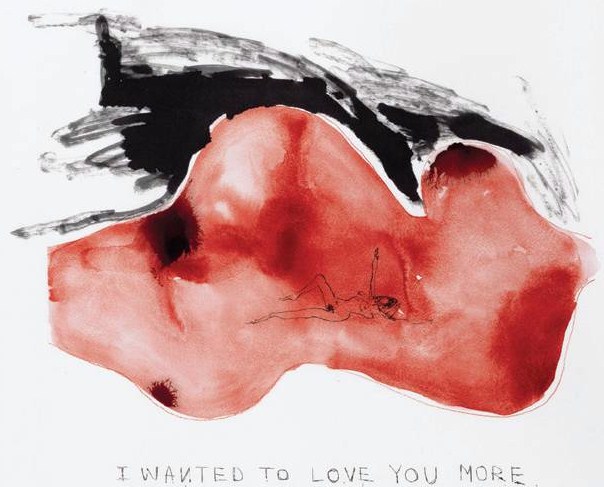
Quite at odds with all this cool rationality is the combined collection by Louise Bourgeois and Tracey Emin, Do Not Abandon Me. Bourgeois (1911-2010) is probably best-known for her 30 foot spider sculpture, Maman, exhibited in Tate Modern’s Turbine Hall in 1999. She is also regarded as the founder of the biographical and symbolic ‘confessional art’ and has been called Tracey Emin’s spiritual grandmother. Working to the very end of her long life, she gave Emin a final set of gouaches of male and female torsos. 16 of these have been adorned by Emin with small scratchy drawings and handwriting, unsurprisingly with “themes of an adult nature” to quote the RWA. Emin became an Royal Academician (RA) at the UK’s premier Royal Academy of Art (also RA) in 1997. Emin recently donated a neon artwork sign, More Passion, to the Government Art Collection which has now been installed in No 10 Downing Street. A year ago she declared her support for the current government, particularly the Conservatives. David Cameron's wife, Samantha, studied art in Bristol at what is now the University of the West of England, UWE.
ADDENDUM 17 OCTOBER
After posting the above on 8 October I tweeted:
There was one reply from @KaiDeyDey, the “personal account” of Karen Drake who describes herself as Finance Manager at Spike Island. This, its website explains, is a “centre for the production and exhibition of art and design based in an 80,000 square foot former Brooke Bond tea packing factory” in Bristol:
I admit that when I describe art I concentrate on matters factual, and possibly useful to any readers, and keep my reactions to the minimum, though I think they are discernible. Not least, this is because I have only a tenuous understanding of the critical language which the visual arts world seems to have adopted. If that makes me unwelcome at Spike Island, so be it, although I would have thought it might be prudent for an organisation which appears to be highly dependent on public funding to accept that taxpayers come in all shapes and sizes.
A previous post described Bridget Riley's exhibition earlier in the year at the National Gallery. In Bristol a selection of her screenprints going back to the 1960s is on display together with works by Michael Kidner (1917-2009) over the same period. Kidner also began with Optical Art but moved towards a constructive abstractionism reflecting his interest in science and mathematics. He would probably have been fascinated by Luke Jerram’s Aeolus, an ‘acoustic and optical pavilion’, its ‘Making’ being the subject of a small exhibition at RWA. The real thing, quite a substantial structure, is currently elsewhere in SW England - at the Eden Project in Cornwall - but Jerram, who is Bristol-based, is apparently looking to find it a permanent home.
Quite at odds with all this cool rationality is the combined collection by Louise Bourgeois and Tracey Emin, Do Not Abandon Me. Bourgeois (1911-2010) is probably best-known for her 30 foot spider sculpture, Maman, exhibited in Tate Modern’s Turbine Hall in 1999. She is also regarded as the founder of the biographical and symbolic ‘confessional art’ and has been called Tracey Emin’s spiritual grandmother. Working to the very end of her long life, she gave Emin a final set of gouaches of male and female torsos. 16 of these have been adorned by Emin with small scratchy drawings and handwriting, unsurprisingly with “themes of an adult nature” to quote the RWA. Emin became an Royal Academician (RA) at the UK’s premier Royal Academy of Art (also RA) in 1997. Emin recently donated a neon artwork sign, More Passion, to the Government Art Collection which has now been installed in No 10 Downing Street. A year ago she declared her support for the current government, particularly the Conservatives. David Cameron's wife, Samantha, studied art in Bristol at what is now the University of the West of England, UWE.ADDENDUM 17 OCTOBER
After posting the above on 8 October I tweeted:
New post: Time almost up to see Tracey Emin and Bridget Riley @rwabristolwhich @rwabristol RT'd.
There was one reply from @KaiDeyDey, the “personal account” of Karen Drake who describes herself as Finance Manager at Spike Island. This, its website explains, is a “centre for the production and exhibition of art and design based in an 80,000 square foot former Brooke Bond tea packing factory” in Bristol:
“@WestIndep: http://bit.ly/oMgzHG” it reads like it was written by someone who read the brochure but didn't go through the door.Fair enough, but I did go through the door, or in the case of the Emin and Bourgeois show, through the thick black curtains (presumably intended to shield such graphic works from delicate Bristolian eyes.)
I admit that when I describe art I concentrate on matters factual, and possibly useful to any readers, and keep my reactions to the minimum, though I think they are discernible. Not least, this is because I have only a tenuous understanding of the critical language which the visual arts world seems to have adopted. If that makes me unwelcome at Spike Island, so be it, although I would have thought it might be prudent for an organisation which appears to be highly dependent on public funding to accept that taxpayers come in all shapes and sizes.
Subscribe to:
Posts (Atom)