Crucible2 is the second sculpture exhibition at Gloucester Cathedral curated by Gallery Pangolin of Chalford, Gloucestershire. The first was in 2010 with 76 contemporary sculptures; this time 100 exhibits by 61 sculptors are set in and around the cathedral. Key pieces, in the view of the curators, include works by Kenneth Armitage, David Backhouse, Ralph Brown, Lynn Chadwick (Jubilee IV in the poster,left), Ann Christopher, Antony Gormley and William Tucker. The 20th and 21st century works are often positioned in startling and stimulating contrast to their mostly English Gothic surroundings. For example, Breon O’Casey’s Large Cockerel (circa 2000, below) in the Cloisters with the earliest fan-vaulting in England circa 1350:
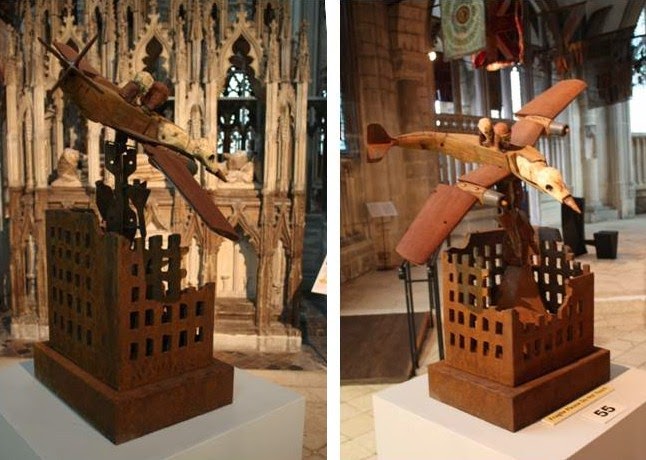
The most celebrated monument at Gloucester is the tomb of Edward II circa 1350, seen below left in the background to Steve Hurst’s Gloucester in Berlin. Hurst, born in 1932 and a witness to bombing in World War 2, sees it as concerning “… the bombing of civilians no matter what their country or who launches the bombing aircraft. It is a personal attempt to regain the viewpoint of a child”.
In the background (right) are the laid up colours of the Gloucestershire Regiment. They appear again (below right) behind Paul Wager’s Omnibus which marks the centenary of the Great War 1914-1918. Similar sentiments inform Deborah van der Beek’s Collateral (below right) – eight million horses died in that war - but it was cast around spent munitions from the conflicts in Iraq and Afghanistan which brought the expression “collateral damage” into common use.
The monument near Damien Hirst’s Anatomy of an Angel (Black) (2008, below) is to Sarah Morley, 29, a mother of four who died a few days after “having sustained the pains of Childbirth at Sea” while returning from Bombay in 1784.
Among the pieces I liked were Antony Gormley’s Pose (2012, below) with In Man’s Nature by Jon Buck behind).
Bryony Marshall’s DNA – Helix of Life (below, left) marks the 60th anniversary of the discovery of DNA. Subsequently mitochondrial DNA was identified as having been passed down to us all from a woman in East Africa about 150,000 years ago, known as Mitochondrial Eve, the inspiration for a sculpture of the same name by Sue Freeborough (below right):
The photograph below left of Geoffrey Clarke’s Taunton Deane Crematorium: Test Panel does not do justice to the colours of the glass. To the right is Sarah Lucas’s Realidad (2013), one of her NUDs series shown as bronzes at the Venice Bienniale in 2013.
John Humphreys’ Ipsius Imago a Latere Extensa probably succeeded as the artist wished in puzzling and confusing the viewer:
but perhaps was not as happily placed as the Eduardo Paolozzi plaster Vulcan near a strange moustachioed carving, perhaps a millennium older:
Among the sculptures in the open were Bruce Beasley’s Breakout II (below, left)in the Cloisters and outside Kenneth Armitage’s final work, Reach for the Stars (below, right).
Crucible2 ends on 31 October. There is no admission charge but a helpful map costs £2 and there is a £3 charge for photography. The catalogue at £16 is both good value and helps support the Cathedral.
UPDATE 2 NOVEMBER 2015
After posting about Beyond Limits: The Landscape of British Sculpture 1950-2015 held at Chatsworth House from 14 September to 25 October 2015, I thought it would be useful to add an image of Gavin Turk's bronze, Nomad (2002, below - and in other colours):
Another version of Chadwick's Jubilee can be seen there, as well.
Showing posts with label YBA. Show all posts
20 October 2014
28 May 2014
Bordeaux’s Institut Culturel Bernard Magrez
Visitors to Bordeaux with an interest in contemporary art should try to find time to visit the Institut Culturel Bernard Magrez. The Institut opened in 2011 in the Château Labottière, not far from the city centre. Until 20 July it is offering a show between shows, Entre deux expositions, exhibiting some of the Institut’s recent acquisitions for its collection.
Before entry the visitor encounters an arresting neon on the Pavilion, Bernard Magrez’s own ‘Autograph’:
A successful entrepreneur, who now owns four major wine-producing chateaux, Magrez is stating the Institut’s mission based on his own four cardinal virtues:
Vivre debout The strength of Living Upright
Respecter l’autre The justice of Respecting the other
Jamais renoncer The courage to Never give up
Gagner en tempérance The wisdom to Gain temperance
These provide a counterpoint to the other neon attached to the building, Le réveil de la jeunesse empoisonnée (The awakening of poisoned youth, 2011?) by Claude Lévêque:
Inside the Pavilion, three videos are being screened, one of them, by Benoit Maire and commissioned by Magrez in 2010, is on the theme of Jamais renoncer. Another, Tracking Happiness (2010), by Mircea Cantor is a hypnotic film of women sweeping sand (left). British visitors may be reminded of Carroll’s “seven maids with seven mops” but can be reassured that its duration at 11 minutes is less than “half a year”, (if slightly in breach of Red Alan’s rule 5).
There are also three large and detailed paintings on paper by a Franco-Serbian artist, Nebojsa Bezanic, exploring the history of three of Magret’s Grand Cru Classé Chateaux (La Tour Carnet 2010, below left) and, as you leave the Pavilion, another neon by Claude Lévêque, advises Riez! (2012, Laugh!, or perhaps more appropriately, Have Fun!):
After the Pavilion the visitor moves on to the main exhibition in a new space adjacent to the Chateau. I won’t attempt to report on all the recent additions to the Collection, but I was struck by the Belgian Wim Delvoye’s Untitled (Car Tyre) 2007 (a hand-carved car tyre, below left) and Serge Poliakoff’s Composition en cinq couleurs (Composition in five colours, 1956-57, below right), one of the earliest-dated works in the collection.
Photographing the exhibits was difficult because of reflections, but prints by Andy Warhol (Depardieu, 1986) and Peter Doig (Canoe Island, 2000) are recognisable, below left and right:
More of the collection is to be found in the main building of Château Labottière which provides a handsome background for sculpture like Jean-Michel Othonier’s Le nœud de Babel, (Node of Babel, 2013):
and for photography - Jean-Marie Périer’s 1966 portrait of Françoise Hardy in a Paco Rabane dress couldn’t be further from Steve McCurry’s Afghan Girl of 1985:
Just as much of a contrast are Damien Hirst’s Painted Skulls 2 (eyes open) (2013, below left) and Pierre et Gilles’ Le Désesperé (The desperate one, 2013, below right), more sedate than Vive La France, their previous appearance on this blog. Another YBA photograph recently acquired for the collection is Sam Taylor-Wood’s large Self Portrait suspended 1 on display near the ticket office.
Finally, although the collection seems to be mainly focussed on two-dimensional representation, as already mentioned it does include sculptures including this piece in the Chateau garden. By Shen Yuan, Crâne de la Terre (Skull of the Earth, 2011) was made in stone and cement and its contrast of skyscrapers and rough stone can be seen as her comment on contemporary China.
Vistors to the Institut’s collection will find that it is well-documented in French and English. It is open Thursday to Sunday, 14:00 to 19:00 but, as always, it is advisable to confirm this on the website. British visitors might like to think which of their countries’ artists they would to see added to the collection – my suggestions (for what they are worth) are Peter Howson and Julian Opie.
Entre deux expositions ends on 20 July.
Before entry the visitor encounters an arresting neon on the Pavilion, Bernard Magrez’s own ‘Autograph’:
A successful entrepreneur, who now owns four major wine-producing chateaux, Magrez is stating the Institut’s mission based on his own four cardinal virtues:
Vivre debout The strength of Living Upright
Respecter l’autre The justice of Respecting the other
Jamais renoncer The courage to Never give up
Gagner en tempérance The wisdom to Gain temperance
These provide a counterpoint to the other neon attached to the building, Le réveil de la jeunesse empoisonnée (The awakening of poisoned youth, 2011?) by Claude Lévêque:
Inside the Pavilion, three videos are being screened, one of them, by Benoit Maire and commissioned by Magrez in 2010, is on the theme of Jamais renoncer. Another, Tracking Happiness (2010), by Mircea Cantor is a hypnotic film of women sweeping sand (left). British visitors may be reminded of Carroll’s “seven maids with seven mops” but can be reassured that its duration at 11 minutes is less than “half a year”, (if slightly in breach of Red Alan’s rule 5).
There are also three large and detailed paintings on paper by a Franco-Serbian artist, Nebojsa Bezanic, exploring the history of three of Magret’s Grand Cru Classé Chateaux (La Tour Carnet 2010, below left) and, as you leave the Pavilion, another neon by Claude Lévêque, advises Riez! (2012, Laugh!, or perhaps more appropriately, Have Fun!):
After the Pavilion the visitor moves on to the main exhibition in a new space adjacent to the Chateau. I won’t attempt to report on all the recent additions to the Collection, but I was struck by the Belgian Wim Delvoye’s Untitled (Car Tyre) 2007 (a hand-carved car tyre, below left) and Serge Poliakoff’s Composition en cinq couleurs (Composition in five colours, 1956-57, below right), one of the earliest-dated works in the collection.
Photographing the exhibits was difficult because of reflections, but prints by Andy Warhol (Depardieu, 1986) and Peter Doig (Canoe Island, 2000) are recognisable, below left and right:
More of the collection is to be found in the main building of Château Labottière which provides a handsome background for sculpture like Jean-Michel Othonier’s Le nœud de Babel, (Node of Babel, 2013):
and for photography - Jean-Marie Périer’s 1966 portrait of Françoise Hardy in a Paco Rabane dress couldn’t be further from Steve McCurry’s Afghan Girl of 1985:
Just as much of a contrast are Damien Hirst’s Painted Skulls 2 (eyes open) (2013, below left) and Pierre et Gilles’ Le Désesperé (The desperate one, 2013, below right), more sedate than Vive La France, their previous appearance on this blog. Another YBA photograph recently acquired for the collection is Sam Taylor-Wood’s large Self Portrait suspended 1 on display near the ticket office.
Vistors to the Institut’s collection will find that it is well-documented in French and English. It is open Thursday to Sunday, 14:00 to 19:00 but, as always, it is advisable to confirm this on the website. British visitors might like to think which of their countries’ artists they would to see added to the collection – my suggestions (for what they are worth) are Peter Howson and Julian Opie.
Entre deux expositions ends on 20 July.
5 May 2014
Joanna Hogg’s ‘Exhibition’
Three years ago I posted here about Joanna Hogg's second film, Archipelago, and later added something about her first, Unrelated. Now her third film, Exhibition, has been released in the UK. It is a portrait of a marriage with three people in it, or to be more precise, a childless couple and their house. The pair are identified in Kafakaesque style only as D and H, and are played by Viv Albertine and Liam Gillick respectively. Albertine was born in 1954, lives in Hackney and is probably best known for being a guitarist in the female punk band the Slits. Gillick was born in 1964, lives in New York, was a YBA and is now a conceptual artist. The house was built in 1969 in Kensington (inner West London) as a late Modernist residence for its architect, James Melvin (1912-2011), to whom the film is dedicated. From recent interviews (eg with cinema scope and the Guardian) it seems that Albertine, Killick, Melvin and the house are, or were, well-known to Hogg.
D and H, after twenty years residence, have decided to sell their house with the help of estate agents (US: realtors), so providing a cameo role for Tom Hiddlestone. He appeared at length in Unrelated and Archipelago but has been busier since. The couple are both artists with workspaces on separate floors of the house, not that they seem to work very intensively. They often communicate, but not about much, using the internal phone. This is understandable since moving between floors involves either traversing a spiral staircase or business with a tricky lift (US: elevator). We see a lot of D nervously moping around the house - she doesn't get out much. Whether the source of her unhappiness is professional, marital, sexual or selling the house, or all four, is opaque, as is their reason for selling or where they are going. Perhaps there has been an intruder, D is nervously security conscious. Apart from the estate agents, the other characters are minor and tiresome. There are numerous sequences centred on D which may be dreams, fantasies or, in at least one case, flashbacks. Hogg continues to avoidusing those cinematographic conventions such as tracking, zooming and panning which usually help carry the viewer along with the screenplay, so D and H's farewell party with a fire eater and a metaphorical demolition of the house comes as a relief. It seems to cheer them up no end, too. Finally, as they pack some books, D tells H that she has been offered a solo show, or, as he then refers to it, 'exhibition'.
I should point out that most of the film critics in the serious media seem to have a high opinion of Exhibition. For example, Kate Muir in The Times awarded it five stars (out of five) and enthused:
D and H, after twenty years residence, have decided to sell their house with the help of estate agents (US: realtors), so providing a cameo role for Tom Hiddlestone. He appeared at length in Unrelated and Archipelago but has been busier since. The couple are both artists with workspaces on separate floors of the house, not that they seem to work very intensively. They often communicate, but not about much, using the internal phone. This is understandable since moving between floors involves either traversing a spiral staircase or business with a tricky lift (US: elevator). We see a lot of D nervously moping around the house - she doesn't get out much. Whether the source of her unhappiness is professional, marital, sexual or selling the house, or all four, is opaque, as is their reason for selling or where they are going. Perhaps there has been an intruder, D is nervously security conscious. Apart from the estate agents, the other characters are minor and tiresome. There are numerous sequences centred on D which may be dreams, fantasies or, in at least one case, flashbacks. Hogg continues to avoidusing those cinematographic conventions such as tracking, zooming and panning which usually help carry the viewer along with the screenplay, so D and H's farewell party with a fire eater and a metaphorical demolition of the house comes as a relief. It seems to cheer them up no end, too. Finally, as they pack some books, D tells H that she has been offered a solo show, or, as he then refers to it, 'exhibition'.
I should point out that most of the film critics in the serious media seem to have a high opinion of Exhibition. For example, Kate Muir in The Times awarded it five stars (out of five) and enthused:
Hogg wrote and directed Exhibition and the ideas developed in her films Unrelated and Archipelago have been given full expression here in a drama of sharp intelligence and insight. Some may find it slow and pretentious, dealing as it does with the privileged classes’ First World problems. But if Hogg is an acquired taste, I have now acquired it.Peter Bradshaw in the Guardian also gave 5/5 and warned off those of us who like their envelopes the way they are:
Joanna Hogg is an artist and film-maker who entrances and enrages. After the first wave of praise from fans (such as me), her movies tend to get a backlash of incredulity and scorn from those who would prefer the envelope unpushed and unmolested. In the runup to its release, this latest film has already provoked some giggles and putdowns online. Some of the tweets I've been getting have felt like seat-bangs from some derisive digital walkout. It only makes me love her more.Mark Kermode in the Observer was less generous at 3/5 and commented:
As with Hogg's previous films, Unrelated and Archipelago, there's an underlying desire to scream at the suffocatingly insular bourgeois ennui; certainly, Exhibition requires both patience and tolerance to get beneath its chilly surface. But under the uninviting skin there's an honest depiction of the ebb and flow of a long-term relationship between two people whose passions affix to objects other than each other; who remain co-dependent, if distant; and whose often queasily frank interactions (played out in unforgiving single takes) seem utterly genuine and not a little uncomfortable. Add to this an element of surreal invention (past and present intertwining, personalities fracturing) and Exhibition reaffirms Hogg's status as a distinctive, singular and challenging voice of British cinema.In the face of such enthusiasm from those whose views count, I will only offer the opinion that I thought Exhibition to be less satisfactory than Archipelago, and, not for the first time here, resort to facts as a substitute for offering an opinion ("not raving but droning"). But DIY'ers of both sexes might like to know that Ikea's BEKVÄM step stool is available as a flat pack for £11 in the UK (only 9.99 euros in France). As Ikea explain: "Hand-hole in the top step makes the step stool easy to move" and "... you can treat it with BEKVÄM glazing paint to make the surface less slippery and more hard wearing and personal". Indeed.
15 June 2013
Christopher Menaul’s ‘Summer in February’
Christopher Menaul has been directing drama series and films for TV for over 40 years but Summer in February seems to be his first film for commercial release. I mentioned it last November in a post about the Laura Knight exhibition in Worcester. The film, “based on a true story”, is set in Cornwall (SW England) in 1913 and was scripted by Jonathan Smith from his novel of the same title about a love triangle among the bohemian community of artists working at that time in Lamorna. In the film Laura (Hattie Morahan) and her husband Harold (Shaun Dingwall) are onlookers as the young emerging artistic talent of the day, AJ Munnings (Dominic Cooper), and the much more conventional local land agent and army officer, Gilbert Evans (Dan Stevens), vie for the affections of Florence Carter-Wood (Emily Browning).
Summer in February is handsomely filmed against some of the finest coastal scenery in Europe and the period settings are as picturesque as some of the works in the Artists in Cornwall show earlier this year, or those to be found at the Penlee House Gallery in Penzance. However, I wasn’t totally persuaded by its characters’ behaviour, although well-acted.Would Laura and Harold have skinny-dipped in quite so unembarrassed a fashion in front of Gilbert and Florence? [See comments below] Would AJ have used f-words in front of women in 1913, Menaul and Cooper seemingly having decided to portray him as a YBA du temps? Did Munnings, notorious for his speech against modernism in 1949, have such a down on Picasso as early as 1913 – the latter’s style in AJ’s parody seems to belong to a later period? A useful, if not impartial, source of information about Munnings is provided by the Castle House Trust’s website. Although there is no mention of his first wife, their biography does point out that “he spent the first three years of the 1914-18 war mainly in Lamorna” and that “It was from Lamorna that he made his excursions to Hampshire where he had discovered, in the gypsy hop pickers, a wealth of painting material.”
Dr James Fox, in his recently repeated BBC4 series, British Masters, put Munnings into context and drew attention to his considerable skill as an artist. Actors aren’t expected to possess such skills of course, but have to look convincing when they take the part of artists (or, worse, musicians), as does the art they are working on (The Morning Ride, sold at Christie’s in 2000, right). The Spectator sent their art critic, Andrew Lambirth, to review Summer in February and he thought the problem had been handled well.
By an odd coincidence, there have been two period films released in the last two weeks, one set in SW France and the other in SW England, both dealing with the consequences for women of choosing the wrong husband!
Summer in February is handsomely filmed against some of the finest coastal scenery in Europe and the period settings are as picturesque as some of the works in the Artists in Cornwall show earlier this year, or those to be found at the Penlee House Gallery in Penzance. However, I wasn’t totally persuaded by its characters’ behaviour, although well-acted.
Dr James Fox, in his recently repeated BBC4 series, British Masters, put Munnings into context and drew attention to his considerable skill as an artist. Actors aren’t expected to possess such skills of course, but have to look convincing when they take the part of artists (or, worse, musicians), as does the art they are working on (The Morning Ride, sold at Christie’s in 2000, right). The Spectator sent their art critic, Andrew Lambirth, to review Summer in February and he thought the problem had been handled well.
By an odd coincidence, there have been two period films released in the last two weeks, one set in SW France and the other in SW England, both dealing with the consequences for women of choosing the wrong husband!
13 June 2013
Patrick Caulfield at Tate Britain
Tate Britain in its lower level galleries is showing retrospectives of Patrick Caulfield (1936–2005) and Gary Hume (1962- ) in parallel. Hume, Tate tells us, was one of the YBAs (Young British Artists) featured in the 1988 Freeze exhibition and is now “one of Britain’s most highly respected painters”. There are about 24 of his works on show, mostly gloss paint on aluminium sheet, including Tony Blackburn, first seen in 1993 at the Lucky Kunst show. Hume invented that show’s name according to Gregor Muir in his book - same title - on the rise and fall of YBA. However, it was Caulfield’s work that I wanted to see.
Caulfield was a contemporary of David Hockney and Peter Blake at the Royal College of Art in the early 1960s but despite this association (and being introduced to screenprinting by Richard Hamilton) rejected classification as a pop artist. As Clarrie Wallis (Curator of Modern and Contemporary Art at Tate) explains in her book about Caulfield for the British Artists series, he engaged with modern life but as part of the European artistic tradition, his work being influenced by Matisse, Gris, Dufy, Braque (Tate's own Braque Curtain 2005 above) and others, including Picasso (below). Looking at Caulfield’s interiors, it isn’t surprising to learn that the American artist he admired was Hopper, not Lichtenstein, despite their common use of black delineation of blocks of colour.
The Tate Britain exhibition is complemented by others at Waddington Custot and the Alan Cristea Gallery (both until 13 July). At the latter there is a chance to see Caulfield’s 1999 screenprint, Les Demoiselles d’Avignon vues de Derrière (above), which Wallis refers to but does not reproduce. I wish I had bought her book, which is an impressive explanation of the complexities of Caulfield’s work and his artistic development in terms accessible to the lay reader, before seeing the Tate show - therefore, ideally, another visit before it closes on 1 September.
28 September 2012
The Pre-Raphaelites at Tate Britain
BBC2 has now finished screening an adaptation, by no less than Tom Stoppard, of Ford Madox Ford’s novel quartet Parade’s End, lavishly filmed at numerous locations no doubt made affordable by HBO backing. Despite the strength of its themes of war, love and social standing and much excellent acting, Parade’s End fails to be as engaging as it should be. Something similar applies to Tate Britain’s Pre-Raphaelites: Victorian Avant-Garde, which, as it happens, features numerous works by Ford’s grandfather, Ford Madox Brown (The Last of England 1860, left).
Perhaps the exhibition, like Parade’s End, suffers from putting forward too many characters and events while not always explaining their relationships and development. At this point I must own up to having been to The Pre-Raphaelites at the Tate Gallery (as it then was) in 1984, and that, if the PRB only appear en masse in London at 28 year intervals like a mutant species of cicada, I’m not expecting to see them again. In 1984 an educational approach was still considered appropriate, so, as well as the main catalogue, informative guides were available (right). This is the text of the first section, “The Group”:
The Pre-Raphaelite Brotherhood was a secret society of seven artists, or aspirant artists, founded in London in September 1848. Its members were, in alphabetical order, James Collinson (1825- 1881), William Holman Hunt (1827-1910), John Everett Millais (1829- 1896), Dante Gabriel Rossetti (1828- 1882), William Michael Rossetti ( 1829-1919), Frederic George Stephens (1828-1907) and Thomas Woolner (1825- 1892). Of these, the original creators of the group and by a long way its dominating personalities, were Hunt, Millais and D.G. Rossetti. All three were brilliantly gifted and very young - twenty-one, nineteen and twenty respectively at the time of the Brotherhood's foundation. Five of the seven were painters, Thomas Woolner was a sculptor, and William Michael Rossetti (Dante Gabriel's brother) quickly dropped the practice of art to become a writer and critic who acted as the group secretary and for a time (1849-1853) kept a journal of its activities. He was also the editor of the group's short lived magazine The Germ, of which four issues appeared between January and March 1850. The Germ was sub-titled Thoughts towards Nature in Poetry, Literature and Art and reminds us that in general the Pre-Raphaelite Brotherhood had a strong literary flavour right from the beginning. Dante Gabriel Rossetti in particular was as distinguished a poet as painter.
William Holman Hunt was the son of a London warehouse manager who enjoyed art but had a low opinion of it as a means of earning a living. Hunt records that his father treated with 'measured toleration my passion for art', a passion developed after a visit to an artist with his father at the age of five. At twelve Hunt became a clerk to an estate agent but continued to practise drawing and eventually entered the Royal Academy Schools in 1844 where he supported himself by making portraits and copies.
In 1844 John Everett Millais had already been four years at the R.A. Schools. At entry in 1840 he was its youngest ever pupil and became a star, winning a silver medal for drawing in 1843 and a gold for painting in 1847. Millais was born in Southampton, his mother's native town. His father came from an old Jersey family and was well off. Millais was brought up in Jersey, and Dinan in Brittany, but when by the age of eight his exceptional gifts as an artist had become clearly evident his parents moved to London in order to further his career. In London he continued to enjoy full parental backing. He and Hunt met at the Royal Academy Schools, becoming close friends sometime about the Spring of 1846.
Dante Gabriel Rossetti was born in London into an academic and intensely artistic family. His father was an Italian political refugee, a poet and Dante scholar who from 1831 taught Italian at King's College, London. His mother was a teacher. One of his two sisters, Christina, became a well known poet. Rossetti entered the Royal Academy Schools in 1844, at the same time as Hunt, but the two only met and became friends in the early Summer of 1848 after Rossetti had admired Hunt's painting of a subject from Keats (No.9) in the Royal Academy Exhibition of that year. Hunt then introduced Rossetti to Millais. The three began to meet regularly at Millais's house where they carried on intensive discussions about art. It was out of these discussions that was born the idea of a revolutionary group of artists: '...our talk is deepest treason against our betters' said Hunt one day.which was followed by another eight equally didactic sections and some “Further Reading”, all with 30 illustrations in black-and-white. Quite a contrast with the first sections of the smaller but colourful leaflet visitors are given currently:
This exhibition presents the Pre-Raphaelites as an avant-garde movement, a group with a self-conscious, radical project of overturning artistic orthodoxies. Boldly original in style and conception, the Pre-Raphaelites made a profound contribution to the history of modern art.
The movement coincided almost exactly with the long reign of Queen Victoria (ruled 1837-1901). The Pre-Raphaelite Brotherhood (PRB) was founded in 1848, a year of revolution across Europe, in a recognisably modern world. Steamships plied the globe. Railway networks linked expanding cities. Science challenged traditional beliefs. Photography offered new ways of seeing. Pre-Raphaelite art distilled the energy of the world's first industrial society into striking new forms.
The leading members of the PRB were the young painters John Everett Millais, Dante Gabriel Rossetti and William Holman Hunt. Their older friend and mentor Ford Madox Brown never formally joined the group. They believed that art had become decadent, and rejected their teachers' belief that the Italian artist Raphael (1483-1520) represented the pinnacle of aesthetic achievement. They looked to earlier art whose bright colours, flat surfaces and truth to nature they admired.
But rather than imitate the early masters, they espoused a rule-breaking originality. Whether painting subjects from Shakespeare, the Bible, landscapes of the Alps or the view from a window, the Pre-Raphaelites brought a new beauty and intensity of vision to British art.
The Pre-Raphaelite Brotherhood was founded in September 1848 at a turbulent time when ruptures in the new industrial society became visible. Hunt and Millais witnessed a Chartist demonstration in that year.
Many Victorians felt that in the machine age, beauty and spirituality had been lost. Gothic Revival architects like Augustus Pugin turned back to medieval styles. The German Nazarene painters rejected modernity and adopted historical styles of painting and of dress. John Ruskin described in The Stones of Venice the 'freedom' of medieval times in contrast to the 'slavery' of the modern factory. The invention of photography in 1839 profoundly changed the way people perceived the world. All these influenced the young Pre-Raphaelites.
At first, they formed a tight-knit, conspiratorial group, refusing to explain the initials PRB on their canvases. Their early works caused critical protest. The sharp outlines and bright colours derived from the early ltalian paintings at the National Gallery. The PRB published a journal, The Germ, which acted as a manifesto, planting the seeds of artistic revolution.
The Pre-Raphaelites managed to be both historical and contemporary in their approach. They adopted the freshness of early-Renaissance art, but their work is essentially modern.- more accessible, but less assured in its handling of facts – we get Raphael’s dates but not those of the Brotherhood. The Guardian’s Fiona MacCarthy in her article, Why the pre-Raphaelites were the YBAs of their day, clearly prefers the new way:
The Tate's last exhibition of pre-Raphaelite art, held in a now distant 1984, was a rather dully chronological affair. According to one critic, the treatment "seemed to symbolise a newly conservative reading of the pre-Raphaelites". Greenery-yallery to Laura Ashley. A press photograph shows Margaret Thatcher at the opening alongside Arthur Hughes's April Love. With 250 exhibits this was a catch-all survey. I remember emerging from it reeling with exhaustion. It succeeded in what one might have thought would be impossible. It managed to make the pre-Raphaelites bland.
The current exhibition will be altogether different: leaner, more thematic, more politically charged. Women will be better represented. (Not difficult, considering that only two paintings by one woman, Elizabeth Siddal, were included in 1984.) Alongside pre-Raphaelite paintings and drawings will be sculpture, photography and prize examples of pre-Raphaelite furniture and textiles, emphasising the wide reach of a movement that was fiercely revolutionary in its aims.The organisation of the two exhibitions provides a similar contrast. In 1984 the sections were resolutely chronological, eg: Early Work, 1845-48, The Critics Attack, 1850; Success and Dissolution, 1852-1854; After 1860, Rossetti and Burne-Jones. But the 1984 exhibition was intended to be a milestone in the revival of interest in the Pre-Raphaelite movement at a time when, unlikely as it may seem now, there was far less public awareness of the painters or the sequence of their works. One could argue that in 2012 the Tate has correctly assumed a level of familiarity sufficient to allow the works to be distributed into themes according to their subject, eg: Nature, Salvation, Beauty. But after these chronology becomes implicit with Paradise given over to William Morris and Arts and Crafts and Mythologies to works by Burne-Jones and late Rossetti (Astarte Syriaca 1877, banner above).
What the visitor does get is a chance to see somewhere in the exhibition most of the significant works we think of as Pre-Raphaelite without having to go to Manchester (Ford Madox Brown, Work, below).
Or Birmingham, or Tyneside or even Delaware (Rossetti Lady Lilith, below).
In practice the allocation of works to Nature as opposed to Paradise can seem arbitrary when they have such a high metaphorical content and are full of details of imaginary historical settings, many out of doors. Perhaps this makes remembering exactly what you have seen more difficult than usual. My favourite art critic, Jackie Wullschlager, remarked in her FT (£) review:
Rossetti, infatuated with William Morris’s wife Jane, attempted suicide, then developed a proto-symbolist oeuvre whose high point is a depiction of Jane as “Proserpine” (1874), goddess of the underworld. The 1984 catalogue acknowledged this as Rossetti’s outstanding work; disgracefully, although it belongs to Tate, and is Rossetti’s most beloved painting, this show omits it. Is it too personal, distinctive, exceptional? Its absence will not only disappoint – it also renders less meaningful the show’s trophy loan, Hunt’s dense final painting “The Lady of Shalott” (1888-1905), borrowed from the Wadsworth Atheneum in Connecticut.A fair point, but if you look up Proserpine on the Tate website, you are advised “On display at Tate Britain Exhibition: Pre-Raphaelites”. I’m not sure I can now definitely remember its being there, but one imagines that the Tate knows the whereabouts of their pictures.
![]() |
| Rossetti's Prosperine and Hunt's Lady of Shallott |
If we can compare 1850s PRBs and 1990s YBAs (and in terms of shock value we definitely can) then [Hunt’s] The Scapegoat finds its obvious parallel in Damien Hirst's shark.To those of us who are just looking, as John Updike put it, the big difference between the YBA and PRB might be that those boys could ‘paint’, in the traditional sense, exceptionally well. Whether the girls could is something that the visitors in 2012/13 can decide for themselves.
Anyone who wants to see the finest Pre-Raphaelites in British collections during the next 12 months on home territory will need to get to Tate Britain by 13 January. Without any of the various concessions it will cost £14. After that Pre-Raphaelites: Victorian Avant-Garde will be at the National Gallery, Washington, from February to May and the Pushkin, Moscow from June to September.
28 August 2012
Tate Modern: The Tanks, Hirst and Munch
A belated post-Olympics visit to a relatively uncrowded Tate Modern with three things to see, in ascending order:
The Tanks
When Tate Modern was created by the transformation of the old Bankside Power Station, the underground oil storage tanks remained in place but no longer had a use. In Tate’s own words: “they have now being transformed into some of the most exciting new spaces for art in the world, The Tanks, the world’s first museum galleries permanently dedicated to exhibiting live art, performance, installation and film works”. Fifteen Weeks of Art in Action in The Tanks started on 18 July and is far better seen and experienced than described, but a listing of the events up to 18 October is available here.
The development of The Tanks has been the first phase of the Tate Modern Project which it is hoped to complete by 2016 at a capital cost of £215 million, three quarters of which has been raised.
Damien Hirst

The first floor gallery of Tate Modern is given over to a major survey, Damien Hirst, an artist whose work is so well-known as to need little description. There are, as to be expected, spot paintings, cabinets full of medicines and other medicalia, a maggot-fly life-cycle piece sustained by a rotting cow’s head which promises to leave an indelible souvenir on Tate’s floor, longitudinally-bisected animals, butterflies both alive and mounted, and, more revolting than anything else for a non-smoker, arrangements of cigarette ends. The pretentiousness of the titles of his works never ceases to impress: The Physical Impossibility of Death in the Mind of Someone Living (the pickled shark) – oh yes, what about a pathologist? – and The Acquired Inability to Escape (cigarette ends), though Crematorium (more cigarette ends) is relatively obvious.
Two items in the hand-out given to visitors struck me:
Also:
Munch
And then on to the second floor and Edvard Munch: The Modern Eye, which I enjoyed more than I expected. Munch (1863-1944) is very widely known for The Scream which he called Der Schrei der Natur (The Scream [or shriek] of Nature). Not always appreciated about this famous image is that Munch frequently produced several versions of the same work. In The Scream’s case, three are in Norwegian museums and it was the 1895 pastel which sold for a public auction record (for any work) of just under $120 million at Sotheby’s in New York in May. The Tate show doesn’t include any versions of The Scream (even the lithographs) but gives one room over to 'Reworkings' to make the point with several versions of The Sick Child and The Girls on the Bridge (above) and again later with Weeping Woman.
Munch, like Degas, took up still photography and he also later made amateur handheld films. In the case of Weeping Woman (left) 1907-09, as well as six paintings, drawings, a lithograph and a sculpture, he made a photograph in 1907 (Rosa Meissner at the hotel room in Warnemunde). Although Munch grew up in Oslo (Cristiana at the time), after his twenties he spent much of his time in Paris and Berlin, only returning to Norway permanently in 1908 after a nervous breakdown. In 1906 in Berlin he had collaborated with Max Reinhardt on artistic aspects of a production of Ibsen’s Ghosts, followed in 1907 by set designs for Hedda Gabler. This is considered to have developed Munch’s interest in the use of small rooms as claustrophobic settings for works like Weeping Woman. To me his earlier Two Human Beings: The Lonely Ones 1905 (below) evokes Ibsen’s The Lady from the Sea (1888), which Munch would almost certainly have seen.
Munch produced some unsparing self-portraits later in life – he was lucky enough to survive the 1919 influenza epidemic. Branded a decadent artist by the Nazis, his final years were spent in artistic isolation during the occupation of Norway.
The arrangement of the paintings and photographs in the exhibition aims to support the idea that Munch is better regarded as a major painter of the early 20th century than as a late 19th century avante gardiste. If his significance as a painter is justified by the prices now paid for his work and his creation of one of the most widely recognised art works of all time, then he has to be regarded as a major painter in whichever period of modern art he is allocated to. Munch left most of his estate to the City of Oslo and it is now held by the Munch-museet which has lent many of the works in the exhibition.
Edvard Munch: The Modern Eye was organised by the Centre Pompidou and has previously appeared in Paris and then Frankfurt, and continues at Tate Modern until 14 October.
PS
An even lower-brow comment than normal, and revealing an over-exposure to Scandinavian noir, but I can’t help seeing a resemblance between the female figure in Ashes 1925 (below) and the Danish actress best-known in the UK for playing the detective Sara Lund in the TV series Forbrydelsen (The Killing). I must get out more!
The Tanks
When Tate Modern was created by the transformation of the old Bankside Power Station, the underground oil storage tanks remained in place but no longer had a use. In Tate’s own words: “they have now being transformed into some of the most exciting new spaces for art in the world, The Tanks, the world’s first museum galleries permanently dedicated to exhibiting live art, performance, installation and film works”. Fifteen Weeks of Art in Action in The Tanks started on 18 July and is far better seen and experienced than described, but a listing of the events up to 18 October is available here.
The development of The Tanks has been the first phase of the Tate Modern Project which it is hoped to complete by 2016 at a capital cost of £215 million, three quarters of which has been raised.
Damien Hirst

The first floor gallery of Tate Modern is given over to a major survey, Damien Hirst, an artist whose work is so well-known as to need little description. There are, as to be expected, spot paintings, cabinets full of medicines and other medicalia, a maggot-fly life-cycle piece sustained by a rotting cow’s head which promises to leave an indelible souvenir on Tate’s floor, longitudinally-bisected animals, butterflies both alive and mounted, and, more revolting than anything else for a non-smoker, arrangements of cigarette ends. The pretentiousness of the titles of his works never ceases to impress: The Physical Impossibility of Death in the Mind of Someone Living (the pickled shark) – oh yes, what about a pathologist? – and The Acquired Inability to Escape (cigarette ends), though Crematorium (more cigarette ends) is relatively obvious.
Two items in the hand-out given to visitors struck me:
"In I Am Become Death, Shatterer of Worlds 2006, one of Hirst's largest butterfly paintings, kaleidoscopic mandala-like forms recall Buddhist and Hindu traditions. The title is taken from the Bhagavad Gita, a part of the ancient Sanskrit epic, the Mahabharata."On 16 July 1945 the first test of a nuclear weapon was carried out in New Mexico. Robert Oppenheimer, who led the scientific effort at Los Alamos during the Manhattan Project, said that witnessing the explosion had reminded him of this same line which he quoted as: Now I am become Death, the destroyer of worlds. It would be interesting to know if Hirst was aware of this. Coincidentally, the test was codenamed Trinity and one of Hirst’s works in the exhibition is Trinity – Pharmacology, Physiology, Pathology 2000.
Also:
"The sculpture Loving in a World of Desire 1996 offers a counterpoint to the rotating spins. Here a giant beach ball hovers above a coloured box. Suspended on a jet of air, the sphere flutters over the structure in an interplay of precariousness and balance, and evokes the title’s themes of love and desire."I’m not sure what exactly is meant by ‘suspended on’ or ‘an interplay of precariousness and balance’. But this is part of how they explain Bernoulli’s equation at Princeton:
A table tennis ball placed in a vertical air jet becomes suspended in the jet, and it is very stable to small perturbations in any direction. Push the ball down, and it springs back to its equilibrium position; push it sideways, and it rapidly returns to its original position in the center of the jet. In the vertical direction, the weight of the ball is balanced by a force due to pressure differences: the pressure over the rear half of the sphere is lower than over the front half because of losses that occur in the wake (large eddies form in the wake that dissipate a lot of flow energy). To understand the balance of forces in the horizontal direction, you need to know that the jet has its maximum velocity in the center, and the velocity of the jet decreases towards its edges. The ball position is stable because if the ball moves sideways, its outer side moves into a region of lower velocity and higher pressure, whereas its inner side moves closer to the center where the velocity is higher and the pressure is lower. The differences in pressure tend to move the ball back towards the center.which sounds more analogous to the stability of a long-term relationship than to the precariousness of love and desire. Hirst, once a YBA, is still only 47 and his artistic reputation will almost certainly have its own ups and downs for decades to come. In the meantime the production of his expensive works provides gainful employment for hundreds of technicians in numerous UK workshops – a welcome trickledown to the UK economy from the global super-rich. Damien Hirst continues until 9 September.
Munch
And then on to the second floor and Edvard Munch: The Modern Eye, which I enjoyed more than I expected. Munch (1863-1944) is very widely known for The Scream which he called Der Schrei der Natur (The Scream [or shriek] of Nature). Not always appreciated about this famous image is that Munch frequently produced several versions of the same work. In The Scream’s case, three are in Norwegian museums and it was the 1895 pastel which sold for a public auction record (for any work) of just under $120 million at Sotheby’s in New York in May. The Tate show doesn’t include any versions of The Scream (even the lithographs) but gives one room over to 'Reworkings' to make the point with several versions of The Sick Child and The Girls on the Bridge (above) and again later with Weeping Woman.
Munch, like Degas, took up still photography and he also later made amateur handheld films. In the case of Weeping Woman (left) 1907-09, as well as six paintings, drawings, a lithograph and a sculpture, he made a photograph in 1907 (Rosa Meissner at the hotel room in Warnemunde). Although Munch grew up in Oslo (Cristiana at the time), after his twenties he spent much of his time in Paris and Berlin, only returning to Norway permanently in 1908 after a nervous breakdown. In 1906 in Berlin he had collaborated with Max Reinhardt on artistic aspects of a production of Ibsen’s Ghosts, followed in 1907 by set designs for Hedda Gabler. This is considered to have developed Munch’s interest in the use of small rooms as claustrophobic settings for works like Weeping Woman. To me his earlier Two Human Beings: The Lonely Ones 1905 (below) evokes Ibsen’s The Lady from the Sea (1888), which Munch would almost certainly have seen.
Munch produced some unsparing self-portraits later in life – he was lucky enough to survive the 1919 influenza epidemic. Branded a decadent artist by the Nazis, his final years were spent in artistic isolation during the occupation of Norway.
![]() |
| Self-Portrait with the Spanish Flu 1919 and Self-Portrait with Bottles ?1938 |
Edvard Munch: The Modern Eye was organised by the Centre Pompidou and has previously appeared in Paris and then Frankfurt, and continues at Tate Modern until 14 October.
PS
An even lower-brow comment than normal, and revealing an over-exposure to Scandinavian noir, but I can’t help seeing a resemblance between the female figure in Ashes 1925 (below) and the Danish actress best-known in the UK for playing the detective Sara Lund in the TV series Forbrydelsen (The Killing). I must get out more!
Subscribe to:
Posts (Atom)