This piece has been commissioned by Tate Modern for the Turbine Hall and will be on display until 6 April 2015.
It complements the survey of Richard Tuttle’s work, I Don’t Know, Or The Weave of Textile Language at the Whitechapel Gallery until 14 December.
Showing posts with label contemporary art. Show all posts
27 October 2014
20 October 2014
Crucible2 at Gloucester Cathedral
Crucible2 is the second sculpture exhibition at Gloucester Cathedral curated by Gallery Pangolin of Chalford, Gloucestershire. The first was in 2010 with 76 contemporary sculptures; this time 100 exhibits by 61 sculptors are set in and around the cathedral. Key pieces, in the view of the curators, include works by Kenneth Armitage, David Backhouse, Ralph Brown, Lynn Chadwick (Jubilee IV in the poster,left), Ann Christopher, Antony Gormley and William Tucker. The 20th and 21st century works are often positioned in startling and stimulating contrast to their mostly English Gothic surroundings. For example, Breon O’Casey’s Large Cockerel (circa 2000, below) in the Cloisters with the earliest fan-vaulting in England circa 1350:
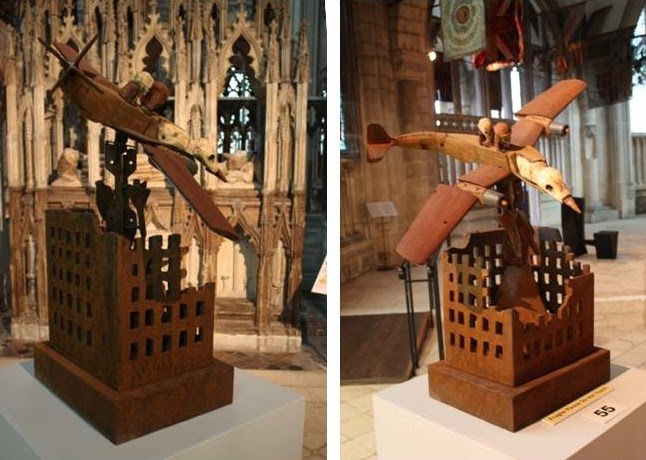
The most celebrated monument at Gloucester is the tomb of Edward II circa 1350, seen below left in the background to Steve Hurst’s Gloucester in Berlin. Hurst, born in 1932 and a witness to bombing in World War 2, sees it as concerning “… the bombing of civilians no matter what their country or who launches the bombing aircraft. It is a personal attempt to regain the viewpoint of a child”.
In the background (right) are the laid up colours of the Gloucestershire Regiment. They appear again (below right) behind Paul Wager’s Omnibus which marks the centenary of the Great War 1914-1918. Similar sentiments inform Deborah van der Beek’s Collateral (below right) – eight million horses died in that war - but it was cast around spent munitions from the conflicts in Iraq and Afghanistan which brought the expression “collateral damage” into common use.
The monument near Damien Hirst’s Anatomy of an Angel (Black) (2008, below) is to Sarah Morley, 29, a mother of four who died a few days after “having sustained the pains of Childbirth at Sea” while returning from Bombay in 1784.
Among the pieces I liked were Antony Gormley’s Pose (2012, below) with In Man’s Nature by Jon Buck behind).
Bryony Marshall’s DNA – Helix of Life (below, left) marks the 60th anniversary of the discovery of DNA. Subsequently mitochondrial DNA was identified as having been passed down to us all from a woman in East Africa about 150,000 years ago, known as Mitochondrial Eve, the inspiration for a sculpture of the same name by Sue Freeborough (below right):
The photograph below left of Geoffrey Clarke’s Taunton Deane Crematorium: Test Panel does not do justice to the colours of the glass. To the right is Sarah Lucas’s Realidad (2013), one of her NUDs series shown as bronzes at the Venice Bienniale in 2013.
John Humphreys’ Ipsius Imago a Latere Extensa probably succeeded as the artist wished in puzzling and confusing the viewer:
but perhaps was not as happily placed as the Eduardo Paolozzi plaster Vulcan near a strange moustachioed carving, perhaps a millennium older:
Among the sculptures in the open were Bruce Beasley’s Breakout II (below, left)in the Cloisters and outside Kenneth Armitage’s final work, Reach for the Stars (below, right).
Crucible2 ends on 31 October. There is no admission charge but a helpful map costs £2 and there is a £3 charge for photography. The catalogue at £16 is both good value and helps support the Cathedral.
UPDATE 2 NOVEMBER 2015
After posting about Beyond Limits: The Landscape of British Sculpture 1950-2015 held at Chatsworth House from 14 September to 25 October 2015, I thought it would be useful to add an image of Gavin Turk's bronze, Nomad (2002, below - and in other colours):
Another version of Chadwick's Jubilee can be seen there, as well.
Labels:
Antony Gormley,
contemporary art,
Damien Hirst,
Deborah van der Beek,
DNA,
Gallery Pangolin,
Gloucestershire,
Lynn Chadwick,
Sarah Lucas,
sculpture,
World War 1,
World War 2,
YBA
21 September 2014
Hauser & Wirth Somerset
Hauser & Wirth Somerset recently opened at Durslade Farm on the edge of the small town of Bruton. Part of a major international art dealership, it seems a long way from their other establishments in Zurich, London, New York and Los Angeles - which is not to say that South West England should be anything but grateful for the arrival of a world-class gallery and arts centre. The investment in renovating buildings and two new-build galleries designed by the Parisian architects, Laplace, must have been considerable. Hauser & Wirth’s aim for the gallery is to:
The inaugural art exhibition is GIG by Phyllida Barlow. Barlow was commissioned by Tate Britain in 2014 to produce a large sculptural installation for the Duveen Galleries, known as dock. At Bruton she has produced a series of installations responding to the gallery’s spaces and rural surroundings, made with common materials similar to those in dock: cement, cardboard, expanded polystyrene, plywood, timber and so on. Photography is not permitted indoors but images are available for untitled (suspended fabric pompoms, below left) and grinder, (below right.
After seeing postscorral inside and stackedchairs (below) outside in the Piggery, I began to wonder whether Barlow had been to the Somerset coast, the latter work called to mind deckchairs at Clevedon or Weston-super-Mare. But part of the fascination of Barlow’s work is that every visitor will be reminded of something different as they walk round, through or under her constructions. Moreover on close examination the viewer begins to appreciate how complex these constructions are in the ways they have been assembled from numerous components and also the subtlety of their colouring.
Photography is unlimited outside and works which I liked included Louise Bourgeois’ Spider 1994 (below, top) and Josephson’s Untitled 1970/73 (below, lower).
It was a delight to visit Hauser & Wirth Somerset on one of the last days of this summer. However, I couldn’t help wondering whether work by Pipilotti Rist will be as appealing to visitors from far and near on a wet Wednesday afternoon in February when the garden will have little to offer but muddy shoes. Across the front of Durslade Farm is a neon by Martin Creed, EVERYTHING IS GOING TO BE ALRIGHT (2011, Work 1086, below top with Subodh Gupta’s Untitled, 2008 in the foreground). Well, I do hope so and that it won’t be necessary to seek comfort from the stylish French neon described in a post here earlier this year: Jamais renoncer. And, of course, it’s far better for the South West that Iwan and Manuela Wirth chose to make Bruton their home and a location for a new gallery rather than, say, Beijing.
… share contemporary art with new audiences and … to engage the public with art, the countryside and the local community. The centre will also provide resources including an archive, reading room, landscaped garden designed by Piet Oudolf and a restaurant for locally-sourced food …Admission is free and there are two opening shows underway. Open Field consists of Oudolf’s designs for this and other projects including The High Line in New York and the Serpentine Gallery in London. Anyone interested in garden design and planting will no doubt enjoy learning more about Oudolf’s approach and his choices for the Hauser & Wirth Somerset garden which contains over 26,000 herbaceous perennials, (below, with Anri Sala’s perspective-defying Clocked Perspective 2012).
The inaugural art exhibition is GIG by Phyllida Barlow. Barlow was commissioned by Tate Britain in 2014 to produce a large sculptural installation for the Duveen Galleries, known as dock. At Bruton she has produced a series of installations responding to the gallery’s spaces and rural surroundings, made with common materials similar to those in dock: cement, cardboard, expanded polystyrene, plywood, timber and so on. Photography is not permitted indoors but images are available for untitled (suspended fabric pompoms, below left) and grinder, (below right.
After seeing postscorral inside and stackedchairs (below) outside in the Piggery, I began to wonder whether Barlow had been to the Somerset coast, the latter work called to mind deckchairs at Clevedon or Weston-super-Mare. But part of the fascination of Barlow’s work is that every visitor will be reminded of something different as they walk round, through or under her constructions. Moreover on close examination the viewer begins to appreciate how complex these constructions are in the ways they have been assembled from numerous components and also the subtlety of their colouring.
Photography is unlimited outside and works which I liked included Louise Bourgeois’ Spider 1994 (below, top) and Josephson’s Untitled 1970/73 (below, lower).
It was a delight to visit Hauser & Wirth Somerset on one of the last days of this summer. However, I couldn’t help wondering whether work by Pipilotti Rist will be as appealing to visitors from far and near on a wet Wednesday afternoon in February when the garden will have little to offer but muddy shoes. Across the front of Durslade Farm is a neon by Martin Creed, EVERYTHING IS GOING TO BE ALRIGHT (2011, Work 1086, below top with Subodh Gupta’s Untitled, 2008 in the foreground). Well, I do hope so and that it won’t be necessary to seek comfort from the stylish French neon described in a post here earlier this year: Jamais renoncer. And, of course, it’s far better for the South West that Iwan and Manuela Wirth chose to make Bruton their home and a location for a new gallery rather than, say, Beijing.
Subscribe to:
Posts (Atom)