Showing posts with label Martin Gayford. Show all posts

2 March 2015

Late Rembrandt at the Rijksmuseum

I missed this winter’s Rembrandt: The Late Works at the National Gallery in London, but what better excuse could there be for a trip to Amsterdam where the same exhibition is continuing at the Rijksmuseum as Late Rembrandt. This is almost certainly the most significant exhibition I will ever post about on this blog, and, as such, readers would probably benefit far more from articles about the NG show by Simon Schama (“jaw-dropping”) or Martin Gayford (“the supreme painter of the inner life”). However, even the best critics seem to have been overwhelmed by The Late Works, so here’s my tuppenceworth.


Titus at his Desk, 1655 (left) Titus in Monk’s Habit, 1660 (right)
This is, it seems, the first exhibition ever to address “late” Rembrandt. The painter’s dates are 1606-1669, the earliest exhibit is dated “about 1648–55” but there are few before 1652, so most are from the painter’s mid-40s until his death at 63. Life had gone well for Rembrandt until early middle age. For a time he had been one of the most successful painters in Holland in the period known as its Golden Age. He had bought a splendid family house in Amsterdam (see below) with borrowed money when he was 33, but three years later his wife, Saskia, died. During perennial financial difficulties he would eventually lose the house. Three of Saskia’s four children would die, only his son, Titus (above), reaching adulthood; Hendrickje Stoffels (probably below), his housekeeper who became his mistress and mother of his daughter, would die in 1663; Titus died the year before his father.

A Woman bathing in a Stream, 1654 
This painting was in the unfashionable less finely finished style which Rembrandt had adopted after 1650. His The Conspiracy of the Batavians under Claudius Civilis (c1661–62, below top) was possibly rejected on these grounds after having been commissioned for the Amsterdam town hall, although at the same time he continued to produce more conventional works like The Sampling Officials of the Amsterdam Drapers’ Guild (1662, known as The Syndics, below lower).


There are far too many magnificent pictures in Late Rembrandt for them all to be reported here. Just a few that I was struck by include the Portrait of Jan Six (c1654, below left) and the Portrait of an Elderly Man (1667, below right) – old chaps are easy for me to identify with of course:


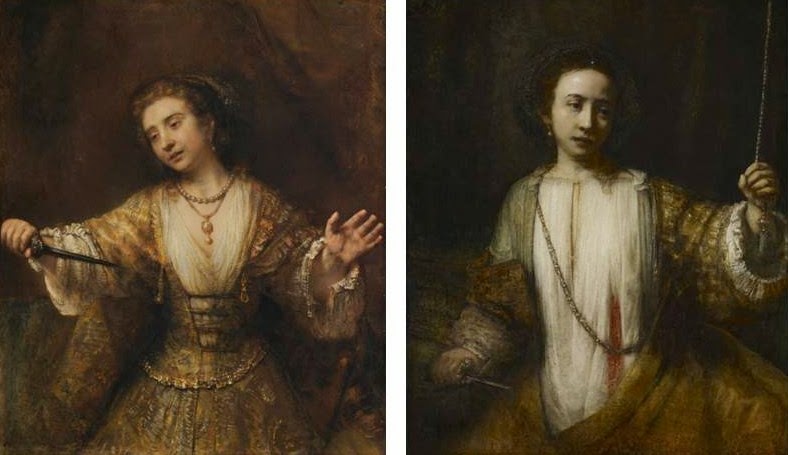
And who could not be moved by poor Lucretia (1664, below left and 1666, below right):

Similarly, The Apostle Batholomew (1657, below left and 1661, below right):


Among the portraits, Portrait of a Lady with an Ostrich-Feather Fan (c1656–58, below), was, like The Syndics, more conventional but no less impressive:


As with the Rubens show currently at the Royal Academy in London, the Late Rembrandt curators have avoided chronology and organised around abstract nouns, eg Intimacy, Contemplation, Emulation and so on. This means that the six significant Rembrandt Self Portraits here are separated after an introductory trio; they are: SP 1659, SP as the Apostle Paul 1661, SP as Zeuxis 1662, SP with Two Circles 1665-9 (also in the poster above), SP at the Age of 63 1669, SP 1669 (clockwise from top left):


One of the last images of Rembrandt is the print of Self Portrait, drawing on an Etching Plate (1658, below left) one of many etchings and drawings featured in Late Rembrandt, too many to describe here. Another is The Conspiracy of the Batavians under Claudius Civilis (c1661, below right) which reveals the full extent of the painting of the same name above before it was cut down in size after rejection.


Anyone seeing the Amsterdam version of Late Rembrandt/Rembrandt: The Late Works, an exhibition which is truly deserving of the term "unmissable", will have the opportunity to view some of his other major works elsewhere in the Rijksmuseum and to visit his house and financial millstone, now a museum, Het Rembrandthuis.

Late Rembrandt continues until 17 May.

Subsequent posts are about the Rembrandt House Museum and some other things seen in the Rijksmuseum and elsewhere in Amsterdam. There is also a post about the Van Gogh Museum.



20 February 2012

Lucien Freud Portraits at the NPG

The National Portrait Gallery (NPG) in London is currently showing Lucien Freud Portraits, the first major retrospective of Lucien Freud (1922-2011) since Tate Britain’s in 2002. So much is available about Freud and his work that it needs little description here. Martin Gayford’s description of his experiences sitting for Freud, Man with a Blue Scarf: On Sitting for a Portrait by Lucian Freud, is fascinating and informative, and the resulting work, Man in a Blue Scarf (2004) is in the NPG exhibition. David Dawson worked for over 20 years as Lucian Freud's assistant, occasionally his model, and was able to take many revealing photographs of the artist at work. He discusses these at The Economist and also his own work at the BBC.

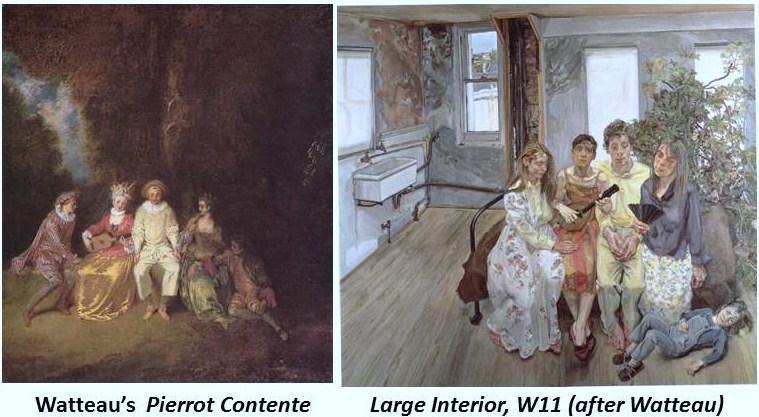
As with the Tate retrospective (with which there is an inevitable overlap), the works on display at the NPG clearly show the change in technique from fine sable brushwork to the heavy application using hog bristle which Freud settled on the late 1950s. Two of the Freud paintings on show were made with explicit reference to other artists (see below).


One of the NPG’s publications to go with their show is Painting People. This might have been more accurate description than Portraits, given that some of the subjects are as much concerned with the human form as portraiture. But there are many conventional portraits whch clearly demonstrate Freud’s ability to capture his sitter’s personality.


Lucien Freud Portraits continues at the NPG until 28 May. Without hesitation, my ‘Anticipointment Index’ rating (out of 5, the lower the better) is 1.