Showing posts with label Impressionism. Show all posts

7 April 2015

Durand-Ruel at the National Gallery


Anyone who picks over the art section of an Oxfam bookshop is quickly reminded of the popularity of the Impressionists. A comprehensive survey of Impressionism would be a massive undertaking, probably beyond the scope of even the Met in New York (their Centenary exhibition in 1975 had only 42 works) or the Musée d’Orsay in Paris. So the curator of a show with the word Impressionism in its title needs a focus to constrain the scope of their offering and in this case, the Impressionists whose works have been selected are those who were taken up by the Parisian art dealer Paul Durand-Ruel (1831-1922; below top right, Renoir’s portrait of 1910) in the 1870s and after, including Monet, Degas, Manet, Renoir, Pissarro and Sisley*. The National Gallery (London) exhibition, Inventing Impressionism: The Man Who Sold a Thousand Monets, is certain to be very popular and I can't imagine many visitors will leave disappointed. There are 85 major works on display, all of the highest quality and a pleasure to see.


The show starts with some of the pictures from Durand-Ruel’s Paris apartment (above lower) like Renoir’s Dance in the City (1883, above top left). One of the doors from the grand salon is on display with six panels painted in 1883 by Monet: Japanese Lilies, Chrysanthemums, Pot of White Azaleas, Gladioli, Branches of White and Pink Azaleas and Basket of Apples (for an image, see here).  Renoir was a friend of Durand-Ruel’s for nearly 50 years and The Dancer (1874, below, left) and The Cup of Chocolate (c1877/78, below right) are among the others shown here. (Renoir’s Girl with a Cat (1880), one of Durand-Ruel’s favourites apparently, was at the Royal Academy’s From Paris:A Taste for Impressionism Paintings from the Clark in 2012 under the title, Sleeping Girl).


From then on the show follows the path of Durand-Ruel’s career and the next section introduces the painters whose art, not much favoured by the official Salon, was being sold by the family business at the time that Paul took over from his father: Corot, Courbet – Still Life with Apples (1872, below top), the Barbizon school – Millet’s The Sheepfold, Moonlight (1856-8, below lower):


Paul’s sponsorship of the Impressionists was a consequence of the Franco-Prussian war of 1870-71. He moved his stock to London and opened a gallery in New Bond Street. Among the artists in exile were Monet – The Thames below Westminster (c1871, below top) and Pissarro – The Avenue, Sydenham (1871, below lower)  producing the sort of avant garde works which appealed to his taste.


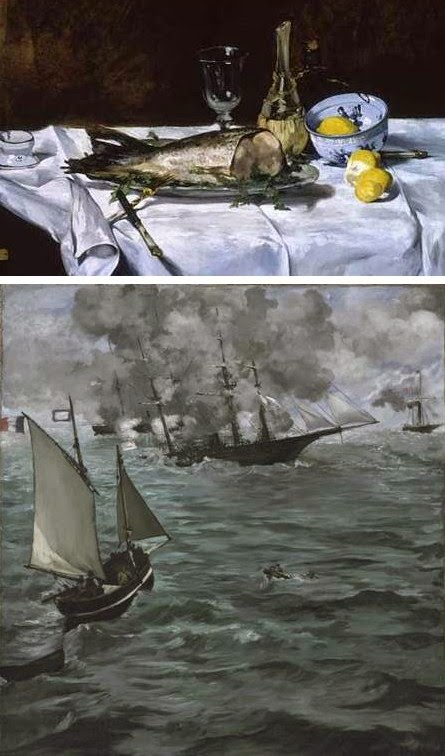
But it was on his return to Paris in 1872 that Durand-Ruel acquired at considerable cost a large number of works by Manet, for example, The Salmon (1869,  below top) and The Battle of the USS Kearsarge and the CSS Alabama (1864, below lower). The latter is an imaginative reconstruction by Manet who painted the Kearsarge at Boulogne after the incident.

Acquisitions of works by Sisley – The Ferry of the Ile de la Loge: Flood (1872, below top left) and Degas – Horses before the Stands (c1866-8, below top right) and Monet - Railroad Bridge, Argenteuil (1873, below lower) were made in the same year, Durand-Ruel not only buying in quantity from his favoured artists but also paying for their work in advance.


At the time of the 1874 First Impressionist Exhibition, Durand-Ruel was in temporary financial difficulty but was able to lend it some of his pictures. By 1876 he was able to take an active part in the Second Impressionist Exhibition and the National Gallery has brought together eight of the 250 works shown then, including Monet’s Springtime (c187, below top) and Degas’ Peasant Girls bathing in the Sea at Dusk (c 1869-75, below lower), both causing controversy at the time.


By the 1880s Durand-Ruel was in a position to put on solo exhibitions for his artists, the case study for this show being Monet with six canvases from 1883, including The Train in the Snow (1875, below top) and The Galettes (1882, below lower).


In 1892 Durand-Ruel displayed in his gallery Monet’s Poplars series, five of the original 15 being brought together again at the National Gallery. By then he had established himself in the New York with the 1886 (Works in Oil and Pastel by the) Impressionists of Paris exhibition and was selling to wealthy American collectors works like Monet’s Autumn Effect at Argenteuil (1873, below top) and Degas’ The Ballet Class (c1880, below lower).


The exhibition ends with a selection of the works Durand-Ruel showed at the Grafton Galleries in London in 1905 – apparently the largest Impressionist exhibition ever held. These include one of the National’s own Degas, Miss La La at the Cirque Fernando (1879, below left), Monet’s The Coal Carriers (c1875, below right top) and Morisot’s dazzling Woman at her Toilette (c1875-80, below right lower).


Wonderful though this show is, I do have a minor reservation about its title: “Inventing Impressionism” – if anyone invented Impressionism surely it was Monet in 1872 with Impression, soleil levant later shown at the 1874 exhibition? Although I can understand why “Marketing Impressionism” or, worse still, “Branding Impressionism” wouldn’t do. However, when it was at the Musée du Luxembourg earlier the show was called Paul Durand-Ruel Le pari de l’impressionnisme (poster below left**), literally ‘the bet on impressionism’ and, if that was acceptable in Paris, I can’t help wondering whether “PD-R the man who gambled on Impressionism” or even “Gambling on Impressionism” might have been both acceptable and more accurate here.


After David Hockney attended the Monet retrospective in Chicago in 1996 he commented:
A great artist, a very great artist. Very finely painted, superb condition now. What? A hundred years old? He knew exactly which paint to use and his work remains in marvellous condition. (Hockney on Art, page 204)
In contrast with the state of some of van Gogh’s works, as touched on in a recent post here. Van Gogh, of course, did not have the benefit of financial support from a Durand-Ruel to assist in the purchase of quality materials. Something which the exhibition hardly touches on is that Durand-Ruel was not exclusively focussed on the Impressionists. Although the term Post-Impressionism would not be invented until 1910, Cézanne featured in the Grafton Galleries exhibition and Seurat’s Bathers at Asnières, to be seen upstairs in the National Gallery, had appeared in the 1886 New York exhibition.

The last time I saw so many Impressionist works in one place was in London in 1973. Unbelievable as it may seem now, the UK was celebrating its entry to the European Economic Community (as the EU was called at the time). The Arts Council’s contribution to this jamboree (Fanfare for Europe) was The Impressionists in London at the Hayward Gallery, with 58 works (though including six by Derain). Looking at the catalogue I noticed the detailed Chronology by Anthea Callen and reproduce it below as it seems so helpful, particularly in the UK.

Inventing Impressionism: The Man Who Sold a Thousand Monets continues until 31 May.

*(Not so) Young French Artists
Monet 1840-1926, so 36 in 1876, the year of the Second Impressionist Exhibition
Degas1834-1917, 42
Manet 1832-1883, 44
Renoir 1841-1919, 35
Pissarro 1830-1903, 46
Sisley 1839-1899, 37

** with Renoir’s Dance at Bougival (centre) and Dance in the Country (right), both 1883. The latter also hang in Durand-Ruel’s grand salon.


20 April 2014

The Pearlman Collection at the Ashmolean

Exhibitions based on collections provide a fascination which can’t be found in shows given over to individual artists or to particular periods in art history. I think it lies in the way the collector (or collectors) exercised their taste given the opportunities and resources which were available. Gertrude Stein and her brothers, for example, were wealthy and were collecting contemporary talent in the right place and time, Paris in the 1920s. Sterling and Francine Clark had been in a similar position a decade earlier. The Radev Collection, on the other hand, reflects its creators’ tastes and long-term opportunities to make acquisitions rather than their funds. So what of Henry and Rose Pearlman’s collection, now on an international tour starting at the Ashmolean Museum, Oxford: Cézanne and the Modern: Masterpieces of Modern Art from the Pearlman Collection?


Henry Pearlman was born in New York in 1895 and set up Eastern Cold Storage in 1919. One can well believe that his company would have done well in the war years and certainly in 1945 he was able to make his first significant purchase of modern art, Chaïm Soutine’s Village Square, Céret (above, top). For nearly 30 years he went on building up his collection, most of which is now at the Ashmolean. The show starts with a large number of late Cézannes, mostly watercolours (not often displayed, no doubt for reasons of conservation), eg Three Pears, (Trois Poires, 1888-90 above lower), from the painter’s later years in Aix en Provence. These lead on to the next room’s Cistern in the Park of Chateau Noir (Citerne au Parc du Château Noir, c 1900, below in Pearlman’s office) and one of the versions of Montagne Sainte-Victoire (c 1902, poster above), much-painted by the artist.


Nearby are Vincent van Gogh’s Tarascon Stage Coach (Tarascon Diligence, 1888, again below in Pearlman’s office) and less satisfactory works by Gauguin, Degas (After the Bath, Woman Drying Herself /Après le bain, femme s'essuyant, 1892, above left) and Toulouse-Lautrec (Messaline, 1901, above right). I found the latter interesting because it was inspired by a visit to the opera in Bordeaux shortly before the painter’s death at Chateau Malromé. Earlier and more pleasing, if undemanding, works are Sisley’s Seine at Verneuil (La Seine à Verneuil, 1889, below, left) and Camille Pissaro’s Still Life: Apples and Pears in a Round Basket (Nature Morte: Pommes et Poires Dans un Panier Rond, 1872, below, right).


Finally, there are more works by Soutine, and two oils and a sculpture by Modigliani. Pearlman discovered after purchase that the small Daumier oil shown nearby, Head of an Old Woman (Tête de Vieille Femme, 1856-60, left), was one of the first purchases made by Leo and Gertrude Stein. It is a pity that Pearlman hadn’t started his collection a decade or two earlier when the opportunities for acquisitions of works by the painters he liked might have been greater (the absence of any cubist work is intriguing when Cézanne is often regarded as their precursor). He displayed what he considered to be his major pieces in his office at Eastern Cold Storage: the van Gogh, its acquisition surely being his apogee as a collector, Modigliani’s Jean Cocteau 1919-17, and Cézanne’s Cistern in the Park of Chateau Noir, (below).


Cézanne and the Modern provides a welcome opportunity in the UK to see works by Soutine and Modigliani as well as some fine Impressionist and Post-Impressionist works. The Pearlman website contains some interesting background information including Henry’s reminiscences, eg:
I found art dealers at first quite difficult to understand with regard to pricing works of art. Being accustomed to a business where selling price is based on cost plus small overhead and ten percent profit, I found that art dealers' prices in most cases bore little relationship to their costs, but were based on what the traffic could bear. I know of a pair of Douanier Rousseau portraits, for example, that were purchased at an auction in the Midi of France for about twenty dollars, repurchased by my French dealer friend for under $600, then sold to one of the New York galleries for $12,000; when I saw them exhibited here and asked the price I was advised that they could be bought for $30,000. Not being interested in owning these Rousseaus, I was amused by the gyrations of the prices. The last price I saw them offered for was $150,000 for the pair.
The show continues at the Ashmolean until 22 June and will be at Le Musée Granet in Aix-en-Provence from 12 July to 5 October. After showings in Atlanta and Vancouver it will return to the Princeton University Art Museum, where the Pearlman collection is on long-term loan, in 2015.


18 July 2012

Paintings from the Clark at the RA

The Royal Academy in London is showing its Summer Exhibition until 12 August. As usual the forces of taste, money and talent seem to achieve a balance in the form of red spots adjacent to things wondrous, weird or woeful, and more of them than ever. But this year it is possible to escape to the Sackler Wing to see something truly wonderful. The Sterling and Francine Clark Art Institute in Williamstown, Massachusetts, while under renovation, has sent some of its collection of 19th century French paintings on a three-year world tour. Their fifth stop is the RA, hence the exhibition, From Paris: A Taste for Impressionism Paintings from the Clark.
 

Most, but not all, of the pictures are Impressionist, with more than 20 by Renoir and others by Manet, Monet, Pissarro, Degas, Sisley and Morisot. These are put in the context of earlier 19th century French art and some of the conventional academic work of the time. Their quantity and quality reflects the Clarks’ taste having matched their substantial resources at a time when such works were expensive rather than only affordable in ones or twos for billionaires and oligarchs.


Although the Clark often lends to London exhibitions (Lautrec’s Jane Avril was at the Courtauld last year), many of the pictures at the RA are unfamiliar, so visitors might be struck by the colouring and composition of Renoir’s Onions (above), and (below) Manet’s Interior at Arcachon (with its bay on the Atlantic coast of SW France in the background).


There is also a chance to see a Degas, Dancers in the Classroom, which didn’t come to the RA for last year’s Degas and the Ballet.

Quite why so many of the Clarks’ receipts from Knoedler & Co and others are on display is unclear. From Paris: A Taste for Impressionism Paintings from the Clark continues until 23 September, and anyone who is interested in Impressionism will want to see it.

(‘Anticipointment rating’ 1 – out of 5, the lower the better)

30 April 2012

'Into the Light' at Compton Verney

The long-list of 10 gallery and museum projects for the Art Fund’s 2012 Prize features three from South West England: M Shed in Bristol, the Holburne Museum in Bath and Exeter’s Royal Albert Memorial Museum & Art Gallery (RAMM). RAMM reopened in December 2011, marking the occasion with a major exhibition, Into the Light: French and British painting from Impressionism to the early 1920s, which has now transferred to Compton Verney.

53 works are on show by artists including Vanessa Bell, Eugene Boudin, Paul Cezanne, Claude Monet, Camille Pissarro, Pierre Auguste Renoir, Walter Sickert, Alfred Sisley, Alexander Stanhope Forbes and Philip Wilson Steer. Into the light describes the cross-Channel travels, connections and influences on their work of British and French Impressionists and Post-impressionists. This exhibition is a delight for anyone with an interest in British art and RAMM deserve praise for their efforts in bringing it about. Professor Sam Smiles of the University of Plymouth and Penelope Sexton (formerly of RAMM and now at Compton Verney) seem to be particularly deserving of appreciation.

Not to neglect two of the themes of this blog (SW England and SW France), there is an opportunity for those unlikely to travel as far west as Plymouth to admire Stanhope Forbes’ dramatic en plein air 'A Fish Sale on a Cornish Beach':


and to compare two Scottish Colourist views of Royan at the mouth of the Gironde estuary:


Into the Light continues until 10 June. The exhibition catalogue by Sam Smiles is excellent value at £14.95, particularly by comparison with the current equivalent on offer at the Courtauld. Better still for Exonians, RAMM have it on sale at £12.50!

Compton Verney is also hosting Gainsborough’s Landscapes: Themes and Variations, which was the subject of a post here when first shown at the Holburne.