Showing posts with label Rembrandt. Show all posts

5 March 2015

Rembrandt’s House, Amsterdam

In 1639 Rembrandt, probably at the peak of his earnings as Holland’s leading artist, bought a fine house in Amsterdam’s Sint Anthonisbreestraat using what would nowadays be regarded as a very high loan-to-value mortgage, at the time several different loans. In 1658,in difficult financial circumstances, he had to move to rented accommodation and the house was sold, many of his possessions having been auctioned in 1656. It is now the Rembrandt House Museum (Het Rembrandthuis), and aims, in so far as these things are possible, to give visitors some feel for the artist’s life there. So there is a period kitchen in the style of the UK’s National Trust, a selection of pigments Mr Turner would have recognised and a recreation of the collection of curiosities which had to go under the hammer (below). When I visited there was a fascinating demonstration of how drypoint etchings, one of Rembrandt’s fortes, are pulled.


In parallel with Late Rembrandt at the Rijksmuseum (previous post), the Rembrandthuis is running an exhibition in its modern extension to the original house, Rembrandt’s Late Pupils – Studying under a Genius, looking at works by some of his students between 1650 and 1669, the year of his death. There was some very helpful commentary on ‘Rembrandt’s Final Twenty Years’ which I think is worth reproducing in full:
During his late period, Rembrandt’s pupils witnessed remarkable developments in his art: increasing concentration in his compositions, the evocation of deep inner emotion and powerfully expressive brushwork. Rembrandt looked mainly to earlier Italian art for inspiration, above all to Venetian masters like Titian and Palma Vecchio. He ran counter to the artistic fashion of the day, which favoured the classicizing Flemish style of Peter Paul Rubens, Anthony van Dyck and their followers. Important commissions for new buildings such as the new Town Hall in Amsterdam and Huis ten Bosch in The Hague went to artists who followed this fashion, with clear outlines, smooth modelling, light tones, strong colours and restrained Baroque dynamism. Rembrandt’s last twenty years were beset with personal problems. 
His financial difficulties began around 1650. When he sold his portrait of his deceased wife Saskia to Jan Six in 1652, he had a pupil make a free copy of it. His bankruptcy in 1656 forced him to leave his large house in Breestraat for smaller rented quarters on Rozengracht in 1658. In 1663 he lost his beloved partner, Hendrickje Stoffels, and five years later his only son, Titus, whom he had trained as an artist.
This is the copy, Portrait of Saskia in Profile (c1652 below left), captioned as by “Anonymous Rembrandt pupil” but possibly Abraham van Dijck, with the original Saskia von Uylenburgh in Profile (c1640, below right) now in Kassel:


In an article for the Financial Times in October 2014, just before the National Gallery version of Late Rembrandt opened, Bendor Grosvenor , editor of arthistorynews.com, addressed the tricky question of Rembrandt attribution, “… the weird world of Rembrandt scholarship. In the first half of the 20th century, Rembrandt was believed to have painted some 600-650 works. But from the 1970s onwards that number shrank rapidly to around 250.” Since then some works which had been rejected have been readmitted to the accepted oeuvre. Grosvenor takes a fairly liberal view on attribution, one of his arguments being:
Finally, we might ask who are all these mysterious, supremely talented “followers of Rembrandt”? Who are the artists able to paint works as fascinating as “The Man with the Golden Helmet” in Rembrandt’s studio, but who have left no trace of any independent practice? I doubt many exist – they are a spectre of modern Rembrandt scholarship.
Not everyone agrees with Grosvenor’s line (anyone who is interested should read the FT article and then the debate between him and the blogger grumpyarthistorian). I would have thought that if “followers of Rembrandt” exist, they might well be found among these Late Pupils though probably not in this show.

Among the works I liked were two portraits by Jacobus Lebeck, Portrait of a Young Man in a Hat (1654, below left) and Portrait of a Man (c1658, below right), the former from the National Trust at Polesdon Lacey:


Nicolaes Maes Young Woman at a Window (c1654, below left), a genre scene on the same theme Rembrandt’s Girl at a Window (1651, below right):


and also a Rembrandt, Portrait of a Man with Arms Akimbo (1658 below left). Seated Old Man with a Stick (1665-8, below right) is by Gottfried Kneller (1646-1723). He was born in Lübeck, apprenticed to (but no admirer of) Rembrandt in 1662 and after a spell in Italy, became a successful painter in England, known to us as Sir Godfrey Kneller!


Rembrandt’s Late Pupils – Studying under a Genius is a very informative complement to Late Rembrandt and well worth visiting. Both exhibitions end on 17 May.


2 March 2015

Late Rembrandt at the Rijksmuseum

I missed this winter’s Rembrandt: The Late Works at the National Gallery in London, but what better excuse could there be for a trip to Amsterdam where the same exhibition is continuing at the Rijksmuseum as Late Rembrandt. This is almost certainly the most significant exhibition I will ever post about on this blog, and, as such, readers would probably benefit far more from articles about the NG show by Simon Schama (“jaw-dropping”) or Martin Gayford (“the supreme painter of the inner life”). However, even the best critics seem to have been overwhelmed by The Late Works, so here’s my tuppenceworth.


Titus at his Desk, 1655 (left) Titus in Monk’s Habit, 1660 (right)
This is, it seems, the first exhibition ever to address “late” Rembrandt. The painter’s dates are 1606-1669, the earliest exhibit is dated “about 1648–55” but there are few before 1652, so most are from the painter’s mid-40s until his death at 63. Life had gone well for Rembrandt until early middle age. For a time he had been one of the most successful painters in Holland in the period known as its Golden Age. He had bought a splendid family house in Amsterdam (see below) with borrowed money when he was 33, but three years later his wife, Saskia, died. During perennial financial difficulties he would eventually lose the house. Three of Saskia’s four children would die, only his son, Titus (above), reaching adulthood; Hendrickje Stoffels (probably below), his housekeeper who became his mistress and mother of his daughter, would die in 1663; Titus died the year before his father.

A Woman bathing in a Stream, 1654 
This painting was in the unfashionable less finely finished style which Rembrandt had adopted after 1650. His The Conspiracy of the Batavians under Claudius Civilis (c1661–62, below top) was possibly rejected on these grounds after having been commissioned for the Amsterdam town hall, although at the same time he continued to produce more conventional works like The Sampling Officials of the Amsterdam Drapers’ Guild (1662, known as The Syndics, below lower).


There are far too many magnificent pictures in Late Rembrandt for them all to be reported here. Just a few that I was struck by include the Portrait of Jan Six (c1654, below left) and the Portrait of an Elderly Man (1667, below right) – old chaps are easy for me to identify with of course:


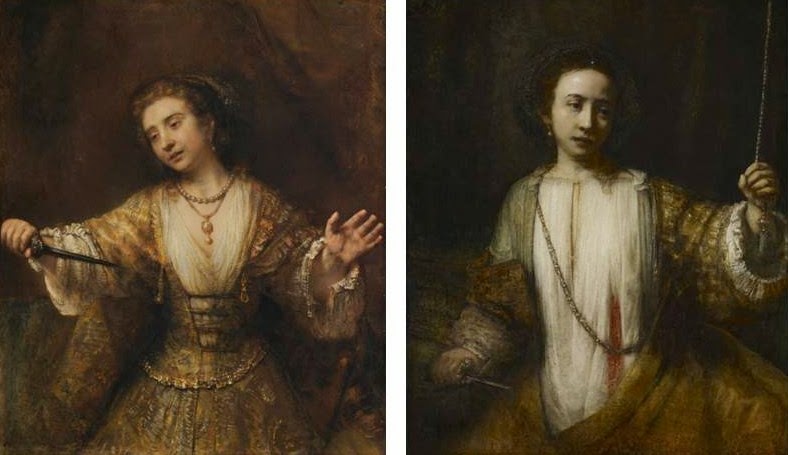
And who could not be moved by poor Lucretia (1664, below left and 1666, below right):


Similarly, The Apostle Batholomew (1657, below left and 1661, below right):


Among the portraits, Portrait of a Lady with an Ostrich-Feather Fan (c1656–58, below), was, like The Syndics, more conventional but no less impressive:


As with the Rubens show currently at the Royal Academy in London, the Late Rembrandt curators have avoided chronology and organised around abstract nouns, eg Intimacy, Contemplation, Emulation and so on. This means that the six significant Rembrandt Self Portraits here are separated after an introductory trio; they are: SP 1659, SP as the Apostle Paul 1661, SP as Zeuxis 1662, SP with Two Circles 1665-9 (also in the poster above), SP at the Age of 63 1669, SP 1669 (clockwise from top left):


One of the last images of Rembrandt is the print of Self Portrait, drawing on an Etching Plate (1658, below left) one of many etchings and drawings featured in Late Rembrandt, too many to describe here. Another is The Conspiracy of the Batavians under Claudius Civilis (c1661, below right) which reveals the full extent of the painting of the same name above before it was cut down in size after rejection.


Anyone seeing the Amsterdam version of Late Rembrandt/Rembrandt: The Late Works, an exhibition which is truly deserving of the term "unmissable", will have the opportunity to view some of his other major works elsewhere in the Rijksmuseum and to visit his house and financial millstone, now a museum, Het Rembrandthuis.

Late Rembrandt continues until 17 May.

Subsequent posts are about the Rembrandt House Museum and some other things seen in the Rijksmuseum and elsewhere in Amsterdam. There is also a post about the Van Gogh Museum.