Showing posts with label Manet. Show all posts

18 January 2016

Three Paris Exhibitions: (3) Villa Flora, the Hahnloser Collection

Shows seen last month in a city subdued and uncrowded after les évènements of 13 December 

Of the three exhibitions which I saw in Paris in December 2015, I have already posted about Picasso.Mania at the Grand Palais, and Splendeurs et misères, images de la prostitution en France (1850-1910) at the Musée d’Orsay. This post is about Villa Flora, Les Temps enchantés at the Musée Marmottan Monet. In 1898, Hedy Buhler married Arthur Hahnloser, and from 1906 to 1936 this wealthy Swiss couple formed an art collection for their home, the Villa Flora at Winterthur, near Zurich. About 75 of the collection’s works, paintings and small sculptures, have been lent to the Marmottan – a first European showing and a pleasure to visit.

Initially the Hahnlosers collected contemporary Swiss art and acquired works by Ferdinand Hodler, like Le massif de la Jungfrau vu de Mürren (1911, below top) and Le Lac Léman avec les Alpes savoyardes (c1905, below lower):


Giovanni Giacometti, Maisons ensolleillées à Stampa (1912, below left) and Self-portrait (1907, below right):
 

and Félix Vallotton (subject of an exhibition in Paris in 2013/14 and one planned for the Royal Academy in London in 2019). The Villa Flora, as well as family portraits by Vallotton, had on show en famille his more challenging Baigneuse de face (1907, below top), and La Blanche et la Noire (1913, below lower):


After 1908, through Vallotton, the Hahnlosers became involved with a wider circle of artists in Paris including Fauves and Nabis and began to acquire works by Pierre Bonnard: Débarcadère (ou l’embarcadère) de Cannes (1928-1934, in the poster above) and La Carafe Provençale (1915, below left):


and Odilon Redon, Le Rêve, (c1908 above right) and Henri Manguin, La Sieste ou Le Rocking-chair, Jeanne (1905, below top) and Albert Marquet, La Fete nationale au Havre (1906 ?-13, below lower):


The Hahnlosers would go on to add depth to the collection by purchasing works by artists they regarded as precursors to the modern works they had already acquired. These include a Cézanne, Portrait de l’artiste (1877-1878, below left) and a Manet, Amazone (1883, below right):


Van Gogh’s Le Semeur (1888, below) would join the collection at a later date having originally been acquired by Arthur’s brother Emil.


Villa Flora, Les Temps enchantés ends on 7 February.


15 January 2016

Three Paris Exhibitions: (2) Splendeurs et misères

Shows seen last month in a city subdued and uncrowded after les évènements of 13 December 


Of the three exhibitions I saw in Paris in December 2015, I have already posted about Picasso.Mania
at the Grand Palais, and the next will be on Villa Flora at the Musée Marmottan Monet. This post is about Splendeurs et misères, images de la prostitution en France (1850-1910) at the Musée d’Orsay, an exhibition which will reappear later in 2016 at Amsterdam’s Van Gogh Museum, to be called Lichte zeden (Easy Virtue). The Paris title presumably refers to a part of Honoré de Balzac's La Comédie humaine: Splendeurs et misères des courtisanes, (The Splendours and Miseries of Courtesans or A Harlot High and Low) published in four parts from 1838-1847. The Musée d’Orsay is not reluctant to take on difficult subjects, their male nude show in 2013 being an example. Splendeurs et misères, examining prostitution, not just in art but as an aspect of the social history of France, is certainly another, a revelation of misery for the many and splendour for a few.

The d’Orsay version addressed five themes and was spread over 15 rooms with numerous pictures and photographs. The first theme, Ambiguity, looked at the position of women, respectable or otherwise, in public places during the daytime and at night in cafés, cabarets and at the opera. Procurement and soliciting were often near the surface at any time of the day, for example in Giovanni Boldini’s En traversant la rue (1873/75, below left) and James Tissot’s La Demoiselle du magasin (1883/85, below right):


Women drinking alone in cafés is a recurrent theme in the art of the time, as in Degas’ L’Absinthe (1875/76, below left) and Manet’s La Prune (1878, below right). Agostina Sagatori au Tambourin (1887, seen earlier in 2015) was on loan from the Van Gogh Museum which also holds Toulouse-Lautrec’s Poudre de riz, (1887).


The cabaret pictures included Lautrec’s Moulin de la Galette (1889, below upper), on loan from the Art Institute of Chicago, and, from the Ny-Carlsberg-Glyptothek Copenhagen, the less well-known M Delaporte au Jardin de Paris (c1893, below lower):


At the opera, Eugène Giraud’s Le Bal de l'Opéra (1866, below top) and Edouard Degas’ Masked Ball at the Opera (1873, below lower) convey the same scene, the latter being far more compelling in its composition: 


After Ambiguity, Brothels - more Lautrecs, of course and photography (there are two sections of contemporary photography). Again from Chicago, Courbet’s Mère Grégoire (1855, 57/59, below left) refers to a character from a popular song, the proprietress of a Parisian brothel. An unfamiliar Lautrec from Budapest was Les Dames au réfectoire (1893/5, below right) conveying the unhappy position of the women employed as prostitutes who had to undergo frequent medical checks – a study for Rue des Moulins, (1894), was in this show, but not the final work, now in Washington.


Prostitution operated at all levels of society including the highest (for which abolition would only finally come in 1946). The section, Les Grandes Horizontales, included, as well as a Fauteuil d’Amour (below top), reputedly used by the Prince of Wales in the 1890s in pursuit of entente cordiale, Rolla (1878, below lower) by Henri Gervex:


followed by Manet’s Olympia (1863, below), bought by the French government in 1890, and introducing the final, rather diffuse, sections of the show:


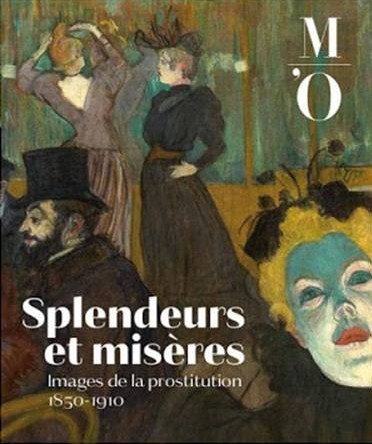
... Prostitution and the imagination and Prostitution and modernity. Lautrec reappeared with the famous Au Moulin Rouge (1892/95, detail in the poster above), again from Chicago, and the Courtauld’s Private Room in the "Le rat mort" (1899, below left) leading on to, among much else, some Picassos from 1901 including Nu aux bas rouges (below right):


Two final images from a show which is informative if not uplifting: Picasso’s La Buveuse d’absinthe (1901, below left) and Kees van Dongen’s Liverpool Lighthouse (1897, below right):


Splendeurs et misères, images de la prostitution en France (1850-1910) ends on 17 January but will be at the Van Gogh Museum from 19 February to 19 June. Unfortunately, although Professor Richard Thomson from Edinburgh University was one of the curators of the exhibition, it will not be coming to the UK.


POST-EXHIBITION NOTE

If one measure of an exhibition is whether it alters one’s ways of seeing, Splendeurs et misères was a success – as recently Manet’s A Bar at the Folies-Bergère (1882, below) in the Courtauld Gallery, London.


And in case anyone should choose to believe that Paris and London were quite different in their mores, The Awakening Conscience (1853, below) by William Holman Hunt clearly shows a man and his mistress, though sanctimoniously overlaid with religious salvation, in keeping with the susceptibilities of Victorian England.


7 April 2015

Durand-Ruel at the National Gallery


Anyone who picks over the art section of an Oxfam bookshop is quickly reminded of the popularity of the Impressionists. A comprehensive survey of Impressionism would be a massive undertaking, probably beyond the scope of even the Met in New York (their Centenary exhibition in 1975 had only 42 works) or the Musée d’Orsay in Paris. So the curator of a show with the word Impressionism in its title needs a focus to constrain the scope of their offering and in this case, the Impressionists whose works have been selected are those who were taken up by the Parisian art dealer Paul Durand-Ruel (1831-1922; below top right, Renoir’s portrait of 1910) in the 1870s and after, including Monet, Degas, Manet, Renoir, Pissarro and Sisley*. The National Gallery (London) exhibition, Inventing Impressionism: The Man Who Sold a Thousand Monets, is certain to be very popular and I can't imagine many visitors will leave disappointed. There are 85 major works on display, all of the highest quality and a pleasure to see.


The show starts with some of the pictures from Durand-Ruel’s Paris apartment (above lower) like Renoir’s Dance in the City (1883, above top left). One of the doors from the grand salon is on display with six panels painted in 1883 by Monet: Japanese Lilies, Chrysanthemums, Pot of White Azaleas, Gladioli, Branches of White and Pink Azaleas and Basket of Apples (for an image, see here).  Renoir was a friend of Durand-Ruel’s for nearly 50 years and The Dancer (1874, below, left) and The Cup of Chocolate (c1877/78, below right) are among the others shown here. (Renoir’s Girl with a Cat (1880), one of Durand-Ruel’s favourites apparently, was at the Royal Academy’s From Paris:A Taste for Impressionism Paintings from the Clark in 2012 under the title, Sleeping Girl).


From then on the show follows the path of Durand-Ruel’s career and the next section introduces the painters whose art, not much favoured by the official Salon, was being sold by the family business at the time that Paul took over from his father: Corot, Courbet – Still Life with Apples (1872, below top), the Barbizon school – Millet’s The Sheepfold, Moonlight (1856-8, below lower):


Paul’s sponsorship of the Impressionists was a consequence of the Franco-Prussian war of 1870-71. He moved his stock to London and opened a gallery in New Bond Street. Among the artists in exile were Monet – The Thames below Westminster (c1871, below top) and Pissarro – The Avenue, Sydenham (1871, below lower)  producing the sort of avant garde works which appealed to his taste.


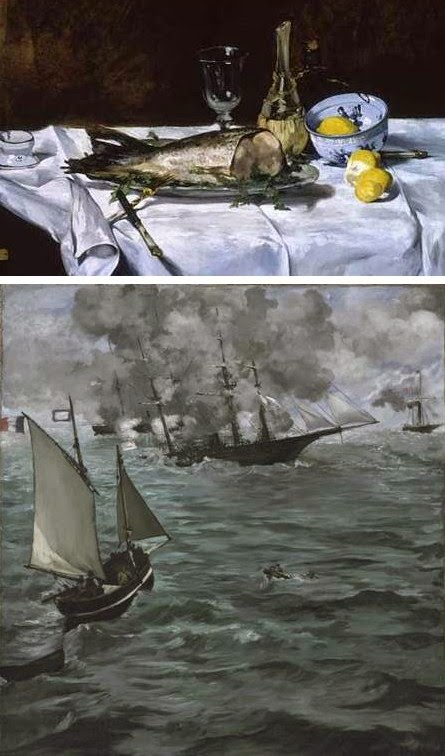
But it was on his return to Paris in 1872 that Durand-Ruel acquired at considerable cost a large number of works by Manet, for example, The Salmon (1869,  below top) and The Battle of the USS Kearsarge and the CSS Alabama (1864, below lower). The latter is an imaginative reconstruction by Manet who painted the Kearsarge at Boulogne after the incident.


Acquisitions of works by Sisley – The Ferry of the Ile de la Loge: Flood (1872, below top left) and Degas – Horses before the Stands (c1866-8, below top right) and Monet - Railroad Bridge, Argenteuil (1873, below lower) were made in the same year, Durand-Ruel not only buying in quantity from his favoured artists but also paying for their work in advance.


At the time of the 1874 First Impressionist Exhibition, Durand-Ruel was in temporary financial difficulty but was able to lend it some of his pictures. By 1876 he was able to take an active part in the Second Impressionist Exhibition and the National Gallery has brought together eight of the 250 works shown then, including Monet’s Springtime (c187, below top) and Degas’ Peasant Girls bathing in the Sea at Dusk (c 1869-75, below lower), both causing controversy at the time.


By the 1880s Durand-Ruel was in a position to put on solo exhibitions for his artists, the case study for this show being Monet with six canvases from 1883, including The Train in the Snow (1875, below top) and The Galettes (1882, below lower).


In 1892 Durand-Ruel displayed in his gallery Monet’s Poplars series, five of the original 15 being brought together again at the National Gallery. By then he had established himself in the New York with the 1886 (Works in Oil and Pastel by the) Impressionists of Paris exhibition and was selling to wealthy American collectors works like Monet’s Autumn Effect at Argenteuil (1873, below top) and Degas’ The Ballet Class (c1880, below lower).


The exhibition ends with a selection of the works Durand-Ruel showed at the Grafton Galleries in London in 1905 – apparently the largest Impressionist exhibition ever held. These include one of the National’s own Degas, Miss La La at the Cirque Fernando (1879, below left), Monet’s The Coal Carriers (c1875, below right top) and Morisot’s dazzling Woman at her Toilette (c1875-80, below right lower).


Wonderful though this show is, I do have a minor reservation about its title: “Inventing Impressionism” – if anyone invented Impressionism surely it was Monet in 1872 with Impression, soleil levant later shown at the 1874 exhibition? Although I can understand why “Marketing Impressionism” or, worse still, “Branding Impressionism” wouldn’t do. However, when it was at the Musée du Luxembourg earlier the show was called Paul Durand-Ruel Le pari de l’impressionnisme (poster below left**), literally ‘the bet on impressionism’ and, if that was acceptable in Paris, I can’t help wondering whether “PD-R the man who gambled on Impressionism” or even “Gambling on Impressionism” might have been both acceptable and more accurate here.


After David Hockney attended the Monet retrospective in Chicago in 1996 he commented:
A great artist, a very great artist. Very finely painted, superb condition now. What? A hundred years old? He knew exactly which paint to use and his work remains in marvellous condition. (Hockney on Art, page 204)
In contrast with the state of some of van Gogh’s works, as touched on in a recent post here. Van Gogh, of course, did not have the benefit of financial support from a Durand-Ruel to assist in the purchase of quality materials. Something which the exhibition hardly touches on is that Durand-Ruel was not exclusively focussed on the Impressionists. Although the term Post-Impressionism would not be invented until 1910, Cézanne featured in the Grafton Galleries exhibition and Seurat’s Bathers at Asnières, to be seen upstairs in the National Gallery, had appeared in the 1886 New York exhibition.

The last time I saw so many Impressionist works in one place was in London in 1973. Unbelievable as it may seem now, the UK was celebrating its entry to the European Economic Community (as the EU was called at the time). The Arts Council’s contribution to this jamboree (Fanfare for Europe) was The Impressionists in London at the Hayward Gallery, with 58 works (though including six by Derain). Looking at the catalogue I noticed the detailed Chronology by Anthea Callen and reproduce it below as it seems so helpful, particularly in the UK.

Inventing Impressionism: The Man Who Sold a Thousand Monets continues until 31 May.

*(Not so) Young French Artists
Monet 1840-1926, so 36 in 1876, the year of the Second Impressionist Exhibition
Degas1834-1917, 42
Manet 1832-1883, 44
Renoir 1841-1919, 35
Pissarro 1830-1903, 46
Sisley 1839-1899, 37

** with Renoir’s Dance at Bougival (centre) and Dance in the Country (right), both 1883. The latter also hang in Durand-Ruel’s grand salon.


22 February 2013

Manet Portraits at the RA


It must have seemed a good idea at the time for the Royal Academy to put on the first major exhibition of Manet’s portraiture in the UK, Manet: Portraying Life, which has now arrived in London after showing at the Toledo Museum of Art. But not so easy to put into practice. For a start Olympia 1863, Le Déjeuner sur l’Herbe 1862/3 and The Balcony 1869, all pictures highly relevant to the theme and to the pivotal position which Édouard Manet (1832-83) occupies between the traditions of the Salon and Modernism, are never (well, hardly ever - see Update 7 March below!) loaned by the Musée d’Orsay. Secondly, no more than 54 works make up the show, a surprising number of which are unfinished. One picture, Interior at Arcachon 1871 is making its second appearance at the RA in five months. But thirdly, and more fundamentally, what is a portrait as opposed to a picture which includes one or more human figures?

The answer, I would guess, is something to do with the indication of character and personality which the painter conveys in the portrait and through the immediate context chosen for the subject. On that basis, there are some fine portraits in the RA show, for example those of Emile Zola 1878, Berthe Morisot with a Bouquet of Violets 1872 (detail in banner above), Stephen Mallarmé 1876 (below), and The Luncheon, 1868, which primarily depicts Léon, the son of Manet’s wife (left).


But others are barely portraits, for example the players in A Game of Croquet 1873 (above), despite its considerable interest in terms of the separation of Manet from the Impressionists. Again, in what sense is the National Gallery’s Music in the Tuileries Gardens 1862, on solitary display in the second gallery and provided with a who’s-who of the 20 individuals in the picture, a work of portraiture (below)?  A portrait of a sector of contemporary society, perhaps.
 

The absence of the Musée d’Orsay’s Le Déjeuner sur l’Herbe is mitigated to some extent by the presence of the Courtauld’s smaller later c1863-8 version. However, the latter’s generosity didn’t extend to a loan of Suzon at her [The] Bar at the Folies-Bergère 1882 (below right), which would have been preferable to so much Victorine Meurent, however fine The Railway 1873 may be.


The small scale of the exhibition helps to explain why Gallery 3 is given over to Manet’s timeline and maps of Paris and France - not that Manet spent much time outside the former. His presence in Arcachon stemmed from his leaving Paris during the period of the Commune, unlike Courbet (who, by the way, appears in the left part of Monet’s version of Le Déjeuner sur l'herbe 1865-1866).

The RA’s show was given considerable media coverage at the start of the year and it certainly provides an opportunity to see significant works by a major artist and to appreciate his skill in painting in black and dark brown which is hardly apparent in reproductions. Nonetheless I do wonder whether some visitors will be disappointed, particularly at a full ticket price of £15. Reviving my 'anticipointment index' of a year ago, I rate it at 3 out of 5, the lower being the better. Manet: Portraying Life continues to 14 April.


UPDATE 7 March

The Musée d’Orsay, with the special permission of President Hollande, is going to lend Olympia (above left) for the first time to an exhibition in Venice this year.

18 July 2012

Paintings from the Clark at the RA

The Royal Academy in London is showing its Summer Exhibition until 12 August. As usual the forces of taste, money and talent seem to achieve a balance in the form of red spots adjacent to things wondrous, weird or woeful, and more of them than ever. But this year it is possible to escape to the Sackler Wing to see something truly wonderful. The Sterling and Francine Clark Art Institute in Williamstown, Massachusetts, while under renovation, has sent some of its collection of 19th century French paintings on a three-year world tour. Their fifth stop is the RA, hence the exhibition, From Paris: A Taste for Impressionism Paintings from the Clark.
 

Most, but not all, of the pictures are Impressionist, with more than 20 by Renoir and others by Manet, Monet, Pissarro, Degas, Sisley and Morisot. These are put in the context of earlier 19th century French art and some of the conventional academic work of the time. Their quantity and quality reflects the Clarks’ taste having matched their substantial resources at a time when such works were expensive rather than only affordable in ones or twos for billionaires and oligarchs.


Although the Clark often lends to London exhibitions (Lautrec’s Jane Avril was at the Courtauld last year), many of the pictures at the RA are unfamiliar, so visitors might be struck by the colouring and composition of Renoir’s Onions (above), and (below) Manet’s Interior at Arcachon (with its bay on the Atlantic coast of SW France in the background).


There is also a chance to see a Degas, Dancers in the Classroom, which didn’t come to the RA for last year’s Degas and the Ballet.

Quite why so many of the Clarks’ receipts from Knoedler & Co and others are on display is unclear. From Paris: A Taste for Impressionism Paintings from the Clark continues until 23 September, and anyone who is interested in Impressionism will want to see it.

(‘Anticipointment rating’ 1 – out of 5, the lower the better)