Showing posts with label World War 1. Show all posts

7 April 2016

Churchill and the Appeasers, Johnson and the Remainers

Would a Prime Minister Johnson "forgive and understand" their wrong-headedness?

Back in February, I remarked in a post here that:
There is even one school of thought that whether the result [of the Brexit referendum] is leave or remain, Boris Johnson will become the next leader of the Conservative party and therefore Prime Minister
and, if anything, this outcome seems more likely, not less. In fact, if being taken seriously is a measure, recent excoriating attacks on Johnson by, for instance, Matthew Parris on 26 March in The Times (Tories have got to end their affair with Boris, Charm can make us forget the dishonesty and recklessness that would be ruthlessly exposed if he became leader) and Nick Cohen in the Guardian a few days later (Boris Johnson. Liar, conman – and prime minister? The mayor of London has been treated with woozy indulgence by the media. But Britain may pay the price), suggest much more likely. Reacting to Parris, John Rentoul in the Independent was calm, It's time to get used to the idea of living under Prime Minister Boris Johnson, or perhaps just resigned.

Not long before, I had come across the biography which Johnson had written in 2014, The Churchill Factor: How One Man Made History. Reviewers tended to regard it as very readable in the style of Johnson’s Daily Telegraph opinion pieces which appear most Mondays (at £5000 a time they say), as not adding much to the huge amount of literature on his subject already available and as being as much about Johnson as Churchill.

It occurred to me that if Johnson were to become PM after a Brexit vote, he would be leading a Cabinet many of whom had been "remainers". How would he deal with them? Would his portrayal of Churchill who, after only three weeks as PM and in a much greater crisis in 1940, had to work with senior members of a Cabinet who had been advocates of appeasing Hitler, offer any insights?

Rather to my surprise, Chapter 1 plunges straight in at this point in Churchill’s life with The Offer from Hitler, made via Italy to negotiate an end to hostilities. This was put to the Cabinet in May 1940 by Lord Halifax, the Foreign Secretary and long-term appeaser of Hitler:
[Halifax] was tall, very tall; at 6 foot 5 he loomed about ten inches above Churchill – though I suppose advantage matters less around a table. (page 11)
Johnson is no more than 5 foot 10 by the way. Later after describing the Cabinet’s deliberations, Johnson comments:
It makes one cringe, now, to read poor Halifax’s defeatism; and we need to forgive and understand his wrong-headedness. (page 16)
and later:
All we are saying – in mitigation of Halifax – is that in seeking peace, he had the support of many British people, at all levels of society. (page 17)
Over 200 pages later (Johnson’s book is thematic in structure, not chronological) Halifax re-appears in 1941, prior to Pearl Harbor and the USA’s entry to WW2, as
… the British ambassador in Washington. This was none other than our old friend the Earl of Halifax: the beanpole-shaped appeaser - he who used to go hunting with Goering. Halifax was the British envoy charged with appealing to the finer feelings of the United States and he was having a terrible time. Shortly after arriving he is said to have sat down and wept - in despair at the culture clash. He couldn't understand the American informality, or their habit of talking on the telephone or popping round for unexpected meetings. In May 1941 the aristocratic old Etonian endured fresh torment when he was taken to a Chicago White Sox baseball game and invited to eat a hotdog. He refused. Then he was pelted with eggs and tomatoes by a group called the Mothers of America. Even for an appeaser, it seems a hell of a punishment. (page 247)
Johnson, if not inclined to vindictiveness, at least seems to have a taste for schadenfreude. He fingers a few other appeasers, for example:
Rab Butler, then a junior Foreign Office minister, was caught telling a Swedish diplomat that he thought Britain should do a deal – if Hitler offered the right terms (page 230)
returns to Johnson’s sights
… Tory drips such as Butler (the old appeaser) … (page 288)
So perhaps Tory remainers shouldn’t hold out too much hope of forgiveness and understanding from a Prime Minister Johnson.

There are some good things in The Churchill Factor. Johnson gives a whole chapter, An Icy Ruthlessness, to the decision to destroy the French fleet at Mers-el-Kébir, a tragedy which the British tend to overlook when revisiting the events of 1940. And another, The Ships that Walked, to Churchill’s sponsorship, when at the Admiralty during WW1, of the initial development of the tank by the Directorate of Naval Construction.

Unlike some celebrity writers, Johnson is happy to give credit to various helpers in the Acknowledgements, in particular Dr Warren Dockter, but my favourite is the one to a fellow Old Etonian:
David Cameron did some invaluable devilling into the exact locations of the pivotal meetings in May 1940 – not at all clear in Lukacs, for instance. (page 361/2)


UPDATE 24 APRIL 2016

Remarks by Johnson about President Obama at the time of the visit to London have led to Borises being sold heavily in the reputations market in the last few days – perhaps never to recover, although there are still 60 days to go before the Referendum.

Earlier in the month Johnson had published his tax return:


 - his earnings from the Daily Telegraph seem to match their reputation. In The Churchill Factor (pages 72 and 73), Johnson dismisses Evelyn Waugh’s criticisms of Churchill’s literary style:
Is it that Waugh was a teensy bit jealous? I think so; and the reason was not just that Churchill had become so much more famous than Waugh had been, by the time he was twenty-five, but that he had made such stupendous sums from writing. And that, for most journalists, alas, is the truly sensitive point of comparison. (page 73)

10 August 2015

The Frankton Memorial, Le Verdon-sur-Mer

There has been a revival of interest in the December 1942 Operation Frankton in the last few years. Better-known in the past as the Cockleshell Heroes operation, it was a clandestine attack on German shipping in Bordeaux harbour mounted by twelve Royal Marines commandos under Major HG "Blondie" Hasler. Infiltrated by submarine to the mouth of the Gironde estuary, the plan was to navigate their way by two-man canoes (“cockleshells”) up the heavily defended estuary for 70 miles to the harbour.

From www.c-royan.com
Five canoes set off with ten men: two died of hypothermia, six were captured and executed by the Germans, two survived including Hasler. Six ships were damaged, one extensively. Far from being futile, Frankton demonstrated the need for inter-agency cooperation while planning for the invasion of France in 1944.

In 2012 Paddy Ashdown’s A Brilliant Little Operation: The Cockleshell Heroes and the Most Courageous Raid of World War 2 was published, a BBC2 Timewatch documentary, The Most Courageous Raid of WWII, narrated by Ashdown, being shown the previous year. Ashdown’s account offers perspectives from someone who is both a senior politician and a former Royal Marines officer who had met Hasler. The documentary and book reveal that unknown to the Combined Operations Command who controlled the Marines, the Special Operations Executive were running similar operations at the same time. Inter-agency issues are explored further in Tom Keene’s Cloak of Enemies: Churchill's SOE, Enemies at Home and the Cockleshell Heroes, also published in 2012. Prior to these two books, the best-known account of the operation had been C. E. Lucas Phillips’ Cockleshell Heroes published in 1956.

In 2011 a memorial commemorating Frankton was installed on the southern edge of the mouth of the estuary at the Pointe de Grave in the commune of Le Verdon-sur-Mer (33). As it is fairly remote, two hours’ drive from Bordeaux, the photographs below may be of interest to anyone unable to visit the site. The memorial was designed by Baca Architects and constructed by Albion Stone Restoration for the Royal Marines Association. Both companies’ websites are worth consulting, Baca explaining that:
The Memorial remembers the 10 courageous Royal Marines, the bravery of the captain and crew of the submarine HMS Tuna and the courageous French citizens who assisted the Royal Marines. The four substantial Portland stone blocks step up towards the front of the memorial, where one may envisage a symbolic representation of the Royal Marines emerging from the sea, standing proud. As one moves around the memorial, different compositions are revealed. The separate stones create individual settings for insignia, as well as stones at the flanks to show the story of mission.
Albion explain that:
The staggered blocks create a dynamic ensemble, growing bolder to the front. The blocks are adorned with polished plaques that commemorative the heroism and retell the story. Symbolically the four stones represent four figures emerging from the sea.


and offer descriptions:


Stone 1: Crests of the participants in Operation Frankton: The Royal Navy, Combined Operations Command, The Royal Marines, The French Resistance


Stone 2: This carries the text tributes in English and French to the gallant 10 Royal Marines, and each named beneath a carved floral motif of the Rose, the Thistle and the Shamrock, representing the birth places of the men England, Scotland and Ireland. There follows tributes to the Capt and crew of HMS Tuna and to the courage of local French people who helped the marines, three, named on this plaque who were deported to concentration camp in Germany, and did not return arrested for being associated with Op Frankton, coincidentally, except for one Lucien Gody who raced late at night to warn Hasler and Sparks to flee their hiding place as Germans were close by. At the base are the words of Lord Mountbatten about the 10 men. 


Stone 3: There is a depiction of the Submarine HMS Tuna, together with the five canoes just after the launch, where they were to be together for the very last time. Two crews were lost in two vicious Tide-races on the first night, two men died of hypothermia and two were captured when they arrived exhausted on the beach and were executed four days later. [The quotation is from the C. E. Lucas Phillips’ book, mentioned above.]


Stone 4: This carries the narrative account of Operation Frankton, again all repeated in French.

The memorial is constructed in Grove Whitbed stone which has a surface markedly different from the limestone widely used for buildings in the Gironde.


The Pointe de Grave is exposed to salt water spray from the Bay of Biscay and the effects of corrosion are already beginning to show on the Frankton memorial. Nearby is another memorial which commemorates the American Expeditionary Forces under General Pershing which arrived in France in 1917. Hopefully it will receive some restoration before the centenary in 2017.


20 October 2014

Crucible2 at Gloucester Cathedral

Crucible2 is the second sculpture exhibition at Gloucester Cathedral curated by Gallery Pangolin of Chalford, Gloucestershire. The first was in 2010 with 76 contemporary sculptures; this time 100 exhibits by 61 sculptors are set in and around the cathedral. Key pieces, in the view of the curators, include works by Kenneth Armitage, David Backhouse, Ralph Brown, Lynn Chadwick (Jubilee IV in the poster,left), Ann Christopher, Antony Gormley and William Tucker. The 20th and 21st century works are often positioned in startling and stimulating contrast to their mostly English Gothic surroundings. For example, Breon O’Casey’s Large Cockerel (circa 2000, below) in the Cloisters with the earliest fan-vaulting in England circa 1350:


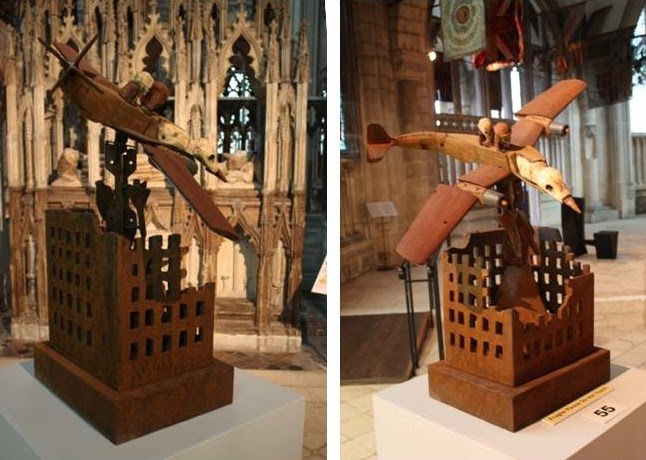
The most celebrated monument at Gloucester is the tomb of Edward II circa 1350, seen below left in the background to Steve Hurst’s Gloucester in Berlin. Hurst, born in 1932 and a witness to bombing in World War 2, sees it as concerning “… the bombing of civilians no matter what their country or who launches the bombing aircraft. It is a personal attempt to regain the viewpoint of a child”.


In the background (right) are the laid up colours of the Gloucestershire Regiment. They appear again (below right) behind Paul Wager’s Omnibus which marks the centenary of the Great War 1914-1918. Similar sentiments inform Deborah van der Beek’s Collateral (below right) – eight million horses died in that war - but it was cast around spent munitions from the conflicts in Iraq and Afghanistan which brought the expression “collateral damage” into common use.


The monument near Damien Hirst’s Anatomy of an Angel (Black) (2008, below) is to Sarah Morley, 29, a mother of four who died a few days after “having sustained the pains of Childbirth at Sea” while returning from Bombay in 1784.


Among the pieces I liked were Antony Gormley’s Pose (2012, below) with In Man’s Nature by Jon Buck behind).


Bryony Marshall’s DNA – Helix of Life (below, left) marks the 60th anniversary of the discovery of DNA. Subsequently mitochondrial DNA was identified as having been passed down to us all from a woman in East Africa about 150,000 years ago, known as Mitochondrial Eve, the inspiration for a sculpture of the same name by Sue Freeborough (below right):


The photograph below left of Geoffrey Clarke’s Taunton Deane Crematorium: Test Panel does not do justice to the colours of the glass. To the right is Sarah Lucas’s Realidad (2013), one of her NUDs series shown as bronzes at the Venice Bienniale in 2013.


John Humphreys’ Ipsius Imago a Latere Extensa probably succeeded as the artist wished in puzzling and confusing the viewer:


but perhaps was not as happily placed as the Eduardo Paolozzi plaster Vulcan near a strange moustachioed carving, perhaps a millennium older:


Among the sculptures in the open were Bruce Beasley’s Breakout II (below, left)in the Cloisters and outside Kenneth Armitage’s final work, Reach for the Stars (below, right).


Crucible2 ends on 31 October. There is no admission charge but a helpful map costs £2 and there is a £3 charge for photography. The catalogue at £16 is both good value and helps support the Cathedral.


UPDATE 2 NOVEMBER 2015

After posting about Beyond Limits: The Landscape of British Sculpture 1950-2015 held at Chatsworth House from 14 September to 25 October 2015, I thought it would be useful to add an image of Gavin Turk's bronze, Nomad (2002, below - and in other colours):


Another version of Chadwick's Jubilee can be seen there, as well.


15 June 2014

Two London Exhibitions - Better late than never

This post is mostly for the record, both these shows having closed on 15 June, but I was glad to have been able to finally get to see them just a few days earlier.

Veronese 


At the National Gallery, Veronese Magnificence in Renaissance Venice fully lived up to its title. Paolo Bazaro (also Caliari), who came from Verona and so was known as Veronese, lived from 1528 to 1588. The time line on the way into the exhibition helpfully explained that these years spanned the establishment of the Church of England, the birth of Shakespeare and the Spanish Armada. Then a chronological sequence of fifty works followed his artistic progress from his home town to Vicenza, Mantua and, from1555, Venice. Some of these were being reunited at the National Gallery, which has ten Veroneses of its own, for the first time in many years.

Many of the pictures were of religious scenes and intended to decorate churches (12 altarpieces), some were based on classical mythology and a few were portraits. In these, Veronese carefully documented the opulent costumes of his wealthy aristocratic subjects, but still managed to convey something of the sitter's personality, as for example in Portrait of a Lady, known as the 'Bellamy Nani' (about 1560-5, below).


I suppose that fewer of us than would have been the case in the past have the biblical awareness to appreciate immediately the content of, say, Christ and the Centurion (about 1750, below)


or to know that a jar is associated with Mary Magdalene. Fortunately, the curators compensated for this in their guide. Some of the exhibits were larger than any I had seen before in a temporary exhibition. For example, The Martyrdom of Saint George (about 1565, below), removed from the church of San Giorgio in Braida, Verona for only the second time in its existence, is approximately 4m by 3m.


The curators and lenders must have faced considerable problems in ensuring its secure and safe transit. Knowing all too little classical mythology, I was also grateful for being provided with brief accounts of works like Perseus and Andromeda (1575-80, below).


However ill-equipped some of us might be to appreciate the biblical and classical references, the details in the paintings revealed an unfamiliar and fascinating 16th century world full of consiglieri, servants, horses, dogs and monkeys. Sea-borne trade was the economic basis of Venice’s wealth and I liked the two Allegories of Navigation, about 1555-60, one with a Cross-Staff (left) and the other with an Astrolabe (right).


No doubt like many others, I left the exhibition thinking it was time to visit Northern Italy, particularly Venice, again. A complementary exhibition, Paolo Veronese L'illusione della realtà, will be at the Museo di Castelvecchio, Verona, from 5 July – 5 October 2014).


Great War Portraits

The Great War in Portraits at the National Portrait Gallery was a small and rather crowded show scheduled to end before the centenary of the start of World War 1 had been reached, or even that of the assassination of Archduke Franz Ferdinand. Perhaps the current Director of the NPG wanted to do something on the subject before he leaves, or it was a Whitehall priority. I can't believe it will be the Gallery's last word on the War before 2018.  Nonetheless, this exhibition quite rightly induced sombre reflection. What a contrast there was between Orpen's slick portraits of the top brass, no doubt unfailingly pleasing to their subjects (particularly himself), and the wall of photographs showing the haunted faces of the ‘Poor Bloody Infantry’. Field Marshal Sir Douglas Haig (1861–1928), KT, GCB, GCVO, KCIE, Commander-in-Chief, France, from 15 December 1915 (1917, below left) and Self-portrait (1917, below, right).


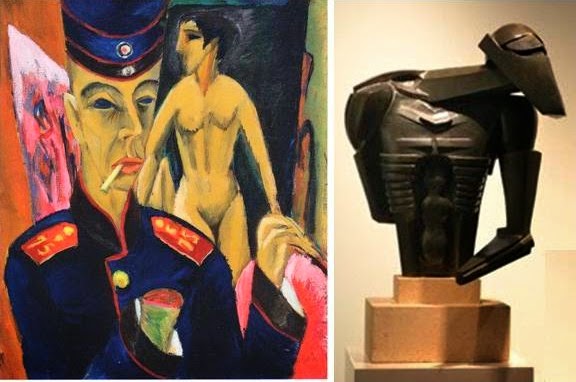
I saw for the first time some of Henry Tonks' famous pastel drawings of injured faces (they feature in Pat Barker’s Toby’s Room). The text didn’t point out that Tonks was originally trained as a surgeon. There was also an opportunity to see a work by the Die Brücke expressionist Ernst Ludwig Kirchner: Selbstbildnis als Soldat (Self-Portrait as a Soldier, 1915, below left) and Jacob Epstein’s Torso in Metal from The Rock Drill 1913 – 14 (below, right).


 A bigger show with more German art would almost certainly have been of more value. Also, while screening German as well as British contemporary newsreel footage was highly desirable, it made the exhibition seem even more crowded. It might have been better left to the BBC, who will probably show most of what is worth seeing in the next four years.


5 January 2014

2014 and All That

Like Sam Cooke I “Don’t know much about history … But I do know that one and one is two” and know enough maths to be sceptical about what non-mathematicians call round numbers, the ones that end with one or more 0s. But, probably because homo sapiens has two hands with five digits and therefore adopted the decimal system, we want to attach significance to the occurrence of numbers like the millennium in 2000 and the 100th anniversary of the outbreak of the First World War in 1914. The latter looks as though it will provide a journalistic field day for at least a year. For example, in an article, China must not copy the Kaiser’s errors, last month in the Financial Times (£), Martin Wolf asked:
Will we sustain an open global economy while also managing tensions between a rising autocracy and democracies in relative economic decline? That was the question posed by the arrival of imperial Germany as Europe’s leading economic and military power in the late 19th century. It is the question posed today by the rise of communist China. Now, as then, mistrust is high and rising. Now, as then, actions of the rising power raise risks of conflict. We know how this story ended in 1914. How will the new one end, a century later?
and the big 100 has set off high-powered academics like Margaret MacMillan who has produced a Brookings Essay, The Rhyme of History, (horrid to read on-screen, the text having been invaded by the graphics) in the ‘dreadful lessons’ genre. For her:
While history does not repeat itself precisely, the Middle East today bears a worrying resemblance to the Balkans then.
whereas
China is a rising power but its preoccupations are likely to be focused on Asia. Further afield it will concentrate, as it is doing at present, on securing the resources it needs for its economy, while probably being reluctant to intervene in far-off conflicts where it has little at stake.
Reassuring, then. But what about two distinctly non-round numbers, 76 and 74, which arise not from the difference between now and 1914, but now and 1938 and 1942?  I recently came across a post by Geoff Wade on The Strategist - The Australian Strategic Policy Institute Blog called China’s six wars in the next 50 years. It’s definitely worth reading in full – he is commenting on:
... an article which appeared on the website of the Chinese news agency Zhongguo Xinwenshe (Chinese, English translation here) in July this year. Entitled ‘Revealing the Six Wars China Must Fight in the Coming 50 Years’ (曝光中国在未来50年里必打的六场战争), the article is another manifestation of the hyper-nationalist attitude seen within some parts of the PLA. However, that an article of this nature was carried by a PRC national news agency suggests that it was approved at a very high level. 
The six ‘inevitable’ wars suggested in the article’s title are presented in the chronological order in which they will take place: 
1. The war to unify Taiwan (2020–2025) 
2. The war to recover the various islands of the South China Sea (2025–2030) 
3. The war to recover southern Tibet (2035–2040) 
4. The war to recover Diaoyutai and the Ryukyus (2040–2045) 
5. The war to unify Outer Mongolia (2045–2050) 
6. The war to recover the territory seized by Russia (2055–2060) 
… the claims to territories which this article avers need to be ‘recovered’ through warfare are long-standing and are remarkably congruent with a 1938 map of ‘China’s shame’ authorised by the Ministry of the Interior of the Republican Government which shows the areas torn from China by imperialists — European and Japanese. (See map below) The ‘lost’ Chinese territories on this map include not only the Russian Far East, the Ryukyus, Taiwan and the South China Sea, but also Korea, Vietnam, Cambodia, Laos, Thailand, the Malay Peninsula and Singapore, Myanmar, Nepal, parts of Pakistan and most of Central Asia.

The map reminded me of the Greater East Asia Co-Prosperity Sphere, the programme for Imperial Japan’s expansion and aggression which reached its maximum extent in 1942. The best map of this that I’ve found is:


At which point an Infographic by John Saeki, AFP graphics editor in Hong Kong, on the China-Japan military balance (or the China-Japan+US military balance) might be food for thought:


This is based on data from the International Institute for Strategic Studies, so it seems appropriate to draw readers’ attention to an article by their Director of Transnational Threats and Political Risk, Nigel Inkster, Conflict Foretold: America and China, published last October. Again definitely worth reading in full, not just because of the author’s background, but also for the incisive summary of the main academic security-dilemma theories which it provides (none based on round numbers), and the fact that he chooses to concentrate on space and cyber as areas of contention and uncertainty. He concludes:
… the Sino-American relationship has to be seen in terms of a dynamic involving one power in relative decline, though still globally pre-eminent, coming to terms with another which is rapidly rising and naturally driven to challenge the status quo imposed and policed by the former. It must also be viewed in light of two guiding political philosophies that are more or less in polar opposition to one another. Even in the best of circumstances, this would be a recipe for tension and competition, exacerbated by the chronic inability of each state’s policymakers to see the world from the other’s perspective.


UPDATE 6 JANUARY

Busy with  other things, I missed a significant article by Liu Xiaoming, the Chinese ambassador to the United Kingdom, which appeared in the Daily Telegraph on 2 January. Called China and Britain won the war together, its thesis was that “Japan’s refusal to face up to its aggressive past is posing a serious threat to global peace”. The particular issue it focussed on was Shinzo Abe, the Japanese prime minister, paying homage at the Yasukuni Shrine, an action which the Chinese clearly perceive as offensive. The article is skilfully written for a UK audience, starting with a reference to Harry Potter:
In the Harry Potter story, the dark wizard Voldemort dies hard because the seven horcruxes, which contain parts of his soul, have been destroyed. If militarism is like the haunting Voldemort of Japan, the Yasukuni Shrine in Tokyo is a kind of horcrux, representing the darkest parts of that nation’s soul.
and ending with a reference to the forthcoming film, The Railway Man:
It tells the tragic story of a British PoW tortured by the Japanese in the Second World War. The film is not only about the atrocities committed by his Japanese captors, but also how one of them is harrowed by his own past. His redemption is only effected through deep remorse and penitence. 
China and Britain were wartime allies. Our troops fought shoulder to shoulder against Japanese aggressors and made enormous sacrifices. Sixty-eight years have passed since that horrible war. Yet there are always some incorrigible people in Japan who show no signs of remorse for war crimes. Instead, they seek to reinterpret history. They pose a serious threat to global peace. The Chinese will not allow such attempts. I am sure British and all other peace-loving folk will not remain indifferent. 
China and Britain are both victors of the Second World War. We played a key role in establishing the post-war international order that has delivered great benefits for mankind. Our two countries have a common responsibility to work with the international community to oppose and condemn any words or actions aimed at invalidating the peaceful post-war consensus and challenging international order. We should join together both to uphold the UN Charter and to safeguard regional stability and world peace.
Rather different in tone from the Beijing Global Times which pointed out last month during David Cameron’s visit to China that:
The Cameron administration should acknowledge that the UK is not a big power in the eyes of the Chinese. It is just an old European country apt for travel and study. This has gradually become the habitual thought of the Chinese people.
Today, Keiichi Hayashi, Japan’s ambassador to the United Kingdom, had his say in the Daily Telegraph, in an article, China risks becoming Asia’s Voldemort. He defends Abe’s visit to Yasukuni, the most recent of many by Japanese prime ministers, and points out that:
As in the case of the Japan-UK relationship, exemplified in the meeting between Eric Lomax and Takashi Nagase described in the book The Railway Man, the only way to heal the wounds of the past is through the pursuit of reconciliation. But, critically, it takes two for this to be achieved. 
… East Asia is now at a crossroads. There are two paths open to China. One is to seek dialogue, and abide by the rule of law. The other is to play the role of Voldemort in the region by letting loose the evil of an arms race and escalation of tensions, although Japan will not escalate the situation from its side. The answer seems obvious. Although China has so far refused to enable dialogue between our leaders, I sincerely hope that it will come forward, rather than keep invoking the ghost of “militarism” of seven decades ago, which no longer exists.
I can’t help wondering whether Japan and China are taking advantage of this old European country’s timezone and being anglophone to express their views because it would be too provocative to do so directly in the US.


UPDATE 7 JANUARY

 The Daily Telegraph today has a third piece on this subject by an ambo, in this case our former man in Hanoi, John Everard, who was British Ambassador to North Korea, 2006-2008. His article, Are China, Japan and South Korea fanning the flames of war?, provides a  summary of  one of the island problems and the recent ADIZ and points out the lack of any regional forum in which they could be addressed.  The article could have done with a map and ends with a 1914/2014 round numbers homily.

This map from Money Morning is helpful and shows that Senkaku/Diaoyu is just one part of a problem which involves states other than the three Everard mentions.