Showing posts with label Expressionism. Show all posts

15 June 2014

Two London Exhibitions - Better late than never

This post is mostly for the record, both these shows having closed on 15 June, but I was glad to have been able to finally get to see them just a few days earlier.

Veronese 


At the National Gallery, Veronese Magnificence in Renaissance Venice fully lived up to its title. Paolo Bazaro (also Caliari), who came from Verona and so was known as Veronese, lived from 1528 to 1588. The time line on the way into the exhibition helpfully explained that these years spanned the establishment of the Church of England, the birth of Shakespeare and the Spanish Armada. Then a chronological sequence of fifty works followed his artistic progress from his home town to Vicenza, Mantua and, from1555, Venice. Some of these were being reunited at the National Gallery, which has ten Veroneses of its own, for the first time in many years.

Many of the pictures were of religious scenes and intended to decorate churches (12 altarpieces), some were based on classical mythology and a few were portraits. In these, Veronese carefully documented the opulent costumes of his wealthy aristocratic subjects, but still managed to convey something of the sitter's personality, as for example in Portrait of a Lady, known as the 'Bellamy Nani' (about 1560-5, below).


I suppose that fewer of us than would have been the case in the past have the biblical awareness to appreciate immediately the content of, say, Christ and the Centurion (about 1750, below)


or to know that a jar is associated with Mary Magdalene. Fortunately, the curators compensated for this in their guide. Some of the exhibits were larger than any I had seen before in a temporary exhibition. For example, The Martyrdom of Saint George (about 1565, below), removed from the church of San Giorgio in Braida, Verona for only the second time in its existence, is approximately 4m by 3m.


The curators and lenders must have faced considerable problems in ensuring its secure and safe transit. Knowing all too little classical mythology, I was also grateful for being provided with brief accounts of works like Perseus and Andromeda (1575-80, below).


However ill-equipped some of us might be to appreciate the biblical and classical references, the details in the paintings revealed an unfamiliar and fascinating 16th century world full of consiglieri, servants, horses, dogs and monkeys. Sea-borne trade was the economic basis of Venice’s wealth and I liked the two Allegories of Navigation, about 1555-60, one with a Cross-Staff (left) and the other with an Astrolabe (right).


No doubt like many others, I left the exhibition thinking it was time to visit Northern Italy, particularly Venice, again. A complementary exhibition, Paolo Veronese L'illusione della realtà, will be at the Museo di Castelvecchio, Verona, from 5 July – 5 October 2014).


Great War Portraits

The Great War in Portraits at the National Portrait Gallery was a small and rather crowded show scheduled to end before the centenary of the start of World War 1 had been reached, or even that of the assassination of Archduke Franz Ferdinand. Perhaps the current Director of the NPG wanted to do something on the subject before he leaves, or it was a Whitehall priority. I can't believe it will be the Gallery's last word on the War before 2018.  Nonetheless, this exhibition quite rightly induced sombre reflection. What a contrast there was between Orpen's slick portraits of the top brass, no doubt unfailingly pleasing to their subjects (particularly himself), and the wall of photographs showing the haunted faces of the ‘Poor Bloody Infantry’. Field Marshal Sir Douglas Haig (1861–1928), KT, GCB, GCVO, KCIE, Commander-in-Chief, France, from 15 December 1915 (1917, below left) and Self-portrait (1917, below, right).


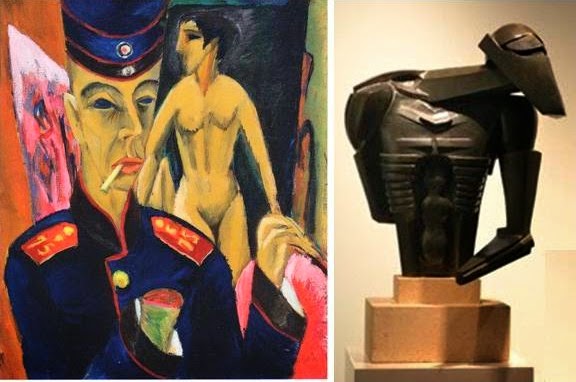
I saw for the first time some of Henry Tonks' famous pastel drawings of injured faces (they feature in Pat Barker’s Toby’s Room). The text didn’t point out that Tonks was originally trained as a surgeon. There was also an opportunity to see a work by the Die Brücke expressionist Ernst Ludwig Kirchner: Selbstbildnis als Soldat (Self-Portrait as a Soldier, 1915, below left) and Jacob Epstein’s Torso in Metal from The Rock Drill 1913 – 14 (below, right).

 A bigger show with more German art would almost certainly have been of more value. Also, while screening German as well as British contemporary newsreel footage was highly desirable, it made the exhibition seem even more crowded. It might have been better left to the BBC, who will probably show most of what is worth seeing in the next four years.


20 October 2013

Georg Grosz at Richard Nagy

George Grosz (or Groß, 1893‑1959) was first referred to here almost two years ago, and more recently I mentioned that some of his drawings are at Leicester. There seems to be only one of his paintings in a public collection in the UK, Selbstmörder (Suicide) 1916 owned by the Tate. Last year the Richard Nagy Ltd gallery showed the Silverman Collection of German and Austrian Expressionist art which included Grosz’s Tempo der Strasse (The Tempo of the Street, left). The Nagy gallery has included this picture in a new show of nearly 50 drawings, oils and watercolours, Georg Grosz’s Berlin: Prostitutes, Politicians, Profiteers, which, as they point out, is the first major exhibition in this country dedicated to Grosz since the Royal Academy’s retrospective in 1997.

The coarseness of Grosz’s work is not to everyone’s taste but his harsh satirical view of a ferocious crowded Berlin is a particular reflection of his times: German defeat in World War 1 and the exile of the Kaiser, hyperinflation, conflict between Communists and Nazis and the rise of Hitler. Most of the works are from 1918 to 1928, Grosz leaving Berlin for the US in 1932. He was a founder of Dada but his use of colour, often watercolour on a wetted surface, can be regarded as showing the influence of his Expressionist contemporaries, although he was undoubtedly familiar with Futurism and Cubism as well.


The Nagy exhibition (above) continues until 2 November, and worth seeing for anyone with an interest in inter-war European art.


19 September 2013

Expressionists and Picasso Ceramics in Leicester

Cultural affairs in the UK, apart from Scotland, are notoriously London-centric, and, of course, the visual arts are no exception. There are arguments for this state of affairs being desirable, for instance Brian Sewell writing in an article in 2007 about the British Art Show’s return to London:
It was damned silly of the Hayward Gallery, to which the show 'belongs', to let loose its grip and allow London to be deprived of it. I know all the arguments for sharing shows of every kind with the far-flung provinces and am wholly in sympathy with them, but London provides by far the largest audience and should never have been eliminated from the circuit. It is in London, more than anywhere, that continuity matters for both the artist and the informed critical audience. (Naked Emperors p28)
In the years since Sewell’s article, London’s national supremacy has become even more firmly established with its emergence as a major international centre for contemporary art. Louisa Buck explained in the autumn 2013 Art Quarterly how this came about, and where to find it at street level. 

However, even though most major exhibitions will always be in London, the establishment of Tate St Ives in Cornwall (South West England) and, more particularly, of Tate Liverpool has done something to redress the balance in England. The efforts made by the Public Catalogue Foundation to digitise the nation’s entire collection of oil paintings and the fact that their images have been made available through BBC Your Paintings are also steps in the same direction. There is also Christopher Lloyd’s In Search of a Masterpiece: An Art Lover's Guide to Great Britain and Ireland, which provides a helpful guide for art lovers as to what is worth seeking out and looking at outside, as well as inside, the M25.

In this spirit, this post will hopefully be the first of an occasional series about some of the good things to be found across England and Wales outside London, and not just in the South West.

Anyone with an interest in the origins of Expressionism, used as a blanket term for avant-garde German art from 1905 until the Nazi ascendancy in the 1930s, will find limited opportunities to see works in Britain. The Radev Collection, recently on tour, holds Blaue strasse c1916 by Jawlensky, a member of the Blaue Reiter group. Last year, the Richard Nagy gallery in London showed a selection from the Silverman Collection including works by Otto Dix, Luwig Meidner and George Grosz. But the best permanent collection covering Der Blaue Reiter and its predecessor, Die Brücke, is that of the New Walk Museum and Art Gallery in Leicester.  [Not on display until 2014]. The majority of the works are drawings and prints but particularly worth seeing is Franz Marc’s Rote Frau 1912 (left), “possibly the most important work by a German Expressionist to be found here [the UK]” according to Lloyd.

Lloyd does not mention that the New Walk Museum also holds the Attenborough Collection of Picasso ceramics, donated by Lord and Lady Attenborough to commemorate the members of their family who died in the Asian Tsunami in 2004. About 40 works (examples below) are on rotating display from a collection of 150 bought by the Attenboroughs from the Madoura pottery in Vallauris (near Antibes, France), starting in the mid-1950s.
 

Together, these ceramics and the Expressionist collection will make a visit to New Walk well worthwhile, once the latter element has returned in 2014.