Showing posts with label Claude Lorrain. Show all posts

8 December 2014

Constable at the V&A

Constable: The Making of a Master at the Victoria and Albert Museum, London aims:
… to offer a new interpretation of Britain’s best-loved artist. ... For the first time, Constable is presented alongside the old masters of classical landscape whose formal values he studiously assimilated. By combining the authority of their compositional ideas with a breathtakingly naturalistic vision that was entirely his own, Constable would ultimately transform the genre of landscape painting, and in the process shape the enduring popular image of the English countryside.
I wonder how many visitors will be surprised to learn that Constable (1776-1837), like other artists of his day, studied and emulated works by his distinguished predecessors. In his case these included Claude Lorraine (who influenced Turner), Rubens, Titian, Jacob van Ruisdael and, closer to home, Gainsborough and Thomas Girlin (an artist unknown to Your Paintings, it seems). The argument is manifestly well-made, for example by putting Claude’s Landscape with Hagar and the Angel (1646 left), with Constable’s Dedham Vale (1802, right):


And from Dulwich Picture Gallery, Jacob van Ruisdael’s Landscape with Windmills near Haarlem (c.1650-2, left) and Constable’s Landscape with Windmills near Haarlem, after Jacob van Ruisdael (1830:, right)


The exhibition also provides a chance to see some of Constable’s masterpieces in their original form, images that sadly are dulled by over-reproduction, for example The Hay Wain 1821:


and Salisbury Cathedral from the Bishop’s Ground, 1823:


There is much else that is far less familiar, for example the oil sketches which seem so ahead of their time like Brighton Beach (1824, below top) and Rainstorm over the Sea (1824–8, below, lower):


Constable tends to be associated with East Anglia (‘Constable country’), but, although he was not an adventurous traveller like Turner, he painted in the South West region beyond just Salisbury, for example nearby at Stonehenge, 1835:
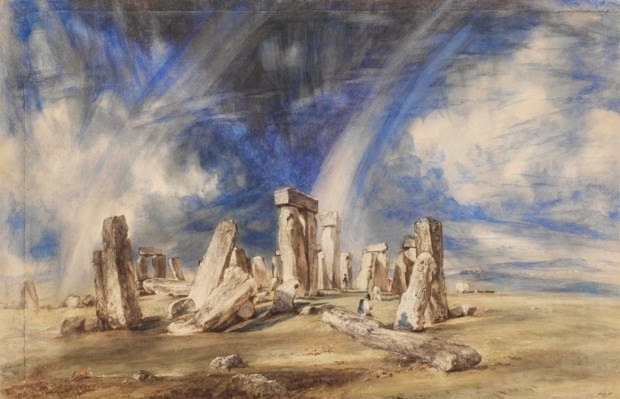

and at Gillingham Mill, Dorset, (1827, below, top) and Weymouth Bay with Approaching Storm (1819, below, lower):


Constable: The Making of a Master ends on 11 January 2015. Although enjoyable and informative, a full ticket price of £14 seems high when so many of the works have come from public collections, particularly the V&A’s own.


29 April 2012

Turner and Claude at the National Gallery, London

In a post last year I commented, after a visit to Claude Lorrain: The Enchanted Landscape at the Ashmolean in Oxford, that there were relatively few paintings being shown by comparison with the numerous drawings and etchings (13 vs 125). The National Gallery’s current spring exhibition, Turner Inspired: In the Light of Claude, provides an opportunity to see about 10 oils by Claude and 20 by Turner, and the ratio of paintings to other works is better balanced. The theme of the National Gallery (NG) show is Claude’s influence on Turner so the latter’s paintings being in the majority is as to be expected. Also Turner’s paintings are readily available in London, so many having been held by the NG and Tate Britain since his 1856 Bequest.

Joseph Mallord William  Turner (1775-1851) painted 200 years after Claude (1604-1682). But Claude became a major influence after Turner’s first encounter in 1799 with works in the possession of the dealer Angerstein (a collection which later became the kernel of the NG). Turner was impressed by and sought to emulate Claude’s ability to invest an ethereal quality to the light at the beginning and end of the day. An impressive example of this is A View of the Roman Campagna from Tivoli, Evening (below) on loan from the Royal Collection.


Turner left the NG his paintings Dido building Carthage and Sun rising through Vapour: Fishermen cleaning and selling Fish on the condition that they would be hung between two paintings by Claude: Seaport with the Embarkation of the Queen of Sheba and Landscape with the Marriage of Isaac and Rebecca and the exhibition hangs all these pictures in close proximity. Later works by Turner reveal his move away from Claude’s style (though commonalities remained – neither painter cared much for figures in their landscapes, preferring trees and water as subjects) to his later, more romantic and free-flowing style, much admired by the French impressionists, particularly Monet.

Turner Inspired: In the Light of Claude ends on 5 June and should not be missed by anyone interested in either of these painters or in the evolution of landscape painting.

2 December 2011

Landscapes in Oxford and Bath

In a post back in August I remarked in passing “should France ever leave the Eurozone, which may seem unlikely”. Now we are being told that the breakup of the euro is the subject of contingency planning in finance ministries, embassies and the headquarters of multinationals across the world. What could be a better way to escape briefly from the encircling economic gloom than two visits to Arcadia?

The Ashmolean in Oxford is showing Claude Lorrain: The Enchanted Landscape, the first major exhibition of his work in over a decade. Claude Gellée (c.1600–1682), spent most of his working life in Rome, but his origins were in the commune of Chamagne in the Duchy of Lorraine, (now in Vosges (88) in France; never Champagne as the Ashmolean press pack states, perhaps wanting to inject some fizz). His biographical details are unclear, he may even have been trained originally as a pastry-cook, but by his thirties he was settled in Rome and had begun to make a name for himself by painting port scenes and landscapes. During his long artistic career he had the patronage of royalty as well as popes and cardinals.

The exhibition is organised in three sections: firstly, sketches and drawings from the Roman countryside; then thirteen paintings mostly with classical (Aeneas and Dido in Carthage, left) or religious themes, all providing the enchantment promised by the show’s name; finally, etchings including the fascinating series of the fireworks in Rome in 1637.

Claude’s work was encountered and collected on the Grand Tour by the English aristocracy who later laid out their parklands in the spirit of his pastoral idyll. One English artist he had some influence over was Thomas Gainsborough (1727-88) whose landscapes are the subject of the Bath Holburne Museum’s second major exhibition since redevelopment, Gainsborough’s Landscapes: Themes and Variations. Although only six paintings are shown, these were well-chosen and helpfully complemented by drawings and prints, all skilfully curated by Susan Sloman. Gainsborough’s fame and livelihood came from his portraiture, particularly during the years 1759-74 when he lived in Bath, but as he said:
I’m sick of portraits and wish very much to take up my viol de gamba and walk off to some sweet village where I can paint landskips and enjoy the fag end of life in quietness and ease.
Perhaps this shows in his portrait of Mr and Mrs Andrews (below) in the National Gallery, London, which, although telling us all we might want to know about them, still manages to be 50% landscape.

Gainsborough painted a romantic view of the countryside around Bath but populated it with more realistic inhabitants, Peasants Returning from Market (left) or looking after pigs, than Claude’s paintings feature. The exhibition reminds us of our encircling economic realities when it explains that Bath’s popularity as an all year spa and resort depended on winter heating provided by the coal mined a few miles to the south of the city.

Economic reality may also be intruding in the way that shows are increasingly augmenting a relatively small number of paintings with drawings, etchings and so on (Table below). In so far as these lesser works add depth and focus and encourage a more scholarly approach in visiting exhibitions, this is probably not entirely a retrograde step. Anyway, given that paintings are inevitably more expensive to transport and insure, we are probably going to have to get used to it.


Claude Lorrain: The Enchanted Landscape continues at the Ashmolean until 8 January and then can be seen at the Städel Museum, Frankfurt from 3 February to 6 May 2012. Gainsborough’s Landscapes: Themes and Variations will be in Bath until 22 January and then the appropriate parkland surroundings of Compton Verney from 11 February to 10 June 2012. Let’s hope the eurozone will survive for both.