Showing posts with label Damien Hirst. Show all posts

8 September 2015

Michel Houellebecq’s ‘The Map and the Territory’

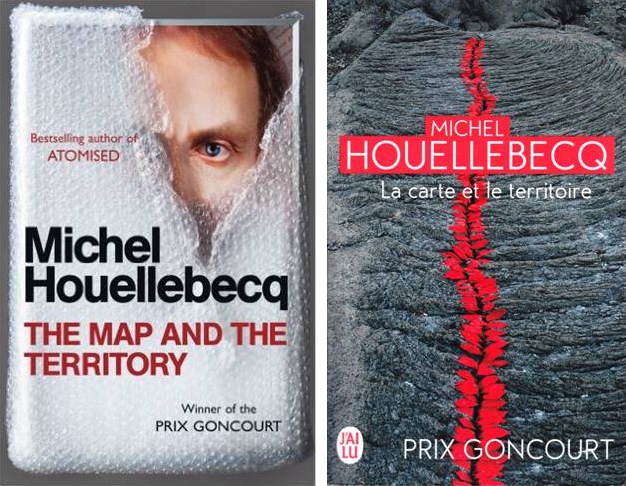
This week sees the publication in English of Michel Houellebecq’s novel, Submission (Soumission). I thought it would be interesting to re-read The Map and the Territory (La carte et le territoire) published in France in 2010 and in English* translation in 2011. The novel gained Houellebecq the Prix Goncourt (for "the best and most imaginative prose work of the year") in 2010.

The Map and the Territory follows the life of a successful French contemporary artist, Jed Martin. After developing one genre based on photographs of Michelin maps, he switches to another, more conventional one of portraits of people at work. Works like Bill Gates and Steve Jobs Discussing the Future of Information Technology, subtitled The Conversation at Palo Alto become internationally successful, although Jed has a problem with Damien Hirst and Jeff Koons Dividing Up the Art Market which is where the book starts:
Koons's forehead was slightly shiny. Jed shaded it off with his brush and stepped back three paces. There was certainly a problem with Koons. Hirst was basically easy to capture: you could make him brutal, cynical in an 'I shit on you from the top of my pile of dosh' kind of way; you could also make him a rebel artist, (but rich all the same) pursuing an anguished work on death; finally, there was in his face something ruddy and heavy, typically English, which made him look like a rank-and-file Arsenal supporter. In short, there were various aspects, but all of them could be combined in the coherent, representable portrait of a British artist typical of his generation. Koons, on the other hand, seemed to carry in him something dual, like an insurmountable contradiction between the basic cunning of the technical sales rep and the exaltation of the ascetic. (page 1)
He also paints portraits of his father, The Architect Jean-Pierre Martin Leaving the Management of his Business, and of Michel Houellebecq, Writer. Jed’s conversations with his father and the alter-Houellebecq are surprising to an English reader because of the interest both characters share in William Morris. Jean-Pierre as a young man had admired Morris as a designer as much as he disliked Mies van der Rohe and
... above all Le Corbusier, who tirelessly built concentration-camp-like spaces, divided into identical cells that were suited ... only for model prisons. (page 145)
but alter-Houellebecq, although admiring Morris as a social reformer, comes to the conclusion that:
What can undoubtedly be said is that the model of society proposed by William Morris certainly would not be utopian in a world where all men were like William Morris. (page 175)
What French readers make of it, one has to wonder, William Morris not being particularly familiar to many of them. Come to that, most English readers will be at a loss with the description of the FR1 (France 1 television) New Year’s Eve party and the personalities there like Jean-Pierre Pernaut.

Houellebecq is never afraid to give offence with his opinions. Jed meets and observes a senior manager at Michelin:
… again he searched for the right words, which is a disadvantage with former pupils of the Polytechnique; they’re a bit cheaper to hire than those of the École Nationale d’Administration but they take more time finding their words; … (page 55)
Jed eventually decides to move into his grandparents’ house in the Creuse. Houellebecq likes the French countryside (see, for example his letters to Bernard-Henri Lévy) but, if his view is the same as Jed’s, not its residents:
Jed had no illusions about the welcome he would get from the inhabitants of his grandparents' village. He had noticed that while he was travelling through La France profonde with Olga, many years before: outside certain very touristy zones like the Provençal hinterland or the Dordogne, the inhabitants of rural zones are generally inhospitable, aggressive and stupid. If you wanted to avoid gratuitous assaults and trouble more generally in the course of your journey, it was preferable, from all points of view, not to leave the beaten paths. And this hostility which was simply latent towards passing visitors, transformed into hate pure and simple when the latter acquired a residence. (page 278)
Nor is Jed keen on Mercedes:
Although he knew nothing about his life, Jed was hardly surprised to see Jasselin arrive at the wheel of a Mercedes Class A. The Mercedes Class A is the ideal car for an old couple without children, who live in an urban or periurban area, yet do not hesitate to treat themselves from time to time to an escapade in a hôtel de charme; but it can also suit a young couple of conservative temperament - it will, then, often be their first Mercedes. An entry into the range offered by the firm with the Silver Star, it is a discreetly different car; the Mercedes four-door saloon Class C and the Mercedes four door Class E are more paradigmatic. The Mercedes in general is the car preferred by those who aren't really interested in cars, who place security and comfort over driving sensations - also for those, of course, who have sufficient means. For more than fifty years - despite the impressive commercial strike force of Toyota, despite the pugnacity of Audi the global bourgeoisie had, on the whole, remained loyal to Mercedes. (page 240).
Jed likes Audis which
… characterise themselves by a particularly high level of finishing which can only be rivalled, according to Auto-Journal, by certain Lexus models. This car was the first one he'd bought since reaching a new wealthy status; from his first visit to the dealer, he'd been seduced by the rigour and precision of the metal assemblages, the gentle click of the doors when he closed them, all that was machine-tooled like a safe. Turning the speed-regulator control, he opted for a cruising speed of 105 km per hour. Some small notches, marking every 5 kph, made driving all the smoother; this car was indeed perfect. (page 165)
Houellebecq places some interesting characters in Jed’s life, for example, the art world PR, Marylin, and Inspecteur Jasselin, the Maigret-like detective who investigates alter-Houellebecq’s murder, and his un-Mme Maigret-like wife. However Olga, for a while Jed’s glamorous Russian girlfriend, is too much of a male fantasy.

Something about Houellebecq which I find intriguing is that he must be one of the very few novelists with an international reputation who had a scientific education, in his case as an agronomist. His mother had trained as an anaesthetist. Although from his student days he was inclined towards literature, Houellebecq later earned a living in information technology (until he could get out) and, according to an interview in Le Figaro magazine this summer, he has had a long-term interest in photography. Certainly if, as he recently told the Guardian, “…the job of a novelist is foremost to hold a mirror up to contemporary society”, he is not reluctant to introduce its technical details, for example here the life-cycle of the housefly. But Houellebecq’s readers can never be sure where the boundary of his satire lies. Does Jed’s dislike of Mercedes and encomium for Audi, both expressed in marketing speak, reflect the author’s world view or, rather more likely, is he tilting at the commercial shallowness of contemporary art and some of its practitioners?

A couple of oddities in the translation. On page 165 Jed is driving an “Audi Sport Wagon” which on page 177 has turned into an Audi Allroad A6. As far as I can tell, “Sport Wagon” is a type of BMW SUV sold in North America. The French original refers to “son break de chasse Audi” – “his Audi shooting brake” or nowadays “his Audi estate”, which could indeed be an Allroad A6.

On page 287 there is a reference in a description of Jed’s camera equipment to “a hard disk of two teraoctets” which non-French readers might not recognise as two Terabytes. The French (with the Romanians and Quebecois) use octet instead of byte for eight bits .

*By “English readers” I mean those in that language, not, of course, just those resident in England.  Page numbers are as in the 2011 UK hardback, (cover above).


29 January 2015

Grayson Perry, Establishment Man

This post began as Grayson Perry at the NPG but providing the necessary context turned it into a wider review. 

In 2013 Perry was the BBC’s Reith Lecturer and in a series titled Playing to the Gallery he discussed “what makes him an artist and the limits of contemporary art”. The BBC website has downloadable pdf transcripts of his four lectures and also shows some drawings he made for them. In 2014 he authored a book, Playing to the Gallery: Helping contemporary art in its struggle to be understood (PttG) with additional material and images. It’s worth reading, not just to have Perry’s astute observations in a more accessible form, but also for some of the extra illustrations which are very amusing (eg page 69, ‘inspiration for the staff bedrooms’; page 90/91, a London art map; page 113, curation) but I thought one conveys Perry’s sardonic views particularly well:


On inspection, Map of Museum based on Interior of Curator’s Head might have been more appropriately titled Map of Art Gallery based on Interior of Director’s Head. But Perry, who regards himself as “a fully paid-up member of the Establishment” (PttG page 82), presumably knows not to bite other dogs . 

About a month after PttG was published, Perry was Guest Editor for the 10 October New Statesman magazine – “A special issue on the Great White Male - That’s the straight, white, middle-class men who dominate our culture (and our politics)”. In the issue’s The NS Essay, They walk among us, Perry bemoaned the fact that:
… white, middle-class, heterosexual men, usually middle-aged … [are] a group that punches far, far above its weight. 
They dominate the upper echelons of our society, imposing, unconsciously or otherwise, their values and preferences on the rest of the population.
and christened them Default Man. Though he had to admit:
I must confess that I qualify in many ways to be a Default Man myself but I feel that by coming from a working-class background and being an artist and a transvestite, I have enough cultural distance from the towers of power. I have space to turn round and get a fairly good look at the edifice. and then spent much of the rest of the essay in the fortunate position of having his cake and being able to eat it: When I am out and about in an eye-catching frock, men often remark to me, “Oh, I wish I could dress like you and did not have to wear a boring suit.” Have to! 
… Personally, working in the arts, I do not often encounter Default Man en masse, but when I do it is a shock. I occasionally get invited to formal dinners in the City of London and on arrival, I am met, in my lurid cocktail dress, with a sea of dinner jackets; perhaps harshly, my expectations of a satisfying conversation drop. I feel rude mentioning the black-clad elephant in the room. I sense that I am the anthropologist allowed in to the tribal ritual.
Just why post-industrial societies in general, not just the UK, are still dominated at their upper levels by men is not something Perry gives much consideration to. At one point he quotes Sherrie Bourg Carter:
Women in today’s workforce ... are experiencing a much more camouflaged foe – second-generation gender biases ... “work cultures and practices that appear neutral and natural on their face”, yet they reflect masculine values and life situations of men.
but he seems more interested in the wearing of suits than the raising of children. Only in The NS Interview, when Perry invites Martin Amis to his studio for a dialogue, does that aspect of reality begin to intrude:
MA You have to whisper it now that there are differences between men and women. There are, though. Women have children, you know. 
GP Yeah, but there’s also a much more encultured version of what it is to be a man and a woman. I sometimes characterise it as: males are defined by what they do and women are often defined by what they are. … 
GP I think that the male role is more heavily policed, in terms of constricting behaviours that are available to it. The male aesthetic is often about camouflage – because he then retains his ability to observe from a supposedly neutral standpoint. Women are one of the groups to be looked at. Everything is defined from that male gaze. Is it possible to unpick the white, male, middle-class, middle-aged, heterosexual effect on culture and take it out? Because they’ve become inextricably woven into what we call culture and “right thinking”. 
MA Males? 
GP Yes. How do you think men have branded the nature of intellectualism and seriousness?
MA It would take for ever to untangle that, wouldn’t it? …
Early on in The NS Essay, Perry reveals that:
In the course of making my documentary series about identity, Who Are You?, for Channel 4, the identity I found hardest to talk about, the most elusive, was Default Man’s. Somehow, his world-view, his take on society, now so overlaps with the dominant narrative that it is like a Death Star hiding behind the moon. We cannot unpick his thoughts and feelings from the “proper, right-thinking” attitudes of our society. It is like in the past, when people who spoke in cut-glass, RP, BBC tones would insist they did not have an accent, only northerners and poor people had one of those. We live and breathe in a Default Male world: no wonder he succeeds, for much of our society operates on his terms. 
Chris Huhne (60, Westminster, PPE Magdalen, self-destructively heterosexual), the Default Man we chose to interview for our series, pooh-poohed any suggestion when asked if he benefited from membership or if he represented this group.
Who Are You?, in which Perry “turns his attention to identity as he creates portraits - from tapestries to sculptures and pots - of diverse individuals who are all trying to define who they are”, was broadcast in three parts starting on 29 October. It was a successor to his 2012 Channel 4 series, In the Best Possible Taste, with its six large accompanying tapestries, The Vanity of Small Differences, which eventually went on a UK tour. This time the Who Are You? pieces are displayed among the National Portrait Gallery’s collection in London (below):

‘Vibrant’ art that working-class people might like – surely not 
There isn’t space here to describe all of the items, let alone reference the 140 or so minutes of video essential to their explanation – see next year’s book by Perry perhaps. But a few are worth mentioning, not least because Default Man turns up in the form of the Huhne Vase (below top). Why Huhne allowed Perry so close when he was in such dire circumstances (before imprisonment and subsequently on release) is a mystery. Later at the NPG, Huhne’s meeting with potter and vase, (which, according to the Guardian:
… was purposefully smashed by Perry and then repaired using an ancient Chinese technique which involves lacquer resin dusted or mixed with gold. The Huhne vase has been decorated with the motifs of Huhne’s face, his H11HNE number plate and a penis.  Perry said: “This is a riposte to the common Default Man’s defence that he is an ‘individual’ and his achievements and behaviour have nothing to do with group identity.  I have smashed the pot and had it repaired with gold to symbolise that vulnerability might be an asset in relationships to such a person.”)
was filmed for the first part of the series, an encounter which resembled that of water and a duck’s back, Huhne not being in the least fazed by Perry, who, he pointed out, was a RA and CBE*. I didn’t think Perry closed on Huhne, who, although he didn’t say so directly, seemed to regard Perry as just another player in the influence game** albeit one with an outré image.


Another item which attracted attention when the show opened was The Ashford Hijab (above lower), a portrait of young Muslim convert, Kayleigh Khosravi, from Ashford in Kent. Perry commented:
What does Islam offer to a young white woman in her twenties?  The answer, I found, appears to be a refuge from the nagging consumer pressures and constant, often sexual, scrutiny of women all pervasive in western society.  Conversion also offers a strong and supportive sisterhood within the congregation of the mosque.
Nearby in Room 31 is Wallis, Duchess of Windsor (1939) by Gerald Leslie Brockhurst, a portrait of a woman who had been on an even more remarkable journey. Whether this was an intentional juxtaposition, the visitor doesn’t know. But it was doubtless deliberate that The Line of Departure (below top), a tapestry in the style of an Afghan rug showing three wounded war veterans, is in Room 23, Expansion and Empire, near Florence Nightingale receiving the Wounded at Scutari by Barrett. I don’t believe the vets featured in the Channel 4 series, an omission which wouldn’t have surprised Kipling. [But see UPDATE 31 JANUARY below]


Probably the most memorable item was the Jesus Army Money Box (above lower), a ceramic in the form of a medieval chasse, a small enamelled chest containing a holy relic. This was inspired by the time Perry spent with a Christian group which helps the homeless.

In the few years since he was first mentioned here, Perry seems to have grown even more popular – no crime that. At the end of 2104 he used his Twitter account (@alan_measles) to keep followers informed, and patiently answering queries, about the construction and decoration of a large (one meter tall) vase:


Large, but not exactly breaking new ground. In the year that Perry became a RA, Brian Sewell wrote rather caustically about Perry:
In the quarter of a century that he has been making them [pots] they have remained essentially the same - perhaps bigger and more provocative in imagery and narrative, but they are so undeveloped that they demonstrate stultifying intellectual and aesthetic limitations. Meanwhile, Claire [*] has gone from strength to strength and it is for her tasteless and preposterous dresses, worn on every possible public occasion, that Perry is now notorious. 
[* earlier] … a female alter ego, Claire, who is now, in adult life, his public persona and has become not only much the subject of his work but the work itself, with the sedulous promotion of being Claire a constantly performed performance that more or less obliterates his unmemorable pottery.
But since then Perry has become a CBE and Reith Lecturer, and Claire engages with duchesses.

Perry with the Duchess of Cambridge
Is he “a fully paid-up member of the Establishment”? Peter Hennessy offered some relevant comment in a recent extended essay called Establishment and Meritocracy:
I reckon there is a permanent element at the core of the British Establishment - a kind of gyroscope - which embraces the grand old professions like the Law and the Civil Service (though the latter is a tad tattered at the moment), the House of Lords (especially sections of the crossbenches where sit the former Cabinet Secretaries, Law Lords, Chiefs of the Defence Staff and Queen's Private Secretaries), the Royal Society, the British Academy, the learned societies generally, the scientific and engineering institutes and the great medical colleges. The reach and clout of these institutions and tribes may fluctuate but they never truly fade, let alone disappear. While around this rooted, inner core there swirl the transient elements in the media, the financial world and the celebritocracy in constellations that vary from generation to generation who can have a powerful, if often passing influence on the mood music of political and economic discussion, and in the case of celebritocracy, the norms of our wider society. (pages 14-15)
So I think it's almost certain that Perry, if not "fully paid-up" and only transiently, is one of the celibritocrats within the British Establishment - will his knighthood arrive before or after Tracey Emin becomes a Dame?

Who are you? continues at the NPG until 15 March


* Respectively, Royal Academician and Commander of the Most Excellent Order of the British Empire.
** In January 2015 Perry was included as one of the 24 most influential people in Art (alongside Tracey Emin, Damien Hirst, David Hockney, Banksy and Iwan Wirth and Manuela Hauser, et al) in Debrett’s Britain’s 500 most influential people in 2015.


UPDATE 31 JANUARY

The London Evening Standard on 30 January carried an article by its owner, Evgeny Lebedev, describing how, as part of his paper’s ongoing campaign, he and Grayson Perry had met homeless veterans at a hostel in East London earlier in the month. According to the article, Perry has offered:
… to create a unique piece of art that would not only reflect the stories of those this campaign is helping but which we could also then exclusively auction to raise more funds for those who need it.
Also:
The CEO of Veterans Aid, Dr Hugh Milroy, was delighted by the visit. “Welcoming Grayson to New Belvedere House was a real pleasure,” he said. “The staff and residents warmed to him immediately. 
“Grayson’s empathy, humanity, humility and genuine interest shone through. We were stunned to learn that he was prepared to create an artwork for us and immensely grateful. Many of the veterans we help have an interest in painting, ceramics, photography or some kind of creative activity so there was great curiosity and enthusiasm when his visit was announced.”


UPDATE 12 APRIL – ESTABLISHMENT MEN AT WORK

On 11 April Grayson Perry wrote a piece in the Guardian, My hero: Neil MacGregor The retiring director of the British Museum transformed a stately institution into a cultural powerhouse.
… Neil was the major museum director’s major museum director. He is effortlessly learned, an astute diplomat and above all a lovely, lovely man. 
I sort of engineered our first meeting [in 2008] after I heard him talk to a small group where he gently berated the clergy of St Paul’s for charging entry fees. Afterwards we all went for supper at Pizza Express and I spotted an opportunity and sat down next to him. As casually as I could, I dropped in that I had an idea for an exhibition. Neil said: “Send me a letter,” and three years later my show, The Tomb of the Unknown Craftsman, opened. It is still my proudest achievement and its passage through the souk of fiefdoms that is the BM I’m sure was much eased by Neil’s initial enthusiasm. 
… I have just been appointed a trustee of the BM; …


20 October 2014

Crucible2 at Gloucester Cathedral

Crucible2 is the second sculpture exhibition at Gloucester Cathedral curated by Gallery Pangolin of Chalford, Gloucestershire. The first was in 2010 with 76 contemporary sculptures; this time 100 exhibits by 61 sculptors are set in and around the cathedral. Key pieces, in the view of the curators, include works by Kenneth Armitage, David Backhouse, Ralph Brown, Lynn Chadwick (Jubilee IV in the poster,left), Ann Christopher, Antony Gormley and William Tucker. The 20th and 21st century works are often positioned in startling and stimulating contrast to their mostly English Gothic surroundings. For example, Breon O’Casey’s Large Cockerel (circa 2000, below) in the Cloisters with the earliest fan-vaulting in England circa 1350:


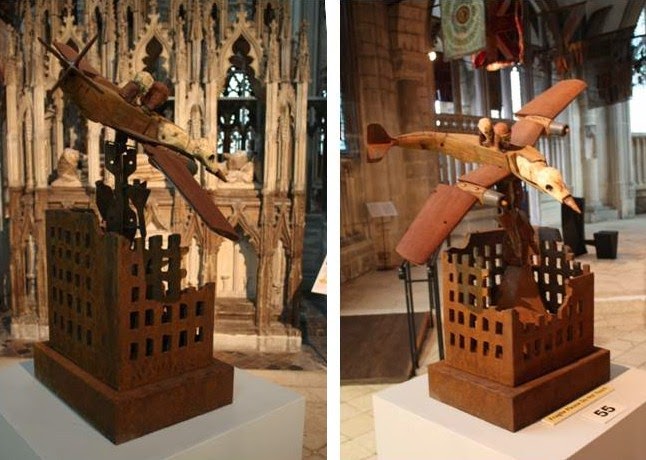
The most celebrated monument at Gloucester is the tomb of Edward II circa 1350, seen below left in the background to Steve Hurst’s Gloucester in Berlin. Hurst, born in 1932 and a witness to bombing in World War 2, sees it as concerning “… the bombing of civilians no matter what their country or who launches the bombing aircraft. It is a personal attempt to regain the viewpoint of a child”.


In the background (right) are the laid up colours of the Gloucestershire Regiment. They appear again (below right) behind Paul Wager’s Omnibus which marks the centenary of the Great War 1914-1918. Similar sentiments inform Deborah van der Beek’s Collateral (below right) – eight million horses died in that war - but it was cast around spent munitions from the conflicts in Iraq and Afghanistan which brought the expression “collateral damage” into common use.


The monument near Damien Hirst’s Anatomy of an Angel (Black) (2008, below) is to Sarah Morley, 29, a mother of four who died a few days after “having sustained the pains of Childbirth at Sea” while returning from Bombay in 1784.


Among the pieces I liked were Antony Gormley’s Pose (2012, below) with In Man’s Nature by Jon Buck behind).


Bryony Marshall’s DNA – Helix of Life (below, left) marks the 60th anniversary of the discovery of DNA. Subsequently mitochondrial DNA was identified as having been passed down to us all from a woman in East Africa about 150,000 years ago, known as Mitochondrial Eve, the inspiration for a sculpture of the same name by Sue Freeborough (below right):


The photograph below left of Geoffrey Clarke’s Taunton Deane Crematorium: Test Panel does not do justice to the colours of the glass. To the right is Sarah Lucas’s Realidad (2013), one of her NUDs series shown as bronzes at the Venice Bienniale in 2013.


John Humphreys’ Ipsius Imago a Latere Extensa probably succeeded as the artist wished in puzzling and confusing the viewer:


but perhaps was not as happily placed as the Eduardo Paolozzi plaster Vulcan near a strange moustachioed carving, perhaps a millennium older:


Among the sculptures in the open were Bruce Beasley’s Breakout II (below, left)in the Cloisters and outside Kenneth Armitage’s final work, Reach for the Stars (below, right).


Crucible2 ends on 31 October. There is no admission charge but a helpful map costs £2 and there is a £3 charge for photography. The catalogue at £16 is both good value and helps support the Cathedral.


UPDATE 2 NOVEMBER 2015

After posting about Beyond Limits: The Landscape of British Sculpture 1950-2015 held at Chatsworth House from 14 September to 25 October 2015, I thought it would be useful to add an image of Gavin Turk's bronze, Nomad (2002, below - and in other colours):


Another version of Chadwick's Jubilee can be seen there, as well.


28 May 2014

Bordeaux’s Institut Culturel Bernard Magrez

Visitors to Bordeaux with an interest in contemporary art should try to find time to visit the Institut Culturel Bernard Magrez. The Institut opened in 2011 in the Château Labottière, not far from the city centre. Until 20 July it is offering a show between shows, Entre deux expositions, exhibiting some of the Institut’s recent acquisitions for its collection.


Before entry the visitor encounters an arresting neon on the Pavilion, Bernard Magrez’s own ‘Autograph’:


A successful entrepreneur, who now owns four major wine-producing chateaux, Magrez is stating the Institut’s mission based on his own four cardinal virtues:

Vivre debout The strength of Living Upright
Respecter l’autre The justice of Respecting the other
Jamais renoncer The courage to Never give up
Gagner en tempérance The wisdom to Gain temperance

These provide a counterpoint to the other neon attached to the building, Le réveil de la jeunesse empoisonnée (The awakening of poisoned youth, 2011?) by Claude Lévêque:


Inside the Pavilion, three videos are being screened, one of them, by Benoit Maire and commissioned by Magrez in 2010, is on the theme of Jamais renoncer. Another, Tracking Happiness (2010), by Mircea Cantor is a hypnotic film of women sweeping sand (left). British visitors may be reminded of Carroll’s “seven maids with seven mops” but can be reassured that its duration at 11 minutes is less than “half a year”, (if slightly in breach of Red Alan’s rule 5).

There are also three large and detailed paintings on paper by a Franco-Serbian artist, Nebojsa Bezanic, exploring the history of three of Magret’s Grand Cru Classé Chateaux (La Tour Carnet 2010, below left) and, as you leave the Pavilion, another neon by Claude Lévêque, advises Riez! (2012, Laugh!, or perhaps more appropriately, Have Fun!):


After the Pavilion the visitor moves on to the main exhibition in a new space adjacent to the Chateau. I won’t attempt to report on all the recent additions to the Collection, but I was struck by the Belgian Wim Delvoye’s Untitled (Car Tyre) 2007 (a hand-carved car tyre, below left) and Serge Poliakoff’s Composition en cinq couleurs (Composition in five colours, 1956-57, below right), one of the earliest-dated works in the collection.


Photographing the exhibits was difficult because of reflections, but prints by Andy Warhol (Depardieu, 1986) and Peter Doig (Canoe Island, 2000) are recognisable, below left and right:


More of the collection is to be found in the main building of Château Labottière which provides a handsome background for sculpture like Jean-Michel Othonier’s Le nœud de Babel, (Node of Babel, 2013):


and for photography - Jean-Marie Périer’s 1966 portrait of Françoise Hardy in a Paco Rabane dress couldn’t be further from Steve McCurry’s Afghan Girl of 1985:


Just as much of a contrast are Damien Hirst’s Painted Skulls 2 (eyes open) (2013, below left) and Pierre et Gilles’ Le Désesperé (The desperate one, 2013, below right), more sedate than Vive La France, their previous appearance on this blog.  Another YBA photograph recently acquired for the collection is Sam Taylor-Wood’s large Self Portrait suspended 1 on display near the ticket office.


Finally, although the collection seems to be mainly focussed on two-dimensional representation, as already mentioned it does include sculptures including this piece in the Chateau garden. By Shen Yuan, Crâne de la Terre (Skull of the Earth, 2011) was made in stone and cement and its contrast of skyscrapers and rough stone can be seen as her comment on contemporary China.

Vistors to the Institut’s collection will find that it is well-documented in French and English. It is open Thursday to Sunday, 14:00 to 19:00 but, as always, it is advisable to confirm this on the website.  British visitors might like to think which of their countries’ artists they would to see added to the collection – my suggestions (for what they are worth) are Peter Howson and Julian Opie.

Entre deux expositions ends on 20 July.


28 August 2012

Tate Modern: The Tanks, Hirst and Munch

A belated post-Olympics visit to a relatively uncrowded Tate Modern with three things to see, in ascending order:

The Tanks

When Tate Modern was created by the transformation of the old Bankside Power Station, the underground oil storage tanks remained in place but no longer had a use. In Tate’s own words: “they have now being transformed into some of the most exciting new spaces for art in the world, The Tanks, the world’s first museum galleries permanently dedicated to exhibiting live art, performance, installation and film works”. Fifteen Weeks of Art in Action in The Tanks started on 18 July and is far better seen and experienced than described, but a listing of the events up to 18 October is available here.

The development of The Tanks has been the first phase of the Tate Modern Project which it is hoped to complete by 2016 at a capital cost of £215 million, three quarters of which has been raised.


Damien Hirst


The first floor gallery of Tate Modern is given over to a major survey, Damien Hirst, an artist whose work is so well-known as to need little description. There are, as to be expected, spot paintings, cabinets full of medicines and other medicalia, a maggot-fly life-cycle piece sustained by a rotting cow’s head which promises to leave an indelible souvenir on Tate’s floor, longitudinally-bisected animals, butterflies both alive and mounted, and, more revolting than anything else for a non-smoker, arrangements of cigarette ends. The pretentiousness of the titles of his works never ceases to impress: The Physical Impossibility of Death in the Mind of Someone Living (the pickled shark) – oh yes, what about a pathologist? – and The Acquired Inability to Escape (cigarette ends), though Crematorium (more cigarette ends) is relatively obvious.

Two items in the hand-out given to visitors struck me:
"In I Am Become Death, Shatterer of Worlds 2006, one of Hirst's largest butterfly paintings, kaleidoscopic mandala-like forms recall Buddhist and Hindu traditions. The title is taken from the Bhagavad Gita, a part of the ancient Sanskrit epic, the Mahabharata."
On 16 July 1945 the first test of a nuclear weapon was carried out in New Mexico. Robert Oppenheimer, who led the scientific effort at Los Alamos during the Manhattan Project, said that witnessing the explosion had reminded him of this same line which he quoted as: Now I am become Death, the destroyer of worlds. It would be interesting to know if Hirst was aware of this. Coincidentally, the test was codenamed Trinity and one of Hirst’s works in the exhibition is Trinity – Pharmacology, Physiology, Pathology 2000.

Also:
"The sculpture Loving in a World of Desire 1996 offers a counterpoint to the rotating spins. Here a giant beach ball hovers above a coloured box. Suspended on a jet of air, the sphere flutters over the structure in an interplay of precariousness and balance, and evokes the title’s themes of love and desire."
I’m not sure what exactly is meant by ‘suspended on’ or ‘an interplay of precariousness and balance’. But this is part of how they explain Bernoulli’s equation at Princeton:
A table tennis ball placed in a vertical air jet becomes suspended in the jet, and it is very stable to small perturbations in any direction. Push the ball down, and it springs back to its equilibrium position; push it sideways, and it rapidly returns to its original position in the center of the jet. In the vertical direction, the weight of the ball is balanced by a force due to pressure differences: the pressure over the rear half of the sphere is lower than over the front half because of losses that occur in the wake (large eddies form in the wake that dissipate a lot of flow energy). To understand the balance of forces in the horizontal direction, you need to know that the jet has its maximum velocity in the center, and the velocity of the jet decreases towards its edges. The ball position is stable because if the ball moves sideways, its outer side moves into a region of lower velocity and higher pressure, whereas its inner side moves closer to the center where the velocity is higher and the pressure is lower. The differences in pressure tend to move the ball back towards the center.
which sounds more analogous to the stability of a long-term relationship than to the precariousness of love and desire. Hirst, once a YBA, is still only 47 and his artistic reputation will almost certainly have its own ups and downs for decades to come. In the meantime the production of his expensive works provides gainful employment for hundreds of technicians in numerous UK workshops – a welcome trickledown to the UK economy from the global super-rich. Damien Hirst continues until 9 September.

Munch


And then on to the second floor and Edvard Munch: The Modern Eye, which I enjoyed more than I expected. Munch (1863-1944) is very widely known for The Scream which he called Der Schrei der Natur (The Scream [or shriek] of Nature). Not always appreciated about this famous image is that Munch frequently produced several versions of the same work. In The Scream’s case, three are in Norwegian museums and it was the 1895 pastel which sold for a public auction record (for any work) of just under $120 million at Sotheby’s in New York in May. The Tate show doesn’t include any versions of The Scream (even the lithographs) but gives one room over to 'Reworkings' to make the point with several versions of The Sick Child and The Girls on the Bridge (above) and again later with Weeping Woman.

Munch, like Degas, took up still photography and he also later made amateur handheld films. In the case of Weeping Woman (left) 1907-09, as well as six paintings, drawings, a lithograph and a sculpture, he made a photograph in 1907 (Rosa Meissner at the hotel room in Warnemunde). Although Munch grew up in Oslo (Cristiana at the time), after his twenties he spent much of his time in Paris and Berlin, only returning to Norway permanently in 1908 after a nervous breakdown. In 1906 in Berlin he had collaborated with Max Reinhardt on artistic aspects of a production of Ibsen’s  Ghosts, followed in 1907 by set designs for Hedda Gabler. This is considered to have developed Munch’s interest in the use of small rooms as claustrophobic settings for works like Weeping Woman. To me his earlier Two Human Beings: The Lonely Ones 1905 (below) evokes Ibsen’s The Lady from the Sea (1888), which Munch would almost certainly have seen.


Munch produced some unsparing self-portraits later in life – he was lucky enough to survive the 1919 influenza epidemic. Branded a decadent artist by the Nazis, his final years were spent in artistic isolation during the occupation of Norway.
 
Self-Portrait with the Spanish Flu 1919 and Self-Portrait with Bottles ?1938
The arrangement of the paintings and photographs in the exhibition aims to support the idea that Munch is better regarded as a major painter of the early 20th century than as a late 19th century avante gardiste. If his significance as a painter is justified by the prices now paid for his work and his creation of one of the most widely recognised art works of all time, then he has to be regarded as a major painter in whichever period of modern art he is allocated to. Munch left most of his estate to the City of Oslo and it is now held by the Munch-museet which has lent many of the works in the exhibition.

Edvard Munch: The Modern Eye was organised by the Centre Pompidou and has previously appeared in Paris and then Frankfurt, and continues at Tate Modern until 14 October.

PS

An even lower-brow comment than normal, and revealing an over-exposure to Scandinavian noir, but I can’t help seeing a resemblance between the female figure in Ashes 1925 (below) and the Danish actress best-known in the UK for playing the detective Sara Lund in the TV series Forbrydelsen (The Killing). I must get out more!


21 June 2012

Post-War British Design at the V&A

I suppose it must have seemed a good idea at the time – a survey of British design in the years since the last time the Olympic Games were in London, 1948. And so came about BRITISH DESIGN 1948–2012: Innovation in the Modern Age, now on at the V&A. It’s in the same space used for Postmodernism: Style and Subversion 1970–1990 last year, which perhaps explains any feeling of ‘déjà vu all over again’.

The new show is in three overlapping sections. The first, Tradition and Modernity, covers the period from the end of WW2 to the mid-1960s, more or less. The second, Subversion, runs from the 1960s onwards but doesn’t show much after 2003. The last, Innovation and Creativity, is spread over the “last half century” or so. And at this point I ought to admit to being someone who grew up in the first period and saw the rest of it through adult eyes at the time. Perhaps that was why for me the first section (view below) worked best:


To the left of Henry Moore’s Harlow Family Group (1954-55) is part of Reg Butler’s Woman Resting (1951). The painting above is William Gear’s Autumn Landscape of the same year. Further to the left and not visible is a fine Lynn Chadwick maquette of 1951 for Stabile Cypress. At the entrance is part of The Englishman’s Home mural (left) by John Piper made for the Festival of Britain in 1951 and his 1962 work (with Patrick Reyntiens) for Coventry Cathedral’s baptistry window appears nearby. After an austere post-War start we move on to a more consumerist society in the form of Terence Conran’s Habitat and the Country House-style of Laura Ashley. Although the exhibition ties these influences to the 1960s, neither seems to have disappeared since. This section ends with a Mini (sadly with a slight dent over the nearside rear wheel arch, but otherwise immaculate). 

Then comes Subversion. The art here includes one of David Hockney’s Walt Whitman-inspired works, We Two Boys Together Clinging (1961, right), and others by Richard Hamilton and Eduardo Paolozzi. The over-whelming impression however is of fashion and pop with costumes for David Bowie and others and contributions from Mary Quant and Alexander McQueen. The YBAs are represented by a section of Damien Hirst’s restaurant/art installation Pharmacy. Only once did an exhibit label make a reference to ‘postmodernism’. 

On to Innovation and Creativity, though the first and most striking objects (see below):


are an E-type Jaguar and Concorde, both more the product of function than of form. It would have been of value to see some of the china, glass and cutlery designed for BA's Concordes.  The aircraft was, of course, an Anglo-French project and at this point the reality of globalisation becomes apparent.  Jonathan Ive rightly appears for his role in designing Apple products, but not Martin Smith for his Audi Quattro. The statement on one of the panel texts:
Innovation has characterised British design from the introduction of spinning machines in the 1780s and the engineering of ships and bridges in the 1840s to the development of computer codes after the Second World War and the invention of the worldwide web in the 1980s.
seems facile, given that Tim Berners-Lee was working at CERN when he proposed the web and brought together hypertext and the internet, both originating in the US. This is not to belittle his achievements, but can they reasonably be labelled “British”?

The exhibition finishes with some complimentary remarks about British architecture and a model of 30 St Mary Axe (the Gherkin to most of us), but the most dominant new building in London is Shard London Bridge designed by an Italian, Renzo Piano. Its observation platform will open to the public next month. In 2012 it seems strange that there is no mention of Anish Kapoor and Cecil Balmond's ArcelorMittal Orbit sculpture at the Olympic Park, surely creative and innovative, albeit controversial.

Innovation in the Modern Age continues until August 31.

6 January 2012

Auteur Theory; Anticipointments

This post consists of two items, both by way of being footnotes to other posts, past and future.

Auteur Theory

My first post about a film, almost a year ago, was titled The King’s Speech. A couple of months later came the next film post, Joanna Hogg’s ‘Archipelago’. And from then on, right up to George Clooney’s ‘The Ides of March’ in November, I’ve always given the name of the director in the possessive before the film title. Belated acknowledgement to Tom Hooper in the original omission.

François Truffaut
Originator of cinéma d'auteur
The Auteur Theory of film “emerged in France about 50 years ago and holds that a director's film reflects the director's personal creative vision, as if they were the primary auteur (Fr author)”, quoting from Wikipedia’s helpful entry. To me the flaws in this are fairly obvious, not least because a film requires craftsmanship and creativity from so many people other than the metteur en scène, for example the screenwriters and the camera men and women. On the other hand, a film is shot by location and the director has to control the assembly along the intended timeline (with flashbacks and other artifices) of those scenes he or she chooses and discards the rest - except the ones selected for resuscitation as Deleted Scenes on the DVD.  Also, there seems to be an increasing awareness among the general film-going public, as opposed to cineastes, of a film’s director, his or her previous and forthcoming films and so on – Allen, Spielberg, Scorsese, Clooney just to give a few current examples.

So for the moment, I will continue putting the director’s name before the film and subscribing to the Auteur Theory - Prétentieux? Moi? Jamais! Next up will probably be The Iron Lady directed by Phyllida Lloyd.

Anticipointment

Cash Peters came up with this word during his Radio 5 swansong last month, attributing it to the Hollywood Reporter. But it seems to go back to 1995, and has a musical existence (The Ashton Shuffle, Australian house music? – I’m way out of my depth). Anyway, as a blend of anticipation and disappointment, anticipointment is a useful concept these days when so much is preceded by a massive PR hype which so little could ever live up to. I will try to develop an Anticipointment Index in future posts and promising candidates might be The Iron Lady (see above) and the David Hockney show, A Bigger Picture at the RA.

Hockney has put a note on the poster for his RA show: "All the works here were made by the artist himself, personally" which has been interpreted as a dig at Damien Hirst. Hirst’s works often involve using a large number of assistants. Somehow I don’t think Hockney would be very supportive of Auteur Theory.

ADDENDUM 16 JANUARY

David Hockney and the RA have now explained that no criticism of Hirst was implied.

I have done some more thinking about the Anticipointment Index and have come up with the chart below where marks out of 5 are given – the higher the mark, the worse the anticipointment. Moreover, the greater the preceding hype the more difficult it is to obtain the desirable low score.
ANTICIPOINTMENT INDEX 1.0