Showing posts with label Jeff Koons. Show all posts

8 January 2016

Three Paris Exhibitions: (1) Picasso

Shows seen last month in a city subdued and uncrowded after les évènements of 13 December


While in Paris, I came across an article by Robin Pogrebin in the International New York Times about developments at the Museum of Modern Art (MoMA) in New York. Back in 2010, a NYT art critic had described MoMA’s conventional wisdom as “a reluctance to question the linear unspooling of art history according to designated styles that remains the Modern’s core value and its Achilles’ heel”. Now, MoMA’s chief curator of painting and sculpture was being quoted as saying that the museum was “reflecting a more widespread shift from thinking in categories – or thinking in so-called canonical narratives – to thinking about multiple histories. Having a sense of curiosity, rather than a desire for pronouncement.” Of the three exhibitions in Paris, the first two, Picasso.Mania at the Grand Palais (described below) and Splendeurs et Misères, can probably be regarded as concerned with multiple histories, the third, Villa Flora (to follow), probably not.

Shows at the Grand Palais aren’t what they used to be. By comparison with their major retrospectives, Georges Braque in 2013 and Edward Hopper in 2012, Picasso.Mania seemed thin stuff. Its thesis was apparently that
After World War II, Picasso became renowned as a modern artistic genius. This public recognition came at a time when contemporary art was once again moving towards “avant-gardism”. This movement’s values, as incarnated by Marcel Duchamp, were in contradiction with Pablo Picasso’s flamboyant subjectivity, media presence and commercial success. As a result, it was only in 1971 that a collective tribute by living artists from different disciplines was organised for the artist’s 90th birthday. In the 1980s, exhibitions showed a new generation of artists how Picasso’s later works were years ahead of his time.
A proposition which was not exactly supported by telling visitors that in the 1960s Roy Lichtenstein was inspired by Picasso and that David Hockney was a repeat visitor to the Picasso exhibition at the Tate in 1960. The show made a good initial impression with Sort of Fabulous (2015), a video installation of 18 artists talking about the impact of Picasso on their work, including Jeff Koons, Frank Gehry, Thomas Houseago and Cecily Brown. An unspooling of art history then followed, starting with All hail the artist!, the Self-Portrait of 1901 (below left), borrowed from the Picasso Museum, and some recent images of the artist including Van Pei Ming’s Portrait of Picasso (2009, below centre) and Rudolf Stingel’s Untitled (2012, below right):


and some of the 90th birthday lithographs from 1971:


The most successful of the exhibition themes which followed was probably that given over to cubism – a wall of Picassos:


and then a homage in the form of various works, many by David Hockney, beginning with his Artist and Model (1973/4, below left) and Harlequin (1975, below right):


From the 1980s onwards Hockney explored multiple viewpoints evoking cubism (“a kind of mechanical cubism”) in, for example, Paint Trolley, LA (1985, below top) and Place Ferstenberg, Paris, August 7, 8, 9 (1985, below lower):


More recent Hockney works were The Jugglers, June 24th 2012 (2012, below), 18 films on 18 screens shown over 22 minutes:


and A Bigger Card Players (2015), as at Annely Juda Fine Art, London last summer. After that, the show began to meander. Picasso on screen projected on three walls clips from a wide variety of films (below) in which either the painter or his works or both appear, ranging from Truffaut’s Jules et Jim to Jean-Luc Godard’s King Lear to Woody Allen’s Midnight in Paris.


Demoiselles from elsewhere and Guernica, a political icon were both Hamlet without the prince, the originals not being available. Various works inspired by Les Demoiselles d’Avignon (1907), included Untitled by Sigmar Polke (2006, below top) and Jeff Koons’ Antiquity (2011, below lower):


Of the works pertinent to Guernica, one of the most interesting to British eyes was Goshka Macuga’s construction, The Nature of the Beast (2009), commissioned by the Whitechapel Gallery in memory of their having exhibited Guernica in 1939 and now owned by the Castello di Rivoli (below left). Part of the work is a glazed circular table which exhibits documents relating to the Spanish civil war and more recent conflicts. I thought the photographs from the Whitechapel’s archive of Clement Attlee in 1939 were thought-provoking (below right) – there is a mention of the Major Attlee Company (sic) in his Wikipedia entry.


After this, a section, It’s a Picasso!, grouped his paintings and prints from the late 1930s and later:


and then some pieces relevant to Picasso and Pop art’s reaction to abstract expressionism including Andy Warhol’s Head (after Picasso) No III (1966, below right top) and Roy Lichtenstein’s Still Life after Picasso (1964, below right lower):


Out of what followed, the impact of Picasso on Jasper Johns’ The Seasons (1985 – 87, Summer below left) with, nearby, Picasso’s Minotaure à la carriole (1936, below right) was notable:


A section covering the media attention Picasso received in his later years was followed by a large display of his late works, some reminiscent of Japanese shunga, seen at Avignon in 1970 and 1973. The final theme was the impact on artists in New York of the Guggenheim’s 1984 Picasso show, for example Jean-Michel Basquiat’s Untitled (Pablo Picasso) (1984, below):


Picasso.Mania ends on 29 February 2016.


3 December 2015

A Visit to the Guggenheim Bilbao

A post here in May described A Visit to the Fondation Louis Vuitton in Paris. This is a companion piece following a visit during the summer of 2015 to the Guggenheim Museum in Bilbao, also designed by Frank Gehry. 


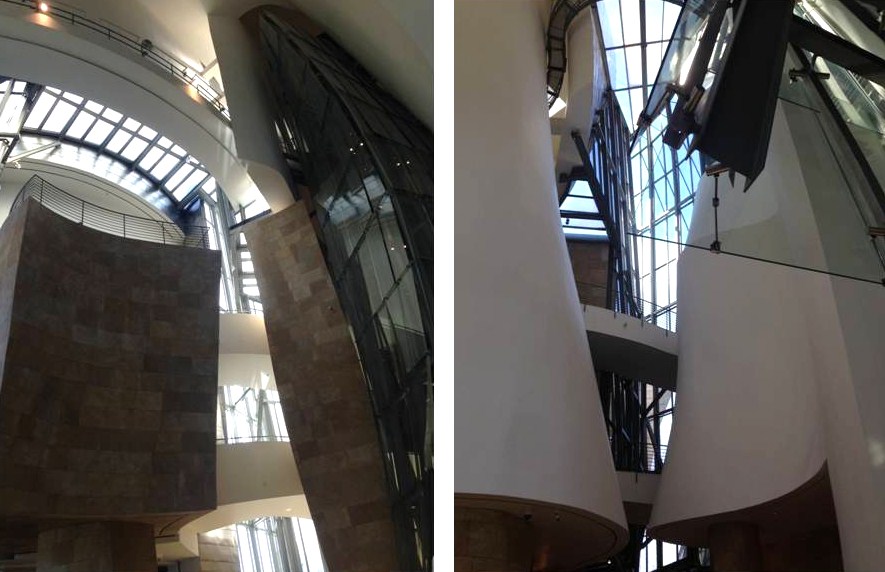
After the collapse of its industrial base in the 1980s, Bilbao was in desperate need of transformation. In 1991 the local administration and the Guggenheim Foundation reached an agreement to construct a contemporary art gallery on a derelict site next to the estuary and near the city centre. The Foundation had previously commissioned Frank Lloyd Wright for its museum in New York which had opened in 1959. Construction of Gehry’s design for Bilbao, which has become almost as well-known as Wright’s, began in 1993 and the museum opened in 1997. The structure is of steel, the surface being clad in titanium where not glazed and with limestone exposed on the exterior and the interior. The complex curving shapes were designed using computer applications originally developed for aerospace by Dassault in France in the 1970s. The exterior presents different forms at different viewpoints and references Bilbao’s maritime history of ships and fishing.


The interior is as just complex, as these views of the atrium reveal:


The Guggenheim Bilbao's permanent collection includes some major site-specific pieces on display externally including Anish Kapoor’s Tall Tree and the Eye (2009, below left) and Louise Bourgeois’ Maman (1999, below right):


and two works by Jeff Koons, Tulips (1995-2004, below top) and Puppy (1992, below lower):


Inside, in the ArcelorMittal gallery, are the seven massive pieces which constitute Richard Serra’s The Matter of Time (2005, below). Made of weathering steel and fabricated locally, they embody Bilbao’s industrial heritage.


At the time of this visit, most of the gallery space was given over to two exhibitions: Jeff Koons: A Retrospective (previously at the Centre Pompidou in Paris and the Whitney Museum of American Art, New York) and Jean-Michel Basquiat: Now’s the Time. People seem either to like Koon’s work or dislike it, not many are indifferent. Michel Houellebecq (quoted in a post here earlier this year) described Koons in unflattering terms as seen through the eyes of another imaginary artist. Julian Barnes at the Edinburgh book festival in August
… offered a text written by American artist Jeff Koons to accompany his work Puppy, a vast sculpture formed from flowering plants belonging to the Guggenheim Bilbao in northern Spain. Reading aloud from Koons’ text, he told the Edinburgh audience that Puppy “helps you have a dialogue about the organic and the inorganic. It’s really about the issue of the baroque, where everything is negotiated. The different aspects of the eternal through biology. Whether you want to serve or be served, love or be loved, all these types of polarities come into play because Puppy sets them up.” Barnes added: “To use the technical term of art criticism, it’s bollocks. I know it’s like shooting fish in a barrel but sometimes fish need to be shot.”
In October Barnes told a Cheltenham Literature Festival audience (including me) that Koons produced “machine-tooled whimsicality”. Jeff Koons: A Retrospective provided plenty of opportunity to make one’s own mind up and included examples of his work from The New Series in the early 1980s (vacuum cleaners in vitrines) to the recent Antiquity series.  I couldn’t help being impressed by the skill of Koons’ technicians in fabricating objects like Lobster (2003, below left), with the appearance of a PVC inflatable but made from “Polychromed aluminum”, and Large Vase of Flowers (1994, below right) made in polychromed wood.


Having seen this show, it may be a while before I feel the need to seek out any more Koons. I was more taken with Basquiat whose work I was seeing for the first time – if BBC Your Paintings is right, he is not represented in any UK public collection. Jean-Michel Basquiat was born in New York in 1960 and died of a heroin overdose in 1988, a year after Andy Warhol who had been his collaborator in the 1980s. Two works which epitomise Basquiat's style and preoccupations are Irony of a Negro Policeman (1981, below left) and Dark Race Horse—Jesse Owens (1983, below right):


Typical of Basquiat’s work with Warhol are Win $ 1,000,000 (below top) and Ailing Ali in Fight of Life (below lower), both 1984:


Man from Naples (1982, below), from Guggenheim Bilbao’s own collection, is a good example of Basquiat’s street graffiti work:


While the Guggenheim Bilbao is probably an even more impressive building than Gehry’s later Fondation Louis Vuitton, I thought it was less visitor-friendly.  The gallery space is less appropriate for exhibitions, particularly retrospectives. The Warhol show was spread over two floors while Basquiat required walking back through galleries 306 and 305 after reaching 307 and then down a corridor to 303 and 302 – not so good, at least on an initial visit. Also, to enter the Museum, visitors descend a flight of steps from street level to the level of the atrium floor level. Leaving is via another flight of steps down to river level. A third set of steps, the length of the other two combined, then has to be climbed to get back to street level. If you want to get back in to the Museum – allowed during the day of visiting – you then redescend the first flight … None of this should deter anyone from visiting in 2016 when Guggenheim Bilbao will be offering shows of works by Warhol and Bourgeois and Windows on the City: The School of Paris, 1900-1945.


8 September 2015

Michel Houellebecq’s ‘The Map and the Territory’

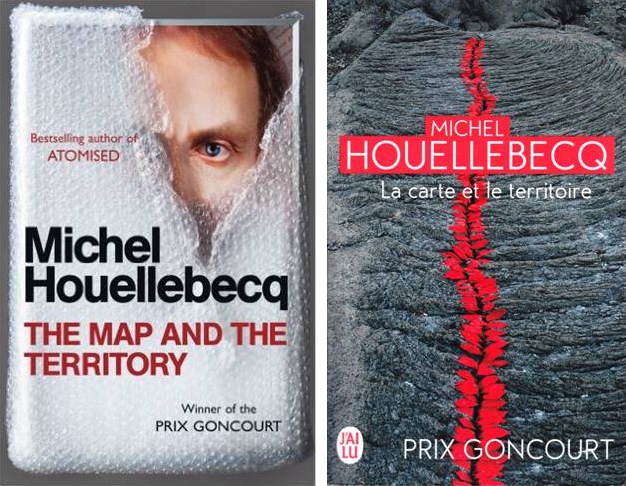
This week sees the publication in English of Michel Houellebecq’s novel, Submission (Soumission). I thought it would be interesting to re-read The Map and the Territory (La carte et le territoire) published in France in 2010 and in English* translation in 2011. The novel gained Houellebecq the Prix Goncourt (for "the best and most imaginative prose work of the year") in 2010.

The Map and the Territory follows the life of a successful French contemporary artist, Jed Martin. After developing one genre based on photographs of Michelin maps, he switches to another, more conventional one of portraits of people at work. Works like Bill Gates and Steve Jobs Discussing the Future of Information Technology, subtitled The Conversation at Palo Alto become internationally successful, although Jed has a problem with Damien Hirst and Jeff Koons Dividing Up the Art Market which is where the book starts:
Koons's forehead was slightly shiny. Jed shaded it off with his brush and stepped back three paces. There was certainly a problem with Koons. Hirst was basically easy to capture: you could make him brutal, cynical in an 'I shit on you from the top of my pile of dosh' kind of way; you could also make him a rebel artist, (but rich all the same) pursuing an anguished work on death; finally, there was in his face something ruddy and heavy, typically English, which made him look like a rank-and-file Arsenal supporter. In short, there were various aspects, but all of them could be combined in the coherent, representable portrait of a British artist typical of his generation. Koons, on the other hand, seemed to carry in him something dual, like an insurmountable contradiction between the basic cunning of the technical sales rep and the exaltation of the ascetic. (page 1)
He also paints portraits of his father, The Architect Jean-Pierre Martin Leaving the Management of his Business, and of Michel Houellebecq, Writer. Jed’s conversations with his father and the alter-Houellebecq are surprising to an English reader because of the interest both characters share in William Morris. Jean-Pierre as a young man had admired Morris as a designer as much as he disliked Mies van der Rohe and
... above all Le Corbusier, who tirelessly built concentration-camp-like spaces, divided into identical cells that were suited ... only for model prisons. (page 145)
but alter-Houellebecq, although admiring Morris as a social reformer, comes to the conclusion that:
What can undoubtedly be said is that the model of society proposed by William Morris certainly would not be utopian in a world where all men were like William Morris. (page 175)
What French readers make of it, one has to wonder, William Morris not being particularly familiar to many of them. Come to that, most English readers will be at a loss with the description of the FR1 (France 1 television) New Year’s Eve party and the personalities there like Jean-Pierre Pernaut.

Houellebecq is never afraid to give offence with his opinions. Jed meets and observes a senior manager at Michelin:
… again he searched for the right words, which is a disadvantage with former pupils of the Polytechnique; they’re a bit cheaper to hire than those of the École Nationale d’Administration but they take more time finding their words; … (page 55)
Jed eventually decides to move into his grandparents’ house in the Creuse. Houellebecq likes the French countryside (see, for example his letters to Bernard-Henri Lévy) but, if his view is the same as Jed’s, not its residents:
Jed had no illusions about the welcome he would get from the inhabitants of his grandparents' village. He had noticed that while he was travelling through La France profonde with Olga, many years before: outside certain very touristy zones like the Provençal hinterland or the Dordogne, the inhabitants of rural zones are generally inhospitable, aggressive and stupid. If you wanted to avoid gratuitous assaults and trouble more generally in the course of your journey, it was preferable, from all points of view, not to leave the beaten paths. And this hostility which was simply latent towards passing visitors, transformed into hate pure and simple when the latter acquired a residence. (page 278)
Nor is Jed keen on Mercedes:
Although he knew nothing about his life, Jed was hardly surprised to see Jasselin arrive at the wheel of a Mercedes Class A. The Mercedes Class A is the ideal car for an old couple without children, who live in an urban or periurban area, yet do not hesitate to treat themselves from time to time to an escapade in a hôtel de charme; but it can also suit a young couple of conservative temperament - it will, then, often be their first Mercedes. An entry into the range offered by the firm with the Silver Star, it is a discreetly different car; the Mercedes four-door saloon Class C and the Mercedes four door Class E are more paradigmatic. The Mercedes in general is the car preferred by those who aren't really interested in cars, who place security and comfort over driving sensations - also for those, of course, who have sufficient means. For more than fifty years - despite the impressive commercial strike force of Toyota, despite the pugnacity of Audi the global bourgeoisie had, on the whole, remained loyal to Mercedes. (page 240).
Jed likes Audis which
… characterise themselves by a particularly high level of finishing which can only be rivalled, according to Auto-Journal, by certain Lexus models. This car was the first one he'd bought since reaching a new wealthy status; from his first visit to the dealer, he'd been seduced by the rigour and precision of the metal assemblages, the gentle click of the doors when he closed them, all that was machine-tooled like a safe. Turning the speed-regulator control, he opted for a cruising speed of 105 km per hour. Some small notches, marking every 5 kph, made driving all the smoother; this car was indeed perfect. (page 165)
Houellebecq places some interesting characters in Jed’s life, for example, the art world PR, Marylin, and Inspecteur Jasselin, the Maigret-like detective who investigates alter-Houellebecq’s murder, and his un-Mme Maigret-like wife. However Olga, for a while Jed’s glamorous Russian girlfriend, is too much of a male fantasy.

Something about Houellebecq which I find intriguing is that he must be one of the very few novelists with an international reputation who had a scientific education, in his case as an agronomist. His mother had trained as an anaesthetist. Although from his student days he was inclined towards literature, Houellebecq later earned a living in information technology (until he could get out) and, according to an interview in Le Figaro magazine this summer, he has had a long-term interest in photography. Certainly if, as he recently told the Guardian, “…the job of a novelist is foremost to hold a mirror up to contemporary society”, he is not reluctant to introduce its technical details, for example here the life-cycle of the housefly. But Houellebecq’s readers can never be sure where the boundary of his satire lies. Does Jed’s dislike of Mercedes and encomium for Audi, both expressed in marketing speak, reflect the author’s world view or, rather more likely, is he tilting at the commercial shallowness of contemporary art and some of its practitioners?

A couple of oddities in the translation. On page 165 Jed is driving an “Audi Sport Wagon” which on page 177 has turned into an Audi Allroad A6. As far as I can tell, “Sport Wagon” is a type of BMW SUV sold in North America. The French original refers to “son break de chasse Audi” – “his Audi shooting brake” or nowadays “his Audi estate”, which could indeed be an Allroad A6.

On page 287 there is a reference in a description of Jed’s camera equipment to “a hard disk of two teraoctets” which non-French readers might not recognise as two Terabytes. The French (with the Romanians and Quebecois) use octet instead of byte for eight bits .

*By “English readers” I mean those in that language, not, of course, just those resident in England.  Page numbers are as in the 2011 UK hardback, (cover above).