Showing posts with label Michel Houellebecq. Show all posts

3 December 2015

A Visit to the Guggenheim Bilbao

A post here in May described A Visit to the Fondation Louis Vuitton in Paris. This is a companion piece following a visit during the summer of 2015 to the Guggenheim Museum in Bilbao, also designed by Frank Gehry. 


After the collapse of its industrial base in the 1980s, Bilbao was in desperate need of transformation. In 1991 the local administration and the Guggenheim Foundation reached an agreement to construct a contemporary art gallery on a derelict site next to the estuary and near the city centre. The Foundation had previously commissioned Frank Lloyd Wright for its museum in New York which had opened in 1959. Construction of Gehry’s design for Bilbao, which has become almost as well-known as Wright’s, began in 1993 and the museum opened in 1997. The structure is of steel, the surface being clad in titanium where not glazed and with limestone exposed on the exterior and the interior. The complex curving shapes were designed using computer applications originally developed for aerospace by Dassault in France in the 1970s. The exterior presents different forms at different viewpoints and references Bilbao’s maritime history of ships and fishing.


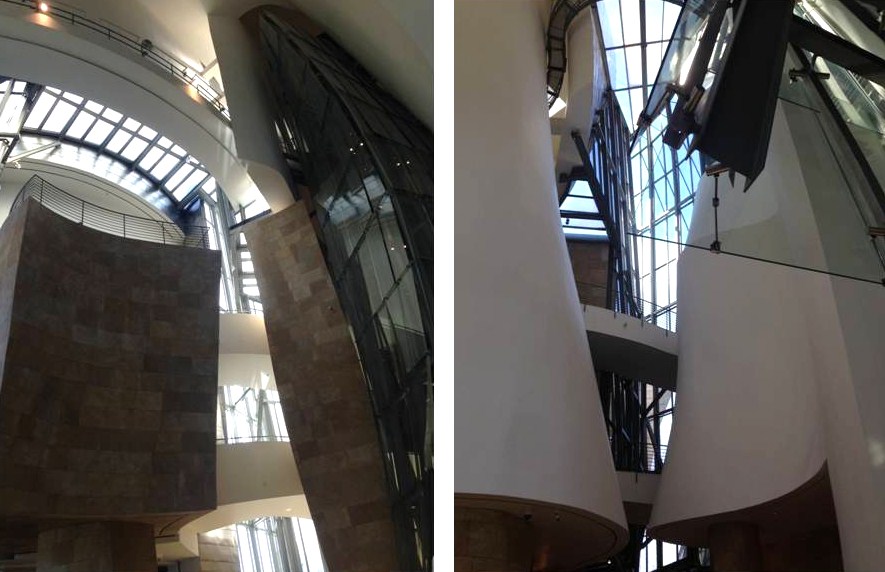
The interior is as just complex, as these views of the atrium reveal:


The Guggenheim Bilbao's permanent collection includes some major site-specific pieces on display externally including Anish Kapoor’s Tall Tree and the Eye (2009, below left) and Louise Bourgeois’ Maman (1999, below right):


and two works by Jeff Koons, Tulips (1995-2004, below top) and Puppy (1992, below lower):


Inside, in the ArcelorMittal gallery, are the seven massive pieces which constitute Richard Serra’s The Matter of Time (2005, below). Made of weathering steel and fabricated locally, they embody Bilbao’s industrial heritage.


At the time of this visit, most of the gallery space was given over to two exhibitions: Jeff Koons: A Retrospective (previously at the Centre Pompidou in Paris and the Whitney Museum of American Art, New York) and Jean-Michel Basquiat: Now’s the Time. People seem either to like Koon’s work or dislike it, not many are indifferent. Michel Houellebecq (quoted in a post here earlier this year) described Koons in unflattering terms as seen through the eyes of another imaginary artist. Julian Barnes at the Edinburgh book festival in August
… offered a text written by American artist Jeff Koons to accompany his work Puppy, a vast sculpture formed from flowering plants belonging to the Guggenheim Bilbao in northern Spain. Reading aloud from Koons’ text, he told the Edinburgh audience that Puppy “helps you have a dialogue about the organic and the inorganic. It’s really about the issue of the baroque, where everything is negotiated. The different aspects of the eternal through biology. Whether you want to serve or be served, love or be loved, all these types of polarities come into play because Puppy sets them up.” Barnes added: “To use the technical term of art criticism, it’s bollocks. I know it’s like shooting fish in a barrel but sometimes fish need to be shot.”
In October Barnes told a Cheltenham Literature Festival audience (including me) that Koons produced “machine-tooled whimsicality”. Jeff Koons: A Retrospective provided plenty of opportunity to make one’s own mind up and included examples of his work from The New Series in the early 1980s (vacuum cleaners in vitrines) to the recent Antiquity series.  I couldn’t help being impressed by the skill of Koons’ technicians in fabricating objects like Lobster (2003, below left), with the appearance of a PVC inflatable but made from “Polychromed aluminum”, and Large Vase of Flowers (1994, below right) made in polychromed wood.


Having seen this show, it may be a while before I feel the need to seek out any more Koons. I was more taken with Basquiat whose work I was seeing for the first time – if BBC Your Paintings is right, he is not represented in any UK public collection. Jean-Michel Basquiat was born in New York in 1960 and died of a heroin overdose in 1988, a year after Andy Warhol who had been his collaborator in the 1980s. Two works which epitomise Basquiat's style and preoccupations are Irony of a Negro Policeman (1981, below left) and Dark Race Horse—Jesse Owens (1983, below right):


Typical of Basquiat’s work with Warhol are Win $ 1,000,000 (below top) and Ailing Ali in Fight of Life (below lower), both 1984:


Man from Naples (1982, below), from Guggenheim Bilbao’s own collection, is a good example of Basquiat’s street graffiti work:


While the Guggenheim Bilbao is probably an even more impressive building than Gehry’s later Fondation Louis Vuitton, I thought it was less visitor-friendly.  The gallery space is less appropriate for exhibitions, particularly retrospectives. The Warhol show was spread over two floors while Basquiat required walking back through galleries 306 and 305 after reaching 307 and then down a corridor to 303 and 302 – not so good, at least on an initial visit. Also, to enter the Museum, visitors descend a flight of steps from street level to the level of the atrium floor level. Leaving is via another flight of steps down to river level. A third set of steps, the length of the other two combined, then has to be climbed to get back to street level. If you want to get back in to the Museum – allowed during the day of visiting – you then redescend the first flight … None of this should deter anyone from visiting in 2016 when Guggenheim Bilbao will be offering shows of works by Warhol and Bourgeois and Windows on the City: The School of Paris, 1900-1945.


23 October 2015

Michel Houellebecq’s ‘Submission’

Before you read any further, I humbly suggest that if you are searching for enlightenment about Michel Houellebecq’s novel, Submission (Soumission), you might well spend your time better with, just for example, Adam Gopnik’s The Next Thing in the New Yorker, or Marco Roth’s Among the Believers in Harper’s Magazine, or Adam Shatz’s Colombey-les-deux-Mosquées in the London Review of Books. Not to mention the series of five interviews Houellebecq gave to Le Figaro magazine in the summer of 2015. But if you’re prepared to go on, perhaps some of the links may prove useful, if little else … 

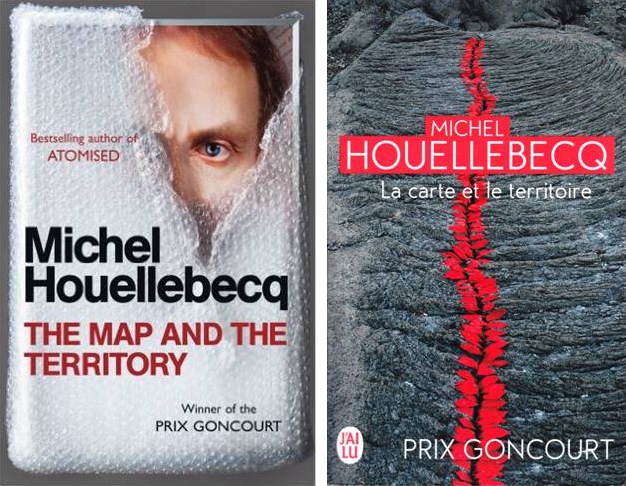
(Page x refers to the UK edition above left, page y to the French above right) 

Michel Houellebecq’s five-part novel, Submission (Soumission), is set in France, mostly in Paris, in 2022 and 2023 during the months of the presidential election campaign and its aftermath. In Part I we learn that the narrator, François, is a professor of literature at the Université Sorbonne Nouvelle – Paris 3, whose speciality from his doctorate onwards has been the work of the fin de siècle French novelist Joris-Karl Huysmans. François is in his early 40s, unmarried after numerous successive affairs with his students, and is unhappy with his situation and his prospects, although he feels that his academic articles about Huysman are “clear, incisive and brilliant” (Page 37).

In Part II the approaching election begins to concern François. The first round is on Sunday, 15 May – the format used for successive chapter titles from then until the end of the month. Although “as political as a bath towel” (Page 39), François is well aware that after the Socialist François Hollande had been re-elected in 2017, the political scene in France had begun to change. An Islamic party, the Muslim Brotherhood, under a charismatic leader, Ben Abbes, a graduate of the École Polytechnique and the École Nationale d’Administration (Page 88), has become increasingly popular. François learns more about what might happen during conversations with Lempereur, a young academic with right-wing connections, and with Alain Tanneur, the husband of another colleague, who works for the DGSI, similar to the UK’s Security Service. After encountering an ugly scene on the streets of Paris, François decides that “it would be prudent to come up with an evacuation plan, in case things took a sudden turn for the worse” (Page 58) and opens an account with an English bank in Paris. His most recent girlfriend, Myriam, who is Jewish and in love with him, as he recognises (Page 83), decides that she should leave for Israel with her family.

Part III opens on Sunday, 29 May with the second round of the election and François up early and taking the A10 autoroute, at first intending to head to the south west but then deciding Spain would be better. Running low on fuel he turns off at a service station to find the pumps turned off and the bodies of the cashier and two young banlieu types. He decides to leave the A10 and head for Martel in the Lot department, where he stays until the middle of July. The second round of the election is cancelled after attacks on polling stations and a third round is to be held a week later. François has another long conversation with Tanneur, who comes from Martel, and, having been compelled to leave the DGSI, is about to retire there. Ben Abbes, backed by the centre right and the Socialists, wins by a landslide. François makes repeated visits to the Chapel of Our Lady at nearby Rocamadour but fails to make the connection with religion that Huysman had achieved.

At the start of Part IV, François has returned to Paris. Far from close to his long-separated parents, he discovers that his mother has died. Soon afterwards he learns that he is to be pensioned off* by what has become the Islamic University of Paris-Sorbonne. Then he hears that his father has died. Isolated and with no role, by early 2023 François has become very depressed. He decides to return to the abbey near Poitiers where Huysman had taken his monastic vows and which François had visited when preparing his dissertation. After three days he leaves.

Part V begins with François on the TGV back to Paris, observing with interest one of his fellow passengers, an Arab with two of his wives. On returning home he finds a letter inviting him to edit Huysman’s work for the prestigious Éditions de Pléiade. Things look up further for François when he is invited to a reception for the reopening of the Sorbonne. He meets Robert Rediger, its new president. Rediger invites François to his splendid house and proposes that he rejoin the faculty on the basis that he is neither Catholic nor atheist and prepared to convert. François takes away a copy of Rediger’s middle-brow best-seller, Ten Questions on Islam, and “Like most men, probably, I skipped the chapters on religious duties, the pillars of wisdom and child-rearing, and went straight to chapter seven: ‘Why Polygamy?’ (Page 224). By the end of the book, François has become a Muslim and takes “the chance at a second life, with very little connection to the old one. I would have nothing to mourn.” (Page 250).

François is a sharp observer with a mordant view of life, (doubtless not dissimilar to Houellebecqq’s – after all, we are warned that Huysmans uses
… a tried and true strategy: he adopts a main character, an authorial stand-in … (Page 38) )
and we are exposed to it early on when Francois, having defined literature as … the major art form of a Western civilisation now ending before our very eyes (Page 6),  soon after explains that:
The academic study of literature leads basically nowhere, as we all know, unless you happen to be an especially gifted student, in which case it prepares you for a career teaching the academic study of literature - it is, in other words, a rather farcical system that exists solely to replicate itself and yet manages to fail more than 95 per cent of the time. Still, it's harmless, and can even have a certain marginal value. A young woman applying for a sales job at Céline or Hermès should naturally attend to her appearance above all; but a degree in literature can constitute a secondary asset, since it guarantees the employer, in the absence of any useful skills, a certain intellectual agility that could lead to professional development - besides which, literature has always carried positive connotations in the world of luxury goods. (Page 10)
François’ views about teaching and women are similarly acerbic and in Part II, he moves on to politics:
History is full of such blindness [to the significance of violence and riots]: we see it among the intellectuals, politicians and journalists of the 1930s, all of whom were convinced that Hitler would ‘come to see reason’. It may well be impossible for people who have lived and prospered under a given social system to imagine the point of view of those who feel it offers them nothing, and who can contemplate its destruction without any particular dismay. (Page 44)
For all his knowingness, François can be surprisingly gauche (in its English usage), for example when he first meets Lempereur:
Alice watched us with the affectionate, slightly mocking look that women get when they witness a conversation between two men – that odd ritual, that is neither buggery or a duel, but something inbetween. (Page 46) 
… As an intellectual of the right, I was thinking, he was seductive enough. He’d stand out in the department, in a minor way. You can let people talk for a long time, they’re always interested in what they have to say, but every now and then you’re supposed to contribute. … ‘You’re what,’ I asked, ‘Catholic? Fascist? A little of both?’ It just popped out. I was out of practice with intellectuals of the right – I couldn’t remember how to behave. All at once in the distance we heard a kind of sustained crackling. (Page47/48)
He likes to disguise his misogynistic views in a cloak of realism:
… I benefited from that basic inequality between men, whose erotic potential diminishes very slowly as they age, and women, for whom the collapse comes with shocking brutality from year to year, or even from month to month. (Page 15) 
… I thought about Annelise's life - and the life of every Western woman. In the morning she probably blow-dried her hair, then she thought about what to wear, as befitted her professional status, whether 'stylish' or 'sexy', most likely 'stylish' in her case. Either way, it was a complex calculation, and it must have taken her a while to get ready before dropping the kids off at day care , then she spent the day e-mailing, on the phone, in various meetings, and once she got home, around nine, exhausted (Bruno was the one who picked the kids up, who made them dinner - he had the hours of a civil servant), she'd collapse, get into a sweatshirt and tracksuit trousers, and that's how she'd greet her lord and master, and some part of him must have known - had to have known - that he was fucked, and some part of her must have known that she was fucked, and that things wouldn't get better over the years. The children would get bigger, the demands at work would increase, as if automatically, not to mention the sagging of the flesh. (Page 76)
Certainly Houellebecq’s male characters are more interesting than the female ones, Tanneur particularly, although the reader is left wondering what happened to the smooth young Lempereur. Rediger, who is rising fast under the new regime, gives François his card:
In the metro I examined the business card that my new acquaintance had given me. It was elegant and tasteful, at least I thought so. Rediger provided his personal phone number, two office numbers, two fax numbers (one personal, one office), three email addresses, ill-defined, two mobile numbers (one French, the other British) and a Skype handle. This was a man who let you know how to get in touch (Page 201)
Although the book is set in the near future it is firmly rooted in the present, notwithstanding the author’s reference to “these inventions of mine” in the Acknowledgements (Page 251). Not just Sarkozy, Hollande, the Le Pens and Copé, but many of the other public personalities mentioned, less well-known outside France, can be found on Wikipédia, for example Pujadas, Barbier, Dély, Thréard, Mégret, (Laurent) Wauquiez, (Renaud) Camus and (Florian) Phillipot. Whether this is a weakness or strength is difficult to say except that, within less than a year, the premises of Submission seem to have been overtaken by more events than might have been expected so soon. The Soumission publication day (7 January 2015) was, of course, that of the attack on the offices of Charlie Hebdo in Paris. The cover of that day’s issue was a caricature of Houellebecq as a wizard making predictions. The long-term consequences of those events remain to be seen but they seem unlikely to strengthen the novel’s key proposition (which is anyway dependent on a personality like that of Ben Abbes having emerged to shape the necessary policies) that after the election of 2017:
In a country gripped by ever more widespread unemployment, the strategy broadened the Brotherhood’s reach far beyond the reach of strictly observant Muslims. Its rise was nothing short of meteoric. After less than five years it was polling [in 2022] just behind the Socialists: at 21 versus 23 per cent. (Page 41)
2015 has also seen the EU having to deal with the migrant crisis and people arriving from Syria and elsewhere. Marine Le Pen seems unlikely now to make this particular mistake:
During the 2017 campaign, the National Front candidate had been persuaded that a woman had to look like Angela Merkel to win the presidency, and she did all she could to match the bristling respectability of the German chancellor, right down to copying the cut of her suits. (Page 89)
And then there are the minor discrepancies, unavoidable with the passage of time, like the UMP changing its name to Les Républicains and the damage to Volkswagen’s reputation from the diesel emission scandal. Fortunately François’ Touareg has a petrol engine (Page 104), unlike the Audi eulogised by its owner in The Map and the Territory.

Everything quoted so far is from Submission, as translated from Soumission by the editor of the New York-based Paris Review, Lorin Stein. Stein seems to have had a US readership in mind and I imagine that he must have asked himself repeatedly what he could reasonably expect them to know about France. So when we read that:
… the Paris Mosque [is] a few blocks from the university. (Page 20)
the original being:
la grande mosquée de Paris, qui était située à quelques rues de la fac. (page 28)
we can assume probably not much – not enough to be able to cope with “a few streets away from”. On the other hand, readers are expected to know what a TGV is (Page 187) and, rather harder, PSG, as on Lempereur’s T-shirt (Page 45) – and would they appreciate the irony of the club being wholly owned by Qatar?

Some things almost defy translation. Marie-Françoise Tanneur explains to François that the advancement of one of their colleagues at the university:
... was due entirely to the fact that he was eating Big Delouze’s pussy. This seemed possible, albeit surprising. … Chantal Delouse, the president of Paris III, had always struck me as a died-in-the-wool lesbian …(Page 20)
the difficult parts of the original being:
il broutait le minou de la mère Delouze… and … une lesbienne 100% brut de béton
Perhaps more literally: “grazes Mother Delouze’s pussy” and “a 100% raw concrete lesbian”. So, apart from “Ma” possibly being better than “Big”, it would not be easy to improve upon Stein’s version, although something still gets lost in translation. (Incidentally, béton brut is the origin of Brutalism in architecture).

Sunday, 29 May sees François
… driving along the hexagonal motorway system at two hundred kilometres per hour … (Page 105)
The original being
traverser, a 200 km/h, le réseau autoroutier hexagonal
Stein is, for sure, aware that the French archly referring to themselves as inhabitants of l’hexagone (look at a map).  But perhaps for most readers this should have been translated as:
... driving along the French motorway network at two hundred kilometres per hour …
assuming they can’t be credited with understanding the word autoroute – on which the speed limit, by the way, is 130 km/h (81 mph).

On Page 60, we find François settling down for election night TV:
The day before, I’d stocked the fridge with two bottles of Rully. As soon as David Pujadas went on the air at 7.50, I knew this election night would be top-notch …
“top-notch” – the original was “un très grand cru” (page 75). Houellebecq, who often mentions Burgundy wines, could be assumed to be aware that there are no Grand Cru wines produced in the Rully commune which only has the lesser Premier Cru, and chose his words for effect - best left intact?

Less interesting are the odd careless mistakes. Page 52 refers correctly to the rue du Cardinal Mercier, but on Page 49 it had been the rue Cardinal Mercier. Page 64 refers to the rue de Santeuil, as does the original on page 79 – but both should have been rue Santeuil. Page 53 mentions YouTube (correct) and RuTube (wrong); on the original’s page 66 it’s the other way round: Youtube (wrong) and Rutube (right). Perhaps more importantly, on Page 58 François tries to find out what’s going on by searching YouTube – in the original it was Rutube (page 72).

Rather more irritating is the reference on Page 56 to “all twenty-two EU member states” – there are currently 28, is Houellebecq forecasting some departures? But no, the original merely refers to “vingt-deux pays de l’union européenne”, the “all” being a gratuitous addition. I was puzzled on Page 96 when the guard of the locked-up university “emerged from the administration building [and] stood in front of the gate” – to do that he would have had to open up, whereupon the impatient crowd outside would have forced an entry in typical Parisian fashion. The original, not surprisingly, is “derrière les grilles” (page 118), Stein having confused his devant and his derrière.

I found Submission to be an odd mixture of a gripping political thriller and an unconvincing futuristic satire. How offensive it would be to a Muslim I can’t say, Islam not being my faith and not having studied theology, any more than I am equipped to judge whether Houellebecq is providing a sensible account of J-K Huysman’s times and works. It is difficult to imagine Soumission’s publication being helpful in France, even without the Charlie Hebdo attack, but the country has its own particular traditions of free speech and satire and is having its own internal debate about the nature of laïcité. As I write, Marine Le Pen is on trial in Lyon on hate speech charges, while earlier in the month it was reported that her National Front party had won the right to create an association at Sciences Po.

Some aspects of Houellebecq’s futurology seem particularly fanciful. The evaporation of the National Front’s support after the first round of the election seems unlikely, but, of course, Houellebecq’s premise is that France acquiesces peaceably in the new order – which is why Lempereur is not seen again. The notion that the EU by 2023 will be in the process of incorporating Algeria, Tunisia, Morocco, Lebanon and Egypt seems improbable too. On page 233 we are told that “the Muslim parties already occupied government seats in Britain …”. Whatever happens in the 2020 UK general election, the outcome will not be that. But Houellebecq never seems particularly interested in or informed about Angleterre (how Britain is referred to in the original, page 278**). The prominence of a senior academic is defined by the way “he was regularly invited to give lectures at Oxford and St Andrews” (Page 238). Oxford, yes but St Andrews?

As usual though, Houellebecq provides food for thought about France – and plenty of food and drink too. François may microwave Chicken Byrianai, Tikka Masala, and Rogan Josh for himself, but he happily eats Marie-Françoise Tanneur’s south west cooking. I was struck by how the need for an evacuation plan occurs to François early on, but there is a long history of times when leaving Paris for France profonde might have been a sensible idea: 1789, 1848, 1871, 1914, 1940, 1968 … 2022 - it’s not just because of the inheritance laws that Parisian families hang on to properties in the country. Of those dates, perhaps 1940 was foremost in Houellebecq’s mind when writing Soumission, together with the accommodations that many Frenchmen would make in the following four years. Part of Le Pen’s current problem may be her use of the occupation word. 

Would I recommend Submission? To anyone with an interest in France who has the time, probably yes, but Houellebecq’s previous novel, The Map and the Territory, (posted about here last month) was better in my view.


 * At 3472 euros per month (page 148). On Page 170 François tells us this is twice the national average. However, in mid-2014 the average gross wage in France was 2480 euros, net 2180. So Francois seems to have been taking a rosy view of his situation, unless wages fall substantially in the next eight years.

** Similarly on page 241, Rediger’s British mobile number is described as “anglais”.


UPDATE 17 NOVEMBER 2015

I said above that “the premises of Submission seem to have been overtaken by more events than might have been expected so soon” without any anticipation of something like the attacks in Paris on 13 November. It was at the Sorbonne (Université Paris-Sorbonne, Paris IV) yesterday that President Hollande, surrounded by students, observed the minute’s silence for those who had been killed.


Michael White’s Guardian Politics blog on 16 November discusses Submission after the attacks in his piece, France and Britain: the differences in their struggle with extremism.


8 September 2015

Michel Houellebecq’s ‘The Map and the Territory’

This week sees the publication in English of Michel Houellebecq’s novel, Submission (Soumission). I thought it would be interesting to re-read The Map and the Territory (La carte et le territoire) published in France in 2010 and in English* translation in 2011. The novel gained Houellebecq the Prix Goncourt (for "the best and most imaginative prose work of the year") in 2010.

The Map and the Territory follows the life of a successful French contemporary artist, Jed Martin. After developing one genre based on photographs of Michelin maps, he switches to another, more conventional one of portraits of people at work. Works like Bill Gates and Steve Jobs Discussing the Future of Information Technology, subtitled The Conversation at Palo Alto become internationally successful, although Jed has a problem with Damien Hirst and Jeff Koons Dividing Up the Art Market which is where the book starts:
Koons's forehead was slightly shiny. Jed shaded it off with his brush and stepped back three paces. There was certainly a problem with Koons. Hirst was basically easy to capture: you could make him brutal, cynical in an 'I shit on you from the top of my pile of dosh' kind of way; you could also make him a rebel artist, (but rich all the same) pursuing an anguished work on death; finally, there was in his face something ruddy and heavy, typically English, which made him look like a rank-and-file Arsenal supporter. In short, there were various aspects, but all of them could be combined in the coherent, representable portrait of a British artist typical of his generation. Koons, on the other hand, seemed to carry in him something dual, like an insurmountable contradiction between the basic cunning of the technical sales rep and the exaltation of the ascetic. (page 1)
He also paints portraits of his father, The Architect Jean-Pierre Martin Leaving the Management of his Business, and of Michel Houellebecq, Writer. Jed’s conversations with his father and the alter-Houellebecq are surprising to an English reader because of the interest both characters share in William Morris. Jean-Pierre as a young man had admired Morris as a designer as much as he disliked Mies van der Rohe and
... above all Le Corbusier, who tirelessly built concentration-camp-like spaces, divided into identical cells that were suited ... only for model prisons. (page 145)
but alter-Houellebecq, although admiring Morris as a social reformer, comes to the conclusion that:
What can undoubtedly be said is that the model of society proposed by William Morris certainly would not be utopian in a world where all men were like William Morris. (page 175)
What French readers make of it, one has to wonder, William Morris not being particularly familiar to many of them. Come to that, most English readers will be at a loss with the description of the FR1 (France 1 television) New Year’s Eve party and the personalities there like Jean-Pierre Pernaut.

Houellebecq is never afraid to give offence with his opinions. Jed meets and observes a senior manager at Michelin:
… again he searched for the right words, which is a disadvantage with former pupils of the Polytechnique; they’re a bit cheaper to hire than those of the École Nationale d’Administration but they take more time finding their words; … (page 55)
Jed eventually decides to move into his grandparents’ house in the Creuse. Houellebecq likes the French countryside (see, for example his letters to Bernard-Henri Lévy) but, if his view is the same as Jed’s, not its residents:
Jed had no illusions about the welcome he would get from the inhabitants of his grandparents' village. He had noticed that while he was travelling through La France profonde with Olga, many years before: outside certain very touristy zones like the Provençal hinterland or the Dordogne, the inhabitants of rural zones are generally inhospitable, aggressive and stupid. If you wanted to avoid gratuitous assaults and trouble more generally in the course of your journey, it was preferable, from all points of view, not to leave the beaten paths. And this hostility which was simply latent towards passing visitors, transformed into hate pure and simple when the latter acquired a residence. (page 278)
Nor is Jed keen on Mercedes:
Although he knew nothing about his life, Jed was hardly surprised to see Jasselin arrive at the wheel of a Mercedes Class A. The Mercedes Class A is the ideal car for an old couple without children, who live in an urban or periurban area, yet do not hesitate to treat themselves from time to time to an escapade in a hôtel de charme; but it can also suit a young couple of conservative temperament - it will, then, often be their first Mercedes. An entry into the range offered by the firm with the Silver Star, it is a discreetly different car; the Mercedes four-door saloon Class C and the Mercedes four door Class E are more paradigmatic. The Mercedes in general is the car preferred by those who aren't really interested in cars, who place security and comfort over driving sensations - also for those, of course, who have sufficient means. For more than fifty years - despite the impressive commercial strike force of Toyota, despite the pugnacity of Audi the global bourgeoisie had, on the whole, remained loyal to Mercedes. (page 240).
Jed likes Audis which
… characterise themselves by a particularly high level of finishing which can only be rivalled, according to Auto-Journal, by certain Lexus models. This car was the first one he'd bought since reaching a new wealthy status; from his first visit to the dealer, he'd been seduced by the rigour and precision of the metal assemblages, the gentle click of the doors when he closed them, all that was machine-tooled like a safe. Turning the speed-regulator control, he opted for a cruising speed of 105 km per hour. Some small notches, marking every 5 kph, made driving all the smoother; this car was indeed perfect. (page 165)
Houellebecq places some interesting characters in Jed’s life, for example, the art world PR, Marylin, and Inspecteur Jasselin, the Maigret-like detective who investigates alter-Houellebecq’s murder, and his un-Mme Maigret-like wife. However Olga, for a while Jed’s glamorous Russian girlfriend, is too much of a male fantasy.

Something about Houellebecq which I find intriguing is that he must be one of the very few novelists with an international reputation who had a scientific education, in his case as an agronomist. His mother had trained as an anaesthetist. Although from his student days he was inclined towards literature, Houellebecq later earned a living in information technology (until he could get out) and, according to an interview in Le Figaro magazine this summer, he has had a long-term interest in photography. Certainly if, as he recently told the Guardian, “…the job of a novelist is foremost to hold a mirror up to contemporary society”, he is not reluctant to introduce its technical details, for example here the life-cycle of the housefly. But Houellebecq’s readers can never be sure where the boundary of his satire lies. Does Jed’s dislike of Mercedes and encomium for Audi, both expressed in marketing speak, reflect the author’s world view or, rather more likely, is he tilting at the commercial shallowness of contemporary art and some of its practitioners?

A couple of oddities in the translation. On page 165 Jed is driving an “Audi Sport Wagon” which on page 177 has turned into an Audi Allroad A6. As far as I can tell, “Sport Wagon” is a type of BMW SUV sold in North America. The French original refers to “son break de chasse Audi” – “his Audi shooting brake” or nowadays “his Audi estate”, which could indeed be an Allroad A6.

On page 287 there is a reference in a description of Jed’s camera equipment to “a hard disk of two teraoctets” which non-French readers might not recognise as two Terabytes. The French (with the Romanians and Quebecois) use octet instead of byte for eight bits .

*By “English readers” I mean those in that language, not, of course, just those resident in England.  Page numbers are as in the 2011 UK hardback, (cover above).


26 October 2013

What the Houellebecque?

Financial Times sub-editing is not what it was. This letter appeared today (26/7 October):


Mr Creese is right about the titles of the two books being the same (although the full title of Greenspan’s is The Map and the Territory: Risk, Human Nature and the Future of Forecasting). And the second only carries that title in translation, the original being La carte et le territoire. However its author was, of course, Michel Houellebecq – how could the FT have let that mistake through?


The similarity in the titles was picked up by Carolyn Kellogg in the Los Angeles Times in an amusing piece, What does Alan Greenspan have in common with Michel Houellebecq? She concluded:
How did very different books by such different writers come to share a title? I think it comes from Alfred Korzybski, the Polish-American philosopher and founder of semantics -- in talking about the difference between a description of a thing and the experience of it, said, "a map is not the territory." Why did they both invert the phrase in the same way? Perhaps Greenspan has spent some of his time after retiring from the Fed reading edgy French literature.


26 January 2012

Michel Houellebecq and Bernard-Henri Lévy

Over a meal, either in late 2008 or early 2009, Michel Houellebecq (MH here, sometimes) and Bernard-Henri Lévy (BHL here and everywhere, nearly always) decided to begin an exchange of 28 letters which would run from January to July 2008. These were published in France the following year under the title Ennemis Publics. A translation into English, Public Enemies: Dueling Writers Take on Each Other and the World, became available in the US a year ago, and, under the title Public Enemies, has just been published in the UK. 

BHL is well-known as a philosopher, journalist, activist, and filmmaker and MH is a well-known writer who won the Prix Goncourt in 2010 for La carte et le territoire, published in the UK as The Map and the Territory in 2011. Houellebecq likes to go on the offensive from the start – The Map and the Territory opens with an ad hominem attack on Jeff Koons and Damien Hurst. So in Public Enemies, it’s not surprising that he opened up on BHL and then turned on himself:
We have, as they say, nothing in common - except for one essential trait: we are both rather contemptible individuals.
A specialist in farcical media stunts, you dishonor even the white shirts you always wear. An intimate of the powerful who, since childhood, has wallowed in obscene wealth, you are the epitome of what certain slightly tawdry magazines like Marianne still call "champagne socialism" and what German journalists more astutely refer to as the Toskana-Fraktion. A philosopher without an original idea but with excellent contacts, you are, in addition, the creator behind the most preposterous film in the history of cinema.
Nihilist, reactionary, cynic, racist, shameless misogynist: to lump me in with the rather unsavory family of "right-wing anarchists" would be to give me too much credit; basically, I'm just a redneck. An unremarkable author with no style, I achieved literary notoriety some years ago as the result of an uncharacteristic error in judgment by critics who had lost the plot. Happily, my heavy-handed provocations have since fallen from favor.
Together, we perfectly exemplify the shocking dumbing-down of French culture and intellect as was recently pointed out, sternly but fairly, by Time magazine.
We have contributed nothing to the electro-pop revival in France. We're not even mentioned in the credits of Ratatouille.
These then are the terms of the debate. (pages 3,4)
MH and BHL
a passage which starts to reveal the challenge which the translators (Miriam Frendo for BHL and Frank Wynne for MH) faced. In the original, “champagne socialism” appeared as «caviar gauche» – in France champagne doesn’t carry the class associations it has elsewhere. Toskana-Fraktion was left untranslated from the German, but is a play on Rote Armee Fraktion, usually translated into English as Red Army Faction - the UK’s Toskana-Fraktion would probably include several leftist luminaries with a fondness for Tuscany. The references to “the most preposterous film in the history of cinema” and Time magazine’s stern-but-fair article might have benefited from referencing (here linked), but the translators probably felt they had enough to do, footnoting the large cast of French literary personalities the two authors discuss, eg:
“A l’agité du bocal": essay by Louis-Ferdinand Céline, considered to be inflammatory and anti-Semitic, which was published in 1948 in response to Sartre's article "Le Portrait d'un antisémite" (1945).
It may be that your reaction to that is «bien sûr», or “of course”. If so, you are probably a graduate in French and are well equipped to appreciate the majority of the discourse between these two intellos. Otherwise, if you are just curious about France, the preoccupations revealed in the letters still offer insights into that complex country, spread among the literary introspection. It is also quite amusing to watch two alpha males with such high opinions of themselves making the transition from locking horns to bonding, of a sort.

BHL was born in 1948 and Houellebecq in 1956 (probably), and it doesn’t take long for them to begin exchanging notes on what their fathers did, or didn’t do, during the war, that is to say the Occupation. Neither man shows much interest in post-war Europe or the EU, but both struggle with the experience of France between 1940 and 1945. For example, BHL:
There are the good stars, the astra, which, on the other hand, make you raise your head, look to the sky, especially the sky of ideas: there's the star of the sailors of the Ile de Sein and the humble fishermen of Brest and Saint-Malo immediately joining the Free French; the idée fixe that, despite the shooting and the slaughter, made the inspired soldiers of Monte Cassino rise to the assault, the light guiding the first French pilots in the Battle of Britain through the night as they resisted the fascination - again, starstruck - of what de Gaulle called “the frightening void of general renunciation."
BHL is not one to let facts impede his poetic flow. Readers should make their own minds up about the contribution of the French Expeditionary Corps in Italy and at Monte Casino with the Moroccan Gourniers in particular. But the RAF Roll of Honour for the Battle of Britain recognises 574 pilots from countries other than the United Kingdom, as flying at least one authorised operational sortie with an eligible unit during the period from 10 July to 31 October 1940, alongside 2,353 British pilots. The largest contribution came from 145 Poles – there were only 13 pilots from France. (Similarly, when talking about writers with an espionage background (page 119) BHL cites Le Carré, but also Orwell when presumably he meant Grahame Greene.)

MH takes a grimmer view of the World Wars:
… In going beyond the acceptable in that appalling, unjustified [First World] war, France lost all right to the love and the respect of its citizens; it brought discredit on itself. And such discredit is. I repeat, permanent.
This, it seems to me, explains a lot of things.
The nihilist rage of Surrealism and Dadaism, the surge of fury André Breton sometimes felt at the sight of a uniform or a flag.
The ease with which a generation of working-class people (whose parents and grandparents were probably irreproachable patriots) was convinced that the country of the workers was the Soviet Union and there could be no other.
Finally, the lack of enthusiasm with which the French fought in 1940. When people condemn the spirit of Munich, I always feel a certain unease, because Munich after all was in 1938 – twenty years after 1918. Twenty years isn't much. And I think one has to beware of reading it as ideological. Because the first thought that occurred to most French people in 1940 was not, I think, "The struggle against Nazism has started," but something more like "Here we go again with the Huns."
If I don’t know quite what my parents did during the Second World War, I know even less about what my grandparents did during the previous war. There is, however, a number I remember because it struck me at the time. My grandmother was part of a family that in 1914 comprised fourteen brothers and sisters. By 1918, there were only three left. This is what they call "taking a heavy toll." (pages 113, 114)
MH takes a mordant view of life in modern France as well:
There is also what one might call the France of Denis Tillinac - all local color and duck confit. I had barely experienced it until two or three years ago when, for a variety of reasons, I had to crisscross the country. And I have to admit, Denis Tillinac is right: it is a very beautiful country. The rural areas with their subtle patchwork of tilled fields, open meadows, and woodlands. The villages, here and there, stone houses, the architecture of the churches. Fifty kilometers farther along all this can change completely and you find a different arrangement, just as harmonious. It is incredibly beautiful what generations of anonyrnous peasants through the centuries have managed to create. Ooh-la-la, I feel like I might be losing it; admire a rural landscape these days and you can find yourself being accused of neo-Pétainism. (page 116)
The last is an intriguing comment. The French elite seem to like spending their holidays by the sea (Île de Ré and so forth), areas which were mostly occupied and therefore not part of Vichy France. As the map shows, this 'Free Zone', for reasons of Nazi strategic defence, was essentially inland and rural.

Writing before the current EU economic crisis, Houellebecq takes a jaundiced view of France’s prospects as well:
… Denis Tillinac is right; he is absolutely right to live in this France … but he is wrong to believe that it will disappear and to feel nostalgic about it. Worldwide, tourism is now the largest economic sector and selling points like that don’t just disappear: they're worth a lot of money. This is what young British people have come to look for when they retire after their careers in the City (and now that they’ve grossly inflated prices in the Dordogne, they've started buying up the Massif Central). This is what, with all their feverish, financial hearts, the Japanese and Russian nouveau riches hoped to find, and we gave it to them. They have their raw-milk cheese, the Romanesque churches, they have their duck confit. We will give the same warm welcome to the nouveau riches from China and India.
As an economic activity for France in the future, that will be more than enough. Does anyone really believe we are going to become world leaders in software development or microprocessors? That we are going to maintain a major export industry? Come on . . . We will still have some manufacturing, that's true, mostly in the same sector (haute couture, perfumes, Joël Robuchon packaged dinners). Trains will be another exception; the French love trains.
Does this mean that I meekly accept the new international division of labor? Well, yes, nor do I see how I could do otherwise. The "emerging countries" want to earn money, much good it may do them; we have lots of things for them to spend it on. To put it more crudely, do I really want to turn France into a dead, mummified country, a sort of tourist brothel? … Without a second thought I say YES.
You wouldn't think it, but I have, in a few sentences, just saved the French economy; which just goes to show that our letters are not a waste of time. (pages 116, 117)
MH has his own way of handling BHL who, on 4 April, sends a long letter including an essay on Epicurianism and the nature of chaos – one expects he always got 20/20 for his philo – ending (page 132): "Now it’s up to you to play." Houellebecq begins his reply on 10 April:
… I moved my boxes of books into a house which is not habitable just yet and won’t be for several months, maybe until the end of the year. Here I am, therefore, utterly powerless to respond to your letter in like terms. …
By May BHL and MH seemed to be finding more in common than either expected – as MH points out on 20 May:
… I realised a fact, a small but significant fact: we already have the same enemies. (page 212)
When all this has calmed down, long after we are dead, some future historian will be able to draw some great lesson from the fact that we both, and at much the same time, have comfortably fulfilled the role of public enemies. I don’t feel able to expand on the idea, it's just an intuition, one that still seems strange to me: but I believe that the person who manages to work out why the two of us, so different from each other, became the chief whipping boys of our era in France will, in doing so, understand many things about the history of France during this period. (page 214)
which might make the US title, Public Enemies: Dueling Writers Take on Each Other and the World, a little misleading. The two writers’ concluding letters in July are appropriately elegiac. Houellebecq quotes Schopenhauer
:“We remember our lives a little better than a novel we once read.” To which I would add that we remember our lives less well than a novel we once wrote. (page 300)
BHL has the last word:
Contrary to the famous theory, I don’t believe that it's at the last moment, the last breath, that you rediscover the total memory, fully available to itself, that life has dispersed. I believe it's here and now, at every moment of life, as long as it is really lived. On each page of each book, as long as it is intensely desired. And my premonition, if I had one, would be rather that it's time to start worrying when in reply to the question "What is living?', too many of those books, moments in life, or the faces that accompanied them stop answering the roll call. There's a feeling in return for a feeling, a wager for a wager.
Let's wait and see. (page 303)
At which point it's possibly worth re-reading the article in Time.