Showing posts with label Grayson Perry. Show all posts

9 March 2016

Grayson Perry’s ‘Sketchbooks’

In May last year I posted about Grayson Perry’s A House for Essex, which had just been the subject of a TV documentary, and remarked:
There was a glimpse at the start of the documentary of some of his preliminary sketches for the House. I would certainly like to see more of his drawings; not all contemporary artists have such a talent - or risk showing it.
and now I have been able to, with the publication of Sketchbooks, a selection of images from the artist’s sketchbooks from 1980 to 2014. There are sections covering 1980 to 1986, when Perry was at art college and establishing himself in London, Practical Pot Making:


Fashion Designs, Etchings, The Walthamstow Tapestry & Our Father, The Tomb of the Unknown Craftsman, The Vanity of Small Differences, The Royal Academy of Arts, Who Are You?, and A House For Essex


The book ends with photographs of Finished Works “that grew out of these sketches”. Sketchbooks has been produced as a paperback of nearly 200 pages with an artful faux-battered cover. The page size is slightly larger than A4, so the centres of what, presumably, were A3 (or larger) drawings when made disappear uncomfortably into the bindings:


However, the quality of the Italian printing is high. Anyone who like me is an admirer of Perry will value the background it provides to the artist’s recent works and the evolution of his style.


3 July 2015

The RA Summer Exhibition 2015


The current Royal Academy Summer Exhibition in London is the best I can remember in over 20 years, most of it good, very little bad or ugly, and the most enjoyable one too, with virtually no photography restrictions and images of all the works available on line. The co-ordinator, Michael Craig-Martin RA, has made the gallery spaces more colourful and reallocated the architecture and other themes within the Academy galleries. At which point I suggest that anyone who reads this post as far as this would, instead of continuing here, probably gain more from exploring the RA Exhibition website pages which include a short introduction by Craig-Martin, behind-the-scenes videos and personal selections by Sebastian Faulks, Grayson Perry, Cath Kidston and others.


But for the record, here are a few items which registered with me out of more than 1100 on show in this slyly cerebral Summer Exhibition. Even before going in, I liked Jim Lambie’s treatment of the main staircase with ZOBOP (above). Craig-Martin chose magenta for Gallery III, enhancing all the work there, including his own Untitled (Watch) (below centre).


In that gallery I was also struck by Gillian Ayres' Tremenheere (below top left), Chantal Joffe’s Megan in Spotted Silk Blouse (below top right) and Mick Moon’s Noon Fishing and Dawn Fishing (below lower left and right respectively).


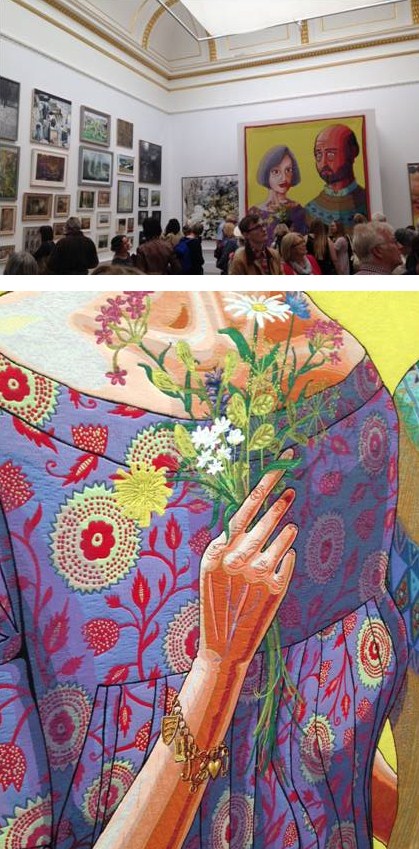
Gallery I this year is given over to small works with the exception of Grayson Perry’s tapestry, Julie and Rob, (below). As explained here in a post in May about A House for Essex, Julie Cope is a fictional “secular Essex everywoman”. Her charm bracelet includes that county’s shield, a cassette tape (a generational thing) and the cause of her untimely decease – was there a particular choice of wild flowers for the bouquet?


The Large Weston Room (below) now has the architectural models and drawings – I sometimes wonder whether the notions on show will ever be constructed but inspiration has to start somewhere, as with Gehry’s Fondation Louis Vuitton.


The Small Weston Room, no longer crammed with small works, is given over to some impressive drawings in ink on torn pages by William Kerridge, installed there by the artist, for example Untitled (The Periphery) (below):


There were two abstract pieces appealed to me in Gallery IV: Christine Stark’s When D'You Last Think You Saw It? (below upper) and Marion Jones’ Bars and Triangles (below lower):


Galleries V and VII are given over to prints, scores of them. So here are just a few; John Duffin’s etching Thames Bridges East (top left below) and Julian Opie’s Tourist with Beard (top right below); and two with South West scenes, Catherine Greenwood’s Silbury Treasure and Iona Howard’s Goonhilly Downs (below lower left and right respectively):


Between V and VII, Gallery VI is arranged by Craig-Martin with several interesting pieces including Lisa Milroy’s Black Dress (below left) and Gary Hume’s The Blue Ground (below right):


which is in the background to this photograph of Anish Kapoor’s study of refraction, Untitled (below):


Gallery VIII provided many fine things, including another South West scene, Cyril Croucher’s PZ101 at Mousehole (below left, PZ indicates a fishing boat registered at Penzance, Cornwall) and two contrasting bronzes by James Butler, Soldier and In the Sun (below right, upper and lower respectively):


Gallery IX, arranged by Alison Wilding and Bill Woodrow around Michael Sandle’s monumental bronze, As Ye Sow So Shall Ye Reap: An Allegory (Acknowledgements to Holman Hunt) (below left), included some interesting political pieces like Bob and Roberta Smith’s Sir Peter Bazalgette's P45, positioned just below Allen Jones’ Salome, (below right):


and Emily Allchurch’s Babel London (After Bruegel) (below) with its warning signs:


The Lecture Room is given over to things sculptural, for example Antony Gormley’s series of six “Small” below:


Nicola Hicks’ Relic (below top) and Dido Crosby's  5 Sheep and a Goat (below lower) seem particularly flattered by the sky blue walls:


More challenging are Eva Rothschild’s What the Eye Wants (below top) and Phillip King’s The Unpainted Gum Tree (below lower):


Geoffrey Clarke’s Taunton Deane Crematorium Test Panel was at Crucible2 in November.

Finally, Gallery X is exclusive to Tom Philips’ A Humement (1966-2015), a page-by-page artistic reworking of an old book (below):


The RA Summer Exhibition 2015 ends on 16 August.


18 May 2015

Grayson Perry’s A House for Essex

“Living Architecture [LLP] was set up five years ago to revolutionise both architecture and UK holiday rentals. We offer a chance to rent houses for a holiday designed by some of the most talented architects at work today, set in some of the most stunning locations in Britain.” 


A documentary on Channel 4 on 18 May, Grayson Perry’s Dream House, revealed Living Architecture’s latest acquisition, A House for Essex, designed by Perry and FAT Architecture. The Living Architecture webpage is full of useful links and images (below) so there is little need for more here. I thought an article in Dezeen magazine particularly informative for the majority of us who, after all, are unlikely to visit the place. 


The House, although secular, was commissioned in the tradition of wayside and pilgrimage chapels and the exterior was influenced, according to the Independent, by arts and crafts houses, English Baroque architecture and Stave churches – medieval churches made of wood. It is dedicated to a saint:
Perry’s saint is a “secular Essex everywoman,” a fictional character called Julie Cope, for whom he has created a rich back story. “I wanted her biography to reflect Essex and women since the war,” he said. Inside the property is a statue of Julie and four tapestries. They tell the story from her birth in 1953 during the great flood of Canvey Island to her death in 2014, when she was killed by a curry house delivery driver on a scooter.
As to where Perry the artist is taking us, I’m not much wiser. Julie’s sad and violent end is reminiscent of that of Tim Rakewell in the sixth of Perry’s The Vanity of Small Differences tapestries, Lamentation, back in 2012. There was a glimpse at the start of the documentary of some of his preliminary sketches for the House. I would certainly like to see more of his drawings; not all contemporary artists have such a talent - or risk showing it.

At the end of the show Perry, in a new ‘Julie’ transvestite alter ego (poster at top), took a group of real Essex women actually called Julie to see the house. One of them at least seemed quite moved by it, all good telly anyway. Channel 4 is the home of Grand Designs, the first in a genre of TV programmes about building projects, mostly beset by problems with builders, weather and cost over-runs. None such in Grayson Perry’s Dream House, whose builders and architect all seemed to know what they were doing, though there was little about the constructional details – how were all those Julie tiles secured? As far as cost problems are concerned, perhaps Simon Kuper, writing about Art and the billionaire heirs, in the FT Weekend Magazine on May 16/17, shed some light:
When I joined the FT as a graduate trainee in 1994 I was told that someone called Alain de Botton had been offered the same job the year before. But de Botton - whose millionaire father had left him a trust fund reportedly worth £200m – had decided to write books instead. He insists he never touched his dad’s money. Still presumably it made artistic life feel secure.
De Botton, the author of, among other things, The Architecture of Happiness, is the creative director and chairman of Living Architecture.

So far I haven’t seen any comparisons between A House for Essex and the Watts Mortuary Chapel at Compton in Surrey – well worth a visit, as is its custodian, the Watts Gallery.


29 January 2015

Grayson Perry, Establishment Man

This post began as Grayson Perry at the NPG but providing the necessary context turned it into a wider review. 

In 2013 Perry was the BBC’s Reith Lecturer and in a series titled Playing to the Gallery he discussed “what makes him an artist and the limits of contemporary art”. The BBC website has downloadable pdf transcripts of his four lectures and also shows some drawings he made for them. In 2014 he authored a book, Playing to the Gallery: Helping contemporary art in its struggle to be understood (PttG) with additional material and images. It’s worth reading, not just to have Perry’s astute observations in a more accessible form, but also for some of the extra illustrations which are very amusing (eg page 69, ‘inspiration for the staff bedrooms’; page 90/91, a London art map; page 113, curation) but I thought one conveys Perry’s sardonic views particularly well:


On inspection, Map of Museum based on Interior of Curator’s Head might have been more appropriately titled Map of Art Gallery based on Interior of Director’s Head. But Perry, who regards himself as “a fully paid-up member of the Establishment” (PttG page 82), presumably knows not to bite other dogs . 

About a month after PttG was published, Perry was Guest Editor for the 10 October New Statesman magazine – “A special issue on the Great White Male - That’s the straight, white, middle-class men who dominate our culture (and our politics)”. In the issue’s The NS Essay, They walk among us, Perry bemoaned the fact that:
… white, middle-class, heterosexual men, usually middle-aged … [are] a group that punches far, far above its weight. 
They dominate the upper echelons of our society, imposing, unconsciously or otherwise, their values and preferences on the rest of the population.
and christened them Default Man. Though he had to admit:
I must confess that I qualify in many ways to be a Default Man myself but I feel that by coming from a working-class background and being an artist and a transvestite, I have enough cultural distance from the towers of power. I have space to turn round and get a fairly good look at the edifice. and then spent much of the rest of the essay in the fortunate position of having his cake and being able to eat it: When I am out and about in an eye-catching frock, men often remark to me, “Oh, I wish I could dress like you and did not have to wear a boring suit.” Have to! 
… Personally, working in the arts, I do not often encounter Default Man en masse, but when I do it is a shock. I occasionally get invited to formal dinners in the City of London and on arrival, I am met, in my lurid cocktail dress, with a sea of dinner jackets; perhaps harshly, my expectations of a satisfying conversation drop. I feel rude mentioning the black-clad elephant in the room. I sense that I am the anthropologist allowed in to the tribal ritual.
Just why post-industrial societies in general, not just the UK, are still dominated at their upper levels by men is not something Perry gives much consideration to. At one point he quotes Sherrie Bourg Carter:
Women in today’s workforce ... are experiencing a much more camouflaged foe – second-generation gender biases ... “work cultures and practices that appear neutral and natural on their face”, yet they reflect masculine values and life situations of men.
but he seems more interested in the wearing of suits than the raising of children. Only in The NS Interview, when Perry invites Martin Amis to his studio for a dialogue, does that aspect of reality begin to intrude:
MA You have to whisper it now that there are differences between men and women. There are, though. Women have children, you know. 
GP Yeah, but there’s also a much more encultured version of what it is to be a man and a woman. I sometimes characterise it as: males are defined by what they do and women are often defined by what they are. … 
GP I think that the male role is more heavily policed, in terms of constricting behaviours that are available to it. The male aesthetic is often about camouflage – because he then retains his ability to observe from a supposedly neutral standpoint. Women are one of the groups to be looked at. Everything is defined from that male gaze. Is it possible to unpick the white, male, middle-class, middle-aged, heterosexual effect on culture and take it out? Because they’ve become inextricably woven into what we call culture and “right thinking”. 
MA Males? 
GP Yes. How do you think men have branded the nature of intellectualism and seriousness?
MA It would take for ever to untangle that, wouldn’t it? …
Early on in The NS Essay, Perry reveals that:
In the course of making my documentary series about identity, Who Are You?, for Channel 4, the identity I found hardest to talk about, the most elusive, was Default Man’s. Somehow, his world-view, his take on society, now so overlaps with the dominant narrative that it is like a Death Star hiding behind the moon. We cannot unpick his thoughts and feelings from the “proper, right-thinking” attitudes of our society. It is like in the past, when people who spoke in cut-glass, RP, BBC tones would insist they did not have an accent, only northerners and poor people had one of those. We live and breathe in a Default Male world: no wonder he succeeds, for much of our society operates on his terms. 
Chris Huhne (60, Westminster, PPE Magdalen, self-destructively heterosexual), the Default Man we chose to interview for our series, pooh-poohed any suggestion when asked if he benefited from membership or if he represented this group.
Who Are You?, in which Perry “turns his attention to identity as he creates portraits - from tapestries to sculptures and pots - of diverse individuals who are all trying to define who they are”, was broadcast in three parts starting on 29 October. It was a successor to his 2012 Channel 4 series, In the Best Possible Taste, with its six large accompanying tapestries, The Vanity of Small Differences, which eventually went on a UK tour. This time the Who Are You? pieces are displayed among the National Portrait Gallery’s collection in London (below):

‘Vibrant’ art that working-class people might like – surely not 
There isn’t space here to describe all of the items, let alone reference the 140 or so minutes of video essential to their explanation – see next year’s book by Perry perhaps. But a few are worth mentioning, not least because Default Man turns up in the form of the Huhne Vase (below top). Why Huhne allowed Perry so close when he was in such dire circumstances (before imprisonment and subsequently on release) is a mystery. Later at the NPG, Huhne’s meeting with potter and vase, (which, according to the Guardian:
… was purposefully smashed by Perry and then repaired using an ancient Chinese technique which involves lacquer resin dusted or mixed with gold. The Huhne vase has been decorated with the motifs of Huhne’s face, his H11HNE number plate and a penis.  Perry said: “This is a riposte to the common Default Man’s defence that he is an ‘individual’ and his achievements and behaviour have nothing to do with group identity.  I have smashed the pot and had it repaired with gold to symbolise that vulnerability might be an asset in relationships to such a person.”)
was filmed for the first part of the series, an encounter which resembled that of water and a duck’s back, Huhne not being in the least fazed by Perry, who, he pointed out, was a RA and CBE*. I didn’t think Perry closed on Huhne, who, although he didn’t say so directly, seemed to regard Perry as just another player in the influence game** albeit one with an outré image.


Another item which attracted attention when the show opened was The Ashford Hijab (above lower), a portrait of young Muslim convert, Kayleigh Khosravi, from Ashford in Kent. Perry commented:
What does Islam offer to a young white woman in her twenties?  The answer, I found, appears to be a refuge from the nagging consumer pressures and constant, often sexual, scrutiny of women all pervasive in western society.  Conversion also offers a strong and supportive sisterhood within the congregation of the mosque.
Nearby in Room 31 is Wallis, Duchess of Windsor (1939) by Gerald Leslie Brockhurst, a portrait of a woman who had been on an even more remarkable journey. Whether this was an intentional juxtaposition, the visitor doesn’t know. But it was doubtless deliberate that The Line of Departure (below top), a tapestry in the style of an Afghan rug showing three wounded war veterans, is in Room 23, Expansion and Empire, near Florence Nightingale receiving the Wounded at Scutari by Barrett. I don’t believe the vets featured in the Channel 4 series, an omission which wouldn’t have surprised Kipling. [But see UPDATE 31 JANUARY below]


Probably the most memorable item was the Jesus Army Money Box (above lower), a ceramic in the form of a medieval chasse, a small enamelled chest containing a holy relic. This was inspired by the time Perry spent with a Christian group which helps the homeless.

In the few years since he was first mentioned here, Perry seems to have grown even more popular – no crime that. At the end of 2104 he used his Twitter account (@alan_measles) to keep followers informed, and patiently answering queries, about the construction and decoration of a large (one meter tall) vase:


Large, but not exactly breaking new ground. In the year that Perry became a RA, Brian Sewell wrote rather caustically about Perry:
In the quarter of a century that he has been making them [pots] they have remained essentially the same - perhaps bigger and more provocative in imagery and narrative, but they are so undeveloped that they demonstrate stultifying intellectual and aesthetic limitations. Meanwhile, Claire [*] has gone from strength to strength and it is for her tasteless and preposterous dresses, worn on every possible public occasion, that Perry is now notorious. 
[* earlier] … a female alter ego, Claire, who is now, in adult life, his public persona and has become not only much the subject of his work but the work itself, with the sedulous promotion of being Claire a constantly performed performance that more or less obliterates his unmemorable pottery.
But since then Perry has become a CBE and Reith Lecturer, and Claire engages with duchesses.

Perry with the Duchess of Cambridge
Is he “a fully paid-up member of the Establishment”? Peter Hennessy offered some relevant comment in a recent extended essay called Establishment and Meritocracy:
I reckon there is a permanent element at the core of the British Establishment - a kind of gyroscope - which embraces the grand old professions like the Law and the Civil Service (though the latter is a tad tattered at the moment), the House of Lords (especially sections of the crossbenches where sit the former Cabinet Secretaries, Law Lords, Chiefs of the Defence Staff and Queen's Private Secretaries), the Royal Society, the British Academy, the learned societies generally, the scientific and engineering institutes and the great medical colleges. The reach and clout of these institutions and tribes may fluctuate but they never truly fade, let alone disappear. While around this rooted, inner core there swirl the transient elements in the media, the financial world and the celebritocracy in constellations that vary from generation to generation who can have a powerful, if often passing influence on the mood music of political and economic discussion, and in the case of celebritocracy, the norms of our wider society. (pages 14-15)
So I think it's almost certain that Perry, if not "fully paid-up" and only transiently, is one of the celibritocrats within the British Establishment - will his knighthood arrive before or after Tracey Emin becomes a Dame?

Who are you? continues at the NPG until 15 March


* Respectively, Royal Academician and Commander of the Most Excellent Order of the British Empire.
** In January 2015 Perry was included as one of the 24 most influential people in Art (alongside Tracey Emin, Damien Hirst, David Hockney, Banksy and Iwan Wirth and Manuela Hauser, et al) in Debrett’s Britain’s 500 most influential people in 2015.


UPDATE 31 JANUARY

The London Evening Standard on 30 January carried an article by its owner, Evgeny Lebedev, describing how, as part of his paper’s ongoing campaign, he and Grayson Perry had met homeless veterans at a hostel in East London earlier in the month. According to the article, Perry has offered:
… to create a unique piece of art that would not only reflect the stories of those this campaign is helping but which we could also then exclusively auction to raise more funds for those who need it.
Also:
The CEO of Veterans Aid, Dr Hugh Milroy, was delighted by the visit. “Welcoming Grayson to New Belvedere House was a real pleasure,” he said. “The staff and residents warmed to him immediately. 
“Grayson’s empathy, humanity, humility and genuine interest shone through. We were stunned to learn that he was prepared to create an artwork for us and immensely grateful. Many of the veterans we help have an interest in painting, ceramics, photography or some kind of creative activity so there was great curiosity and enthusiasm when his visit was announced.”


UPDATE 12 APRIL – ESTABLISHMENT MEN AT WORK

On 11 April Grayson Perry wrote a piece in the Guardian, My hero: Neil MacGregor The retiring director of the British Museum transformed a stately institution into a cultural powerhouse.
… Neil was the major museum director’s major museum director. He is effortlessly learned, an astute diplomat and above all a lovely, lovely man. 
I sort of engineered our first meeting [in 2008] after I heard him talk to a small group where he gently berated the clergy of St Paul’s for charging entry fees. Afterwards we all went for supper at Pizza Express and I spotted an opportunity and sat down next to him. As casually as I could, I dropped in that I had an idea for an exhibition. Neil said: “Send me a letter,” and three years later my show, The Tomb of the Unknown Craftsman, opened. It is still my proudest achievement and its passage through the souk of fiefdoms that is the BM I’m sure was much eased by Neil’s initial enthusiasm. 
… I have just been appointed a trustee of the BM; …


26 May 2014

Grayson Perry’s 'Red Alan’s Manifesto'


How to explain? Alan Measles is “a 50-year-old teddy bear, dictator and God of the imaginary world of artist Grayson Perry” according to Tweeter @Alan_Measles (who is actually Grayson Perry, RA).

In 2012 Perry, who requires no description here, produced a ceramic sculpture of Alan Measles, Red Alan. In his BBC Reith Lectures, Playing to the Gallery, last year, Perry provided food for thought for anyone interested in art – whatever that might be. Now, he has produced an artwork for the Royal Academy, Red Alan’s Manifesto. For future ease of reference to its precepts, I’ve copied it below.


This post owes much to an article by the Royal Academy’s Amy Macpherson.


30 May 2012

The far side of Grayson Perry RA

RA is the Royal Academy of Arts Magazine and the Summer 2012 issue has just arrived:


I like Grayson Perry (as I explained in a post about his British Museum exhibition) and I thought his cover for RA was quite amusing. It was described inside:
Turner Prize-winning artist Grayson Perry RA is famous for his wonderful pots which combine dazzling visual exuberance and dramatic physical presence with imagery that reveals a sharp social observation. For our summer cover he has drawn a special Summer Exhibition pot, bulging inside with the show's goodies, while offering on the outside a gently teasing vision of its supposedly Waitrose-shopping, Radio 4-listening, National Trust-supporting audience.
Although I’m not a great fan of the RA Summer Exhibition or BBC1’s Antiques Roadshow, I’m afraid that my household has to put ticks of varying thicknesses, rather than crosses, in all the other ‘boxes’ (including the NT) except for The Proms. This issue of RA is launching a new opinion column with a contribution from Perry, No accounting for taste, on the class basis of aesthetics. As he points out:
In Britain, the most pervasive influence on the things we buy and do is social class.
He goes on to observe that the bedrock notion of middle-class taste is restraint and that:
I think this buttoned-up refinement can be seen in some of my favourite paintings. Someone once described modern British art as 'tightrope walking six inches off the ground'. I interpret this as an observation that British artists such as Paul Nash, Eric Ravilious, Ben Nicholson, even Francis Bacon with his glazed gold frames, did a polite, drawing-room-friendly version of Modernism, unlike those garish shouty foreigners with their café philosophy and angry politics. The shrine to this tasteful notion of bohemia must surely be Charleston in Sussex, the exquisitely faded farmhouse plavground of the Bloomsbury group …
Oh dear, more ticks: Ravilious and Nicholson have appeared in posts here, as would have Nash and Bacon if the opportunity had arisen – and I have been a supporter of the Charleston Trust for over 20 years …

So, just as people used to speculate about the once unseen far side of the moon, what would there have been on the far side of Perry’s RA pot, if it had been made, not just drawn? Well here are some suggestions for additional middle-class, Summer Exhibition-goers preferences in 2012:

The Dordogne
Volvo for sure at one time, but perhaps BMW or Audi now
The Killing or, better, Forbrydelsen
The Duchess of Cambridge
Ikea (mentioned in the article but not on the pot)
A trio of ’national treasures’: Alan Bennett, David Attenborough and Tony Benn
Most but probably not all of GAMA - Google, Amazon, Microsoft, Apple
Emma Bridgewater
Paul Smith (added 1 June)

I will add more if I can think of them, but coontributions are, as always, welcome.

On 5 June Perry is starting a three-part Channel 4 series, In the Best Possible Taste, based on talking to people from some of the tribes that make up modern British society that he came across in Sunderland, Tunbridge Wells, and the Cotswolds. The last of these is mostly located in South West England, of course. If it seems appropriate I will comment here on the series and also on his related exhibition, The Vanity of Small Differences, at the Victoria Miro Gallery, if I get to it.

Addendum 8 June

I should have known better than to try to be clever where Perry is concerned.  His Victoria Miro show includes the original, RA Pot, for the RA cover, and also a companion piece, Tate Pot, (left) for the Tate incorporating another 14 favoured brands. Assuming that there isn’t much to differentiate the taste of Summer Exhibition goers and Tate supporters, it’s a fair conclusion that the Tate pot is in effect the far side of the RA one. Well, I got three right: Apple, Amazon and Ikea. And what is a MINI if not a BMW? But I’m kicking myself about Pret A Manger.

I will post soon about The Vanity of Small Differences and the TV series, but in the meantime I recommend anyone interested in Perry’s work to make the trip to Victoria Miro 14 in Wharf Road, N1 to see Perry's six large tapestries and some new pots.

If, like me, you don’t aspire to the use of taxis, a 43 bus works fine: get out at Windsor Terrace, aim for the back of McDonald’s (not to be found on either pot ...) and look out for the Victoria Miro banner.


15 November 2011

Grayson Perry at the British Museum

In 2009 many people had the chance to see the Hayward Gallery’s touring exhibition, Unpopular Culture, which had been curated by Grayson Perry drawing on the Arts Council Collection. Perry is well-known for having won the Turner Prize in 2003 and for his transvestism. Most of his work consists of large decorated pots, and he can be dismissed as a potter rather than an artist. But I thought that the selection of British art he made for Unpopular Culture was informed and informative, and that the thoughts and opinions which accompanied the exhibition and that he inscribed on his pots revealed a sharp and knowing mind. Unpopular Culture had been preceded in 2006 by The Charms of Lincolnshire (left) where he put some of his own work alongside historical artefacts selected from the county’s museums.

Grayson has now curated The Tomb of the Unknown Craftsman, an installation of some of his new works alongside objects from the British Museum’s collection. On entry visitors are confronted by You Are Here (below left), covered in images of people like themselves and captioned to suggest that Grayson takes a realistic view of his audience’s motivations for coming. What follows provides a dialogue between Grayson’s craftsmanship and that of his anonymous predecessors over the centuries. He has a good eye for an interesting artefact and his own contributions reveal his intelligence and industriousness. His Rosetta Vase, (below right) covered with mid-2011 mots du jour and a satirical map of the contemporary art exhibition scene, amused me (in view of recent posts) with its inscriptions ‘babyboomers’ and ‘post-post-modernism’, as well as a quotation from the now somewhat forgotten Jacob Bronowski – presumably Grayson may have seen his television series, The Ascent of Man, (and counterpart to Lord Clark’s Civilisation), when a teenager in the 1970s.  


Some people may find Grayson’s feminine alter ego, Claire, and his teddy bear/personal god, Alan Measles, off-putting, (the latter had ample coverage in BBC1’s recent Imagine) but I think they should put that aside and look at the creativity of his work before forming an opinion. The BM exhibition continues until 19 February.

ADDENDUM 5 DECEMBER

The Tate has recently made available one of its Bloomberg TateShots of Grayson in his studio during the making of Rosetta Vase.

ADDENDUM 26 MARCH 2012

Decca Aitkenhead interviews Grayson Perry at the Guardian's Open Weekend.