This was also the title of a post here four years ago which covered an exhibition at Gallery Pangolin in Chalford and that year’s Fresh Air outdoor sculpture exhibition not far away in Quenington. History repeats itself, sometimes agreeably, because Pangolin are putting on their fourth one-man show of works by Terence Coventry, Sculpture and Works on paper, while Fresh Air 2015 has just finished.
Coventry was born in Birmingham in 1938 but has spent much of his life in Cornwall including a period working for Barbara Hepworth in St Ives. Some of his spare and dramatic pieces are made in Corten steel (COR-TEN) which weathers to a stable oxide surface, for example Corten Owl I (below left) and Corten Torso (below right):
Bronzes of various sizes at Pangolin include Man Releasing Bird II and Woman Releasing Bird (below, left and right):
Another bronze, Boar II (below top) and the powder-coated steel, Monumental Steel Bull (below lower):
were at Gloucester Cathedral during Crucible2 last year, as were bronzes by Coventry, Monumental Gannet Head, and by Jon Buck, Midnite Movie Heads, both to be seen at Fresh Air 2015:
There were over 170 items at Quenington, so what follows is just a few of those which I liked, starting with a bronze by Carol Peace, Red Ribbon (below left), quite different from Edwina Bridgeman’s Cos After All (below right), constructed from recycled plastic crates:
I’m not sure garden sculpture is at its best when it attempts to compete for space in the border as a quasi-vegetable (top), but Dorcas Casey’s Mule Head (lower) was clearly there on its own terms:
as were Tom Hackett’s Shaggy Dog Stories (below left), funded by Arts Council England, and Paul Cox’s Rabbits (£3000 and £1390 each respectively):
What would I like to have taken home to my own garden? Probably Wendy Lawrence’s ceramic Disc Form (below):
Terence Coventry, Sculpture and Works continues until 24 July. Fresh Air 2015 ended on 5 July but will be back in 2017, all being well.
I posted here about Fresh Air 2013.
Showing posts with label Gallery Pangolin. Show all posts
13 July 2015
20 October 2014
Crucible2 at Gloucester Cathedral
Crucible2 is the second sculpture exhibition at Gloucester Cathedral curated by Gallery Pangolin of Chalford, Gloucestershire. The first was in 2010 with 76 contemporary sculptures; this time 100 exhibits by 61 sculptors are set in and around the cathedral. Key pieces, in the view of the curators, include works by Kenneth Armitage, David Backhouse, Ralph Brown, Lynn Chadwick (Jubilee IV in the poster,left), Ann Christopher, Antony Gormley and William Tucker. The 20th and 21st century works are often positioned in startling and stimulating contrast to their mostly English Gothic surroundings. For example, Breon O’Casey’s Large Cockerel (circa 2000, below) in the Cloisters with the earliest fan-vaulting in England circa 1350:
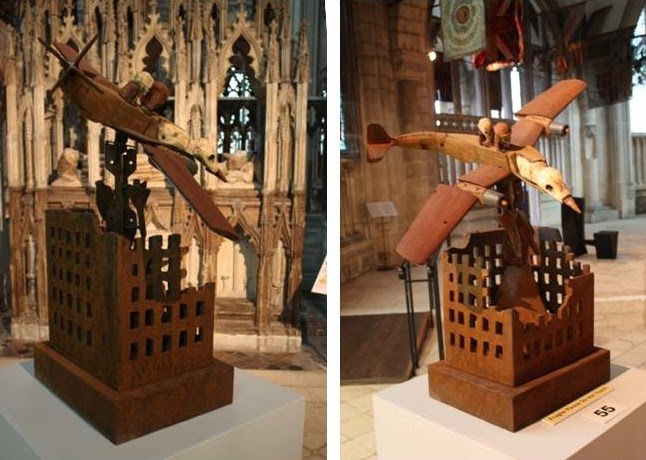
The most celebrated monument at Gloucester is the tomb of Edward II circa 1350, seen below left in the background to Steve Hurst’s Gloucester in Berlin. Hurst, born in 1932 and a witness to bombing in World War 2, sees it as concerning “… the bombing of civilians no matter what their country or who launches the bombing aircraft. It is a personal attempt to regain the viewpoint of a child”.
In the background (right) are the laid up colours of the Gloucestershire Regiment. They appear again (below right) behind Paul Wager’s Omnibus which marks the centenary of the Great War 1914-1918. Similar sentiments inform Deborah van der Beek’s Collateral (below right) – eight million horses died in that war - but it was cast around spent munitions from the conflicts in Iraq and Afghanistan which brought the expression “collateral damage” into common use.
The monument near Damien Hirst’s Anatomy of an Angel (Black) (2008, below) is to Sarah Morley, 29, a mother of four who died a few days after “having sustained the pains of Childbirth at Sea” while returning from Bombay in 1784.
Among the pieces I liked were Antony Gormley’s Pose (2012, below) with In Man’s Nature by Jon Buck behind).
Bryony Marshall’s DNA – Helix of Life (below, left) marks the 60th anniversary of the discovery of DNA. Subsequently mitochondrial DNA was identified as having been passed down to us all from a woman in East Africa about 150,000 years ago, known as Mitochondrial Eve, the inspiration for a sculpture of the same name by Sue Freeborough (below right):
The photograph below left of Geoffrey Clarke’s Taunton Deane Crematorium: Test Panel does not do justice to the colours of the glass. To the right is Sarah Lucas’s Realidad (2013), one of her NUDs series shown as bronzes at the Venice Bienniale in 2013.
John Humphreys’ Ipsius Imago a Latere Extensa probably succeeded as the artist wished in puzzling and confusing the viewer:
but perhaps was not as happily placed as the Eduardo Paolozzi plaster Vulcan near a strange moustachioed carving, perhaps a millennium older:
Among the sculptures in the open were Bruce Beasley’s Breakout II (below, left)in the Cloisters and outside Kenneth Armitage’s final work, Reach for the Stars (below, right).
Crucible2 ends on 31 October. There is no admission charge but a helpful map costs £2 and there is a £3 charge for photography. The catalogue at £16 is both good value and helps support the Cathedral.
UPDATE 2 NOVEMBER 2015
After posting about Beyond Limits: The Landscape of British Sculpture 1950-2015 held at Chatsworth House from 14 September to 25 October 2015, I thought it would be useful to add an image of Gavin Turk's bronze, Nomad (2002, below - and in other colours):
Another version of Chadwick's Jubilee can be seen there, as well.
Labels:
Antony Gormley,
contemporary art,
Damien Hirst,
Deborah van der Beek,
DNA,
Gallery Pangolin,
Gloucestershire,
Lynn Chadwick,
Sarah Lucas,
sculpture,
World War 1,
World War 2,
YBA
23 June 2011
Sculpture in Gloucestershire
There are currently two opportunities to see some modern British sculpture in Gloucestershire (SW England) – at Quenington and at Chalford, 18 miles (30km) to the west.
The Quenington Sculpture Trust has been running shows of contemporary sculpture in the riverside gardens of Quenington Old Rectory since 1992. The 10th show, Fresh Air 2011, which started on 19 June, features about 170 items from over 100 contributors, all in the delightful setting of Mr and Mrs Abel-Smith’s garden. Thanks to their support, what started as a local event has now become a significant biennale of sculpture with coverage in the national media.
Lorraine Robbins, the curator, asked five young artists to produce responses to Chadwick’s work and these are displayed alongside the relevant piece. Robbins gamely made her own contribution intended as a reaction to Chadwick’s Beast VII, commenting:
We are left to draw our own conclusions as to the significance of Robbins' head being concealed by an empty box of dog biscuits, in contrast to the ravaging mandibles of Chadwick’s creation. Beast 43 was still on sale when I visited – I hope it finds a buyer at £2000 before the show ends on 15 July.
Fresh Air 2011 closes on 10 July.
The Quenington Sculpture Trust has been running shows of contemporary sculpture in the riverside gardens of Quenington Old Rectory since 1992. The 10th show, Fresh Air 2011, which started on 19 June, features about 170 items from over 100 contributors, all in the delightful setting of Mr and Mrs Abel-Smith’s garden. Thanks to their support, what started as a local event has now become a significant biennale of sculpture with coverage in the national media.
Soaring Figure by Rick Kirby
![]() |
|
Fragment by Jilly Sutton
|
Gallery Pangolin at Chalford is the showcase for the sculpture foundry, Pangolin Editions. The foundry had a long relationship with the sculptor Lynn Chadwick (1914-2003) and to mark the 60th anniversary of the Festival of Britain, when Chadwick’s talent was first recognised, the Gallery is showing Strange Beasts Lynn Chadwick and the New Generation.
![]() |
| Beast VII by Lynn Chadwick |
Lorraine Robbins, the curator, asked five young artists to produce responses to Chadwick’s work and these are displayed alongside the relevant piece. Robbins gamely made her own contribution intended as a reaction to Chadwick’s Beast VII, commenting:
What strikes me about Chadwick's work and this piece in particular, is a real maleness in its welded angular construction, emphasising hard geometric shapes. In her book, The Nude in Art, Lynda Nead suggests that ‘if the male signifies culture, order, geometry ... then the female stands for nature and physicality.' She also posits that within the ideal, muscular, male body there lies a fear that it may revert to ‘its own female formlessness' or 'the beast within'. Beast 43 started as a desire to physically become Chadwick's beast. I wanted to perch heavily and precariously on a plinth, an unsavoury intruder in the gallery. In making the cast I chose to wear a bra and G-string, (a garment described by Roland Barthes in his essay 'Striptease' as the ‘ultimate triangle'), the flimsy, ornate triangles of underwear forming a distorted echo to the simple, masculine forms of Chadwick's Beast VII.
![]() |
| Beast 43 by Lorraine Robbins |
Fresh Air 2011 closes on 10 July.
Subscribe to:
Posts (Atom)