Showing posts with label Victoria and Albert Museum. Show all posts

8 December 2014

Constable at the V&A

Constable: The Making of a Master at the Victoria and Albert Museum, London aims:
… to offer a new interpretation of Britain’s best-loved artist. ... For the first time, Constable is presented alongside the old masters of classical landscape whose formal values he studiously assimilated. By combining the authority of their compositional ideas with a breathtakingly naturalistic vision that was entirely his own, Constable would ultimately transform the genre of landscape painting, and in the process shape the enduring popular image of the English countryside.
I wonder how many visitors will be surprised to learn that Constable (1776-1837), like other artists of his day, studied and emulated works by his distinguished predecessors. In his case these included Claude Lorraine (who influenced Turner), Rubens, Titian, Jacob van Ruisdael and, closer to home, Gainsborough and Thomas Girlin (an artist unknown to Your Paintings, it seems). The argument is manifestly well-made, for example by putting Claude’s Landscape with Hagar and the Angel (1646 left), with Constable’s Dedham Vale (1802, right):


And from Dulwich Picture Gallery, Jacob van Ruisdael’s Landscape with Windmills near Haarlem (c.1650-2, left) and Constable’s Landscape with Windmills near Haarlem, after Jacob van Ruisdael (1830:, right)


The exhibition also provides a chance to see some of Constable’s masterpieces in their original form, images that sadly are dulled by over-reproduction, for example The Hay Wain 1821:


and Salisbury Cathedral from the Bishop’s Ground, 1823:


There is much else that is far less familiar, for example the oil sketches which seem so ahead of their time like Brighton Beach (1824, below top) and Rainstorm over the Sea (1824–8, below, lower):


Constable tends to be associated with East Anglia (‘Constable country’), but, although he was not an adventurous traveller like Turner, he painted in the South West region beyond just Salisbury, for example nearby at Stonehenge, 1835:
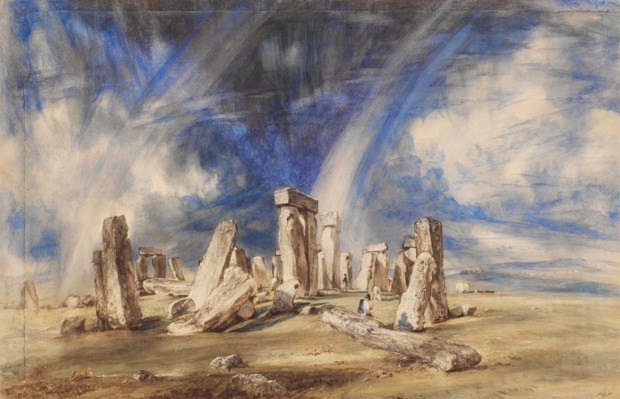

and at Gillingham Mill, Dorset, (1827, below, top) and Weymouth Bay with Approaching Storm (1819, below, lower):


Constable: The Making of a Master ends on 11 January 2015. Although enjoyable and informative, a full ticket price of £14 seems high when so many of the works have come from public collections, particularly the V&A’s own.


29 October 2014

V&A Prints on tour

The V&A has an extensive collection of fine art prints and related material. The range of the modern holdings is clear from their 2001 publication, Impressions of the 20th Century, and these have been drawn on to send Modern Masters: Matisse, Picasso, Dali and Warhol on tour this year to Lincoln, Plymouth, currently Bath’s Victoria Art Gallery and soon Inverness. Visitors to the show should be able to find something of interest from all four artists in the form of prints, books and other items.

The works by Picasso spanned most of his career from 1904 to 1957. I liked the portrait of the dealer Ambroise Vollard (1937, below left) and The Sleeping Woman (1947, below right):


There were also four of the sugar-lift aquatint and drypoint etchings from the portfolio of Buffon’s L’Histoire Naturelle, including The Lizard (1942, below left), which were printed during the Occupation, and Skull of a Goat on a Table (1952, below right):


The Matisse exhibits included both the print (image unavailable) and the wood block (1905, below right) for Nude in Profile on a Chaise Longue. The lithograph Interior, Reading (1925, below right) is of a subject he painted on various occasions:


Visitors to the recent Matisse exhibition at Tate Modern may have come away with the impression that his later work consisted only of cut-outs. Not so, as demonstrated colourfully by Marie-Jose in a Yellow Dress (1950, below):


Curiously, Salavador Dali was omitted from Impressions of the 20th Century. I hadn’t seen before any of the six posters which Salvador Dali designed for the French railways (SNCF) in 1969, two of the four on display here:


Andy Warhol’s work like Marilyn (exhibition poster above, three of the ten colour ways of this print are on show) is, as they say, iconic and also ubiquitous to the point of over-exposure (in a week I came across him in shows in Bath and Blenheim and at the NPG) but this colour offset litho poster from 1978, based on two of his Self Portraits from 1966, was striking:


This Louisiana is the Museum of Modern Art in Humlebaek, Denmark which, from its website, seems well worth visiting, although like many British people I’m deterred by the prospect of Danish prices. However, as the website states “DINNER BUFFET IN LOUISIANA CAFÉ EAT AS MUCH AS YOU WANT FOR DKK 149”, which would be just under £16 (US$26), perhaps I ought to think again.

Modern Masters in Print Matisse, Picasso, Dali and Warhol ends in Bath on 23 November 2014.


21 June 2012

Post-War British Design at the V&A

I suppose it must have seemed a good idea at the time – a survey of British design in the years since the last time the Olympic Games were in London, 1948. And so came about BRITISH DESIGN 1948–2012: Innovation in the Modern Age, now on at the V&A. It’s in the same space used for Postmodernism: Style and Subversion 1970–1990 last year, which perhaps explains any feeling of ‘déjà vu all over again’.

The new show is in three overlapping sections. The first, Tradition and Modernity, covers the period from the end of WW2 to the mid-1960s, more or less. The second, Subversion, runs from the 1960s onwards but doesn’t show much after 2003. The last, Innovation and Creativity, is spread over the “last half century” or so. And at this point I ought to admit to being someone who grew up in the first period and saw the rest of it through adult eyes at the time. Perhaps that was why for me the first section (view below) worked best:


To the left of Henry Moore’s Harlow Family Group (1954-55) is part of Reg Butler’s Woman Resting (1951). The painting above is William Gear’s Autumn Landscape of the same year. Further to the left and not visible is a fine Lynn Chadwick maquette of 1951 for Stabile Cypress. At the entrance is part of The Englishman’s Home mural (left) by John Piper made for the Festival of Britain in 1951 and his 1962 work (with Patrick Reyntiens) for Coventry Cathedral’s baptistry window appears nearby. After an austere post-War start we move on to a more consumerist society in the form of Terence Conran’s Habitat and the Country House-style of Laura Ashley. Although the exhibition ties these influences to the 1960s, neither seems to have disappeared since. This section ends with a Mini (sadly with a slight dent over the nearside rear wheel arch, but otherwise immaculate). 

Then comes Subversion. The art here includes one of David Hockney’s Walt Whitman-inspired works, We Two Boys Together Clinging (1961, right), and others by Richard Hamilton and Eduardo Paolozzi. The over-whelming impression however is of fashion and pop with costumes for David Bowie and others and contributions from Mary Quant and Alexander McQueen. The YBAs are represented by a section of Damien Hirst’s restaurant/art installation Pharmacy. Only once did an exhibit label make a reference to ‘postmodernism’. 

On to Innovation and Creativity, though the first and most striking objects (see below):


are an E-type Jaguar and Concorde, both more the product of function than of form. It would have been of value to see some of the china, glass and cutlery designed for BA's Concordes.  The aircraft was, of course, an Anglo-French project and at this point the reality of globalisation becomes apparent.  Jonathan Ive rightly appears for his role in designing Apple products, but not Martin Smith for his Audi Quattro. The statement on one of the panel texts:
Innovation has characterised British design from the introduction of spinning machines in the 1780s and the engineering of ships and bridges in the 1840s to the development of computer codes after the Second World War and the invention of the worldwide web in the 1980s.
seems facile, given that Tim Berners-Lee was working at CERN when he proposed the web and brought together hypertext and the internet, both originating in the US. This is not to belittle his achievements, but can they reasonably be labelled “British”?

The exhibition finishes with some complimentary remarks about British architecture and a model of 30 St Mary Axe (the Gherkin to most of us), but the most dominant new building in London is Shard London Bridge designed by an Italian, Renzo Piano. Its observation platform will open to the public next month. In 2012 it seems strange that there is no mention of Anish Kapoor and Cecil Balmond's ArcelorMittal Orbit sculpture at the Olympic Park, surely creative and innovative, albeit controversial.

Innovation in the Modern Age continues until August 31.

15 November 2011

Postmodernism at the V&A

US Supreme Court Justice Potter Stewart famously admitted in 1964 that while he couldn’t define hard-core pornography, “I know it when I see it”. After visiting Postmodernism: Style and Subversion 1970–1990 at the Victoria and Albert Museum in London, you might come to a similar conclusion about postmodernism, at least as far as design and architecture are concerned.

This exhibition follows on from previous shows at the V&A: Art Deco: 1910-1939 in 2003 and Modernism: Designing a New World: 1914-1939 in 2006. If postmodernism is definable at all (and the V&A avoids doing so directly), it is probably as a reaction to the latter. The show follows the movement from its attacks on modernism and on subordination of style to functionality through to its commercial success and acceptance.

I found the objects (eg furniture, a surprisingly large number of teapots) and the architecture more convincing than the cinema (Blade Runner) and the music. I mentioned in an earlier post the “monstrous carbuncle” problem in adding a modern extension to an existing building, so it was relevant to be reminded that London’s most prominent postmodernist building is Venturi and Brown’s Sainsbury Wing of the National Gallery. Perhaps objectors should consider what they wish for.

Some people might argue with the dates the curators have used to bracket this show – one argument is that postmodernism was largely pre-internet and that the quest for modernity has now moved on. Certainly, one of the cult objects of the present moment is the iPad, but surely its design seems to represent a continuation of modernism. The exhibition catalogue includes a remarkable chart by Charles Jencks (pages 276, 267) on the various strands of pluralism from 1960 to 2010. He also argues that post-modernist (he keeps the hyphen) architecture continues to flourish, for example the John Lewis store in Leicester.

There is a generous amount of information about postmodernism on the V&A website, and the show runs until 15 January. If you go, perhaps like me you will find it exceeds your expectations. You might even come to view Stewart’s remark as postmodern itself.