Showing posts with label World War 2. Show all posts

7 April 2016

Churchill and the Appeasers, Johnson and the Remainers

Would a Prime Minister Johnson "forgive and understand" their wrong-headedness?

Back in February, I remarked in a post here that:
There is even one school of thought that whether the result [of the Brexit referendum] is leave or remain, Boris Johnson will become the next leader of the Conservative party and therefore Prime Minister
and, if anything, this outcome seems more likely, not less. In fact, if being taken seriously is a measure, recent excoriating attacks on Johnson by, for instance, Matthew Parris on 26 March in The Times (Tories have got to end their affair with Boris, Charm can make us forget the dishonesty and recklessness that would be ruthlessly exposed if he became leader) and Nick Cohen in the Guardian a few days later (Boris Johnson. Liar, conman – and prime minister? The mayor of London has been treated with woozy indulgence by the media. But Britain may pay the price), suggest much more likely. Reacting to Parris, John Rentoul in the Independent was calm, It's time to get used to the idea of living under Prime Minister Boris Johnson, or perhaps just resigned.

Not long before, I had come across the biography which Johnson had written in 2014, The Churchill Factor: How One Man Made History. Reviewers tended to regard it as very readable in the style of Johnson’s Daily Telegraph opinion pieces which appear most Mondays (at £5000 a time they say), as not adding much to the huge amount of literature on his subject already available and as being as much about Johnson as Churchill.

It occurred to me that if Johnson were to become PM after a Brexit vote, he would be leading a Cabinet many of whom had been "remainers". How would he deal with them? Would his portrayal of Churchill who, after only three weeks as PM and in a much greater crisis in 1940, had to work with senior members of a Cabinet who had been advocates of appeasing Hitler, offer any insights?

Rather to my surprise, Chapter 1 plunges straight in at this point in Churchill’s life with The Offer from Hitler, made via Italy to negotiate an end to hostilities. This was put to the Cabinet in May 1940 by Lord Halifax, the Foreign Secretary and long-term appeaser of Hitler:
[Halifax] was tall, very tall; at 6 foot 5 he loomed about ten inches above Churchill – though I suppose advantage matters less around a table. (page 11)
Johnson is no more than 5 foot 10 by the way. Later after describing the Cabinet’s deliberations, Johnson comments:
It makes one cringe, now, to read poor Halifax’s defeatism; and we need to forgive and understand his wrong-headedness. (page 16)
and later:
All we are saying – in mitigation of Halifax – is that in seeking peace, he had the support of many British people, at all levels of society. (page 17)
Over 200 pages later (Johnson’s book is thematic in structure, not chronological) Halifax re-appears in 1941, prior to Pearl Harbor and the USA’s entry to WW2, as
… the British ambassador in Washington. This was none other than our old friend the Earl of Halifax: the beanpole-shaped appeaser - he who used to go hunting with Goering. Halifax was the British envoy charged with appealing to the finer feelings of the United States and he was having a terrible time. Shortly after arriving he is said to have sat down and wept - in despair at the culture clash. He couldn't understand the American informality, or their habit of talking on the telephone or popping round for unexpected meetings. In May 1941 the aristocratic old Etonian endured fresh torment when he was taken to a Chicago White Sox baseball game and invited to eat a hotdog. He refused. Then he was pelted with eggs and tomatoes by a group called the Mothers of America. Even for an appeaser, it seems a hell of a punishment. (page 247)
Johnson, if not inclined to vindictiveness, at least seems to have a taste for schadenfreude. He fingers a few other appeasers, for example:
Rab Butler, then a junior Foreign Office minister, was caught telling a Swedish diplomat that he thought Britain should do a deal – if Hitler offered the right terms (page 230)
returns to Johnson’s sights
… Tory drips such as Butler (the old appeaser) … (page 288)
So perhaps Tory remainers shouldn’t hold out too much hope of forgiveness and understanding from a Prime Minister Johnson.

There are some good things in The Churchill Factor. Johnson gives a whole chapter, An Icy Ruthlessness, to the decision to destroy the French fleet at Mers-el-Kébir, a tragedy which the British tend to overlook when revisiting the events of 1940. And another, The Ships that Walked, to Churchill’s sponsorship, when at the Admiralty during WW1, of the initial development of the tank by the Directorate of Naval Construction.

Unlike some celebrity writers, Johnson is happy to give credit to various helpers in the Acknowledgements, in particular Dr Warren Dockter, but my favourite is the one to a fellow Old Etonian:
David Cameron did some invaluable devilling into the exact locations of the pivotal meetings in May 1940 – not at all clear in Lukacs, for instance. (page 361/2)


UPDATE 24 APRIL 2016

Remarks by Johnson about President Obama at the time of the visit to London have led to Borises being sold heavily in the reputations market in the last few days – perhaps never to recover, although there are still 60 days to go before the Referendum.

Earlier in the month Johnson had published his tax return:


 - his earnings from the Daily Telegraph seem to match their reputation. In The Churchill Factor (pages 72 and 73), Johnson dismisses Evelyn Waugh’s criticisms of Churchill’s literary style:
Is it that Waugh was a teensy bit jealous? I think so; and the reason was not just that Churchill had become so much more famous than Waugh had been, by the time he was twenty-five, but that he had made such stupendous sums from writing. And that, for most journalists, alas, is the truly sensitive point of comparison. (page 73)

10 August 2015

The Frankton Memorial, Le Verdon-sur-Mer

There has been a revival of interest in the December 1942 Operation Frankton in the last few years. Better-known in the past as the Cockleshell Heroes operation, it was a clandestine attack on German shipping in Bordeaux harbour mounted by twelve Royal Marines commandos under Major HG "Blondie" Hasler. Infiltrated by submarine to the mouth of the Gironde estuary, the plan was to navigate their way by two-man canoes (“cockleshells”) up the heavily defended estuary for 70 miles to the harbour.

From www.c-royan.com
Five canoes set off with ten men: two died of hypothermia, six were captured and executed by the Germans, two survived including Hasler. Six ships were damaged, one extensively. Far from being futile, Frankton demonstrated the need for inter-agency cooperation while planning for the invasion of France in 1944.

In 2012 Paddy Ashdown’s A Brilliant Little Operation: The Cockleshell Heroes and the Most Courageous Raid of World War 2 was published, a BBC2 Timewatch documentary, The Most Courageous Raid of WWII, narrated by Ashdown, being shown the previous year. Ashdown’s account offers perspectives from someone who is both a senior politician and a former Royal Marines officer who had met Hasler. The documentary and book reveal that unknown to the Combined Operations Command who controlled the Marines, the Special Operations Executive were running similar operations at the same time. Inter-agency issues are explored further in Tom Keene’s Cloak of Enemies: Churchill's SOE, Enemies at Home and the Cockleshell Heroes, also published in 2012. Prior to these two books, the best-known account of the operation had been C. E. Lucas Phillips’ Cockleshell Heroes published in 1956.

In 2011 a memorial commemorating Frankton was installed on the southern edge of the mouth of the estuary at the Pointe de Grave in the commune of Le Verdon-sur-Mer (33). As it is fairly remote, two hours’ drive from Bordeaux, the photographs below may be of interest to anyone unable to visit the site. The memorial was designed by Baca Architects and constructed by Albion Stone Restoration for the Royal Marines Association. Both companies’ websites are worth consulting, Baca explaining that:
The Memorial remembers the 10 courageous Royal Marines, the bravery of the captain and crew of the submarine HMS Tuna and the courageous French citizens who assisted the Royal Marines. The four substantial Portland stone blocks step up towards the front of the memorial, where one may envisage a symbolic representation of the Royal Marines emerging from the sea, standing proud. As one moves around the memorial, different compositions are revealed. The separate stones create individual settings for insignia, as well as stones at the flanks to show the story of mission.
Albion explain that:
The staggered blocks create a dynamic ensemble, growing bolder to the front. The blocks are adorned with polished plaques that commemorative the heroism and retell the story. Symbolically the four stones represent four figures emerging from the sea.


and offer descriptions:


Stone 1: Crests of the participants in Operation Frankton: The Royal Navy, Combined Operations Command, The Royal Marines, The French Resistance


Stone 2: This carries the text tributes in English and French to the gallant 10 Royal Marines, and each named beneath a carved floral motif of the Rose, the Thistle and the Shamrock, representing the birth places of the men England, Scotland and Ireland. There follows tributes to the Capt and crew of HMS Tuna and to the courage of local French people who helped the marines, three, named on this plaque who were deported to concentration camp in Germany, and did not return arrested for being associated with Op Frankton, coincidentally, except for one Lucien Gody who raced late at night to warn Hasler and Sparks to flee their hiding place as Germans were close by. At the base are the words of Lord Mountbatten about the 10 men. 


Stone 3: There is a depiction of the Submarine HMS Tuna, together with the five canoes just after the launch, where they were to be together for the very last time. Two crews were lost in two vicious Tide-races on the first night, two men died of hypothermia and two were captured when they arrived exhausted on the beach and were executed four days later. [The quotation is from the C. E. Lucas Phillips’ book, mentioned above.]


Stone 4: This carries the narrative account of Operation Frankton, again all repeated in French.

The memorial is constructed in Grove Whitbed stone which has a surface markedly different from the limestone widely used for buildings in the Gironde.


The Pointe de Grave is exposed to salt water spray from the Bay of Biscay and the effects of corrosion are already beginning to show on the Frankton memorial. Nearby is another memorial which commemorates the American Expeditionary Forces under General Pershing which arrived in France in 1917. Hopefully it will receive some restoration before the centenary in 2017.


21 June 2015

The Bayeux Tapestry

When I worked in London, overseas visitors would sometimes ask what I thought they should visit. One recommendation was the Crown Jewels: after all, just because something is obvious, it doesn’t mean it’s not worth seeing, queuing considerations apart. So I wanted to find out whether the same applies to the Bayeux Tapestry, more properly, given its location, La Tapisserie de Bayeux. Just in case someone reading this does not know, according to Wikipedia the Tapestry is:
… an embroidered cloth nearly 70 metres (230 ft) long and 50 centimetres (20 in) tall, which depicts the events leading up to the Norman conquest of England concerning William, Duke of Normandy, and Harold, Earl of Wessex, later King of England, and culminating in the Battle of Hastings.
Or, more particularly, a fight between Norman and Danish (Anglo-Saxon) aristocrats as to who should take over the English throne.

There are about 50 scenes with brief Latin descriptions running along the the cloth, complemented by a decorative border which includes some interesting vignettes of peasant life:
Scenes 10a (upper) and 13
One famous scene shows Halley’s Comet, as seen in England in March 1066 – a bad omen for Harold:
Scene 32
Another scene of the disembarkation of the invading Norman forces at Pevensey in Kent seems particularly apt in Bayeux, a few kilometres from the D-Day beaches:
Scene 39
Once ashore, the top brass have a good breakfast:
Scene 43a (with detail)
before battle commences and the Poor Bloody Infantry have to confront Norman cavalry and archers, unsuccessfully as it turns out:
Scenes 52a (upper) and 54
 Harold dies:
Scene 57
and as a consequence Duke William becomes William the Conqueror.

Subsequently, William would expropriate English property holdings and enrich his Norman followers, as well as constructing Winchester Cathedral, the Tower of London (present day home of the Crown Jewels) and other notable buildings. The English language started to develop as a complex mix of Old English (Germanic) and Old French (Romance) with a marked social divide, as described in this interesting recent post on the OxfordWords blog by Adrastos Omissi.

The Tapestry is now carefully conserved (low light, humidity, temperature) by the Bayeux Museum, with an accompanying exhibition and, of course, a shop. To avoid queuing, go during the sacrosanct French lunch period (13:00 to 14:00). And to answer my question: although obvious, it is definitely worth seeing.

NOTE

The origins of the Tapestry are argued about by scholars but it is thought likely to have been made in Canterbury on the other side of Le Manche in the 1070s. However, given the modern French obsession with BDs (BD, bande dessinée, comic book), its current location seems quite appropriate.


15 March 2015

Saul Dibb's 'Suite Française'

Films based on novels often disappoint those who read first and view second. So I should say that I haven’t read Suite Française, based on Irène Némirovsky’s unfinished sequence of novels and published in an English translation in 2006, but the film was disappointing enough in its own right.


Even now, after so many other traumas since 1945, from Dien Bien Phu to Charlie Hebdo, the years of the Nazi Occupation remain a raw memory in France. Not surprisingly, French films and TV dramatizations set during those dark years tend towards providing comforting myths of heroic resistance rather than portrayals of acquiescence, not always sullen. The few conversations touching on the Occupation that I’ve had with French people of my own generation (the one with parents who were young adults during the war) underline just how difficult a subject it remains. In her review of Suite Française in The Times, Kate Muir, an admirer of the book, concluded:
If I were the French, I’d get the rights back to Némirovsky’s work, and make a sophisticated movie in my own language.
Well nigh impossible, I suspect – that is securing the sophistication, not the rights which are in fact already with TF1, more or less France’s BBC1/ITV equivalent. According to IMDb, Suite Française is a UK/France/Canada production, was mostly filmed in Belgium and the director and much of the crew came from the UK. But while nuanced enough to avoid “Nazis all bad, French all good”, it still offers the “Germans mostly bad and even the odd good one flawed, French mostly good and even the odd bad one rising above themselves” mythical formulation beloved of French TV. I

It is obvious from the outset that this is going to be a film with a simple narrative – occupied France, young handsome German officer, young attractive French woman whose husband is away at the war - so just how is this going to end badly? And, as a drama, it unfolds well if not pacily; Matthias Schoenaerts as Leutnant Bruno von Falk and Michelle Williams as Lucile Angellier perform soundly in their parts. Kristin Scott Thomas provides a particularly stiff and icy mother-in-law foil to Lucile and Bruno, who has been billeted chez Angellier. (Why Scott Thomas should have complained on BBC1’s The Marr Show recently about a lack of parts for actresses of her age, I can’t understand – she turns up in posts here every six months). The film looks good but still conveys the horribleness of war and the tragedy of Occupation, despite its implausible conclusion. Belgium provides a convincing substitute for France and the interiors, bourgeois ou paysan, match anyone’s expectations of French Country Style. Whether the Wermacht equipment was strictly 1940 issue, I wouldn’t like to say, but I was a little puzzled by the exact period of the film, if not the location.

A little history for anyone interested. France and the UK declared war on Germany in September 1939; Germany invaded France (and the Benelux countries) in May 1940. The French government soon departed for Bordeaux and a partly evacuated Paris fell on 14 June 1940 (not 1941, as Kate Muir seems to think). France signed an armistice on 22 June and was then divided, as indicated in the map below, into Occupied and “Free” Zones, the latter being administered from Vichy in the centre of France.


So the film Suite Française is set in the summer of 1940 during and after the invasion and surrender of France. Note, however, that the deportation of the country’s Jewish population did not start until 1942, the year Némirovsky died in Auschwitz, and something which Scott Thomas fans should be aware of from Sarah’s Key (2010). At the start of Suite Française, its setting is given as “Bussy, Central France”, though some reviewers place the town east of Paris. Given the extended presence of the Wehrmacht (von Falk’s unit is replaced at the end of the film), Bussy would have been in the Occupied Zone, as was Burgundy where Némirovsky spent the period from 1940 to 1942 when she started writing her novel sequence. In reality, the French police and civil service were the main agents for the rounding up and deportation of the Jews in France, working with the Gestapo rather than the Wehrmacht.

This film will be released in France in a couple of months. I can’t imagine that its content will prove that controversial, but the language convention used might. As produced, the cast speak English instead of French and any German being spoken is subtitled in English. It is straightforward enough for German to be subtitled in French instead, but French characters speaking English and being subtitled in French … or will they have to be dubbed?  At least, Suite Française won’t present TF1 with the problems it had with Marcel Ophuls’ unsparing anti-mythical 1969 documentary about the Occupation, Le Chagrin et La Pitié.

The Reichsmarschall at the Channel
If my comments seems unsympathetic to the French, they aren't meant to be. The only sensible perspective from Britain, saved from the Nazis by 20 miles (33 km) of sea, has to be one of “There but for the grace of God …”. The Nazis’ intention - quite by coincidence a chillingly obvious reminder of it appears in the post before this one – was to invade the United Kingdom and subjugate its citizens to the will of the Third Reich just like the rest of Europe. To imagine that, if that had happened, the British would have behaved better than anyone else is an illusion, but at least we were spared a myth.


11 March 2015

Also Observed in Amsterdam

Previous posts here have been about the Amsterdam Rijksmuseum’s current exhibition, Late Rembrandt, Rembrandt’s House and the Van Gogh Museum. This post covers a few other bits and pieces that might be helpful or of interest.

There is much to see at the Rijksmuseum outside the exhibition including a large selection of works on the second floor by painters of the Dutch Golden Age (1600-1700). Rembrandt’s The Night Watch (see below) and Vermeer’s The Milkmaid are probably the two most famous. Memorable by way of contrast with the exhibition was the early Rembrandt Self Portrait (1628, below left) and I couldn’t help but like Franz Hals’ Portrait of a couple (1622, below right):


The first floor of the Rijksmuseum covers the later periods of 1700-1800 and 1800-1900. There is a very large canvas of the Battle of Waterloo (1824) by Jan Willem Pieneman. It will be interesting to see if in the UK the Dutch contribution to Napoleon’s defeat gets due credit this year, the 200th anniversary of the battle. There were some 19th century pictures, new to me, from The Hague School, Jacob Maris’ The Arrival of the Boats (1884, below top), reminiscent of the Newlyn painters, and from the Amsterdam Impressionists, works by George Hendrick Breitner including The Bridge over the Singel at the Paleisstraat, Amsterdam (1896-98, below lower):


More as might be expected were a fine Monet landscape, La Corniche near Monaco (1884, below left) and an 1887 van Gogh Self Portrait. It was surprising to learn that the British artist Frank Brangwyn (1867-1956) had donated 270 etchings and lithographs to the Rijksmuseum in 1927 (“at the height of his fame” but who “fell into oblivion soon after his death”) – perhaps he thought they should be near Rembrandt’s – one on display was The Bridge of Sighs, Venice (1911, below right):


The relatively small third floor of the Rijksmuseum has some 20th century material, two works by Mondrian, some art nouveau and De Stijl furniture, and, from 1940, a grim item, the Nazi chess set (below). This was probably a gift from Heinrich Himmler to the leader of the Dutch National Socialists. The ceramic pieces are weapons and the border lists Nazi expansion starting: 1939 SCHACH-MATT (checkmate) 1940 POLEN DENEMARK NORWEGEN HOLLAND BELGIEN FRANKREICH ending ominously with ENGLAND U / W presumably unterwegs (on its way), although Operation Sea Lion was postponed indefinitely on 17 September 1940 (quite by coincidence relevant to the next post on this blog).


General Notes

This is, as I have said before, not a travel blog but here are some thoughts for anyone art-minded who may be going to Amsterdam. Even at the end of February, the museums and galleries were busy – I was told it gets worse from now on. So if you want to see The Night Watch like this:


and not like this:


get there early – staying at a hotel nearby and walking to the Museumplein is a good idea. The Rijksmuseum is open every day of the year, but only open for tickets from 09:00 to 16:30. It makes sense to buy tickets online beforehand. The Van Gogh Museum is open longer and has some late nights but has 1.5 million visitors a year, an average of over 4000 a day, so again advance ticketing is advisable – otherwise Sunflowers may look like this:


Once inside, things are easy for an English-speaker – everything is captioned in Dutch and English, the de facto second language of the Netherlands. Walking in Amsterdam is easy – as long as it isn’t raining - but be aware that on the streets, bridges and canal-sides there is a pecking order: trams first, then cyclists and cars, then finally pedestrians, who consequently need to keep their eyes open in all directions. But on foot they are the best-placed to enjoy the unique cityscape of Amsterdam!


UPDATE 17 MAY 2015

Parts one and two of an interesting article about some architectural aspects of the new Rijksmuseum.


1 December 2014

Anselm Kiefer at the Royal Academy

Within the last three years, London’s gallery-goers have had the chance to see retrospectives of the three German artists who are regarded as the most significant since the Second World War. Tate Modern showed Gerhard Richter in 2011 and now it has Alibis: Sigmar Polke while the Royal Academy is offering Anselm Kiefer. I’m not sure that the RA has used the term “retrospective” to describe their show, and if they haven’t it was a wise choice, because significant pieces of Kiefer’s work are monumental installations fixed elsewhere. Anyone visiting the exhibition should find the recent Alan Yentob programme in the BBC1 imagine series a valuable complement to the RA exhibition because it reveals the scale of the works which remain in Kiefer’s workshops in Germany, southern France and near Paris. As it is, the canvases and installations, some made for this show, fill the RA’s rooms to capacity.

Kiefer was born in 1945 and he emerged as an artist in the late 1960s with Occupations, a series of photographs of the artist performing the Nazi salute while wearing his father’s military uniform. The image appears in Heroic Symbol V (1970, Heroisches Sinnbild V, below):


Landscape is a recurring theme in Kiefer’s work, for example Winter Landscape (1970, Winterlandschaf, below top) and Black Flakes (2006, Schwarze Flocken, below lower):


And so is German history. Kiefer grew up in Germany in the aftermath of the Second World War and his work continues to address this period in works like Operation Sea Lion (1975, Unternehmen Seelöwe, the planned invasion of the UK in 1940, below top), Interior (1981, Innenraum), below middle, the ruins of Speer’s New Reich Chancellery in 1945) and Morgenthau Plan, (2013, bottom and detail in the poster above, the US plan for “converting Germany into a country primarily agricultural and pastoral”):


Other recent works at the RA are concerned with the Atlantic Wall and the Siegfried Line. Inevitably Kiefer has addressed the Holocaust in his work, notably through the poetry of Paul Celan, a Romanian survivor of the camps. His poem Death Fugue (Todesfuge) which ends 'Tod ist ein Meister aus Deutschland' ('Death is a master from Deutschland') compares the blonde Margarete and the dark–haired Jewess Shulamite. For Margarete (1981, below top) Kiefer attached yellow straw to a painting of ruined fields, and Shulamite (1983, below lower) is printed over an image of the Nazi Funeral Hall for the Great German Soldier, built in Berlin.


Kiefer’s wide interests in history and philosophy are given expression in works like the massive (2.9 x 5 metres) Ways of Worldly Wisdom: Hermann's Battle, (1980 Wege der Weltweisheit: die Hermannsschlacht, below). This is one of several works of similar titles and which require a Neil MacGregor on hand to explain the full significance of the images Kiefer chose to include:


Personally I find Kiefer’s enthusiasm for alchemy and other mysticisms difficult. His preoccupation with lead in terms of “texture, colour, strength and malleability” to quote the RA’s Gallery Guide is understandable but:
He believes it is the only material heavy enough to carry the weight of human history, and that its properties most closely resemble ours. ‘It is in flux. It’s changeable and has potential to reach a higher state of gold.’ This reference to alchemy, the transformation of base metals into gold, a subject that fascinates Kiefer, is perhaps a metaphor for the way his art attempts to transform and redeem the past.
Well perhaps, and better lead than uranium, denser and with a fissile isotope. Lead certainly makes impressive sculptures, overbearing even. For example, installed at the entrance to the show, Language of the Birds 2013:


Equally striking are the contents of the vitrines in the RA courtyard, Velimir Khlebnikov: Fates of Nations: The New Theory of War. Time, Dimension of the World, Battles at Sea Occur Every 317 Years or Multiples Thereof, Namely 317 x 1, 2, 3, 4, 5, 6 . . . . . . . ., 2011-14, though Kiefer is on record as saying that Khlebnikov’s ideas are “complete nonsense”:


Specifically for the RA, and occupying the whole of Gallery 7, is The Ages of the World (2014, below), an installation with a strong geological metaphor –the word ‘Devon’ in one of the accompanying paintings indirectly referring to SW England:


Towards the end of the exhibition, and in marked contrast, are “books” by Kiefer, one-off folios might be a better description, containing among other things some fairly graphic erotica. The Gallery Guide explains their derivation from similar pieces by Rodin, but possibly there is a link to Schiele’s nudes (currently  in London at the Courtauld Gallery).

Anselm Kiefer ends at the RA on 14 December.


20 October 2014

Crucible2 at Gloucester Cathedral

Crucible2 is the second sculpture exhibition at Gloucester Cathedral curated by Gallery Pangolin of Chalford, Gloucestershire. The first was in 2010 with 76 contemporary sculptures; this time 100 exhibits by 61 sculptors are set in and around the cathedral. Key pieces, in the view of the curators, include works by Kenneth Armitage, David Backhouse, Ralph Brown, Lynn Chadwick (Jubilee IV in the poster,left), Ann Christopher, Antony Gormley and William Tucker. The 20th and 21st century works are often positioned in startling and stimulating contrast to their mostly English Gothic surroundings. For example, Breon O’Casey’s Large Cockerel (circa 2000, below) in the Cloisters with the earliest fan-vaulting in England circa 1350:


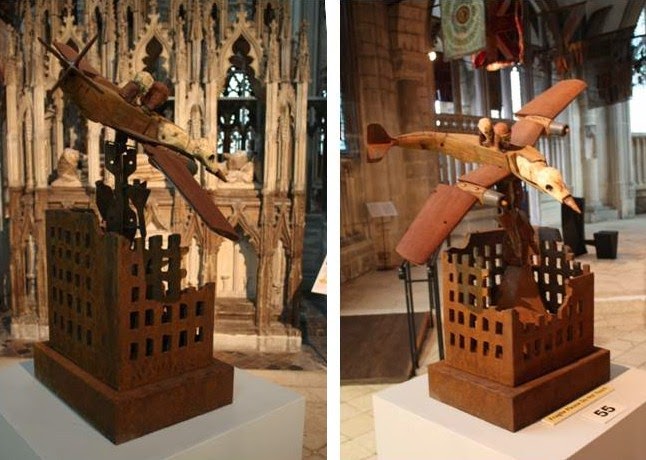
The most celebrated monument at Gloucester is the tomb of Edward II circa 1350, seen below left in the background to Steve Hurst’s Gloucester in Berlin. Hurst, born in 1932 and a witness to bombing in World War 2, sees it as concerning “… the bombing of civilians no matter what their country or who launches the bombing aircraft. It is a personal attempt to regain the viewpoint of a child”.


In the background (right) are the laid up colours of the Gloucestershire Regiment. They appear again (below right) behind Paul Wager’s Omnibus which marks the centenary of the Great War 1914-1918. Similar sentiments inform Deborah van der Beek’s Collateral (below right) – eight million horses died in that war - but it was cast around spent munitions from the conflicts in Iraq and Afghanistan which brought the expression “collateral damage” into common use.


The monument near Damien Hirst’s Anatomy of an Angel (Black) (2008, below) is to Sarah Morley, 29, a mother of four who died a few days after “having sustained the pains of Childbirth at Sea” while returning from Bombay in 1784.


Among the pieces I liked were Antony Gormley’s Pose (2012, below) with In Man’s Nature by Jon Buck behind).


Bryony Marshall’s DNA – Helix of Life (below, left) marks the 60th anniversary of the discovery of DNA. Subsequently mitochondrial DNA was identified as having been passed down to us all from a woman in East Africa about 150,000 years ago, known as Mitochondrial Eve, the inspiration for a sculpture of the same name by Sue Freeborough (below right):


The photograph below left of Geoffrey Clarke’s Taunton Deane Crematorium: Test Panel does not do justice to the colours of the glass. To the right is Sarah Lucas’s Realidad (2013), one of her NUDs series shown as bronzes at the Venice Bienniale in 2013.


John Humphreys’ Ipsius Imago a Latere Extensa probably succeeded as the artist wished in puzzling and confusing the viewer:


but perhaps was not as happily placed as the Eduardo Paolozzi plaster Vulcan near a strange moustachioed carving, perhaps a millennium older:


Among the sculptures in the open were Bruce Beasley’s Breakout II (below, left)in the Cloisters and outside Kenneth Armitage’s final work, Reach for the Stars (below, right).


Crucible2 ends on 31 October. There is no admission charge but a helpful map costs £2 and there is a £3 charge for photography. The catalogue at £16 is both good value and helps support the Cathedral.


UPDATE 2 NOVEMBER 2015

After posting about Beyond Limits: The Landscape of British Sculpture 1950-2015 held at Chatsworth House from 14 September to 25 October 2015, I thought it would be useful to add an image of Gavin Turk's bronze, Nomad (2002, below - and in other colours):


Another version of Chadwick's Jubilee can be seen there, as well.