Showing posts with label France. Show all posts

9 July 2017

Deciders meet deliverers


On 4 April 2013 David Cameron was “winched from a helicopter onto HMS Victorious, one of our Trident nuclear submarines” to quote from his own account later that day. According to a local newspaper, the Lennox Herald:
Mr Cameron joined the submarine at sea as it finished an 88-day mission and spent time with crew members on board the giant strategic missile submarine and visited the vessel’s operations room, messes and living spaces.
Photographs of Cameron on board HMS Victorious at the end of the 100th Trident patrol appeared in the national press the following day (see above).

Then on 8 April the death of Lady Thatcher started a flood of media articles in the days before the funeral on 17 April. One was by Angela Huth in the Daily Mail on 11 April:
Back in 1986, a producer friend at the BBC suggested that a book I had written, The English Woman’s Wardrobe, would make a good documentary film. The book was not about fashion, but about women’s feelings about their clothes. Princess Margaret was the star of the printed version: we wanted Mrs Thatcher to take that role in the film. Amazingly, she agreed.
At Number 10 the PM
… led us into the sitting room. There, some 20 different garments were hanging before us on a long clothes rack. She had abandoned her lunch break to heave them from her bedroom into the sitting room. … Mrs Thatcher remembered the history of everything on the rack, and described each one with merry recall. She pointed to a severe beige suit. ‘This we wore on a visit to the Polaris missile,’ she explained, with a touch of nostalgia. The ‘we’ she referred to meant, I think, she and her dressmaker.
The beige suit is probably the garment fourth from the right below.


A clue to “Polaris missile” can be found on the Margaret Thatcher Foundation’s (MTF) excellent website, which has recently made available her private files for 1982:
On 31 July MT paid a visit to HMS Resolution, one of the four Polaris submarines carrying Britain's strategic nuclear deterrent, a visit held so secret in advance that her appointment diary was left blank for the day: we only have timings for it because she kept the tiny engagement card she received each morning detailing the appointments for the day ahead. (Generally those cards do not survive.) Admiral Fieldhouse accompanied her and afterwards she wrote to him (10 Aug):  
It was a marvellous experience - made wonderful by the superlative and yet modest qualities of the commander and crew. The feeling of comradeship and yet discipline and respect were marvellous to see. We are fortunate indeed in the high personal qualities of our ordinary folk - if ordinary is the word to use: they all seem so able to demonstrate extraordinary qualities when called upon to do so. …
A couple of aspects of this seem noteworthy. Firstly, the somewhat de haut en bas reference in 1984 to “ordinary folk”, although qualified, and the use of a regal “we” to Huth in 1986 suggest that Mrs Thatcher’s feet had lost contact with the ground earlier than indicated by some of the accounts of her despatch in 1990 by her exasperated colleagues. The well-known “We have become a grandmother” was in 1989. Secondly, and more interestingly, it raises the question of how many other Prime Ministers have taken the trouble to visit Polaris or Trident submarines. Why should they? Peter Hennessy devotes a whole chapter of The Secret State Preparing for the Worst 1945-2010 to “The Human Button: Deciders and Deliverers” and makes the point:
… the premier [with the Chief of the Defence Staff (CDS)] makes up the first of the pairs that comprise the firing chain from the prime ministerial bunker to the Royal Navy Trident submarine on patrol. (page 358)
The Royal Navy became “Deliverers” at the start of the first Polaris patrol in 1968 since when there have been eight “Decider” Prime Ministers, four Conservative and four Labour. Of the Conservatives we know for certain that Cameron and Thatcher have been on board HM submarines carrying the nuclear deterrent. John Major may have been – he visited the Faslane base in August 1996 and made a speech at the ceremony to mark the decommissioning of the last Polaris submarine, HMS Repulse, by which time the first two Trident submarines were operational. Whether Ted Heath made such a visit in the Polaris period between 1970 and 1974 is uncertain. Margaret Thatcher was Heath’s education secretary so the MTF is making papers from his government available on-line. One is a record of a conversation between Heath and President Pompidou in November 1973 indicating the former’s interest in future nuclear cooperation with France rather than the US (page 8/9). So perhaps not.

Again, it is yet to be established whether or not any of the four Labour PMs (Wilson, Callaghan, Blair and Brown) visited a Polaris or, in the case of the latter two, Trident submarine. Of course, not doing so, or not wanting it to be publicised if they did, does not mean that they failed to take their Decider responsibilities seriously. Hennessy records Lord Guthrie’s comment on his briefing when CDS of Tony Blair as to the Trident force and its capability:
He was quite quiet when he actually heard what was at the country’s disposal. (page 310)
In France, a country which embraces égalité (but is run by élites) and where a Socialist President is unencumbered by a left wing with unilateralist tendencies, the Decider can go to sea early on in his time in office to mix with les gens ordinaires who are ready to do the delivering (François Hollande on Le Terrible in July 2012, below).


UPDATE JULY 2017

Well, don't the years go by! Another French president made a visit to the same submarine (as reported by BBC News, Emmanuel Macron aboard France's Le Terrible nuclear submarineon 4 July apparently.


Will Theresa May follow in her predecessor's footsteps?  Too much else going on one would have thought.


9 May 2017

Who Do You Think You Are Kidding, Mr Macron?*

On Sunday 7 May the Downing Street spokesperson on duty that evening said that Theresa May had congratulated Emmanuel Macron on being voted French president and that
“The leaders briefly discussed Brexit and the Prime Minister reiterated that the UK wants a strong partnership with a secure and prosperous EU once we leave.”
They “looked forward to meeting and holding discussions at the upcoming NATO and G7 summits”. 

So it’s now definitely worth reviewing Macron’s opinions on Brexit and the UK. Eleven months ago, just before the Brexit referendum, when he was economy minister and still a socialist, he gave Le Monde an interview:
How would you vote in the “Brexit” referendum? 
If I were British, I would resolutely vote "Remain" because it is the UK's interest. Leaving the EU would mean "guerneseyfication" (the île anglo-normande [Channel Island] that is a British crown dependency but not part of the EU) of the United Kingdom, which would then be a small country à l’échelle du monde [literally “on the ladder of the world”, so on a much lower rung in the world, or, more loosely, on the world stage]. It would become isolated and a trading post, a place of arbitrage on the border of Europe. 
If the British choose Brexit, what should be their status? 
The European Council of 28 June must collectively have a very firm message and timetable in the event of a negative vote. We cannot, in the interest of the EU, leave ambiguity floating and too much time elapsing. One is in or out. The day after the departure, there will be no financial passport for the British institutions. The European Council will have to issue an ultimatum to the British on their [the UK’s] intentions and the President of the Republic will be very clear on this aspect. If the UK wants a commercial treaty to access the European market, the British will have to contribute to the European budget like the Norwegians or the Swiss. If London does not want it, it must be a total exit. 
"When we are no longer capable of providing a project for Europe, we give room for doubters. Our challenge, the day after, is twofold: to avoid contamination and immediately relaunch the dynamic of a positive project for Europe".
In February 2017, Macron made an En Marche! campaign visit to London which included a visit to Downing Street. It is informative to contrast the versions of what he said outside Number 10.  One was intended for francophone consumption, emphasising the importance of cooperation on defence and counter-terrorism, but in English Macron chose to stress that he wanted to put in place:
… a series of initiatives to get talented people in research and lots of fields working here to come to France. I was very happy to see that some academics and researchers in the UK because of Brexit are considering coming to France to work. It will be part of my programme to be attractive for these kinds of people. I want banks, talents, researchers, academics and so on. I think that France and the European Union are a very attractive space now so in my programme I will do everything I can to make it attractive and successful.
More recently, Macron was interviewed by Monocle magazine:
M: Let’s talk about Brexit. What is the best response to the UK when it comes to negotiations? 
EM: I am a hard Brexiter. I think that Europe has made a mistake negotiating the inter-governmental accord [the “special status” deal David Cameron struck with the EU in February last year]. It created a precedent, which is that a single state can twist the European debate to its own interests. Cameron was toying with Europe and we agreed to go along with it, which was a big mistake. Britain must understand that our interest in the medium to long term is to have clear rules. So if Britain wants to trade with Europe it has to choose a model, such as the Swiss, Norwegian or Canadian. We have to accept that there are losses. But it’s the British who will lose the most. You cannot enjoy rights in Europe if you are not a member – otherwise it will fall apart. Europe is what has enabled us since 1945, in an unprecedented way, to preserve peace, security, freedom and prosperity in our continent. The British are making a serious mistake over the long term. [Foreign secretary] Boris Johnson enjoys giving flamboyant speeches but has no strategic vision; the turmoil he created the day after Brexit proves it. [Former leader of Ukip] Nigel Farage and Mr Johnson are responsible for this crime: they sailed the ship into battle and jumped overboard at the moment of crisis. Theresa May has handled it but what has been happening since then? On the geopolitical level as well as on the financial, realignment and submission to the US. What is going to happen is not “taking back control”: it’s servitude.
These remarks were made during the period when Macron had one eye on the Elysée and some expectation of a second-round contest with Marine Le Pen, distinctively anti-euro and anti-EU. His views as President will perhaps be more nuanced. However, his forecasts for the UK of "guerneseyfication", slipping down the échelle du monde and servitude, combined with his belief that “Europe is what has enabled us since 1945 to preserve peace … in our continent” rather than NATO, suggest that, however brilliant an énarque he may be, his judgements are founded on a view of how France would like the world to be rather than realism.

Ahead of the late-May NATO and G7 summits referred to earlier, here is a reminder of where the UK is currently placed on the global ladder:

An échelle du monde
So when the UK leaves the EU, the latter will lose:
one of its three G7 members,
a key member of NATO and one of the four EU members of NATO which currently meet the 2% of GDP defence expenditure requirement (but see below),
one of its two permanent members of the UN Security Council (P5),
one of its two of the five Nuclear Proliferation Treaty Nuclear Weapon States (NWS),
its only member of the ‘5 Eyes’ intelligence community,
one of its three members of the Commonwealth.

None of this is likely to worry Macron who seems to be focused on Germany as a partner, not in a servile way of course, as he explained to Monocle:
M: What role can France play with Germany on the global stage? 
EM: Paris and Berlin have to reinforce a much stronger partnership that is in line with our common interests. Angela Merkel is well aware of the current dangers and challenges. Germany is becoming a great military power again. Two per cent of its GDP will be spent on defence – more than France, which hasn’t happened since 1945. Burdened by its history, Germany cannot handle this alone. France is not strong enough economically to play the role it once had at international level. Paris must reinforce an independent diplomacy and at the same time build new areas of discussion and co-operation with Berlin.
Bon chance with that!

*Pastiche of the theme song of Dad's Army (a British TV sitcom set during World War 2).


28 October 2016

Mia Hansen-Løve’s ‘Things to Come’

I saw Mia Hansen-Løve’s L’Avenir in France during the summer and have now had the benefit of the subtitled UK release. Why the French title could not be translated literally as ‘The Future’, rather than reviving a celebrated usage by HG Wells in 1936, who knows?

Isabelle Huppert’s Nathalie Chazeaux is a Parisian philosophy teacher with grown-up children. After an ultimatum from their daughter, Nathalie’s husband Heinz (André Marcon), who also teaches philo, leaves her for his girlfriend, taking some of Nathalie’s books with him. Other traumas follow: Nathalie’s mother goes into a terminal decline; she has to take final leave of her husband’s family’s holiday home in Brittany; her publisher no longer thinks her books fit the market; going to the cinema solo she falls prey to a molester. Worse, philosophy being such an important part of Nathalie’s life, she finds herself at odds with Fabien (Roman Kolinka, right) a former pupil who seems to be turning towards anarchism. But after all this prospects of a happier future for Nathalie begin to emerge, not least as a grandmother. Huppert provides a totally convincing portrayal of a woman, and it could only be a woman, having to cope with so many intellectual and practical demands at the same time. Unsurprisingly unsentimental, Nathalie sends Heinz away rather than let him rejoin the family for poulet on Le Reveillon (chicken for Christmas Eve supper).

Philosophy is a prestigious subject in the French baccalauréat (approximately A-level in the UK or high school diploma level in the US) though Nathalie seems to be teaching at the even more demanding ‘prepa’ level which candidates for the grandes écoles have to achieve. For Arts students taking the bac literary stream, philosophy has the highest weighting (coeff) of all subjects.  In France exams are marked out of 20, 16 (80%) is a very high mark. There is a “little primer” on the philosophical references in L’Avenir on the ScreenPrism website. Some reviewers have referred to the Cazeaux as “academics”, but, although their pupils will call them profs, they are not university teachers.

Mia Hansen-Løve’s The Father of My Children impressed me in 2009 with its maturity of insight and elegant filming. L’Avenir is of just as high a standard, shot in Brittany and the Vosges as well as Paris. The director/writer draws heavily on her own experiences and discussed the similarities between Nathalie and her own mother with Xan Brooks in the Guardian. Hansen-Løve made an interesting choice of music, perhaps the most significant piece is the Schubert lied, Auf dem Wasser zu singen (To sing on the water), D774, sung by Dietrich Fischer-Dieskau:

Like yesterday and today may time again escape from me,
Until I on towering, radiant wings
Myself escape from changing time


1 February 2016

NT Live: Les Liaisons Dangereuses

Sexual intrigues among amoral aristocrats while the tumbrils await 


For most of us back in 1988, in the absence of NT Live or anything like it, Stephen Frear’s film Dangerous Liaisons was our first encounter with Les Liaisons Dangereuses. Christopher Hampton had based the film’s script on his own play, first staged in 1985* and taken from a novel by Pierre Choderlos de Laclos, an artillery officer, published in 1782. Hampton has since written numerous screenplays (notably Atonement), stage plays and translations. His appearance at the Cheltenham Literary Festival in 2013 to discuss the Académie Française was the subject of a post here.

Les Liaisons Dangereuses has been revived several times in recent years and was recently broadcast by NT Live from its current run at the Donmar Warehouse in London. Cleverly staged in their small space, it reveals how the cynical Vicomte de Valmont (Dominic West), in league with the equally amoral Marquise de Merteuil (Janet McTeer), sets about the seduction of two women, one young and naïve, Cécile Volanges, the other married and virtuous, Madame de Tourvel (Elaine Cassidy). These manoeuvrings do not end well for anyone. Unlike de Laclos, we know that the French Revolution was almost upon these characters, one might think no more than some of them deserve, but on reflection they could all be regarded as being trapped in their class and time, particularly the women.

The Donmar setting projects into the audience, some of whom can be glimpsed in the across-stage camera angles – only mildly disconcerting in the second act to see someone finishing their G&T.  Les Liaisons Dangereuses ends at the Donmar on 13 February. There will be NT Live Encore showings this month onwards – well worth seeing for the excellent acting, particularly McTeer and Cassidy.

*In the original 1985 RSC Les Liaisons Dangereuses, which after Stratford went to London and Broadway, the part of the Vicomte de Valmont was taken by Alan Rickman who died on 14 January 2016.


23 October 2015

Michel Houellebecq’s ‘Submission’

Before you read any further, I humbly suggest that if you are searching for enlightenment about Michel Houellebecq’s novel, Submission (Soumission), you might well spend your time better with, just for example, Adam Gopnik’s The Next Thing in the New Yorker, or Marco Roth’s Among the Believers in Harper’s Magazine, or Adam Shatz’s Colombey-les-deux-Mosquées in the London Review of Books. Not to mention the series of five interviews Houellebecq gave to Le Figaro magazine in the summer of 2015. But if you’re prepared to go on, perhaps some of the links may prove useful, if little else … 

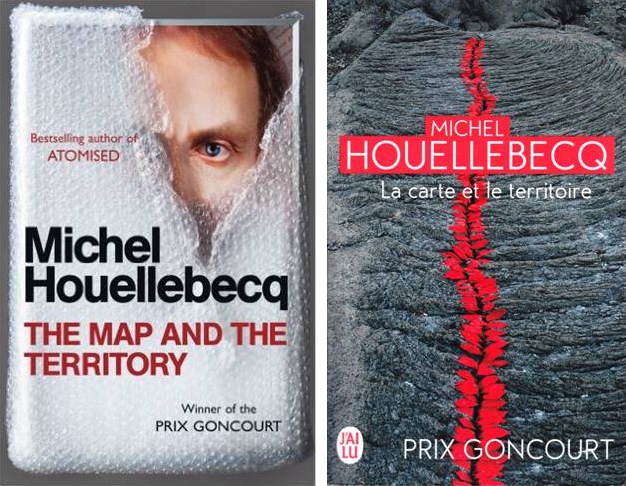
(Page x refers to the UK edition above left, page y to the French above right) 

Michel Houellebecq’s five-part novel, Submission (Soumission), is set in France, mostly in Paris, in 2022 and 2023 during the months of the presidential election campaign and its aftermath. In Part I we learn that the narrator, François, is a professor of literature at the Université Sorbonne Nouvelle – Paris 3, whose speciality from his doctorate onwards has been the work of the fin de siècle French novelist Joris-Karl Huysmans. François is in his early 40s, unmarried after numerous successive affairs with his students, and is unhappy with his situation and his prospects, although he feels that his academic articles about Huysman are “clear, incisive and brilliant” (Page 37).

In Part II the approaching election begins to concern François. The first round is on Sunday, 15 May – the format used for successive chapter titles from then until the end of the month. Although “as political as a bath towel” (Page 39), François is well aware that after the Socialist François Hollande had been re-elected in 2017, the political scene in France had begun to change. An Islamic party, the Muslim Brotherhood, under a charismatic leader, Ben Abbes, a graduate of the École Polytechnique and the École Nationale d’Administration (Page 88), has become increasingly popular. François learns more about what might happen during conversations with Lempereur, a young academic with right-wing connections, and with Alain Tanneur, the husband of another colleague, who works for the DGSI, similar to the UK’s Security Service. After encountering an ugly scene on the streets of Paris, François decides that “it would be prudent to come up with an evacuation plan, in case things took a sudden turn for the worse” (Page 58) and opens an account with an English bank in Paris. His most recent girlfriend, Myriam, who is Jewish and in love with him, as he recognises (Page 83), decides that she should leave for Israel with her family.

Part III opens on Sunday, 29 May with the second round of the election and François up early and taking the A10 autoroute, at first intending to head to the south west but then deciding Spain would be better. Running low on fuel he turns off at a service station to find the pumps turned off and the bodies of the cashier and two young banlieu types. He decides to leave the A10 and head for Martel in the Lot department, where he stays until the middle of July. The second round of the election is cancelled after attacks on polling stations and a third round is to be held a week later. François has another long conversation with Tanneur, who comes from Martel, and, having been compelled to leave the DGSI, is about to retire there. Ben Abbes, backed by the centre right and the Socialists, wins by a landslide. François makes repeated visits to the Chapel of Our Lady at nearby Rocamadour but fails to make the connection with religion that Huysman had achieved.

At the start of Part IV, François has returned to Paris. Far from close to his long-separated parents, he discovers that his mother has died. Soon afterwards he learns that he is to be pensioned off* by what has become the Islamic University of Paris-Sorbonne. Then he hears that his father has died. Isolated and with no role, by early 2023 François has become very depressed. He decides to return to the abbey near Poitiers where Huysman had taken his monastic vows and which François had visited when preparing his dissertation. After three days he leaves.

Part V begins with François on the TGV back to Paris, observing with interest one of his fellow passengers, an Arab with two of his wives. On returning home he finds a letter inviting him to edit Huysman’s work for the prestigious Éditions de Pléiade. Things look up further for François when he is invited to a reception for the reopening of the Sorbonne. He meets Robert Rediger, its new president. Rediger invites François to his splendid house and proposes that he rejoin the faculty on the basis that he is neither Catholic nor atheist and prepared to convert. François takes away a copy of Rediger’s middle-brow best-seller, Ten Questions on Islam, and “Like most men, probably, I skipped the chapters on religious duties, the pillars of wisdom and child-rearing, and went straight to chapter seven: ‘Why Polygamy?’ (Page 224). By the end of the book, François has become a Muslim and takes “the chance at a second life, with very little connection to the old one. I would have nothing to mourn.” (Page 250).

François is a sharp observer with a mordant view of life, (doubtless not dissimilar to Houellebecqq’s – after all, we are warned that Huysmans uses
… a tried and true strategy: he adopts a main character, an authorial stand-in … (Page 38) )
and we are exposed to it early on when Francois, having defined literature as … the major art form of a Western civilisation now ending before our very eyes (Page 6),  soon after explains that:
The academic study of literature leads basically nowhere, as we all know, unless you happen to be an especially gifted student, in which case it prepares you for a career teaching the academic study of literature - it is, in other words, a rather farcical system that exists solely to replicate itself and yet manages to fail more than 95 per cent of the time. Still, it's harmless, and can even have a certain marginal value. A young woman applying for a sales job at Céline or Hermès should naturally attend to her appearance above all; but a degree in literature can constitute a secondary asset, since it guarantees the employer, in the absence of any useful skills, a certain intellectual agility that could lead to professional development - besides which, literature has always carried positive connotations in the world of luxury goods. (Page 10)
François’ views about teaching and women are similarly acerbic and in Part II, he moves on to politics:
History is full of such blindness [to the significance of violence and riots]: we see it among the intellectuals, politicians and journalists of the 1930s, all of whom were convinced that Hitler would ‘come to see reason’. It may well be impossible for people who have lived and prospered under a given social system to imagine the point of view of those who feel it offers them nothing, and who can contemplate its destruction without any particular dismay. (Page 44)
For all his knowingness, François can be surprisingly gauche (in its English usage), for example when he first meets Lempereur:
Alice watched us with the affectionate, slightly mocking look that women get when they witness a conversation between two men – that odd ritual, that is neither buggery or a duel, but something inbetween. (Page 46) 
… As an intellectual of the right, I was thinking, he was seductive enough. He’d stand out in the department, in a minor way. You can let people talk for a long time, they’re always interested in what they have to say, but every now and then you’re supposed to contribute. … ‘You’re what,’ I asked, ‘Catholic? Fascist? A little of both?’ It just popped out. I was out of practice with intellectuals of the right – I couldn’t remember how to behave. All at once in the distance we heard a kind of sustained crackling. (Page47/48)
He likes to disguise his misogynistic views in a cloak of realism:
… I benefited from that basic inequality between men, whose erotic potential diminishes very slowly as they age, and women, for whom the collapse comes with shocking brutality from year to year, or even from month to month. (Page 15) 
… I thought about Annelise's life - and the life of every Western woman. In the morning she probably blow-dried her hair, then she thought about what to wear, as befitted her professional status, whether 'stylish' or 'sexy', most likely 'stylish' in her case. Either way, it was a complex calculation, and it must have taken her a while to get ready before dropping the kids off at day care , then she spent the day e-mailing, on the phone, in various meetings, and once she got home, around nine, exhausted (Bruno was the one who picked the kids up, who made them dinner - he had the hours of a civil servant), she'd collapse, get into a sweatshirt and tracksuit trousers, and that's how she'd greet her lord and master, and some part of him must have known - had to have known - that he was fucked, and some part of her must have known that she was fucked, and that things wouldn't get better over the years. The children would get bigger, the demands at work would increase, as if automatically, not to mention the sagging of the flesh. (Page 76)
Certainly Houellebecq’s male characters are more interesting than the female ones, Tanneur particularly, although the reader is left wondering what happened to the smooth young Lempereur. Rediger, who is rising fast under the new regime, gives François his card:
In the metro I examined the business card that my new acquaintance had given me. It was elegant and tasteful, at least I thought so. Rediger provided his personal phone number, two office numbers, two fax numbers (one personal, one office), three email addresses, ill-defined, two mobile numbers (one French, the other British) and a Skype handle. This was a man who let you know how to get in touch (Page 201)
Although the book is set in the near future it is firmly rooted in the present, notwithstanding the author’s reference to “these inventions of mine” in the Acknowledgements (Page 251). Not just Sarkozy, Hollande, the Le Pens and Copé, but many of the other public personalities mentioned, less well-known outside France, can be found on Wikipédia, for example Pujadas, Barbier, Dély, Thréard, Mégret, (Laurent) Wauquiez, (Renaud) Camus and (Florian) Phillipot. Whether this is a weakness or strength is difficult to say except that, within less than a year, the premises of Submission seem to have been overtaken by more events than might have been expected so soon. The Soumission publication day (7 January 2015) was, of course, that of the attack on the offices of Charlie Hebdo in Paris. The cover of that day’s issue was a caricature of Houellebecq as a wizard making predictions. The long-term consequences of those events remain to be seen but they seem unlikely to strengthen the novel’s key proposition (which is anyway dependent on a personality like that of Ben Abbes having emerged to shape the necessary policies) that after the election of 2017:
In a country gripped by ever more widespread unemployment, the strategy broadened the Brotherhood’s reach far beyond the reach of strictly observant Muslims. Its rise was nothing short of meteoric. After less than five years it was polling [in 2022] just behind the Socialists: at 21 versus 23 per cent. (Page 41)
2015 has also seen the EU having to deal with the migrant crisis and people arriving from Syria and elsewhere. Marine Le Pen seems unlikely now to make this particular mistake:
During the 2017 campaign, the National Front candidate had been persuaded that a woman had to look like Angela Merkel to win the presidency, and she did all she could to match the bristling respectability of the German chancellor, right down to copying the cut of her suits. (Page 89)
And then there are the minor discrepancies, unavoidable with the passage of time, like the UMP changing its name to Les Républicains and the damage to Volkswagen’s reputation from the diesel emission scandal. Fortunately François’ Touareg has a petrol engine (Page 104), unlike the Audi eulogised by its owner in The Map and the Territory.

Everything quoted so far is from Submission, as translated from Soumission by the editor of the New York-based Paris Review, Lorin Stein. Stein seems to have had a US readership in mind and I imagine that he must have asked himself repeatedly what he could reasonably expect them to know about France. So when we read that:
… the Paris Mosque [is] a few blocks from the university. (Page 20)
the original being:
la grande mosquée de Paris, qui était située à quelques rues de la fac. (page 28)
we can assume probably not much – not enough to be able to cope with “a few streets away from”. On the other hand, readers are expected to know what a TGV is (Page 187) and, rather harder, PSG, as on Lempereur’s T-shirt (Page 45) – and would they appreciate the irony of the club being wholly owned by Qatar?

Some things almost defy translation. Marie-Françoise Tanneur explains to François that the advancement of one of their colleagues at the university:
... was due entirely to the fact that he was eating Big Delouze’s pussy. This seemed possible, albeit surprising. … Chantal Delouse, the president of Paris III, had always struck me as a died-in-the-wool lesbian …(Page 20)
the difficult parts of the original being:
il broutait le minou de la mère Delouze… and … une lesbienne 100% brut de béton
Perhaps more literally: “grazes Mother Delouze’s pussy” and “a 100% raw concrete lesbian”. So, apart from “Ma” possibly being better than “Big”, it would not be easy to improve upon Stein’s version, although something still gets lost in translation. (Incidentally, béton brut is the origin of Brutalism in architecture).

Sunday, 29 May sees François
… driving along the hexagonal motorway system at two hundred kilometres per hour … (Page 105)
The original being
traverser, a 200 km/h, le réseau autoroutier hexagonal
Stein is, for sure, aware that the French archly referring to themselves as inhabitants of l’hexagone (look at a map).  But perhaps for most readers this should have been translated as:
... driving along the French motorway network at two hundred kilometres per hour …
assuming they can’t be credited with understanding the word autoroute – on which the speed limit, by the way, is 130 km/h (81 mph).

On Page 60, we find François settling down for election night TV:
The day before, I’d stocked the fridge with two bottles of Rully. As soon as David Pujadas went on the air at 7.50, I knew this election night would be top-notch …
“top-notch” – the original was “un très grand cru” (page 75). Houellebecq, who often mentions Burgundy wines, could be assumed to be aware that there are no Grand Cru wines produced in the Rully commune which only has the lesser Premier Cru, and chose his words for effect - best left intact?

Less interesting are the odd careless mistakes. Page 52 refers correctly to the rue du Cardinal Mercier, but on Page 49 it had been the rue Cardinal Mercier. Page 64 refers to the rue de Santeuil, as does the original on page 79 – but both should have been rue Santeuil. Page 53 mentions YouTube (correct) and RuTube (wrong); on the original’s page 66 it’s the other way round: Youtube (wrong) and Rutube (right). Perhaps more importantly, on Page 58 François tries to find out what’s going on by searching YouTube – in the original it was Rutube (page 72).

Rather more irritating is the reference on Page 56 to “all twenty-two EU member states” – there are currently 28, is Houellebecq forecasting some departures? But no, the original merely refers to “vingt-deux pays de l’union européenne”, the “all” being a gratuitous addition. I was puzzled on Page 96 when the guard of the locked-up university “emerged from the administration building [and] stood in front of the gate” – to do that he would have had to open up, whereupon the impatient crowd outside would have forced an entry in typical Parisian fashion. The original, not surprisingly, is “derrière les grilles” (page 118), Stein having confused his devant and his derrière.

I found Submission to be an odd mixture of a gripping political thriller and an unconvincing futuristic satire. How offensive it would be to a Muslim I can’t say, Islam not being my faith and not having studied theology, any more than I am equipped to judge whether Houellebecq is providing a sensible account of J-K Huysman’s times and works. It is difficult to imagine Soumission’s publication being helpful in France, even without the Charlie Hebdo attack, but the country has its own particular traditions of free speech and satire and is having its own internal debate about the nature of laïcité. As I write, Marine Le Pen is on trial in Lyon on hate speech charges, while earlier in the month it was reported that her National Front party had won the right to create an association at Sciences Po.

Some aspects of Houellebecq’s futurology seem particularly fanciful. The evaporation of the National Front’s support after the first round of the election seems unlikely, but, of course, Houellebecq’s premise is that France acquiesces peaceably in the new order – which is why Lempereur is not seen again. The notion that the EU by 2023 will be in the process of incorporating Algeria, Tunisia, Morocco, Lebanon and Egypt seems improbable too. On page 233 we are told that “the Muslim parties already occupied government seats in Britain …”. Whatever happens in the 2020 UK general election, the outcome will not be that. But Houellebecq never seems particularly interested in or informed about Angleterre (how Britain is referred to in the original, page 278**). The prominence of a senior academic is defined by the way “he was regularly invited to give lectures at Oxford and St Andrews” (Page 238). Oxford, yes but St Andrews?

As usual though, Houellebecq provides food for thought about France – and plenty of food and drink too. François may microwave Chicken Byrianai, Tikka Masala, and Rogan Josh for himself, but he happily eats Marie-Françoise Tanneur’s south west cooking. I was struck by how the need for an evacuation plan occurs to François early on, but there is a long history of times when leaving Paris for France profonde might have been a sensible idea: 1789, 1848, 1871, 1914, 1940, 1968 … 2022 - it’s not just because of the inheritance laws that Parisian families hang on to properties in the country. Of those dates, perhaps 1940 was foremost in Houellebecq’s mind when writing Soumission, together with the accommodations that many Frenchmen would make in the following four years. Part of Le Pen’s current problem may be her use of the occupation word. 

Would I recommend Submission? To anyone with an interest in France who has the time, probably yes, but Houellebecq’s previous novel, The Map and the Territory, (posted about here last month) was better in my view.


 * At 3472 euros per month (page 148). On Page 170 François tells us this is twice the national average. However, in mid-2014 the average gross wage in France was 2480 euros, net 2180. So Francois seems to have been taking a rosy view of his situation, unless wages fall substantially in the next eight years.

** Similarly on page 241, Rediger’s British mobile number is described as “anglais”.


UPDATE 17 NOVEMBER 2015

I said above that “the premises of Submission seem to have been overtaken by more events than might have been expected so soon” without any anticipation of something like the attacks in Paris on 13 November. It was at the Sorbonne (Université Paris-Sorbonne, Paris IV) yesterday that President Hollande, surrounded by students, observed the minute’s silence for those who had been killed.


Michael White’s Guardian Politics blog on 16 November discusses Submission after the attacks in his piece, France and Britain: the differences in their struggle with extremism.


8 September 2015

Michel Houellebecq’s ‘The Map and the Territory’

This week sees the publication in English of Michel Houellebecq’s novel, Submission (Soumission). I thought it would be interesting to re-read The Map and the Territory (La carte et le territoire) published in France in 2010 and in English* translation in 2011. The novel gained Houellebecq the Prix Goncourt (for "the best and most imaginative prose work of the year") in 2010.

The Map and the Territory follows the life of a successful French contemporary artist, Jed Martin. After developing one genre based on photographs of Michelin maps, he switches to another, more conventional one of portraits of people at work. Works like Bill Gates and Steve Jobs Discussing the Future of Information Technology, subtitled The Conversation at Palo Alto become internationally successful, although Jed has a problem with Damien Hirst and Jeff Koons Dividing Up the Art Market which is where the book starts:
Koons's forehead was slightly shiny. Jed shaded it off with his brush and stepped back three paces. There was certainly a problem with Koons. Hirst was basically easy to capture: you could make him brutal, cynical in an 'I shit on you from the top of my pile of dosh' kind of way; you could also make him a rebel artist, (but rich all the same) pursuing an anguished work on death; finally, there was in his face something ruddy and heavy, typically English, which made him look like a rank-and-file Arsenal supporter. In short, there were various aspects, but all of them could be combined in the coherent, representable portrait of a British artist typical of his generation. Koons, on the other hand, seemed to carry in him something dual, like an insurmountable contradiction between the basic cunning of the technical sales rep and the exaltation of the ascetic. (page 1)
He also paints portraits of his father, The Architect Jean-Pierre Martin Leaving the Management of his Business, and of Michel Houellebecq, Writer. Jed’s conversations with his father and the alter-Houellebecq are surprising to an English reader because of the interest both characters share in William Morris. Jean-Pierre as a young man had admired Morris as a designer as much as he disliked Mies van der Rohe and
... above all Le Corbusier, who tirelessly built concentration-camp-like spaces, divided into identical cells that were suited ... only for model prisons. (page 145)
but alter-Houellebecq, although admiring Morris as a social reformer, comes to the conclusion that:
What can undoubtedly be said is that the model of society proposed by William Morris certainly would not be utopian in a world where all men were like William Morris. (page 175)
What French readers make of it, one has to wonder, William Morris not being particularly familiar to many of them. Come to that, most English readers will be at a loss with the description of the FR1 (France 1 television) New Year’s Eve party and the personalities there like Jean-Pierre Pernaut.

Houellebecq is never afraid to give offence with his opinions. Jed meets and observes a senior manager at Michelin:
… again he searched for the right words, which is a disadvantage with former pupils of the Polytechnique; they’re a bit cheaper to hire than those of the École Nationale d’Administration but they take more time finding their words; … (page 55)
Jed eventually decides to move into his grandparents’ house in the Creuse. Houellebecq likes the French countryside (see, for example his letters to Bernard-Henri Lévy) but, if his view is the same as Jed’s, not its residents:
Jed had no illusions about the welcome he would get from the inhabitants of his grandparents' village. He had noticed that while he was travelling through La France profonde with Olga, many years before: outside certain very touristy zones like the Provençal hinterland or the Dordogne, the inhabitants of rural zones are generally inhospitable, aggressive and stupid. If you wanted to avoid gratuitous assaults and trouble more generally in the course of your journey, it was preferable, from all points of view, not to leave the beaten paths. And this hostility which was simply latent towards passing visitors, transformed into hate pure and simple when the latter acquired a residence. (page 278)
Nor is Jed keen on Mercedes:
Although he knew nothing about his life, Jed was hardly surprised to see Jasselin arrive at the wheel of a Mercedes Class A. The Mercedes Class A is the ideal car for an old couple without children, who live in an urban or periurban area, yet do not hesitate to treat themselves from time to time to an escapade in a hôtel de charme; but it can also suit a young couple of conservative temperament - it will, then, often be their first Mercedes. An entry into the range offered by the firm with the Silver Star, it is a discreetly different car; the Mercedes four-door saloon Class C and the Mercedes four door Class E are more paradigmatic. The Mercedes in general is the car preferred by those who aren't really interested in cars, who place security and comfort over driving sensations - also for those, of course, who have sufficient means. For more than fifty years - despite the impressive commercial strike force of Toyota, despite the pugnacity of Audi the global bourgeoisie had, on the whole, remained loyal to Mercedes. (page 240).
Jed likes Audis which
… characterise themselves by a particularly high level of finishing which can only be rivalled, according to Auto-Journal, by certain Lexus models. This car was the first one he'd bought since reaching a new wealthy status; from his first visit to the dealer, he'd been seduced by the rigour and precision of the metal assemblages, the gentle click of the doors when he closed them, all that was machine-tooled like a safe. Turning the speed-regulator control, he opted for a cruising speed of 105 km per hour. Some small notches, marking every 5 kph, made driving all the smoother; this car was indeed perfect. (page 165)
Houellebecq places some interesting characters in Jed’s life, for example, the art world PR, Marylin, and Inspecteur Jasselin, the Maigret-like detective who investigates alter-Houellebecq’s murder, and his un-Mme Maigret-like wife. However Olga, for a while Jed’s glamorous Russian girlfriend, is too much of a male fantasy.

Something about Houellebecq which I find intriguing is that he must be one of the very few novelists with an international reputation who had a scientific education, in his case as an agronomist. His mother had trained as an anaesthetist. Although from his student days he was inclined towards literature, Houellebecq later earned a living in information technology (until he could get out) and, according to an interview in Le Figaro magazine this summer, he has had a long-term interest in photography. Certainly if, as he recently told the Guardian, “…the job of a novelist is foremost to hold a mirror up to contemporary society”, he is not reluctant to introduce its technical details, for example here the life-cycle of the housefly. But Houellebecq’s readers can never be sure where the boundary of his satire lies. Does Jed’s dislike of Mercedes and encomium for Audi, both expressed in marketing speak, reflect the author’s world view or, rather more likely, is he tilting at the commercial shallowness of contemporary art and some of its practitioners?

A couple of oddities in the translation. On page 165 Jed is driving an “Audi Sport Wagon” which on page 177 has turned into an Audi Allroad A6. As far as I can tell, “Sport Wagon” is a type of BMW SUV sold in North America. The French original refers to “son break de chasse Audi” – “his Audi shooting brake” or nowadays “his Audi estate”, which could indeed be an Allroad A6.

On page 287 there is a reference in a description of Jed’s camera equipment to “a hard disk of two teraoctets” which non-French readers might not recognise as two Terabytes. The French (with the Romanians and Quebecois) use octet instead of byte for eight bits .

*By “English readers” I mean those in that language, not, of course, just those resident in England.  Page numbers are as in the 2011 UK hardback, (cover above).


4 September 2015

NT Live: The Beaux’ Stratagem

Like a lot of other hicks in the sticks (and a good few Londoners who don’t get seats at the National Theatre), I’ve enjoyed NT Live cinema screenings and posted about them here (Skylight, The Hard Problem, Man and Superman). I wasn’t sure I would enjoy the Restoration comedy, The Beaux’ Stratagem, first performed in 1707 and written by George Farquhar (1677 – 1707). This revival is running at the NT until 20 September. 

There is a summary of the plot on Wikipedia. In brief, two young and unscrupulous toffs, Aimwell and Archer, on the lookout for some women with money to marry, fetch up at an inn in the city of Lichfield in the English Midlands. They encounter Lady Bountiful’s daughter, Dorinda and her sister-in-law, Mrs Sullen, unhappily married to Lady Bountiful’s son. The actions of the innkeeper, his daughter, the highwaymen they collude with, and Lady Bountiful’s factotum, Scrub, provide the sub-plots which might stop the main characters getting what they want, but eventually, of course, they do. I could see some parallels with Da Ponte's plot for Mozart's Così fan tutte (1790).


Simon Godwin who directed The Beaux’ Stratagem, also directed Man and Superman but this time kept to the original period. This was a good idea -  the sort of audience this play is likely to get can work out the relevancies to contemporary life (feminism, Anglo-French relations* etc) for themselves. Lizzie Clachan’s set design (above) was ingenious and even more complex than it seemed at first sight. The craft of the performers – they sang, they danced, they made complicated coordinated movements across, up and down the set, every word being clearly delivered – was faultless. Hours of work must have gone into the staging. All the performances were good but Susannah Fielding as Mrs Sullen right) and Geoffrey Streatfeild as Archer were particularly impressive.

The NT Live showing in the UK and Europe was on 3 September; Encore showings in the UK and other countries can be found on the NT Live website. The interval included a brief “Making of …” film which will probably get onto YouTube. It concentrated on the staging but it would be interesting to learn a little about the transmission techniques, presumably via satellite, for example is it in 4K resolution?

*The War of the Spanish Succession  (1701-14) was presumably the reason why French officers were being detained in Lichfield circa 1707. The Recruiting Officer (1706) is another well-known play by Farquhar.


27 August 2015

Some pylône posers

Most people in the UK with smartphones know all too well that, as they drive away from a built-up area, their reception moves from 3G (possibly preceded by 4G if they’re lucky) to GPRS (2G) and, if they turn off an A-road, to quite possibly nothing (0G). So it’s not surprising that the government’s 10-point plan to improve rural productivity – snappily entitled Towards a one nation economy: A 10-point plan for boosting productivity in rural areas – which came out in August has set a goal of ‘High quality, widely available mobile communications’. In particular:
The government will put in place the right conditions, and work actively with providers, to ensure rural areas have the best possible coverage of high quality mobile services: 
The government will work closely with industry to support further improvements to mobile coverage in the UK. This will supplement the legally binding obligation on Mobile Network Operators to provide voice and SMS text coverage to 90% of the UK by 2017 and Telefonica’s licence obligation to deliver indoor 4G coverage to 98% of UK premises by 2017. 
• The government proposes to extend permitted development rights to taller mobile masts in both protected and non-protected areas in England to support improved mobile connectivity, subject to conclusions from the Call for Evidence which closes on 21 August 2015. (page 13)
“Taller” can be taken as meaning more than the 20 metres which is currently the maximum in the UK. 25 metre masts are in common use elsewhere in Europe, for example this mast (pylône) which is under construction in South West France: 


- not a pretty thing, but nicely positioned between sunflowers and vines. The logos on one of the cabinets at its base reveal that it belongs to Orange, provider of communications services in France and formerly known as France Telecom:


Nearby was this notice (the name of the nearby commune has been obscured to spare the innocent any embarrassment):


It is common practice in France for public works to have an explanation of their cost and sources of funding on a placard nearby*. In this case, nearly a quarter is coming from the European Union, in particular their fund for regional development (FEDER). I would be very interested to know:

Why is the Aquitaine region, not a poor region of France and certainly not one of the EU’s neediest, receiving development funds?

On the good-luck-to-them-if-they-can-get-away-with-it principle, are UK regions receiving similar assistance? If not, why not?

Orange is a private company, albeit one with a large government shareholding, and, as in the UK, there are other mobile telephone providers – so how does that work? How are the pylônes and FEDER funds being spread across the providers or does Orange scoop the lot?

Why was a 17 weeks (semaines) of works (travaux) project, expected to end (fin) on 30 March, still not finished 17 weeks later?

More seriously, there are anecdotes that there are teams located throughout the French government dedicated to identifying and securing EU sources of funding. French civil servants probably have more experience and a better understanding of the EU budgets and their operation (often by French fonctionnaires seconded to Brussels) than those of any other country. I suspect that sadly the UK ranks with Latvia, Hungary or Malta when it comes to playing the EU system.


UDATE 28 AUGUST

This post seems to have generated more interest than many – particularly in Germany, I wonder why.

* Just an afterthought about “public works [having] an explanation of their cost and sources of funding on a placard nearby”. I would be happy to see this in the UK because it would improve the public’s understanding of how taxes are spent and the capital costs of public investment. It’s unlikely to happen for various reasons: the widespread use of PFI – government finance off balance sheet. Also in the UK not many projects are funded from multiple sources. The Treasury (UK finance ministry) would hate this – it might lose control if there were too many parties and budgets involved, particularly its ability to cancel and delay projects.


20 July 2015

Anne Fontaine’s ‘Gemma Bovery’

Flaubert’s novel Madame Bovary, set in mid-19th century Normandy and a pillar of French literature, has been filmed on several occasions, for example by Claude Chabrol in 1991 and by Sophie Barthes in 2014, soon to be released in the UK. We are also going to have the opportunity to see Anne Fontaine’s Gemma Bovery, a version at one remove from Flaubert’s and with a British twist. Posy Simmonds started her cartoon comic strips in the Guardian in the 1970s. They offered a satirical view of contemporary middle-class life, at least as lived by Guardian readers, and anticipated the sharper style of some of Grayson Perry’s pots and tapestries. In 1999 the Guardian ran Simmonds’ reworking of Flaubert as a graphic novel in which Emma Bovary becomes Gemma Bovery, half of an expatriate British couple living in present-day Normandy. It was later published in book form, with rather more text than would be found in a normal bande dessinée (see below, thanks to Amazon):


It is hardly a plot spoiler to say that Emma’s enthusiasm for adultery ends badly - if it hadn’t, the prosecution of Flaubert in 1857 for obscenity might not have failed. Gemma’s particular fate is retold in Simmond’s version through the eyes of the local baker (Boulanger with a small b …) and Flaubert admirer, Raymond Joubert. In the film he becomes Martin Joubert and is played by Fabrice Luchini, an actor whose expression conveys paragraphs. The intertwining of Joubert and Flaubert brings to mind Luchini in Philippe-le-Guay’s Alceste à bicyclette, where the literary presence was Molière and the setting the Ile de Ré. Gemma Arterton as Gemma Bovery is well-equipped to set male pulses racing and there are some comical scenes, for example when Martin teaches Gemma to knead dough. The attractive locations apart, Gemma Bovery is carried by Luchini and Arterton, the two leads overshadowing the rest of the cast, even Jason Flemyng as husband Charles/Charlie. Some of the other British characters seem to have been cast in the style of Woody Allen’s London films – all spoken English is now apparently a hybrid of Mockney and Estuarial.

I thought it was a better film than Stephen Frears' Tamara Drewe in 2010, also with Arterton in the title role and based on a Simmonds graphic novel modernising Thomas Hardy’s Wessex novel Far from the Madding Crowd. Tamara Drewe was given 4* ratings by Peter Bradshaw in the Guardian and Philip French in the Observer - perhaps not surprisingly - and elsewhere. It will be interesting to see the UK critics’ reactions to Gemma Bovery next month.


6 July 2015

Bertrand Tavernier’s 'Quai d’Orsay'

Bertrand Tavernier, born in 1941, is one of France’s most long-standing film directors, probably best known outside France for Round Midnight (1986). His most recent film, Quai d’Orsay (2013), was not released in the UK* and had a limited US distribution under the title The French Minister. (The French foreign affairs ministry is located in Paris at the Quai d’Orsay and is often referred to by its location.)

Tavernier’s film begins with a young énarque**, Arthur Vlaminck (Raphaël Personnaz), being escorted through the grandeur of the Quai (similar to that of the Elysée revealed in Patrick Rotman’s documentary, Le Pouvoir) to an interview for a post as a personal speechwriter for Alexandre Taillard de Vorms (Thierry Lhermitte), the minister. Getting the job turns out to be the start of Vlaminck’s problems as de Vorms, moving from one intellectual flight of fancy to another, endlessly rejects his speeches and urges their improvement with references to poetry and philosophy. He also encounters rivalry and intrigue among the minister’s other advisers, including the vampish and ambitious adviser on Africa, played by one Julie Gayet (see below). The only clear heads are those of de Vorms’ directeur de cabinet, Claude Maupas (Niels Arestrup), unflappable with years of experience of crisis management, and Arthur’s partner, Marina (Anaïs Demoustier) a sensible teacher. After excursions to Berlin and francophone Africa, de Vorms goes to the UN in New York to deliver a grandiloquent speech articulating his country’s foreign policy.

Personnaz and Gayet
Anyone interested in France and its ruling elite (or has had to write speeches for a boss who only knows what he doesn't want to say) is bound to find the film very amusing, and played to great comic effect by Lhermitte, more subtly by Arestrup. But the background to Quai d’Orsay is informative, too, the film having been adapted from two bandes dessinées (BD, comic books) of the same name by Christophe Blain and Abel Lanzac. Blain was the illustrator, but the writer, “Abel Lanzac”, turned out to be a pseudonym adopted by Antonin Baudry who had worked as a speechwriter for Dominique de Villepin, foreign minister from 2002 to 2004, the period leading up to the Iraq war. When the first BD came out in 2010, de Villepin’s response was surprising but probably wise in the circumstances:
I found the drawings very telling, very strong and the dialogues some of the best descriptions I have read, heard or seen of life inside a ministry.
Unusually, both BDs are available in English translation under the title Weapons of Mass Diplomacy - a typical scene below:

The film captures the look of the drawings in the BD remarkably well, right up to de Vorms’ UN speech, and its writing credits are shared by Blain, Lanzac and Tavernier. I suspect that it was Lanzac/Baudry’s intention to satirise the Quai as an institution rather than de Villepin’s speech which is highly regarded by many in France, although the man clearly has his idiosyncrasies.

Sudhir Hazareesingh in his new book, How the French Think: An Affectionate Portrait of an Intellectual People, begins the Introduction with a section, Le Style Français, which he sees as epitomised by that speech:
In February 2003, French Foreign Minister Dominique de Villepin delivered a speech at a Security Council debate at the United Nations in New York on whether to sanction the use of force against Saddam Hussein's regime in Iraq. Speaking in the name of an 'old country' and an 'old continent' that had experienced 'wars, occupations and barbarity', Villepin declared - prophetically - that a war against the Iraqi regime would have catastrophic consequences for the region's stability: 'The option of war may appear a priori the most effective. But let us not forget that, after winning the war, peace has to be built.' Stressing that 'the use of force [was] not justified,' he ended by expressing his faith in the capacity of the international community to build a more harmonious world: ‘We are the guardians of an ideal, the guardians of a conscience. The heavy responsibility and the immense honour which is ours should lead us to give priority to peaceful disarmament.' 
Villepin's speech was welcomed across the world, typifying as it did a shared collective aspiration for a different kind of politics, grounded in humanism rather than force. And yet in his vision, and the way in which it was elaborated, there was also something very recognizably, unquestionably French: the seductive masculinity and rhetorical verve, which drew on the nation's finest traditions of public oratory; the appeal to reason and logic, with the issue under discussion being neatly framed into binary oppositions (conflict and harmony; self-interest and the common good; morality and power politics); the sense of articulating an age-old wisdom resting on centuries of often painful historical experience; and a confident optimism, underpinned by a belief in France's cultural superiority. Indeed, although it did not do so explicitly - and was all the more compelling for it - the speech threw down the gauntlet to George Bush's America and its complaisant ally, Great Britain, and held up the actions of these nations to the court of international public opinion as threats to peace and stability. This silent demonization of the dastardly Anglo-Saxons' was the climax of Villepin's oratorical artistry along with his characteristically French claim to be speaking in the name of universal principles - all the more sincerely so, one felt, because these happened to coincide exactly with French national interests.
I should say that Hazareesingh’s book, as one might expect coming from a fellow of Balliol College, Oxford, is examining French intellectuality at the highest levels, those of literature, philosophy, the Académie and the grandes écoles. Cinema is only touched on briefly and certainly not BDs!

* However, the DVD is on sale in France in 2015 for about 10 euros (or less as part of a multi-buy) and comes with English subtitles.

** A graduate of the ÉNA, École nationale d'administration, one of France’s elite grandes écoles.


21 June 2015

The Bayeux Tapestry

When I worked in London, overseas visitors would sometimes ask what I thought they should visit. One recommendation was the Crown Jewels: after all, just because something is obvious, it doesn’t mean it’s not worth seeing, queuing considerations apart. So I wanted to find out whether the same applies to the Bayeux Tapestry, more properly, given its location, La Tapisserie de Bayeux. Just in case someone reading this does not know, according to Wikipedia the Tapestry is:
… an embroidered cloth nearly 70 metres (230 ft) long and 50 centimetres (20 in) tall, which depicts the events leading up to the Norman conquest of England concerning William, Duke of Normandy, and Harold, Earl of Wessex, later King of England, and culminating in the Battle of Hastings.
Or, more particularly, a fight between Norman and Danish (Anglo-Saxon) aristocrats as to who should take over the English throne.

There are about 50 scenes with brief Latin descriptions running along the the cloth, complemented by a decorative border which includes some interesting vignettes of peasant life:
Scenes 10a (upper) and 13
One famous scene shows Halley’s Comet, as seen in England in March 1066 – a bad omen for Harold:
Scene 32
Another scene of the disembarkation of the invading Norman forces at Pevensey in Kent seems particularly apt in Bayeux, a few kilometres from the D-Day beaches:
Scene 39
Once ashore, the top brass have a good breakfast:
Scene 43a (with detail)
before battle commences and the Poor Bloody Infantry have to confront Norman cavalry and archers, unsuccessfully as it turns out:
Scenes 52a (upper) and 54
 Harold dies:
Scene 57
and as a consequence Duke William becomes William the Conqueror.

Subsequently, William would expropriate English property holdings and enrich his Norman followers, as well as constructing Winchester Cathedral, the Tower of London (present day home of the Crown Jewels) and other notable buildings. The English language started to develop as a complex mix of Old English (Germanic) and Old French (Romance) with a marked social divide, as described in this interesting recent post on the OxfordWords blog by Adrastos Omissi.

The Tapestry is now carefully conserved (low light, humidity, temperature) by the Bayeux Museum, with an accompanying exhibition and, of course, a shop. To avoid queuing, go during the sacrosanct French lunch period (13:00 to 14:00). And to answer my question: although obvious, it is definitely worth seeing.

NOTE

The origins of the Tapestry are argued about by scholars but it is thought likely to have been made in Canterbury on the other side of Le Manche in the 1070s. However, given the modern French obsession with BDs (BD, bande dessinée, comic book), its current location seems quite appropriate.


27 March 2015

Julie Bertuccelli’s ‘School of Babel’

It’s surprising how many French films are set in or around school – in 2013, for example, we had Jeune et Jolie, Something in the Air, and In the House. Longer ago, Nicholas Philibert’s 2002 documentary Être et Avoir was set in a primary school in remote central France and in 2009 Laurent Cantet directed a near-documentary, The Class (Entre les Murs), set during an academic year in a secondary school in the 20th arrondissement of Paris. The class’s teacher was played by François Bégaudeau, co-writer of the screenplay based on his semi-autobiographical novel. His 13 and 14 year-olds, who came from various ethnic groups, were difficult or challenging, depending on how you look at it.


Julie Bertuccelli’s documentary, School of Babel (La cour de Babel, which would translate literally as The School Courtyard of Babel), is in some ways a companion piece to The Class. This school is in Paris’s 10th arrondissement and with slightly younger pupils who have recently arrived in France and been placed in a reception class (classe d’acceuil). They will not be allowed to join normal classes until their French is adequate. The 25 or so children come from almost as many different countries. Part of the film’s charm is the way they get to know and appreciate each other despite differences in race, religion, background and circumstances. They benefit enormously from their experienced teacher, Mme Cervoni, who gently helps them correct their inexact French - conveyed by deliberately mangled English subtitles - and who patiently explains their progress to parents or guardians.

At the end of the year Mme Cervoni tells her class that she is off to the French education ministry to become an inspector. This is an implicit reminder that the film would almost certainly not have been made without official support. Perhaps not surprisingly, there is very little material in it which could be deployed by critics of France’s educational system.

Undoubtedly some of the children in the reception class are very able and will soon start to do well in France; others appeared to have problems which could be longer-lasting. Lucy Wadham’s article, Rigorous to a fault, about what’s wrong with France’s schools, in April 2015’s Prospect magazine, is written from the point of view of a parent in France and in the light of the January Paris terrorist attacks. The three jihadist perpetrators were all products of l’Education Nationale. She regards France as having an over-rigid approach to education, one which is optimised to identify and develop an elite. She points out that:
Despite what Hollande says about the Republic recognising all children as equal, there is a chronic problem of educational inequality in France and it often follows ethnic lines. In its Survey of Adult Skills, the OECD found that France's education system, while it produces an impressive intellectual elite, leaves a large proportion of its adult population barely able to read: 21.6 per cent of those surveyed in France scored the lowest level of literacy, compared to 15.5 per cent across 24 other countries. In a culture that puts such emphasis on academic achievement, the stigma of failure is, of course, that much greater. The OECD's final report said of France: "The scores for French people [in literacy and numeracy] vary considerably according to training levels and social background, and this is to a far greater degree than the average across participating countries. The differences in literacy standards between individuals born in France and those who were born abroad are much greater than the average across participating countries."
Perhaps Mme Cervoni really is as exceptional as she seems.