Showing posts with label van Gogh. Show all posts

18 January 2016

Three Paris Exhibitions: (3) Villa Flora, the Hahnloser Collection

Shows seen last month in a city subdued and uncrowded after les évènements of 13 December 

Of the three exhibitions which I saw in Paris in December 2015, I have already posted about Picasso.Mania at the Grand Palais, and Splendeurs et misères, images de la prostitution en France (1850-1910) at the Musée d’Orsay. This post is about Villa Flora, Les Temps enchantés at the Musée Marmottan Monet. In 1898, Hedy Buhler married Arthur Hahnloser, and from 1906 to 1936 this wealthy Swiss couple formed an art collection for their home, the Villa Flora at Winterthur, near Zurich. About 75 of the collection’s works, paintings and small sculptures, have been lent to the Marmottan – a first European showing and a pleasure to visit.

Initially the Hahnlosers collected contemporary Swiss art and acquired works by Ferdinand Hodler, like Le massif de la Jungfrau vu de Mürren (1911, below top) and Le Lac Léman avec les Alpes savoyardes (c1905, below lower):


Giovanni Giacometti, Maisons ensolleillées à Stampa (1912, below left) and Self-portrait (1907, below right):
 

and Félix Vallotton (subject of an exhibition in Paris in 2013/14 and one planned for the Royal Academy in London in 2019). The Villa Flora, as well as family portraits by Vallotton, had on show en famille his more challenging Baigneuse de face (1907, below top), and La Blanche et la Noire (1913, below lower):


After 1908, through Vallotton, the Hahnlosers became involved with a wider circle of artists in Paris including Fauves and Nabis and began to acquire works by Pierre Bonnard: Débarcadère (ou l’embarcadère) de Cannes (1928-1934, in the poster above) and La Carafe Provençale (1915, below left):


and Odilon Redon, Le Rêve, (c1908 above right) and Henri Manguin, La Sieste ou Le Rocking-chair, Jeanne (1905, below top) and Albert Marquet, La Fete nationale au Havre (1906 ?-13, below lower):


The Hahnlosers would go on to add depth to the collection by purchasing works by artists they regarded as precursors to the modern works they had already acquired. These include a Cézanne, Portrait de l’artiste (1877-1878, below left) and a Manet, Amazone (1883, below right):


Van Gogh’s Le Semeur (1888, below) would join the collection at a later date having originally been acquired by Arthur’s brother Emil.


Villa Flora, Les Temps enchantés ends on 7 February.


15 January 2016

Three Paris Exhibitions: (2) Splendeurs et misères

Shows seen last month in a city subdued and uncrowded after les évènements of 13 December 


Of the three exhibitions I saw in Paris in December 2015, I have already posted about Picasso.Mania
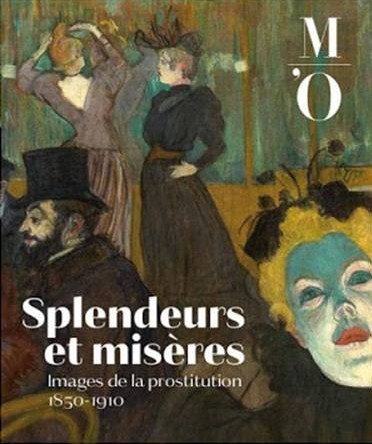
at the Grand Palais, and the next will be on Villa Flora at the Musée Marmottan Monet. This post is about Splendeurs et misères, images de la prostitution en France (1850-1910) at the Musée d’Orsay, an exhibition which will reappear later in 2016 at Amsterdam’s Van Gogh Museum, to be called Lichte zeden (Easy Virtue). The Paris title presumably refers to a part of Honoré de Balzac's La Comédie humaine: Splendeurs et misères des courtisanes, (The Splendours and Miseries of Courtesans or A Harlot High and Low) published in four parts from 1838-1847. The Musée d’Orsay is not reluctant to take on difficult subjects, their male nude show in 2013 being an example. Splendeurs et misères, examining prostitution, not just in art but as an aspect of the social history of France, is certainly another, a revelation of misery for the many and splendour for a few.

The d’Orsay version addressed five themes and was spread over 15 rooms with numerous pictures and photographs. The first theme, Ambiguity, looked at the position of women, respectable or otherwise, in public places during the daytime and at night in cafés, cabarets and at the opera. Procurement and soliciting were often near the surface at any time of the day, for example in Giovanni Boldini’s En traversant la rue (1873/75, below left) and James Tissot’s La Demoiselle du magasin (1883/85, below right):


Women drinking alone in cafés is a recurrent theme in the art of the time, as in Degas’ L’Absinthe (1875/76, below left) and Manet’s La Prune (1878, below right). Agostina Sagatori au Tambourin (1887, seen earlier in 2015) was on loan from the Van Gogh Museum which also holds Toulouse-Lautrec’s Poudre de riz, (1887).


The cabaret pictures included Lautrec’s Moulin de la Galette (1889, below upper), on loan from the Art Institute of Chicago, and, from the Ny-Carlsberg-Glyptothek Copenhagen, the less well-known M Delaporte au Jardin de Paris (c1893, below lower):


At the opera, Eugène Giraud’s Le Bal de l'Opéra (1866, below top) and Edouard Degas’ Masked Ball at the Opera (1873, below lower) convey the same scene, the latter being far more compelling in its composition: 


After Ambiguity, Brothels - more Lautrecs, of course and photography (there are two sections of contemporary photography). Again from Chicago, Courbet’s Mère Grégoire (1855, 57/59, below left) refers to a character from a popular song, the proprietress of a Parisian brothel. An unfamiliar Lautrec from Budapest was Les Dames au réfectoire (1893/5, below right) conveying the unhappy position of the women employed as prostitutes who had to undergo frequent medical checks – a study for Rue des Moulins, (1894), was in this show, but not the final work, now in Washington.


Prostitution operated at all levels of society including the highest (for which abolition would only finally come in 1946). The section, Les Grandes Horizontales, included, as well as a Fauteuil d’Amour (below top), reputedly used by the Prince of Wales in the 1890s in pursuit of entente cordiale, Rolla (1878, below lower) by Henri Gervex:


followed by Manet’s Olympia (1863, below), bought by the French government in 1890, and introducing the final, rather diffuse, sections of the show:


... Prostitution and the imagination and Prostitution and modernity. Lautrec reappeared with the famous Au Moulin Rouge (1892/95, detail in the poster above), again from Chicago, and the Courtauld’s Private Room in the "Le rat mort" (1899, below left) leading on to, among much else, some Picassos from 1901 including Nu aux bas rouges (below right):


Two final images from a show which is informative if not uplifting: Picasso’s La Buveuse d’absinthe (1901, below left) and Kees van Dongen’s Liverpool Lighthouse (1897, below right):


Splendeurs et misères, images de la prostitution en France (1850-1910) ends on 17 January but will be at the Van Gogh Museum from 19 February to 19 June. Unfortunately, although Professor Richard Thomson from Edinburgh University was one of the curators of the exhibition, it will not be coming to the UK.


POST-EXHIBITION NOTE

If one measure of an exhibition is whether it alters one’s ways of seeing, Splendeurs et misères was a success – as recently Manet’s A Bar at the Folies-Bergère (1882, below) in the Courtauld Gallery, London.


And in case anyone should choose to believe that Paris and London were quite different in their mores, The Awakening Conscience (1853, below) by William Holman Hunt clearly shows a man and his mistress, though sanctimoniously overlaid with religious salvation, in keeping with the susceptibilities of Victorian England.


10 March 2015

The Van Gogh Museum, Amsterdam


I remember years ago reading a holiday brochure which was urging travellers to visit Arles in southern France, one of its attractions being a Van Gogh museum. Well certainly Arles was the setting for some of Vincent van Gogh’s most famous paintings, eg The Yellow House (1888 above), but there’s no Van Gogh museum there, nor is there ever likely to be, unless Amsterdam’s Museumplein, along with the rest of northern Europe, is threatened by an ice sheet. In the meantime, thanks to van Gogh’s descendants, the world’s largest collection of his works remains in the country of the painter’s birth at the Van Gogh Museum in Amsterdam, very near the Reijksmuseum. Anyone visiting the city should take the opportunity, if they can, to see the originals of some of the most famous images in art, like The Bedroom/Bedroom in Arles (1888, below – there are other versions in Paris and Chicago).


On the Museum’s ground floor there is an introduction to van Gogh (1853-90), mainly in the form of a series of self-portraits, concentrating on the ten years up to his death, the dominant period of his artistic life. (Below right: Self Portrait with Grey Felt Hat, 1887; below left: a portrait by his Australian friend, John Peter Russell, Vincent van Gogh, 1886) A display case shows a palette that van Gogh used and some of his tubes of paint. These had come into use in the 1840s, and were being filled with the new pigments developed by chemists in the 19th century (but see below). Renoir said that “Without tubes of paint, there would be no Cézanne, no Monet, no Pissarro, and no Impressionism” and, one can assume, no van Gogh.


On the first floor the visitor’s initial encounter is with work from van Gogh’s early years as an artist in Brussels and Holland, sombre landscapes and studies of peasant life. Probably the best-known is The Potato Eaters (1885 below):


But in March 1886 Vincent moved to live with his brother Theo in Paris. Tuition and encountering Impressionism had a transformative effect on his art. Among the artists he met was Henri de Toulouse-Lautrec, whose Young woman at a table (Poudre de riz, 1887, below left) was owned by Theo and eventually passed to the Museum. Vincent painted his lover, a café owner, in a similar style – In the café Agostina Sagatori in Le Tambourin (1887, below right):


Van Gogh put on an exhibition of his Japanese woodcuts in Le Tambourin. These had become available in the 1870s and were admired by contemporary artists. Not only were some of his works - Bridge in the rain (1887, below left) directly after Hiroshige, but others like Fishing Boats on the Beach at Saintes-Maries (1888, below right) reveal the indirect influence of Japanese art.


In the spring of 1888, and sponsored by Theo, van Gogh left Paris for Arles where he would work frenetically, attempt to set up an artists’ colony in the Yellow House, and be joined later in the year by Gaugin. Works from this time are on the Museum’s second floor, for example, The Harvest (1888, below left) and Gaugin’s Chair (1888, below right):


And one version of probably his most famous work, Sunflowers:


There are two series of van Gogh Sunflowers. The first is of four pictures all made in Paris, the second is of four painted in Arles in 1888 with three more “Repetitions” made in 1889. Last year the Van Gogh Museum’s Repetition was exhibited in London alongside the National Gallery’s 1888 version (below left). The NG’s Vincent’s Chair (1888, below right) is shown for comparison with Gaugin’s Chair and The Bedroom, both above.

Both in the National Gallery, London
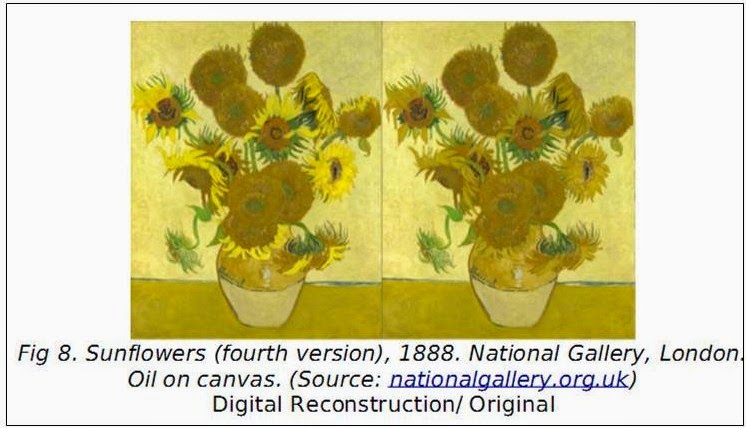
There are good grounds for thinking that the colours we see in these paintings are not the ones van Gogh was intending. For various reasons, the pigments have changed their appearance. Below is one suggestion as to how the appearance of the National Gallery Sunflowers may have changed. This is obviously a subject for experts and probably a contentious one, but Alex Daish’s paper, from which the figure below is taken, is an informative initial introduction and contains other examples. Not surprisingly, the Museum is undertaking research ion the subject (REVIGO - REassessing VIncent van Gogh).


The recently redeveloped third floor of the Museum covers the period 1889-90. By the end of 1888, Van Gogh’s health had deteriorated and he would spend much of 1889 in the asylum at Saint-Remy. In 1890 he left the south and took up residence in the village of Auvers-sur-Oise where he would produce two of his most famous paintings, both in the Musée d’Orsay in Paris: The Church at Auvers (1890) and a portrait of the local doctor who was supervising him, Portrait of Dr Gachet (1890, 2nd version):

Both in the Musée d'Orsay, Paris
Vincent van Gogh died in July 1890 after shooting himself in the chest. Theo died in 1881 and is buried at Auvers next to Vincent. The third floor of the Museum also has a selection of his considerable correspondence, much of it with Theo, and conducted in French. Vincent had revealed a preference for French language and culture in Still Life with Bible 1886 (below left) with its copy of Zola’s La Joie de Vivre. In one letter, he told his sister Willemina not to study in Holland. The Van Gogh Museum collection includes works by many other artists and on the third floor they are used, not as before to explain influences on van Gogh, but instead as examples of his posthumous influence on later artists, for example Vlaminck’s The Seine at Nanterre (1907, below right) which the Museum purchased in 2008.


At the end was a temporary loan from the UK Arts Council of a picture I’d last seen in 2013, Francis Bacon’s Study for Portrait of Van Gogh VI (1957, below right), alongside a reproduction of the van Gogh self-depiction, The Painter on the Road to Tarascon (1888, below left), destroyed, like one of the four 1888 Arlesian Sunflowers, by fire in WW2.


In September 2015 a new entrance to the Van Gogh Museum from the Museumplein, designed by Kisho Kurokawa & Associates, will open. The exhibition Munch:Van Gogh, exploring parallels between the two artists, will transfer from the Munch Museum in Oslo later that month.


UPDATE 14 MARCH

Since my post the March issue of Apollo, an international art magazine published in the UK, has appeared with the Van Gogh Museum as its cover story. The editorial by Thomas Marks is on the theme of the single-artist museum (he likes Leighton House) and he says that after visiting the Van Gogh Museum recently he “left with the glow of a pilgrim”. His accompanying article, Versions of Vincent, describes the Museum with a much more informed eye than mine and reports his interview with the Museum’s director, Axel Rüger.

In the last few days there has also been coverage in the mainstream media of the problem of deterioration of some of the pigments use by van Gogh (see above). The Mail Online Science and Tech provided more details than most and gave links to the recent Belgian chemical research.


20 April 2014

The Pearlman Collection at the Ashmolean

Exhibitions based on collections provide a fascination which can’t be found in shows given over to individual artists or to particular periods in art history. I think it lies in the way the collector (or collectors) exercised their taste given the opportunities and resources which were available. Gertrude Stein and her brothers, for example, were wealthy and were collecting contemporary talent in the right place and time, Paris in the 1920s. Sterling and Francine Clark had been in a similar position a decade earlier. The Radev Collection, on the other hand, reflects its creators’ tastes and long-term opportunities to make acquisitions rather than their funds. So what of Henry and Rose Pearlman’s collection, now on an international tour starting at the Ashmolean Museum, Oxford: Cézanne and the Modern: Masterpieces of Modern Art from the Pearlman Collection?


Henry Pearlman was born in New York in 1895 and set up Eastern Cold Storage in 1919. One can well believe that his company would have done well in the war years and certainly in 1945 he was able to make his first significant purchase of modern art, Chaïm Soutine’s Village Square, Céret (above, top). For nearly 30 years he went on building up his collection, most of which is now at the Ashmolean. The show starts with a large number of late Cézannes, mostly watercolours (not often displayed, no doubt for reasons of conservation), eg Three Pears, (Trois Poires, 1888-90 above lower), from the painter’s later years in Aix en Provence. These lead on to the next room’s Cistern in the Park of Chateau Noir (Citerne au Parc du Château Noir, c 1900, below in Pearlman’s office) and one of the versions of Montagne Sainte-Victoire (c 1902, poster above), much-painted by the artist.


Nearby are Vincent van Gogh’s Tarascon Stage Coach (Tarascon Diligence, 1888, again below in Pearlman’s office) and less satisfactory works by Gauguin, Degas (After the Bath, Woman Drying Herself /Après le bain, femme s'essuyant, 1892, above left) and Toulouse-Lautrec (Messaline, 1901, above right). I found the latter interesting because it was inspired by a visit to the opera in Bordeaux shortly before the painter’s death at Chateau Malromé. Earlier and more pleasing, if undemanding, works are Sisley’s Seine at Verneuil (La Seine à Verneuil, 1889, below, left) and Camille Pissaro’s Still Life: Apples and Pears in a Round Basket (Nature Morte: Pommes et Poires Dans un Panier Rond, 1872, below, right).


Finally, there are more works by Soutine, and two oils and a sculpture by Modigliani. Pearlman discovered after purchase that the small Daumier oil shown nearby, Head of an Old Woman (Tête de Vieille Femme, 1856-60, left), was one of the first purchases made by Leo and Gertrude Stein. It is a pity that Pearlman hadn’t started his collection a decade or two earlier when the opportunities for acquisitions of works by the painters he liked might have been greater (the absence of any cubist work is intriguing when Cézanne is often regarded as their precursor). He displayed what he considered to be his major pieces in his office at Eastern Cold Storage: the van Gogh, its acquisition surely being his apogee as a collector, Modigliani’s Jean Cocteau 1919-17, and Cézanne’s Cistern in the Park of Chateau Noir, (below).


Cézanne and the Modern provides a welcome opportunity in the UK to see works by Soutine and Modigliani as well as some fine Impressionist and Post-Impressionist works. The Pearlman website contains some interesting background information including Henry’s reminiscences, eg:
I found art dealers at first quite difficult to understand with regard to pricing works of art. Being accustomed to a business where selling price is based on cost plus small overhead and ten percent profit, I found that art dealers' prices in most cases bore little relationship to their costs, but were based on what the traffic could bear. I know of a pair of Douanier Rousseau portraits, for example, that were purchased at an auction in the Midi of France for about twenty dollars, repurchased by my French dealer friend for under $600, then sold to one of the New York galleries for $12,000; when I saw them exhibited here and asked the price I was advised that they could be bought for $30,000. Not being interested in owning these Rousseaus, I was amused by the gyrations of the prices. The last price I saw them offered for was $150,000 for the pair.
The show continues at the Ashmolean until 22 June and will be at Le Musée Granet in Aix-en-Provence from 12 July to 5 October. After showings in Atlanta and Vancouver it will return to the Princeton University Art Museum, where the Pearlman collection is on long-term loan, in 2015.