Showing posts with label Paris. Show all posts

18 January 2016

Three Paris Exhibitions: (3) Villa Flora, the Hahnloser Collection

Shows seen last month in a city subdued and uncrowded after les évènements of 13 December 

Of the three exhibitions which I saw in Paris in December 2015, I have already posted about Picasso.Mania at the Grand Palais, and Splendeurs et misères, images de la prostitution en France (1850-1910) at the Musée d’Orsay. This post is about Villa Flora, Les Temps enchantés at the Musée Marmottan Monet. In 1898, Hedy Buhler married Arthur Hahnloser, and from 1906 to 1936 this wealthy Swiss couple formed an art collection for their home, the Villa Flora at Winterthur, near Zurich. About 75 of the collection’s works, paintings and small sculptures, have been lent to the Marmottan – a first European showing and a pleasure to visit.

Initially the Hahnlosers collected contemporary Swiss art and acquired works by Ferdinand Hodler, like Le massif de la Jungfrau vu de Mürren (1911, below top) and Le Lac Léman avec les Alpes savoyardes (c1905, below lower):


Giovanni Giacometti, Maisons ensolleillées à Stampa (1912, below left) and Self-portrait (1907, below right):
 

and Félix Vallotton (subject of an exhibition in Paris in 2013/14 and one planned for the Royal Academy in London in 2019). The Villa Flora, as well as family portraits by Vallotton, had on show en famille his more challenging Baigneuse de face (1907, below top), and La Blanche et la Noire (1913, below lower):


After 1908, through Vallotton, the Hahnlosers became involved with a wider circle of artists in Paris including Fauves and Nabis and began to acquire works by Pierre Bonnard: Débarcadère (ou l’embarcadère) de Cannes (1928-1934, in the poster above) and La Carafe Provençale (1915, below left):


and Odilon Redon, Le Rêve, (c1908 above right) and Henri Manguin, La Sieste ou Le Rocking-chair, Jeanne (1905, below top) and Albert Marquet, La Fete nationale au Havre (1906 ?-13, below lower):


The Hahnlosers would go on to add depth to the collection by purchasing works by artists they regarded as precursors to the modern works they had already acquired. These include a Cézanne, Portrait de l’artiste (1877-1878, below left) and a Manet, Amazone (1883, below right):


Van Gogh’s Le Semeur (1888, below) would join the collection at a later date having originally been acquired by Arthur’s brother Emil.


Villa Flora, Les Temps enchantés ends on 7 February.


15 January 2016

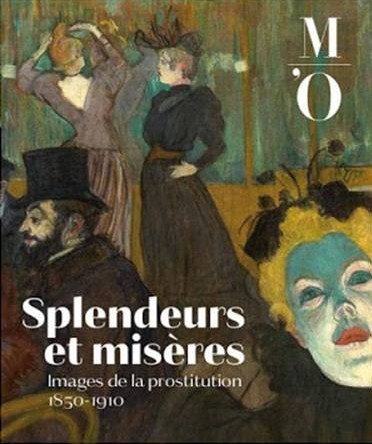
Three Paris Exhibitions: (2) Splendeurs et misères

Shows seen last month in a city subdued and uncrowded after les évènements of 13 December 


Of the three exhibitions I saw in Paris in December 2015, I have already posted about Picasso.Mania
at the Grand Palais, and the next will be on Villa Flora at the Musée Marmottan Monet. This post is about Splendeurs et misères, images de la prostitution en France (1850-1910) at the Musée d’Orsay, an exhibition which will reappear later in 2016 at Amsterdam’s Van Gogh Museum, to be called Lichte zeden (Easy Virtue). The Paris title presumably refers to a part of Honoré de Balzac's La Comédie humaine: Splendeurs et misères des courtisanes, (The Splendours and Miseries of Courtesans or A Harlot High and Low) published in four parts from 1838-1847. The Musée d’Orsay is not reluctant to take on difficult subjects, their male nude show in 2013 being an example. Splendeurs et misères, examining prostitution, not just in art but as an aspect of the social history of France, is certainly another, a revelation of misery for the many and splendour for a few.

The d’Orsay version addressed five themes and was spread over 15 rooms with numerous pictures and photographs. The first theme, Ambiguity, looked at the position of women, respectable or otherwise, in public places during the daytime and at night in cafés, cabarets and at the opera. Procurement and soliciting were often near the surface at any time of the day, for example in Giovanni Boldini’s En traversant la rue (1873/75, below left) and James Tissot’s La Demoiselle du magasin (1883/85, below right):


Women drinking alone in cafés is a recurrent theme in the art of the time, as in Degas’ L’Absinthe (1875/76, below left) and Manet’s La Prune (1878, below right). Agostina Sagatori au Tambourin (1887, seen earlier in 2015) was on loan from the Van Gogh Museum which also holds Toulouse-Lautrec’s Poudre de riz, (1887).


The cabaret pictures included Lautrec’s Moulin de la Galette (1889, below upper), on loan from the Art Institute of Chicago, and, from the Ny-Carlsberg-Glyptothek Copenhagen, the less well-known M Delaporte au Jardin de Paris (c1893, below lower):


At the opera, Eugène Giraud’s Le Bal de l'Opéra (1866, below top) and Edouard Degas’ Masked Ball at the Opera (1873, below lower) convey the same scene, the latter being far more compelling in its composition: 


After Ambiguity, Brothels - more Lautrecs, of course and photography (there are two sections of contemporary photography). Again from Chicago, Courbet’s Mère Grégoire (1855, 57/59, below left) refers to a character from a popular song, the proprietress of a Parisian brothel. An unfamiliar Lautrec from Budapest was Les Dames au réfectoire (1893/5, below right) conveying the unhappy position of the women employed as prostitutes who had to undergo frequent medical checks – a study for Rue des Moulins, (1894), was in this show, but not the final work, now in Washington.


Prostitution operated at all levels of society including the highest (for which abolition would only finally come in 1946). The section, Les Grandes Horizontales, included, as well as a Fauteuil d’Amour (below top), reputedly used by the Prince of Wales in the 1890s in pursuit of entente cordiale, Rolla (1878, below lower) by Henri Gervex:


followed by Manet’s Olympia (1863, below), bought by the French government in 1890, and introducing the final, rather diffuse, sections of the show:


... Prostitution and the imagination and Prostitution and modernity. Lautrec reappeared with the famous Au Moulin Rouge (1892/95, detail in the poster above), again from Chicago, and the Courtauld’s Private Room in the "Le rat mort" (1899, below left) leading on to, among much else, some Picassos from 1901 including Nu aux bas rouges (below right):


Two final images from a show which is informative if not uplifting: Picasso’s La Buveuse d’absinthe (1901, below left) and Kees van Dongen’s Liverpool Lighthouse (1897, below right):


Splendeurs et misères, images de la prostitution en France (1850-1910) ends on 17 January but will be at the Van Gogh Museum from 19 February to 19 June. Unfortunately, although Professor Richard Thomson from Edinburgh University was one of the curators of the exhibition, it will not be coming to the UK.


POST-EXHIBITION NOTE

If one measure of an exhibition is whether it alters one’s ways of seeing, Splendeurs et misères was a success – as recently Manet’s A Bar at the Folies-Bergère (1882, below) in the Courtauld Gallery, London.


And in case anyone should choose to believe that Paris and London were quite different in their mores, The Awakening Conscience (1853, below) by William Holman Hunt clearly shows a man and his mistress, though sanctimoniously overlaid with religious salvation, in keeping with the susceptibilities of Victorian England.


8 January 2016

Three Paris Exhibitions: (1) Picasso

Shows seen last month in a city subdued and uncrowded after les évènements of 13 December


While in Paris, I came across an article by Robin Pogrebin in the International New York Times about developments at the Museum of Modern Art (MoMA) in New York. Back in 2010, a NYT art critic had described MoMA’s conventional wisdom as “a reluctance to question the linear unspooling of art history according to designated styles that remains the Modern’s core value and its Achilles’ heel”. Now, MoMA’s chief curator of painting and sculpture was being quoted as saying that the museum was “reflecting a more widespread shift from thinking in categories – or thinking in so-called canonical narratives – to thinking about multiple histories. Having a sense of curiosity, rather than a desire for pronouncement.” Of the three exhibitions in Paris, the first two, Picasso.Mania at the Grand Palais (described below) and Splendeurs et Misères, can probably be regarded as concerned with multiple histories, the third, Villa Flora (to follow), probably not.

Shows at the Grand Palais aren’t what they used to be. By comparison with their major retrospectives, Georges Braque in 2013 and Edward Hopper in 2012, Picasso.Mania seemed thin stuff. Its thesis was apparently that
After World War II, Picasso became renowned as a modern artistic genius. This public recognition came at a time when contemporary art was once again moving towards “avant-gardism”. This movement’s values, as incarnated by Marcel Duchamp, were in contradiction with Pablo Picasso’s flamboyant subjectivity, media presence and commercial success. As a result, it was only in 1971 that a collective tribute by living artists from different disciplines was organised for the artist’s 90th birthday. In the 1980s, exhibitions showed a new generation of artists how Picasso’s later works were years ahead of his time.
A proposition which was not exactly supported by telling visitors that in the 1960s Roy Lichtenstein was inspired by Picasso and that David Hockney was a repeat visitor to the Picasso exhibition at the Tate in 1960. The show made a good initial impression with Sort of Fabulous (2015), a video installation of 18 artists talking about the impact of Picasso on their work, including Jeff Koons, Frank Gehry, Thomas Houseago and Cecily Brown. An unspooling of art history then followed, starting with All hail the artist!, the Self-Portrait of 1901 (below left), borrowed from the Picasso Museum, and some recent images of the artist including Van Pei Ming’s Portrait of Picasso (2009, below centre) and Rudolf Stingel’s Untitled (2012, below right):


and some of the 90th birthday lithographs from 1971:


The most successful of the exhibition themes which followed was probably that given over to cubism – a wall of Picassos:


and then a homage in the form of various works, many by David Hockney, beginning with his Artist and Model (1973/4, below left) and Harlequin (1975, below right):


From the 1980s onwards Hockney explored multiple viewpoints evoking cubism (“a kind of mechanical cubism”) in, for example, Paint Trolley, LA (1985, below top) and Place Ferstenberg, Paris, August 7, 8, 9 (1985, below lower):


More recent Hockney works were The Jugglers, June 24th 2012 (2012, below), 18 films on 18 screens shown over 22 minutes:


and A Bigger Card Players (2015), as at Annely Juda Fine Art, London last summer. After that, the show began to meander. Picasso on screen projected on three walls clips from a wide variety of films (below) in which either the painter or his works or both appear, ranging from Truffaut’s Jules et Jim to Jean-Luc Godard’s King Lear to Woody Allen’s Midnight in Paris.


Demoiselles from elsewhere and Guernica, a political icon were both Hamlet without the prince, the originals not being available. Various works inspired by Les Demoiselles d’Avignon (1907), included Untitled by Sigmar Polke (2006, below top) and Jeff Koons’ Antiquity (2011, below lower):


Of the works pertinent to Guernica, one of the most interesting to British eyes was Goshka Macuga’s construction, The Nature of the Beast (2009), commissioned by the Whitechapel Gallery in memory of their having exhibited Guernica in 1939 and now owned by the Castello di Rivoli (below left). Part of the work is a glazed circular table which exhibits documents relating to the Spanish civil war and more recent conflicts. I thought the photographs from the Whitechapel’s archive of Clement Attlee in 1939 were thought-provoking (below right) – there is a mention of the Major Attlee Company (sic) in his Wikipedia entry.


After this, a section, It’s a Picasso!, grouped his paintings and prints from the late 1930s and later:


and then some pieces relevant to Picasso and Pop art’s reaction to abstract expressionism including Andy Warhol’s Head (after Picasso) No III (1966, below right top) and Roy Lichtenstein’s Still Life after Picasso (1964, below right lower):


Out of what followed, the impact of Picasso on Jasper Johns’ The Seasons (1985 – 87, Summer below left) with, nearby, Picasso’s Minotaure à la carriole (1936, below right) was notable:


A section covering the media attention Picasso received in his later years was followed by a large display of his late works, some reminiscent of Japanese shunga, seen at Avignon in 1970 and 1973. The final theme was the impact on artists in New York of the Guggenheim’s 1984 Picasso show, for example Jean-Michel Basquiat’s Untitled (Pablo Picasso) (1984, below):


Picasso.Mania ends on 29 February 2016.


26 November 2014

Israel Horovitz’s ‘My Old Lady’

Like The Ides of March and August: Osage County, My Old Lady was originally written for the US stage. Israel Horovitz turned his script into a screenplay and then directed this film of the same name. Although shot in Paris by a largely French crew (judging from the credits), the film is an Anglo-American production with New York post-production.

The plot is straightforward enough. Mathias (Kevin Kline), impecunious after three divorces, travels to the Marais in central Paris where he has inherited an apartment from his father. He finds it occupied by 90 year-old, Mathilde (Maggie Smith) who, with the support of her célibataire daughter, Chloé (Kristin Scott Thomas), intends to stay put. The apartment was sold to Mathias’ father en viager, that is to say by a sale which gives the vendor tenancy for life and an annuity from the purchaser. Mathias’ original intention of selling the apartment for millions of euros looks shaky from the start and then some dark and complex family secrets begin to be revealed.
The three leads are all top class and Scott Thomas is able to drop frumpy, for which she is inherently unsuited, fairly early on. If you know the Marais, you will recognise and enjoy the setting, while the schmaltziness common in American films in Paris, France is mostly avoided (apart from the Mozart duet by the Seine, sans blague!).  Although the appeal of My Old Lady to under-45s might be limited, it doesn’t deserve to be categorised as cinema geriatrica in the vein of Quartet or The Best Exotic Marigold Hotel.


24 December 2012

Down but far from out in Paris

A few weeks ago I commented on a pretty gloomy report in The Economist on France. The Financial Times has now run (22 December)  a front page story in a similar downbeat vein: Tax and economy hit French joie de vivre:
The French are popping fewer champagne corks and spending less on toys as higher taxes, a deteriorating economy and an exodus of national icons sap the country’s joie de vivre. “There is a moroseness, a sadness among the French population at the moment which has led to our compatriots drinking a little less champagne this year,” said Paul-François Vranken, chairman and chief executive of Vranken Pommery Monopole, one of the country’s best-known Reims-based houses. “Champagne consumption follows the mood of the country. Today, there isn’t a mood conducive to celebration.”
But a recent visit to Paris left me wondering whether things are quite that bad, at least for some. Le Bon Marché is the second oldest department store in the world, if you agree that the oldest was in Newcastle-upon-Tyne. Le Bon Marché Rive Gauche, as it calls itself, is in Paris’s affluent 7th arrondissement (left and left bank) and caters for the elite. Its food hall, La Grande Épicerie de Paris, in its own adjacent building, makes those in London look like my local Tesco.

After reading The Economist I was expecting some signs of austerity, even in the 7th, but au contraire. In October the subground floors of both buildings (“-1” as they call it) had been transformed into “l’homme”, a ‘new masculine world’ described below:

which I have attempted to translate:
In the autumn of 2012, Le Bon Marché Rive Gauche dedicated to man the whole of its floor ‘-1’. Grouped into a single space in the style of an apartment, all the aspects of masculine elegance are highlighted with a uniform approach. The sharp trends, tailoring, sportswear and exceptional new services (barber, shoe shine ...) offer a unique experience for every visitor. In November, this great locker room will be joined by a new wine cellar concept directly accessible from La Grande Épicerie de Paris, creating a real synergy between the two Le Bon Marché buildings. Thus, this new masculine world will accompany modern man in his choice between diversity and essentiality.
To put it another way, an astonishing amount of expensive men’s clothing of different brands from all over the world, and wine up to 3350€ per bottle (Petrus 1998). Oh, and champagne up to 3000€ per bottle (Billecart-Salmon 1961). Of course, Le Bon Marché, when embarking on this development, may not have expected the European economic downturn to be as persistent. Or is it that the incomes of Paris’s elite, just as London’s, are detached from the austerity experienced by the rest of the population?  It seems unlikely that Le Bon Marché is aiming particularly at the tourist market, being, unlike some of its rival grands magasins, resolutely francophone.