Showing posts with label Man Ray. Show all posts

21 July 2014

Virginia Woolf at the NPG

Novelist, essayist, biographer and critic, Virginia Woolf is the most famous and influential modernist prose writer of the 20th century. She occupied a central position within the Bloomsbury Group: that union of friends who helped rid art, design and society of the constrictions and conventions left over from the Victorian period. 
Frances Spalding 

Virginia Woolf: Art, Life and Vision at the National Portrait Gallery in London has been curated by Frances Spalding, an eminent art historian, author of several books relating to Bloomsbury and now of the NPG exhibition’s catalogue. She has selected more than 100 objects relevant to Woolf’s life including paintings, photographs, first editions of her novels and archival material such as correspondence and diaries. This material is mostly arranged chronologically but, unusually for a modern exhibition, there is no timeline presented at entry, although one taken from the catalogue is available on the NPG's website. Consequently, there is no context for the first images the visitor encounters: photographs of the devastating effect of the London blitz in 1940 on the Woolfs’ former Bloomsbury home, 52 Tavistock Square and on 37 Mecklenburgh Square where they were living at the time (when not at Monk’s House at Rodmell in Sussex). This was a year before Virginia’s death in 1941, the point at which the exhibition eventually ends.

Although their work is not universally admired for its quality, it cannot be denied that the painter members of the Bloomsbury Group, whether at Charleston Farmhouse or elsewhere, had no shortage of noteworthy subjects close at hand. Obviously this show concentrates on images of Virginia – I liked in particular Duncan Grant’s 1911 portrait and Vanessa Bell’s of 1912:


but Lytton Strachey,1904 by Simon Bussy, Mark Gertler’s Samuel Koteliansky, 1930 (below, left and right) and Vannessa Bell’s The Memoir Club c 1943 (below, lower) were all memorable (the Bloomsberries in this picture include both Bells and their son, Quentin, Leonard Woolf, the Keynes’s, EM Forster and Duncan Grant):


Among the many photographs of Virginia in the exhibition are the familiar 1902 society studies by GC Beresford, but more interesting to me were the Man Ray portrait (one of several, I believe, for a Time Magazine cover feature in April 1937), (below top, left and right) and some of the last to be taken of her, by Gisèle Freund in 1939, including one of Leonard and Virginia at 52 Tavistock Square (below, lower, left and right):


 It would be difficult to come away from this exhibition without seeing and learning something new. For example:

Virginia typeset TS Eliot’s The Waste Land (a copy is on display) during the period she and Leonard were living in Richmond-upon-Thames and had set up the Hogarth Press and Virginia was writing Mrs Dalloway. Lady Ottoline Morrell took a photograph of Eliot and Woolf (right) in 1924, the year the Woolfs returned to Bloomsbury.

Leonard and Virginia visited Sigmund Freud in Hampstead soon after his arrival from Vienna in June 1938.

Virginia was a Sponsor and Patron of the campaign led by Roland Penrose to exhibit Picasso’s Guernica and the studies for it, in London and elsewhere in late 1938/1939.

This exhibition should have a wide appeal: to admirers of Woolf’s writing, to those fascinated by the Bloomsbury Group – Dorothy Parker is said to have observed that 'Bloomsbury paints in circles, lives in squares, and loves in triangles' - and to anyone with an interest in 20th century British art. Virginia Woolf: Art, Life and Vision continues at the NPG until 26 October.



6 April 2013

Man Ray, Gertrude Stein and Picasso

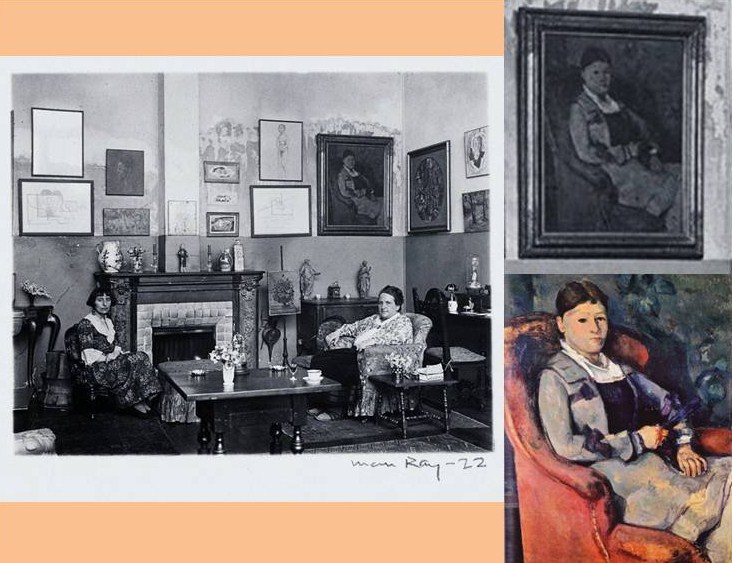
Last month a post here about the Man Ray exhibition currently at the National Portrait Gallery in London bemoaned the cost of its catalogue. But subsequently I had the chance to browse a copy bought by a less parsimonious friend (people from South West England are notoriously tight-fisted). I was surprised to read that the picture in the background to a Man Ray photograph of Gertrude Stein with Alice B Toklas (below left) was, according to the catalogue, Picasso’s portrait of Stein.

Surely the picture in this photograph, taken in 1922, is one of Cezanne’s studies of his wife - Madame Cézanne à l'éventail (The Artist's Wife with a Fan), c 1878/88 (above lower right) - which was at that time owned by Stein and is now at the Foundation E. G. Bührle Collection in Zurich? A post here in December 2011 about the exhibition Matisse, Cézanne, Picasso… L’aventure des Stein, then in Paris, juxtaposed Picasso’s Gertrude Stein 1905-6 (below left) with the Man Ray photograph of Stein taken in1924 which has the Picasso in the background. In 1946 Stein left her portrait to the Metropolitan Museum of Art in New York.

Ah well, I’m sure there are far worse errors in this blog.

2 March 2013

Man Ray Portraits at the NPG

Man Ray was an American who spent most of his adult life (1890-1976) in Paris, so perhaps it isn't so surprising that in the UK many people’s first encounter with his work is through that of Lee Miller, the American photographer who married a Briton, Roland Penrose, who she first met in Paris.  Miller’s famous 1937 image of a picnic on the Ile Sainte-Marguerite, includes Man Ray and his amour of the time, Ady Fidelin. The two of them are in another photograph from the same holiday which is the cover of Peter Calvocoressi’s Lee Miller Portraits from a Life (left), in which the picnic photograph can be found, too.

Miller’s fascinating life and photographic work has been the subject of many exhibitions in the UK in recent years, owing much to the efforts of her son Antony Penrose and the energetic team at Farley Farm House. I knew that she had been Ray's assistant, model and lover in Paris in the 1930s and that she seemed to have had a key role in the discovery of a photographic technique, solarisation (see Ray’s 1929 image of Miller in the National Portrait Gallery poster, left), while she was with him. However, it wasn't until I saw a US DVD about his work that I began to appreciate the extent of Man Ray's achievement not just as an outstanding photographer but as an artist and as a contributor to Dada and Surrealism (eg Le Violon d’Ingres 1924, with his lover at the time, Kiki de Montparnasse, below). His most productive period was spent in Paris from 1921, when he arrived from New York under the aegis of Marcel Duchamp, and 1940 when Ray had to return to the US as the Nazis advanced across Europe.
 

Ray seems to have mixed with and photographed most of the Parisian inter-war avant garde (think Woody Allen’s cast from Midnight in Paris and many more). The NPG show includes portraits from this period of Gertrude Stein (but see this later post), Dali, Picasso, Miró, Cocteau, Hemingway, Joyce, Vlaminck to name but some, and, of course, Duchamp and Miller. There are also photographs from his time in New York before leaving for France. The show ends with Ray’s portrait work in Hollywood in the 1940s and after his return to Paris in 1951, all of which seems a little uninspired in comparison with the 1920s and 30s.

With over 150 works in a fairly confined area, this exhibition is best avoided at busy times when the admission of £14 may seem a high price to be paying. If the NPG’s catalogue seems unaffordable at £35 (£25 paperback at the NPG), the Tate’s Man Ray in Paris by Erin Garcia, which ranges more widely than portraits, might be worth buying at £14.99. Interestingly she points out that, although it was portraiture that Ray relied on financially and made him well-known to tout Paris, he found it frustrating and artistically unrewarding!

Man Ray Portraits continues at the NPG until 27 May.


ADDENDUM 8 March

The ArtFund has produced this to show the “weird and wonderful connections between [Man Ray’s] most famous subjects".

23 December 2011

Two Paris Exhibitions

Paul Cézanne was born in Aix-en-Provence in 1839, and it was in Provence that many of his most celebrated works were produced. However, encouraged by his school friend, Émile Zola, he first travelled to Paris in 1861 and would return there many times to paint in the city or in the surrounding countryside (Pontoise, below). About 80 works from in or around the capital provide the theme for Cézanne et Paris, currently at the Musée du Luxembourg.

Cézanne now seems to be classed as a Post-Impressionist rather than as an Impressionist (“un peintre déjà sorti de l’impressionisme”, said Renoir), and many of the works in the exhibition (portrait of Mme Cézanne, left) hint at later developments by other artists, particularly Cubism . He is often called the father of modern art ("notre père à tous" said Picasso or Matisse, or both of them). Nonetheless, Cézanne had exhibited at the 1863 Salon des Refusés and at the first Impressionist exhibition in 1874 when his works were among the most disliked.

The son of a banker, Cézanne had no financial need to sell his work and it was only after the solo exhibition put on by the dealer Ambroise Vollard (right) in November 1895 that his reputation became established. Cézanne died in Aix-en-Provence in 1906. By this time some wealthy young Americans had come to live in Paris, and their art collection is the subject of the second exhibition, Matisse, Cézanne, Picasso… L’aventure des Stein, in the Petit Palais, across the Seine from the Musée du Luxembourg.

The Stein family were of German-Jewish origins and had become wealthy through the San Francisco tramway business co-owned by Daniel Stein. Daniel died in 1891 at the age of 59, three years after his wife who had died at 46. This left their four children, aged between 17 and 26, to pursue lives that, but for their intellectual inclinations, might have been labelled trustafarian in Britain a century later. Leo Stein (1872-1947) was the first to develop a serious interest in art. In 1900 he was studying 15th century Italian art in Florence under the influence of Bernard Berenson. However, while there he met Roger Fry (who was to introduce Post-Impressionism to Britain in 1910) and saw a Cézanne for the first time. At the end of 1902 he moved to Paris. In 1903 he purchased a Cézanne and was joined by his younger sister Gertrude Stein (1874-1946). By 1904 Leo and Gertrude had bought more works by Cézanne, as well as by Gauguin and Renoir. That year they were joined by the oldest Stein brother and would-be paterfamilias, Michael (1865-1938), and his wife Sarah (1870-1953). In the years that followed all four Steins were to make substantial purchases of works by these and other artists.  Hung in their two Paris apartments (Michael and Sarah's, left; Gertrude and Leo's, right) the paintings were to be admired during Saturday soirées held for Paris’s artistic avante garde.

Picasso became a close friend of Gertrude and painted her famous portrait  in 1905-6 (below), (photographed together by Man Ray in 1922). Gertrude had by then started her literary career and became a supporter of Picasso during his development of Cubism. She famously remarked of Picasso:
He alone among painters did not set himself the problem of expressing truths which all the world can see, but the truth which only he can see.

The exhibition brings together some of the exceptional works which passed through the Steins’ hands, and are now dispersed in museums and private collections around the world. Michael and Sarah collected many works by Matisse only to lose some of the best during the First World War while on loan to a gallery in Berlin. In the late 1920s Le Corbusier designed them a Modernist villa near Paris but they were to leave after a few years when the rise of fascism prompted their return to the US. By 1914 Leo had taken himself and his preferred pictures, mostly Renoirs, to Italy. This left his sister and her companion, Alice B Toklas, to be the core of the American literary and artistic community in Paris in the 1920s and 30s, (recently portrayed in Woody Allen’s comedy, Midnight in Paris). 

After the First World War, Gertrude could no longer afford to buy Picasso’s work and, although she continued to act as patron to emerging artistic talent, her later acquisitions turned out to be much less significant. The expensive exhibition catalogue (63 euros for the English edition) makes little mention of her experiences in France during the Occupation of the Second World War (she and Alice had been highly regarded for their American Red Cross work during the First). However, as Barbara Will has shown in Unlikely Collaboration: Gertrude Stein, Bernard Fay, and the Vichy Dilemma, Gertrude's judgement in becoming an apologist for Pétain’s Vichy France, particularly by translating his speeches for US consumption, was questionable, even if it ensured the preservation of her art collection. 

Both exhibitions contain works of the highest quality and are rewarding to visit. Cézanne et Paris is the more straightforward as a retrospective on one artist, whereas L’aventure des Stein has to weave together the works of four major artists (63 Matisses, 43 Picassos etc) and many others and the histories of their collectors, a complex task skilfully done.  Cézanne et Paris continues to 26 February 2012. Matisse, Cézanne, Picasso… L’aventure des Stein has been extended to 22 January (check!) and then travels to the Metropolitan Museum of Art, New York (1 February to 3 June 2012). It started at the San Francisco Museum of Modern Art (May to September 2011).


22 October 2011

Woody Allen’s ‘Midnight in Paris’

For more than 30 years I’ve seen nearly every new Woody Allen film, even the ones he’s made since 2000, not all of which were screened in the UK:


These make up a rather mixed bag, and have not all been that popular. I’ve imported Region 1 DVDs of some, so I suppose I’m one of a rather small number of Britons who have seen Hollywood Ending. I can remember watching a showing of Whatever Works a couple of years ago, sat in an audience of three (and one of them was Mrs WI). And I have to admit that the films set in London, Match Point, Scoop, Cassandra's Dream and You Will Meet a Tall Dark Stranger were variable to put it kindly, and at times embarrassingly bad. Match Point had its moments but Cassandra’s Dream was probably one of his worst. You Will Meet a Tall Dark Stranger struck me as a New York story transported to London. The London films are oddly cast, and Allen often seems to have a wooden ear for English as it’s spoken in England.

On the other hand, if I were a New Yorker I might find Allen’s preoccupation with the wealthy West Side milieu of Melinda and Melinda a bit tiresome. However I’m not, and although Midnight in Paris centres around some rich Americans, Allen doesn’t show them in a very flattering light anyway. Midnight in Paris is a romantic comedy about a would be novelist, a well-judged Woody alter ego played by Owen Wilson, time travelling from Paris in 2010 to mix with the avant-garde in Paris in the 1920s. Time travellers in the movies go down a well-trodden path, but the usual tropes of things yet to come (tranquillisers) and of knowledge of the future (suggesting the plot of El ángel exterminador (The Exterminating Angel) to Buñuel about 40 years prematurely) are kept under control. Carla Bruni puts in a better performance as a guide in the Musée Rodin than might have been expected from press reports at the time of shooting – ‘Carla Bruni-Sarkozy took 35 takes in Woody Allen scene’, ‘Bruni takes 5 hours to get simple bread scene right’ – and the boulangerie scene, if it ever existed, didn’t make the final cut. The art department did a convincing job with Gertrude Stein’s art collection. As far as I could tell, but I’m not an expert, there weren’t any anomalies in the succession of cute meets with the literary and artistic giants who were in Paris in the Twenties – Hemingway could have compared Picasso with Miró, Buñuel did work with Dali, Man Ray was there while Lee Miller was still in New York.  Attending this exhibition, currently in Paris, would be informative.

So, definitely worth seeing and more fun than Vicky Cristina Barcelona; I hope Nero Fiddled (formerly Bop Decameron), set in Rome, will be as good, but we will find out next year.

CORRECTION 24 OCTOBER

I originally and erroneously stated:
suggesting the plot of Le charme discret de la bourgeoisie to Buñuel about 50 years prematurely
which was quite wrong, and thanks to a much wiser blogger, have put it right.  The Discreet Charm ... was about people who couldn't ever get to dine together, not about diners who couldn't get away!


UPDATE 3 DECEMBER

I should have pointed out that Hemingway was played by Tom Hiddleston who appeared in Joanna Hogg’s Archipelago and Unrelated. In contrast to the troubled young men of those films, his Hemingway had the approachable self-assurance that we are getting used to coming from other modern old Etonians like David Cameron. A profile of Hiddleston by Xan Brooks appeared in the Guardian recently for the launch of The Deep Blue Sea.