Showing posts with label Gertrude Stein. Show all posts

20 April 2014

The Pearlman Collection at the Ashmolean

Exhibitions based on collections provide a fascination which can’t be found in shows given over to individual artists or to particular periods in art history. I think it lies in the way the collector (or collectors) exercised their taste given the opportunities and resources which were available. Gertrude Stein and her brothers, for example, were wealthy and were collecting contemporary talent in the right place and time, Paris in the 1920s. Sterling and Francine Clark had been in a similar position a decade earlier. The Radev Collection, on the other hand, reflects its creators’ tastes and long-term opportunities to make acquisitions rather than their funds. So what of Henry and Rose Pearlman’s collection, now on an international tour starting at the Ashmolean Museum, Oxford: Cézanne and the Modern: Masterpieces of Modern Art from the Pearlman Collection?


Henry Pearlman was born in New York in 1895 and set up Eastern Cold Storage in 1919. One can well believe that his company would have done well in the war years and certainly in 1945 he was able to make his first significant purchase of modern art, Chaïm Soutine’s Village Square, Céret (above, top). For nearly 30 years he went on building up his collection, most of which is now at the Ashmolean. The show starts with a large number of late Cézannes, mostly watercolours (not often displayed, no doubt for reasons of conservation), eg Three Pears, (Trois Poires, 1888-90 above lower), from the painter’s later years in Aix en Provence. These lead on to the next room’s Cistern in the Park of Chateau Noir (Citerne au Parc du Château Noir, c 1900, below in Pearlman’s office) and one of the versions of Montagne Sainte-Victoire (c 1902, poster above), much-painted by the artist.


Nearby are Vincent van Gogh’s Tarascon Stage Coach (Tarascon Diligence, 1888, again below in Pearlman’s office) and less satisfactory works by Gauguin, Degas (After the Bath, Woman Drying Herself /Après le bain, femme s'essuyant, 1892, above left) and Toulouse-Lautrec (Messaline, 1901, above right). I found the latter interesting because it was inspired by a visit to the opera in Bordeaux shortly before the painter’s death at Chateau Malromé. Earlier and more pleasing, if undemanding, works are Sisley’s Seine at Verneuil (La Seine à Verneuil, 1889, below, left) and Camille Pissaro’s Still Life: Apples and Pears in a Round Basket (Nature Morte: Pommes et Poires Dans un Panier Rond, 1872, below, right).


Finally, there are more works by Soutine, and two oils and a sculpture by Modigliani. Pearlman discovered after purchase that the small Daumier oil shown nearby, Head of an Old Woman (Tête de Vieille Femme, 1856-60, left), was one of the first purchases made by Leo and Gertrude Stein. It is a pity that Pearlman hadn’t started his collection a decade or two earlier when the opportunities for acquisitions of works by the painters he liked might have been greater (the absence of any cubist work is intriguing when Cézanne is often regarded as their precursor). He displayed what he considered to be his major pieces in his office at Eastern Cold Storage: the van Gogh, its acquisition surely being his apogee as a collector, Modigliani’s Jean Cocteau 1919-17, and Cézanne’s Cistern in the Park of Chateau Noir, (below).


Cézanne and the Modern provides a welcome opportunity in the UK to see works by Soutine and Modigliani as well as some fine Impressionist and Post-Impressionist works. The Pearlman website contains some interesting background information including Henry’s reminiscences, eg:
I found art dealers at first quite difficult to understand with regard to pricing works of art. Being accustomed to a business where selling price is based on cost plus small overhead and ten percent profit, I found that art dealers' prices in most cases bore little relationship to their costs, but were based on what the traffic could bear. I know of a pair of Douanier Rousseau portraits, for example, that were purchased at an auction in the Midi of France for about twenty dollars, repurchased by my French dealer friend for under $600, then sold to one of the New York galleries for $12,000; when I saw them exhibited here and asked the price I was advised that they could be bought for $30,000. Not being interested in owning these Rousseaus, I was amused by the gyrations of the prices. The last price I saw them offered for was $150,000 for the pair.
The show continues at the Ashmolean until 22 June and will be at Le Musée Granet in Aix-en-Provence from 12 July to 5 October. After showings in Atlanta and Vancouver it will return to the Princeton University Art Museum, where the Pearlman collection is on long-term loan, in 2015.


6 April 2013

Man Ray, Gertrude Stein and Picasso

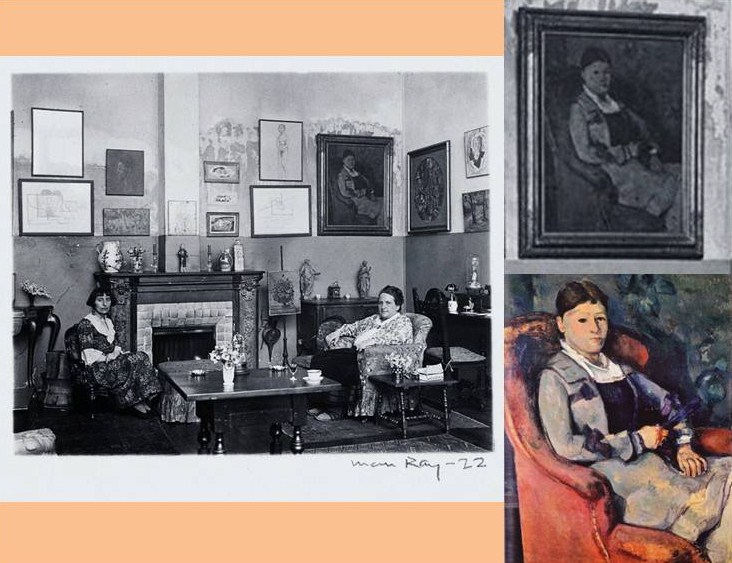
Last month a post here about the Man Ray exhibition currently at the National Portrait Gallery in London bemoaned the cost of its catalogue. But subsequently I had the chance to browse a copy bought by a less parsimonious friend (people from South West England are notoriously tight-fisted). I was surprised to read that the picture in the background to a Man Ray photograph of Gertrude Stein with Alice B Toklas (below left) was, according to the catalogue, Picasso’s portrait of Stein.

Surely the picture in this photograph, taken in 1922, is one of Cezanne’s studies of his wife - Madame Cézanne à l'éventail (The Artist's Wife with a Fan), c 1878/88 (above lower right) - which was at that time owned by Stein and is now at the Foundation E. G. Bührle Collection in Zurich? A post here in December 2011 about the exhibition Matisse, Cézanne, Picasso… L’aventure des Stein, then in Paris, juxtaposed Picasso’s Gertrude Stein 1905-6 (below left) with the Man Ray photograph of Stein taken in1924 which has the Picasso in the background. In 1946 Stein left her portrait to the Metropolitan Museum of Art in New York.

Ah well, I’m sure there are far worse errors in this blog.

2 March 2013

Man Ray Portraits at the NPG

Man Ray was an American who spent most of his adult life (1890-1976) in Paris, so perhaps it isn't so surprising that in the UK many people’s first encounter with his work is through that of Lee Miller, the American photographer who married a Briton, Roland Penrose, who she first met in Paris.  Miller’s famous 1937 image of a picnic on the Ile Sainte-Marguerite, includes Man Ray and his amour of the time, Ady Fidelin. The two of them are in another photograph from the same holiday which is the cover of Peter Calvocoressi’s Lee Miller Portraits from a Life (left), in which the picnic photograph can be found, too.

Miller’s fascinating life and photographic work has been the subject of many exhibitions in the UK in recent years, owing much to the efforts of her son Antony Penrose and the energetic team at Farley Farm House. I knew that she had been Ray's assistant, model and lover in Paris in the 1930s and that she seemed to have had a key role in the discovery of a photographic technique, solarisation (see Ray’s 1929 image of Miller in the National Portrait Gallery poster, left), while she was with him. However, it wasn't until I saw a US DVD about his work that I began to appreciate the extent of Man Ray's achievement not just as an outstanding photographer but as an artist and as a contributor to Dada and Surrealism (eg Le Violon d’Ingres 1924, with his lover at the time, Kiki de Montparnasse, below). His most productive period was spent in Paris from 1921, when he arrived from New York under the aegis of Marcel Duchamp, and 1940 when Ray had to return to the US as the Nazis advanced across Europe.
 

Ray seems to have mixed with and photographed most of the Parisian inter-war avant garde (think Woody Allen’s cast from Midnight in Paris and many more). The NPG show includes portraits from this period of Gertrude Stein (but see this later post), Dali, Picasso, Miró, Cocteau, Hemingway, Joyce, Vlaminck to name but some, and, of course, Duchamp and Miller. There are also photographs from his time in New York before leaving for France. The show ends with Ray’s portrait work in Hollywood in the 1940s and after his return to Paris in 1951, all of which seems a little uninspired in comparison with the 1920s and 30s.

With over 150 works in a fairly confined area, this exhibition is best avoided at busy times when the admission of £14 may seem a high price to be paying. If the NPG’s catalogue seems unaffordable at £35 (£25 paperback at the NPG), the Tate’s Man Ray in Paris by Erin Garcia, which ranges more widely than portraits, might be worth buying at £14.99. Interestingly she points out that, although it was portraiture that Ray relied on financially and made him well-known to tout Paris, he found it frustrating and artistically unrewarding!

Man Ray Portraits continues at the NPG until 27 May.


ADDENDUM 8 March

The ArtFund has produced this to show the “weird and wonderful connections between [Man Ray’s] most famous subjects".

23 December 2011

Two Paris Exhibitions

Paul Cézanne was born in Aix-en-Provence in 1839, and it was in Provence that many of his most celebrated works were produced. However, encouraged by his school friend, Émile Zola, he first travelled to Paris in 1861 and would return there many times to paint in the city or in the surrounding countryside (Pontoise, below). About 80 works from in or around the capital provide the theme for Cézanne et Paris, currently at the Musée du Luxembourg.

Cézanne now seems to be classed as a Post-Impressionist rather than as an Impressionist (“un peintre déjà sorti de l’impressionisme”, said Renoir), and many of the works in the exhibition (portrait of Mme Cézanne, left) hint at later developments by other artists, particularly Cubism . He is often called the father of modern art ("notre père à tous" said Picasso or Matisse, or both of them). Nonetheless, Cézanne had exhibited at the 1863 Salon des Refusés and at the first Impressionist exhibition in 1874 when his works were among the most disliked.

The son of a banker, Cézanne had no financial need to sell his work and it was only after the solo exhibition put on by the dealer Ambroise Vollard (right) in November 1895 that his reputation became established. Cézanne died in Aix-en-Provence in 1906. By this time some wealthy young Americans had come to live in Paris, and their art collection is the subject of the second exhibition, Matisse, Cézanne, Picasso… L’aventure des Stein, in the Petit Palais, across the Seine from the Musée du Luxembourg.

The Stein family were of German-Jewish origins and had become wealthy through the San Francisco tramway business co-owned by Daniel Stein. Daniel died in 1891 at the age of 59, three years after his wife who had died at 46. This left their four children, aged between 17 and 26, to pursue lives that, but for their intellectual inclinations, might have been labelled trustafarian in Britain a century later. Leo Stein (1872-1947) was the first to develop a serious interest in art. In 1900 he was studying 15th century Italian art in Florence under the influence of Bernard Berenson. However, while there he met Roger Fry (who was to introduce Post-Impressionism to Britain in 1910) and saw a Cézanne for the first time. At the end of 1902 he moved to Paris. In 1903 he purchased a Cézanne and was joined by his younger sister Gertrude Stein (1874-1946). By 1904 Leo and Gertrude had bought more works by Cézanne, as well as by Gauguin and Renoir. That year they were joined by the oldest Stein brother and would-be paterfamilias, Michael (1865-1938), and his wife Sarah (1870-1953). In the years that followed all four Steins were to make substantial purchases of works by these and other artists.  Hung in their two Paris apartments (Michael and Sarah's, left; Gertrude and Leo's, right) the paintings were to be admired during Saturday soirées held for Paris’s artistic avante garde.

Picasso became a close friend of Gertrude and painted her famous portrait  in 1905-6 (below), (photographed together by Man Ray in 1922). Gertrude had by then started her literary career and became a supporter of Picasso during his development of Cubism. She famously remarked of Picasso:
He alone among painters did not set himself the problem of expressing truths which all the world can see, but the truth which only he can see.

The exhibition brings together some of the exceptional works which passed through the Steins’ hands, and are now dispersed in museums and private collections around the world. Michael and Sarah collected many works by Matisse only to lose some of the best during the First World War while on loan to a gallery in Berlin. In the late 1920s Le Corbusier designed them a Modernist villa near Paris but they were to leave after a few years when the rise of fascism prompted their return to the US. By 1914 Leo had taken himself and his preferred pictures, mostly Renoirs, to Italy. This left his sister and her companion, Alice B Toklas, to be the core of the American literary and artistic community in Paris in the 1920s and 30s, (recently portrayed in Woody Allen’s comedy, Midnight in Paris). 

After the First World War, Gertrude could no longer afford to buy Picasso’s work and, although she continued to act as patron to emerging artistic talent, her later acquisitions turned out to be much less significant. The expensive exhibition catalogue (63 euros for the English edition) makes little mention of her experiences in France during the Occupation of the Second World War (she and Alice had been highly regarded for their American Red Cross work during the First). However, as Barbara Will has shown in Unlikely Collaboration: Gertrude Stein, Bernard Fay, and the Vichy Dilemma, Gertrude's judgement in becoming an apologist for Pétain’s Vichy France, particularly by translating his speeches for US consumption, was questionable, even if it ensured the preservation of her art collection. 

Both exhibitions contain works of the highest quality and are rewarding to visit. Cézanne et Paris is the more straightforward as a retrospective on one artist, whereas L’aventure des Stein has to weave together the works of four major artists (63 Matisses, 43 Picassos etc) and many others and the histories of their collectors, a complex task skilfully done.  Cézanne et Paris continues to 26 February 2012. Matisse, Cézanne, Picasso… L’aventure des Stein has been extended to 22 January (check!) and then travels to the Metropolitan Museum of Art, New York (1 February to 3 June 2012). It started at the San Francisco Museum of Modern Art (May to September 2011).