Showing posts with label Daumier. Show all posts

20 April 2014

The Pearlman Collection at the Ashmolean

Exhibitions based on collections provide a fascination which can’t be found in shows given over to individual artists or to particular periods in art history. I think it lies in the way the collector (or collectors) exercised their taste given the opportunities and resources which were available. Gertrude Stein and her brothers, for example, were wealthy and were collecting contemporary talent in the right place and time, Paris in the 1920s. Sterling and Francine Clark had been in a similar position a decade earlier. The Radev Collection, on the other hand, reflects its creators’ tastes and long-term opportunities to make acquisitions rather than their funds. So what of Henry and Rose Pearlman’s collection, now on an international tour starting at the Ashmolean Museum, Oxford: Cézanne and the Modern: Masterpieces of Modern Art from the Pearlman Collection?


Henry Pearlman was born in New York in 1895 and set up Eastern Cold Storage in 1919. One can well believe that his company would have done well in the war years and certainly in 1945 he was able to make his first significant purchase of modern art, Chaïm Soutine’s Village Square, Céret (above, top). For nearly 30 years he went on building up his collection, most of which is now at the Ashmolean. The show starts with a large number of late Cézannes, mostly watercolours (not often displayed, no doubt for reasons of conservation), eg Three Pears, (Trois Poires, 1888-90 above lower), from the painter’s later years in Aix en Provence. These lead on to the next room’s Cistern in the Park of Chateau Noir (Citerne au Parc du Château Noir, c 1900, below in Pearlman’s office) and one of the versions of Montagne Sainte-Victoire (c 1902, poster above), much-painted by the artist.


Nearby are Vincent van Gogh’s Tarascon Stage Coach (Tarascon Diligence, 1888, again below in Pearlman’s office) and less satisfactory works by Gauguin, Degas (After the Bath, Woman Drying Herself /Après le bain, femme s'essuyant, 1892, above left) and Toulouse-Lautrec (Messaline, 1901, above right). I found the latter interesting because it was inspired by a visit to the opera in Bordeaux shortly before the painter’s death at Chateau Malromé. Earlier and more pleasing, if undemanding, works are Sisley’s Seine at Verneuil (La Seine à Verneuil, 1889, below, left) and Camille Pissaro’s Still Life: Apples and Pears in a Round Basket (Nature Morte: Pommes et Poires Dans un Panier Rond, 1872, below, right).


Finally, there are more works by Soutine, and two oils and a sculpture by Modigliani. Pearlman discovered after purchase that the small Daumier oil shown nearby, Head of an Old Woman (Tête de Vieille Femme, 1856-60, left), was one of the first purchases made by Leo and Gertrude Stein. It is a pity that Pearlman hadn’t started his collection a decade or two earlier when the opportunities for acquisitions of works by the painters he liked might have been greater (the absence of any cubist work is intriguing when Cézanne is often regarded as their precursor). He displayed what he considered to be his major pieces in his office at Eastern Cold Storage: the van Gogh, its acquisition surely being his apogee as a collector, Modigliani’s Jean Cocteau 1919-17, and Cézanne’s Cistern in the Park of Chateau Noir, (below).


Cézanne and the Modern provides a welcome opportunity in the UK to see works by Soutine and Modigliani as well as some fine Impressionist and Post-Impressionist works. The Pearlman website contains some interesting background information including Henry’s reminiscences, eg:
I found art dealers at first quite difficult to understand with regard to pricing works of art. Being accustomed to a business where selling price is based on cost plus small overhead and ten percent profit, I found that art dealers' prices in most cases bore little relationship to their costs, but were based on what the traffic could bear. I know of a pair of Douanier Rousseau portraits, for example, that were purchased at an auction in the Midi of France for about twenty dollars, repurchased by my French dealer friend for under $600, then sold to one of the New York galleries for $12,000; when I saw them exhibited here and asked the price I was advised that they could be bought for $30,000. Not being interested in owning these Rousseaus, I was amused by the gyrations of the prices. The last price I saw them offered for was $150,000 for the pair.
The show continues at the Ashmolean until 22 June and will be at Le Musée Granet in Aix-en-Provence from 12 July to 5 October. After showings in Atlanta and Vancouver it will return to the Princeton University Art Museum, where the Pearlman collection is on long-term loan, in 2015.


15 December 2013

Daumier at the Royal Academy

Daumier (1808-1879): Visions of Paris at the Royal Academy is apparently the first Honoré Daumier exhibition in London since the early 1960s. He is probably best known to British eyes as a lithographer who provided a sharp political and social commentary during a particularly turbulent period of French history (see below). Gargantua 1831 (below left) satirizes King Louis-Phillipe, while Nadar elevating photography to art 1862 (below, right) is a commentary on the aerial photography craze which Julian Barnes touched on in his recent Levels of Life.
The RA’s exhibition reveals that  Daumier could also turn his hands to political caricature in the form of clay busts and sculpture, as well as watercolours (The Sideshow (Parade de saltimbanques), c.1865–66 in the poster above) and oil paintings acceptable to the Salon (The Laundress, (La Sortie du bateau à lessive), 1861–63) and The Painter at His Easel (Le Peintre devant son tableau), c.1870–1875 (below, left and right).


Daumier (1808-1879): Visions of Paris continues at the RA until 26 January 2014.


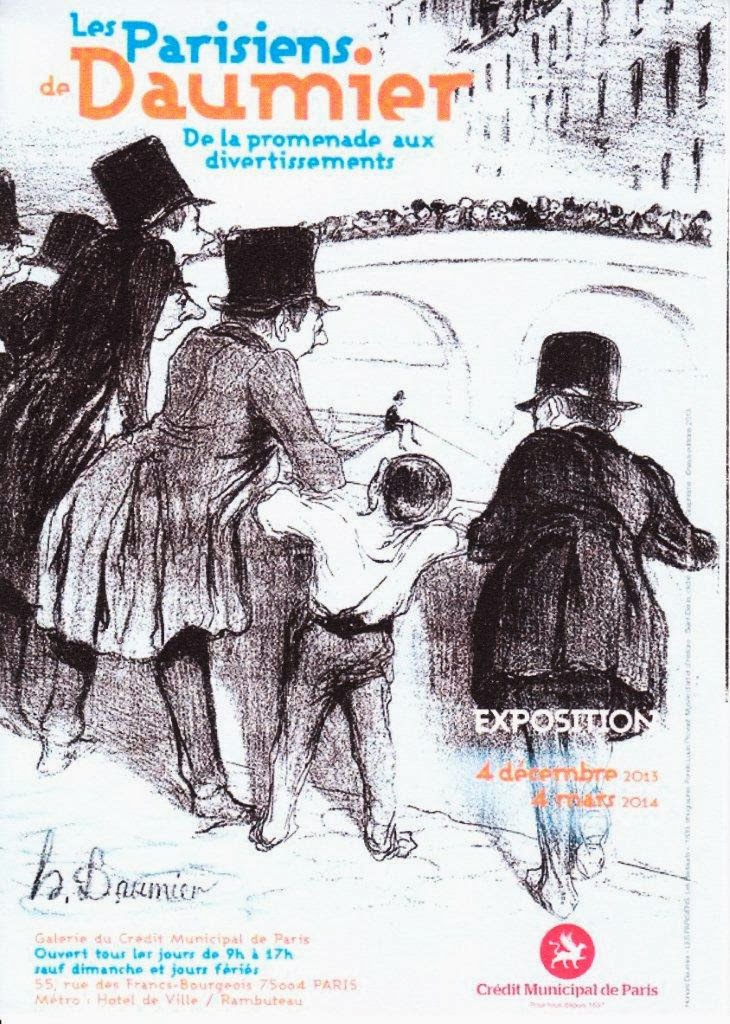
Anyone visiting Paris in the next few months and interested in the mainstream of the artist’s work should take the chance to see Les Parisiens de Daumier, sponsored by the Crédit Mutuel de Paris at their gallery in the Marais (details on their website, poster above). There are plenty of examples of his drawings for magazines (Le Charivari in particular) satirising contemporary Parisian life. Some depict a world that is now almost unrecognisable, others seem oddly familiar - La crinoline finnisant par être soupçonnée (below, right) should amuse anyone who has been through a security check in the last ten years. The Head of Louis-Phillipe in the form of a pear (Tête de Louis-Phillipe en forme de poire), 1840 (below, left), from the musée Carnavalet, would have been worth borrowing by the RA as a fine expression of the artist's Republican beliefs.


Les Parisiens de Daumier runs until 4 March at Galerie du Crédit Municipal de Paris - 55, rue des Francs-Bourgeois 75004 Paris. Open Monday to Saturday from 9h to 17h, closed on Sundays and public holidays.


Some major political events in France in Daumier’s lifetime: 

1814 Restoration of the Bourbon monarchy (King Charles X) in place of Napoléon Bonaparte
1830 After a revolution, King Louis-Phillipe installed in place of Charles X
1848 Second Republic declared after the abdication of Louis-Phillipe
1852 Louis-Napoléon (Napoléon III) installed as Emperor after a coup d’état
1870 Third Republic declared after Napoléon’s defeat by the Prussians at Sedan
1871 Siege of Paris and suppression of the Commune